

Asia Pacific Pilling Machine Market Size & Forecast:
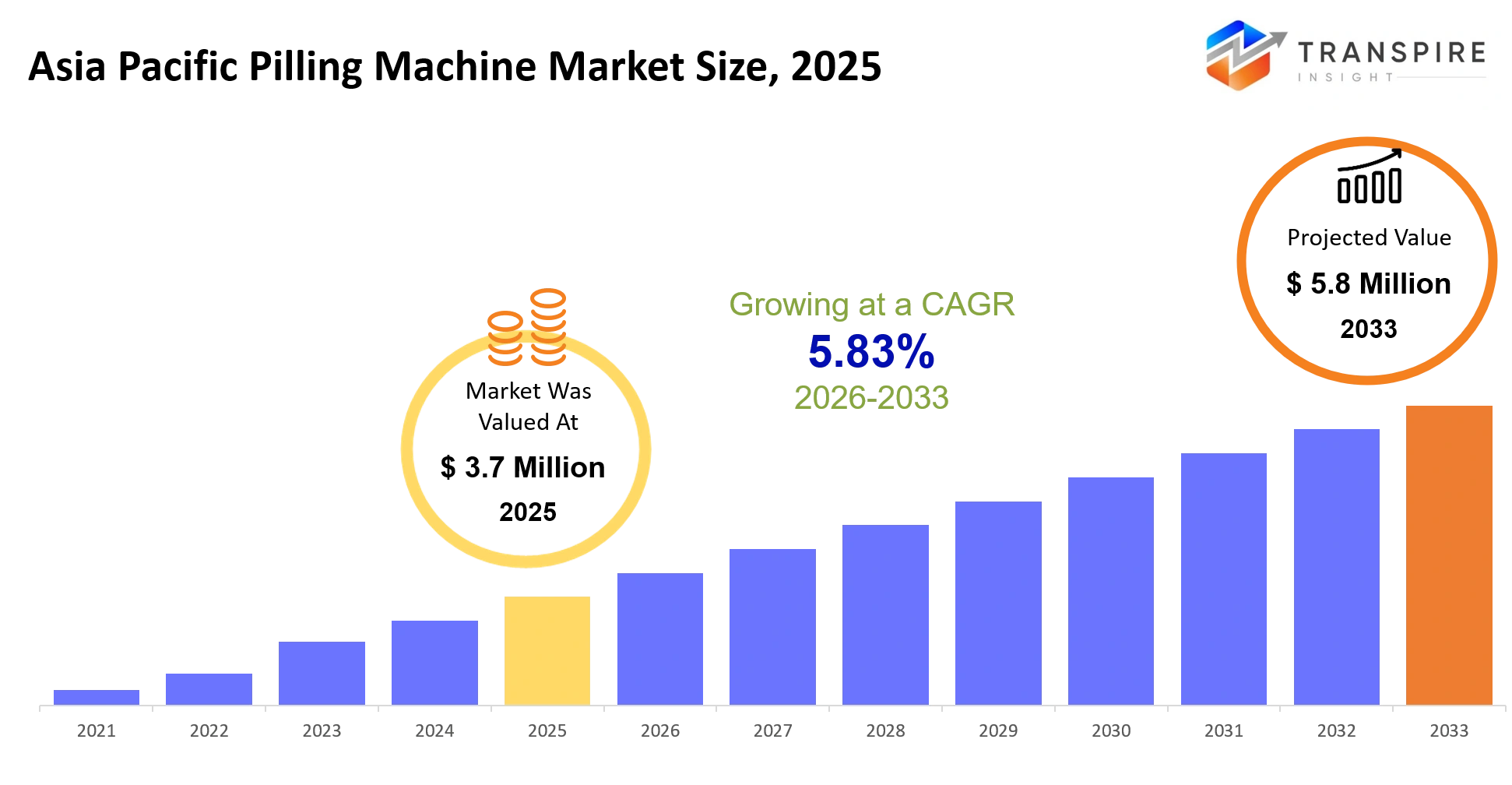
- Asia Pacific Pilling Machine Market Size 2025: USD 3.7 Million
- Asia Pacific Pilling Machine Market Size 2033: USD 5.8 Million
- Asia Pacific Pilling Machine Market CAGR: 5.83%
- Asia Pacific Pilling Machine Market Segments: By Machine Type (Laboratory Pilling Testers, Fabric Pilling Machines, Martindale Testers, Random Tumble Pilling Testers, ICI Pilling Testers, Brush Pilling Testers, Fabric Abrasion Testers, Others); By Application (Textile Testing, Apparel Manufacturing, Quality Control, Research Laboratories, Yarn Testing, Fabric Development, Certification Testing, Others); By Operation (Automatic, Semi-Automatic, Manual, Digital Systems, PLC Controlled Systems, Benchtop Systems, Industrial Systems, Others); By End User (Textile Mills, Apparel Manufacturers, Testing Laboratories, Research Institutes, Certification Bodies, Universities, Fabric Producers, Others).
Asia Pacific Pilling Machine Market Summary
The Asia Pacific Pilling Machine Market was valued at USD 3.7 Million in 2025. It is forecast to reach USD 5.8 Million by 2033. That is a CAGR of 5.83% over the period.
The Asia Pacific piling machine market consists of equipment which is employed to drive piles into ground or seabeds to provide solid foundations for construction of bridges, ports, offshore platforms, high rise buildings and transportation corridors. On practical ground, piling machines define whether heavy infrastructure can stand on fragile ground and reclaimed land, especially when expansion and urbanization is happening more intensely on coastal and reclaiming land areas. Over the past 3-5 years the piling machine market has moved from the old, diesel-powered rigs to hydraulically-optimized semi-automated piling machines that offer better accuracy and reduced idle time at busy work sites. The "big changes" within the market are the adoption of digital monitoring and vibration control systems into piling machines, which was triggered by the supply chain disruptions during the COVID pandemic, and the subsequent high public infrastructure spending stimulus by governments in China, India and Southeast Asia, leading to the preference for high-efficiency machinery and thus shortening replacement cycle and enhancing aftermarket income for the companies.
Key Market Insights
- With a 35-40% estimated share, China dominates the Asia Pacific Pilling Machine Market in 2025 on the back of a tremendous transport and coastal infrastructure pipeline
- India is anticipated to register the fastest growth rate across regions (2025-2030) on account of smart city initiatives, metro infrastructure upgrades, and highway modernization campaigns
- Growing adoption of piling machines can be seen across South East Asia due to port upgrades and offshore energy construction investments
- Hydraulic piling rigs will hold the dominant share in the Asia Pacific Pilling Machine Market in 2025 with a share of ~45% due to higher accuracy and lesser vibration output
- Diesel hammer systems will hold the second largest share segment, catering to cost sensitive construction infrastructure requirements
- Vibratory piling equipment will register the fastest growth rate across application segments (2025-2030) owing to increasing construction noise regulations within urban environments
- Bridge and highway foundation works constitute the largest application segment at ~38% owing to cross border connectivity & logistics projects
- Offshore wind and marine construction is expected to emerge as the fastest growing application segment, driven by clean energy construction in Asia's coastal region
- Civil infrastructure contractors hold the dominant share in the Asia Pacific Pilling Machine Market at ~50%
What are the Key Drivers, Restraints, and Opportunities in the Asia Pacific Pilling Machine Market?
Increased infrastructure spending within the economies of China, India, and the ASEAN nations, which focus on transport corridors, ports, and urban mass transit, is the largest driver within the Asia Pacific Pilling Machine Market. These government-fueled investments, often structured using public-private partnerships, have decreased project timelines and driven demand for high-capacity hydraulic Pilling Machines that expedite project schedules while strengthening the reliability of foundational structures, increasing machine usage and fleet renewal patterns for contractors.
High upfront equipment costs and operational and maintenance complexity of more technologically advanced Pilling Machines, including those that utilize vibration and are fully automated, act as significant constraints. A large number of middle-tier contractors throughout these Asian countries delay adoption of newer machines due to capital access limitations and inconsistent project flows, creating an industry-wide obstacle to further technological implementation. Older Diesel-powered units will remain active for the longer term due to these structural obstacles, which have prevented widespread productivity improvements in the sector.
Emerging trends include demand related to offshore windfarms and coastal defenses in locations like Vietnam, Taiwan, and India. Deep water solutions, and dedicated marine Pilling Machine equipment are necessary for these project needs. A surge in renewable energy investments offers long-term demand for both capital and service based revenue streams, particularly for firms providing more environmentally sustainable, hybrid diesel machines.
What Has the Impact of Artificial Intelligence Been on the Asia Pacific Pilling Machine Market?
Artificial intelligence is progressively transforming operational efficiency in the Asia Pacific Pilling Machine Market through smarter control and data-led construction planning. Automated correction of alignment and real-time analysis of soil resistance offered by AI powered piling machines now increase precision when placing foundations for larger infrastructure jobs and minimizes the chance of human error while maintaining stability under challenging geotechnical conditions.
With the rise of predictive maintenance, ML models use vibration data, hydraulic pressures, and engine load readings to predict equipment breakdown. This ensures higher uptime due to routine maintenance preceding any significant failure. Contractors are also adopting performance optimization solutions in the AI based software, for reducing fuel consumption and enhancing cycle efficiency during repetitive piling operations.
The operational aspects benefit from AI implementation due to reduction in downtime and efficient distribution of the fleet throughout the construction job site, but there are challenges to widespread adoption, as a lack of connectivity at rural sites make it difficult for continuous transmission of real-time data. The high cost of implementing such technologies as well as the absence of reliable and standardized training sets for various geotechnical issues hinders its adoption by smaller contractors in the Asia Pacific Pilling Machine Market.
Key Market Trends
- The market share of hydraulic piling machines rose from 32% in 2020 to almost 45% in 2025 as their widespread use is displacing older diesel hammer systems, especially in urban construction applications.
- Chinese contractors shifted purchasing trends to smart piling rigs after 2022 as the focus on precision control gained prevalence due to dense construction needs of metro projects and bridge construction.
- The infrastructure boom in India from 2021 onward saw an increase of 40% in piling equipment deployments for highway projects and smart city foundation work.
- Vibration-control legislations in Japan and South Korea after 2023 prompted manufacturers to advance low-noise hydraulic piling technologies.
- Expansion of offshore wind development in Taiwan and Vietnam from 2022 boosted the sales of deep-water piling systems that are suitable for offshore foundation installation.
- Supply chain bottlenecks from 2020 to 2021 led to a 20% extension in equipment lifespan for piling rigs in the Asia Pacific region which led to the rise of aftermarket service revenue.
- The product portfolios of SANY Group and XCMG expanded with more automated piling equipment after 2023 as they sought to compete with the supply of high-precision equipment from Europe.
- After 2021, equipment renting increased in the Asian Pacific region particularly among middle-tier contractors who wanted to save on large initial costs of expensive smart piling rigs.
- Digital monitoring system integration in piling equipment started increasing sharply after 2022 because of the increasing trend to better monitor real time soil resistance to avoid foundation failure.
- Development and upgrades of ports in Southeast Asia from 2023 onwards created significant demand for high capacity piling machines to handle deep coastal soil.
Asia Pacific Pilling Machine Market Segmentation
By Machine Type:
The controlled quality of fabric surface evaluation is performed across the different production facilities of textiles with Martindale system, laboratory pilling tester. Fabric pilling machines and random tumble testers have been used by the bulk of quality tests in industrial settings. Quality and efficiency will be improved by a strong shift in preference towards automated and digital testing instruments, leading to lower manual errors and increased conformity of the evaluation results against the established fabric parameters.
The shift in machine types can be observed from manually operated testing instruments to the ones that are operated via PLC-controlled devices and fully digital test execution. Traditional bench-top machines are being replaced with automated fabric testers by both fabric manufacturing facilities and certification test laboratories in an effort to increase throughput efficiency. The development of robust automated test apparatus that has excellent repeatability of results, strong control over calibration, and low operator dependent measurement capability is highly preferred in the manufacturing industry.
By Application:
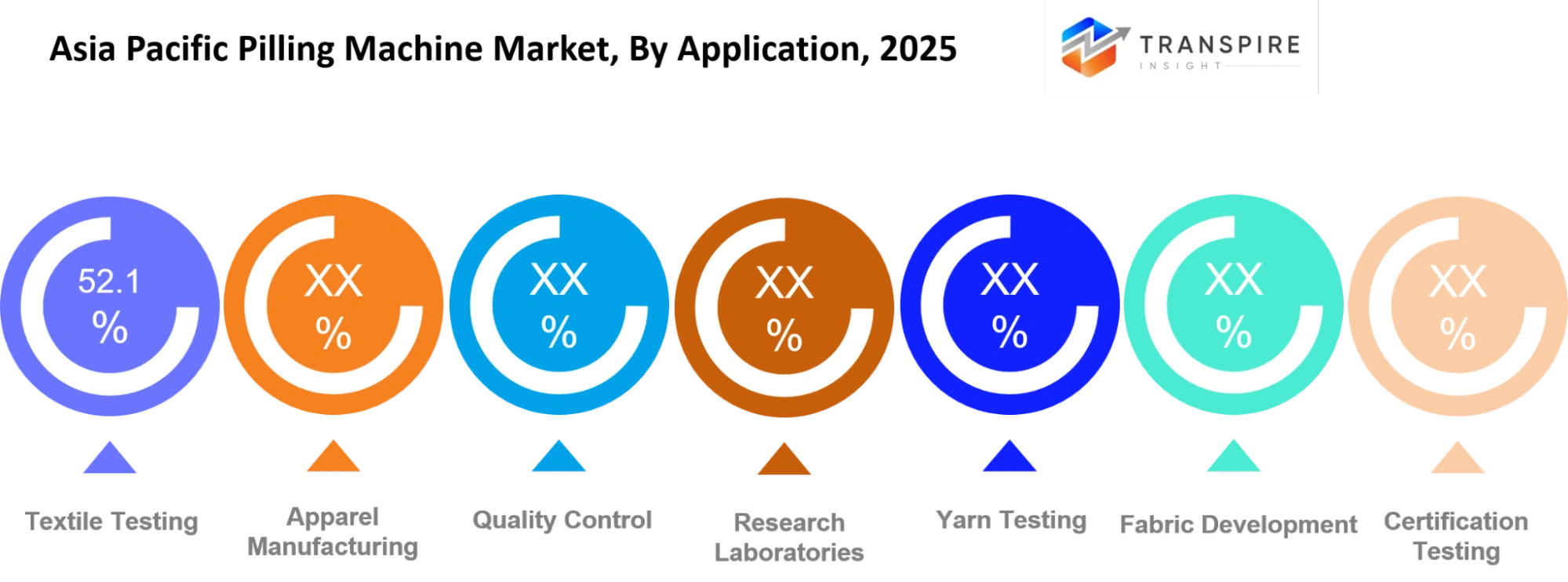
Testing in the quality control department at the mill as well as in the laboratories of different firms, in evaluating surface resistance and strength of the fabric, is predominantly used. Quality tests, in grading and production assessment of clothing manufacturing plants, are carried out to ensure its fabric does not cause the wearing of garment into pilling. Tests for yarn and fabrics, development of new material, and quality control tests for standard fabrics used in certification of textile products within export markets in Asia Pacific region will grow.
Following a new set of stricter global sourcing standards post-2021, demand for higher conformity will force certification testing to become more prevalent. More and more test centers and fabric development laboratories will implement the utilization of advanced testing systems for new material development. Apparel manufacturers are more inclined to adopt the quality testing procedures as an integral part of development, minimizing rejections in a bid to improve production line efficiency.
By Operation :
The automated and PLC based systems are predominant in today's testing laboratories, because of higher accuracy and minimal intervention by the operator. Smaller laboratory and medium scale operations utilize semi-automatic and bench top machines. Digital systems facilitate real-time test data recording. The industrial systems meet large volume textile testing needs of manufacturing conglomerates in Asia Pacific nations.
The shift from manual testers to automated digital systems has been observed since 2020, owing to increasing need for standard accuracy of tests. Manufacturing companies started using PLC based abrasion testers to replace manual units; thereby improving consistency of test results. Higher production speed demands and higher standard test compliance is expected to drive further growth in adoption of automated machines.
By End User:
Textile mills and apparel exporters are among the main end-users, due to continuous need to monitor the quality of fabrics being produced. Testing labs and certification agencies ensure compliance with national and import/export standards. R&D institutes and universities conduct materials research and textile engineering studies, in both developed and developing countries of Asia Pacific.
The usage pattern among the end-users has altered significantly after 2021, with increasing focus on outsourcing and quality for exports, throughout the textile supply chain. Testing labs are experiencing an increase in volume and hence there is an increase in testing conducted by certification bodies due to stringent standards at global level. Labs started using advanced digital equipment, to reduce testing time. Growth in fabric manufacturers and apparel exporters is likely to support the demand for pilling testing equipment.
What are the Key Use Cases Driving the Asia Pacific Pilling Machine Market?
Fabric wear & surface resistance testing in mills and garment manufacturers represents the primary application driving pilling machine sales throughout Asia Pacific, as rigorous buyer quality expectations require constant testing in order to minimize rejections, increase efficiency.
Use cases are also increasing to include certification testing, yarn quality analysis and research lab testing conducted in Universities and Fabric Development facilities as textile mills and testing labs install systems in order to pass industry standards and advance materials innovation on accelerated schedules as globally sourced production and compliance change.
Nascent use cases will be digitalinline pilling assessment as well as smart factories & integrated quality control leveraging artificial intelligence. Use case pilots in sustainable textiles & recycling verification, and smart factories are promising in terms of improving tracking, reducing scrap and increasing productivity.
|
Report Metrics |
Details |
|
Market size value in 2025 |
USD 3.7 Million |
|
Market size value in 2026 |
USD 3.9 Million |
|
Revenue forecast in 2033 |
USD 5.8 Million |
|
Growth rate |
CAGR of 5.83% from 2026 to 2033 |
|
Base year |
2025 |
|
Historical data |
2021 - 2024 |
|
Forecast period |
2026 - 2033 |
|
Report coverage |
Revenue forecast, competitive landscape, growth factors, and trends |
|
Regional scope |
Asia Pacific (India, China, Japan, Australia, South Korea, Rest of Asia Pacific) |
|
Key company profiled |
James Heal, SDL Atlas, TESTEX, Uster Technologies, Roaches International, Labthink, Paramount Instruments, Texcare Instruments, Gester Instruments, ChiuVention, Presto Group, Instron, Tinius Olsen, Mecmesin, Qinsun. |
|
Customization scope |
Free report customization (country, regional & segment scope). Avail customized purchase options to meet your exact research needs. |
|
Report Segmentation |
By Machine Type (Laboratory Pilling Testers, Fabric Pilling Machines, Martindale Testers, Random Tumble Pilling Testers, ICI Pilling Testers, Brush Pilling Testers, Fabric Abrasion Testers, Others); By Application (Textile Testing, Apparel Manufacturing, Quality Control, Research Laboratories, Yarn Testing, Fabric Development, Certification Testing, Others); By Operation (Automatic, Semi-Automatic, Manual, Digital Systems, PLC Controlled Systems, Benchtop Systems, Industrial Systems, Others); By End User (Textile Mills, Apparel Manufacturers, Testing Laboratories, Research Institutes, Certification Bodies, Universities, Fabric Producers, Others). |
Which Regions are Driving the Asia Pacific Pilling Machine Market Growth?
China dominates the Pilling Machine Market within Asia Pacific owing to the enormous number of infrastructure building projects and continuous coastline development initiatives. Robust and consistent high-capacity pilling machinery is propelled by large infrastructure investment from the government through ports, bridges and expressways. A highly developed local manufacturing capability facilitates swift mobilization and economic cost for all piling machines at construction sites. Pilling machines utilized as part of the Belt and Road Initiative has given steady support for their use in all its associated construction projects.
Japan and South Korea have an advanced and stagnant market that has continued and sustainable needs, owing to large scale projects for infrastructure of highly precise engineering standard and urban regeneration and city development projects. Japan and South Korea's development drivers focus on rigorous engineering standards, seismic considerations and longevity of the foundation engineering, port maintenance projects, and metro expansion projects drive steady machinery renewal. Tight regulations governing safe construction provide regular demand from suppliers and developers for efficient pilling machines.
The Indian construction industry leads the rest of the Asia Pacific region, with rapid development of highway projects, metro rail construction and upgrading of existing ports. India has given consistent importance and increased infrastructure focus and corridor projects, along with city development projects, creating huge business prospects and driving the adoption of piling machines within public as well as private sector projects. Investment for and within the Indian market has and will continually give investment opportunities through 2026-2033 as scaling of infrastructure continues.
Who are the Key Players in the Asia Pacific Pilling Machine Market and How Do They Compete?
The Asia Pacific Pilling Machine Market has a moderately consolidated market structure with engineering equipment manufacturers based in Developed countries and cost competitive regionally developed vendors vying for market share. The factors that contribute to market competition are technology efficiency, reliability and after-sales services and not strictly price. The purchasing patterns of the end-users have started favoring those vendors that can provide digital monitoring of the rig, fuel efficient operations and reduced vibration technology to meet regulatory standards for urban applications. This trend would strengthen technology based market leaders and put increasing pressure on the low-end equipment providers.
The factors of the SANY Group and XCMG is their manufacturing cost efficiency and their scale of manufacturing capability. These would allow them to cater to the huge infrastructure market volumes all across Asia. Their competitive advantage is integrated supply chain and prompt machine availability to support the Government supported civil construction market. Whereas, the Liebherr Group's core competitiveness lies in their high-precision engineering capabilities with advanced hydraulic systems that can work well in challenging geotechnical environments. The Bauer AG and Soilmec cater to specialized solutions in the domain of foundation engineering with a focus on offshore and heavy infrastructure applications based on deep piling technologies. Junttan is trying to position itself based on their hydraulic piling rigs for vibration-sensitive applications in urban locations and to tap markets in South East Asia and India through partnerships with regional distributors.
Company List
- James Heal
- SDL Atlas
- TESTEX
- Uster Technologies
- Roaches International
- Labthink
- Paramount Instruments
- Texcare Instruments
- Gester Instruments
- ChiuVention
- Presto Group
- Instron
- Tinius Olsen
- Mecmesin
- Qinsun
Recent Development News
In January 2026, Liebherr Group announced expansion of its piling and drilling equipment lineup for Asia Pacific construction markets. The company introduced enhanced digital control features in its foundation rigs to improve precision in dense urban infrastructure projects. This development strengthens demand for low-vibration piling solutions across metro and bridge construction projects in India and Southeast Asia.
Source: https://www.liebherr.com
In March 2026, SANY Group launched an upgraded series of hydraulic piling rigs targeted at high-load infrastructure applications in China and export markets. The new machines integrate fuel efficiency improvements and remote monitoring systems to reduce downtime in large-scale construction projects. This move supports contractors working on transport corridors and coastal infrastructure under tight delivery timelines.
Source: https://www.sanyglobal.com
What Strategic Insights Define the Future of the Asia Pacific Pilling Machine Market?
The Asia Pacific Pilling Machine Market is structurally oriented towards greater automation, digital control and digitally observed piling foundations as density of construction rises through the urban corridor and the coast. The rate of growth has transitioned away from pure volume construction and into high precision Pilling requirements for hazardous soil conditions and increasingly aggressive project schedules, thereby expediting the transition from traditional diesel-operated piling rigs toward modern hydraulic and smart-controlled technology. Less prominent is the increased level of concentration amongst leading piling machine manufacturers and the corresponding implications of limited pricing maneuverability and slower technology dissemination for medium contractors.
Perhaps a major latent opportunity is the offshore wind turbine foundation market in Vietnam, Taiwan and India. These are still underdeveloped markets for deep water Pilling solutions, but their growth curve will be steep. In terms of a market entry opportunity or the design focus of existing player; modular, low-emission Pilling rigs with a high degree of remote diagnostication should be the way forward, as contractors look for increased utilization rates and tighter regulations across key urban centers of Asia Pacific.
Asia Pacific Pilling Machine Market Report Segmentation
By Machine Type
- Laboratory Pilling Testers
- Fabric Pilling Machines
- Martindale Testers
- Random Tumble Pilling Testers
- ICI Pilling Testers
- Brush Pilling Testers
- Fabric Abrasion Testers
By Application
- Textile Testing
- Apparel Manufacturing
- Quality Control
- Research Laboratories
- Yarn Testing
- Fabric Development
- Certification Testing
By Operation
- Automatic
- Semi-Automatic
- Manual
- Digital Systems
- PLC Controlled Systems
- Benchtop Systems
- Industrial Systems
By End User
- Textile Mills
- Apparel Manufacturers
- Testing Laboratories
- Research Institutes
- Certification Bodies
- Universities
- Fabric Producers
Frequently Asked Questions
Find quick answers to common questions.
The Asia Pacific Pilling Machine Market size is USD 5.8 Million in 2033.
Key segments for the Asia Pacific Pilling Machine Market are By Machine Type (Laboratory Pilling Testers, Fabric Pilling Machines, Martindale Testers, Random Tumble Pilling Testers, ICI Pilling Testers, Brush Pilling Testers, Fabric Abrasion Testers, Others); By Application (Textile Testing, Apparel Manufacturing, Quality Control, Research Laboratories, Yarn Testing, Fabric Development, Certification Testing, Others); By Operation (Automatic, Semi-Automatic, Manual, Digital Systems, PLC Controlled Systems, Benchtop Systems, Industrial Systems, Others); By End User (Textile Mills, Apparel Manufacturers, Testing Laboratories, Research Institutes, Certification Bodies, Universities, Fabric Producers, Others).
Major Asia Pacific Pilling Machine Market players are James Heal, SDL Atlas, TESTEX, Uster Technologies, Roaches International, Labthink, Paramount Instruments, Texcare Instruments, Gester Instruments, ChiuVention, Presto Group, Instron, Tinius Olsen, Mecmesin, Qinsun.
The Asia Pacific Pilling Machine Market size is USD 3.7 Million in 2025.
The Asia Pacific Pilling Machine Market CAGR is 5.83% from 2026 to 2033.
- James Heal
- SDL Atlas
- TESTEX
- Uster Technologies
- Roaches International
- Labthink
- Paramount Instruments
- Texcare Instruments
- Gester Instruments
- ChiuVention
- Presto Group
- Instron
- Tinius Olsen
- Mecmesin
- Qinsun
About the Authors

Kartik bhong
I am Kartik Bhong, a Senior Research Analyst at Transpire Insight, specializing in the Packaging, Manufacturing, and Construction industry. My work focuses on analyzing market trends, emerging technologies, industry regulations, and competitive landscapes to deliver accurate, data-driven insights. I am passionate about transforming complex industry information into clear, practical content that helps businesses, professionals, and decision-makers stay informed and make confident strategic decisions. Through continuous research and a strong commitment to accuracy, I strive to create reliable, well-researched content that reflects the latest developments across these dynamic industries and supports the vision of Transpire Insight in delivering valuable market intelligence.

Chakradhar Khansole
Chakradhar serves as the Research Director at Transpire Insight, bringing over 8 years of experience in technology, innovation, and strategic market intelligence. He specializes in transforming complex market data into actionable business insights that enable organizations to make informed, growth-oriented decisions. Recognized for his strategic vision and analytical expertise, Chakradhar leads high-impact research initiatives, delivering comprehensive market assessments, competitive intelligence, and forward-looking industry analysis.
Recently Published Reports
-
Apr 2026
Handling and Lifting Equipment Market
Handling and Lifting Equipment Market Size, Share & Analysis Report By Product (Cranes and Hoists, Forklifts, Conveyor Systems, Aerial Work Platforms, Others), By Application (E-Commerce, Automotive and Railway, Food and Beverages, Aviation, Others), and Geography (North America, Europe, Asia-Pacific, Middle East and Africa, South and Central America), 2021 - 2031
-
Apr 2026
HVAC Equipment Market
HVAC Equipment Market Size, Share & Analysis Report By Heating Equipment Type (Boilers and Furnaces, Heat Pumps, and Unitary Heaters), By Ventilation Equipment (Air Handling Units, Humidifiers and Dehumidifiers, Air Filters, and Fan Coiling Units), By Air Conditioning Equipment (Unitary Air Conditioners, Room Air Conditioners, Packaged Terminal Air Conditioners, and Chillers), By End User (Commercial, Residential, Industrial, and others), and Geography (North America, Europe, Asia-Pacific, Middle East and Africa, South and Central America), 2021 – 2031
-
Apr 2026
Refrigeration Valves Market
Refrigeration Valves Market Size, Share & Analysis Report By Type (Solenoid Valves, Expansion Valves, Check Valves, Service Valves, Others), By Application (Commercial Refrigeration, Industrial Refrigeration, Transport Refrigeration, Residential Refrigeration, Air Conditioning Systems), By End User (Food and Beverage Industry, Pharmaceutical Industry, HVAC Industry, Chemical Industry, Others), and Geography (North America, Europe, Asia-Pacific, Middle East and Africa, South and Central America), 2021 – 2031
-
Apr 2026
E-Commerce Packaging Materials Market
E-Commerce Packaging Materials Market By Material Type (Corrugated Boxes, Paper & Paperboard, Foam & Cushioning Materials, Plastic Packaging, Flexible Packaging, Protective Packaging, Others), By Product(Primary Packaging, Secondary Packaging, Tertiary Packaging), By Packaging Function (Protective Packaging, Branding & Presentation Packaging, Transit & Logistic Packaging, Sustainable Packaging, Tamper Evidence Packaging), By End-User (Retail & Consumer Goods, Electronic Appliances, Food & Beverages, Healthcare & Pharmaceutical, Fashion & Apparel, Home & Furnishing, Others); By Industry Analysis, Size, Share, Growth, Trends, and Forecasts 2021-2033