
Asia Pacific Personal Protective Equipment (PPE) Market Summary
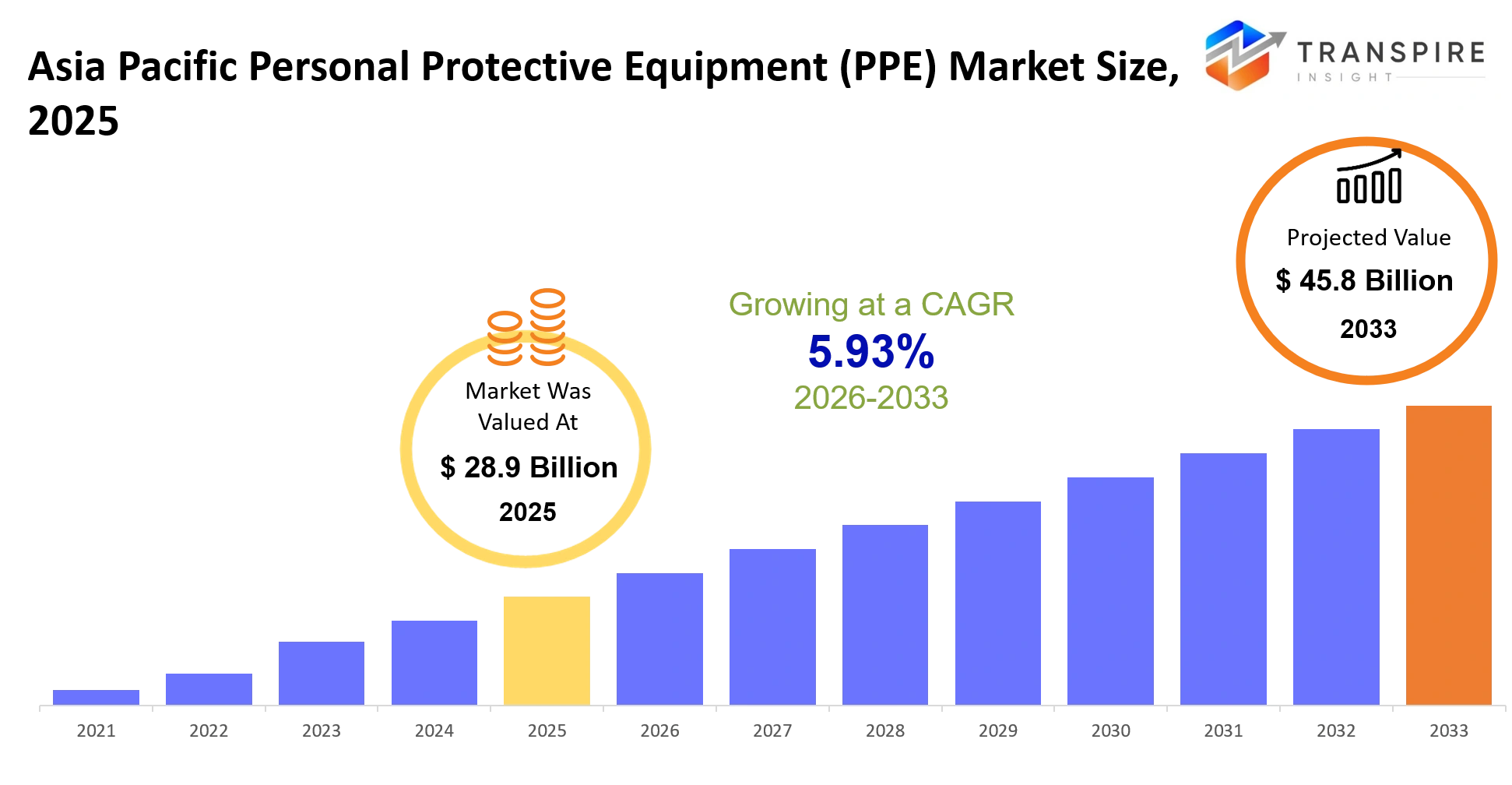
As per Transpire Insight Analysis the Asia Pacific Personal Protective Equipment (PPE) Market size is estimated at USD 28.9 Billion in 2025 and is anticipated to reach USD 45.8 Billion by 2033, growing at a CAGR of 5.93% from 2026 to 2033.
The Asia Pacific Personal Protective Equipment (PPE) market ends up being a pretty big deal, when it comes to safeguarding workers in manufacturing, construction, healthcare, mining, oil and gas, logistics, and maritime operations because all sorts of physical, chemical, biological, and environmental threats are pretty much “normal” in day to day duties. Having reliable safety gear lets organisations cut down on injuries at work, stay in line with regulatory rules , and avoid costly operational hiccups, even when things get complicated.
In the last three to five years, the whole buying pattern has moved away from just chasing volume, and more toward performance oriented PPE that is tied to specific uses, which is being pushed by tighter occupational safety regulations and also newer digital monitoring features. Then COVID-19 came along, and basically acted as a strong trigger, it highlighted weak spots in regional supply chains. That pushed governments and industries to build up domestic production and larger strategic reserves.
Now, as employers try to choose better protective solutions and think about workforce resilience over the long run, their procurement approach is starting to lean more toward value. This in turn stretches replacement cycles, encourages more premium product adoption, and keeps supporting steady revenue growth throughout the region.
Asia Pacific Personal Protective Equipment (PPE) Market Size & Forecast:
- Asia Pacific Personal Protective Equipment (PPE) Market Size 2025: USD 28.9 Billion
- Expected Market Value 2033: USD 45.8 Billion
- Forecast CAGR: 5.93%
- Leading region in 2025: China
- Fastest Growing region: India
- Key Profile: 3M, Honeywell, Ansell, DuPont, Kimberly-Clark, Top Glove, Hartalega, Kossan Rubber Industries, Supermax, Lakeland Industries, MSA Safety, Dräger, Cardinal Health, Uvex, Delta Plus.
Key Market Insights
- China pretty much dominates the Asia Pacific Personal Protective Equipment (PPE) Market, holding about 43% market share in 2025, and this is backed by large scale production, plus industrial safety compliance that seems to keep getting stricter.
- India, on the other hand, looks like the fastest-growing regional market through 2025–2033, mainly because infrastructure spending keeps rising, factories are expanding, and occupational safety enforcement is getting stronger too.
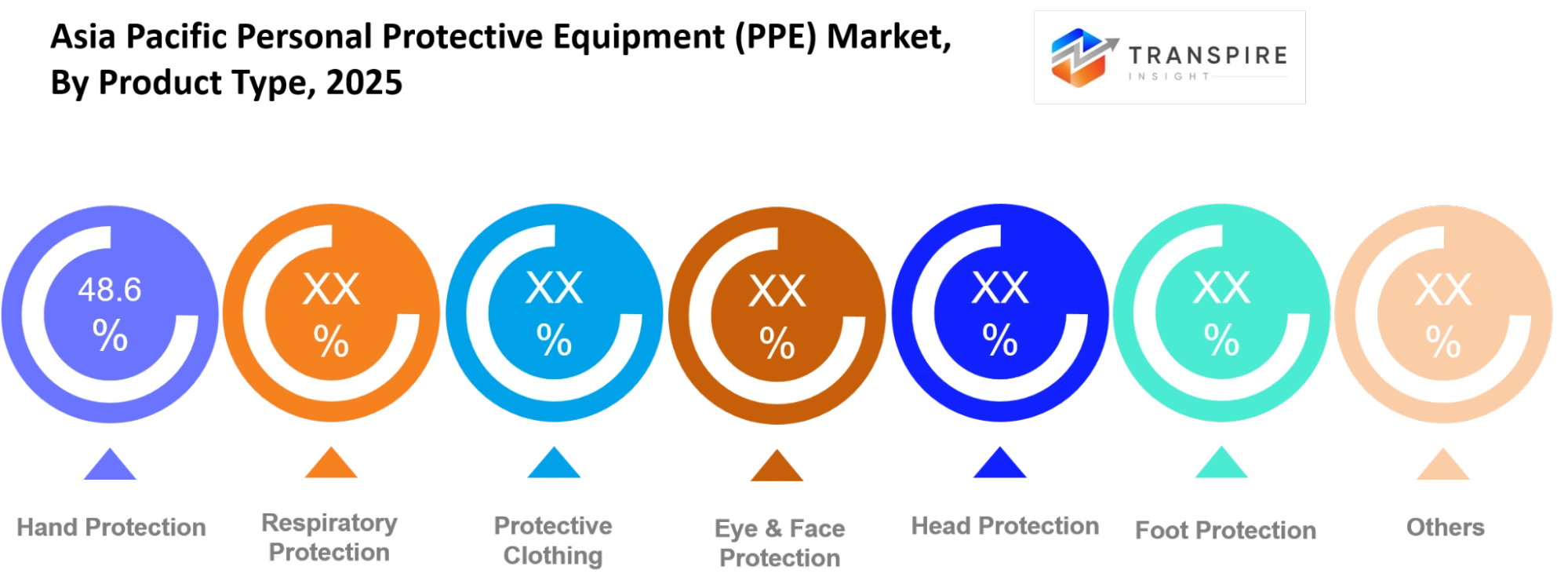
- For products, hand protection sits on top with close to 30% market share, which makes sense since it’s broadly adopted in manufacturing, construction, mining, and logistics, all at once.
- Protective clothing comes next, and it’s the second biggest segment, as chemical processing, pharmaceuticals, and heavy industries push tougher workplace protection requirements.
- Respiratory protective equipment is projected to be the fastest-growing product segment by 2033, fueled by tighter air quality rules and better control of industrial emissions.
- When it comes to applications, manufacturing leads with roughly 35% share in 2025, because production sites keep upgrading worker protection programmes and the compliance systems around them.
- Healthcare is expected to see the quickest application expansion over the forecast period, as hospitals increase infection prevention spending and also boost emergency preparedness investments.
- As for end users, manufacturing still remains the top category with nearly 40% market share, with ongoing industrial output and mandatory safety compliance doing most of the heavy lifting.
- Finally, construction is set to become the fastest-growing end-user segment through 2033, driven by transport, energy, and urban infrastructure programmes happening across the Asia Pacific region.
What are the Key Drivers, Restraints, and Opportunities in the Asia Pacific Personal Protective Equipment (PPE) Market?
The most powerful growth driver is the tightening of occupational health and safety rules across a bunch of major Asia Pacific markets. Governments have been sharpening inspection frameworks after those pandemic-era workplace checks and the industrial accident probes. Manufacturers now set aside bigger budgets for certified protective gear, not just the basic safety supplies. Then digital compliance audits kinda lock in procurement choices. This regulatory swing ends up helping replacement cycles, pushes more premium product take up, and it also opens up repeat revenue chances for suppliers that serve manufacturing, healthcare, mining, and infrastructure.
The largest structural headwind is still supply chain concentration for specialised materials, like high-performance fibres, filtration media, and advanced polymers. Production capacity can’t pivot quickly, since certification requirements, heavy capex, and the necessary technical know-how all mean long qualification timelines. From the Transpire Insight review of regional procurement announcements and launch timing, supply chain concentration stays the main execution risk. So you get delayed deliveries, increased procurement spend, postponed industrial projects, and suppressed revenue chances during stretches when raw materials are disrupted.
The next kind of growth phase will likely come from connected personal protective equipment that is plugged into industrial IoT platforms. Smart helmets, wearable sensors, and AI-enabled monitoring systems deliver real time worker wellbeing and ambient hazard signals, so it feels more immediate. China, India, and parts of Southeast Asia keep pushing smart manufacturing investments, which in turn backs that shift. And as linked plants become the norm, intelligent PPE will slide out of only premium rollouts and toward wider company adoption, creating product line up with better margins and longer term service revenues, basically.
What Has the Impact of Artificial Intelligence Been on the Asia Pacific Personal Protective Equipment (PPE) Market?
Artificial intelligence is kind of transforming the regional personal protective equipment industry, not just by upgrading gear but by linking wearable safety devices to digital monitoring platforms that do a lot of the compliance work for people. With these systems, compliance, hazard detection, and even workforce supervision get automated, mostly in real time. AI powered cameras and computer vision setups check if workers are using the approved helmet respirator gloves or protective clothing before they walk into restricted zones, so fewer manual spot checks are needed and regulatory compliance tends to look better.
At the same time machine learning models peek at purchasing patterns, how equipment is actually used, and when replacement cycles usually happen. Then they forecast inventory needs and help optimize distribution across industrial facilities. Predictive analytics, for example, helps manufacturers expect demand swings, cut down on stock shortages, and tweak production scheduling without piling up too much surplus inventory cost.
On top of that, digital platforms improve day to day operations by noticing equipment failure rhythms, tracking environmental exposure, and enabling preventive maintenance for reusable protective devices. Large industrial organisations often report higher compliance levels, reduced workplace incident risk, and quicker response times after they integrate connected safety systems with their enterprise management software. Still, the AI adoption story has limits that are pretty practical. Implementation costs can be high, digital infrastructure is sometimes fragmented, and industrial data quality can be inconsistent. Also connectivity constraints in remote mining, construction, and offshore settings slow down deployment quite a bit. Because of these issues many small and medium sized enterprises struggle to fully adopt intelligent PPE solutions, even though the benefits are measurable and fairly clear.
Key Market Trends
- Manufacturers are increasingly swapping the usual PPE for application specific , certified products, as industrial safety rules tightened somewhere between 2022 and 2025, and that shift is pretty visible across plants.
- Connected helmets and wearable safety devices kind of took off in the market after 2023, letting firms track workers in real time , and also push out automated compliance reporting.
- Respiratory protection adoption moved faster across semiconductor, electronics, and battery manufacturing, mostly after workplace air quality requirements got stricter.
- India also became a big production hub after multinational manufacturers broadened regional manufacturing capacity between 2023 and 2025, so suppliers there had more volume.
- 3M, Honeywell, and MSA Safety expanded their digital safety line ups, by tying wearable technologies into industrial monitoring platforms.
- Procurement strategies meanwhile kind of moved away from merely the lowest-cost purchase approach, toward lifecycle value assessment, because enterprises started valuing durability, certification, and replacement efficiency more consistently.
- Local manufacturing capacity did grow after pandemic related supply chain disruptions, which then helped lower dependence on imported protective gear across a handful of Asian economies, more or less.
- At the same time, sustainability initiatives also appeared to nudge adoption of reusable protective equipment and recyclable materials inside industrial workplaces after 2024, even though some sites went slower than others.
- Industrial automation projects increased demand for specialised protective gear built for robotics, electronics manufacturing, and high precision production environments.
- Regional distributors strengthened their strategic partnerships with global PPE manufacturers too, mainly to improve product availability, technical guidance, and after sales service across emerging markets .
Asia Pacific Personal Protective Equipment (PPE) Market Segmentation
By Product Type :
Hand protection grabs the biggest share , like it mostly holds the lead, because manufacturing, construction, automotive production, mining, and logistics all need ongoing protection against cuts, abrasions, chemical exposure , and those nasty mechanical risks. Since gloves tend to wear down during normal industrial work, the standard replacement cycles keep sales pretty steady, even if demand shifts slightly. And on top of that, product innovation— better grip, more comfort, and improved chemical resistance—makes the premium segment feel more attractive across a few different industries.
Respiratory protection is also gaining ground, sort of keeps gathering momentum , as air quality regulations get stricter in manufacturing, pharmaceuticals, mining, and electronics production. Protective clothing stays a large slice, likely because chemical processing, healthcare, and heavy industries need certified garments, for safety on the job. Eye and face protection, head protection, and foot protection remain in steady demand due to workplace regulations, and specialised items that sit in the other category, help for niche environments where the safety needs are very specific and application driven.
By End User :
Manufacturing counts as the biggest end user group because plant sites run on machinery , chemicals, welding gear, and also automated production systems, so they need certified protective equipment every single day, no real pause. Worksite checks and safety compliance programmes push continuous procurement, not those one off purchases that happen once in a while. Plus industrial expansion across a handful of Asian economies helps keep spend climbing for workforce protection solutions .
Healthcare stays a major driver too, since hospitals, laboratories , and diagnostic centres keep strict infection control routines going, along with emergency preparedness programmes. Construction shows solid momentum, because transport projects, office type buildings, and city infrastructure upgrades tend to generate extra safety requirements for workers. Oil and gas, food processing, mining, and other industrial sectors keep funding specialised protective products, the kind that match operational dangers and regulatory standards.
By Material :
Nitrile leads on material demand because it has strong chemical resistance, real durability, and latex-free properties, so it fits healthcare, labs, manufacturing, and even food processing facilities. Its consistent product performance , kind of like it stays reliable, has helped it get picked up across industries that want high protection standards. Also, steady access to raw materials has kept the momentum going and in recent years it has supported broader commercial acceptance.
Latex is still important too, especially for medical procedures that need flexibility and a more tactile sensitivity , even though allergy concerns end up limiting wider adoption. Polyethylene and polypropylene work well for disposable garments, protective covers, and lighter industrial uses where cost efficiency stays important. Leather continues to be used for heavy-duty industrial tasks needing abrasion resistance, while other specialised materials cover heat-resistant, electrical, and chemical protection products, all aimed at demanding work environments.
By Distribution Channel :
Direct sales account for the largest share because big industrial organisations usually want long-run supply agreements, custom product suggestions, and reliable delivery schedules. Enterprise procurement teams often negotiate contracts that cover multiple facilities, so manufacturers end up with more steady business ties, and this whole setup feels more “locked in”. Technical help and after-sales support also make the distribution model feel stronger for industrial customers, overall.
Meanwhile, industrial distributors keep a solid market presence by offering a wide product range to regional businesses, and they often manage faster delivery capabilities, too. Online retail is still growing because digital procurement platforms make product comparisons, ordering, and even inventory management easier for small to medium sized enterprises. Specialty stores and other distribution channels stay useful for technical goods that need expert guidance, or industry specific certification support, which matters a lot.
By Application :
Industrial safety kind of takes the lead application wise, mainly because manufacturing plants , warehouses, mining sites, and construction projects need steady worker protection during routine operations, not only when something goes wrong. Regulatory inspections and workplace safety programmes also push organizations toward regular equipment replacement, rather than those last minute emergency purchases. And as industrial production keeps expanding across Asia, it keeps feeding long-term procurement activity in this same application segment.
Medical safety on the other hand keeps widening too, think hospitals, clinics, laboratories, plus emergency healthcare services, all of which depend on dependable protective products for infection prevention. Chemical protection, fire protection, and electrical safety still benefit from tighter operational standards in hazardous industries where certified equipment tends to lower workplace risks. Other specialised applications cover more niche, sector specific requirements, helping with broader product development, and opening up opportunities for suppliers serving different industrial environments.
What are the Key Use Cases Driving the Asia Pacific Personal Protective Equipment (PPE) Market?
Manufacturing still ends up being the main use case, because factories keep buying certified protective equipment to meet workplace safety rules and, basically, keep production running without stopping. Big automotive, electronics, metal fabrication, and machinery players manage steady procurement volumes via scheduled replacement programmes, plus they have strict compliance requirements, so it stays pretty consistent even when demand shifts.
Healthcare and construction are also growing as application areas across the region, not just slowly, but in a noticeable way. Hospitals and diagnostic laboratories keep putting money into advanced protective equipment for infection control, while construction contractors procure specialised products to safeguard workers who handle transport, energy, and urban infrastructure projects. These projects operate under tighter safety standards and that drives what gets purchased.
New use cases are starting to show up inside semiconductor manufacturing, battery production, and renewable energy facilities. In those spaces, specialised protective solutions back high-precision operations and hazardous material handling. You can even see more traction around offshore wind installations and advanced electronics production, since industrial buyers want equipment designed for controlled, technically demanding working environments.
|
Report Metrics |
Details |
|
Market size value in 2025 |
USD 28.9 Billion |
|
Market size value in 2026 |
USD 30.6 Billion |
|
Revenue forecast in 2033 |
USD 45.8 Billion |
|
Growth rate |
CAGR of 5.93% from 2026 to 2033 |
|
Base year |
2025 |
|
Historical data |
2021 - 2024 |
|
Forecast period |
2026 - 2033 |
|
Report coverage |
Revenue forecast, competitive landscape, growth factors, and trends |
|
Regional scope |
Asia Pacific (India, China, Japan, Australia, South Korea, Rest of Asia Pacific) |
|
Key company profiled |
3M, Honeywell, Ansell, DuPont, Kimberly-Clark, Top Glove, Hartalega, Kossan Rubber Industries, Supermax, Lakeland Industries, MSA Safety, Dräger, Cardinal Health, Uvex, Delta Plus. |
|
Customization scope |
Free report customization (country, regional & segment scope). Avail customized purchase options to meet your exact research needs. |
|
Report Segmentation |
By Product Type (Hand Protection, Respiratory Protection, Protective Clothing, Eye & Face Protection, Head Protection, Foot Protection, Others); By End User (Healthcare, Manufacturing, Construction, Oil & Gas, Food Processing, Mining, Others); By Material (Nitrile, Latex, Polyethylene, Polypropylene, Leather, Others); By Distribution Channel (Direct Sales, Industrial Distributors, Online Retail, Specialty Stores, Others); By Application (Industrial Safety, Medical Safety, Chemical Protection, Fire Protection, Electrical Safety, Others). |
Which Regions are Driving the Asia Pacific Personal Protective Equipment (PPE) Market Growth?
China makes up around 43% of the regional revenue , so it ends up being the main market through Asia Pacific. There are tough occupational safety rules, a lot of manufacturing capacity, and ongoing enforcement of industrial compliance standards, which all helps procurement keep going across different sectors. You also have this wide mix of domestic makers, overseas suppliers, industrial distributors and raw material producers , and that actually helps production stay steady while lowering the chance of supply disruptions. On top of that, extra money going into advanced manufacturing automation and workplace safety programmes should keep China’s position strong across the whole forecast window.
Japan comes in as the second biggest regional contributor, mostly because demand is more about stable industrial output rather than new, fast capacity growth. Workplace safety regulations stay consistent, capital spending is fairly predictable , and the manufacturing base is mature, so buying cycles in automotive electronics chemicals and healthcare stay reliable. Instead of jumping due to short term market shifts, buyers keep replacing protective equipment based on tight quality checks and compliance rules. That kind of controlled procurement atmosphere gives suppliers steadier revenue, and it also supports more even long term market results.
India is projected to see the fastest kind of growth between 2026 and 2033 , more or less because of rapid infrastructure development, manufacturing expansion, and tighter enforcement of occupational safety rules. Production linked incentive programmes along with industrial corridor investments have pushed up factory construction , so that protective gear suppliers now get wider opportunities too. At the same time, building up domestic manufacturing capacity has helped regional supply chains stay more solid and has cut down reliance on imported products. Overall, these structural shifts should open up promising avenues for manufacturers, distributors, and technology providers that are looking for steady, long term expansion across a mix of high-growth industrial sectors.
Who are the Key Players in the Asia Pacific Personal Protective Equipment (PPE) Market and How Do They Compete?
Competition is still pretty fragmented, with multinational manufacturers moving head to head with regional producers and, also specialised safety equipment suppliers, who tend to be more niche. When buyers decide, the biggest drivers stay pretty consistent—product performance, regulatory certification, pricing, distribution reach, and after-sales technical support, even if the order of importance shifts. Bigger, established firms keep adding to their technology portfolios plus regional manufacturing capacity, meanwhile newer suppliers push harder on cost-efficient production, faster delivery, and more industry-specific product offerings. In other words, industrial customers are increasingly looking at whether suppliers are reliable long-term, whether product quality holds up, and how strong their compliance capabilities are , not just the purchase price.
3M stays distinct via ongoing investment in advanced respiratory protection, hearing protection, and connected safety technologies that help teams meet industrial requirements and keep productivity moving. Honeywell leans into integrated worker safety systems, by pairing personal protective equipment with digital monitoring platforms, which creates extra value for major industrial clients. Ansell concentrates on high-performance hand and body protection, and it keeps extending specialised product lines for chemical processing, healthcare, and manufacturing, places where durability and certification are critical.
MSA Safety is trying to boost its competitiveness via connected wearable technologies, plus gas detection solutions that tie in with industrial safety management systems. Meanwhile DuPont expands its range of protective clothing by leaning on advanced material technologies for hazardous industrial settings, places that really need strong chemical and thermal resistance. Both groups keep putting money into regional manufacturing, distribution partnerships, product innovation and various certification programmes, so they can open up market access while still dealing with evolving workplace safety requirements across Asia Pacific, kind of all at once.
Company List
- 3M
- Honeywell
- Ansell
- DuPont
- Kimberly-Clark
- Top Glove
- Hartalega
- Kossan Rubber Industries
- Supermax
- Lakeland Industries
- MSA Safety
- Dräger
- Cardinal Health
- Uvex
- Delta Plus
Recent Development News
In April 2026, Ansell received the WorldStar Packaging Award for its SMART Pack packaging solution. The recognition validated the company's packaging innovation for medical and PPE products while strengthening sustainability differentiation across healthcare and industrial protective equipment.
Source: https://www.ansell.com/
In January 2026, Ansell launched TouchNTuff™ 93-800, the first disposable glove offering at least 15 minutes of acetone resistance. The product expanded protection for workers in aerospace, automotive, chemical manufacturing, and maintenance, reinforcing innovation in high-performance hand protection.
Source: https://www.ansell.com/
What Strategic Insights Define the Future of the Asia Pacific Personal Protective Equipment (PPE) Market?
The Asia Pacific Personal Protective Equipment (PPE) Market will be inching toward higher value , more tech enabled protective solutions, instead of trying to win just on production volume. On the ground, industrial automation, tougher workplace compliance rules, and digital safety management platforms will likely push buyers to focus on certified products that show measurable performance, last longer service wise, and can also provide operational data. There is a challenge that is a bit less visible too. It keeps coming back to how manufacturers still depend on specialised raw materials and tight, concentrated supply networks. That reliance can mean cost swings, plus longer delivery times, even if overall demand looks stable.
Meanwhile, intelligent protective equipment that pairs wearable sensors with industrial IoT systems looks set to become a meaningful growth lane, especially for advanced manufacturing sites in China, India, and Southeast Asia. For companies in the market, the practical win will come from putting money into regional production capacity, building certified product development pipelines, and forming digital safety partnerships that improve supply resilience while also helping them offer something more differentiated to industrial customers.
Asia Pacific Personal Protective Equipment (PPE) Market Report Segmentation
By Product Type
- Hand Protection
- Respiratory Protection
- Protective Clothing
- Eye & Face Protection
- Head Protection
- Foot Protection
By End User
- Healthcare
- Manufacturing
- Construction
- Oil & Gas
- Food Processing
- Mining
By Material
- Nitrile
- Latex
- Polyethylene
- Polypropylene
- Leather
By Distribution Channel
- Direct Sales
- Industrial Distributors
- Online Retail
- Specialty Stores
By Application
- Industrial Safety
- Medical Safety
- Chemical Protection
- Fire Protection
- Electrical Safety
Frequently Asked Questions
Find quick answers to common questions.
The expected Asia Pacific Personal Protective Equipment (PPE) Market size for the market will be USD 45.8 Billion in 2033.
Key segments for the Asia Pacific Personal Protective Equipment (PPE) Market are By Product Type (Hand Protection, Respiratory Protection, Protective Clothing, Eye & Face Protection, Head Protection, Foot Protection, Others); By End User (Healthcare, Manufacturing, Construction, Oil & Gas, Food Processing, Mining, Others); By Material (Nitrile, Latex, Polyethylene, Polypropylene, Leather, Others); By Distribution Channel (Direct Sales, Industrial Distributors, Online Retail, Specialty Stores, Others); By Application (Industrial Safety, Medical Safety, Chemical Protection, Fire Protection, Electrical Safety, Others).
Major Asia Pacific Personal Protective Equipment (PPE) Market players are 3M, Honeywell, Ansell, DuPont, Kimberly-Clark, Top Glove, Hartalega, Kossan Rubber Industries, Supermax, Lakeland Industries, MSA Safety, Dräger, Cardinal Health, Uvex, Delta Plus.
The Asia Pacific Personal Protective Equipment (PPE) Market size is USD 28.9 Billion in 2025.
The Asia Pacific Personal Protective Equipment (PPE) Market CAGR is 5.93% from 2026 to 2033.
- 3M
- Honeywell
- Ansell
- DuPont
- Kimberly-Clark
- Top Glove
- Hartalega
- Kossan Rubber Industries
- Supermax
- Lakeland Industries
- MSA Safety
- Dräger
- Cardinal Health
- Uvex
- Delta Plus
About the Authors

Pankaj Ghogare Patil
I am Pankaj Ghogare Patil, a Senior Research Analyst at Transpire Insight, specializing in the Pharmaceutical, Chemicals & Materials, Healthcare IT, and Biotechnology industry. My expertise lies in conducting comprehensive market research, analyzing industry trends, evaluating competitive landscapes, and translating complex data into actionable insights. At Transpire Insight, I closely follow emerging technologies, regulatory developments, and market innovations to create accurate, well-researched, and informative content that helps businesses and professionals make informed decisions. I am committed to producing credible, evidence-based articles that reflect industry best practices while making technical topics accessible and valuable for a broad audience.

Chakradhar Khansole
Chakradhar serves as the Research Director at Transpire Insight, bringing over 8 years of experience in technology, innovation, and strategic market intelligence. He specializes in transforming complex market data into actionable business insights that enable organizations to make informed, growth-oriented decisions. Recognized for his strategic vision and analytical expertise, Chakradhar leads high-impact research initiatives, delivering comprehensive market assessments, competitive intelligence, and forward-looking industry analysis.
Recently Published Reports
-
May 2026
Healthcare Polymer Packaging Market
Healthcare Polymer Packaging Market Size, Share & Analysis Report By Packaging Type (Syringes, IV Bottles and Pouches, Clamshells, Blisters, Bottles & Jars, Containers, Tubes, IV Parental Packaging, Others), By Type (Regulated, Non-regulated), By Polymer Type (LDPE (Low-Density Polyethylene), HDPE (High-Density Polyethylene), Homo-polymer (Homo), Random Copolymer (Random), Block Copolymer (Block), PET, Polystyrene, Polyvinyl Chloride, Polyamide/EVOH, Others), and Geography (North America, Europe, Asia-Pacific, Middle East and Africa, South and Central America), 2021 - 2031
-
Apr 2026
Hydrophilic Tape (Waterstop) Market
Hydrophilic Tape (Waterstop) Market Size, Share & Analysis Report By Type (Bentonite-Based Hydrophilic Tape, Rubber-Based Hydrophilic Tape), By Application (Residential Buildings, Commercial Buildings, Infrastructure Projects), and Geography (North America, Europe, Asia-Pacific, Middle East and Africa, South and Central America), 2021 - 2031
-
Apr 2026
Metalens Market
Metalens Market Size, Share & Analysis Report By Type (Visible Light Metalens, and Infrared Metalens), By Application (Consumer Electronics, Automotive Electronics, Industrial, Medical, and Others), and Geography (North America, Europe, Asia-Pacific, Middle East and Africa, South and Central America), 2021 - 2031
-
Apr 2026
PBT Resin Market
PBT Resin Market Size, Share & Analysis Report By Type (Reinforced PBT Resin, Unreinforced PBT Resin), By Processing Method (Injection Molding, Extrusion, Blow Molding, Others), By End-User (Automotive, Electrical & Electronics, Consumer Appliances, Industrial Machinery, Medical Devices, Packaging, Others), and Geography (North America, Europe, Asia-Pacific, Middle East and Africa, South and Central America), 2021 - 2031