

Asia Pacific PD-1 and PDL-1 Inhibitor Market Size & Forecast:
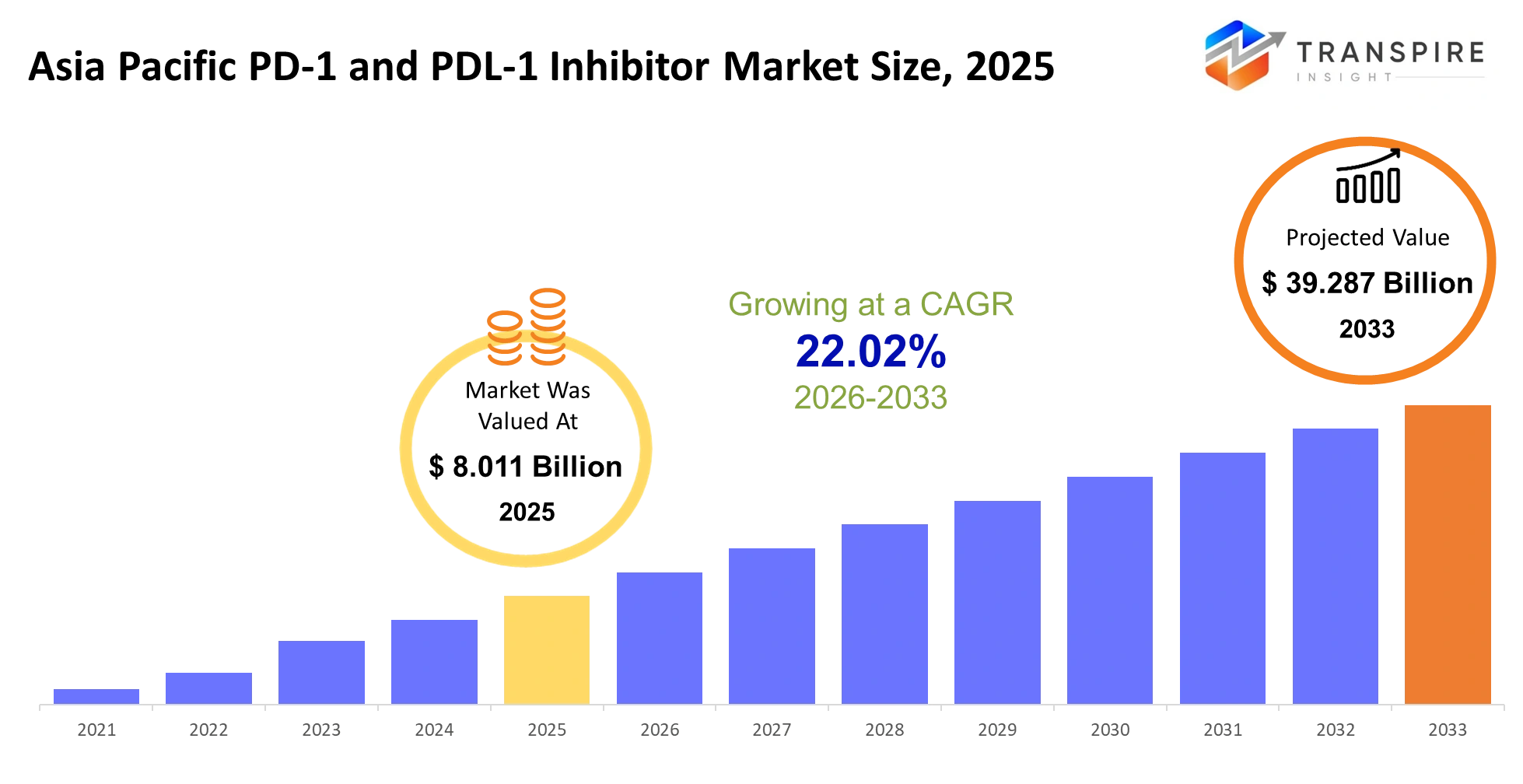
- Asia Pacific PD-1 and PDL-1 Inhibitor Market Size 2025: USD 8.011 Billion
- Asia Pacific PD-1 and PDL-1 Inhibitor Market Size 2033: USD 39.287 Billion
- Asia Pacific PD-1 and PDL-1 Inhibitor Market CAGR: 22.02%
- Asia Pacific PD-1 and PDL-1 Inhibitor Market Segments: By Drug Type (PD-1 Inhibitors, PD-L1 Inhibitors, Combination Therapy, Monotherapy, Biosimilars, Others); By Application (Lung Cancer, Melanoma, Renal Cancer, Head & Neck Cancer, Bladder Cancer, Others); By End-User (Hospitals, Cancer Centers, Clinics, Research Institutes, Specialty Centers, Others); By Distribution (Hospital Pharmacy, Retail Pharmacy, Online Pharmacy, Specialty Pharmacy, Direct Supply, Others).
To learn more about this report,  Download Free Sample Report
Asia Pacific PD-1 and PDL-1 Inhibitor Market Summary:
The Asia Pacific PD-1 and PDL-1 Inhibitor Market size is estimated at USD 8.011 Billion in 2025 and is anticipated to reach USD 39.287 Billion by 2033, growing at a CAGR of 22.02% from 2026 to 2033.
The oncology sector in Asia Pacific is experiencing market changes because cancer treatment requirements are evolving through various healthcare systems. The current market situation is being shaped by three factors which include the rising demand for targeted therapies, the enhanced ability of advanced biomarker testing to deliver exact results, and the changing regulatory methods that Asian healthcare systems are implementing. The upcoming phase will bring about more advanced precision oncology tool integration and increased adoption of combination immunotherapy and greater policy collaboration which will change how medical institutions in Asia Pacific implement new technologies.
What Has the Impact of Artificial Intelligence Been on the Asia Pacific PD-1 and PDL-1 Inhibitor Market?
The use of artificial intelligence has transformed decision-making processes in oncology drug development by improving data analysis methods and creating better connections between clinical results and market needs. AI in Asia Pacific PD-1 and PD-L1 inhibitor market enables stakeholders to assess patient response data and trial outcomes and pricing dynamics more effectively. The artificial intelligence system for Asia Pacific PD-1 and PD-L1 inhibitor market enables hospitals and research networks to identify treatment demand patterns through its advanced analytics capabilities which track minute changes in therapeutic usage. The current transition works to build precision-based commercial methods while making treatment progression throughout the area more transparent.
The Asia Pacific PD-1 and PD-L1 inhibitor market uses predictive analytics together with machine learning models to enhance demand forecasting precision within its overall commercial operations. The implementation of smart automation technology enables supply chain operations to run more efficiently which results in faster delivery times and better product distribution at oncology centers. AI-driven insights make it easier for manufacturers to improve their pricing strategies and resource distribution which leads to the development of new market trends.
Key Market Trends & Insights:
- China leads the Asia Pacific PD-1 and PD-L1 inhibitor market with approximately 38 to 42 percent market share in 2024 because of its robust clinical trial system and its high demand for cancer treatment.
- The Japanese market operates at substantial capacity because it adopted biologic treatments earlier and developed sophisticated systems to reimburse cancer therapies.
- The period between 2024 and 2030 sees India become the most rapidly expanding area because the country develops more cancer diagnostic centers and makes immunotherapy treatments more affordable.
- The PD-1 inhibitor market in Asia Pacific receives major market share from PD-1 inhibitors which achieve approximately 55 percent market share because of their extensive clinical research approvals.
- The second largest market segment for PD-L1 inhibitors operates through increasing usage of these inhibitors which doctors prescribe together with other medications.
- The segment for combination immunotherapy shows the highest growth rate until 2030 because treatment effectiveness continues to improve.
- The Asia Pacific PD-1 and PD-L1 inhibitor market sees its major usage through lung cancer treatments which account for almost 40 percent of all cases because lung cancer shows high disease occurrence.
- The segments for melanoma and bladder cancer develop quickly because clinical research expands throughout Asia.
- Hospitals maintain their position as the main end-user sector which accounts for approximately 60 percent of the total market because they possess superior capabilities for cancer treatment.
- The companies expand their clinical development programs by using combination immunotherapy research to create new treatments which will help patients achieve better results.
Asia Pacific PD-1 and PDL-1 Inhibitor Market Segmentation
By Drug Type:
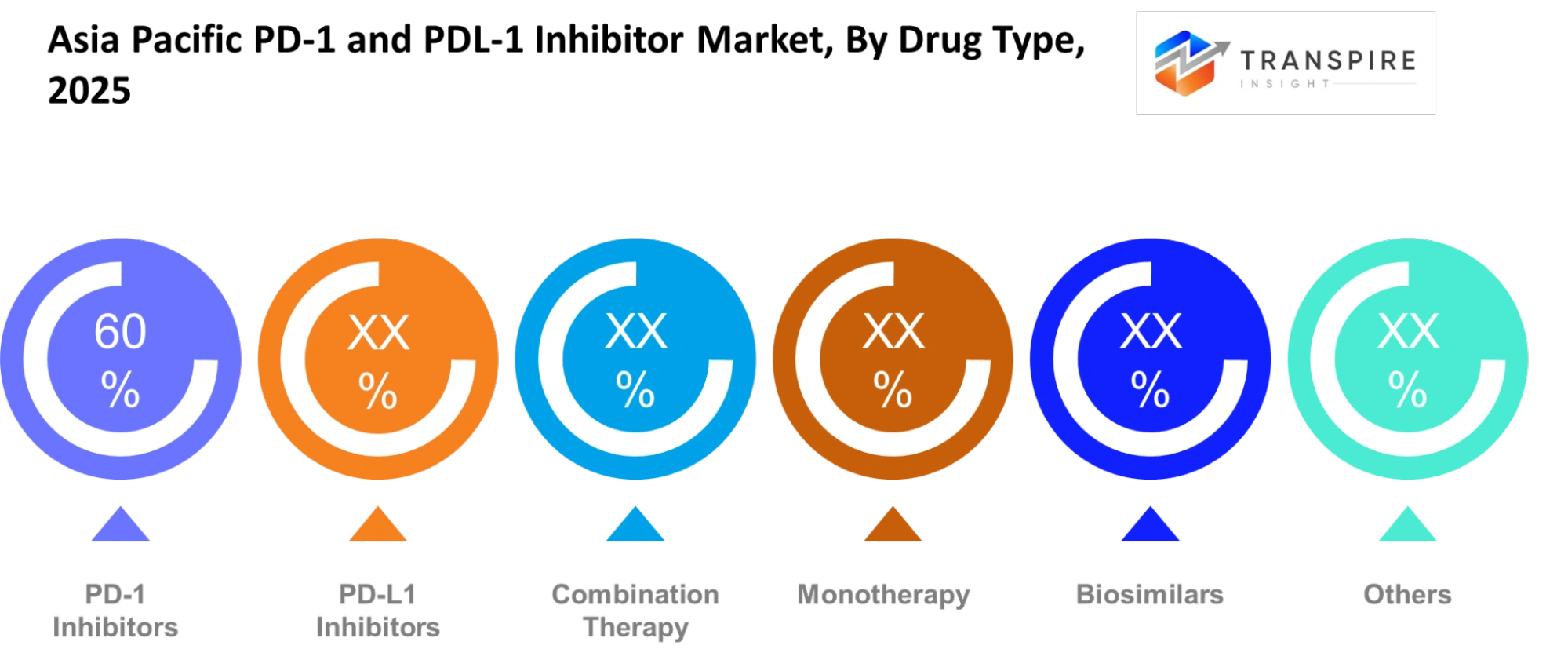
The Asia Pacific PD-1 and PDL-1 Inhibitor Market demonstrates substantial market growth across various drug categories because PD-1 inhibitors maintain the highest market share through their established clinical use in oncology treatment protocols. Hospitals are increasingly adopting PD-L1 inhibitors because they provide advanced cancer patients with more precise immunotherapy treatment choices. The adoption of combination therapy will rise because treatment guidelines now recommend multiple medications which enhance patient outcomes in oncology treatment facilities.
To learn more about this report, Download Free Sample Report
By Application:
The Asia Pacific PD-1 and PDL-1 Inhibitor Market sees lung cancer as its primary segment because the disease occurs frequently and healthcare providers widely use immunotherapy as a treatment method. The field of melanoma research experiences continuous growth because scientists now have better methods to diagnose patients and healthcare professionals understand the advantages of early-stage immunotherapy.
The adoption of advanced biologic treatments by hospitals as standard care pathways leads to expanded applications in Renal cancer and head & neck cancer. Bladder cancer treatment is also witnessing increased use of checkpoint inhibitors, supported by better patient screening and evolving clinical guidelines. Research efforts will expand to study other cancer types which will enable doctors to use immunotherapy in multiple oncology treatment areas.
By End-User:
Hospitals serve as the main end-user segment in the Asia Pacific PD-1 and PDL-1 Inhibitor Market because they have established systems and advanced cancer treatment facilities. The demand for specialized immunotherapy services grows throughout urban areas which leads to rapid growth of cancer centers.
Specialty centers and clinics are becoming more essential because outpatient treatment models have increased, and patients now have better access to targeted cancer treatments. Research institutes continue to support innovation through clinical trials and drug development programs. Other end-user categories will gradually support niche treatment delivery and localized oncology care expansion.
By Distribution:
The active distribution channels currently include hospital pharmacy retail pharmacy online pharmacy specialty pharmacy, direct supply and other distribution channels. The Asia Pacific PD-1 and PDL-1 Inhibitor Market designates hospital pharmacy as its primary distribution method because hospitals need to control drug distribution and monitor cancer therapies. The specialty pharmacy channels experience growth because complex biologics require both dedicated handling procedures and extensive patient support systems.
The current retail and online pharmacy channels experience a restricted market presence which will start to expand as regulatory frameworks develop and regional access enhancements occur. The direct supply model establishes a growing connection between manufacturers and healthcare institutions which helps both parties to operate more efficiently while minimizing operational delays. The different distribution methods will maintain their role in enabling flexible delivery systems which will adapt to the changing needs of healthcare networks.
What are the Main Challenges for the Asia Pacific PD-1 and PDL-1 Inhibitor Market Growth?
The Asia Pacific PD-1 and PD-L1 inhibitor market suffers from technical and operational difficulties which create ongoing problems because biologic stability and cold-chain requirements and precise dosing methods need to be maintained by medical professionals. Patient response rates show variability which creates challenges for doctors because they need to plan treatments while maintaining effective outcomes across different patient groups.
The Asia Pacific PD-1 and PD-L1 inhibitor market encounters major growth barriers because manufacturing and commercialization obstacles exist which arise from expensive production processes and strict regulatory compliance standards that medical facilities must follow. The development of complex biologic products requires extended time periods which result in product delays for multiple global markets. The Asia Pacific PD-1 and PD-L1 inhibitor market faces pricing difficulties because healthcare systems in the region restrict reimbursement access which delays product market entry in various Asia Pacific nations.
The asia pacific pd-1 and pdl-1 inhibitor market faces obstacles through both adoption challenges and infrastructure restrictions which particularly affect developing countries that lack proper oncology facilities and diagnostic services.
The asia pacific pd-1 and pdl-1 inhibitor market experiences two main influences which originate from competitive market dynamics and developing market hazards because cancer treatment alternatives and biosimilar products increase price competition. The constant changes to regulatory requirements together with the development of new approval systems create planning difficulties for organizations that operate in the industry.
Regional Insights
The PD-1 and PDL-1 Inhibitor Market in Asia Pacific displays substantial differences between nations, which results in China emerging as the top market due to its extensive patient population and rapid clinical trial progress and broad distribution of immunotherapy treatments. The Japanese healthcare system maintains steady treatment adoption because of its reliable reimbursement policies and its quick implementation of new cancer therapies into medical practice. South Korea maintains its research output through its expanding cancer research programs and enhanced medical facility capacity.
India is expanding its presence in the Asia Pacific PD-1 and PDL-1 Inhibitor Market because cancer knowledge is growing and diagnostic testing has become more accessible in urban medical facilities. The process of widespread implementation continues to face challenges because people from rural areas find it difficult to obtain treatment. Australia operates a developed healthcare system which provides continuous immunotherapy treatment because it has effective regulatory systems and high-quality cancer treatment procedures.
The Asia Pacific PD-1 and PDL-1 Inhibitor Market in Southeast Asian nations witnesses increasing demand because of two factors which include rising cancer cases and ongoing improvements in healthcare facilities. The current system limits patient access because it offers insufficient coverage for medical expenses and only allows certain patients to receive treatment. The market will continue to be influenced by regional variations because developed countries will drive technology adoption while developing countries will build their operational capacity through market expansion.
Recent Development News
In April 2026, Merck & Co., Inc. (MSD) announced a strategic partnership with LaNova Medicines. The deal focuses on co-developing a next-generation PD-1/VEGF bispecific antibody candidate, strengthening MSD’s oncology pipeline and expanding its presence in the Asia-Pacific immunotherapy market.
Source: https://pharmaphorum.com
In February 2026, Eisai Co., Ltd. entered into an exclusive commercialization and co-development licensing agreement with Shanghai Henlius Biotech, Inc. for the anti-PD-1 antibody serplulimab in Japan. The agreement aims to expand access to PD-1 immunotherapy in Asia and accelerate regulatory and commercial rollout in the Japanese market.
Source: https://www.eisai.com
|
Report Metrics |
Details |
|
Market size value in 2025 |
USD 8.011 Billion |
|
Market size value in 2026 |
USD 9.757 Billion |
|
Revenue forecast in 2033 |
USD 39.287 Billion |
|
Growth rate |
CAGR of 22.02% from 2026 to 2033 |
|
Base year |
2025 |
|
Historical data |
2021 - 2024 |
|
Forecast period |
2026 - 2033 |
|
Report coverage |
Revenue forecast, competitive landscape, growth factors, and trends |
|
Regional scope |
Asia Pacific ( China, India, Japan, South Korea, Australia, Rest of Asia Pacific) |
|
Key company profiled |
Bristol Myers Squibb, Merck, Roche, AstraZeneca, Pfizer, Novartis, Eli Lilly, Amgen, Sanofi, GSK, BeiGene, Innovent Biologics, Hengrui Medicine, Junshi Biosciences, Regeneron. |
|
Customization scope |
Free report customization (country, regional & segment scope). Avail customized purchase options to meet your exact research needs. |
|
Report Segmentation |
By Drug Type (PD-1 Inhibitors, PD-L1 Inhibitors, Combination Therapy, Monotherapy, Biosimilars, Others); By Application (Lung Cancer, Melanoma, Renal Cancer, Head & Neck Cancer, Bladder Cancer, Others); By End-User (Hospitals, Cancer Centers, Clinics, Research Institutes, Specialty Centers, Others); By Distribution (Hospital Pharmacy, Retail Pharmacy, Online Pharmacy, Specialty Pharmacy, Direct Supply, Others). |
How Can New Companies Establish a Strong Foothold in the Asia Pacific PD-1 and PDL-1 Inhibitor Market?
The new companies that enter the Asia Pacific PD-1 and PDL-1 inhibitor market must establish their market presence through specific competitional methods instead of attempting to create general market presence. The success of this project requires the identification of oncology needs which remain unfulfilled across Asia Pacific healthcare systems that include rare cancer types and combination immunotherapy treatment gaps. The Asia Pacific PD-1 and PDL-1 inhibitor market will provide advantages to companies that utilize actual patient information together with biomarker research to create better treatment connections and better patient results in countries which deal with high cancer rates.
The Asia Pacific PD-1 and PDL-1 inhibitor market will see organizations strengthen their market position through strategic partnerships which include hospital alliances and research institute partnerships and regional biotech collaborations. The biopharmaceutical company Akeso Biopharma and the biopharmaceutical company Innovent Biologics both prove that localized innovation together with swift clinical trial processes enables organizations to obtain faster approval. The Asia Pacific PD-1 and PDL-1 inhibitor market will advance toward businesses that use artificial intelligence for drug discovery together with flexible clinical trial methods which enhance development speed and increase probability of success.
The Asia Pacific PD-1 and PDL-1 inhibitor market will continue to use technology differentiation as its main competitive edge because companies will begin using new biologics engineering methods together with automated manufacturing technologies. New market entrants must develop production methods that can be expanded across different Asia Pacific regions while working to create efficient supply chain operations. The Asia Pacific PD-1 and PDL-1 inhibitor market will favor organizations that create new products while ensuring they comply with regulations and develop marketing strategies for each regional market.
Key Asia Pacific PD-1 and PDL-1 Inhibitor Market Company Insights
The Asia Pacific PD-1 and PDL-1 Inhibitor Market displays intense competition because global pharmaceutical companies and regional biotech firms compete in this space. The major companies develop their oncology product lines through two strategies: building clinical research capacity and achieving better outcomes with combination therapies. The growing need for advanced immunotherapy treatments is driving businesses to allocate funds to research projects and expedite regulatory approval processes across Asia Pacific medical facilities.
Innovent Biologics and Akeso Biopharma have emerged as strong regional competitors in the Asia Pacific PD-1 and PDL-1 Inhibitor Market through successful clinical trial development and execution of local research projects. The market remains controlled by Merck & Co., Roche and Bristol Myers Squibb, which offer established PD-1 and PD-L1 treatments. The companies operate in the market through ongoing research and development activities, which lead to new products that expand their treatment options for various cancer types.
The Asia Pacific PD-1 and PDL-1 Inhibitor Market will experience higher competition because of two factors, which are increased pricing pressure and the introduction of biosimilars. Companies will focus on partnerships with hospitals and research institutions to improve treatment access and strengthen distribution networks. The ability of organizations to succeed in the market depends on their capacity to innovate quickly and work together with various regions while they provide solutions for cancer treatments which remain unsolved.
Company List
- Bristol Myers Squibb
- Merck
- Roche
- AstraZeneca
- Pfizer
- Novartis
- Eli Lilly
- Amgen
- Sanofi
- GSK
- BeiGene
- Innovent Biologics
- Hengrui Medicine
- Junshi Biosciences
- Regeneron
What are the Key Use-Cases Driving the Growth of the Asia Pacific PD-1 and PDL-1 Inhibitor Market?
The Asia Pacific PD-1 and pdl-1 inhibitor market experiences growth because hospitals across the region use this treatment method for advanced cancer cases which include non-small cell lung cancer and melanoma. The medical field sees increased usage of immunotherapy as a primary treatment and as part of combination therapies which leads to better survival rates and broadens treatment options at hospitals. The Asia Pacific PD-1 and pdl-1 inhibitor market will continue to grow because precision oncology programs require biomarker testing and genetic profiling which supports their usage.
The Asia Pacific PD-1 and pdl-1 inhibitor market experiences growth because hospitals now implement immune checkpoint inhibitors as standard treatments in their oncology departments. Cancer centers are increasingly using these therapies for renal, bladder, and head and neck cancers, which show better response rates than standard chemotherapy. The Asia Pacific PD-1 and pdl-1 inhibitor market develops through clinical trial expansion programs which investigate combination therapies for difficult-to-treat cancer types.
Research and pharmaceutical development is another strong use-case supporting the Asia Pacific PD-1 and pdl-1 inhibitor market, where biotech firms are using these inhibitors in next-generation drug discovery pipelines. Academic institutes and biotech companies are exploring new immunotherapy combinations to improve treatment durability and reduce resistance. The Asia Pacific PD-1 and pdl-1 inhibitor market will also see wider adoption as real-world evidence studies support broader indications and improved patient stratification models.
Asia Pacific PD-1 and PDL-1 Inhibitor Market Report Segmentation
By Drug Type
- PD-1 Inhibitors
- PD-L1 Inhibitors
- Combination Therapy
- Monotherapy
- Biosimilars
- Others
By Application
- Lung Cancer
- Melanoma
- Renal Cancer
- Head & Neck Cancer
- Bladder Cancer
- Others
By End-User
- Hospitals
- Cancer Centers
- Clinics
- Research Institutes
- Specialty Centers
- Others
By Distribution
- Hospital Pharmacy
- Retail Pharmacy
- Online Pharmacy
- Specialty Pharmacy
- Direct Supply
- Others
Frequently Asked Questions
Find quick answers to common questions.
The approximate Asia Pacific PD-1 and PDL-1 Inhibitor Market size for the market will be USD 39.287 Billion in 2033.
Key segments for the Asia Pacific PD-1 and PDL-1 Inhibitor Market are By Drug Type (PD-1 Inhibitors, PD-L1 Inhibitors, Combination Therapy, Monotherapy, Biosimilars, Others); By Application (Lung Cancer, Melanoma, Renal Cancer, Head & Neck Cancer, Bladder Cancer, Others); By End-User (Hospitals, Cancer Centers, Clinics, Research Institutes, Specialty Centers, Others); By Distribution (Hospital Pharmacy, Retail Pharmacy, Online Pharmacy, Specialty Pharmacy, Direct Supply, Others).
Major Asia Pacific PD-1 and PDL-1 Inhibitor Market players are Bristol Myers Squibb, Merck, Roche, AstraZeneca, Pfizer, Novartis, Eli Lilly, Amgen, Sanofi, GSK, BeiGene, Innovent Biologics, Hengrui Medicine, Junshi Biosciences, Regeneron.
The Asia Pacific PD-1 and PDL-1 Inhibitor Market size is USD 8.011 Billion in 2025.
The Asia Pacific PD-1 and PDL-1 Inhibitor Market CAGR is 22.02%.
- Bristol Myers Squibb
- Merck
- Roche
- AstraZeneca
- Pfizer
- Novartis
- Eli Lilly
- Amgen
- Sanofi
- GSK
- BeiGene
- Innovent Biologics
- Hengrui Medicine
- Junshi Biosciences
- Regeneron
Recently Published Reports
-
Dec 2025
Biosimilars Market
Biosimilars Market By Product Type (Monoclonal Antibodies, Recombinant Hormones, Erythropoietin, G-CSF, Others), By Indication (Oncology, Autoimmune Diseases, Blood Disorders, Diabetes, Others), By Manufacturing Type (In-House Manufacturing, Contract Manufacturing), By Distribution Channel (Hospital Pharmacies, Retail Pharmacies, Online Pharmacies), By Industry Analysis, Size, Share, Growth, Trends, and Forecasts 2021-2033
-
Dec 2025
Gastrointestinal Endoscopy Market
Gastrointestinal Endoscopy Market By Type (Rigid Gastrointestinal Endoscope, Flexible Gastrointestinal Endoscopes, Disposable Gastrointestinal Endoscope), By Procedure Type (Colonoscopy, Gastroscopy, Duodenoscopy, Enteroscopy, Flexible Sigmoidoscopy, Others), By Application (Diagnosis, Treatment), By End-Users (Hospitals, Ambulatory Surgical Centers, Specialty Clinics, Laboratories, Others), By Industry Analysis, Size, Share, Growth, Trends, and Forecasts 2021-2033
-
Jan 2026
Rare Inherited Metabolic Disorder Drug Market
Rare Inherited Metabolic Disorder Drug Market By Drug Class (Enzyme Replacement Drugs, Gene Therapy Drugs, Substrate Reduction Drugs, Small Module Drugs, Protein Drugs), By Route of Administration(Parenteral, Oral, Intrathecal), By Clinical Development (Marketed Drugs, Late Stage Clinical Phase III, Early Stage Clinical Phase I-II, Preclinical Candidates), By Indication (Lysosomal Storage Disorders, Urea Cycle Disorders, Amino Acid Metabolic Disorders, organic Acidemias, Peroximal Disorders), By Industry Analysis, Size, Share, Growth, Trends, and Forecasts 2021-2033
-
Jan 2026
Pharmaceutical Cleanroom Technology Market
Pharmaceutical Cleanroom Technology Market By Product (Equipment, Consumables, Services); By Cleanroom Type (Standard Cleanrooms, Modular Cleanrooms); By End Use (Pharmaceutical Companies, Biotechnology Companies), By Industry Analysis, Size, Share, Growth, Trends, and Forecasts 2021-2033