

Asia Pacific Non-destructive Testing For Nuclear Market Size & Forecast:
- Asia Pacific Non-destructive Testing For Nuclear Market Size 2025: USD 4.09 Billion
- Asia Pacific Non-destructive Testing For Nuclear Market Size 2033: USD 8.82 Billion
- Asia Pacific Non-destructive Testing For Nuclear Market CAGR: 10.06%
- Asia Pacific Non-destructive Testing For Nuclear Market Segments: By Testing Method (Ultrasonic Testing, Radiographic Testing, Eddy Current Testing, Magnetic Particle Testing, Visual Inspection, Acoustic Emission Testing, Infrared Thermography, Others); By Component (Reactors, Steam Generators, Piping Systems, Pressure Vessels, Turbines, Containment Structures, Fuel Assemblies, Others); By Application (Inspection, Maintenance, Quality Assurance, Life Extension Programs, Safety Monitoring, Regulatory Compliance, Asset Integrity, Others); By End User (Nuclear Power Plants, Research Reactors, Regulatory Bodies, Service Providers, Equipment Manufacturers, Government Agencies, Defense Facilities, Others) Xxxxxx
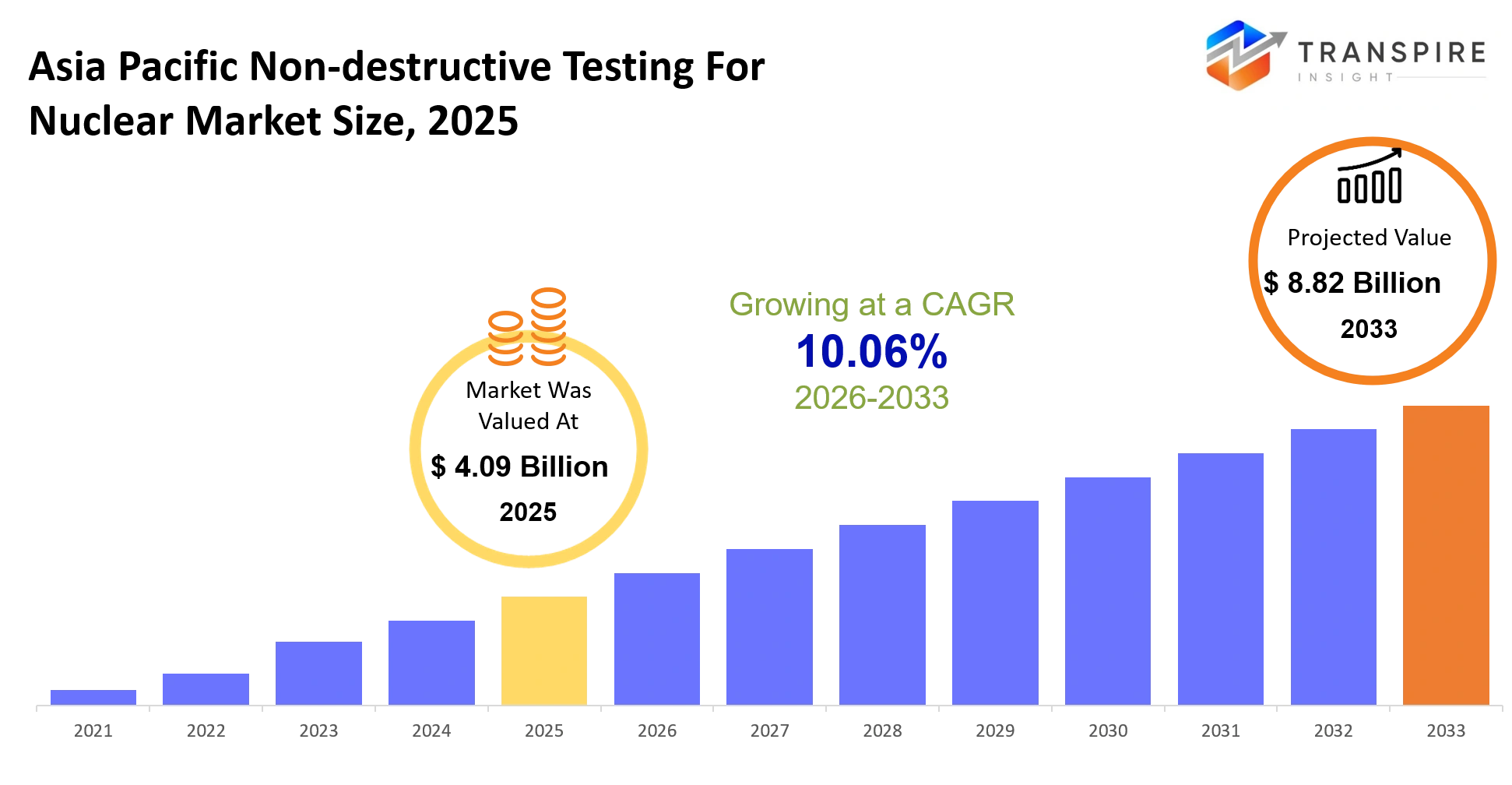
Asia Pacific Non-destructive Testing For Nuclear Market Summary
The Asia Pacific Non-destructive Testing For Nuclear Market was valued at USD 4.09 billion in 2025. It is forecast to reach USD 8.82 billion by 2033. That is a CAGR of 10.06% over the period.
When we talk about facilities we need to make sure they are safe and working properly. This is where non-destructive testing comes in. It checks the reactor vessels, welds, piping systems and containment assets to ensure they are strong and safe. This testing is very important because it does not interrupt the operations of the facility and it does not compromise safety.In the few years the way people do non-destructive testing has changed. They used to do it with ultrasonic and radiographic inspection methods. Now they use automated, digital and robotics-assisted evaluation methods. These new methods use analytics to get better results. This change happened because of safety rules and the use of new technologies like phased array ultrasonic testing and digital radiography systems.
The market for -destructive testing started to grow faster because of concerns about energy security. There were some changes in the world that made people want to build more nuclear facilities and make the existing ones last longer. This is especially true in the Asia Pacific region. Now the people who run these facilities are investing in inspection technologies and maintenance models. This means that the companies that provide these solutions will have a stream of income for a long time. Nuclear facilities and non-destructive testing are very important for our energy security and safety.
Key Market Insights
- The Asia Pacific Non-destructive Testing For Nuclear Market is led by testing methods. They make up 38 to 42 percent of the market in 2025. This is because they are very precise in inspecting reactors.
- Radiographic testing is the biggest segment. It is often used to check welds and make sure the structure of assets is okay.
- Automated phased array ultrasonic testing is growing fast. It will keep growing from 2026 to 2032. This is because of changes in how inspections are done.
- Most of the Asia Pacific Nondestructive Testing For Nuclear Market is made up of service-based inspection models. They have more than 55 percent of the market. This is because maintenance is needed all the time.
- Equipment-based solutions are becoming more popular. This is because of investments in imaging and sensor technologies.
- Inspecting reactor pressure vessels is the application. It makes up over 30 percent of the market. This is because it is very important for safety.
- Inspecting decommissioning is growing really fast. This is because many reactors in the area are getting old.
- Nuclear power plants use -destructive testing the most. They make up 60 percent of the market in 2025.
- Companies that provide nuclear maintenance services are becoming more popular. This is because many companies are choosing to outsource their inspection work.
- Some big companies in the Asia Pacific Nondestructive Testing For Nuclear Market are Baker Hughes, SGS, Bureau Veritas, Intertek, TÜV Rheinland and MISTRAS Group.
What are the Key Drivers, Restraints, and Opportunities in the Asia Pacific Non-destructive Testing For Nuclear Market?
Drivers
The main driver of the Asia Pacific Nondestructive Testing For Nuclear Market is that people want to make nuclear reactors last longer. They have to follow strict safety rules. This is happening because a lot of the reactors in the Asia Pacific area are getting old. Countries are trying to get the most out of their reactors instead of building new ones. So they are spending money on advanced systems to check the reactors. These systems include phased array testing, digital radiography and robotic crawlers. This means that companies will make money from checking the reactors and selling new equipment.
Restraints
The biggest problem is that it is very hard to get permission to sell equipment that can be used in reactors. The rules are very strict. It takes a long time to get approval. This makes it difficult for companies to sell their products and make money. Even though people really need this equipment, companies have to wait a long time to get paid.
Opportunity
There is a chance for companies to make money by helping to develop small modular reactors in the Asia Pacific area. These reactors need equipment that can check for problems automatically. Companies that invest in intelligence and remote robotic inspection tools will be able to get long-term contracts. This is because small modular reactors are going to become more popular in the future. The Asia Pacific Non-destructive Testing For Nuclear Market is going to grow because of this.
What Has the Impact of Artificial Intelligence Been on the Asia Pacific Non-destructive Testing For Nuclear Market?
The Asia Pacific Non-destructive Testing For Nuclear Market is changing a lot because of intelligence and advanced digital technologies. These technologies are changing the way we do inspections. We used to do inspections but now we use automated systems that make decisions based on data.In the places where people work with things artificial intelligence is used with imaging tools to look at the results of ultrasonic and radiographic inspections. These tools can automatically find cracks, problems with welds and issues with materials. They can do this consistently than people can. This helps us finish inspections faster and make decisions when we are doing maintenance on reactors.
The Asia Pacific Non-destructive Testing For Nuclear Market is also using machine learning models to predict when maintenance will be needed. We use information from inspections to figure out when parts of the reactor might get tired and need to be replaced. This helps us schedule maintenance before something goes wrong which reduces the time the reactor is not working and helps the parts last longer.In some places digital inspection platforms have shown that they can reduce the time it takes to do inspections and make it easier to keep track of paperwork. This helps us follow the rules for safety.
There are some problems. We do not have good information to train our artificial intelligence systems, especially for rare problems. This means the systems might not work well as we want them to. It is also expensive to integrate these systems with the old inspection equipment, which makes it hard to use them in all the old nuclear facilities. The Asia Pacific Non-destructive Testing For Nuclear Market is still working on these issues.
Key Market Trends
- The use of array ultrasonic testing became really popular after 2023 because companies wanted to be more precise when they checked the safety of reactors. They stopped using the manual way of doing things.
- Digital radiography systems got a lot bigger from 2024 to 2025. This helped because it made inspections faster and easier to see problems in welds.
- Around 2024 robots started being used often to inspect places that were not safe for people. This happened in nuclear facilities where the radiation was high.
- Tools that used intelligence to find defects worked better because they made fewer mistakes than people did. This was helpful when looking at pictures of reactor parts.
- After 2023 people started doing maintenance in a way. They stopped waiting for things to break. Instead checked the condition of equipment to see when it needed to be fixed.
- Companies that did inspections started to offer their services on a basis instead of just selling equipment. This meant that they would take care of the equipment for a time.
- Some old reactors in the Asia Pacific area were shut down after 2025. This meant that inspections had to be done to make sure everything was safe.
- The government made rules after 2023 that said companies had to keep track of everything they did during inspections. This meant that companies had to use systems to keep records.
- Companies, like Baker Hughes, SGS and Bureau Veritas started to offer digital services to help with inspections. They used intelligence and automated technology to make things better.
- Technology that allowed for inspections became more popular because it was hard to get to some places during shutdowns. This helped companies work efficiently and safely.
Asia Pacific Non-destructive Testing For Nuclear Market Segmentation
By Testing Method:
Ultrasonic Testing is widely used in nuclear inspection activities in Asia Pacific because it gives accurate results in evaluating welds and reactor components.This method is preferred due to its accuracy.Radiographic Testing helps visualize defects in metal structures used in pressure systems and containment units.Eddy Current Testing is used to detect conductivity-based defects in steam generator tubing and piping networks.Magnetic Particle Testing is still used to identify surface cracks in materials in reactor support structures.During shutdown assessments Visual Inspection is important because it allows for observation, which supports compliance validation.Acoustic Emission Testing allows for real-time monitoring of crack growth during stress conditions.Infrared Thermography helps detect anomalies in electrical and mechanical systems.There is a shift toward automated inspection systems, which increases demand for high-resolution sensors and integrated analysis platforms.This shift improves safety assurance. Reduces inspection cycle time across nuclear facilities by transitioning from manual inspection to data-driven evaluation.
By Component:
The Reactors segment drives demand because verifying integrity is critical during operation and life extension programs.
Reactors need to be inspectedSteam Generators require inspection due to thermal stress accumulation and tube degradation patterns.Steam Generators are inspected often.Piping Systems are inspected frequently due to corrosion and pressure variation impacts across coolant circulation networks.Piping Systems are critical.Pressure Vessels require imaging solutions for fatigue and crack detection under high-load conditions.Pressure Vessels need inspection.Turbines require monitoring for vibration-induced wear in rotating assemblies.Turbines need to be monitored.Containment Structures require regulatory inspection cycles to ensure radiation safety and structural reliability.Containment Structures are inspected strictly.Fuel Assemblies require precision testing to monitor material degradation and radiation exposure effects.
Fuel Assemblies need precision testing.There is a shift toward maintenance, which increases the adoption of digital inspection tools across all nuclear components.Digital inspection tools are used more.The integration of robotics improves inspection efficiency in high-radiation zones. Reduces operational downtime during maintenance shutdowns.
By Application:
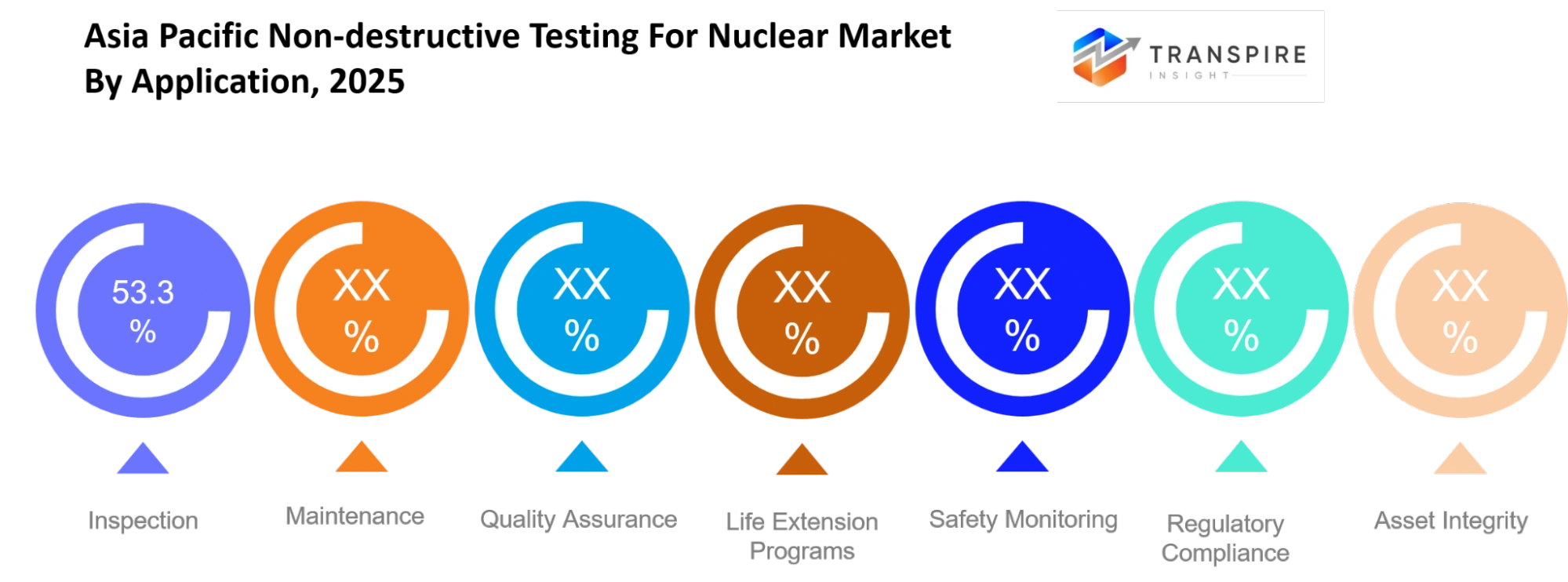
Inspection activities dominate due to compliance checks across nuclear installations and safety-critical infrastructure.
Inspection is crucial.Maintenance applications expand with a shift toward condition-based monitoring strategies replacing fixed schedule servicing.Maintenance is important.Quality Assurance processes strengthen through the adoption of documentation and traceable inspection records.Quality Assurance is key.Life Extension Programs gain importance as aging reactors undergo operational approvals supported by advanced testing methods.Life Extension Programs are important.
Safety Monitoring systems integrate evaluation technologies for early fault detection.Safety Monitoring is critical.Regulatory Compliance drives the adoption of inspection protocols aligned with nuclear authority requirements.Regulatory Compliance is necessary.Asset Integrity management improves through analytics and structural health monitoring systems.Asset Integrity is important.Increased automation reduces inspection errors and improves decision-making speed across operational workflows.
By End User:
Nuclear Power Plants represent a primary demand source due to inspection requirements for operational safety and efficiency.Nuclear Power Plants need inspections.Research Reactors contribute demand through experimental validation and material testing requirements.Research Reactors are used.Regulatory Bodies enforce inspection standards influencing the adoption of advanced testing technologies.Regulatory Bodies set standards.Service Providers expand offerings through inspection contracts and digital monitoring services.Service Providers offer services.Equipment Manufacturers invest in sensor and imaging technologies for improved detection accuracy.Equipment Manufacturers invest in technology.Government Agencies support nuclear infrastructure safety programs and modernization initiatives.
Government Agencies provide support.Defense Facilities require inspection systems for controlled nuclear applications.Defense Facilities have needs.There is a shift toward inspection ecosystems, which strengthens collaboration, between operators and technology providers improving reliability and compliance outcomes across nuclear infrastructure.Digital inspection ecosystems are used.
What are the Key Use Cases Driving the Asia Pacific Non-destructive Testing For Nuclear Market?
Core adoption in the Asia Pacific Non-destructive Testing For Nuclear Market is driven by reactor inspection and structural integrity verification in operating nuclear power plants. Pressure vessels, reactor cores, and containment structures require continuous evaluation to ensure safety under high radiation and thermal stress. This use case generates the highest demand because regulatory authorities mandate frequent inspection cycles and zero-error tolerance for critical nuclear components.
Expanding applications include steam generator tube inspection and piping system monitoring within nuclear power plants and service provider operations. These areas are gaining traction as aging infrastructure faces higher corrosion risks and utilities shift toward condition-based maintenance. Maintenance contractors and inspection service firms are increasingly deployed to support outage periods and compliance-driven checks.
Emerging use cases include life-extension validation programs for aging reactors and inspection support for small modular reactor deployments. Government agencies and regulatory bodies are also beginning to adopt digital NDT systems for real-time compliance tracking. These applications are expected to grow as nuclear expansion and modernization programs accelerate across the region.
|
Report Metrics |
Details |
|
Market size value in 2025 |
USD 4.09 Billion |
|
Market size value in 2026 |
USD 4.51 Billion |
|
Revenue forecast in 2033 |
USD 8.82 Billion |
|
Growth rate |
CAGR of 10.06% from 2026 to 2033 |
|
Base year |
2025 |
|
Historical data |
2021 - 2024 |
|
Forecast period |
2026 - 2033 |
|
Report coverage |
Revenue forecast, competitive landscape, growth factors, and trends |
|
Regional scope |
Asia Pacific |
|
Key company profiled |
Baker Hughes, MISTRAS Group, SGS, Intertek, Bureau Veritas, Applus+, TÜV Rheinland, Zetec, Eddyfi Technologies, Olympus, Waygate Technologies, Sonatest, Magnaflux, Fujifilm NDT, Acuren |
|
Customization scope |
Free report customization (country, regional & segment scope). Avail customized purchase options to meet your exact research needs. |
|
Report Segmentation |
By Testing Method (Ultrasonic Testing, Radiographic Testing, Eddy Current Testing, Magnetic Particle Testing, Visual Inspection, Acoustic Emission Testing, Infrared Thermography, Others); By Component (Reactors, Steam Generators, Piping Systems, Pressure Vessels, Turbines, Containment Structures, Fuel Assemblies, Others); By Application (Inspection, Maintenance, Quality Assurance, Life Extension Programs, Safety Monitoring, Regulatory Compliance, Asset Integrity, Others); By End User (Nuclear Power Plants, Research Reactors, Regulatory Bodies, Service Providers, Equipment Manufacturers, Government Agencies, Defense Facilities, Others) |
Which Regions are Driving the Asia Pacific Non-destructive Testing For Nuclear Market Growth?
East Asia leads the Asia Pacific Non-destructive Testing For Nuclear Market due to its dense nuclear reactor base and strict safety enforcement frameworks. Strong government oversight in nuclear operations drives frequent inspection cycles and adoption of advanced ultrasonic and radiographic testing systems. Mature industrial ecosystems in Japan, South Korea, and China support continuous investment in high-precision inspection equipment. Established vendor networks and experienced service providers ensure fast deployment of maintenance and compliance testing solutions. This structured regulatory environment and high installed reactor base sustain consistent demand across lifecycle inspection activities.
South Asia remains a stable contributor, supported by gradual expansion of nuclear capacity and steady investment in operational safety programs. Unlike East Asia’s mature ecosystem, this region relies more on phased development of infrastructure and controlled reactor commissioning schedules. Utilities focus on maintaining operational reliability of existing reactors rather than rapid expansion. Regulatory frameworks are strengthening but still evolve at a measured pace, which creates predictable demand for inspection services. This stability supports consistent procurement of non-destructive testing systems without sharp demand fluctuations.
Southeast Asia shows the fastest growth momentum due to new nuclear planning initiatives and accelerated energy diversification strategies. Recent investments in power infrastructure planning and early-stage regulatory development have opened pathways for future reactor construction programs. Countries in this region are building foundational safety inspection frameworks aligned with international standards. This shift is attracting technology providers offering automated and digital NDT solutions for upcoming projects. Over 2026–2033, this region will present strong entry opportunities for vendors that align early with infrastructure development cycles and regulatory onboarding.
Who are the Key Players in the Asia Pacific Non-destructive Testing For Nuclear Market and How Do They Compete?
The Asia Pacific Non-destructive Testing For Nuclear Market shows a moderately consolidated competitive structure where a few global inspection and certification players dominate high-value nuclear contracts, while regional service providers compete in maintenance and subcontracting work. Competition is primarily driven by technological capability, regulatory certifications, and the ability to deliver high-accuracy inspection under nuclear-grade safety standards. Incumbents maintain advantage through long-term utility relationships and approved vendor status, while new entrants face barriers linked to certification timelines and compliance requirements.
Baker Hughes strengthens its position through advanced digital inspection systems and robotics-enabled NDT solutions that improve precision in reactor environments. Its Waygate Technologies division differentiates through high-resolution imaging systems and automated defect detection tools, supporting adoption in life-extension nuclear programs. SGS focuses on end-to-end inspection services with strong compliance auditing capabilities, enabling utility clients to meet stringent regulatory reporting requirements across inspection cycles.
Bureau Veritas and TÜV Rheinland compete strongly in certification-led inspection services, leveraging deep regulatory expertise and established safety approval networks to secure recurring contracts. Bureau Veritas expands through partnerships with nuclear operators for lifecycle integrity programs, while TÜV Rheinland strengthens its presence through standardization services and cross-border inspection approvals. MISTRAS Group differentiates with acoustic emission monitoring and structural health monitoring technologies, expanding through service-based contracts tied to predictive maintenance programs in aging reactor infrastructure.
Company List
- Baker Hughes
- MISTRAS Group
- SGS
- Intertek
- Bureau Veritas
- Applus+
- TÜV Rheinland
- Zetec
- Eddyfi Technologies
- Olympus (Evident Scientific – NDT)
- Waygate Technologies
- Sonatest
- Magnaflux
- Fujifilm NDT
- Acuren
Recent Development News
In February 2026, Baker Hughes expanded its advanced inspection portfolio through continued integration of digital NDT and asset integrity technologies via its Waygate Technologies division, strengthening automated ultrasonic and radiographic inspection solutions for energy and nuclear infrastructure.https://www.bakerhughes.com
In 2025, Bureau Veritas announced expansion of its digital inspection and predictive maintenance capabilities through partnerships focused on AI-driven asset integrity and industrial inspection services across critical infrastructure sectors including nuclear-related facilities.
https://group.bureauveritas.com
In 2025, SGS continued scaling its industrial inspection and certification services with increased focus on advanced non-destructive testing technologies supporting energy, infrastructure, and high-risk industrial assets requiring regulatory compliance and lifecycle monitoring.https://www.sgs.com
What Strategic Insights Define the Future of the Asia Pacific Non-destructive Testing For Nuclear Market?
Over the 5 to 7 years the Asia Pacific Non-destructive Testing For Nuclear Market is going to change in a big way. It will become fully digital. Use remote controls to check things. This is because the people in charge of power plants want to keep the old reactors running for a longer time instead of building new ones. They want to make sure everything is safe. They are using new systems to predict when things might go wrong. This way they can stop problems before they happen. Keep the reactors running for a longer time.There is also a problem that's not so easy to see. A few big companies are making all the equipment for checking power plants. This means that it might be harder to get a price for these things and it could slow down new ideas, in countries that are just starting to use nuclear power.
One good thing that could happen is that small modular reactors are being built. These reactors will have inspection systems built into them from the start. This means that the companies that make these systems will have an advantage for a long time. To take advantage of this, companies should start using robots that can check things and are connected to computers. They should also work with the people who are building these reactors. This will help them get term contracts to check the reactors and be a part of the new nuclear power programs.
Asia Pacific Non-destructive Testing For Nuclear Market Report Segmentation
-
By Testing Method
- Ultrasonic Testing
- Radiographic Testing
- Eddy Current Testing
- Magnetic Particle Testing
- Visual Inspection
- Acoustic Emission Testing
- Infrared Thermography
- Others
-
By Component
- Reactors
- Steam Generators
- Piping Systems
- Pressure Vessels
- Turbines
- Containment Structures
- Fuel Assemblies
- Others
-
By Application
- Inspection
- Maintenance
- Quality Assurance
- Life Extension Programs
- Safety Monitoring
- Regulatory Compliance
- Asset Integrity
- Others
-
By End User
- Nuclear Power Plants
- Research Reactors
- Regulatory Bodies
- Service Providers
- Equipment Manufacturers
- Government Agencies
- Defense Facilities
- Others
Frequently Asked Questions
Find quick answers to common questions.
The expected Asia Pacific Non-destructive Testing For Nuclear Market size for the market will be USD 8.82 Billion in 2033.
Key segments for the Asia Pacific Non-destructive Testing For Nuclear Market are By Testing Method (Ultrasonic Testing, Radiographic Testing, Eddy Current Testing, Magnetic Particle Testing, Visual Inspection, Acoustic Emission Testing, Infrared Thermography, Others); By Component (Reactors, Steam Generators, Piping Systems, Pressure Vessels, Turbines, Containment Structures, Fuel Assemblies, Others); By Application (Inspection, Maintenance, Quality Assurance, Life Extension Programs, Safety Monitoring, Regulatory Compliance, Asset Integrity, Others); By End User (Nuclear Power Plants, Research Reactors, Regulatory Bodies, Service Providers, Equipment Manufacturers, Government Agencies, Defense Facilities, Others).
Major Asia Pacific Non-destructive Testing For Nuclear Market players are Baker Hughes, MISTRAS Group, SGS, Intertek, Bureau Veritas, Applus+, TÜV Rheinland, Zetec, Eddyfi Technologies, Olympus, Waygate Technologies, Sonatest, Magnaflux, Fujifilm NDT, Acuren.
The Asia Pacific Non-destructive Testing For Nuclear Market size is USD 4.09 Billion in 2025.
The Asia Pacific Non-destructive Testing For Nuclear Market CAGR is 10.06% from 2026 to 2033.
- Baker Hughes
- MISTRAS Group
- SGS
- Intertek
- Bureau Veritas
- Applus+
- TÜV Rheinland
- Zetec
- Eddyfi Technologies
- Olympus (Evident Scientific – NDT)
- Waygate Technologies
- Sonatest
- Magnaflux
- Fujifilm NDT
- Acuren
About the Authors

Avinash Kumar
I’m Avinash Kumar, a Senior Research Analyst at Transpire Insight, with expertise in the Electronics and Semiconductor and Energy & Power industry. My work focuses on analyzing emerging technologies, market trends, industry developments, and innovation across these sectors. I specialize in transforming complex technical and market insights into clear, research-backed content that helps professionals, businesses, and decision-makers stay informed. Through continuous industry research and data-driven analysis, I strive to deliver accurate, reliable, and practical perspectives on the latest advancements shaping the semiconductor and energy landscape.

Chakradhar Khansole
Chakradhar serves as the Research Director at Transpire Insight, bringing over 8 years of experience in technology, innovation, and strategic market intelligence. He specializes in transforming complex market data into actionable business insights that enable organizations to make informed, growth-oriented decisions. Recognized for his strategic vision and analytical expertise, Chakradhar leads high-impact research initiatives, delivering comprehensive market assessments, competitive intelligence, and forward-looking industry analysis.
Recently Published Reports
-
Apr 2026
Active Power Filter Market
Active Power Filter Market Size, Share & Analysis Report By Type (Shunt Active Power Filters, Series Active Power Filter, Hybrid Active Power Filter), By Application (Harmonics Mitigation, Reactive Power Compensation, Voltage Regulation, Power Factor Correction), By Phase (Single Phase, Three Phase), By End-User Industry (Manufacturing, Healthcare, Commercial, Automotive, Oil and Gas, Others), and Geography (North America, Europe, Asia-Pacific, Middle East and Africa, South and Central America), 2021 - 2031
-
Apr 2026
Electrical Transformer Market
Electrical Transformer Market Size, Share & Analysis Report By Core (Closed, Shell, and Berry), By Insulation (Gas, Oil, Solid, Air, and Other), By Phase (Single, and Three), By Rating (100 MVA to 500 MVA, 501 MVA to 800 MVA, and 801 MVA to 1200 MVA), and Geography (North America, Europe, Asia-Pacific, Middle East and Africa, South and Central America), 2021 – 2031
-
Apr 2026
Hydraulic Piston Pumps Market
Hydraulic Piston Pumps Market Size, Share & Analysis Report By Type (Axial Piston Pumps, Radial Piston Pumps), By Operating Pressure (Low Pressure, Medium Pressure, High Pressure), By Application (Construction, Mining, Agriculture, Automotive, Oil & Gas, Industrial Machinery, Others), By End-User (OEMs, Aftermarket), and Geography (North America, Europe, Asia-Pacific, Middle East and Africa, South and Central America), 2021 – 2031
-
Apr 2026
Laboratory Gas Generators Market
Laboratory Gas Generators Market Size, Share & Analysis Report By Product (Nitrogen Gas Generator, Hydrogen Gas Generator, Zero Air Gas Generator, Purge Gas Generator, TOC Gas Generators, Others), By Application (Gas Chromatography, Liquid Chromatography-mass Spectrometry (LC-MS), Gas Analyzers, Others), By End-user (Life Science, Chemical & Petrochemical, Food & Beverage, Others), and Geography (North America, Europe, Asia-Pacific, Middle East and Africa, South and Central America), 2021 – 2031