
Asia Pacific Nitrile Butadiene Rubber Market Size & Forecast:
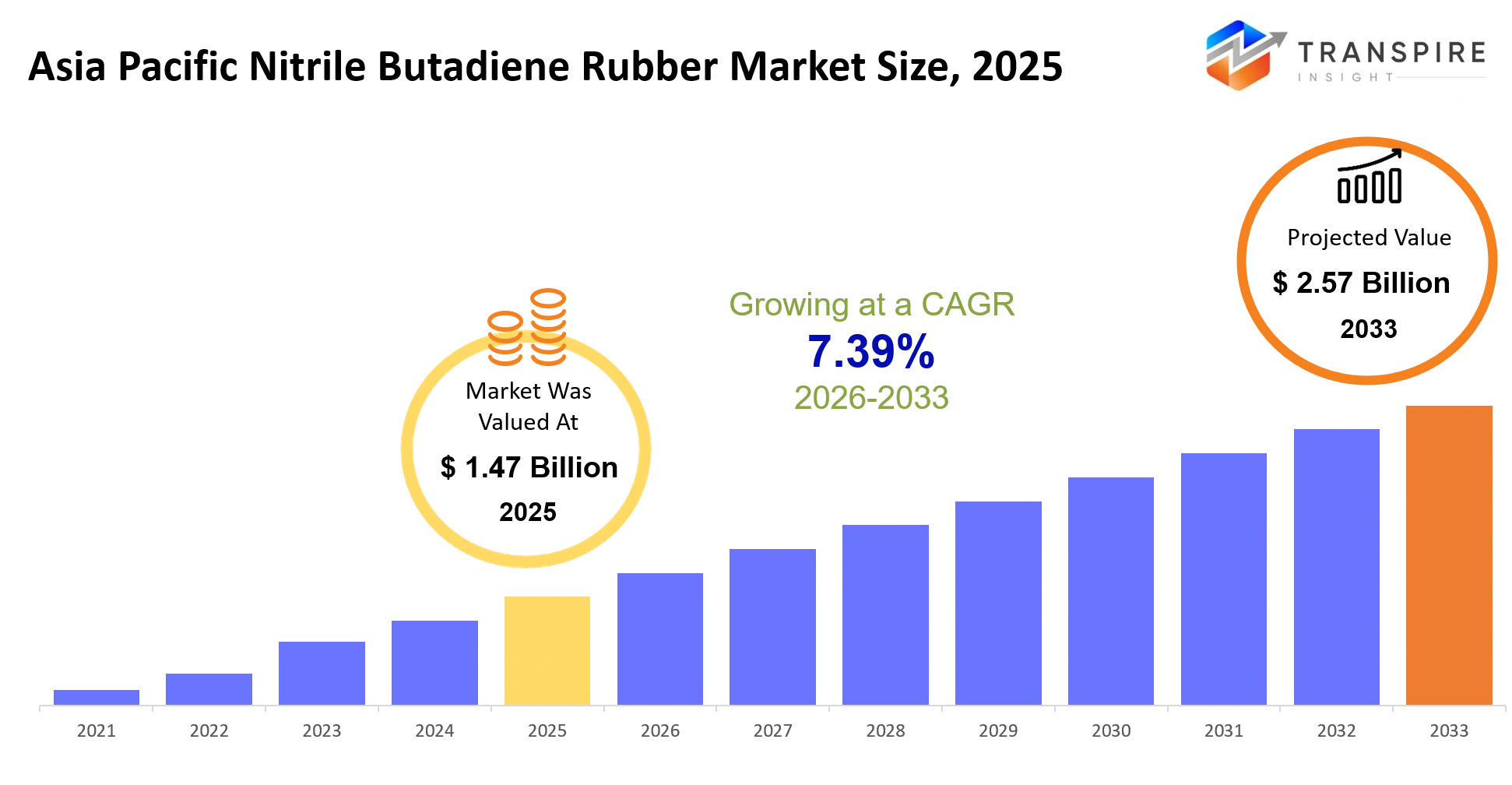
- Asia Pacific Nitrile Butadiene Rubber Market Size 2025: USD 1.47 Billion
- Asia Pacific Nitrile Butadiene Rubber Market Size 2033: USD 2.57 Billion
- Asia Pacific Nitrile Butadiene Rubber Market CAGR: 7.39%
- Asia Pacific Nitrile Butadiene Rubber Market Segments: By Product Type (Solid NBR, Liquid NBR, Carboxylated NBR, Powder NBR, Hydrogenated NBR, Specialty NBR, Blended NBR, Others); By Application (Automotive Components, Industrial Belts, Seals & O-Rings, Hoses, Footwear, Adhesives, Wire & Cable, Others); By End User (Automotive, Manufacturing, Construction, Oil & Gas, Electrical, Aerospace, Consumer Goods, Others); By Distribution Channel (Direct Sales, Distributors, Industrial Suppliers, Online Channels, OEM Supply, Export Sales, Contract Supply, Others).
Asia Pacific Nitrile Butadiene Rubber Market Summary
The Asia Pacific Nitrile Butadiene Rubber Market was valued at USD 1.47 Billion in 2025. It is forecast to reach USD 2.57 Billion by 2033. That is a CAGR of 7.39% over the period.
The Asia Pacific Nitrile Butadiene Rubber (NBR) market supports industries that depend on materials capable of withstanding oils, fuels, chemicals, and harsh operating environments. In practice, NBR is embedded in automotive seals, industrial hoses, conveyor belts, protective gloves, and energy infrastructure components where equipment reliability directly affects operational uptime and safety. Over the last five years, the market has shifted from commodity-grade production toward specialized formulations with higher resistance, lower emissions, and application-specific performance. One major trigger was the pandemic-era surge in disposable glove consumption, which exposed supply vulnerabilities and pushed manufacturers to diversify production capacity and secure feedstock access. At the same time, Asia Pacific’s accelerating vehicle electrification and industrial automation programs are reshaping demand patterns. As manufacturers pursue longer component lifecycles and stricter environmental compliance, NBR suppliers are moving up the value chain, creating opportunities for premium products and improving revenue realization beyond volume expansion alone.
Key Market Insights
- China dominates the Asia Pacific Nitrile Butadiene Rubber Market, accounting for approximately 42% to 45% of regional demand in 2025 due to its extensive automotive and industrial manufacturing ecosystem.
- Southeast Asia is the fastest-growing sub-region through 2030, supported by manufacturing investments in Malaysia, Thailand, and Vietnam.
- India is steadily expanding its market share through domestic manufacturing initiatives, infrastructure investments, and growing automotive production capacity.
- Solid NBR leads with nearly 55% market share in 2025 because of its widespread use in seals, hoses, belts, and industrial components.
- Hydrogenated NBR remains the second-largest segment, supported by applications requiring superior heat resistance and extended service life.
- Carboxylated NBR is projected to be the fastest-growing segment through 2030 due to advanced glove production and abrasion-resistant applications.
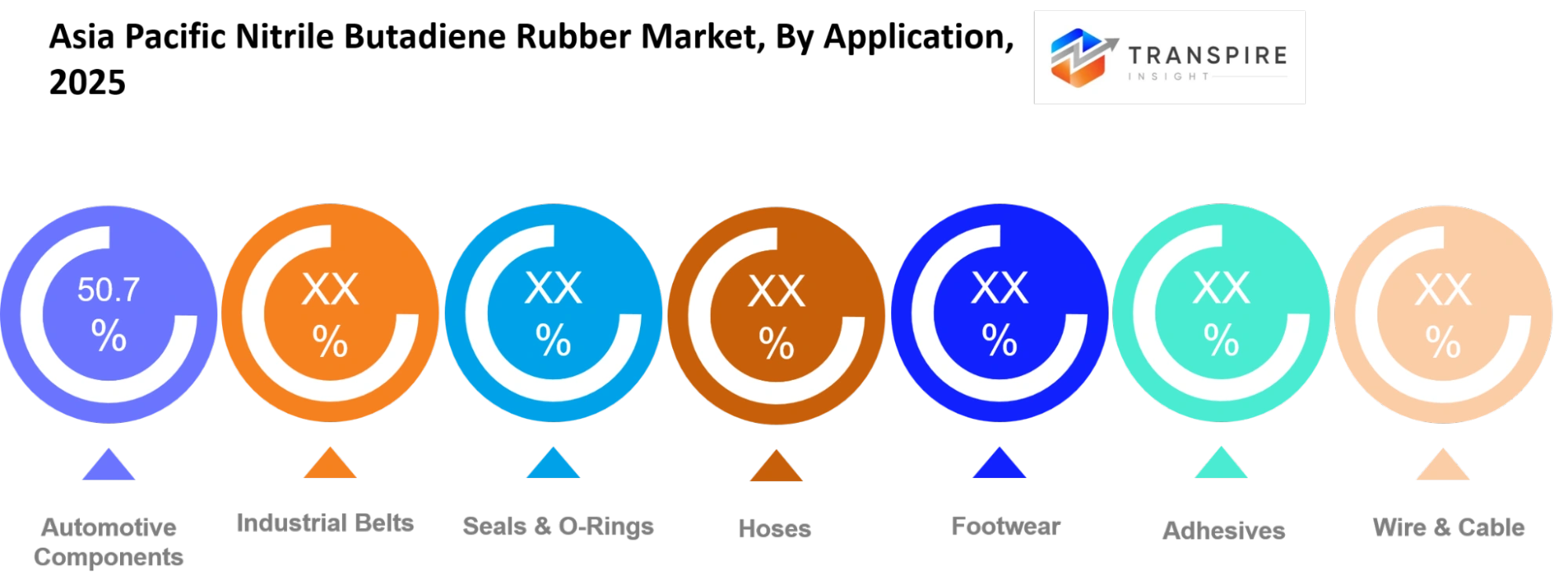
- Automotive components dominate applications with approximately 38% market share in 2025, driven by sealing systems and fuel-resistant components.
- Protective gloves are among the fastest-growing applications due to stronger workplace safety requirements and healthcare preparedness initiatives.
- Industrial machinery applications continue expanding as manufacturers seek durable materials that reduce equipment downtime.
- Automotive manufacturing remains the leading end-user segment, contributing more than 35% of total consumption in 2025.
What are the Key Drivers, Restraints, and Opportunities in the Asia Pacific Nitrile Butadiene Rubber Market?
The strongest force accelerating the Asia Pacific Nitrile Butadiene Rubber Market is the expansion of automotive electrification and industrial automation across China, India, Japan, and Southeast Asia. Vehicle manufacturers are redesigning components to withstand higher temperatures, chemical exposure, and longer operating cycles, creating a greater need for advanced elastomers. Government incentives supporting electric vehicle production and domestic manufacturing have accelerated this transition. As production volumes increase, manufacturers require durable seals, hoses, gaskets, and vibration management systems, directly expanding NBR consumption and allowing suppliers to capture higher revenue from premium-grade products.
Volatility in butadiene feedstock prices remains the market’s most significant structural barrier. NBR production depends heavily on petrochemical supply chains that are vulnerable to crude oil fluctuations, refinery output changes, and geopolitical disruptions. Building new feedstock infrastructure requires substantial capital investment and years of development, making short-term corrections difficult. This uncertainty compresses manufacturer margins, delays long-term procurement contracts, and discourages smaller downstream industries from shifting toward specialized NBR solutions.
High-performance hydrogenated nitrile butadiene rubber presents the next growth opportunity. Industrial operators across India and Southeast Asia are investing in energy infrastructure, robotics, and advanced manufacturing facilities that require materials with extended durability. For example, hydrogenated NBR is increasingly used in electric vehicle battery systems, oil and gas equipment, and high-pressure industrial environments, creating a pathway for suppliers to move beyond commodity products and expand premium revenue streams.
What Has the Impact of Artificial Intelligence Been on the Asia Pacific Nitrile Butadiene Rubber Market?
Artificial intelligence is transforming the Asia Pacific Nitrile Butadiene Rubber industry by improving manufacturing efficiency, quality consistency, and supply chain responsiveness. Producers are integrating AI into polymerization plants to automate process controls, monitor reaction temperatures, and optimize energy consumption in real time. Digital twins and industrial IoT platforms continuously track production variables, allowing operators to maintain precise material specifications for automotive, healthcare, and industrial applications.
Machine learning models are also strengthening predictive capabilities across production facilities. Manufacturers analyze equipment vibration, pressure fluctuations, and historical maintenance records to predict failures before they occur. Predictive maintenance programs can reduce unplanned downtime by 20% to 30% while extending the lifespan of critical assets such as reactors, compressors, and mixing systems. AI-driven demand forecasting further helps suppliers align inventory levels with automotive production cycles and glove manufacturing requirements, reducing excess stock and procurement inefficiencies.
These technologies improve plant utilization, lower operating costs, and enhance supply chain resilience across the region. However, one significant limitation remains. Many facilities still operate on legacy infrastructure that was not designed for advanced data integration. Upgrading plants requires substantial capital investment, and fragmented data collection systems often reduce the accuracy and scalability of AI models, particularly for smaller manufacturers across emerging Asian economies.
Key Market Trends
- Since 2021, manufacturers have accelerated investments in specialty NBR grades that offer greater heat, oil, and chemical resistance for demanding applications.
- Automotive customers have shifted procurement strategies toward longer-life elastomer components to support electric vehicle architectures and reduce maintenance requirements.
- China has gradually reduced its role as the sole manufacturing hub as companies expand production footprints into Malaysia, Thailand, and Vietnam.
- Hydrogenated NBR adoption has increased since 2022 because industrial operators require materials that withstand higher temperatures and harsher environments.
- Glove manufacturers have diversified supplier networks after pandemic-related disruptions exposed concentration risks within regional production chains.
- Producers such as LG Chem, Kumho Petrochemical, and ARLANXEO have expanded premium product portfolios instead of competing primarily on price.
- Digital manufacturing technologies have become more common since 2023, enabling producers to optimize energy consumption and improve batch consistency.
- Buyers have become more cautious about long-term procurement contracts because butadiene feedstock volatility continues to affect production economics.
- Environmental regulations have pushed manufacturers to invest in lower-emission production processes and more energy-efficient facilities.
- Since 2024, companies have increasingly prioritized strategic partnerships with automotive suppliers to secure stable demand and co-develop advanced material solutions.
Asia Pacific Nitrile Butadiene Rubber Market Segmentation
By Product Type:
Product innovation is gradually changing purchasing behavior across the nitrile butadiene rubber industry. Solid NBR continues to hold the largest position because automotive and industrial manufacturers rely on durable materials for seals, hoses, belts, and gaskets. Production priorities have shifted from standard formulations to performance-oriented grades that deliver higher resistance to oil, chemicals, and heat. Manufacturers now focus on balancing durability with operational efficiency.
Hydrogenated NBR has gained strong traction in applications that require long service life under demanding conditions. Carboxylated NBR also attracts investment because glove manufacturers and industrial users need better abrasion resistance. Specialty grades continue to expand as customers request application-specific materials instead of generic solutions. Product portfolios now emphasize premium performance rather than volume production alone.
By Application:
Automotive components remain the largest application area because fuel systems, sealing systems, and vibration control parts require reliable elastomer materials. Electric vehicle production has also altered material specifications across manufacturing facilities. Longer component lifecycles and improved thermal stability have become important purchasing criteria. Suppliers continue to align product development with changing vehicle architectures.
Protective gloves represent one of the fastest-moving application categories due to stronger workplace safety requirements and healthcare preparedness programs. Industrial machinery applications also continue to expand because factories seek materials that lower maintenance frequency. Demand patterns have shifted toward products capable of operating in harsh environments for longer periods. Application diversification has reduced dependence on a single industry.
By End User:
Automotive manufacturing remains the leading end-user category because vehicle production directly influences consumption volumes. Expansion of electric mobility programs across China, India, Japan, and Southeast Asia has created new opportunities for advanced elastomer solutions. Manufacturing facilities increasingly prioritize materials that improve reliability and reduce replacement cycles. Premium products have become more attractive for long-term operational savings.
Healthcare manufacturing has strengthened market influence due to stable investments in protective equipment production. Energy and heavy industrial sectors also continue to increase material adoption for demanding operating environments. Industrial operators seek products that maintain performance under chemical exposure and temperature fluctuations. End-user diversification has improved market resilience against sector-specific disruptions.
By Distribution Channel:
Direct sales channels continue to dominate because large manufacturers prefer long-term supply agreements and stable procurement systems. Strategic partnerships between producers and industrial buyers have become more common since supply chain disruptions highlighted sourcing risks. Bulk purchasing agreements also provide greater pricing stability. Strong supplier relationships have become an important competitive advantage.
Distributors remain important for small and medium-sized businesses that require flexible purchasing options. Digital procurement platforms have started influencing purchasing behavior by improving product visibility and shortening transaction timelines. Regional inventory networks have expanded to reduce delivery delays. Distribution strategies now focus on supply reliability, faster response times, and stronger customer support services.
What are the Key Use Cases Driving the Asia Pacific Nitrile Butadiene Rubber Market?
Automotive sealing systems remain the primary use case driving NBR consumption across Asia Pacific. Vehicle manufacturers rely on the material for fuel hoses, O-rings, gaskets, and sealing components because these parts must tolerate constant exposure to oils, lubricants, and temperature fluctuations while maintaining durability over long operating cycles.
Protective medical gloves and industrial machinery components have become important secondary applications. Healthcare manufacturers in Malaysia, Thailand, and China continue expanding glove production capacity, while industrial equipment producers use NBR in conveyor belts, rollers, and hydraulic seals to improve equipment reliability and reduce maintenance interruptions.
Emerging applications are developing around electric vehicles, battery systems, and advanced robotics. Manufacturers are exploring specialized elastomer formulations for thermal management components and high-performance sealing systems that can operate under demanding conditions. Growth in smart manufacturing facilities across India and Southeast Asia will create additional opportunities over the forecast period.
|
Report Metrics |
Details |
|
Market size value in 2025 |
USD 1.47 Billion |
|
Market size value in 2026 |
USD 1.56 Billion |
|
Revenue forecast in 2033 |
USD 2.57 Billion |
|
Growth rate |
CAGR of 7.39% from 2026 to 2033 |
|
Base year |
2025 |
|
Historical data |
2021 - 2024 |
|
Forecast period |
2026 - 2033 |
|
Report coverage |
Revenue forecast, competitive landscape, growth factors, and trends |
|
Regional scope |
Asia Pacific |
|
Key company profiled |
LG Chem, Zeon, Kumho Petrochemical, Synthos, JSR, ARLANXEO, Sibur, Versalis, Nantex, OMNOVA, PetroChina, Reliance Industries, TSRC, Dynasol, Ningbo Shunze. |
|
Customization scope |
Free report customization (country, regional & segment scope). Avail customized purchase options to meet your exact research needs. |
|
Report Segmentation |
By Product Type (Solid NBR, Liquid NBR, Carboxylated NBR, Powder NBR, Hydrogenated NBR, Specialty NBR, Blended NBR, Others); By Application (Automotive Components, Industrial Belts, Seals & O-Rings, Hoses, Footwear, Adhesives, Wire & Cable, Others); By End User (Automotive, Manufacturing, Construction, Oil & Gas, Electrical, Aerospace, Consumer Goods, Others); By Distribution Channel (Direct Sales, Distributors, Industrial Suppliers, Online Channels, OEM Supply, Export Sales, Contract Supply, Others). |
Which Regions are Driving the Asia Pacific Nitrile Butadiene Rubber Market Growth?
Automotive sealing systems remain the primary use case driving NBR consumption across Asia Pacific. Vehicle manufacturers rely on the material for fuel hoses, O-rings, gaskets, and sealing components because these parts must tolerate constant exposure to oils, lubricants, and temperature fluctuations while maintaining durability over long operating cycles.
Protective medical gloves and industrial machinery components have become important secondary applications. Healthcare manufacturers in Malaysia, Thailand, and China continue expanding glove production capacity, while industrial equipment producers use NBR in conveyor belts, rollers, and hydraulic seals to improve equipment reliability and reduce maintenance interruptions.
Emerging applications are developing around electric vehicles, battery systems, and advanced robotics. Manufacturers are exploring specialized elastomer formulations for thermal management components and high-performance sealing systems that can operate under demanding conditions. Growth in smart manufacturing facilities across India and Southeast Asia will create additional opportunities over the forecast period.
The largest share of NBR consumption in Asia Pacific comes from automotive sealing and fluid-handling systems. Vehicle manufacturers use the material in fuel hoses, gaskets, O-rings, and sealing assemblies because these components must withstand continuous contact with oils, fuels, and chemicals while delivering long service life. Expanding vehicle production and stricter performance requirements have reinforced this application as the industry's most important source of demand.
Beyond automotive uses, healthcare and industrial manufacturing have become important growth areas. Medical glove production remains a major outlet for nitrile-based materials, particularly in manufacturing hubs such as Malaysia, Thailand, and China. Industrial equipment producers also utilize NBR in conveyor systems, hydraulic seals, and machinery components where durability and resistance to harsh operating conditions directly affect productivity.
Several emerging applications are creating new opportunities for suppliers. Electric vehicle platforms increasingly require advanced sealing materials for battery systems and thermal management equipment. Robotics, automation systems, and high-performance industrial machinery are also adopting specialty grades designed for extended operating cycles. Continued investment in advanced manufacturing infrastructure across Asia Pacific will support the commercialization of these newer applications over the coming years.
Who are the Key Players in the Asia Pacific Nitrile Butadiene Rubber Market and How Do They Compete?
Competition in the Asia Pacific Nitrile Butadiene Rubber Market is moderately consolidated, with a handful of large petrochemical producers controlling a significant portion of regional production capacity. Competition no longer depends solely on price because customers increasingly prioritize performance, supply reliability, and application-specific formulations. Established manufacturers are defending market share by moving toward premium products, while smaller participants focus on specialized applications instead of competing directly on production scale. Geographic proximity to automotive and industrial manufacturing hubs has also become an important competitive factor.
LG Chem differentiates itself through strong integration across its petrochemical value chain, allowing better feedstock management and more stable supply during periods of market volatility. The company continues to expand high-value elastomer offerings that support automotive and industrial customers seeking improved durability. Kumho Petrochemical uses production scale and research capabilities to develop specialized grades for demanding applications while strengthening partnerships with downstream manufacturers across Asia.
Zeon Corporation focuses on high-performance materials that serve automotive, energy, and industrial sectors requiring advanced heat and chemical resistance. JSR Corporation differentiates itself by emphasizing precision material engineering and customized formulations for specific end-use requirements. ARLANXEO continues to strengthen regional competitiveness through advanced elastomer technologies and strategic collaboration with industrial customers. Many companies are expanding technical support services and establishing closer relationships with automotive suppliers to secure long-term contracts and reduce exposure to short-term price competition.
Company List
- LG Chem
- Zeon
- Kumho Petrochemical
- Synthos
- JSR
- ARLANXEO
- Sibur
- Versalis
- Nantex
- OMNOVA
- PetroChina
- Reliance Industries
- TSRC
- Dynasol
- Ningbo Shunze
Recent Development News
"In May 2025, ARLANXEO and TSRC inaugurated a relocated and expanded joint venture NBR plant in Nantong, China. The facility increased annual production capacity to 40,000 tons and broadened the product portfolio to strengthen China's domestic supply base and the global NBR supply chain.
Source: https://www.tsrc.com
"In May 2025, ARLANXEO and TSRC expanded operations through their Nantong joint venture by relocating production to a larger facility aligned with environmental protection initiatives along the Yangtze River. The investment introduced additional production capabilities and supported long-term NBR demand growth in China.
Source: https://www.european-rubber-journal.com
What Strategic Insights Define the Future of the Asia Pacific Nitrile Butadiene Rubber Market?
Over the next five to seven years, the Asia Pacific Nitrile Butadiene Rubber Market will move away from commodity-driven competition and toward performance-led specialization. Growth will increasingly depend on advanced applications linked to electric vehicles, industrial automation, energy infrastructure, and high-specification healthcare products rather than broad manufacturing output alone. The underlying force behind this transition is the growing requirement for materials that can operate under higher temperatures, stricter durability standards, and longer replacement cycles.
One hidden risk is the concentration of upstream feedstock availability. A large portion of production economics remains tied to butadiene supply, which depends on refinery operations and petrochemical output. Any disruption in refining investments or prolonged feedstock imbalances could create price instability that weakens margins and discourages downstream adoption.
An emerging opportunity is developing in India’s advanced manufacturing ecosystem, particularly around electric mobility and industrial robotics. Specialized hydrogenated nitrile butadiene rubber formulations could become increasingly important in battery systems and high-performance industrial equipment. Market participants should invest early in application-specific research partnerships with automotive and industrial equipment manufacturers, because future competitive advantage will depend more on technical integration capabilities than on production volume alone.
Asia Pacific Nitrile Butadiene Rubber Market Report Segmentation
By Product Type
- Solid NBR
- Liquid NBR
- Carboxylated NBR
- Powder NBR
- Hydrogenated NBR
- Specialty NBR
- Blended NBR
- Others
By Application
- Automotive Components
- Industrial Belts
- Seals & O-Rings
- Hoses
- Footwear
- Adhesives
- Wire & Cable
- Others
By End User
- Automotive
- Manufacturing
- Construction
- Oil & Gas
- Electrical
- Aerospace
- Consumer Goods
- Others
By Distribution Channel
- Direct Sales
- Distributors
- Industrial Suppliers
- Online Channels
- OEM Supply
- Export Sales
- Contract Supply
- Others
Frequently Asked Questions
Find quick answers to common questions.
The expected Asia Pacific Nitrile Butadiene Rubber Market size for the market will be USD 2.57 Billion in 2033.
Key segments for the Asia Pacific Nitrile Butadiene Rubber Market are By Product Type (Solid NBR, Liquid NBR, Carboxylated NBR, Powder NBR, Hydrogenated NBR, Specialty NBR, Blended NBR, Others); By Application (Automotive Components, Industrial Belts, Seals & O-Rings, Hoses, Footwear, Adhesives, Wire & Cable, Others); By End User (Automotive, Manufacturing, Construction, Oil & Gas, Electrical, Aerospace, Consumer Goods, Others); By Distribution Channel (Direct Sales, Distributors, Industrial Suppliers, Online Channels, OEM Supply, Export Sales, Contract Supply, Others).
Major Asia Pacific Nitrile Butadiene Rubber Market players are LG Chem, Zeon, Kumho Petrochemical, Synthos, JSR, ARLANXEO, Sibur, Versalis, Nantex, OMNOVA, PetroChina, Reliance Industries, TSRC, Dynasol, Ningbo Shunze.
The Asia Pacific Nitrile Butadiene Rubber Market size is USD 1.47 Billion in 2025.
The Asia Pacific Nitrile Butadiene Rubber Market CAGR is 7.39% from 2026 to 2033.
- LG Chem
- Zeon
- Kumho Petrochemical
- Synthos
- JSR
- ARLANXEO
- Sibur
- Versalis
- Nantex
- OMNOVA
- PetroChina
- Reliance Industries
- TSRC
- Dynasol
- Ningbo Shunze
About the Authors

Pankaj Ghogare Patil
I am Pankaj Ghogare Patil, a Senior Research Analyst at Transpire Insight, specializing in the Pharmaceutical, Chemicals & Materials, Healthcare IT, and Biotechnology industry. My expertise lies in conducting comprehensive market research, analyzing industry trends, evaluating competitive landscapes, and translating complex data into actionable insights. At Transpire Insight, I closely follow emerging technologies, regulatory developments, and market innovations to create accurate, well-researched, and informative content that helps businesses and professionals make informed decisions. I am committed to producing credible, evidence-based articles that reflect industry best practices while making technical topics accessible and valuable for a broad audience.

Chakradhar Khansole
Chakradhar serves as the Research Director at Transpire Insight, bringing over 8 years of experience in technology, innovation, and strategic market intelligence. He specializes in transforming complex market data into actionable business insights that enable organizations to make informed, growth-oriented decisions. Recognized for his strategic vision and analytical expertise, Chakradhar leads high-impact research initiatives, delivering comprehensive market assessments, competitive intelligence, and forward-looking industry analysis.
Recently Published Reports
-
May 2026
Healthcare Polymer Packaging Market
Healthcare Polymer Packaging Market Size, Share & Analysis Report By Packaging Type (Syringes, IV Bottles and Pouches, Clamshells, Blisters, Bottles & Jars, Containers, Tubes, IV Parental Packaging, Others), By Type (Regulated, Non-regulated), By Polymer Type (LDPE (Low-Density Polyethylene), HDPE (High-Density Polyethylene), Homo-polymer (Homo), Random Copolymer (Random), Block Copolymer (Block), PET, Polystyrene, Polyvinyl Chloride, Polyamide/EVOH, Others), and Geography (North America, Europe, Asia-Pacific, Middle East and Africa, South and Central America), 2021 - 2031
-
Apr 2026
Hydrophilic Tape (Waterstop) Market
Hydrophilic Tape (Waterstop) Market Size, Share & Analysis Report By Type (Bentonite-Based Hydrophilic Tape, Rubber-Based Hydrophilic Tape), By Application (Residential Buildings, Commercial Buildings, Infrastructure Projects), and Geography (North America, Europe, Asia-Pacific, Middle East and Africa, South and Central America), 2021 - 2031
-
Apr 2026
Metalens Market
Metalens Market Size, Share & Analysis Report By Type (Visible Light Metalens, and Infrared Metalens), By Application (Consumer Electronics, Automotive Electronics, Industrial, Medical, and Others), and Geography (North America, Europe, Asia-Pacific, Middle East and Africa, South and Central America), 2021 - 2031
-
Apr 2026
PBT Resin Market
PBT Resin Market Size, Share & Analysis Report By Type (Reinforced PBT Resin, Unreinforced PBT Resin), By Processing Method (Injection Molding, Extrusion, Blow Molding, Others), By End-User (Automotive, Electrical & Electronics, Consumer Appliances, Industrial Machinery, Medical Devices, Packaging, Others), and Geography (North America, Europe, Asia-Pacific, Middle East and Africa, South and Central America), 2021 - 2031