

Asia Pacific Magnetic Ink Recognition Devices Market Size & Forecast:
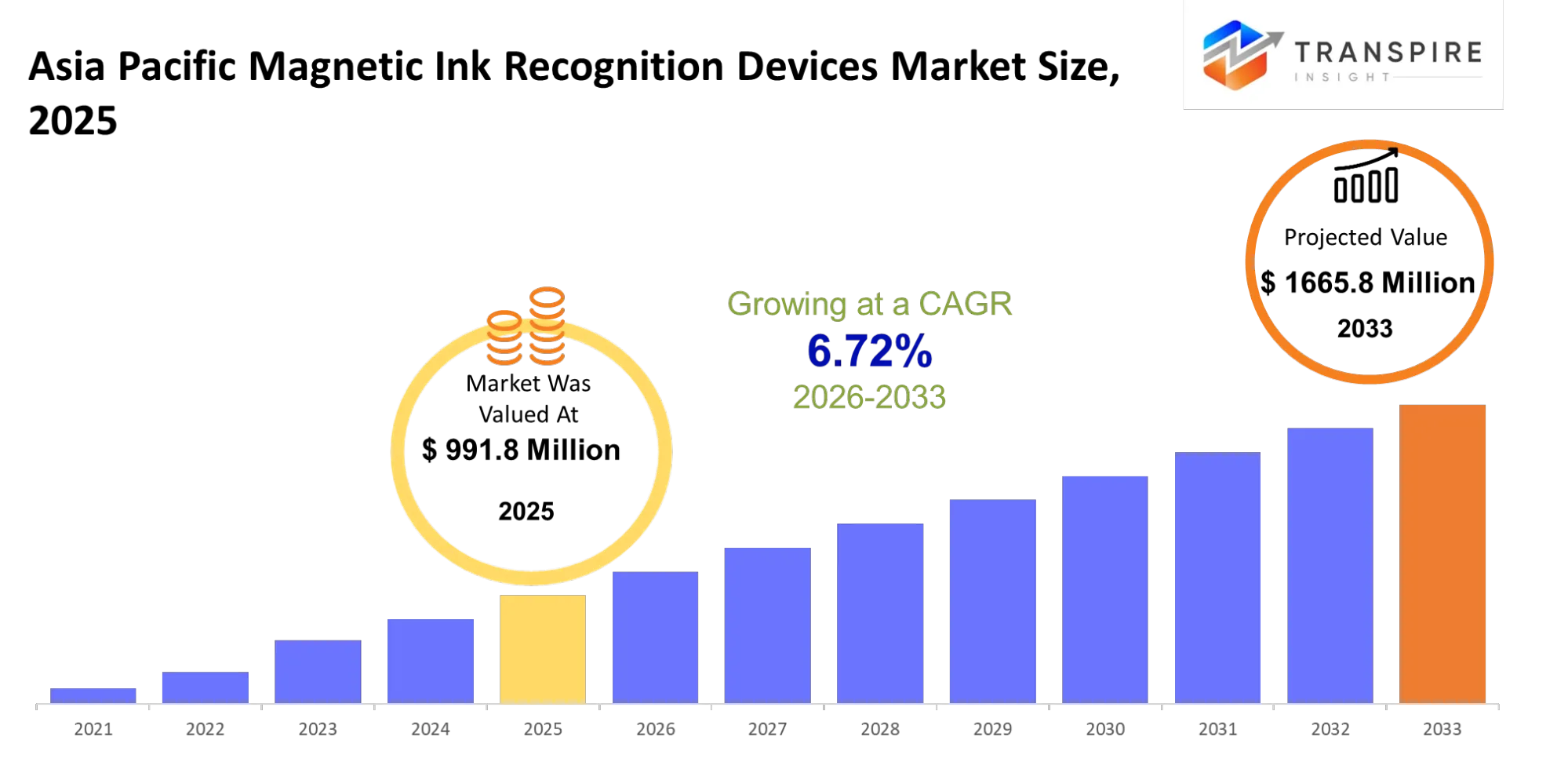
- Asia Pacific Magnetic Ink Recognition Devices Market Size 2025: USD 991.8 Million
- Asia Pacific Magnetic Ink Recognition Devices Market Size 2033: USD 1665.8 Million
- Asia Pacific Magnetic Ink Recognition Devices Market CAGR: 6.72%
- Asia Pacific Magnetic Ink Recognition Devices Market Segments: By Type (MICR Readers, MICR Printers, Combined Devices, Others); By Application (Banking, Financial Services, Retail, Government, Others); By End-User (Banks, Financial Institutions, Retailers, Government Agencies, Enterprises, Others); By Technology (OCR, MICR Technology, Barcode Integration, Others)
To learn more about this report,  Download Free Sample Report
Asia Pacific Magnetic Ink Recognition Devices Market Summary
The Asia Pacific Magnetic Ink Recognition Devices Market was valued at USD 991.8 Million in 2025. It is forecast to reach USD 1665.8 Million by 2033. That is a CAGR of 6.72% over the period.
The Asia Pacific Magnetic Ink Recognition Devices Market focuses on devices which read magnetic ink characters from cheques and payment documents to automate the clearing process and verify account information while decreasing the requirement for manual reconciliation work between banks and clearing houses. The devices enable financial institutions which process large cheque volumes to execute faster settlement times while decreasing their operational workload.
The market has experienced a major structural change during the past five years because organizations now prefer using integrated cheque imaging systems which combine MICR and OCR and digital archiving through their banking automation systems. The COVID-19 pandemic accelerated the shift as banks expanded remote deposit capture and reduced branch-based processing, while regulatory expansion of cheque truncation systems in India and modernization programs in Australia reinforced digitized clearing workflows.
Banks are making infrastructure improvements to achieve faster processing times and better fraud detection results while transferring their expenses from traditional hardware systems which require ongoing support to software-based service solutions that deliver continuous revenue to vendors.
Key Market Insights
- The Asia Pacific Magnetic Ink Recognition Devices Market which leads the world now holds a market share of 40 to 45 percent because India and Australia process a high volume of cheque transactions.
- The Indian market grows fastest among all regions because the country expands its cheque truncation system through digital banking reforms which will last from 2024 until 2026.
- The Japanese and Chinese markets sustain constant demand because they prioritize both banking automation improvements and their fraud prevention system development projects.
- The banking industry depends on MICR cheque scanners which have become the most popular solution since they handle more than 50 percent of the market.
- The integrated imaging systems which combine MICR recognition with OCR and digital archiving technology to deliver faster clearing cycles stand as the second largest market solution.
- The period from 2025 to 2030 shows hybrid digital MICR platforms as their fastest-growing segment because software-defined banking transformation drives their expansion.
- The need for compliance and secure transactions leads to automated reconciliation and fraud detection becoming the most rapidly growing applications.
- The commercial banking sector accounts for approximately 55% of end-user market share because urban financial networks require high-volume cheque clearing operations.
- The fastest-growing end-user group consists of fintech-enabled banking service providers that use MICR systems for their digital-first workflows.
- Government banking institutions upgrade their old systems to create better transparency and decrease settlement mistakes.
What are the Key Drivers, Restraints, and Opportunities in the Asia Pacific Magnetic Ink Recognition Devices Market?
The Asia Pacific Magnetic Ink Recognition Devices Market grows because banks continue to improve their cheque clearing systems which operate through their entire banking networks. The required digitization processes which include cheque truncation rules in India and Australia standardization of cheque clearing procedures have compelled banks to develop MICR-based automated systems for their verification processes. The new system enables faster payments while decreasing operational mistakes which results in higher processing capacity therefore financial institutions need to purchase more MICR devices and imaging systems while they update their branch equipment. The vendors experience advantages because financial institutions need to refresh their hardware and they generate revenue from the combination of software and service products.
The market maintains its current growth rate because advanced economies such as Japan and South Korea experience a persistent decline of cheque-based transactions. The decline represents a permanent shift because consumers now prefer to use real-time digital payments together with mobile banking services. Banks reduce their MICR system investments as cheque use decreases which results in decreased revenue for device makers because banks use their current systems for longer periods of time.
A key opportunity is emerging from hybrid banking environments in India and Southeast Asia which enable customers to use cheques while they can also access digital banking services. Financial institutions are increasingly deploying AI-enhanced MICR and imaging systems which connect to their cloud-based clearing platforms. The banking digitization programs in India have implemented extensive system upgrades which now allow solution providers to develop intelligent cheque processing systems at better scalability.
What Has the Impact of Artificial Intelligence Been on the Asia Pacific Magnetic Ink Recognition Devices Market?
The Asia Pacific Magnetic Ink Recognition Devices Market undergoes transformation through artificial intelligence together with advanced digital technologies which replace traditional MICR verification methods with automatic document processing systems. The banks use AI-powered optical character recognition technology together with MICR readers to create an automated system which verifies cheques while matching signatures and detecting fraud, thereby minimizing the need for human workers in their cheque processing operations. Branch capture points and central clearing houses experience faster processing times because of this automation which also decreases operational mistakes and reduces back-office duties.
Machine learning models are increasingly used to enhance predictive maintenance of MICR scanners and cheque imaging systems. The models use usage pattern analysis together with scan quality decline assessment and component wear tracking to predict equipment failures before downtime starts. Financial institutions applying these systems report improved device uptime and more stable cheque processing cycles, particularly in high-transaction banking networks across India and Southeast Asia. AI-driven analytics systems optimize branch workflow distribution, which leads to better processing efficiency and shorter cheque settlement times.
The high costs of system integration together with the broken state of existing banking systems prevent organizations from adopting new technologies. The cheque processing systems of mid-tier banks use outdated technology because they do not support standard data formats which creates challenges for AI integration. Vendors maintain their investment in cloud-based MICR platforms together with intelligent document processing systems because these technologies eventually boost operational capacity while cutting expenses and enhancing compliance accuracy in regulated banking environments.
Key Market Trends
- Since 2022, over 60% of new banking deployments have shifted from standalone MICR readers to integrated imaging and AI-enabled cheque processing systems.
- India’s cheque truncation expansion between 2023–2026 accelerated replacement of manual verification systems, which resulted in public banks adopting automated MICR systems at a higher rate.
- Japan and South Korea experienced continuous declines in cheque usage, which caused their hardware replacement schedules to become slower while they changed their purchasing methods to focus on maintenance-only upgrades.
- Cloud-connected cheque clearing platforms gained traction after 2021 because they enabled banks with multiple branches to validate checks in real time and process checks from a central location.
- Leading vendors including NCR Corporation and Canon Inc. increasingly bundle MICR hardware with software services, which causes them to generate revenue through ongoing service agreements.
- Using predictive maintenance has decreased MICR device downtime by 25% for large banks because they use sensors to monitor device performance and conduct diagnostic tests.
- The market competition evolved into partnerships between imaging technology providers and fintech companies, which enabled complete digital payment systems to work together.
- Southeast Asia emerged as a high-growth deployment zone because mid-sized banks now update their old cheque processing systems to comply with new banking regulations.
Asia Pacific Magnetic Ink Recognition Devices Market Segmentation
By Type :
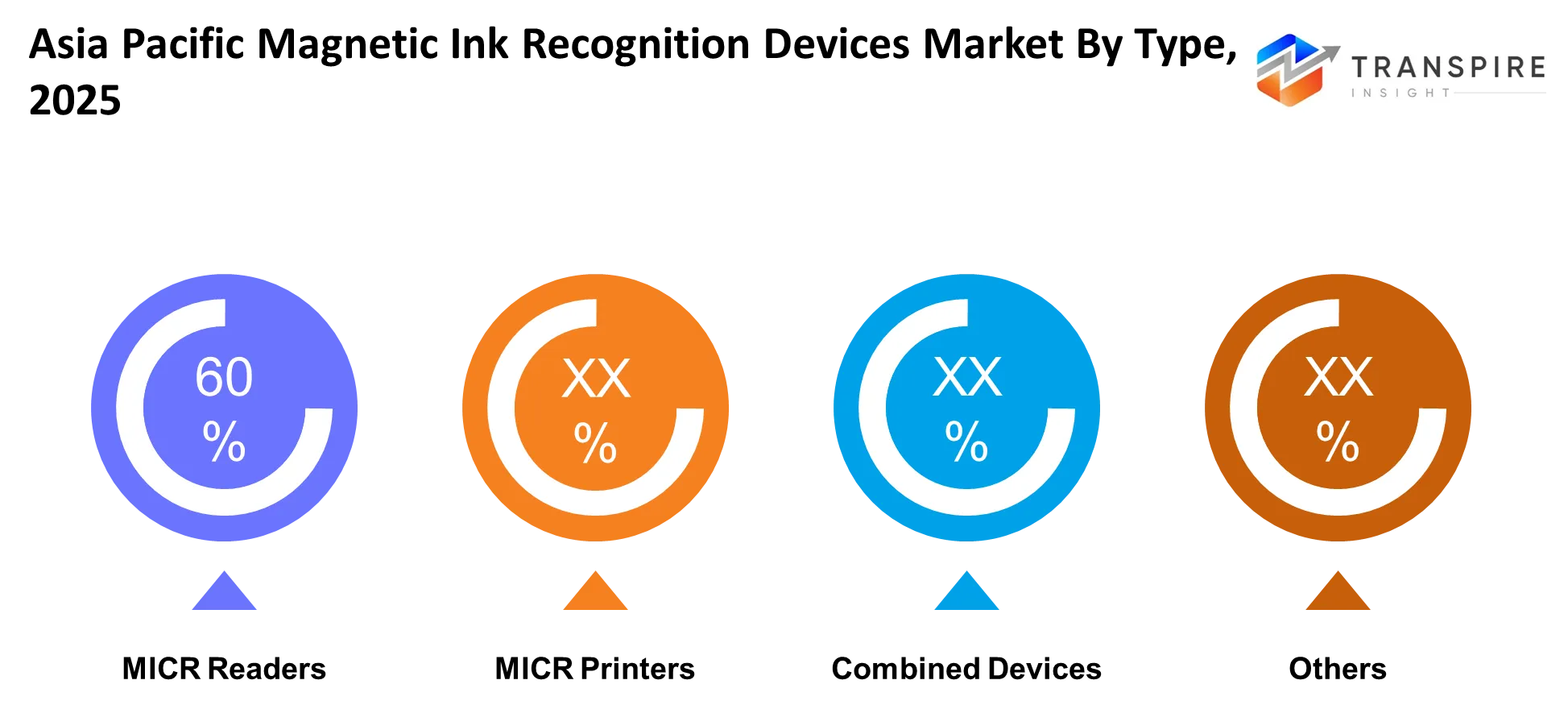
The system has been developed to work with information that was collected until the month of October in the year 2023. The devices work together to process checks because they can read and print the magnetic ink characters that appear on banking documents. The system functions as a combined device which enables users to perform both reading and printing operations, thus decreasing the duration needed for document processing. The available equipment provides particular processing capabilities that match the current operation requirements of the business.
The devices enable organizations to achieve precise results while they process checks and handle documents. The combined devices need less physical space while they help organizations work better, but the standalone readers and printers operate efficiently for specific activities that occur during busy times. Different document processing environments can use various document types to ensure efficient processing of financial documents.
To learn more about this report, Download Free Sample Report
By Application :
The banking sector uses MICR devices for three main functions which include cheque clearance and account processing and transaction validation. Financial services use the solution to handle documents securely and process payments. Retail applications enable businesses to accept payments through cheques, while government organizations use the system for tax processing and public payment handling and record verification purposes. The applications depend on MICR systems to decrease errors and boost the speed of their operational transactions.
Banking institutions and financial service providers remain the primary users of these systems because they handle large volumes of documents. The government and retail sectors use these systems to ensure proper payment processing and record management during their normal business activities.
By End-User :
The primary users of MICR devices are banks and financial institutions which operate the devices to process cheques and conduct secure transactions. The systems enable retailers to process cheque payments which government agencies use for their public finance activities. Enterprises use them to handle their payment processes and maintain their payment records.
The different user groups of MICR systems need these systems because they help them achieve better document accuracy and decrease their need for manual document verification. Banks and financial institutions lead usage due to large transaction volumes. Government agencies and enterprises use these devices to support structured and reliable financial operations.
By Technology :
OCR technology helps read printed text on documents, while MICR technology focuses on magnetic ink characters used in cheque processing. The system uses barcode integration to enable document tracking and identification which results in faster processing and decreased need for manual financial data entry across all sectors.
The two technologies work together to enhance data accuracy during the data collection process and the data analysis process. MICR remains essential for banking documents while OCR and barcode systems provide additional document management options for multiple operational processes. Financial institutions achieve faster processing times and lower error rates through the combined application of these technologies.
What are the Key Use Cases Driving the Asia Pacific Magnetic Ink Recognition Devices Market?
The Asia Pacific Magnetic Ink Recognition Devices Market experiences core adoption through its use in commercial banking operations for cheque clearing and validation processes. Banks use MICR-based systems for cheque processing because these systems enable banks to handle their cheque processing needs while decreasing the number of verification mistakes and enhancing their settlement speed to centralized clearing houses.
Mid-tier banks and government financial institutions expand their operational capabilities through the dual implementation of fraud detection systems and automated reconciliation processes. The users of MICR scanners are expanding their system connections to core banking platforms and imaging systems because these integrations help them achieve better audit results while meeting the increased transaction monitoring standards from financial networks that operate under Indian and Southeast Asian regulations.
Banks use hybrid digital onboarding processes to develop new applications that combine MICR cheque capture technology with remote deposit and mobile banking services. Fintech-enabled banking service providers are investigating API-linked cheque processing systems which allow real-time data transfer between traditional cheque instruments and contemporary digital payment systems.
|
Report Metrics |
Details |
|
Market size value in 2025 |
USD 991.8 Million |
|
Market size value in 2026 |
USD 1056.3 Million |
|
Revenue forecast in 2033 |
USD 1665.8 Million |
|
Growth rate |
CAGR of 6.72% from 2026 to 2033 |
|
Base year |
2025 |
|
Historical data |
2021 - 2024 |
|
Forecast period |
2026 - 2033 |
|
Report coverage |
Revenue forecast, competitive landscape, growth factors, and trends |
|
Regional scope |
Asia Pacific (India, China, Japan, Australia,South Korea, Rest of Asia Pacific) |
|
Key company profiled |
Canon, HP, Epson, Xerox, IBM, NCR Corporation, Panini, Digital Check, MagTek, Ricoh, Toshiba, Fujitsu, Oki Electric, Seiko Epson, Brother |
|
Customization scope |
Free report customization (country, regional & segment scope). Avail customized purchase options to meet your exact research needs. |
|
Report Segmentation |
By Type (MICR Readers, MICR Printers, Combined Devices, Others); By Application (Banking, Financial Services, Retail, Government, Others); By End-User (Banks, Financial Institutions, Retailers, Government Agencies, Enterprises, Others); By Technology (OCR, MICR Technology, Barcode Integration, Others) |
Which Regions are Driving the Asia Pacific Magnetic Ink Recognition Devices Market Growth?
India has established itself as the leading force in the Asia Pacific Magnetic Ink Recognition Devices Market because public sector organizations and corporate banking networks use cheques on a large scale. The Reserve Bank of India created a standardized electronic clearing system through its cheque truncation system which generates ongoing requirements for MICR-enabled scanners at branches and clearing houses. The ongoing use of equipment occurs because banks maintain a system of regional clearing centers which handles high volumes of interbank cheque transactions. Financial institutions have started using automated cheque validation systems because regulatory agencies enforce strict rules about settlement deadlines.
The Asia Pacific Magnetic Ink Recognition Devices Market sees Japan functioning as a stable and developed market which operates through its organized corporate banking system. The country requires high-value business payments which need enterprise accounting systems to process legacy cheque transactions. Financial institutions focus on accuracy and auditability together with long-lasting equipment instead of using multiple devices at once. The current requirement for MICR systems will remain stable because organizations need to manage their systems while incoming cheque handling declines.
The rapid banking digitization process in Indonesia and Vietnam and the Philippines makes Southeast Asia the fastest developing region. The recent branch modernization investments together with electronic clearing framework development have brought MICR systems to banking facilities that previously lacked automated systems. The government agencies are improving financial systems to enable established payment networks while decreasing their reliance on cash transactions. The current operational pace creates substantial chances for vendors to access markets because institutions will accelerate their purchasing activities from 2026 to 2033 to meet their basic payment processing and fraud detection requirements.
Who are the Key Players in the Asia Pacific Magnetic Ink Recognition Devices Market and How Do They Compete?
The Asia Pacific Magnetic Ink Recognition Devices Market shows a moderately consolidated competitive landscape where a few global incumbents control enterprise banking deployments while regional specialists compete on customization and integration. The competition between banks exists because of their need for MICR systems which combine imaging technology with fraud detection systems and core banking connectivity. Established vendors defend share through long-term banking contracts, while newer entrants focus on modular upgrades that fit into legacy cheque processing environments.
NCR Corporation strengthens its position through end-to-end banking automation platforms that integrate MICR scanning with branch transformation solutions. Its system enables banks to combine cheque processing with cash handling through its ability to connect directly to ATM and teller systems. The company achieves growth by signing multi-year service contracts with major banks throughout India and Southeast Asia which provide stable income and extend project timespan.
Canon Inc. and Epson compete through high-precision imaging hardware and reliability-focused cheque scanning systems. Canon uses its optical imaging knowledge to make cheque documents readable during rapid processing times. Meanwhile, Panini S.p.A. and Digital Check Corp focus on specialized cheque capture devices tailored for mid-tier banks. MagTek expands through secure transaction hardware integration, linking MICR validation with encrypted payment authentication systems for fraud-sensitive banking environments.
Company List
- Canon
- HP
- Epson
- Xerox
- IBM
- NCR Corporation
- Panini
- Digital Check
- MagTek
- Ricoh
- Toshiba
- Fujitsu
- Oki Electric
- Seiko Epson
- Brother
Recent Development News
In April 2026,NEC Asia Pacific will exhibit its advanced digital identity and secure authentication technologies which will serve government and enterprise needs at Milipol TechX 2026. NEC operates as an identity verification vendor because its secure data processing systems work with banking environments which use MICR devices for check processing and fraud prevention.
Source https://www.prnewswire.com/
In June 2025, NEXT Biometrics secured a NOK 6.3 million purchase order for its FAP 20 Basalt L1 Slim sensor through distributor XM Holder, with integration support targeting India’s Aadhaar-linked payment ecosystem. The deployment strengthens biometric authentication in payment and POS devices, complementing secure transaction processing technologies used in banking environments where MICR devices remain relevant.
Source https://www.inderes.se/releases/
What Strategic Insights Define the Future of the Asia Pacific Magnetic Ink Recognition Devices Market?
The Asia Pacific Magnetic Ink Recognition Devices Market has developed into integrated software-enabled cheque processing ecosystems that use software to process cheques instead of using standalone MICR hardware systems. Banks will adopt new technologies in the next 5 to 7 years because of their digital transformation projects and centralized clearing system improvements which will turn MICR devices into components of intelligent document processing systems instead of separate assets. The new system will decrease the amount of hardware required at each branch but will enhance operational value through its analytics capabilities and automated functions together with service-based business models.
Urban banking centers adopt digital payment systems at an increasing rate which decreases their need for cheques because of real-time digital payment systems. The situation will result in accelerated replacement cycles which will leave behind obsolete infrastructure in developed markets such as Japan and South Korea. The complete integration process will take longer because banking institutions face difficulties combining their traditional systems with contemporary AI-powered cheque processing solutions which raises their expenses during the transition period.
Southeast Asian hybrid banking systems present a new business opportunity because they enable banks to keep using cheques while they advance their digital transformation efforts. The market leaders will emerge from vendors who develop cloud-based MICR systems that use APIs to connect with digital banking platforms. Market participants should prioritize modular, upgradeable systems that align with phased digitization strategies rather than full infrastructure replacement.
Asia Pacific Magnetic Ink Recognition Devices Market Report Segmentation
By Type
- MICR Readers
- MICR Printers
- Combined Devices
By Application
- Banking
- Financial Services
- Retail
- Government
By End-User
- Banks
- Financial Institutions
- Retailers
- Government Agencies
- Enterprises
By Technology
- OCR
- MICR Technology
- Barcode Integration
Frequently Asked Questions
Find quick answers to common questions.
The Asia Pacific Magnetic Ink Recognition Devices Market size is USD 1665.8 Million in 2033.
Key segments for the Asia Pacific Magnetic Ink Recognition Devices Market are By Type (MICR Readers, MICR Printers, Combined Devices, Others); By Application (Banking, Financial Services, Retail, Government, Others); By End-User (Banks, Financial Institutions, Retailers, Government Agencies, Enterprises, Others); By Technology (OCR, MICR Technology, Barcode Integration, Others).
Major Asia Pacific Magnetic Ink Recognition Devices Market players are Canon, HP, Epson, Xerox, IBM, NCR Corporation, Panini, Digital Check, MagTek, Ricoh, Toshiba, Fujitsu, Oki Electric, Seiko Epson, Brother.
The Asia Pacific Magnetic Ink Recognition Devices Market size is USD 991.8 Million in 2025.
The Asia Pacific Magnetic Ink Recognition Devices Market CAGR is 6.72% from 2026 to 2033.
- Canon
- HP
- Epson
- Xerox
- IBM
- NCR Corporation
- Panini
- Digital Check
- MagTek
- Ricoh
- Toshiba
- Fujitsu
- Oki Electric
- Seiko Epson
- Brother
Recently Published Reports
-
Apr 2026
3D Optical Profiler Market
3D Optical Profiler Market Size, Share & Analysis Report By Type (Desktop 3D Optical Profiler, and Portable 3D Optical Profiler), By Technology (Confocal Technology, and White Light Interference), By End-Use Industry (Manufacturing, Research Institutions, Automotive, Aerospace and Defense, Medical Devices, and Other), and Geography (North America, Europe, Asia-Pacific, Middle East and Africa, South and Central America), 2021 - 2031
-
Apr 2026
Depth Sensor Market
Depth Sensor Market Size, Share & Analysis Report By Type (Infrared Depth Sensors, Time-of-Flight (ToF) Sensors, Stereo Vision Sensors, Structured Light Sensors, Ultrasonic Depth Sensors), By Application (Automotive, Robotics, Gaming, Consumer Electronics, Industrial Automation, Healthcare, Security & Surveillance, Others), By End Users (Automotive Manufacturers, Consumer Electronics Companies, Healthcare Providers, Industrial Companies, Security Agencies, Gaming Companies, Robotics Companies, Others), and Geography (North America, Europe, Asia-Pacific, Middle East and Africa, South and Central America), 2021 – 2031
-
Apr 2026
Digital Manufacturing Market
Digital Manufacturing Market Size, Share & Analysis Report By Component (Hardware, Software, and Services), By Technology (Robotics, 3D Printing, Internet of Things (IoT), and Others), By Application (Automotive and Transportation, Aerospace and Defense, Consumer Electronics, Industrial Machinery, and Others), By Process Type (Computer-Based Designing, Computer-Based Simulation, Computer 3D Visualization, Analytics, and Others), and Geography (North America, Europe, Asia-Pacific, Middle East and Africa, South and Central America), 2021 – 2031
-
Apr 2026
Digital Visa Services Market
Digital Visa Services Market Size, Share & Analysis Report By Type (Individual Travelers, Group Travelers), By Application (Tourism, Business Travel, Others), and Geography (North America, Europe, Asia-Pacific, Middle East and Africa, South and Central America), 2021 – 2031