

Asia Pacific Luxury Car Market Summary
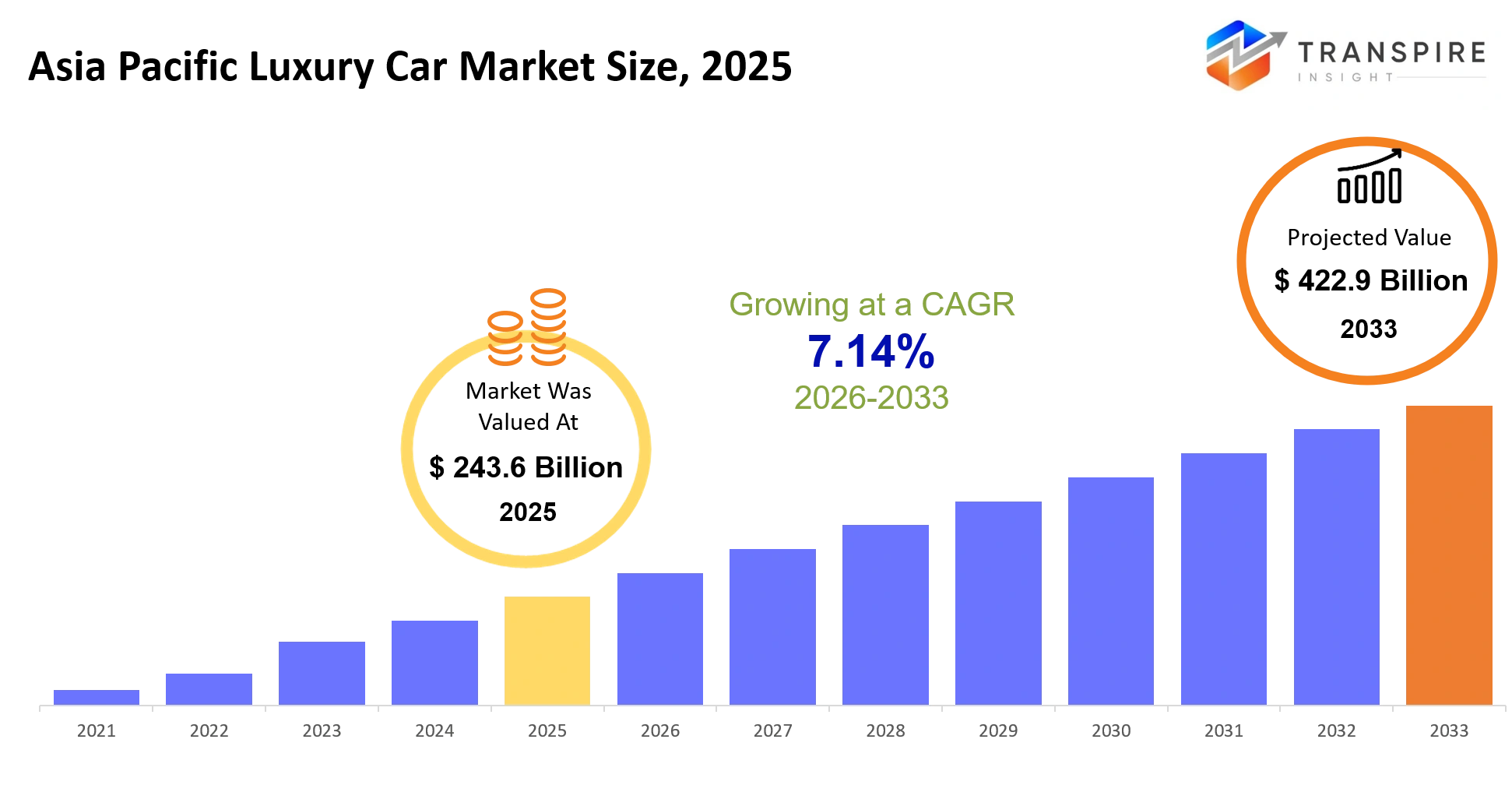
As per Transpire Insight Analysis the Asia Pacific Luxury Car Market size is estimated at USD 243.6 Billion in 2025 and is anticipated to reach USD 422.9 Billion by 2033, growing at a CAGR of 7.14% from 2026 to 2033.
The Asia Pacific luxury car market basically serves buyers who want that premium mobility vibe, advanced engineering, real comfort, and of course brand prestige, while also covering executive transportation, high-end tourism, and corporate mobility needs. On top of personal ownership, these luxury vehicles kind of show technological leadership ,and they help manufacturers build higher-value product portfolios that end up improving profitability, even if people don’t always think about it.
Over the last five years, the market has gone through a structural change toward electrified luxury models, since governments rolled out tougher emission standards and automakers pushed out more premium electric vehicle lineups. During the pandemic there were supply chain disruptions ,plus semiconductor shortages, so vehicle availability got squeezed for a while. In that period, manufacturers tended to focus on higher-margin luxury production and also tighten regional sourcing, which made a noticeable difference.
Once production got more stable, affluent consumers came back, and they brought stronger preference for connected, personalized, and sustainable vehicles. So overall, regulatory pressure mixed with product innovation ,and evolving customer expectations has pushed more people toward premium vehicle adoption. It has also encouraged investment in advanced manufacturing, and created stronger revenue chances for established brands, plus new luxury electric vehicle entrants across the region.
Asia Pacific Luxury Car Market Size & Forecast:
- Asia Pacific Luxury Car Market Size 2025: USD 243.6 Billion
- Expected Market Value 2033: USD 422.9 Billion
- Forecast CAGR: 7.14%
- Leading region in 2025: China
- Fastest Growing region: India
- Key Profile: Mercedes-Benz, BMW, Audi, Lexus, Porsche, Volvo Cars, Jaguar Land Rover, Tesla, Rolls-Royce Motor Cars, Bentley Motors, Ferrari, Lamborghini, Maserati, Genesis, Acura.
Key Market Insights
- In 2025, China kind of dominated the regional industry size, holding about 46% market share , and this was backed by premium electric vehicle output plus affluent city dwellers who keep spending more.
- India, meanwhile , is expected to stay the fastest-growing regional market through 2025–2033, with luxury ownership spreading outside metro areas as financing keeps getting better and dealership coverage spreads out.
- When it comes to the product segment, luxury SUVs led in 2025 with roughly 58% share , since many shoppers are leaning toward premium utility vehicles instead of traditional sedans.
- Luxury sedans stayed in the second slot, because executive commuting needs, and corporate fleet buying, kept premium vehicle sales fairly steady across the key markets.
- For vehicle powertrain types, battery electric luxury models should post the quickest growth up to 2033, driven by premium OEMs pushing more focused EV launches and charging infrastructure expanding , bit by bit.
- On applications, personal mobility took the lead in 2025 with around 82% market share, mainly because high net worth customers want ownership flexibility and a more premium driving feel.
- Premium mobility services are set to grow the quickest through 2033 , as luxury rentals and chauffeur-style platforms keep expanding across major Asian cities.
- Looking at end users, individual consumers were the leading segment in 2025, at nearly 76% , supported by rising wealth and easier access to premium financing.
- Corporate and hospitality buyers should be the fastest-growing end-user group, as executive transport fleets start adopting connected, electrified luxury vehicles through 2033.
What are the Key Drivers, Restraints, and Opportunities in the Asia Pacific Luxury Car Market?
The strongest growth driver seems like the move toward premium electric mobility ,which is being propped up by tighter vehicle emission policies and more charging infrastructure showing up in real life. In China, South Korea and several Southeast Asian markets, governments pushed incentives faster for electrified vehicles .At the same time, manufacturers rolled out luxury EV platforms that promise longer driving ranges and more advanced software. People ,well buyers, shifted their spending toward technologically sharper models rather than sticking with the usual conventional premium vehicles. As a result, higher ticket sizes and extra personalization choices boosted manufacturer revenue, and that in turn motivates more commitment to local production sites and digital retail routes.
The biggest restraint is still kind of the same theme: supply chain concentration for semiconductors, battery materials, and advanced electronic components. Premium vehicles need sophisticated chips ,sensors and software. Those depend on specialized suppliers ,whose production capacity is limited. Building out this ecosystem does not happen overnight ,it takes years of investment plus regulatory greenlights. If timelines slip, product launches get delayed, dealership inventory stays thinner than expected, and sales can get flattened during those high-demand moments. Based on a Transpire Insight review of regional procurement announcements and launch schedules, the supply chain concentration remains the main execution risk, not just a minor concern.
A big opportunity is sitting in the software-defined luxury vehicles, sort of powered by artificial intelligence, plus over-the-air updates and those premium subscription services that people can keep adding on. Automakers are still putting money into regional engineering centers, to make the digital features feel more local for Asian drivers. India, and Southeast Asia, feel especially interesting for expansion, mainly because premium ownership is still not that deep in the market, while high-income households keep growing in number. The manufacturers that manage to blend advanced software with electrification and localized production, should end up improving profitability and then really kick off the next phase of market expansion.
What Has the Impact of Artificial Intelligence Been on the Asia Pacific Luxury Car Market?
Artificial intelligence , and digital technologies are kind of swapping out the whole way premium vehicle manufacturing happens. also how retail works, and even how ownership feels in the regional luxury automotive industry. Manufacturers put in AI driven vision systems, so they can handle production quality checks automatically, battery testing, and assembly monitoring too. At the same time digital twins help tune the factory output, and they cut down on production slowdowns, more or less. Then machine learning models go through consumer likes, dealership stock, and even regional buying patterns so they can sharpen demand predictions and vehicle distribution decisions. Predictive analytics also backs up battery health assessment, component upkeep planning, and connected vehicle diagnostics, which means fewer surprise service stop hours and a better overall customer experience. On top of that, smarter software supports route optimization, energy control , and driver assistance functions, so the results show up as improved operating efficiency and stronger vehicle reliability.
Dealers more and more are using AI powered virtual assistants and personalized suggestion engines, trying to deepen customer engagement and speed up those premium sales conversions. Even so adoption is still uneven because bringing advanced AI platforms into older manufacturing setups takes serious spending, plus specialized technical know how. And there are more issues: data standardization struggles, cybersecurity needs, and patchy digital infrastructure across emerging markets , all of which keeps full scale rollout from happening—especially for smaller suppliers along the regional premium automotive value chain.
Key Market Trends
- Luxury electric vehicle launches seemed to pick up speed after 2022, like BMW, Mercedes-Benz and Audi were pushing harder on their premium EV lineups across China , Japan and South Korea.
- In 2024 and again in 2025 Chinese premium manufacturers upped the ante, rolling out high performance intelligent luxury cars, with more sophisticated autonomous driving capabilities , kind of a big deal for buyers who want the “future” feel.
- Also, luxury SUV sales kept gaining share starting around 2021, and in most Asia Pacific markets they actually moved faster than premium sedans, mostly because preferences have shifted, less about the old body styles and more about versatility I guess.
- After 2023 , software defined vehicle platforms turned into a strategic focus. That shift helped make over the air upgrades normal, plus subscription digital services became easier to bundle for premium customers.
- Between 2023 and 2025 regional battery sourcing started to look more varied too, as manufacturers tried to lower risk from concentrated supply chains , and from geopolitical disruptions that can pop up out of nowhere.
- Premium brands then expanded localized manufacturing investments, aiming to shrink delivery timelines and keep cost competitiveness steady, especially in high volume Asian markets where pace matters.
- Connected vehicle ecosystems moved forward quickly via cloud based diagnostics, predictive maintenance, and personalized infotainment that links well with smartphone platforms, not just standalone screens.
- At the same time charging infrastructure partnerships spread more across China , India, and Southeast Asia, which supported adoption of luxury battery electric vehicles faster than before.
- Finally digital retail platforms and virtual showrooms became common after 2022, boosting customer engagement and cutting down the time it takes to actually purchase a luxury vehicle, which is honestly a lot of friction removed.
Asia Pacific Luxury Car Market Segmentation
By Vehicle Type :
SUVs keep the leading position, because many buyers really care about roomy cabin spaces, advanced safety systems , and that solid road presence for everyday commuting and longer hauls. Also, Luxury SUVs tend to fit family routines pretty well, while still giving that premium comfort feel and high-performance features. Meanwhile, strong model launches from global makers keep pushing sales forward in most of the big economies, even when the market gets a bit uneven.
On another note, battery powered sports cars, premium coupes, convertibles, hatchbacks and other niche models are built for people who want exclusive performance and a standout design, not just basic transportation. New tech , lighter materials, and connected features keep upgrading the overall driving experience across these groups. And when companies expand their premium lineups they can match different customer moods or expectations while still holding a strong brand presence.
By Propulsion :
Internal combustion engine vehicles keep taking a big share, mostly because there is a pretty extensive fueling infrastructure, and also established customer confidence that helps keep sales steady, you know. Hybrid electric models have started to feel more normal to buyers, as people look for better fuel economy without really changing their familiar driving habits, not too much. Battery electric vehicles keep growing too, especially when premium brands roll out longer driving ranges, faster charging capability , and more advanced digital features. Plug-in hybrid vehicles are still appealing as well, since they give customers more flexibility during the whole shift toward electrification, in that transition phase.
Meanwhile hydrogen fuel cell models are still pretty limited, largely because the infrastructure is still in early shape across most countries. If investment keeps going into charging networks, and if government support stays consistent, then adoption of electrified luxury vehicles should strengthen during the forecast period. Premium manufacturers also keep expanding their research and production capacity, so they can respond to changing mobility needs, rather quickly.
By Price Range :
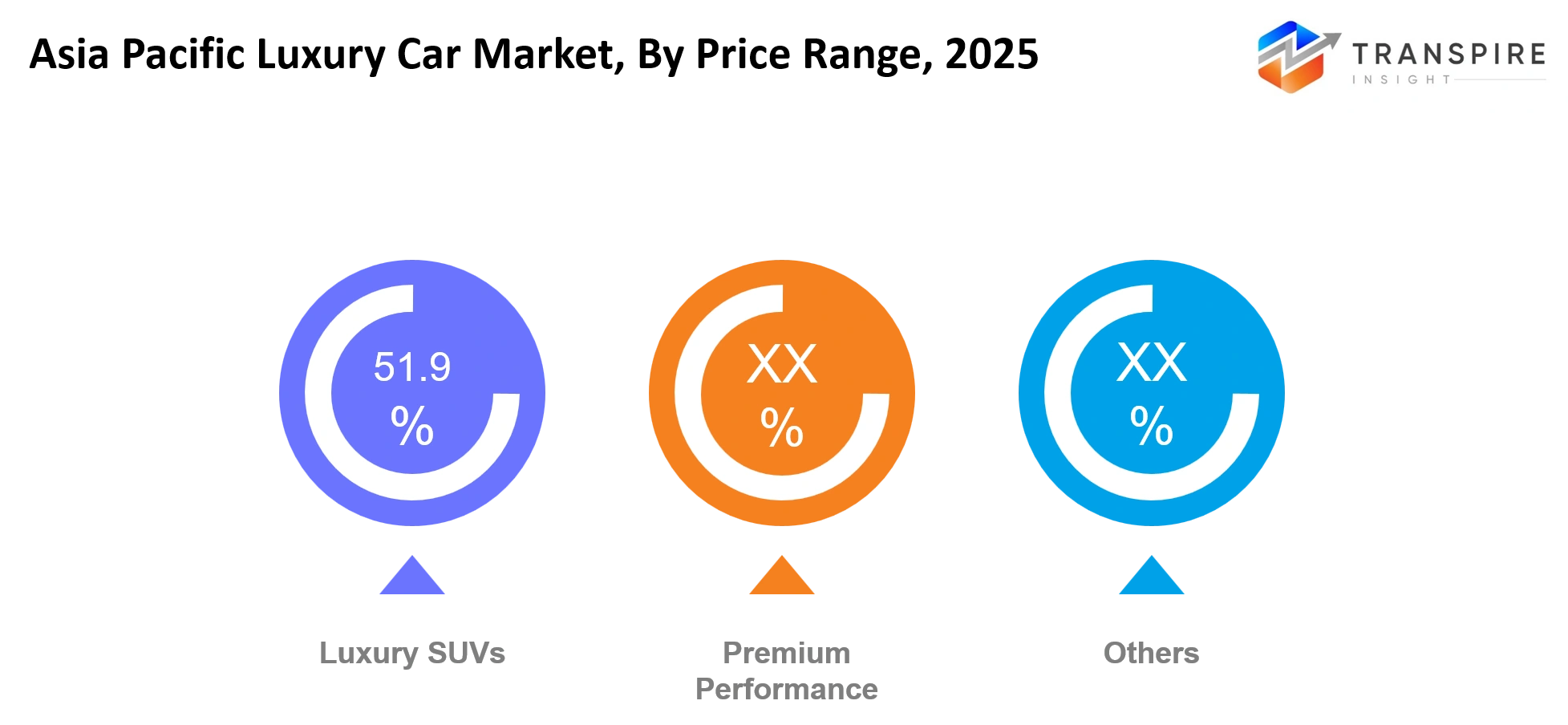
Entry luxury vehicles take up a lot of the market , because people buying premium for the first time are basically hunting for smart advanced tech, comfort that feels effortless and also the brand cachet, all while staying in the more reachable price band. Mid luxury models still get strong attention from professionals and business owners, who want a bit more refinement and added features, but they don’t want to jump into the absolute top price tier. Ultra luxury vehicles keep a steady rhythm too, pulled along by high-net-worth customers who want exclusivity, handcrafted interiors, and a sort of tailor-made ownership experience. Premium performance models keep drawing enthusiasts as well, thanks to strong engines and advanced driving systems that feel responsive and precise .
Car makers keep growing their lineups across multiple price levels, so they can meet a wider set of buyers. On top of that, flexible financing approaches plus customized ownership programs help keep momentum across the various premium segments. And still, differentiation by means of technology and design is a main competitive lever .
By End User :
Individual buyers are still the biggest customer cluster, mostly because personal ownership keeps mirroring lifestyle preferences, premium mobility, and that longer arc of perceived value. There’s also strong curiosity about linked technologies, electrification, and slightly tailored, customized features. That blend tends to steer buying choices among wealthier households even when budgets get tight. Corporate buyers, on the other hand, keep a more stable rhythm for executive transportation and for senior management mobility needs. Premium fleet upgrades likewise help sales within business organizations , in a pretty direct way.
Meanwhile rental and leasing companies keep enlarging their premium vehicle fleets to cover luxury travel and shorter term mobility needs. Government organizations, for their part, select premium vehicles for official transportation, plus diplomatic assignments. Beyond that, other institutional buyers offer extra avenues too, including specialized use cases and commercial expectations.
By Distribution Channel :
Authorized dealerships stay the main sales route, largely because people tend to want that bit of professional guidance, proper vehicle demonstrations, steady financing help and then the after service backing before they go ahead with those premium purchases. At the same time, luxury car showrooms keep pushing customer engagement forward, kinda through personalized moments, private feeling product displays, and that curated showroom vibe. Direct sales are still growing too, mostly as manufacturers tweak how they interact with buyers and build stronger brand loyalty. And, digital retail platforms sort of tie things together by making it easier to compare options quickly, plus handle booking processes without much hassle.
Online sales, meanwhile, keep getting more weight, helped by virtual consultations, digital financing, and even home delivery arrangements for certain models. Manufacturers also keep investing in unified sales platforms that blend the physical experience with the digital one, so customers don’t feel split between channels and convenience is higher, customer satisfaction too. Using multiple distribution channels lets brands reach broader audiences, but they still aim to keep premium service standards in place.
What are the Key Use Cases Driving the Asia Pacific Luxury Car Market?
Luxury SUVs still kinda stay the main use case, because business owners, senior executives, and affluent families want premium rides that mix comfort, safety and day to day practicality, at the same time. The demand looks strong in personal ownership too, since buyers care about advanced tech, roomy interiors and the ability for long hauls without much hassle.
Corporate mobility plus premium rental services are still expanding across big metropolitan areas. Corporate buyers increasingly pick luxury vehicles for executive transport, and at the same time hospitality firms and premium leasing providers are beefing up their fleets, to better serve business travelers and high-value clients.
Battery electric luxury models are opening fresh doors as emission policies push low carbon mobility across several Asia Pacific countries. Software enabled premium vehicles, with connected services and advanced driver assistance systems, are also pulling in tech minded buyers, and that in turn supports a slower steady push into future mobility applications.
|
Report Metrics |
Details |
|
Market size value in 2025 |
USD 243.6 Billion |
|
Market size value in 2026 |
USD 260.9 Billion |
|
Revenue forecast in 2033 |
USD 422.9 Billion |
|
Growth rate |
CAGR of 7.14% from 2026 to 2033 |
|
Base year |
2025 |
|
Historical data |
2021 - 2024 |
|
Forecast period |
2026 - 2033 |
|
Report coverage |
Revenue forecast, competitive landscape, growth factors, and trends |
|
Regional scope |
Asia Pacific (India, China, Japan, Australia, South Korea, Rest of Asia Pacific) |
|
Key company profiled |
Mercedes-Benz, BMW, Audi, Lexus, Porsche, Volvo Cars, Jaguar Land Rover, Tesla, Rolls-Royce Motor Cars, Bentley Motors, Ferrari, Lamborghini, Maserati, Genesis, Acura. |
|
Customization scope |
Free report customization (country, regional & segment scope). Avail customized purchase options to meet your exact research needs. |
|
Report Segmentation |
By Vehicle Type (Sedans, SUVs, Hatchbacks, Coupes, Convertibles, Sports Cars, Others); By Propulsion (Internal Combustion Engine, Hybrid Electric, Battery Electric, Plug-in Hybrid, Hydrogen Fuel Cell, Others); By Price Range (Entry Luxury, Mid Luxury, Ultra Luxury, Premium Performance, Others); By End User (Individual Buyers, Corporate Buyers, Rental & Leasing Companies, Government Organizations, Others); By Distribution Channel (Authorized Dealerships, Online Sales, Direct Sales, Luxury Car Showrooms, Others). |
Which Regions are Driving the Asia Pacific Luxury Car Market Growth?
China takes the lead in regional revenue, roughly 46% , and it keeps kind of influencing premium vehicle sales all across Asia Pacific. With strong government backing for electric mobility, better charging infrastructure rolling out, and fairly strict vehicle emission rules, the move toward luxury electrified models has sped up. On top of that, the region benefits from wide manufacturing capacity, local battery production, premium technology suppliers , and ongoing investment from major global car makers, so the whole ecosystem stays sturdy. And then, when you add high consumer spending , nonstop product upgrades, and software-defined vehicle features getting broader, market leadership should stay in place during the forecast window.
Japan, meanwhile, comes in as the second-biggest regional market, but its foundation feels more like engineering sharpness and steady replacement demand, not a quick push for huge volumes. Regulatory settings are consistent, automotive standards are already mature , and the economic backdrop is pretty predictable, so premium vehicle players get a dependable stage. There are also strong domestic luxury marques, solid research muscle, and a dependable supplier web that keep production and revenue ticking along. Customer loyalty tends to last, plus ongoing investment in hybrid and premium mobility solutions, and that should help preserve stable market performance through the next few years.
India is expected to post the quickest growth through the whole forecast window , as premium vehicle ownership keeps rolling into fresh urban hubs. In the last few years, higher infrastructure outlays , a more extensive charging network rollout , and policy support for electric mobility have basically boosted the market pace. Meanwhile, the whole wealth building trend is expanding, financing options have gotten easier to access, and dealership reach keeps growing , so first-time luxury buyers keep getting pulled in across several cities. All these changes should open up nice prospects for automakers, technology suppliers, and investors looking for steady long range expansion somewhere between 2026 and 2033.
Who are the Key Players in the Asia Pacific Luxury Car Market and How Do They Compete?
Competition across the Asia Pacific Luxury Car Market still feels moderately consolidated, mostly because only a handful of global premium manufacturers grab a big chunk of regional sales. Instead of competeing purely on price, the main fight is really about tech innovation, electrification, connected vehicle software, and that kind of premium customer experience people get used to. The big, established players keep defending their market share via localized production, plus digital services that feel seamless. At the same time, newer premium electric vehicle brands—almost like they came in with a software first mindset—are challenging the older groups with products that roll out faster, and in a more iterative manner, if that makes sense.
BMW, for example, builds competitiveness with dedicated luxury electric vehicle platforms, advanced digital cockpit technologies, and regional manufacturing investments that help improve delivery efficiency. Mercedes-Benz differentiates with premium driver assistance systems, luxury interior design, and a more strategic push into electric vehicle production plus charging partnerships across Asia. Audi keeps investing in connected mobility technologies and software integration, so premium buyers can get frequent digital feature upgrades during their ownership period, not just at purchase time.
Lexus maintains an edge through hybrid know-how, reliability, and customer service, while also expanding electrified premium vehicles across regional markets. Porsche focuses on high performance luxury mobility, supported by premium charging partnerships, personalized vehicle customization, and continued investment in battery electric sports vehicle development. Taken together, these somewhat distinct strategies help manufacturers maintain customer loyalty while they respond to shifting technology preferences and the evolving regulatory requirements around them.
Company List
- Mercedes-Benz
- BMW
- Audi
- Lexus
- Porsche
- Volvo Cars
- Jaguar Land Rover
- Tesla
- Rolls-Royce Motor Cars
- Bentley Motors
- Ferrari
- Lamborghini
- Maserati
- Genesis
- Acura
Recent Development News
In March 2025, BMW Group and Alibaba expanded their strategic partnership to integrate Alibaba's Qwen large language model into BMW's Neue Klasse vehicles for China. The collaboration strengthens AI-powered in-car experiences and reinforces BMW's localization strategy in the region.
Source: https://www.alibabagroup.com/
In April 2025, Mercedes-Benz unveiled the Vision V concept and multiple China-focused vehicle technologies at Auto Shanghai 2025. The launch highlighted the company's continued investment in premium digital mobility and localized innovation for its largest regional market.
Source: https://group.mercedes-benz.com/
What Strategic Insights Define the Future of the Asia Pacific Luxury Car Market?
Over the next five to seven years, the Asia Pacific Luxury Car Market is likely headed toward software-defined electrified premium mobility, with regional manufacturing expansion and advanced digital ecosystems in the mix rather than leaning on vehicle hardware alone. The way value gets made will increasingly hinge on connected services, artificial intelligence, and recurring software revenue that’s built right into premium ownership, not just the car purchase. There is also a less obvious risk, and it comes from the concentration of battery materials, semiconductor production, and advanced electronic components in a relatively small number of supply networks. That situation can throw off production timelines, even if consumer spending stays pretty strong.
At the same time, an interesting opening is forming in India and Southeast Asia, where premium electric mobility infrastructure and localized production investments are giving room for long-term growth to take hold. For manufacturers and investors, the ones who gain the most will probably be those who craft resilient regional supply chains, push localized research along with production depth, and reinforce partnerships around charging infrastructure , battery technology and digital mobility services before competitive intensity climbs even more.
Asia Pacific Luxury Car Market Report Segmentation
By Vehicle Type
- Sedans
- SUVs
- Hatchbacks
- Coupes
- Convertibles
- Sports Cars
By Propulsion
- Internal Combustion Engine
- Hybrid Electric
- Battery Electric
- Plug-in Hybrid
- Hydrogen Fuel Cell
By Price Range
- Entry Luxury
- Mid Luxury
- Ultra Luxury
- Premium Performance
By End User
- Individual Buyers
- Corporate Buyers
- Rental & Leasing Companies
- Government Organizations
By Distribution Channel
- Authorized Dealerships
- Online Sales
- Direct Sales
- Luxury Car Showrooms
Frequently Asked Questions
Find quick answers to common questions.
The expected Asia Pacific Luxury Car Market size for the market will be USD 422.9 Billion in 2033.
Key segments for the Asia Pacific Luxury Car Market are By Vehicle Type (Sedans, SUVs, Hatchbacks, Coupes, Convertibles, Sports Cars, Others); By Propulsion (Internal Combustion Engine, Hybrid Electric, Battery Electric, Plug-in Hybrid, Hydrogen Fuel Cell, Others); By Price Range (Entry Luxury, Mid Luxury, Ultra Luxury, Premium Performance, Others); By End User (Individual Buyers, Corporate Buyers, Rental & Leasing Companies, Government Organizations, Others); By Distribution Channel (Authorized Dealerships, Online Sales, Direct Sales, Luxury Car Showrooms, Others).
Major Asia Pacific Luxury Car Market players are Mercedes-Benz, BMW, Audi, Lexus, Porsche, Volvo Cars, Jaguar Land Rover, Tesla, Rolls-Royce Motor Cars, Bentley Motors, Ferrari, Lamborghini, Maserati, Genesis, Acura.
The Asia Pacific Luxury Car Market size is USD 243.6 Billion in 2025.
The Asia Pacific Luxury Car Market CAGR is 7.14% from 2026 to 2033.
- Mercedes-Benz
- BMW
- Audi
- Lexus
- Porsche
- Volvo Cars
- Jaguar Land Rover
- Tesla
- Rolls-Royce Motor Cars
- Bentley Motors
- Ferrari
- Lamborghini
- Maserati
- Genesis
- Acura
About the Authors

Mayur Shinde
I am Mayur Shinde, a Senior Research Analyst at Transpire Insight, specializing in the Automotive & Transportation and Information & Communication Technology (ICT) Industry. My work focuses on analyzing emerging market trends, technological advancements, competitive landscapes, and industry developments to deliver accurate, data-driven insights. I am passionate about transforming complex market information into clear, actionable content that helps businesses, professionals, and decision-makers stay informed and make confident strategic decisions.

Chakradhar Khansole
Chakradhar serves as the Research Director at Transpire Insight, bringing over 8 years of experience in technology, innovation, and strategic market intelligence. He specializes in transforming complex market data into actionable business insights that enable organizations to make informed, growth-oriented decisions. Recognized for his strategic vision and analytical expertise, Chakradhar leads high-impact research initiatives, delivering comprehensive market assessments, competitive intelligence, and forward-looking industry analysis.
Recently Published Reports
-
Apr 2026
ATV & UTV Market
ATV & UTV Market Size, Share & Analysis Report By Type (ATV, and UTV), By Variants (Less Than 400 CC, 400 CC To 800 CC, and More Than 800 CC), and Geography (North America, Europe, Asia-Pacific, Middle East and Africa, South and Central America), 2021 - 2031
-
Apr 2026
Automotive Central Gateway Module Market
Automotive Central Gateway Module Market Size, Share & Analysis Report By Type (Ethernet Central Gateway Module, CAN Central Gateway Module, LIN Central Gateway Module, and FlexRay), By Application (Powertrain Control, Body Control, Infotainment System, Advanced Driver Assistance Systems (ADAS), and Others), By End User (Passenger Vehicles, and Commercial Vehicles), and Geography (North America, Europe, Asia-Pacific, Middle East and Africa, South and Central America), 2021 - 2031
-
Apr 2026
Automotive Engine Oil Filter Market
Automotive Engine Oil Filter Market Size, Share & Analysis Report By Filter Type (Fuel Filter, Engine Oil Filter, Hydraulic Oil Filter, and Others), By Filter Media (Cellulose, Synthetic, and Micro), By Sales Channel (OEMs, and Aftermarket), By Vehicle Type (Passenger Cars, Light Commercial Vehicles, Heavy Duty Trucks, Buses and Coaches, and Off-road Vehicles), and Geography (North America, Europe, Asia-Pacific, Middle East and Africa, South and Central America), 2021 - 2031
-
Apr 2026
Automotive Parts Aluminium Die Casting Market
Automotive Parts Aluminium Die Casting Market Size, Share & Analysis Report By Production Process (Pressure Die Casting, Vacuum Die Casting, Squeeze Die Casting, Gravity Die Casting), By Application (Body Parts, Engine Parts, Transmission Parts, Battery And Related Components, Other Application Types), and Geography (North America, Europe, Asia-Pacific, Middle East and Africa, South and Central America), 2021 - 2031
Our Clients



