

Asia Pacific Laundry Care Market Size & Forecast:
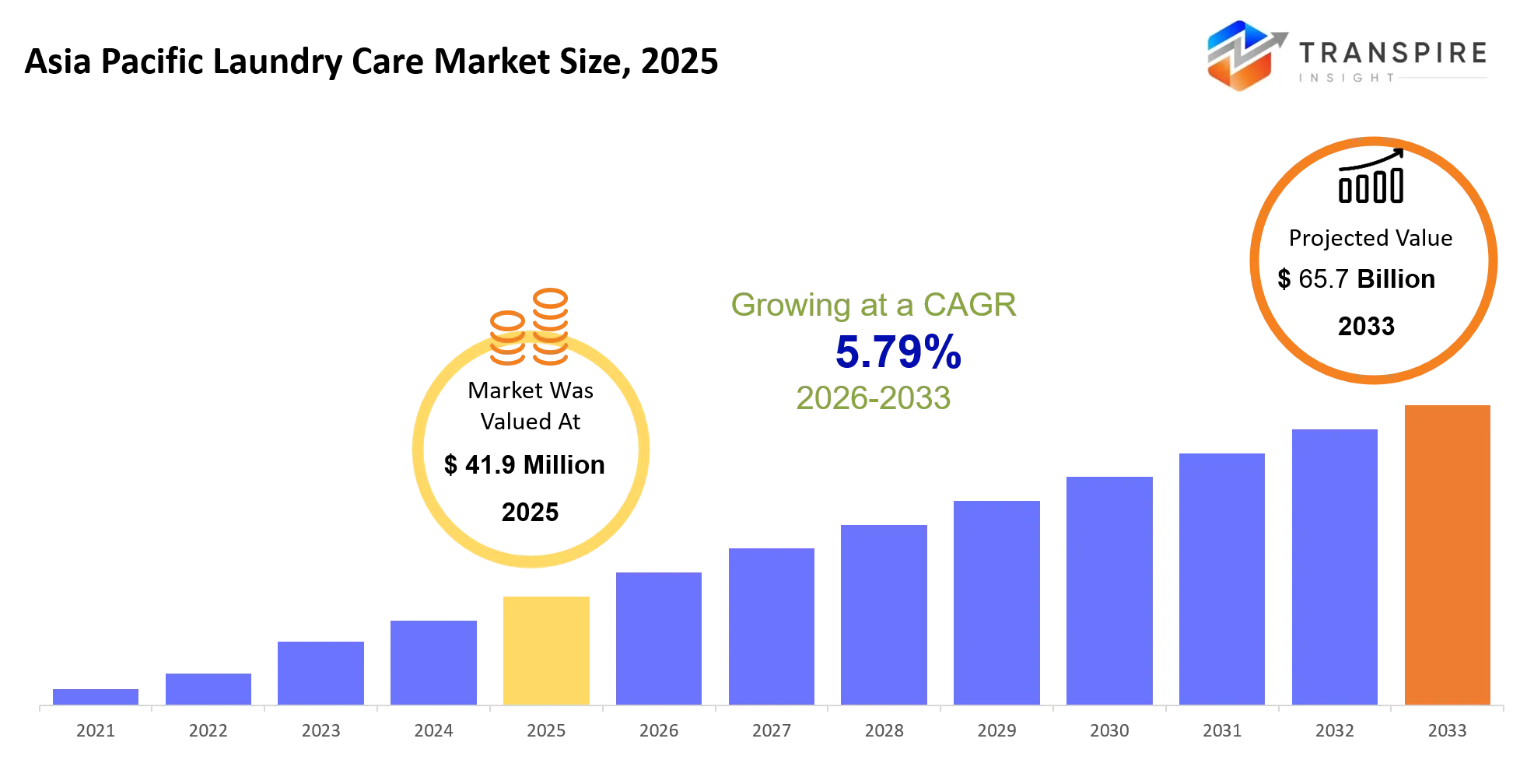
- Asia Pacific Laundry Care Market Size 2025: USD 41.9 Billion
- Asia Pacific Laundry Care Market Size 2033: USD 65.7 Billion
- Asia Pacific Laundry Care Market CAGR: 5.79%
- Asia Pacific Laundry Care Market Segments: By Product Type (Detergents, Fabric Softeners, Stain Removers, Bleach, Laundry Additives, Others); By Form (Liquid, Powder, Pods, Sheets, Others); By Distribution Channel (Supermarkets, Convenience Stores, Online Retail, Others); By End User (Households, Commercial Laundry, Hospitality, Others)
To learn more about this report,  Download Free Sample Report
Asia Pacific Laundry Care Market Summary
The Asia Pacific Laundry Care Market was valued at USD 41.9 Billion in 2025. It is forecast to reach USD 65.7 Billion by 2033. That is a CAGR of 5.79% over the period.
In practice, the Asia Pacific Laundry Care Market kind of supports cleaning, treatment, and ongoing maintenance of textiles across private households, and also in high-volume commercial environments like hospitality, healthcare, and industrial laundries that work with shipping fleets or manufacturing units. Basically it helps keep hygiene compliance on track, improve fabric durability and keep day-to-day operations efficient in places where linen gets turned over at scale all the time
Over the past 3–5 years the market has been leaning more toward concentrated enzyme based solutions and low-phosphate formulations, while institutional laundries have also been adopting automated dosing systems more widely. One noticeable structural change is the pivot away from traditional powder detergents, toward liquid and capsule formats, which are meant to boost dosage accuracy and cut down on waste. COVID-19 was sort of a big trigger, tightening hygiene protocols in hospitals, hotels and maritime operations, so companies moved faster toward disinfectant grade laundry chemicals and even higher outsourcing of laundry services. This overall shift then supported repeat institutional usage, and increased demand for compliance led efficiency solutions.
Key Market Insights
- Asia Pacific Laundry Care Market is kinda shifting more and more toward liquid detergents, mostly because dosing is more precise, fabrics stay safer, and there s also less chemical wastage in busy urban homes.
- On the other hand, Sustainability based blends using low-phosphate systems and biodegradable surfactants are getting momentum across the Asia Pacific Laundry Care Market too, as environmental rules keep getting stricter.
- China is still the biggest name in regional demand, with more than 35% share, backed by large scale manufacturing and really high household consumption intensity during 2025.
- India meanwhile is the quickest mover through 2032, mainly tied to rising disposable income and the rapid spread of organized retail distribution routes.
- And for products, detergents are still the top segment, taking the largest share, because household penetration is widespread and people tend to buy again on a regular basis.
- Liquid detergents look like the fastest-growing slice here, because people are moving toward convenience-first routines and those high-efficiency wash solutions that feel quicker.
- For where they’re used, it seems household applications still lead the way, yet commercial laundry services are growing at the quickest pace, especially across hospitality and healthcare.
- On the institutional side, demand from hotels, hospitals, and industrial laundries keeps rising, mainly tied to stricter hygiene expectations and the broader outsourcing mindset.
- Also, many companies are trying to harden their competitive edge through enzyme driven formulations, “smart” packaging concepts, and concentrated detergent formats, so they can cut transport overheads and lessen the environmental footprint a bit.
- And expansion into Southeast Asia is ramping up, as brands aim at fast-growing city clusters plus underpenetrated rural markets for detergent, which is kinda interesting, right.
What are the Key Drivers, Restraints, and Opportunities in the Asia Pacific Laundry Care Market?
The Asia Pacific Laundry Care Market mostly gets pushed along by fast changes in everyday city life, and also by a kind of standardization around institutional cleanliness. The biggest push though is the growth of organized hospitality and healthcare—those places use a lot more high-performance detergents and cleaning solutions that are basically disinfectant-grade. If you think about it, this whole direction really took off after the pandemic, when sanitation protocols became normal, so people and institutions ended up doing deeper cleaning cycles more often. That change in habits then supports repeat buying,and it also steadies revenue for manufacturers in both retail and commercial sales, so the cycle keeps going.
The main thing that holds it back is ongoing price sensitivity across a bunch of emerging economies, especially in rural plus semi-urban parts of Asia. This is kind of a structural wall, because it makes premium product entry harder. Consumers still lean toward low-cost powdered detergents, rather than the more advanced liquid or enzyme-driven alternatives. So manufacturers end up dealing with squeezed margins and slower uptake of higher-value formulations, which in turn reduces how much overall market value they can actually capture, even if total volumes keep rising.
Still, there’s a real opportunity in the fast digital retail expansion, plus subscription-style home delivery models, especially across Southeast Asia and India. E-commerce is letting brands deliver laundry products straight to consumers, and some systems even handle automated re-stocking. This can improve brand loyalty and increase how often people purchase. Firms that build localized supply chains, and go digital-first on distribution, look well placed to unlock the next growth stage for the Asia Pacific Laundry Care Market.
What Has the Impact of Artificial Intelligence Been on the Asia Pacific Laundry Care Market?
Artificial intelligence is slowly but surely, reshaping operational efficiency and product lifecycle optimization across the Asia Pacific Laundry Care Market, especially when it comes to industrial and institutional laundry setups. AI enabled automation is now being pushed into smart dosing systems, where detergent concentration gets regulated by load size, fabric category, and water condition. The result is less chemical waste and a more steady wash outcome, even for bigger facilities.
At the same time, machine learning models are being used more and more for predictive maintenance of industrial laundry gear. They can spot wear signals in washing machines, pumps, and thermal units well before a breakdown happens. In real-world commercial operations, like hotel laundries or hospital services, this translates into better equipment uptime, fewer surprise repairs, and smoother throughput performance.
From an operational angle, AI powered analytics platforms are also steering water and energy usage. This leads to real, measurable reductions in utility spend and helps with meeting environmental discharge requirements. The same tools can back up performance comparisons across multiple site laundry networks, which then supports smarter resource allocation choices.
Still, there is a big catch: data availability can be inconsistent, and system integration gets pretty complex across the fragmented laundry infrastructure seen across Asia Pacific. A lot of mid-sized operators continue using older machines without IoT connectivity, which basically slows down, or even blocks, the broader scaling of AI models. It also makes real-time optimization harder across the overall scrubber performance systems and the wider industrial laundry ecosystem.
Key Market Trends
- After 2021 liquid detergent adoption kind of jumped sharply, swapping out powder type formats across urban households in the Asia Pacific Laundry Care Market, sort of like a quiet replacement that happened fast.
- In 2022, enzyme based formulations expanded. Manufacturers did more than just tweak, they reformulated to align with tougher wastewater discharge rules in China and India, which frankly nudged the whole product direction.
- Smart dosing systems started getting real traction in institutional laundries after 2023, and that reduced detergent overuse by almost 15–20% in the bigger facilities.
- COVID-19 also rearranged demand patterns in a lasting way. From 2020 onward it drove higher disinfectant-grade laundry chemicals across hospitals, and hospitality too, and it stayed that way.
- Post 2021 e-commerce channels grew noticeably. Platforms like Amazon India and Shopee changed how detergent moved around across Southeast Asia, making distribution feel different.
- Then in Japan and South Korea sustainability mandates came in stronger, so phosphate free detergent adoption accelerated, and older formulations got pushed away from premium retail shelves.
- Private label brands moved aggressively after 2022, grabbing price sensitive consumers. That also pressured established FMCG players across the Asia Pacific Laundry Care Market, more than people expected.
- In 2023–2025 industrial laundry outsourcing climbed, with hotels and hospitals reducing in house washing to lower labor, and also water costs, kind of double saving.
- Concentrated detergent formats rose quickly since 2022, reducing packaging waste while improving logistics efficiency for companies like Unilever and Procter & Gamble.
- Finally, regulatory tightening on microplastics and surfactant discharge reshaped development pipelines, which forced continuous reformulation across major Asia Pacific Laundry Care Market manufacturers, without a real break.
Asia Pacific Laundry Care Market Segmentation
By Product Type :
Detergents keep having the most usage in the Asia Pacific Laundry Care Market, because day to day washing needs stay pretty high across both households and commercial zones. There’s also a strong pull toward cost-effective cleaning solutions, so detergent consumption stays steady in many urban and semi-urban areas, not just in the biggest cities.
Fabric softeners plus stain removers keep getting taken up at a calm, consistent pace as shoppers start caring more about fabric maintenance, and they want longer clothing life. At the same time laundry additives and bleach products are moving forward in institutional cleaning setups, where hygiene expectations stay strict, and where deep-clean cycles happen again and again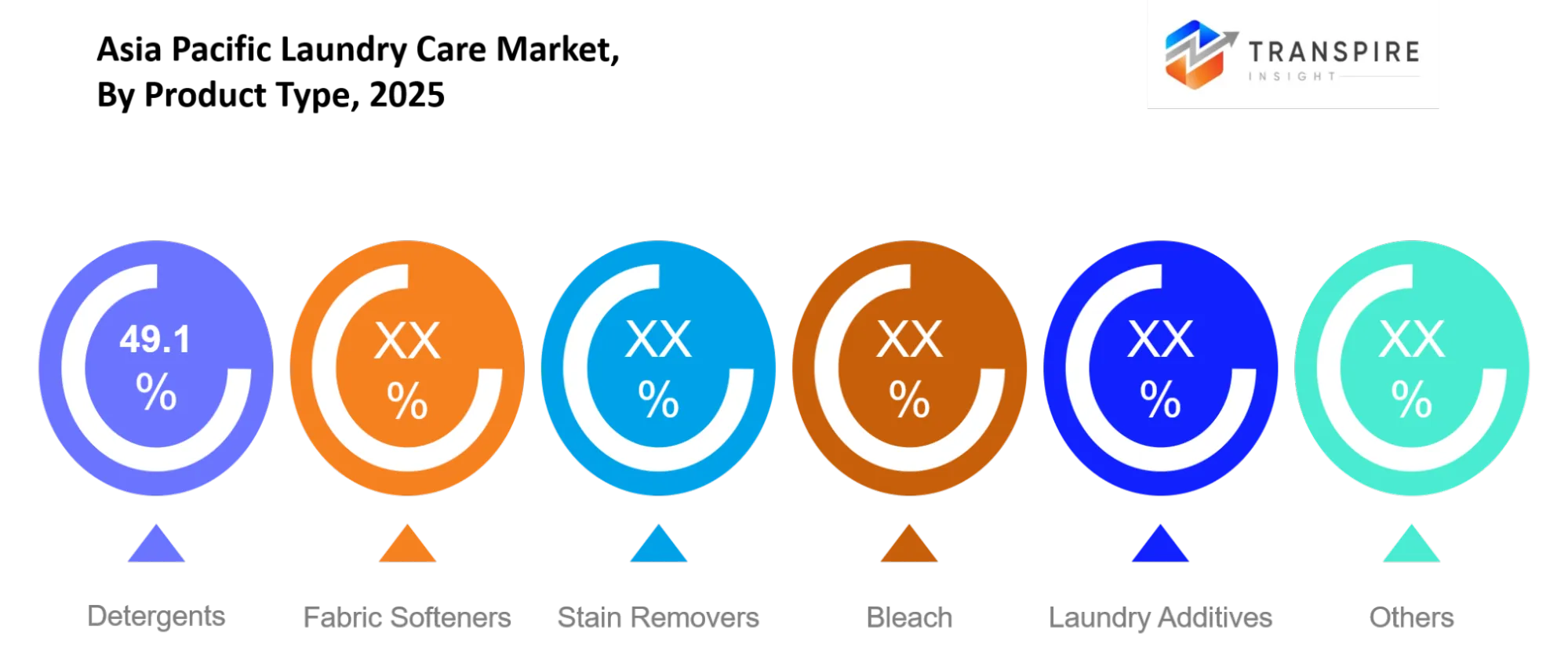
To learn more about this report, Download Free Sample Report
By Form :
Liquid detergents are also getting strong acceptance, mainly since they mix better, are simpler to measure, and show improved cleaning efficiency in the newer washing machines. And as automatic laundry systems spread across cities, that supports the movement toward liquid formats across the Asia Pacific Laundry Care Market, overall.
Meanwhile powder detergents still remain widely used in price-sensitive regions, where older style washing habits are still common. Pods and sheets are getting more attention slowly in premium urban areas, where convenience, easy portability, and more controlled dosing help reshape what consumers do.
By Distribution Channel :
Supermarkets keep going as a huge sales channel, because bulk buying behavior is still pretty strong with household consumers. In rural and semi-urban places, physical retail outlets still feel relevant too, since customers can just reach the product directly and then make repeat purchases faster maybe.
Online retail also grows quickly, especially as digital adoption rises across the Asia Pacific markets. Things like discount pricing, subscription based delivery models, and more product variety all help e-commerce sink deeper, so people start buying more often through a convenient home delivery system.
By End User :
For end users, households stay the biggest group, mostly since daily laundry requirements don’t really stop, and consumption trends are influenced by population size. Urban lifestyle shifts push customers toward more frequent washing and stronger interest in specialized cleaning products.
On the other hand, commercial laundry plus hospitality sectors are expanding even faster as more companies outsource laundry operations. Hotels, hospitals, and service facilities lean into professional laundry systems to boost hygiene compliance, cut down operational costs, and handle big textile workloads more efficiently, overall.
What are the Key Use Cases Driving the Asia Pacific Laundry Care Market?
Household fabric washing cleaning stays like the big core use case across the Asia Pacific Laundry Care Market, mostly because people still do routine washes and textiles seem to turnover quickly in city and semi urban homes. More people are getting laundry appliances at home, and they seem to prefer anything that saves time so detergent usage stays pretty steady. So yeah, everyday clothing care ends up being the biggest chunk of demand.
At the same time, commercial laundry services and hospitality groups are growing, like hotels, hospitals, and bigger residential buildings are outsourcing their washing to cut down on costs. Healthcare organizations too lean into intense wash cycles to stay aligned with hygiene protocols, and that in turn lifts demand for disinfectant-grade laundry products plus specialized cleaning mixtures.
Then there are the newer angles too, like industrial textile upkeep and those on-demand laundry subscription services. Factories and production units are using more controlled wash routines for workwear maintenance, while digital platforms are also enabling scheduled pickup and drop-off models. This ends up boosting convenience, and it helps standardize the way fabrics are treated across many urban markets.
|
Report Metrics |
Details |
|
Market size value in 2025 |
USD 41.9 Billion |
|
Market size value in 2026 |
USD 44.3 Billion |
|
Revenue forecast in 2033 |
USD 65.7 Billion |
|
Growth rate |
CAGR of 5.79% from 2026 to 2033 |
|
Base year |
2025 |
|
Historical data |
2021 - 2024 |
|
Forecast period |
2026 - 2033 |
|
Report coverage |
Revenue forecast, competitive landscape, growth factors, and trends |
|
Regional scope |
Asia Pacific (India, China, Japan, Australia, South Korea, Rest of Asia Pacific) |
|
Key company profiled |
P&G, Unilever, Henkel, Reckitt, Kao, Lion Corporation, Church & Dwight, SC Johnson, Amway, Nirma, Godrej, RSPL, Colgate-Palmolive, LG Household & Health Care, Wings Group |
|
Customization scope |
Free report customization (country, regional & segment scope). Avail customized purchase options to meet your exact research needs. |
|
Report Segmentation |
By Product Type (Detergents, Fabric Softeners, Stain Removers, Bleach, Laundry Additives, Others); By Form (Liquid, Powder, Pods, Sheets, Others); By Distribution Channel (Supermarkets, Convenience Stores, Online Retail, Others); By End User (Households, Commercial Laundry, Hospitality, Others) |
Which Regions are Driving the Asia Pacific Laundry Care Market Growth?
China is still basically the top region in the Asia Pacific Laundry Care Market, mainly because it has such a huge urban population and it keeps a strong manufacturing base for consumer cleaning products. Also, really strict rules about wastewater discharge have forced detergent companies to reformulate quickly, so people are seeing more higher-value options and they start adopting them faster. On top of that, there is a very dense retail distribution setup across tier 1 and tier 2 cities, so products stay on shelf and the replacement demand stays high. And since the FMCG supply chains are already well established, both local and international brands can scale quickly, without too much delay.
Japan and South Korea work more like steady support, with demand coming from high hygiene expectations plus regular cycles of product upgrading. They’re a bit different from China, since growth there is not mostly about total volume, it’s more about value, like concentrated detergent formats and premium positioning that consumers actually prefer. Strong regulatory oversight on chemical safety and packaging waste also helps keep innovation moving, but it doesn’t cause those big sudden demand swings. Because consumers tend to stick with known brands for a long time, manufacturers usually get predictable revenue streams in these markets.
India is moving the fastest, and that’s because household income is rising, urban clusters are expanding, and retail penetration is improving even in smaller cities. People have also been gradually shifting from informal detergent use to branded products, and that shift has sped up lately due to organized trade growth, plus digital commerce expansion. On top of that, government-led sanitation programs affect how often detergents get used in both rural and urban areas, not just one side. Overall, this momentum is creating solid entry chances for global and regional players, especially for those trying to widen their distribution footprint between 2026 and 2033.
Who are the Key Players in the Asia Pacific Laundry Care Market and How Do They Compete?
Competition in the Asia Pacific Laundry Care Market is still, pretty much, moderately consolidated, but it kinda feels more split in practice. Global FMCG players hold the premium and mass-market areas while regional companies push hard on price. The incumbents keep defending share via brand strength, product reformulation, and broad distribution reach through supermarkets, plus a growing set of online channels. Overall competition is mostly driven by product innovation, cost-efficient pricing, and localized marketing approaches that fit both urban and rural shoppers a bit differently.
Unilever plays the scale card cost leadership with an actually strong brand presence—in household detergents across Asia Pacific. It keeps widening that edge using concentrated detergent formats and sustainability-led formulations that help cut down packaging and logistics expenses. Growth continues through deep retail relationships and digital commerce tie-ins, especially across the faster-growing South Asian markets.
Procter & Gamble tends to win through technology-led differentiation, mainly with enzyme-based cleaning systems that boost stain removal while also allowing lower wash temperatures. Its approach leans on premium brand messaging and ongoing product enhancements, so it feels easier to defend those higher price points in bigger urban areas. And for reach, distribution expansion is being reinforced through e-commerce platforms, which supports deeper penetration in India and across Southeast Asia.
Henkel, on the other hand, builds strength via specialized mixes aimed at fabric care results and industrial-grade cleaning effectiveness. The differentiator is its chemical innovation know-how, along with partnerships with institutional laundry operators. Moving forward, growth is supported by a more selective expansion into commercial laundry services, plus sustainability-certified detergent lines across the region.
Company List
- P&G
- Unilever
- Henkel
- Reckitt
- Kao
- Lion Corporation
- Church & Dwight
- SC Johnson
- Amway
- Nirma
- Godrej
- RSPL
- Colgate-Palmolive
- LG Household & Health Care
- Wings Group
Recent Development News
In September 2025, MAXI-PRESS announced the acquisition of Filterfab Pty Ltd and Filterfab NZ Limited. The deal strengthens its consumables and after-sales portfolio for industrial laundry operations across Australia and New Zealand, improving service reach in healthcare and institutional cleaning segments. Source https://www.maxi-press.com/
In April 2026, Purex launched redesigned concentrated liquid laundry detergent formulations with enhanced cleaning efficiency and improved sustainability profile. The product upgrade reflects growing industry movement toward high-efficiency, lower-waste detergent systems across global laundry care markets. Source https://www.prnewswire.com/
What Strategic Insights Define the Future of the Asia Pacific Laundry Care Market?
In the Asia Pacific Laundry Care Market, things are kind of moving, not just in a straight line but more structurally, toward high-efficiency, low-waste, and digitally assisted cleaning systems over the next 5–7 years. That’s happening because of urban density going up, stricter rules around environmental discharge, and also more automation showing up in institutional laundry operations. What you see next is demand that keeps leaning into concentrated liquids, enzyme-driven formulations, and service-led approaches that cut down water and energy use in both homes and commercial spaces, kind of at the same time.
There’s also a risk that’s less obvious on the surface. It’s the growing dependency on specific raw materials, like specialty surfactants and bio-based inputs, which are still exposed to supply volatility and price swings across the global chemical supply chains. Even if the end-market demand stays fairly steady, this can squeeze margins, especially for mid-tier manufacturers that don’t have much sourcing flexibility, so they can’t really shift quickly when prices move.
But there’s an opportunity too, and it feels pretty timely. In Southeast Asian megacities, companies can integrate subscription laundry services with smart appliance ecosystems. Digital retail adoption is accelerating there faster than traditional retail growth, so instead of just one-time detergent purchases you can build recurring revenue streams. In practice, firms should push for localized production networks along with digital-first distribution strategies, to help lock in longer consumer retention and to lower the exposure to import-driven cost fluctuations.
Asia Pacific Laundry Care Market Report Segmentation
By Product Type
- Detergents
- Fabric Softeners
- Stain Removers
- Bleach
- Laundry Additives
By Form
- Liquid
- Powder
- Pods
- Sheets
By Distribution Channel
- Supermarkets
- Convenience Stores
- Online Retail
By End User
- Households
- Commercial Laundry
- Hospitality
Frequently Asked Questions
Find quick answers to common questions.
The Asia Pacific Laundry Care Market size is USD 65.7 Billion in 2033.
Key Segments for the Asia Pacific Laundry Care Market are By Product Type (Detergents, Fabric Softeners, Stain Removers, Bleach, Laundry Additives, Others); By Form (Liquid, Powder, Pods, Sheets, Others); By Distribution Channel (Supermarkets, Convenience Stores, Online Retail, Others); By End User (Households, Commercial Laundry, Hospitality, Others).
Major Asia Pacific Laundry Care Market Players are P&G, Unilever, Henkel, Reckitt, Kao, Lion Corporation, Church & Dwight, SC Johnson, Amway, Nirma, Godrej, RSPL, Colgate-Palmolive, LG Household & Health Care, Wings Group.
The Asia Pacific Laundry Care Market size is USD 41.9 Billion in 2025.
The Asia Pacific Laundry Care Market CAGR is 5.79% from 2026 to 2033.
- P&G
- Unilever
- Henkel
- Reckitt
- Kao
- Lion Corporation
- Church & Dwight
- SC Johnson
- Amway
- Nirma
- Godrej
- RSPL
- Colgate-Palmolive
- LG Household & Health Care
- Wings Group
About the Authors

Chetan Dhatrak
I’m Chetan Dhatrak, a Senior Research Analyst at Transpire Insight, specializing in the Consumer Goods, Foods and Beverages industry. I focus on analyzing market trends, consumer behavior, competitive landscapes, and industry developments to deliver accurate, data-driven insights. My research at Transpire Insight is built on credible sources and in-depth analysis, helping businesses and readers better understand market dynamics, emerging opportunities, and evolving consumer preferences. I’m committed to creating reliable, well-researched content that supports informed decision-making and reflects the latest developments in the consumer goods and food & beverage sectors.

Chakradhar Khansole
Chakradhar serves as the Research Director at Transpire Insight, bringing over 8 years of experience in technology, innovation, and strategic market intelligence. He specializes in transforming complex market data into actionable business insights that enable organizations to make informed, growth-oriented decisions. Recognized for his strategic vision and analytical expertise, Chakradhar leads high-impact research initiatives, delivering comprehensive market assessments, competitive intelligence, and forward-looking industry analysis.
Recently Published Reports
-
Apr 2026
Bottled Water Market
Bottled Water Market Size, Share & Analysis Report By Product Type (Still Bottled Water, Carbonated Bottled Water, Functional Bottled Water, and Others), By Packaging (PET, Cans, and Others), By Sales Channel (Supermarkets/Hypermarkets, Convenience Stores/Drug Stores, Grocery Stores/Club Stores, Foodservice, and Others) and Geography (North America, Europe, Asia-Pacific, Middle East and Africa, South and Central America), 2021 - 2032
-
Apr 2026
Color Cosmetic Packaging Market
Color Cosmetic Packaging Market Size, Share & Analysis Report By Application (Mascara Packaging, Liquid Packaging, and Liquid Face), By Type (Tubes & Bottles, Pens & Markers, Compacts & Containers, and Droppers & Pumps), and Geography (North America, Europe, Asia-Pacific, Middle East and Africa, South and Central America), 2021 - 2031
-
Apr 2026
External Microphone For Camera Market
External Microphone For Camera Market Size, Share & Analysis Report By Type (Shotgun Microphone, Lavalier Microphone, and Others), By Application (Digital Camera, Professional Video Camera, and Others), and Geography (North America, Europe, Asia-Pacific, Middle East and Africa, South and Central America), 2021 - 2031
-
Apr 2026
Foot Orthotic Insoles Market
Foot Orthotic Insoles Market Size, Share & Analysis Report By Type (Pre-fabricated, and Custom-made), By Material (Thermoplastic, Composite Carbon Fiber, and Others), By Distribution Channel (Drug Stores, Hospitals & Clinics, and Others), and Geography (North America, Europe, Asia-Pacific, Middle East and Africa, South and Central America), 2021 - 2031