

Asia Pacific Isobutanol Market Summary
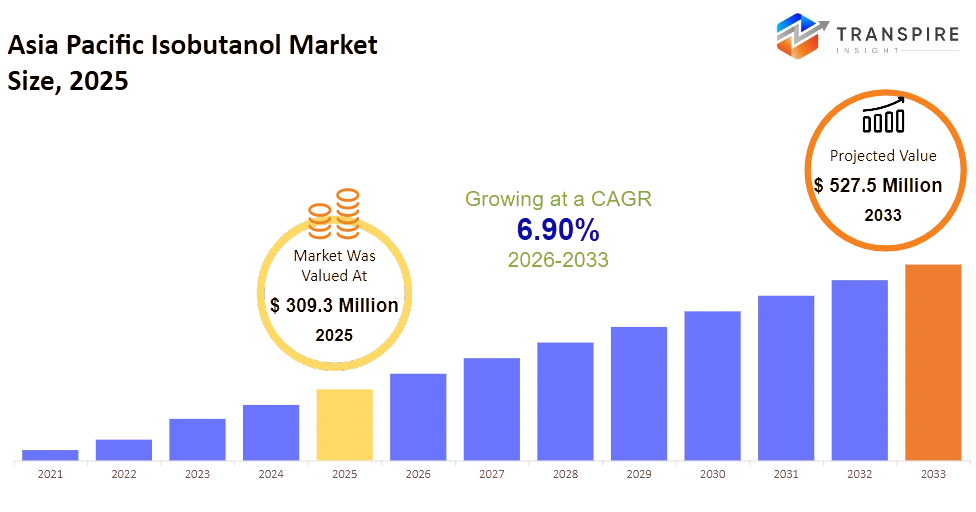
As per Transpire Insight Analysis, the Asia Pacific Isobutanol Market size is estimated at USD 309.3 Million in 2025 and is anticipated to reach USD 527.5 Million by 2033, growing at a CAGR of 6.90% from 2026 to 2033.
The Asia Pacific isobutanol market provides a sort of all around chemical used to nudge coatings, adhesives, lubricants, plastics, fuel additives, and also specialty chemicals into better performance. It helps manufacturers reach improved durability, smoother processing efficiency, and more stable formulations, you know. At the same time, it backs industrial output because it acts as an important intermediate, for derivatives that get used across construction, automotive, packaging and broader chemical manufacturing.
In the last five years, the market has been moving more and more toward lower-carbon production paths, and the momentum seems to have picked up fast. Bio based isobutanol, plus “cleaner” manufacturing technologies, has drawn real commercial attention, even while traditional petrochemical routes are still in the mix. Environmental rules that push for fewer emissions, along with supply chain disruptions during and after the pandemic, basically pushed makers to rethink raw material sourcing, and to build stronger regional production ability.
Because of all this, companies have accelerated investment in capacity expansion and process optimization. This lets suppliers lock in longer term contracts. Meanwhile downstream industries get the chance to use higher-value formulations, which can improve day to day operational performance and also open up stronger revenue prospects across the regional chemical value chain.
Asia Pacific Isobutanol Market Size & Forecast:
- Asia Pacific Isobutanol Market Size 2025: USD 309.3 Million
- Expected Market Value 2033: USD 527.5 Million
- Forecast CAGR: 6.90%
- Leading region in 2025: China
- Fastest Growing country: India
- Key Profile: BASF, Dow, OQ Chemicals, Eastman Chemical, Gevo, Butamax Advanced Biofuels, Mitsubishi Chemical, KH Neochem, Sasol, Evonik Industries, Solvay, INEOS Oxide, LG Chem, Sinopec, PetroChina
Key Market Insights
- China kinda led the regional market in 2025, with around 46% market share, and that was backed up by integrated petrochemical capacity plus big downstream chemical manufacturing pull.
- India, on the other hand, is set to be the fastest-growing regional market over 2025–2033, largely because fresh chemical manufacturing investments are coming in, along with domestic production expansion.
- On the product side, Synthetic isobutanol stayed out in front, basically holding nearly 72% market share in 2025, since the petrochemical feedstock availability is already well established.
- Meanwhile, bio-based isobutanol sits as the second-largest product segment. This happened as commercial-scale projects rolled out across selected Asia Pacific economies after 2023, not all at once but still fairly quickly.
- Bio-based isobutanol is also forecast to grow the fastest through 2033, supported by renewable fuel programs and further sustainable chemical production investments.
- For applications, chemical intermediates were the top choice in 2025, at about 38% market share, which points to solid demand from downstream specialty chemical production.
- Fuel additives are expected to become the fastest-growing application from 2025–2033, mainly tied to cleaner fuel blending needs and refinery modernization efforts.
- In terms of end-use, chemical manufacturing remained the leading segment, taking nearly 44% market share in 2025 , supported by the ongoing rise in regional industrial output.
- Automotive chemicals are projected to register the fastest growth in the end-user category during the forecast period, as advanced lubricant and coating formulations keep getting adopted.
What are the Key Drivers, Restraints, and Opportunities in the Asia Pacific Isobutanol Market?
The main growth engine is basically the push to expand downstream specialty chemical manufacturing across China, India, and Southeast Asia. New capacity in coatings , adhesives, plasticizers and fuel additives has bumped up demand for isobutanol as a key building block intermediate. At the same time, tighter fuel quality rules and tougher industrial emission standards are pushing refiners and chemical producers toward higher performance formulations. Each extra downstream production line, kind of reinforces the upstream purchasing volumes . So this straight connection backs stronger revenues for nearby producers, and it also ends up pulling more investment into manufacturing scale.
The biggest brake though is feedstock price whiplash plus supply concentration risks. Isobutanol manufacture relies a lot on petrochemical raw materials, so its costs move with crude oil and natural gas markets. If you want alternative production sites, you still need major capital, long permitting timelines, and real technical know-how, which makes quick diversification hard. From the Transpire Insight look at regional procurement announcements and the launch timing schedules, supply chain concentration stays the main execution risk. Production hiccups, lower margins because operating conditions get compressed, and expansion projects that get shifted out… all those things keep the market from reaching its full potential during periods when raw materials get disrupted.
There is a real chance right now in doing commercial- scale bio based isobutanol production that is kinda backed by industrial biotechnology and newer fermentation methods . In Asia Pacific, a bunch of governments are putting money into low carbon chemical manufacturing , and at the same time multinational companies are hunting for renewable feedstocks for niche chemicals and even sustainable aviation fuel supply chains. India and parts of Southeast Asia look especially promising , mostly because they are growing bio refining investments, they have agricultural feedstock options, and their industrial policy support is moving forward. Basically, the players that lock in reliable biomass supply over the long run and also can scale up fermentation technologies will be in a strong place to win the next phase of expansion in the regional market .
What Has the Impact of Artificial Intelligence Been on the Asia Pacific Isobutanol Market?
Artificial intelligence along with digital technologies are starting to reshape isobutanol production, mainly by boosting plant efficiency and keeping processes steadier, plus helping with day to day operational choices. More and more chemical producers are rolling out AI centered process control setups that watch things like reaction temperatures, how well the catalyst behaves, emissions levels, and even energy use, all basically in real time. At the same time, automated quality control cuts down on production swing , and it also supports facilities in meeting stricter environmental rules that keep tightening. Then machine learning is used to forecast raw material needs, tune inventory plans, and flag equipment problems early, so failures don’t suddenly stop output. With predictive maintenance in place, unplanned shutdowns go down, equipment life tends to stretch out , and overall plant utilization gets better. That means producers can trim maintenance expenses without sacrificing steady output. Digital twins let operators test production modifications ahead of time, so capacity expansions come with less operational risk . And advanced analytics, sort of quietly, push feedstock utilization and energy efficiency higher, which improves production economics across linked chemical sites. Still, AI uptake isn’t effortless. A lot of older manufacturing facilities run on legacy control systems, and those often need expensive retrofits before advanced analytics can work the way it should. Also, differences in data quality across several production units can mess with prediction precision, especially when the chemical reactions are more complicated, which slows how fast digital transformation can deliver its full operational value across the regional isobutanol market.
Key Market Trends
- Since 2022, bio-based isobutanol projects have gotten a lot faster, mostly because industrial biotechnology kept improving the commercial production economics, and the whole product scaling side too.
- During 2023–2025 , Chinese producers pushed further into integrated petrochemical operations, which in turn made regional supply security feel more solid, and exports more competitive in practice.
- Chemical manufacturers meanwhile invested more often in digital process optimization after 2023, so production efficiency climbed , and operational downtime dropped, even if the results were not always instant.
- Fuel additive demand actually got stronger from 2022 through 2025, as refiners started upgrading blending capabilities so they could meet tighter fuel specifications, you know the kind that keep changing.
- Also, companies diversified raw material sourcing after pandemic-related disruptions, which helped lower procurement risk across the Asia Pacific chemical value chains, at least compared with earlier periods.
- India then showed stronger specialty chemical investment commitments across 2024–2026, so this should support future isobutanol consumption across industrial applications over time.
- BASF and Mitsubishi Chemical Group expanded their technology investments , aiming to lift process efficiency and enable higher-value downstream chemical production.
- And fermentation technology advances since 2023 have made the commercial story better for renewable isobutanol , especially when used in specialty chemicals, and in sustainable fuels too.
- Finally, regional manufacturers signed long-term supply agreements with downstream chemical producers, so revenue visibility improved and production planning looks steadier through 2033.
Asia Pacific Isobutanol Market Segmentation
By Product Type :
Synthetic isobutanol seems to hold the biggest share because chemical manufacturers leaned on familiar petrochemical production, pretty steady product quality, and dependable large scale supply. There was also strong push from coatings , solvents, plasticizers ,and industrial chemicals so output stayed fairly consistent across major manufacturing hubs. A lot of the big integrated chemical plants kind of helped too, since feedstock was available more efficiently, and that kept production costs competitive. Overall, stable supply chains and mature manufacturing know how just reinforced the position of this segment across many regional industries.
Meanwhile, bio based isobutanol showed the quickest expansion. That growth followed more investments in fermentation technology and the ongoing rise of renewable chemical production. High purity isobutanol, in particular, got more traction in pharmaceutical and specialty chemical manufacturing, where consistency really stayed a must. Industrial grade isobutanol kept solid demand from adhesives, coatings, and everyday industrial processing because it offers broad application flexibility. And the other specialty grades also opened up extra room for growth, since advanced manufacturing sectors often need tailored chemical formulations, not just a one size fit approach.
By Application :
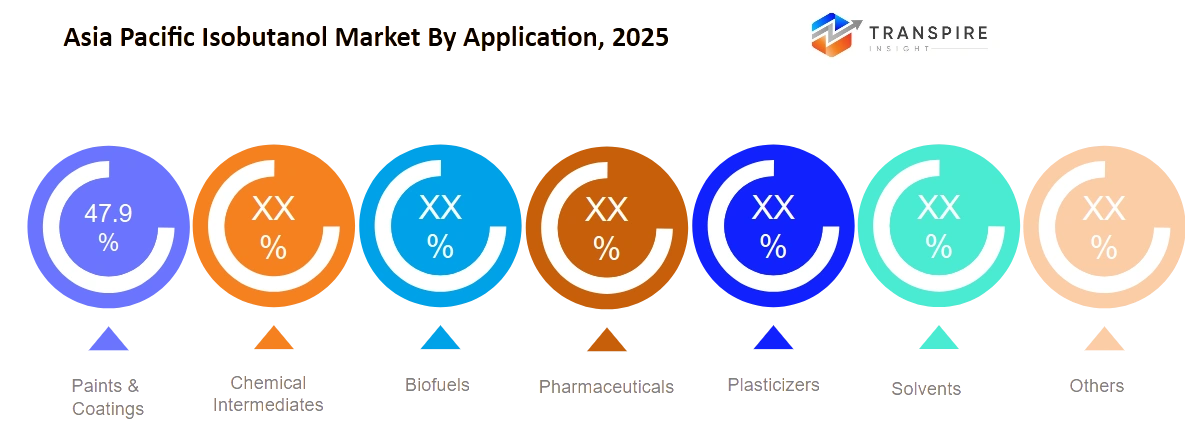
Chemical intermediates ended up being the leading kind of use, because isobutanol acted like a key building material for several downstream, very specialized chemicals. More room in production for plasticizers, acrylates, and some other industrial chemicals helped keep consumption steady across most manufacturing sites. Ongoing spending on specialty chemical output also pushed longer purchasing arrangements between suppliers and industrial buyers. On top of that, higher manufacturing capacity across Asia Pacific made demand feel even stronger from this area.
Biofuels showed up as the fastest moving application, since the push for renewable fuels brought in extra industrial investment and policy backing. Paints and coatings stayed solid too, mainly when construction activity and automotive manufacturing were running across developing economies. Pharmaceutical uses grew in a steady way, because high purity materials became more valuable inside certain specialized processing steps. And then solvents, plasticizers and a bunch of other industrial purposes kept demand reasonably even across multiple manufacturing segments.
By End User :
The chemical industry stayed the biggest end-user because isobutanol supported production across lots of downstream value chains, more or less. Big scale manufacturing of coatings, specialty chemicals, solvents, and plasticizers created fairly stable purchasing volumes across the forecast. When production is integrated, facilities tend to improve supply efficiency, and also cut operating costs for chemical manufacturers, honestly. And the continuous push for specialty chemical capacity helped reinforce long term market stability, which matters.
For the energy sector, growth is expected to be the fastest, mainly with the growing attention in renewable fuels and advanced fuel blending technologies. Automotive manufacturers kept on using isobutanol derived products in coatings, lubricants, and performance chemicals , which then improved overall product quality. In construction, activity backed the demand through protective coatings, adhesives, and sealants, especially for commercial and infrastructure projects. Even pharmaceutical manufacturing added steady momentum, since it requires specialized chemical processing and tightly controlled inputs.
By Distribution Channel :
Direct sales make up the biggest chunk, largely because big industrial buyers seemed to favor long term supply contracts with manufacturers, to keep product quality steady and pricing predictable. When orders were high volume, production plans got easier, and logistics handling was more efficient. There was also this strong relationship between producers and major chemical companies, which helped keep procurement consistent across different regional markets. Buying in bulk is reduced, both transportation costs and inventory hold costs, quite a bit too.
Online procurement is expected to grow the quickest, since digital purchasing platforms improved price transparency and also sped up the whole procurement cycle. Chemical distributors carried on serving mid sized manufacturers who want flexibility in order sizes and a wider product selection. With digital supply chain management, inventory planning and order tracking became simpler, for industrial customers. Meanwhile, other distribution channels stayed fairly steady, helping with niche product needs and giving local market access.
By Production Process :
Petrochemical synthesis stayed the main production way because already built infrastructure sort of holds everything up, supports big production volumes and a dependable commercial supply. The mature manufacturing know-how kept delivering steady product quality too, partly because integrated refinery and petrochemical operations stay tightly connected. Big facilities also manage to hit better production efficiency via optimized process control and dependable feedstock availability. And overall, strong industrial demand keeps backing investments into conventional production capacity.
Fermentation is expected to grow the quickest, since renewable feedstocks and biotechnology upgrades make commercial viability more realistic. More work in industrial biotechnology should improve production efficiency while nudging manufacturing toward lower‑carbon routes. Money going into pilot plants and then commercial-scale bio-based facilities will likely open brand new business chances across the regional chemical industry. Meanwhile, the other production options will still matter for specialized manufacturing needs and for future process innovation, just not as the top choice in general.
What are the Key Use Cases Driving the Asia Pacific Isobutanol Market?
Chemical intermediate production still feels like the biggest use case, because specialty chemical makers kind of rely on isobutanol to make plasticizers, acrylates, and other things downstream too. Big chemical producers buy steady volumes, so their manufacturing stays continuous, and the product quality stays fairly stable across several industrial value chains, even when demand shifts a little.
Biofuel blending and high-performance coatings are also getting more traction these days. Energy companies are looking at isobutanol for cleaner fuel formulations that can match newer emission rules, and at the same time, paint and coating manufacturers use it so formulations behave better for automotive, construction, plus industrial customers that ask for durable finishes.
On top of that, new opportunities are showing up in sustainable aviation fuel feedstocks and bio-based specialty chemicals, especially where advanced fermentation technologies are involved. Industrial biotechnology groups and renewable chemical developers are putting more money into these paths, since governments push lower-carbon manufacturing, and because businesses are actively trying to find alternative feedstocks that lessen dependence on conventional petrochemical sources.
|
Report Metrics |
Details |
|
Market size value in 2025 |
USD 309.3 Million |
|
Market size value in 2026 |
USD 330.6 Million |
|
Revenue forecast in 2033 |
USD 527.5 Million |
|
Growth rate |
CAGR of 6.90% from 2026 to 2033 |
|
Base year |
2025 |
|
Historical data |
2021 - 2024 |
|
Forecast period |
2026 - 2033 |
|
Report coverage |
Revenue forecast, competitive landscape, growth factors, and trends |
|
Regional scope |
Asia Pacific (India, China, Japan, Australia, South Korea, Rest of Asia Pacific) |
|
Key company profiled |
BASF, Dow, OQ Chemicals, Eastman Chemical, Gevo, Butamax Advanced Biofuels, Mitsubishi Chemical, KH Neochem, Sasol, Evonik Industries, Solvay, INEOS Oxide, LG Chem, Sinopec, PetroChina . |
|
Customization scope |
Free report customization (country, regional & segment scope). Avail customized purchase options to meet your exact research needs. |
|
Report Segmentation |
By Product Type (Bio-Based Isobutanol, Synthetic Isobutanol, High-Purity Isobutanol, Industrial Grade Isobutanol, Others); By Application (Paints & Coatings, Chemical Intermediates, Biofuels, Pharmaceuticals, Plasticizers, Solvents, Others); By End User (Chemical Industry, Automotive, Construction, Pharmaceuticals, Energy, Others); By Distribution Channel (Direct Sales, Chemical Distributors, Online Procurement, Others); By Production Process (Fermentation, Petrochemical Synthesis, Others) |
Which Regions are Driving the Asia Pacific Isobutanol Market Growth?
China showed up for roughly 46% of regional revenue in 2025, so East Asia is kinda the main growth hub for isobutanol both consumption and output. The whole thing is kept strong by industrial policies that back petrochemical growth, integrated refining capacity, and chemical manufacturing clusters, it’s still a big reinforcement. Big local producers, plus well known downstream chemical manufacturers, and also logistics systems that run pretty smoothly, all together build a pretty dependable supply ecosystem. That ecosystem then feeds coatings, plasticizers, solvents, and specialty chemicals production. And with investments that keep moving ahead, process modernization, capacity upgrades, and advanced manufacturing, regional leadership should stay in place across the forecast window.
Japan comes next as the second major regional contributor, but the way it grows feels more anchored in technological specialization, not just production size. Environmental rules stay steady, industrial standards remain consistent, and long-term funding in specialty chemicals forms dependable buying behavior across pharmaceuticals, electronics, and advanced materials. The emphasis on high-value manufacturing tends to pull demand toward premium chemical grades, rather than plain commodity-focused output. This setup gives more predictable revenue streams and keeps long-term supplier connections more stable even though capacity expansion stays on the moderate side.
India is expected to see the fastest growth across the forecast period, as chemical manufacturing investments and industrial infrastructure projects start to accelerate, a bit like a slow build that suddenly gets momentum. Production-linked incentives, an expansion of specialty chemical capacity, and rising domestic processing capabilities have already boosted industrial demand in recent years. At the same time, more money flowing into renewable chemicals, plus upgrades to modern production facilities, is opening up fresh opportunities for both traditional manufacturing and bio-based manufacturing. If industrial expansion keeps strengthening between 2026 and 2033, it should bring favorable conditions for capacity additions, strategic partnerships, and long-term investments across the regional value chain, in other words it becomes a pretty solid platform to grow.
Who are the Key Players in the Asia Pacific Isobutanol Market and How Do They Compete?
Competition across the Asia Pacific isobutanol market is still, sort of moderately consolidated because making it really needs quite a lot of capital investment , plus integrated feedstock access and some advanced processing technology. Cost efficiency and manufacturing scale keep staying the main competitive levers, while tech development and specialty product quality offer extra separation. Meanwhile, the already established producers keep pushing into more capacity and squeezing better operational efficiency out of their sites, and at the same time biotechnology companies are bringing in renewable alternatives which gradually nudge the competitive landscape.
BASF strengthens its position by putting ongoing money into process optimization, along with specialty chemical integration, so it can run efficient production and keep product quality consistent across several industrial uses. OXEA stays centered on high-performance oxo intermediates and differentiated product grades, backed by manufacturing expertise that works well for customers who need dependable technical specifications, without surprises. Mitsubishi Chemical Group leans into advanced materials and technology led product development, which creates value for industries that expect premium chemical performance.
Mitsui Chemicals is expanding its regional work a bit more, via investments into downstream chemical applications and also some strategic production muscle, that is meant to back long term industrial demand. Gevo meanwhile stands out because of its bio based isobutanol approach , which was developed for renewable fuels and for sustainable chemicals. At the same time, commercialization partnerships help sort of secure future market openings. And then Butamax Advanced Biofuels pushes forward fermentation know-how and renewable manufacturing processes, giving it that edge in low carbon chemical making, as industrial customers start diversifying feedstock sources and tightening up their sustainability plan.
Company List
- BASF
- Dow
- OQ Chemicals
- Eastman Chemical
- Gevo
- Butamax Advanced Biofuels
- Mitsubishi Chemical
- KH Neochem
- Sasol
- Evonik Industries
- Solvay
- INEOS Oxide
- LG Chem
- Sinopec
- PetroChina
Recent Development News
In September 2025, Frontier Infrastructure, Gevo, and Verity entered a strategic partnership to launch an integrated carbon management platform for ethanol producers. The collaboration supports lower-carbon production pathways for renewable isobutanol and related bio-based chemicals while improving commercial scalability for participating producers.
Source https://www.prnewswire.com/
In October 2025, Gevo completed the sale of Agri-Energy, LLC while retaining ownership of its patented isobutanol production equipment and associated technology rights. The transaction reduced idle facility costs and allowed greater focus on commercial deployment of renewable isobutanol technologies and future production investments.
Source https://investors.gevo.com/
What Strategic Insights Define the Future of the Asia Pacific Isobutanol Market?
The Asia Pacific Isobutanol Market will move toward a more diversified production structure over the next five to seven years , as specialty chemicals, renewable feedstocks, and advanced industrial manufacturing kinda reshape purchasing priorities. Value creation will increasingly depend on process efficiency, product quality, and linkages with downstream chemical value chains, not just on production volume alone. There is also a quieter risk that’s less visible, stemming from continued reliance on concentrated petrochemical feedstock supplies, where raw material disruptions or policy shifts tied to refinery operations could quickly squeeze margins and push back expansion plans.
At the same time, commercial scale fermentation technology , backed by industrial biotechnology investments in India and a few selected Southeast Asian economies, creates an opportunity that still feels underdeveloped but it’s getting more real and practical momentum. Market participants will do better when they secure long term feedstock agreements, while also putting capital into flexible production platforms that can handle both conventional grades and bio based grades. That way, adaptation is faster when industrial requirements change and when future sustainability standards come into play.
Asia Pacific Isobutanol Market Report Segmentation
By Product Type
- Bio-Based Isobutanol
- Synthetic Isobutanol
- High-Purity Isobutanol
- Industrial Grade Isobutanol
By Application
- Paints & Coatings
- Chemical Intermediates
- Biofuels
- Pharmaceuticals
- Plasticizers
- Solvents
By End User
- Chemical Industry
- Automotive
- Construction
- Pharmaceuticals
- Energy
By Distribution Channel
- Direct Sales
- Chemical Distributors
- Online Procurement
By Production Process
- Fermentation
- Petrochemical Synthesis
Frequently Asked Questions
Find quick answers to common questions.
The expected Asia Pacific Isobutanol Market size for the market will be USD 527.5 Million in 2033.
Key segments for the Asia Pacific Isobutanol Market are By Product Type (Bio-Based Isobutanol, Synthetic Isobutanol, High-Purity Isobutanol, Industrial Grade Isobutanol, Others); By Application (Paints & Coatings, Chemical Intermediates, Biofuels, Pharmaceuticals, Plasticizers, Solvents, Others); By End User (Chemical Industry, Automotive, Construction, Pharmaceuticals, Energy, Others); By Distribution Channel (Direct Sales, Chemical Distributors, Online Procurement, Others); By Production Process (Fermentation, Petrochemical Synthesis, Others).
Major Asia Pacific Isobutanol Market players are BASF, Dow, OQ Chemicals, Eastman Chemical, Gevo, Butamax Advanced Biofuels, Mitsubishi Chemical, KH Neochem, Sasol, Evonik Industries, Solvay, INEOS Oxide, LG Chem, Sinopec, PetroChina.
The Asia Pacific Isobutanol Market size is USD 309.3 Million in 2025.
The Asia Pacific Isobutanol Market CAGR is 6.90% from 2026 to 2033.
- BASF
- Dow
- OQ Chemicals
- Eastman Chemical
- Gevo
- Butamax Advanced Biofuels
- Mitsubishi Chemical
- KH Neochem
- Sasol
- Evonik Industries
- Solvay
- INEOS Oxide
- LG Chem
- Sinopec
- PetroChina
About the Authors

Pankaj Ghogare Patil
I am Pankaj Ghogare Patil, a Senior Research Analyst at Transpire Insight, specializing in the Pharmaceutical, Chemicals & Materials, Healthcare IT, and Biotechnology industry. My expertise lies in conducting comprehensive market research, analyzing industry trends, evaluating competitive landscapes, and translating complex data into actionable insights. At Transpire Insight, I closely follow emerging technologies, regulatory developments, and market innovations to create accurate, well-researched, and informative content that helps businesses and professionals make informed decisions. I am committed to producing credible, evidence-based articles that reflect industry best practices while making technical topics accessible and valuable for a broad audience.

Chakradhar Khansole
Chakradhar serves as the Research Director at Transpire Insight, bringing over 8 years of experience in technology, innovation, and strategic market intelligence. He specializes in transforming complex market data into actionable business insights that enable organizations to make informed, growth-oriented decisions. Recognized for his strategic vision and analytical expertise, Chakradhar leads high-impact research initiatives, delivering comprehensive market assessments, competitive intelligence, and forward-looking industry analysis.
Recently Published Reports
-
May 2026
Healthcare Polymer Packaging Market
Healthcare Polymer Packaging Market Size, Share & Analysis Report By Packaging Type (Syringes, IV Bottles and Pouches, Clamshells, Blisters, Bottles & Jars, Containers, Tubes, IV Parental Packaging, Others), By Type (Regulated, Non-regulated), By Polymer Type (LDPE (Low-Density Polyethylene), HDPE (High-Density Polyethylene), Homo-polymer (Homo), Random Copolymer (Random), Block Copolymer (Block), PET, Polystyrene, Polyvinyl Chloride, Polyamide/EVOH, Others), and Geography (North America, Europe, Asia-Pacific, Middle East and Africa, South and Central America), 2021 - 2031
-
Apr 2026
Hydrophilic Tape (Waterstop) Market
Hydrophilic Tape (Waterstop) Market Size, Share & Analysis Report By Type (Bentonite-Based Hydrophilic Tape, Rubber-Based Hydrophilic Tape), By Application (Residential Buildings, Commercial Buildings, Infrastructure Projects), and Geography (North America, Europe, Asia-Pacific, Middle East and Africa, South and Central America), 2021 - 2031
-
Apr 2026
Metalens Market
Metalens Market Size, Share & Analysis Report By Type (Visible Light Metalens, and Infrared Metalens), By Application (Consumer Electronics, Automotive Electronics, Industrial, Medical, and Others), and Geography (North America, Europe, Asia-Pacific, Middle East and Africa, South and Central America), 2021 - 2031
-
Apr 2026
PBT Resin Market
PBT Resin Market Size, Share & Analysis Report By Type (Reinforced PBT Resin, Unreinforced PBT Resin), By Processing Method (Injection Molding, Extrusion, Blow Molding, Others), By End-User (Automotive, Electrical & Electronics, Consumer Appliances, Industrial Machinery, Medical Devices, Packaging, Others), and Geography (North America, Europe, Asia-Pacific, Middle East and Africa, South and Central America), 2021 - 2031