
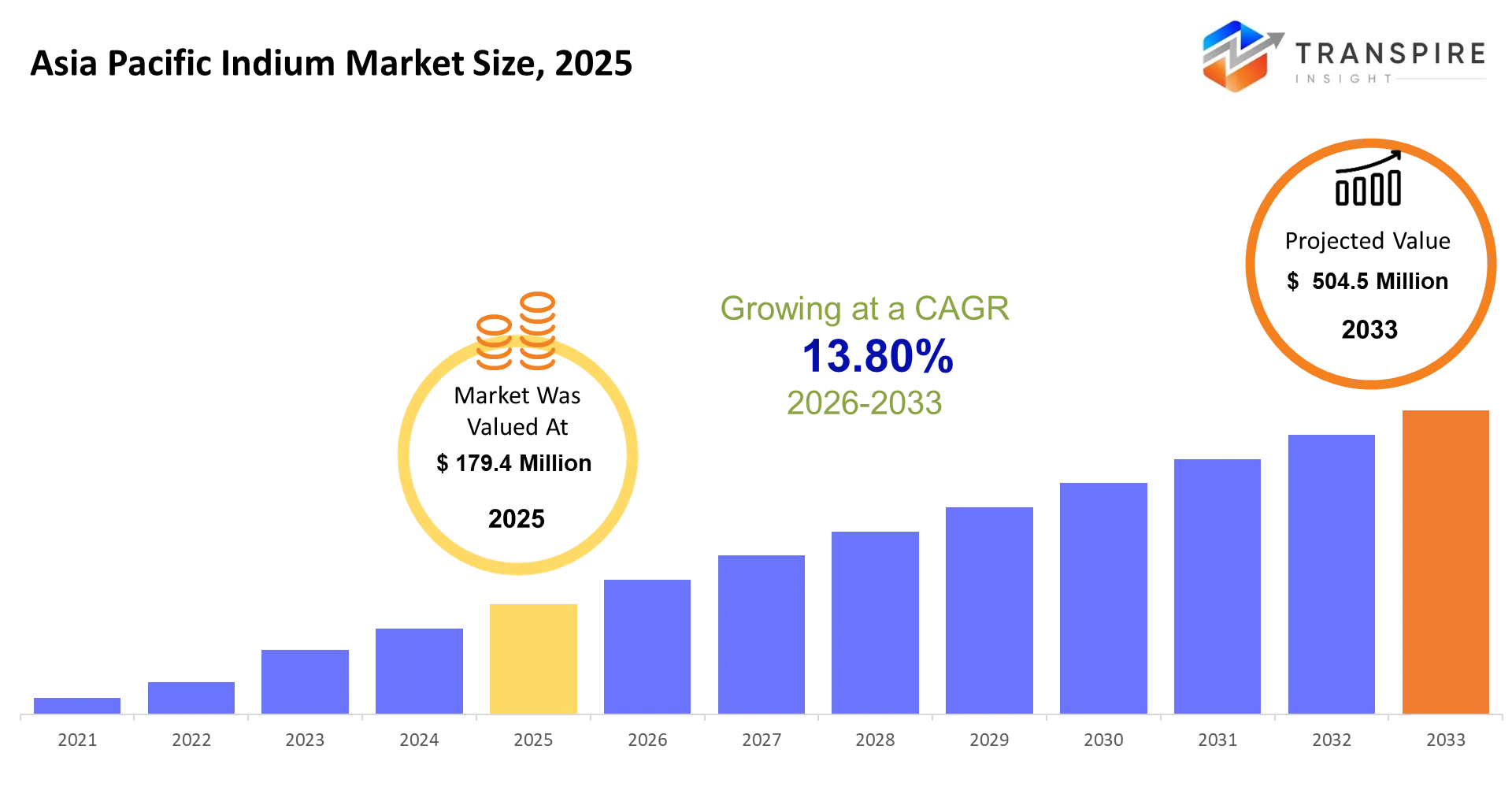
Asia Pacific Indium Market Size & Forecast:
- Asia Pacific Indium Market Size 2025: USD 179.4 Million
- Asia Pacific Indium Market Size 2033: USD 504.5 Million
- Asia Pacific Indium Market CAGR: 13.80%
- Asia Pacific Indium Market Segments: By Type (Primary Indium, Secondary Indium, Others); By Application (Semiconductors, LCD Displays, Solar Panels, Alloys, Others); By End-User (Electronics Industry, Solar Industry, Industrial Sector, Automotive Industry, Others); By Form (Ingot, Powder, Foil, Others)
To learn more about this report,  Download Free Sample Report
Asia Pacific Indium Market Summary
The Asia Pacific Indium Market was valued at USD 179.4 Million in 2025. It is forecast to reach USD 504.5 Million by 2033. That is a CAGR of 13.80% over the period.
The Asia Pacific Indium Market supports transparent conductive coatings used in display panels, touchscreens, semiconductors, and thin-film solar cells for modern electronics manufacturing. It enables responsive smartphones, clear flat-panel displays, and efficient photovoltaic layers used in energy systems.
The market experienced its first major transformation during the past five years because manufacturers switched their operations from LCD technology to OLED systems and advanced touch-capable devices, which required them to use indium with higher accuracy and follow stricter material standards. The supply-side situation worsened because geopolitical restrictions on essential mineral shipments from China combined with semiconductor production interruptions that occurred during the pandemic, which revealed the industry dependency on specific supply sources.
The system required companies to create inventory buffers, establish long-term purchasing agreements, and increase their efforts to recycle indium from industrial scrap materials. The electronics sector in Asia Pacific experiences its growth through supply chain security mechanisms and material efficiency advances.
Key Market Insights
- China controls more than 45% of the Asia Pacific Indium Market because of its smelting facilities and electronics production capabilities.
- Japan operates as a technology center which produces high-value indium and semiconductor-grade materials through its advanced indium refining processes.
- The period until 2026 will show India and Southeast Asia becoming the fastest-growing regions because of their electronics assembly growth and increased industrial investments.
- Indium tin oxide (ITO) materials hold the leading share of nearly 50% which results from their common application in display panels and touchscreens.
- The second-largest market segment consists of refined indium and alloys which industrial coatings and semiconductor applications use.
- The recycling of indium together with its secondary recovery methods has become the most rapidly expanding industry because organizations now prioritize supply chain security.
- The Asia Pacific Indium Market shows its main strength through display and touchscreen applications which hold a 55% market share that depends on the rising production of smartphones and panels.
- The application sector for semiconductor and advanced chip manufacturing shows the most rapid growth because of artificial intelligence and electronic devices becoming smaller.
- The market shows its highest demand from consumer electronics manufacturers who control more than 50% of the market through their production of smartphones, TVs and wearable technology.
- The renewable energy sector together with photovoltaic producers represents the most rapidly expanding end-user market because of thin-film solar technology development.
What are the Key Drivers, Restraints, and Opportunities in the Asia Pacific Indium Market?
The Asia Pacific Indium Market experiences market growth because advanced display manufacturing and semiconductor integration require more indium. The transition from conventional LCD systems to OLED and high-resolution touch-enabled panels has increased reliance on indium tin oxide coatings which serve as essential materials that provide both conductivity and transparency in modern electronics. The shift occurred because rapid consumer electronics upgrades happened across smartphones, wearables and automotive infotainment systems. The rising complexity of devices leads to more specialized indium use because manufacturers need specific materials which generate higher revenue through their specialized applications.
Indium supply exists under a major constraint because most of its production occurs as a byproduct during zinc refining processes. The process creates production restrictions because output follows base metal mining operations instead of responding to actual market demands. The market suffers from intermittent shortages and price fluctuations which force manufacturers to postpone their purchasing decisions and drive up their expenses for long-term contracts. Primary indium mining operations cannot solve the structural imbalance because they fail to achieve economic viability at large operational sizes.
Cities present their first chances through urban mining which enables them to extract indium from discarded electronic waste through recycling processes. Japan and South Korea are developing extraction technologies which enable them to recover indium from display scrap and semiconductor manufacturing waste. The development of this secondary supply chain enables price stabilization while facilitating the growth of the Asia Pacific Indium Market within high-tech manufacturing regions.
What Has the Impact of Artificial Intelligence Been on the Asia Pacific Indium Market?
The Asia Pacific Indium Market experiences transformation through artificial intelligence and advanced digital systems which enhance operational efficiency in refining and electronics manufacturing and recycling processes. AI-enabled control systems in industrial smelting and indium extraction processes optimize furnace temperatures while they track byproduct recovery and stabilize yield from zinc refining streams which contain indium. The process helps downstream electronics producers maintain supply reliability because it prevents material losses while recovering more materials.
Semiconductor and display manufacturing lines that use indium-based materials now employ predictive analytics models for their operations. The machine learning algorithms predict equipment deterioration in thin-film deposition systems and transparent conductive coating units which lets manufacturers execute maintenance tasks before equipment breakdowns. The production process now operates with higher efficiency because it has reduced unplanned downtime while increasing production uptime and decreasing scrap rates during high-precision display manufacturing. AI process optimization has enabled some facilities to achieve energy savings and better coating performance which meets their quality control requirements.
The process faces obstacles because mining and refining environments lack sufficient top-quality training data which results in operational variations and sensor integration difficulties. The AI system implementation process faces delays because legacy metallurgical infrastructure needs high upfront costs for AI system integration which particularly affects mid-scale processing facilities throughout developing regions of the area.
Key Market Trends
- The period from 2019 to 2021 witnesses an indium consumption pattern which begins with LCD devices and ends with OLED technology usage across Asian Pacific display manufacturing operations.
- The primary indium supply from China reached 45% by 2025, which led electronics manufacturers to implement strategies that decrease their dependency on other regions.
- The semiconductor industry improved its indium usage accuracy after 2022, which resulted in 12% material waste reduction through new thin-film deposition technology.
- Japan developed its indium recycling facilities after 2023 because urban mining operations supplied more than 15% of secondary materials used in electronic waste recovery systems.
- South Korean display manufacturers adopted ITO alternatives that provide better efficiency, which resulted in lower indium consumption per product while preserving required conductivity standards.
- The period from 2020 to 2022 experienced supply chain interruptions, which led companies to establish permanent indium supply agreements that ensured price certainty and revenue forecasting stability for their upstream operations.
- Indium tin oxide production processes shifted toward AI-assisted quality control systems after 2024, which enhanced coating consistency and decreased defect occurrence.
- Renewable energy manufacturers increased indium adoption in thin-film solar cells after 2023, driven by efficiency gains in lightweight photovoltaic modules.
- Smaller electronics hubs in Southeast Asia began using indium-based materials during 2024, which became possible when assembly operations moved from China to their locations.
Asia Pacific Indium Market Segmentation
By Type :
The ongoing mining operations in Asia Pacific nations together with their refining practices will ensure that primary indium production maintains its significance. The display and electronics manufacturing sector will create strong demand which will drive market growth. The regional market will experience supply stability and cost efficiency because industrial scrap recycling activities will boost secondary indium production.
Zinc ore processing will remain essential for primary indium supply because indium gets extracted as a byproduct during this process. Improved recycling systems for electronic waste will increase the amount of secondary indium that gets recovered. The category of "others" will contain niche sourcing methods which assist small-scale industrial operations and special applications.
By Application :
Indium use in semiconductors will grow because of increased chip production and rising demand for advanced electronics in the Asia Pacific region. LCD display manufacturing will continue to absorb large volumes, while solar panel applications will increase with renewable energy expansion. The industry will use alloys and other materials to meet their thermal and electrical performance requirements.
Indium serves as an essential component needed to create high-performance compounds which the semiconductor industry uses for electronic components. The existing production facilities throughout the region will sustain LCD displays as a primary application for display technology. Indium-based thin-film technologies will enhance solar panel efficiency, which will help energy efficiency goals. The other applications will encompass both coatings and materials designed for industrial use in specialized contexts.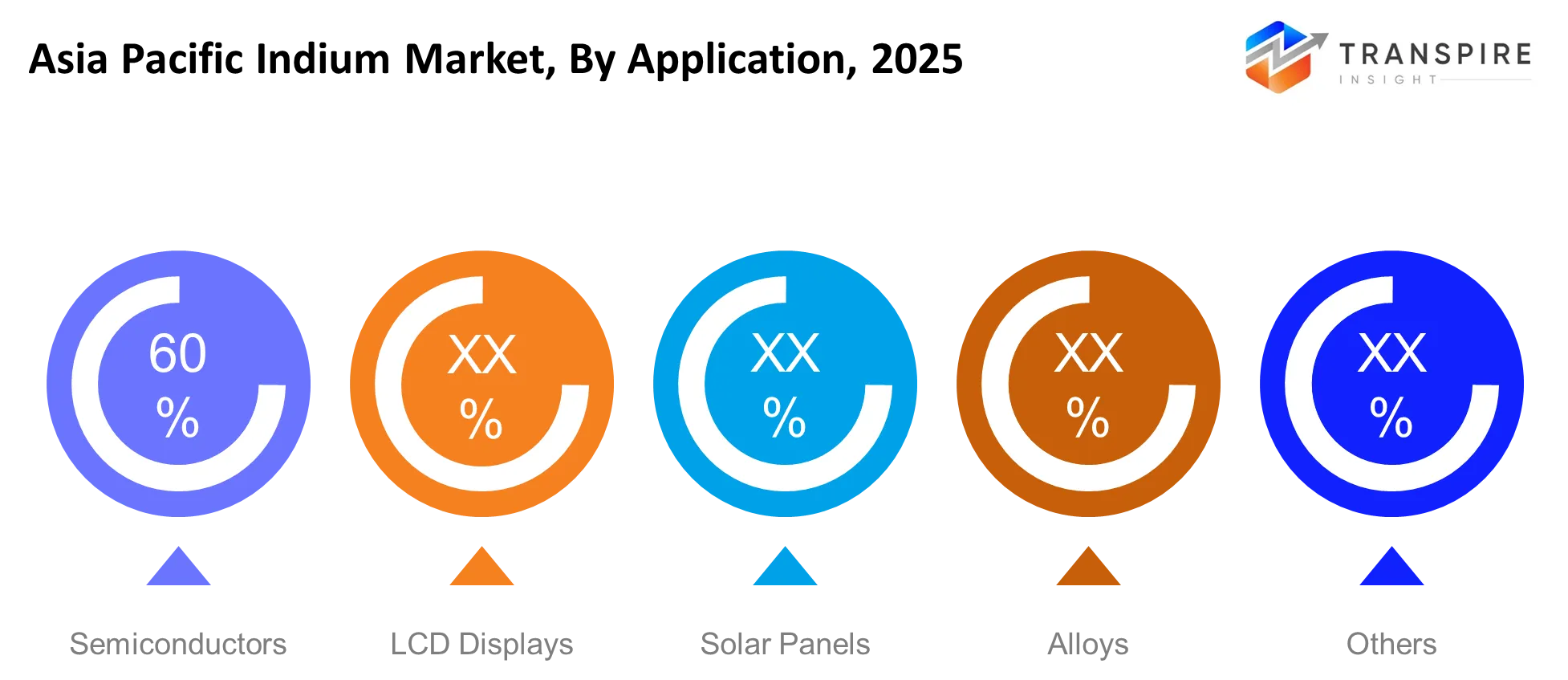
To learn more about this report, Download Free Sample Report
By End-User :
The electronics industry will use most of the indium supply because Asian countries will produce high volumes of smartphones screens and advanced devices. The solar industry will experience increased adoption as renewable installations continue to grow. Industrial and automotive sectors will provide support through their use of coatings, sensors, and performance materials which will create various demand patterns throughout their operations.
Electronics manufacturing will continue to be the primary end-user, driven by display and semiconductor production. The solar industry will experience higher demand through clean energy policies that support its development. Industrial sector usage will include thermal and conductive applications, while automotive industry adoption will focus on electronics integration and efficiency improvements.
By Form :
The industry needs ingot form material because it provides simple solutions for storage, transportation, and industrial material processing. The powder form will meet advanced manufacturing requirements, especially in the fields of electronics and coatings. The foil form will be utilized in specialized applications which demand thin, flexible, and conductive materials that operate at high-precision standards across different sectors.
The industrial supply chains will depend on ingot indium because it will support their operations and refining activities. The powder form will be preferred in applications requiring fine material control and precision manufacturing. The foil form will fulfill specialized needs in electronics and protective layers because these applications require flexibility and conductivity to achieve optimal performance.
What are the Key Use Cases Driving the Asia Pacific Indium Market?
The primary application of Indium in the Asia Pacific market is its use in transparent conductive coatings which display panels and touchscreens required for smartphones and televisions and automotive infotainment systems. The application creates maximum demand because indium tin oxide provides both electrical conductivity and optical transparency which modern high-resolution interactive devices require for production in China, Japan and South Korea.
Indium finds use in semiconductor fabrication and advanced chip packaging because it enables both thin-film deposition and thermal interface material functions. Consumer electronics manufacturers and industrial electronics firms are increasing adoption as device miniaturization requires more precise conductive layering. Indium-based materials serve as essential components in thin-film photovoltaic cells which renewable energy producers use to achieve higher efficiency in lightweight solar installations.
Indium coatings have found new applications in flexible electronics and foldable display technologies through their conversion into bendable substrate systems. Aerospace and defense electronics are also beginning to integrate indium-based materials for high-performance sensor systems operating under extreme conditions.
|
Report Metrics |
Details |
|
Market size value in 2025 |
USD 179.4 Million |
|
Market size value in 2026 |
USD 204.1 Million |
|
Revenue forecast in 2033 |
USD 504.5 Million |
|
Growth rate |
CAGR of 13.80% from 2026 to 2033 |
|
Base year |
2025 |
|
Historical data |
2021 - 2024 |
|
Forecast period |
2026 - 2033 |
|
Report coverage |
Revenue forecast, competitive landscape, growth factors, and trends |
|
Regional scope |
Asia Pacific (India, China, Japan, Australia,South Korea, Rest of Asia Pacific) |
|
Key company profiled |
Indium Corporation, Umicore, Korea Zinc, Nyrstar, Dowa Holdings, Teck Resources, China Minmetals, Yunnan Tin, Zhuzhou Smelter, Guangxi China Tin, Mitsui Mining, Sumitomo Metal Mining, JX Nippon Mining, Toho Zinc, Boliden |
|
Customization scope |
Free report customization (country, regional & segment scope). Avail customized purchase options to meet your exact research needs. |
|
Report Segmentation |
By Type (Primary Indium, Secondary Indium, Others); By Application (Semiconductors, LCD Displays, Solar Panels, Alloys, Others); By End-User (Electronics Industry, Solar Industry, Industrial Sector, Automotive Industry, Others); By Form (Ingot, Powder, Foil, Others) |
Which Regions are Driving the Asia Pacific Indium Market Growth?
The Asia Pacific Indium Market maintains China as its leading market because the country operates extensive zinc refining facilities which create indium as an essential byproduct. The display and semiconductor industries receive uninterrupted material supply because metal extraction operations work together with electronics manufacturing processes. The government-supported industrial clusters of Yunnan and Guangdong provinces improve refining operations through their industrial infrastructure which guarantees continuous access to essential raw materials. The ecosystem sustains itself through the continuous production of smartphones and panels and photovoltaic components which create stable domestic market requirements.
Japan represents a more technologically specialized and stable contributor to the Asia Pacific Indium Market, differing from China’s scale-driven model. The company operates two core competencies which include high-purity indium refining and precision material engineering for advanced semiconductors and display applications. The electronics manufacturers have established long-term investments which create constant demand because they implement strict quality requirements that remain active during international supply chain disruptions. The company has established recycling systems which enable safe industrial scrap recovery to create a dependable secondary supply source that decreases its need for direct imports.
Southeast Asia is the fastest-growing region, driven by rapid relocation of electronics assembly operations from China to Vietnam, Malaysia, and Thailand. The recent investments into industrial parks and export-oriented manufacturing incentives help to accelerate the process of integrating indium-based components into production. The region has achieved stronger performance through its improved port logistics and semiconductor packaging development which attracted foreign direct investment. The period from 2026 to 2033 will establish Southeast Asia as a vital expansion center which brings new distribution channels to suppliers who want to access multiple electronics supply chains.
Who are the Key Players in the Asia Pacific Indium Market and How Do They Compete?
The Asia Pacific Indium Market shows moderate competition because indium production depends on limited smelting operators who refine zinc into indium at the upstream refining stage. The downstream material processing sector shows scattered operations because specialized suppliers control the market. The industry competes through supply security and refining efficiency and ultra-high purity indium delivery for electronics production, which becomes more important than pricing.
Indium Corporation operates as a high-purity indium producer that delivers recycling solutions to its semiconductor and display manufacturer partners. Umicore establishes competitive advantage through its circular materials recovery process, which enables it to extract indium from industrial scrap while recycling materials from its Asian supply contracts. Dowa Holdings operates a Japanese integrated zinc smelting facility, which uses its scrap recovery system to maintain continuous high-quality indium delivery through binding contracts with electronics producers.
The China Nonferrous Metal Mining Group achieves cost leadership through its extensive zinc and indium production operations which enable the company to control the domestic market supply to electronics manufacturing centers. The Yunnan Tin Company operates a tin and indium refining facility which enables the company to increase its production capacity in order to meet rising demand from Chinese display and semiconductor manufacturers.The firms are enhancing their competitive position through capacity expansions and market entry and recycling research that decreases their need for primary ore resources.
Company List
- Indium Corporation
- Umicore
- Korea Zinc
- Nyrstar
- Dowa Holdings
- Teck Resources
- China Minmetals
- Yunnan Tin
- Zhuzhou Smelter
- Guangxi China Tin
- Mitsui Mining
- Sumitomo Metal Mining
- JX Nippon Mining
- Toho Zinc
- Boliden
Recent Development News
In April 2026, Indium Corporation joined India’s IDSPS (Indian Design, Semiconductor, Packaging and Systems) consortium partnership to support semiconductor R&D and advanced packaging ecosystem development. The collaboration enhances regional supply-chain integration for advanced materials used in electronics manufacturing across Asia Pacific, including indium-based applications. Source https://www.3dincites.com/
In April 2026, Indium Corporation announced a strategic agreement for domestic critical metals recovery focused on semiconductor packaging and electronics assembly materials. The agreement supports scaling recovery processes for key inputs relevant to indium-group metals used in high-performance electronics supply chains across Asia Pacific.
Source https://www.indium.com/
What Strategic Insights Define the Future of the Asia Pacific Indium Market?
The Asia Pacific Indium Market is undergoing a fundamental transformation which establishes a high-efficiency system that operates at limited supply capacities. The period of 5 to 7 years will witness demand changes because of three technological factors which include advanced electronics miniaturization and OLED technology expansion and semiconductor technology development. The region leads display manufacturing and chip packaging operations which create increasing upstream dependency for this development.
A hidden danger exists in the fast replacement of display materials because display technologies currently move toward transparent conductive materials which decrease future demand for indium usage. The technological substitution risk will create demand changes which will reduce future consumption growth.
The closed-loop indium recovery systems which operate within electronics manufacturing facilities in Japan and South Korea present an emerging business opportunity. The pilot systems are now advancing to industrial production which will create new economic possibilities for secondary supply management. Recycling partnerships between market players and display companies as well as semiconductor manufacturers will provide companies with material supply security while decreasing their risk from fluctuating primary material availability.
Asia Pacific Indium Market Report Segmentation
By Type
- Primary Indium
- Secondary Indium
By Application
- Semiconductors
- LCD Displays
- Solar Panels
- Alloys
By End-User
- Electronics Industry
- Solar Industry
- Industrial Sector
- Automotive Industry
By Form
- Ingot
- Powder
- Foil
Frequently Asked Questions
Find quick answers to common questions.
The Asia Pacific Indium Market size is USD 504.5 Million in 2033.
Key Segments for the Asia Pacific Indium Market are By Type (Primary Indium, Secondary Indium, Others); By Application (Semiconductors, LCD Displays, Solar Panels, Alloys, Others); By End-User (Electronics Industry, Solar Industry, Industrial Sector, Automotive Industry, Others); By Form (Ingot, Powder, Foil, Others).
Major Asia Pacific Indium Market Players are Indium Corporation, Umicore, Korea Zinc, Nyrstar, Dowa Holdings, Teck Resources, China Minmetals, Yunnan Tin, Zhuzhou Smelter, Guangxi China Tin, Mitsui Mining, Sumitomo Metal Mining, JX Nippon Mining, Toho Zinc, Boliden.
The Current Asia Pacific Indium Market size is USD 179.4 Million in 2025.
The Asia Pacific Indium Market CAGR is 13.80% from 2026 to 2033.
- Indium Corporation
- Umicore
- Korea Zinc
- Nyrstar
- Dowa Holdings
- Teck Resources
- China Minmetals
- Yunnan Tin
- Zhuzhou Smelter
- Guangxi China Tin
- Mitsui Mining
- Sumitomo Metal Mining
- JX Nippon Mining
- Toho Zinc
- Boliden
Recently Published Reports
-
Apr 2026
Cord Blood Banking Services Market
Cord Blood Banking Services Market Size, Share & Analysis Report By Type of Service (Collection, Processing, Storage), By Bank Type (Private Banks, Public Banks, and Hybrid Banks), By Component (Cord Blood, and Cord Tissue), By End User (Hospitals, Research Institutions, Biotechnology Companies, and Others) and Geography (North America, Europe, Asia-Pacific, Middle East and Africa, South and Central America), 2021 - 2031
-
Apr 2026
ELISA Processors Market
ELISA Processors Market Size, Share & Analysis Report By Type (Optical Filter ELISA Analyzer, and Optical Grating ELISA Analyzers), By Mode (Automated ELISA Analyzers, and Semi-Automated ELISA Analyzers), By Applications (Immunology, Vaccine development, Drug Monitoring, and Others), By End Users (Biotechnology Companies, Pharmaceutical Companies, Contract Research Organization, and Diagnostic Laboratories) and Geography (North America, Europe, Asia-Pacific, Middle East and Africa, South and Central America), 2021 - 2031
-
Apr 2026
Microscope Slide Scanner Market
Microscope Slide Scanner Market Size, Share & Analysis Report By Type (Portable Microscope Slide Scanner, and Desktop Microscope Slide Scanner), By Application (Biological Research, Medicine, Veterinary, and Other) and Geography (North America, Europe, Asia-Pacific, Middle East and Africa, South and Central America), 2021 - 2031
-
Apr 2026
Microwave Cookware Market
Microwave Cookware Market Size, Share & Analysis Report By Material Type (Plastic, Glass, Ceramic, Silicone, and Metal), By Application (Cooking, Reheating, and Defrosting), By End User (Household, Commercial (Restaurants, Hotels, and Cafes), and Food Service Industry), By Sales Channel (Online Retail, Offline Retail (Supermarkets, Hypermarkets, Specialty Stores), and Direct Sales (Company Outlets)) and Geography (North America, Europe, Asia-Pacific, Middle East and Africa, South and Central America), 2021 - 2031