

North America Solar Tracker Market Size & Forecast:
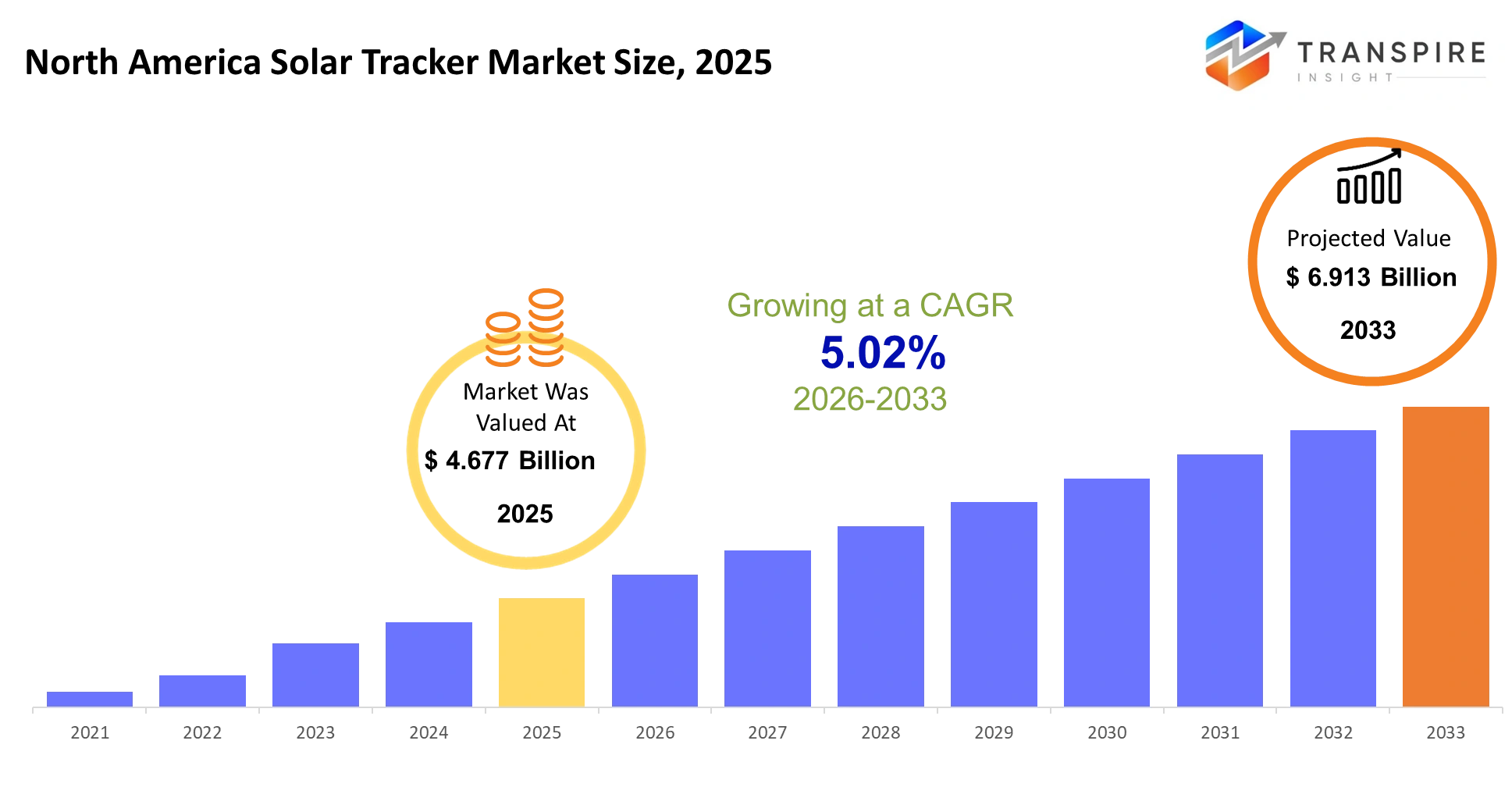
- North America Solar Tracker Market Size 2025: USD 4.677 Billion
- North America Solar Tracker Market Size 2033: USD 6.913 Billion
- North America Solar Tracker Market CAGR: 5.02%
- North America Solar Tracker Market Segments: By Type (Single-axis, Dual-axis, Horizontal, Vertical, Tilted, Others), By Technology (PV, CSP, Hybrid, Smart Tracking, AI-based, Others), By Application (Utility-scale, Commercial, Residential, Industrial, Agriculture, Others), By Component (Controllers, Sensors, Motors, Drives, Software, Others).
To learn more about this report,  Download Free Sample Report
North America Solar Tracker Market Summary:
The North America Solar Tracker Market size is estimated at USD 4.677 Billion in 2025 and is anticipated to reach USD 6.913 Billion by 2033, growing at a CAGR of 5.02% from 2026 to 2033. The North America Solar Tracker Market is experiencing strong growth because utilities and renewable energy developers now work to enhance their solar power output. Solar trackers which move panels to match the sun's position throughout the day achieve higher energy production results than fixed-tilt systems.
The North America Solar Tracker Market grows because businesses develop large-scale solar projects in the United States and Canada through their increased investment while government incentives and carbon reduction targets create a supportive environment. The demand for utility-scale renewable energy systems is growing because of the increasing need for such resources.
Technological improvements which include AI-powered tracking systems and dual-axis trackers which optimize energy collection during different weather conditions create the second main factor which drives the North America Solar Tracker Market.The growing energy security concerns and fluctuating fossil fuel costs have led businesses to adopt solar energy systems. The solar industry becomes more accessible to users because installation costs have decreased and system durability has improved.
What Has the Impact of Artificial Intelligence Been on the North America Solar Tracker Market?
Artificial intelligence is currently changing the North America Solar Tracker Market because it creates new methods for stakeholders to examine data and predict future needs and improve solar tracking systems. The North America Solar Tracker Market uses AI technology which enables businesses to analyze extensive data sets instantaneously while achieving better results for market trend analysis and investment forecasting.
Developers can better synchronize solar projects with energy usage patterns because advanced predictive analytics technology has improved demand forecasting for the North America Solar Tracker Market. The data-driven method strengthens decision-making capabilities while providing better results for extended project implementation.
Artificial intelligence drives both smart automation and operational efficiency improvements throughout solar installations in the North America Solar Tracker Market. The machine learning models use weather data to determine optimal tracker positions, which results in higher energy production and lower maintenance expenses. AI-powered supply chain optimization helps the North America Solar Tracker Market because it reduces procurement delays while boosting cost savings for component acquisition. The North America Solar Tracker Market achieves stronger competitive advantages through AI advancements which create new solutions and boost system dependability and operational capacity for solar energy installation.
Key Market Trends & Insights:
- The United States holds a dominant 70 to 75 percent market share in the North America Solar Tracker Market because of its extensive solar farm installations and its federal government funding programs.
- The North America Solar Tracker Market will see its most rapid growth during the 2025 to 2030 period because Canada implements clean energy solutions and utility infrastructure development initiatives.
- The North America Solar Tracker Market has its main market segment through single-axis trackers which achieve more than 80 percent market share because they provide cost-effective solutions that can be easily expanded.
- The North America Solar Tracker Market contains dual-axis trackers as a minor segment which generates high revenue because their use is expanding in regions with strong sunlight.
- The segment with the highest growth rate from 2024 to 2030 includes smart AI-enabled trackers because they provide automated energy management together with precise energy usage control.
- The North America Solar Tracker Market receives 85 percent of its total market share from utility-scale solar farms which operate through their extensive system development.
- The commercial and industrial solar sector experiences its most rapid growth because businesses set emission reduction targets and seek to decrease their energy expenses.
- The North America Solar Tracker Market sees independent power producers (IPPs) as its main market leader since they make substantial investments in renewable energy projects.
- The commercial sector currently leads all other user groups in growing solar tracker usage because businesses want to achieve environmental goals while reducing operational expenses.
North America Solar Tracker Market Segmentation
By Type
The North American Solar Tracker Market mainly depends on single-axis systems because they provide affordable installation costs and dependable energy output enhancements for extensive solar power facilities. The utility developers prefer this technology because it enables them to operate their systems without requiring extensive maintenance while they can expand their operations. The demand for renewable power projects in the region continues to increase which drives the growth of installation projects that require high-capacity solar systems which need to balance efficiency and cost factors.
The dual-axis systems maintain their status as a minor market segment because they deliver precise tracking capabilities which enhance energy capture in areas that experience diverse sunlight conditions. The team uses horizontal and tilted configurations to fulfill their project requirements based on the specific characteristics of their project location. The industry experiences continuous expansion because organizations focus on optimizing their performance through the implementation of intelligent adjustment technologies.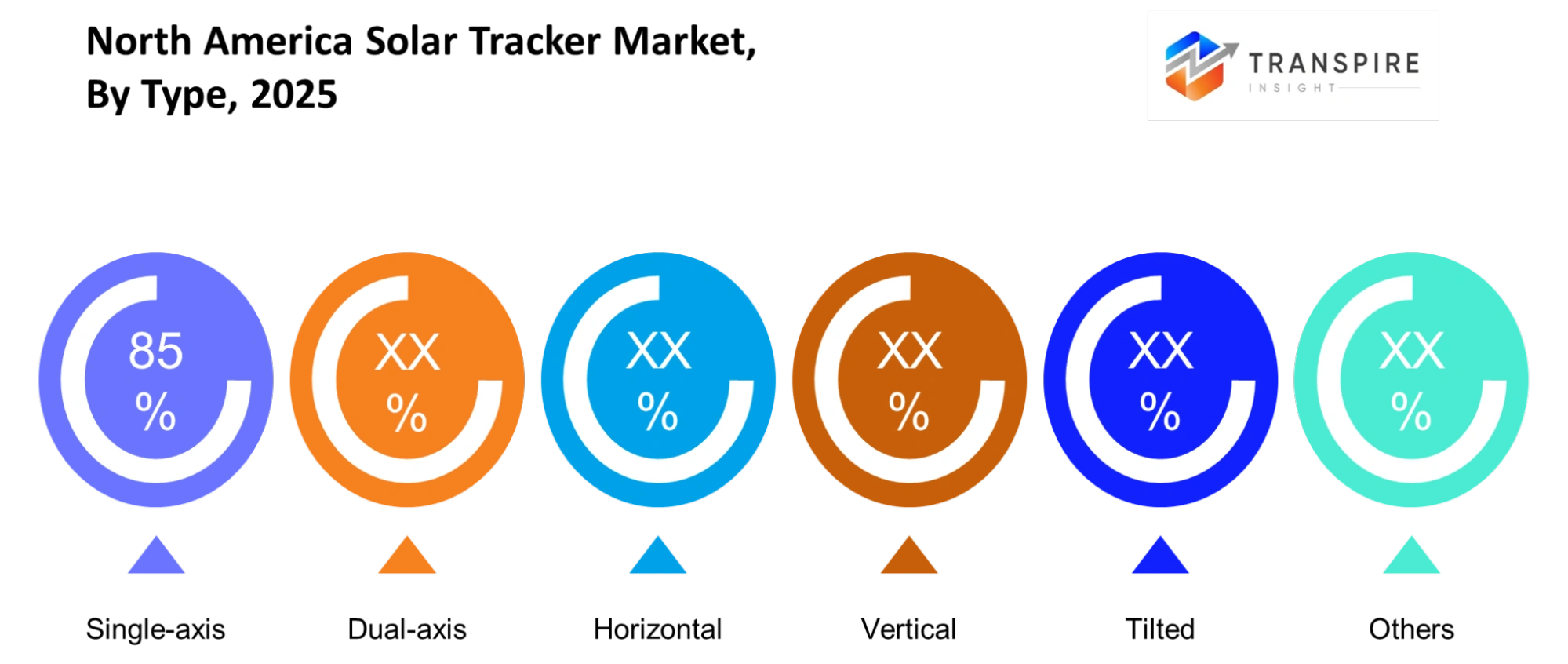
To learn more about this report, Download Free Sample Report
By Technology
The technology adoption of photovoltaic-based tracking systems remains strong because they work well with utility solar installations and they provide substantial efficiency gains. The CSP and hybrid systems maintain their function in specific energy projects that need both concentrated power generation and thermal power system operation.
Smart tracking systems together with AI technologies use predictive analytics together with machine learning solutions for real-time panel tracking. The technologies enable better energy production alongside decreased need for human work while they operate at greater efficiency in power generation for massive energy facilities. The development of technology now centers on software solutions together with automation tools which enhance both tracking precision and system dependability. The ongoing development of control algorithms enables systems to operate more effectively when weather patterns change.
By Application
The main use of utility-scale solar farms exists because they provide electricity for regions which need high electricity power and they operate their solar systems with high power generation capacity. Large-scale projects need solar tracking because it brings efficiency improvements and cost reductions which help projects achieve their maximum production capacity. The growing adoption of renewable energy technologies receives support from both policy frameworks and renewable energy target requirements.
Businesses in commercial and industrial sectors are increasing their operations because they install solar tracking systems which help them lower power expenses and boost their energy efficiency. Enterprises drive their sustainability efforts through their rising energy expenses which creates demand for solar adoption. Solar tracking technology helps organizations to decrease their operational costs through better energy usage monitoring.
The combination of distributed energy systems and rural electrification programs supports the development of agricultural and residential energy needs. People now install distributed energy systems within their homes together with their small facilities. The system enables communities to create better access to renewable energy technologies which they can adopt throughout their entire area.
By Component
The system utilizes controllers which provide essential functions to maintain tracking systems and execute solar position calculations. The sensors function as essential equipment which enables the system to determine both sunlight orientation and current environmental conditions. The current installations achieve better tracking results because of advanced sensor technology which delivers more accurate readings.
The system uses motors and drives to enable panel movement which results in accurate tracking operations. The software systems provide users with capabilities to control systems in real time while conducting diagnostic tests and improving system performance. The system uses these components to achieve maximum energy production while minimizing operational interruptions.
The solar industry benefits from ongoing component development which leads to better project durability and lower maintenance needs and increased operational efficiency. Smart monitoring systems provide essential capabilities which boost system performance and reliability. The organization uses predictive maintenance systems to identify equipment faults at an early stage which helps extend the lifespan of their machinery.
What are the Main Challenges for the North America Solar Tracker Market Growth?
The North America Solar Tracker Market expansion process faces ongoing delays because of technical and operational problems which need high-precision systems to operate efficiently during different weather and terrain situations. Large-scale solar farms experience performance instability because of tracking misalignment and mechanical wear and their sensitivity to wind loads.
The North America Solar Tracker Market also faces integration issues with existing photovoltaic infrastructure because the system compatibility problems between different systems prevent their proper implementation. The project execution timelines experience disruption because supply chain problems affect the delivery of essential components which include sensors and motors to the project site.
The North America Solar Tracker Market faces major obstacles from manufacturing and commercialization challenges which stem from its need for advanced engineering and strict quality control to complete production processes. The high manufacturing expenses combined with the difficult assembly requirements make it hard for small and mid-scale developers to implement mass deployment.
The North America Solar Tracker Market experiences delays in commercializing its products because companies must comply with regulations and complete certification processes which create extended periods of time before new technologies can enter the market. The constraints make it harder for manufacturers to operate their businesses because they need to expand their production capabilities while maintaining efficiency during market competition.
The North America Solar Tracker Market faces two primary problems which stem from two different issues. The market faces two major problems which hinder its growth because regions lack both skilled workers and proper solar facilities. The market faces two obstacles which prevent small energy developers from financing their operations. The main obstacle to North America Solar Tracker Market expansion exists because market operators face difficulties in accessing training programs which provide maintenance knowledge required for system upkeep.
Country Insights
The United States Solar Tracker Market in North America reaches its highest point because the country has established numerous utility-scale solar projects and it provides strong federal financial assistance for solar energy projects and it shows fast progress in developing renewable energy initiatives.
The North American Solar Tracker Market experiences steady growth in Canada because the country aims to achieve its clean energy transition goals while increasing its utility-scale solar installations and provincial governments establish policies that support solar development. The country needs advanced tracking systems because its harsh environmental conditions require these systems to operate with high efficiency and maintain their performance throughout extended periods of renewable energy development across different parts of the country.
Recent Development News
In April 2026, Nextracker Expands Revenue Outlook Amid Strong U.S. Solar Demand: The U.S.-based solar tracking leader Nextracker reported strong financial momentum supported by rising utility-scale solar installations across the country. The company highlighted increased order volumes and growing adoption of advanced tracking systems integrated with software-based optimization. This development reinforces how leading firms in the North America Solar Tracker Market are benefiting from large-scale renewable deployment and stable policy support in the United States.
Source: https://www.investors.com
In April 2026, First Solar and Ecosystem Expansion Driving Tracker Integration: First Solar reported strong revenue growth driven by high demand for utility-scale solar projects that increasingly integrate tracking systems for higher efficiency output. The company’s expanding project backlog reflects rising installation activity across the United States, indirectly boosting demand within the North America Solar Tracker Market. Strong investor confidence and long-term project visibility are supporting continued solar infrastructure scaling. First Solar remains a key contributor to upstream solar ecosystem growth.
Source: https://www.reddit.com
|
Report Metrics |
Details |
|
Market size value in 2025 |
USD 4.677 Billion |
|
Market size value in 2026 |
USD 4.906 Billion |
|
Revenue forecast in 2033 |
USD 6.913 Billion |
|
Growth rate |
CAGR of 5.02% from 2026 to 2033 |
|
Base year |
2025 |
|
Historical data |
2021 – 2024 |
|
Forecast period |
2026 – 2033 |
|
Report coverage |
Revenue forecast, competitive landscape, growth factors, and trends |
|
Country scope |
North America (Canada, The United States, and Mexico) |
|
Key company profiled |
Nextracker, Array Technologies, First Solar, SunPower, Trina Solar, Canadian Solar, JinkoSolar, Soltec, Arctech Solar, GameChange Solar, PV Hardware, FTC Solar, Ideematec, STI Norland, Convert Italia |
|
Customization scope |
Free report customization (country, regional & segment scope). Avail customized purchase options to meet your exact research needs. |
|
Report Segmentation |
By Type (Single-axis, Dual-axis, Horizontal, Vertical, Tilted, Others), By Technology (PV, CSP, Hybrid, Smart Tracking, AI-based, Others), By Application (Utility-scale, Commercial, Residential, Industrial, Agriculture, Others), By Component (Controllers, Sensors, Motors, Drives, Software, Others). |
How Can New Companies Establish a Strong Foothold in the North America Solar Tracker Market?
New companies can establish a strong foothold in the North America Solar Tracker Market by focusing on clear differentiation through technology innovation and targeted niche applications. Startups in the North America Solar Tracker Market must focus on developing AI-based smart tracking systems together with real-time monitoring technologies and predictive maintenance systems because the market operates with high competition. "TerraTrack Solar" represents an emerging company that develops lightweight modular tracker designs which enable faster installation and better utility-scale project adaptability. Early market entry requires companies to create strong value by reducing costs and optimizing energy.
In the North America Solar Tracker Market, companies use partnership-driven expansion as their main strategy to accelerate market adoption through partnerships with solar EPC contractors and utility providers and renewable energy developers.
The North America Solar Tracker Market requires businesses to solve supply chain delays and high maintenance costs and system inefficiencies to achieve successful market positioning. New entrants can stand out by offering durable, low-maintenance tracker systems with faster deployment capabilities. The North America Solar Tracker Market continues to favor companies that combine innovation with operational reliability, especially as utility-scale solar demand increases across the United States.
Key North America Solar Tracker Market Company Insights
Nextracker maintains a leading market position in the North America Solar Tracker Market through its advanced smart tracking systems and its deployment of numerous large utility projects throughout the entire United States. The ongoing funding for AI-based optimization tools leads to energy efficiency improvements and decreased operational downtime. The development of software-based solutions enhances our ability to compete in large solar infrastructure projects while maintaining project performance reliability throughout the renewable energy industry.
The North America Solar Tracker Market has experienced rapid growth because modular tracking systems enable faster installations and better system expansion. The company engineering team establishes its design priorities for preassembled structures which enable quicker installation at solar utility sites. The growing need for effective construction techniques drives implementation, which particularly benefits major solar projects that necessitate manpower reductions while enhancing operational speed.
The North American Solar Tracker Market positions Soltec as a competitive force through its advanced single-axis tracking technology which delivers high efficiency output. The company improved its performance capability through the development of adaptable designs which function effectively across different terrain conditions. The company excels in engineering research and project development because its utility-scale projects require optimal energy production and system reliability for extended solar energy performance.
Expanding footprint in North America Solar Tracker Market is driven by intelligent tracking systems which feature real-time monitoring capabilities. The company improves energy output from its solar facilities through its focus on automated systems and precise control methods which operate throughout extensive solar facilities. The company develops its project execution abilities through strategic partnerships and technological upgrades which help it compete better in the United States renewable energy infrastructure market.
Company List
- Nextracker
- Array Technologies
- First Solar
- SunPower
- Trina Solar
- Canadian Solar
- JinkoSolar
- Soltec
- Arctech Solar
- GameChange Solar
- PV Hardware
- FTC Solar
- Ideematec
- STI Norland
- Convert Italia
What are the Key Use-Cases Driving the Growth of the North America Solar Tracker Market?
The North America Solar Tracker Market exists because large solar farms require tracking systems which help them achieve maximum energy output throughout the day. The North America Solar Tracker Market grows because electricity demand increases and United States clean energy commitments persist, which utility developers use to implement advanced tracking systems that boost operational efficiency. The installations enable solar projects to generate more energy for each acre used, which creates better financial opportunities and makes projects suitable for permanent connection to the power grid.
The North America Solar Tracker Market experiences expansion because the commercial and industrial energy sector has begun using solar energy technology in its operations. The North America Solar Tracker Market is gaining momentum from enterprises aiming to reduce operational energy costs while meeting sustainability targets. The system performance of solar trackers is enhanced through their application in large rooftop and ground-mounted installations which operate at peak energy production for the entire day.
Agriculture and water management applications are also expanding the North America Solar Tracker Market, where solar-powered irrigation systems and farm energy setups rely on tracking technology for consistent performance. The systems operate to enhance efficiency across locations which lack reliable electricity connections. The North America Solar Tracker Market now gains new growth prospects through its application in smart infrastructure and decentralized energy systems because cities and utilities use solar tracking for their contemporary energy design needs which require both strength and expansion capabilities.
North America Solar Tracker Market Report Segmentation
By Type
- Single-axis
- Dual-axis
- Horizontal
- Vertical
- Tilted
- Others
By Technology
- PV
- CSP
- Hybrid
- Smart Tracking
- AI-based
- Others
By Application
- Utility-scale
- Commercial
- Residential
- Industrial
- Agriculture
- Others
By Component
- Controllers
- Sensors
- Motors
- Drives
- Software
- Others
Frequently Asked Questions
Find quick answers to common questions.
The Approximate North America Solar Tracker Market size for the Market will be USD 6.913 Billion in 2033.
The key Segments of the North America Solar Tracker Market are By Type (Single-axis, Dual-axis, Horizontal, Vertical, Tilted, Others), By Technology (PV, CSP, Hybrid, Smart Tracking, AI-based, Others), By Application (Utility-scale, Commercial, Residential, Industrial, Agriculture, Others), By Component (Controllers, Sensors, Motors, Drives, Software, Others).
Major Players in the North America Solar Tracker Market are Nextracker, Array Technologies, First Solar, SunPower, Trina Solar, Canadian Solar, JinkoSolar, Soltec, Arctech Solar, GameChange Solar, PV Hardware, FTC Solar, Ideematec, STI Norland, Convert Italia.
The Current Market size of the North America Solar Tracker Market is USD 4.677 Billion in 2025.
The North America Solar Tracker Market CAGR is 5.02%.
- Nextracker
- Array Technologies
- First Solar
- SunPower
- Trina Solar
- Canadian Solar
- JinkoSolar
- Soltec
- Arctech Solar
- GameChange Solar
- PV Hardware
- FTC Solar
- Ideematec
- STI Norland
- Convert Italia
Recently Published Reports
-
Dec 2024
Active Power Filter Market
Active Power Filter Market Size, Share & Analysis Report By Type (Shunt Active Power Filters, Series Active Power Filter, Hybrid Active Power Filter), By Application (Harmonics Mitigation, Reactive Power Compensation, Voltage Regulation, Power Factor Correction), By Phase (Single Phase, Three Phase), By End-User Industry (Manufacturing, Healthcare, Commercial, Automotive, Oil and Gas, Others), and Geography (North America, Europe, Asia-Pacific, Middle East and Africa, South and Central America), 2021 - 2031
-
Apr 2026
Electrical Transformer Market
Electrical Transformer Market Size, Share & Analysis Report By Core (Closed, Shell, and Berry), By Insulation (Gas, Oil, Solid, Air, and Other), By Phase (Single, and Three), By Rating (100 MVA to 500 MVA, 501 MVA to 800 MVA, and 801 MVA to 1200 MVA), and Geography (North America, Europe, Asia-Pacific, Middle East and Africa, South and Central America), 2021 – 2031
-
Apr 2026
Hydraulic Piston Pumps Market
Hydraulic Piston Pumps Market Size, Share & Analysis Report By Type (Axial Piston Pumps, Radial Piston Pumps), By Operating Pressure (Low Pressure, Medium Pressure, High Pressure), By Application (Construction, Mining, Agriculture, Automotive, Oil & Gas, Industrial Machinery, Others), By End-User (OEMs, Aftermarket), and Geography (North America, Europe, Asia-Pacific, Middle East and Africa, South and Central America), 2021 – 2031
-
Apr 2026
Laboratory Gas Generators Market
Laboratory Gas Generators Market Size, Share & Analysis Report By Product (Nitrogen Gas Generator, Hydrogen Gas Generator, Zero Air Gas Generator, Purge Gas Generator, TOC Gas Generators, Others), By Application (Gas Chromatography, Liquid Chromatography-mass Spectrometry (LC-MS), Gas Analyzers, Others), By End-user (Life Science, Chemical & Petrochemical, Food & Beverage, Others), and Geography (North America, Europe, Asia-Pacific, Middle East and Africa, South and Central America), 2021 – 2031