
Asia Pacific Immersive Location-based Entertainment Market Summary
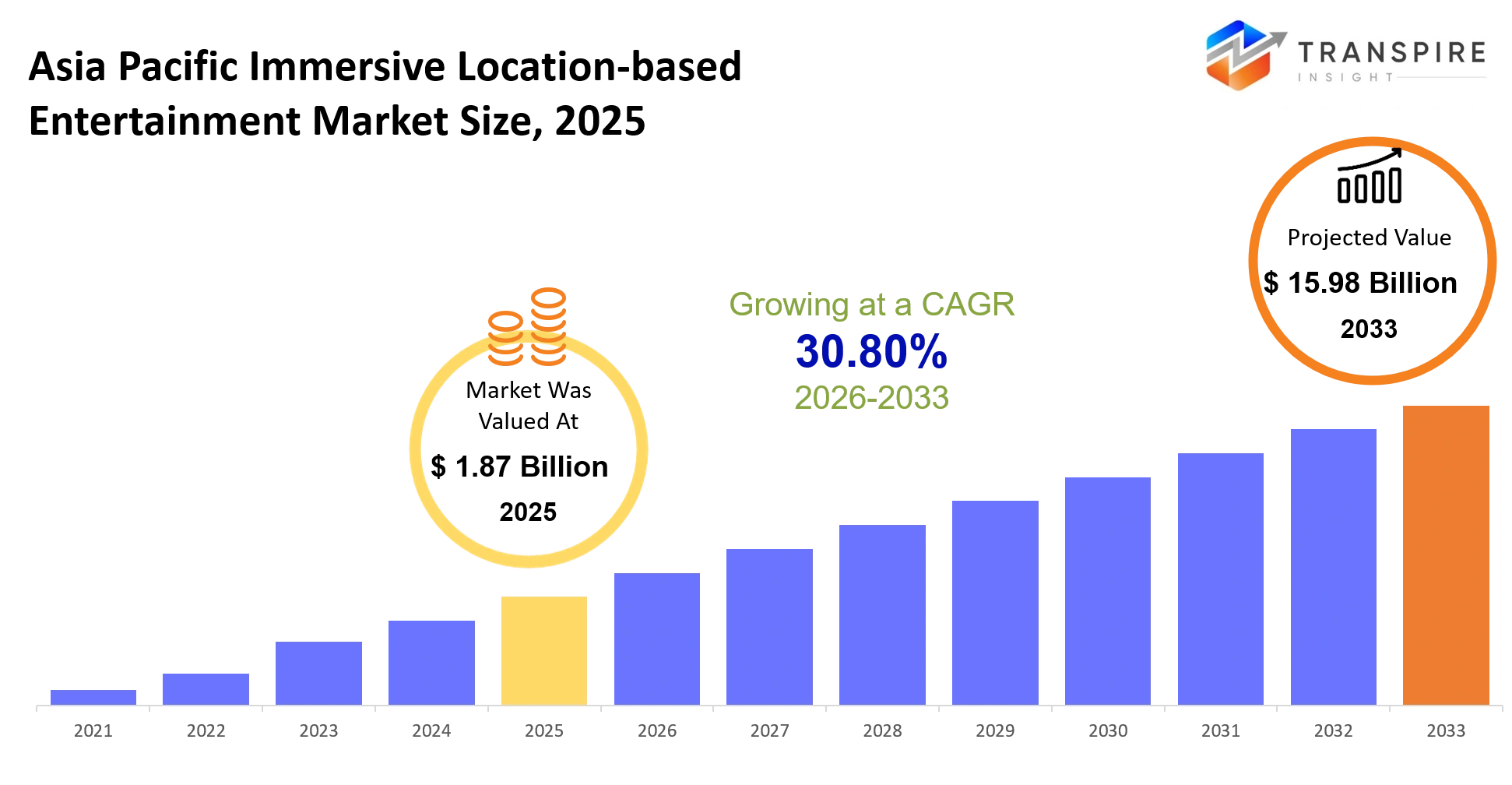
As per Transpire Insight Analysis the Asia Pacific Immersive Location-based Entertainment Market size is estimated at USD 1.87 Billion in 2025 and is anticipated to reach USD 15.98 Billion by 2033, growing at a CAGR of 30.80% from 2026 to 2033.
The Asia Pacific Immersive Location-based Entertainment Market kind of turns everyday physical spaces into interactive stopover points, where people can actually step into virtual reality, mixed reality, simulation, and multiplayer scenarios, the whole thing just can’t really be copied at home. Entertainment operators basically lean on these attractions to nudge up visitor spend, keep people around longer, and bring them back again and again. Meanwhile , shopping malls theme parks, and family entertainment centers also try to boost footfall using tech-driven experiences, so it feels more lively and less generic. In the last five years, the market has moved away from plain standalone VR arcades toward multi-sensory attractions that are assisted by artificial intelligence, motion tracking, and haptic systems, so it’s more immersive, more “in the moment” you know. After the COVID-19 pandemic, when venues reopened , investment picked up pretty fast in experiential attractions, because operators needed fresh methods to regain attendance and also broaden income streams. Add to that , lower hardware costs stronger 5G connectivity, and larger digital content libraries, all of which make these setups more commercially workable. As a result, venue owners across Asia Pacific are rolling out immersive attractions that help raise occupancy, support premium ticket pricing, and keep visitors coming back for recurring engagement.
Asia Pacific Immersive Location-based Entertainment Market Size & Forecast:
- Asia Pacific Immersive Location-based Entertainment Market Size 2025: USD 1.87 Billion
- Expected Market Value 2033: USD 15.98 Billion
- Forecast CAGR: 30.80%
- Leading region in 2025:Japan
- Fastest Growing region:India
- Key Profile: Sandbox VR, Zero Latency, The VOID, Dreamscape Immersive, HTC Vive, Meta Platforms, Bandai Namco, SEGA, Merlin Entertainments, Disney, Universal Destinations, CJ 4DPLEX, Holovis, Hologate, Spaces
Key Market Insights
- In 2025 Japan basically dominates the Asia Pacific Immersive Location-based Entertainment Market, with something like 28–30% share, backed by really advanced gaming infrastructure and then a lot of theme park investment. It’s one of those situations where the hardware and the physical attractions seem to be moving together, kind of steadily.
- India on the other hand is expected to end up being the fastest grower through 2033 , fueled by expanding shopping malls, family entertainment centers, and the quick take up of digital attractions. You can almost see it in how venues are being planned to serve multiple ages at once.
- Virtual Reality Experiences make up nearly 35% of the industry revenue in 2025, and that’s why VR is still the leading attraction segment. People seem to really favor multiplayer setups, which helps a lot.
- Mixed Reality Experiences are forecast to expand the quickest through 2033 , because operators mix physical spaces with digital interaction for those more premium style attractions. It’s not just entertainment, it’s more like a coordinated experience across real and virtual elements.
- Theme Parks bring in around 38% of venue revenue in 2025, while standalone immersive experience centers keep rolling out across major metropolitan cities.
- Families are the leading end user group, with roughly 32% market share, and corporate groups are showing up as a higher value customer category, especially for team building events. That segment keeps looking more attractive each year.
- Companies such as Sandbox VR, Zero Latency, HTC Vive, Dreamscape Immersive, Bandai Namco, and Merlin Entertainments keep strengthening their positions via technology upgrades and regional expansion, yes even when local demand varies.
- Meanwhile AI powered content personalization, motion tracking , and haptic feedback are nudging visitor engagement upward. That tends to translate into more repeat visits and better premium ticket sales for operators.
- Strategic partnerships between entertainment operators, technology providers, and shopping mall developers are also speeding up new venue launches across Southeast Asia, China and India. Overall it feels like the ecosystem is syncing up, not separately.
What are the Key Drivers, Restraints, and Opportunities in the Asia Pacific Immersive Location-based Entertainment Market?
The main driver of the Asia Pacific Immersive Location-based Entertainment Market seems to be the rapid shift toward experience-led consumer spending, paired with the steady drop in costs for virtual reality hardware and newer advanced visualization technologies. In the last few years, the upgrades in standalone VR headsets, 5G connectivity, motion tracking, and real time graphics have made these immersive attractions more dependable , and also easier to run in a commercial sense for entertainment operators. Shopping malls , theme parks , and family entertainment centers have already reacted by rolling out premium experiences that keep visitors around longer, improve ticket yields, and then add extra income from food, merchandise , and event packages. In a way, this move toward newer technology has nudged both long standing operators and fresh investors to widen immersive footprints across the big cities.
Still, the biggest restraint is the heavy capital outlay needed to set up and keep immersive venues running. Things like advanced projection systems, motion platforms, haptic devices, specialized computing infrastructure, plus the constant content upgrades , bring both high initial costs and ongoing recurring expenses. This bottleneck is hard to fix, because tech refresh cycles stay short, while premium digital content actually needs constant licensing and development. Smaller operators often end up delaying expansion, so market penetration tends to stop near major metro areas, and secondary cities do not fully capture the same revenue potential.
One more important opportunity is the integration of artificial intelligence, cloud based content management, and location aware digital experiences across emerging economies like India, Indonesia, Vietnam, and the Philippines.
What Has the Impact of Artificial Intelligence Been on the Asia Pacific Immersive Location-based Entertainment Market?
Artificial intelligence is kinda reshaping the Asia Pacific Immersive Location-based Entertainment Market, not just by one thing but by a bunch of changes like improving operational efficiency, tailoring visitor experiences, and making attraction performance feel more “on target”. With AI powered analytics , systems can watch visitor flow, queue sizes, equipment utilization, and even how people play, in real time. Then operators can shift staffing levels faster, cut down on waiting, and generally get more out of the same venue capacity. On top of that computer vision plus motion recognition can automate player tracking too, so multiplayer sessions become more responsive, and there is less need for constant manual checking or intervention. Overall, these features support better customer satisfaction, and they tend to lift revenue per visitor.
At the same time, machine learning models are also behind predictive maintenance, by pulling in data from VR headsets, motion platforms, haptic devices and projection systems. When hardware issues are spotted early, maintenance can be scheduled before anything turns into a full failure. That means less downtime, and equipment life gets extended. Also, AI assisted content recommendation engines sort of steer game scenarios toward the right preferences, like visitor age, group size, and past participation, which makes repeat visits more likely. It can also nudge spending higher for premium experiences. Beyond that, digital twins and cloud based analytics help venue managers judge attraction performance, fine tune energy consumption, and improve operational efficiency across multiple locations, not only one site.
Still, there are some drawbacks or at least hurdles, because AI adoption isn’t purely smooth. Integrating artificial intelligence with legacy entertainment infrastructure needs a real amount of investment, including software, sensors, networking, and skilled technical personnel . If that support isn’t there, the whole rollout can slow down.
Key Market Trends
- Virtual reality attractions sort of moved away from single-player setups, and more into multiplayer free roam vibes, now, with 60% plus of all the new venue launches since 2022 leaning hard on group based fun and not just solo sessions.
- Around after 2023, artificial intelligence along with real time analytics got more common, and it helped operators trim queue times by about 15–25% using more adaptive visitor flow control, like suddenly they’re able to reroute people in a smoother way.
- Shopping malls also started teaming up with immersive entertainment providers more often, and in mixed use developments they’re giving out something like 10–15% extra space for experience led attractions, compared to what they did five years ago.
- Then there’s the tech side, motion tracking and haptic tools improved a lot, and because of that, premium rides can ask 20–30% higher ticket prices than the regular conventional VR experiences in big cities.
- Companies like Sandbox VR Zero Latency HTC Vive and Bandai Namco, expanded partnerships across Asia Pacific, which sped up the rollout of these next generation immersive entertainment venues.
- Also, cloud based content delivery basically replaced manual software updates, so operators can bring new interactive experiences online in a few days, rather than waiting several weeks.
- Mixed reality has been gaining momentum since 2022 too, mixing physical spaces with digital storytelling, and it seems to pull in families, tourists , and corporate event organizers as well.
- Entertainment operators are also leaning into membership programs and bundled packages more and more, so they can keep customers coming back, and build recurring income beyond a one time ticket purchase.
- Standalone immersive experience centers, aren’t only sticking to the biggest metropolitan areas anymore; they are pushing into Tier 2 cities as digital infrastructure keeps improving and commercial developments grow around them.
- Lastly, sustainability got more attention operationally, with newer venues using energy efficient display systems and smaller VR hardware, which is supposed to reduce operating costs a bit too.
Asia Pacific Immersive Location-based Entertainment Market Segmentation
By Attraction Type
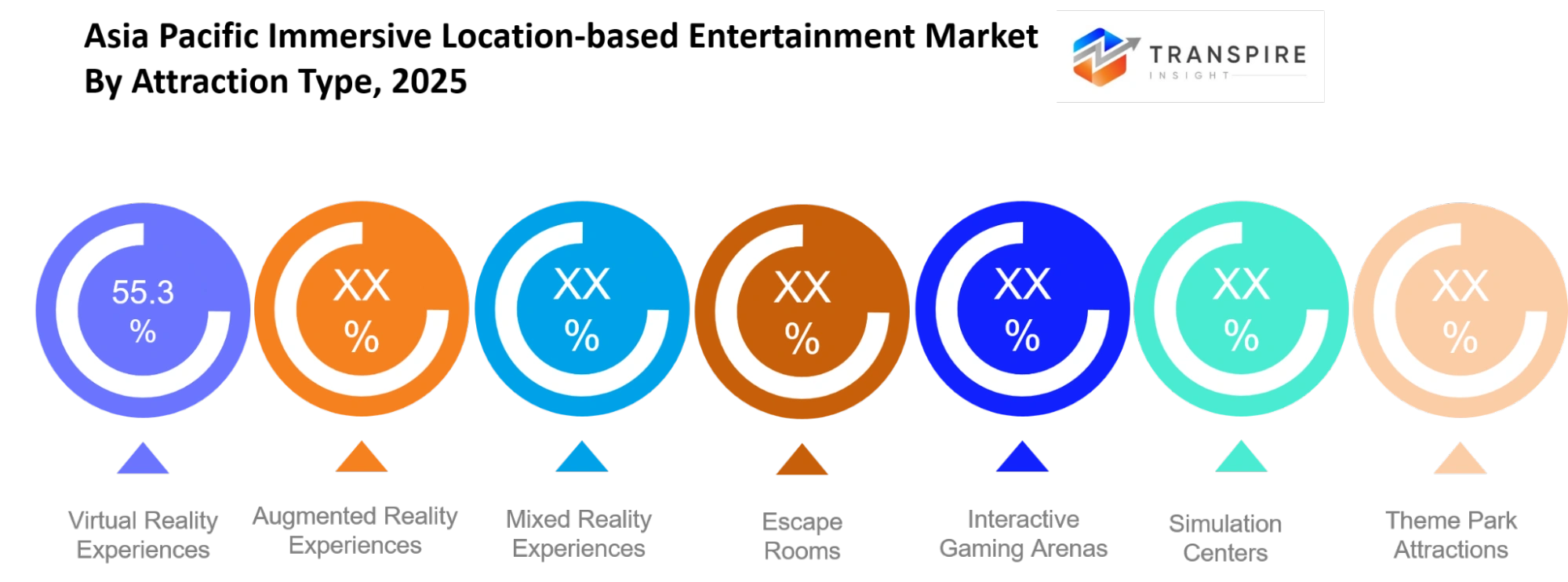
Virtual Reality Experiences will hold the biggest share, mainly because fully immersive gameplay, lifelike spaces, and multiplayer togetherness keep drawing in a wide pool of visitors. Augmented Reality Experiences are also moving fast, especially in retail and learning spaces, since they blend digital content with what’s already around you, it feels almost like a second layer over reality. Mixed Reality Experiences are getting more buzz as newer headsets and spatial computing enable a more natural way to interact with both real and virtual objects, not just one or the other. Escape Rooms keep evolving too ,using digital storytelling and extra interactive technologies to refine older puzzle-solving ideas.
Interactive Gaming Arenas stay popular as a competitive group pastime, especially for teenagers and young adults who are basically looking for social fun. Simulation Centers support all kinds of applications, from racing and aviation to sports coaching, they provide realistic environments with advanced motion systems that make the whole thing feel more convincing. Theme Park Attractions are folding immersive tech into rides they already have, to boost visitor interest and encourage repeat stops. Other options include holographic theaters, hands-on exhibitions, and projection-based moments that widen the entertainment menu across many commercial locations.
By Technology
Virtual Reality still feels like the base of most immersive attractions, because high-quality headsets, better graphics and, in general lower equipment costs have made it way more doable to roll out. Augmented Reality keeps growing too, mostly from smartphone based experiences and some wearable devices that kind of mix digital content with whats actually there in the room. Mixed Reality kind of straddles the line, so you get interactive attractions where real things and virtual bits run together, more or less at the same time. Motion Tracking tech also helps a lot, since it boosts precision by reading body movements, and that makes gameplay feel more responsive, even when you think youre just standing still.
Then there’s Projection Mapping, which can turn walls floors, and entire buildings into reactive visual scenes, so large scale entertainment setups become possible. Haptic Technology gives touch and vibration feedback that feels more real, and that usually makes games and simulations feel deeper. Artificial Intelligence helps with customization, visitor management, and predictive upkeep, plus it lets operators tune venue performance in a smarter way. Other tools show up in the background as well, like cloud computing, edge processing, spatial audio, and newer display options, all of which keep lifting immersive entertainment quality over time.
By Venue Type
Theme Parks still kind of stay as the leading venue category, since big visitor numbers and ongoing attraction upgrades, they do end up building solid commercial returns. Shopping Malls are also leaning in more lately by adding immersive attractions, so they can boost footfall and keep people around a bit longer. Family Entertainment Centers blend gaming virtual experiences and hands-on activities, which helps them cover multiple age groups inside one destination, and it feels more seamless. Arcades meanwhile are moving forward with newer VR systems, multiplayer matches, and regular digital content updates.
Museums are adopting immersive technologies too, to roll out interactive learning moments and make people actually engage more with the exhibitions. Cinemas are going beyond regular screenings, adding virtual reality events and other interactive entertainment formats, kind of like a hybrid thing. Standalone Experience Centers focus fully on premium immersive attractions, with specialized equipment, plus exclusive digital content. And then others—like resorts hotels , convention centers, and mixed use commercial developments—keep layering in immersive entertainment offerings as well, bit by bit, over time.
By End User
Families generate the largest share, because immersive attractions offer activities that fit quite a few ages, in one shared entertainment setting, and well it just seems more practical. Kids are still a key customer group too, especially since educational games and interactive storytelling keep showing up more often across different venues. Teenagers often go for competitive multiplayer stuff, esports attractions, and advanced virtual reality games, which really nudges them toward social interaction. Adults add a more consistent stream of revenue via premium experiences, simulation activities, and location-based digital entertainment, you know the kind.
Corporate groups are also booking immersive venues more and more, for team-building sessions, product releases, and employee engagement programs. Tourists help the whole market grow by chasing destination specific attractions, where technology blends with local themes and cultural moments. Educational institutions adopt immersive learning programs for science, history, engineering, and vocational training uses. Other buyers include community organizations, private event planners, and special-interest groups, they tend to use immersive venues for tailored experiences, with a kind of bespoke vibe.
By Revenue Model
Ticket Sales are still basically the main money stream, since the single entry pricing approach stays the go to option for most entertainment venues. Membership Programs do a good job at keeping people around, because repeat guests get discounted access, exclusive happenings, and more premium content, not just the usual. Subscription Plans are showing up more and more too, mainly when operators roll out a recurring access model for frequent users. Event Bookings add extra revenue on top, think birthday celebrations, product introductions, seasonal festivals, and those private entertainment sessions people reserve for, well, special groups.
Corporate Packages bring in the higher value business chances, by blending immersive experiences with meeting spaces, catering, and custom activities for organizations. Sponsorships help spread the revenue risk, through ties with tech companies, consumer brands, and entertainment partners who want stronger visibility in front of audiences. Merchandise Sales add further earnings via branded items, gaming accessories, collectibles, and themed keepsakes. Others cover digital content licensing, advertising collaborations, food and beverage services, and upgraded premium experiences, all of which help stretch the long term revenue base.
What are the Key Use Cases Driving the Asia Pacific Immersive Location-based Entertainment Market?
In theme parks and family entertainment centers, virtual reality attractions pretty much end up being the biggest use case inside the Asia Pacific Immersive Location-based Entertainment Market. Free-roam multiplayer games , interactive adventure scenarios and simulation style attractions tend to pull in families, teenagers, and adults who want a more premium type of fun that goes beyond home gaming. Because the ticket prices are higher and people stay longer on site, these setups can become a major revenue driver for venue operators, almost like a steady faucet.
Corporate entertainment alongside educational experiences is also growing, even if it’s more like a secondary track. Corporate groups are using immersive venues for team-building exercises, leadership sessions and product showcasings, while schools and universities roll out virtual simulations for science, engineering, healthcare, and even for historical learning. Museums too are stepping in, adding interactive digital exhibitions so visitors stay engaged, and so learning results get better or, at least, more memorable.
On the newer side, you see mixed reality live events, holographic shows, and AI-powered personalized entertainment experiences starting to appear. Tourism areas are beginning to launch location specific immersive attractions that blend local culture with advanced digital storytelling , not just generic content. Cloud based content platforms and spatial computing technologies are expected to back these next generation experiences, and that should open additional revenue opportunities for entertainment operators across the whole forecast period, bit by bit.
|
Report Metrics |
Details |
|
Market size value in 2025 |
USD 1.87 Billion |
|
Market size value in 2026 |
USD 2.44 Billion |
|
Revenue forecast in 2033 |
USD 15.98 Billion |
|
Growth rate |
CAGR of 30.80% from 2026 to 2033 |
|
Base year |
2025 |
|
Historical data |
2021 - 2024 |
|
Forecast period |
2026 - 2033 |
|
Report coverage |
Revenue forecast, competitive landscape, growth factors, and trends |
|
Regional scope |
United States; Canada; Mexico; United Kingdom; Germany; France; Italy; Spain; Denmark; Sweden; Norway; China; Japan; India; Australia; South Korea; Thailand; Brazil; Argentina; South Africa; Saudi Arabia; United Arab Emirates |
|
Key company profiled |
Sandbox VR, Zero Latency, The VOID, Dreamscape Immersive, HTC Vive, Meta Platforms, Bandai Namco, SEGA, Merlin Entertainments, Disney, Universal Destinations, CJ 4DPLEX, Holovis, Hologate, Spaces |
|
Customization scope |
Free report customization (country, regional & segment scope). Avail customized purchase options to meet your exact research needs. |
|
Report Segmentation |
By Attraction Type (Virtual Reality Experiences, Augmented Reality Experiences, Mixed Reality Experiences, Escape Rooms, Interactive Gaming Arenas, Simulation Centers, Theme Park Attractions, Others); By Technology (Virtual Reality, Augmented Reality, Mixed Reality, Motion Tracking, Projection Mapping, Haptic Technology, Artificial Intelligence, Others); By Venue Type (Theme Parks, Shopping Malls, Family Entertainment Centers, Arcades, Museums, Cinemas, Standalone Experience Centers, Others); By End User (Families, Children, Teenagers, Adults, Corporate Groups, Tourists, Educational Institutions, Others); By Revenue Model (Ticket Sales, Membership Programs, Subscription Plans, Event Bookings, Corporate Packages, Sponsorships, Merchandise Sales, Others) |
Which Regions are Driving the Asia Pacific Immersive Location-based Entertainment Market Growth?
Japan is sort of leading the regional market, mostly because its gaming industry is already mature, plus the digital infrastructure is more advanced, and then there’s this really solid ecosystem of entertainment technology companies. Ongoing investment in theme parks, amusement centers, and mixed use commercial developments keeps backing big scale rollout of immersive attractions in a bunch of main cities. When tech developers, content creators, and venue operators collaborate, the new experiences can actually get to the market faster, but they still keep pretty high operational standards , which matters. And honestly, strong consumer acceptance of premium entertainment experiences , along with globally known gaming brands, keeps reinforcing Japan’s leadership across the region.
China sits as the second largest regional market, and it has a somewhat different growth pattern. Here it’s driven by big domestic consumer demand and the sustained push into commercial entertainment infrastructure. Big shopping malls , tourism hotspots, and cultural attractions continue folding in virtual reality and mixed reality formats, to boost how long and how engaged visitors stay. Local governments are also backing digital economy initiatives, they basically encourage investment in extended reality solutions and smart entertainment projects. That mix of steady economic funding, growing urban consumer bases, and strong home grown technology capability makes China a consistent contributor to regional market revenue.
India is expected to show the fastest growth over the forecast period. This is mainly because organized retail is expanding, family entertainment centers are multiplying, and premium shopping destinations are showing up more often across metro areas plus Tier-2 cities. Better affordability of VR hardware, wider 5G rollout, and more private investment in experiential entertainment create pretty favorable conditions for new venue development.
Who are the Key Players in the Asia Pacific Immersive Location-based Entertainment Market and How Do They Compete?
Competition still looks pretty moderately fragmented, with global immersive entertainment companies right next to regional gaming operators and attraction folks. In practice, winning seems to rely less on shaving prices, and more on things like exclusive content, immersive tech, operating reliability, and then that ability to grow via franchise partnerships or broader strategic collaborations. Most players are trying to stand out using proprietary software, motion tracking systems that are their own, multiplayer formats, plus intellectual property partnerships that basically nudge people back for another go.
Sandbox VR leans hard into premium free-roam multiplayer virtual reality , with full-body motion capture and haptic technology that feels pretty precise. Their franchise approach helps them enter new markets quickly, and the partnerships with entertainment brands create exclusive content that you usually cannot find on competing platforms. Zero Latency differentiates by going warehouse-scale with wireless virtual reality , with bigger playing areas and group gameplay that is a lot more interactive. That angle makes it especially appealing for family entertainment centers, and for commercial operators that want dependable throughput. Dreamscape Immersive mixes cinematic storytelling with advanced motion capture capabilities, so they can offer high-quality narrative experiences that tend to fit premium entertainment venues.
HTC Vive competes with enterprise-grade virtual reality hardware and software platforms, which let commercial operators build customized immersive attractions. Bandai Namco , meanwhile, pulls from its deep gaming portfolio and a well-established entertainment ecosystem to produce branded attractions that draw loyal audiences across Asia.
Company List
• Sandbox VR
• Zero Latency
• The VOID
• Dreamscape Immersive
• HTC Vive
• Meta Platforms
• Bandai Namco
• SEGA
• Merlin Entertainments
• Disney
• Universal Destinations
• CJ 4DPLEX
• Holovis
• Hologate
• Spaces
Recent Development News
In May 2026, Sandbox VR announced the opening of a new premium location-based virtual reality venue in Miami through a partnership with Solis Entertainment LLC, expanding its global footprint and strengthening access to immersive entertainment experiences.https://www.prnewswire.com
In April 2026, Sandbox VR expanded its partnership with LOL Entertainment to launch two additional premium virtual reality venues in Washington, D.C. and Baltimore, accelerating franchise-led expansion across North America.https://www.prnewswire.com
In March 2025, Dreamscape Immersive adopted Vicon Markerless motion capture technology for its latest location-based VR experience in Geneva, improving user movement accuracy while reducing wearable tracking equipment.https://www.globenewswire.com
What Strategic Insights Define the Future of the Asia Pacific Immersive Location-based Entertainment Market?
Honestly, the market seems to be shifting, toward these big, content-led immersive places where proprietary intellectual property really matters, plus artificial intelligence, cloud based content delivery, and mixed reality stuff kinda stack up as differentiators that go beyond hardware alone. You can see operators that keep refreshing the digital content and then build longer term franchise ecosystems getting more of the recurring revenue pie over the next five to seven years.
There is also a risk that is less visible, like the dependence on licensed entertainment content, which can quietly raise operating costs and make venue operators deal with licensing renewals… or even exclusivity restrictions. Still, on the flip side, location-aware mixed reality attractions, that are tied into tourism destinations and smart retail developments, are showing up as an opportunity, but it’s still underpenetrated across Southeast Asia and India.
So, if a company is coming in, they should really focus on scalable software platforms, smart content partnerships, and modular attraction designs. Basically, aim for upgrades that are fast and don’t require extensive capital replacement, so you keep more flexibility while immersive technologies keep evolving.
Asia Pacific Immersive Location-based Entertainment Market Report Segmentation
By Attraction Type
• Virtual Reality Experiences
• Augmented Reality Experiences
• Mixed Reality Experiences
• Escape Rooms
• Interactive Gaming Arenas
• Simulation Centers
• Theme Park Attractions
• Others
By Technology
• Virtual Reality
• Augmented Reality
• Mixed Reality
• Motion Tracking
• Projection Mapping
• Haptic Technology
• Artificial Intelligence
• Others
By Venue Type
• Theme Parks
• Shopping Malls
• Family Entertainment Centers
• Arcades
• Museums
• Cinemas
• Standalone Experience Centers
• Others
By End User
• Families
• Children
• Teenagers
• Adults
• Corporate Groups
• Tourists
• Educational Institutions
• Others
By Revenue Model
• Ticket Sales
• Membership Programs
• Subscription Plans
• Event Bookings
• Corporate Packages
• Sponsorships
• Merchandise Sales
• Others
Frequently Asked Questions
Find quick answers to common questions.
The expected Asia Pacific Immersive Location-based Entertainment Market size for the market will be USD 15.98 Billion in 2033.
Key segments for the Asia Pacific Immersive Location-based Entertainment Market are By Attraction Type (Virtual Reality Experiences, Augmented Reality Experiences, Mixed Reality Experiences, Escape Rooms, Interactive Gaming Arenas, Simulation Centers, Theme Park Attractions, Others); By Technology (Virtual Reality, Augmented Reality, Mixed Reality, Motion Tracking, Projection Mapping, Haptic Technology, Artificial Intelligence, Others); By Venue Type (Theme Parks, Shopping Malls, Family Entertainment Centers, Arcades, Museums, Cinemas, Standalone Experience Centers, Others); By End User (Families, Children, Teenagers, Adults, Corporate Groups, Tourists, Educational Institutions, Others); By Revenue Model (Ticket Sales, Membership Programs, Subscription Plans, Event Bookings, Corporate Packages, Sponsorships, Merchandise Sales, Others).
Major Asia Pacific Immersive Location-based Entertainment Market players are Sandbox VR, Zero Latency, The VOID, Dreamscape Immersive, HTC Vive, Meta Platforms, Bandai Namco, SEGA, Merlin Entertainments, Disney, Universal Destinations, CJ 4DPLEX, Holovis, Hologate, Spaces.
The Asia Pacific Immersive Location-based Entertainment Market size is USD 1.87 Billion in 2025.
The Asia Pacific Immersive Location-based Entertainment Market CAGR is 30.80% from 2026 to 2033.
• Sandbox VR
• Zero Latency
• The VOID
• Dreamscape Immersive
• HTC Vive
• Meta Platforms
• Bandai Namco
• SEGA
• Merlin Entertainments
• Disney
• Universal Destinations
• CJ 4DPLEX
• Holovis
• Hologate
• Spaces
About the Authors

Mayur Shinde
I am Mayur Shinde, a Senior Research Analyst at Transpire Insight, specializing in the Automotive & Transportation and Information & Communication Technology (ICT) Industry. My work focuses on analyzing emerging market trends, technological advancements, competitive landscapes, and industry developments to deliver accurate, data-driven insights. I am passionate about transforming complex market information into clear, actionable content that helps businesses, professionals, and decision-makers stay informed and make confident strategic decisions.

Chakradhar Khansole
Chakradhar serves as the Research Director at Transpire Insight, bringing over 8 years of experience in technology, innovation, and strategic market intelligence. He specializes in transforming complex market data into actionable business insights that enable organizations to make informed, growth-oriented decisions. Recognized for his strategic vision and analytical expertise, Chakradhar leads high-impact research initiatives, delivering comprehensive market assessments, competitive intelligence, and forward-looking industry analysis.
Recently Published Reports
-
Apr 2026
3D Optical Profiler Market
3D Optical Profiler Market Size, Share & Analysis Report By Type (Desktop 3D Optical Profiler, and Portable 3D Optical Profiler), By Technology (Confocal Technology, and White Light Interference), By End-Use Industry (Manufacturing, Research Institutions, Automotive, Aerospace and Defense, Medical Devices, and Other), and Geography (North America, Europe, Asia-Pacific, Middle East and Africa, South and Central America), 2021 - 2031
-
Apr 2026
Depth Sensor Market
Depth Sensor Market Size, Share & Analysis Report By Type (Infrared Depth Sensors, Time-of-Flight (ToF) Sensors, Stereo Vision Sensors, Structured Light Sensors, Ultrasonic Depth Sensors), By Application (Automotive, Robotics, Gaming, Consumer Electronics, Industrial Automation, Healthcare, Security & Surveillance, Others), By End Users (Automotive Manufacturers, Consumer Electronics Companies, Healthcare Providers, Industrial Companies, Security Agencies, Gaming Companies, Robotics Companies, Others), and Geography (North America, Europe, Asia-Pacific, Middle East and Africa, South and Central America), 2021 – 2031
-
Apr 2026
Digital Manufacturing Market
Digital Manufacturing Market Size, Share & Analysis Report By Component (Hardware, Software, and Services), By Technology (Robotics, 3D Printing, Internet of Things (IoT), and Others), By Application (Automotive and Transportation, Aerospace and Defense, Consumer Electronics, Industrial Machinery, and Others), By Process Type (Computer-Based Designing, Computer-Based Simulation, Computer 3D Visualization, Analytics, and Others), and Geography (North America, Europe, Asia-Pacific, Middle East and Africa, South and Central America), 2021 – 2031
-
Apr 2026
Digital Visa Services Market
Digital Visa Services Market Size, Share & Analysis Report By Type (Individual Travelers, Group Travelers), By Application (Tourism, Business Travel, Others), and Geography (North America, Europe, Asia-Pacific, Middle East and Africa, South and Central America), 2021 – 2031