

Asia Pacific Horse Riding Equipment Market Summary
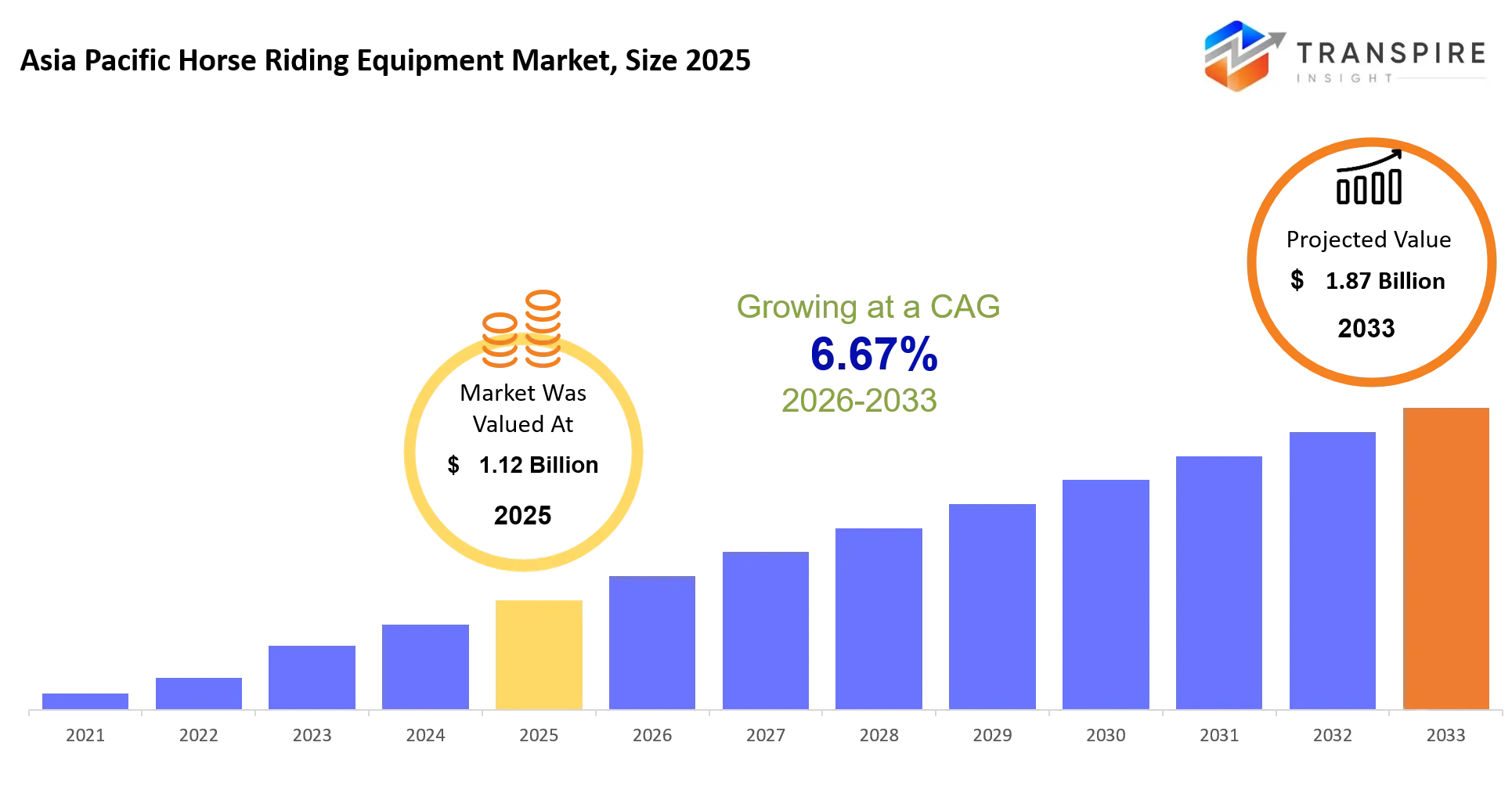
As per Transpire Insight Analysis, the Asia Pacific Horse Riding Equipment Market size is estimated at USD 1.12 Billion in 2025 and is anticipated to reach USD 1.87 Billion by 2033, growing at a CAGR of 6.67% from 2026 to 2033.
The Asia Pacific Horse Riding Equipment Market kinda supports safe, high performance equestrian activities by providing protective gear, saddles, bridles, riding apparel, and all sorts of horse accessories that are used in professional sports, racing, polo, riding schools, and also just recreational riding. In a way these items help with rider safety, keep the horse more comfortable, and improve training efficiency, while still meeting performance, and regulatory requirements. Over the last five years the market has been shifting toward more technologically advanced protective gear, like lighter composite materials, impact resistant helmets, and more ergonomic saddle designs. That shift really sped up after pandemic related supply chain disruptions, which made regional manufacturers diversify what they produce, and push stronger domestic sourcing across Asia Pacific, somewhat faster than before. Meanwhile governments and equestrian federations upped their spending on sports infrastructure, plus youth riding programs ,so more people would join competitive equestrian disciplines. And now, as premium equipment becomes easier to locate through digital retail channels, and also via specialized distributors, manufacturers appear to pull in higher value sales, while at the same time building more durable customer loyalty across both pro and recreational riders.
Asia Pacific Horse Riding Equipment Market Size & Forecast:
- Asia Pacific Horse Riding Equipment Market Size 2025: USD 1.12 Billion
- Expected Market Value 2033: USD 1.87 Billion
- Forecast CAGR: 6.67%
- Leading region in 2025:
- Fastest Growing region:
- Key Profile: Ariat International, Decathlon, Charles Owen, Samshield, Hermès, Dover Saddlery, WeatherBeeta, LeMieux, Cavallo, Pikeur, HKM Sports Equipment, Kerrits, Horseware Ireland, Shires Equestrian, Stubben
Key Market Insights
- Asia Pacific Horse Riding Equipment Market is projected to hit USD 1.87 Billion by 2033, showing a steady , kinda consistent push in the industry mainly because premium equipment is being adopted more and more.
- Australia leads the region, with an estimated 34% market share in 2025 , and that’s mostly backed by long standing equestrian sports and racing ecosystems.
- India is set to post the fastest growth through 2033, driven by more riding academies, polo tourism, and private equestrian clubs, all becoming a more frequent thing.
- Riding helmets are taking close to 29% of market revenue in 2025, helped by tougher competition safety regulations that riders actually need to follow.
- Riding boots stay in second place for the product mix, they benefit from faster turnover cycles and rising demand for performance footwear.
- Protective gear is forecast to grow the quickest as lightweight impact-resistant materials become the norm, especially across professional meets.
- Professional equestrian sports are about 42% of application demand, supported by horse racing, show jumping, and dressage events.
- Recreational riding keeps expanding fast too , as equestrian tourism and riding schools bring in newer riders across Southeast Asia.
- On the end-user side, professional riders still hold the largest share at nearly 46%, while amateur riders are the quickest growing customer group.
- Key players like Ariat International, Decathlon, Charles Owen, Samshield, LeMieux, and Horseware Ireland are improving competitiveness via premium product launches, local collaborations, digital commerce growth, and newer protective equipment technologies.
What are the Key Drivers, Restraints, and Opportunities in the Asia Pacific Horse Riding Equipment Market?
Honestly, the main growth lever still seems to be the professionalization of equestrian sports, along with stricter rider safety rules that were rolled out by national equestrian federations and racing authorities… so, you get this whole push toward “okay, no more casual gear”. Mandatory certification for riding helmets, body protectors, and even competition apparel has kinda nudged riders riding schools and clubs to start swapping older gear for certified versions. At the same time, more money keeps going into riding academies, horse racing facilities, and equestrian tourism across Australia, India, China, and bits of Southeast Asia, and that has widened the buyer base for the premium stuff. So because of this shift manufacturers can push higher average selling prices while also boosting repeat replacements, mainly for safety focused items.
Premium horse riding equipment stays pricey mostly because the makers lean on higher grade leather, advanced composites, specialized textiles, and that sort of hand craftsmanship which takes real know-how. Those production traits basically lock in structural cost constraints, and you cannot fix them fast just by scaling up. On top of that, in several developing Asian countries, participation levels in equestrian sports are still limited , which also caps production quantities… and that feeds into higher retail pricing. As a result, many recreational riders delay upgrades, or they choose budget alternatives , which then shrinks the revenue upside for premium international brands.
Looking farther ahead, the best long-term opening looks like expanding digital commerce, backed by personalized product fitting technologies plus smart protective equipment. With AI-enabled sizing platforms, virtual fitting tools, and wearable rider safety devices, manufacturers can reach customers beyond the typical equestrian retail channels. In a way it’s like a tailored safety and comfort pathway, without relying only on the local store presence.
What Has the Impact of Artificial Intelligence Been on the Asia Pacific Horse Riding Equipment Market?
Artificial intelligence is slowly, like for real, reshaping the Asia Pacific horse riding equipment industry, mostly by improving product development , manufacturing efficiency, inventory management, and the overall customer experience. More and more manufacturers are turning to AI assisted design software, to fine tune helmet impact protection, saddle comfort in ergonomic terms , and riding boot feel, using biomechanical simulations plus rider motion analysis.At the same time, machine learning models also look at production quality signals to flag real inconsistencies before assembly, that usually makes fewer product defects, and in a kind of quieter way it cuts manufacturing waste too.
On the commerce side , digital sales platforms are starting to lean on AI recommendation engines that basically match riders with helmets, boots, saddles, and even apparel, based on riding discipline, body measurements , purchase history , and skill level. A few premium brands are going further and using predictive analytics to guess seasonal demand across racing, polo, and recreational riding segments too. This helps them allocate inventory better, while also reducing those annoying stock shortages. Then there are computer vision tools that can run automated quality checks, raising manufacturing consistency and lowering production costs, at least in many settings.
Still, AI adoption is not fully smooth because the regional equestrian industry is pretty fragmented. A lot of manufacturers work with limited digital infrastructure and, frankly, not enough product performance datasets, so advanced predictive models end up being less accurate than expected. Also, the investment needed for AI integration plus specialized engineering know-how keeps slowing things down, especially for small and medium sized equipment manufacturers across emerging parts of the Asia Pacific.
Key Market Trends
- After 2021, manufacturers started to swap the older heavier materials for lighter composite shells, and then pair that with impact absorbing technologies that feel more “premium” in riding helmets. It kind of shifted fast, like the whole thing got iterated, and not just lightly.
- Online sales channels also picked up quite a lot in market share, as brands rolled out virtual fitting, AI assisted sizing, and direct-to-consumer setups across Asia Pacific. You could almost say the whole purchasing path changed, even for people who used to prefer offline.
- Riding schools, more and more, began standardizing certified protective equipment after new competition safety rules were adopted by national equestrian organizations. So yeah, it became more uniform, not just “recommended”.
- Premium brands then expanded manufacturing partnerships across Asia, mainly to cut logistics costs. This happened after the global supply chain disruptions during 2020–2022 made sourcing vulnerabilities obvious to everyone.
- In Australia, leadership was reinforced by continued investment in horse racing, eventing, and professional riding competitions, which in turn helped riders buy the better, premium equipment. Not surprising, really.
- India’s equestrian world grew via private riding academies, polo clubs, and tourism projects too, and that opened fresh openings for international equipment manufacturers.
- Companies like Ariat International, Charles Owen, Samshield, and LeMieux accelerated premium product releases. They leaned into ergonomic designs, and advanced protective materials, with a kind of consistent focus.
- Sustainable leather alternatives plus recycled technical textiles started seeing wider commercial adoption. Manufacturers seemed to respond to changing customer purchasing preferences, and it’s like they adjusted quickly.
- Smart wearable technologies, connected with rider training and performance monitoring platforms, started affecting premium product development strategies after 2023. The direction was clearer, even if the integrations looked scattered at first.
- Finally, regional manufacturers increasingly pushed localized production and faster product customization. The goal was to stay competitive against imported premium brands, and honestly it’s been working for them.
Asia Pacific Horse Riding Equipment Market Segmentation
By Product Type
Product type segmentation actually mirrors the varied riding needs that show up across competitive sports, casual leisure, and even training environments. Saddles stay kinda essential, because comfort, rider balance, and also the horse performance depend on a correct saddle design and its fit. Riding helmets take up a pretty big role too, since safety regulations still push for certified protective headgear during competitions plus in more organized riding sessions. Riding boots help with stability and grip, while bridles really improve communication and control, between horse and rider.
Riding apparel is more like a combination of comfort , flexibility and durability, meant for day to day practice as well as bigger professional events. Protective gear, like body protectors and safety vests, keeps gaining importance as riding organizations raise their safety expectations. Then there are other items such as gloves, spurs, reins, and horse accessories, which support specific riding disciplines and wrap up the equipment requirements for riders at different levels of experience.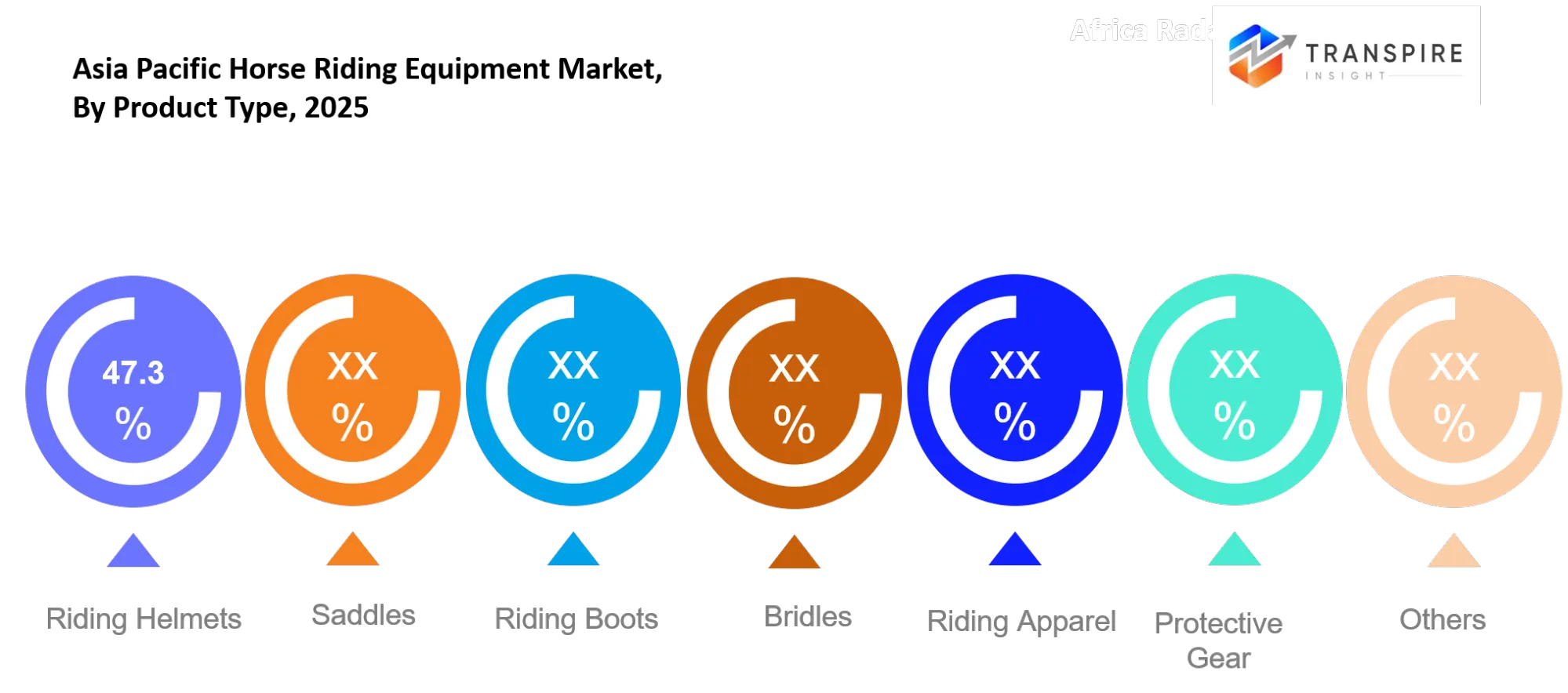
By Material
Material selection kind of shapes product durability, comfort, maintenance too, and the overall performance it seems. Leather still stays near the top, since premium saddles, boots, and bridles usually get a long service life, real flexibility, and that traditional craftsmanship vibe. Synthetic materials work as a practical alternative, with reduced maintenance needs, lighter weight, and better moisture resistance, so these products are more fitting for beginners and riding schools in general. Composite materials keep expanding especially in protective helmets and body armor, because impact resistance along with lighter builds helps improve rider safety.
Textile materials back up riding apparel using breathable fabrics, a stretch oriented performance, and weather protection for different climates across the Asia Pacific region. Technical fabrics also raise comfort during long rides and even competitive events. Then there are other materials, like advanced polymers and mixed material pairings, that let manufacturers roll out innovative products balancing durability, appearance, and production efficiency, in a smoother way than before.
By Application
Professional equestrian sports kinda generate a lot of equipment demand, mainly because events need products that are certified, and they have to really hit performance and safety benchmarks. Recreational riding keeps growing too, driven by riding clubs, tourism activities and even those weekend leisure programs. Because of that there are steady buys of helmets, boots, and riding apparel too, sort of consistently.
Horse racing relies on light, specialized equipment, meant to squeeze out more rider control and better racing speed. Polo also adds a different angle, since it calls for purpose built gear that helps with speed, maneuverability, and basic player safety.
Training stays a big deal here, because riding academies expect dependable equipment for daily lessons and ongoing skill development. The replacement cycles are still going strong, mostly because everything gets used every day in structured learning. Besides that you still see ceremonial riding, endurance events, and community riding programs, and those bring extra demand across multiple customer groups.
By End User
Professional equestrian sports kinda generate a lot of equipment demand, mainly because events need products that are certified, and they have to really hit performance and safety benchmarks. Recreational riding keeps growing too, driven by riding clubs, tourism activities and even those weekend leisure programs. Because of that there are steady buys of helmets, boots, and riding apparel too, sort of consistently.
Horse racing relies on light, specialized equipment, meant to squeeze out more rider control and better racing speed. Polo also adds a different angle, since it calls for purpose built gear that helps with speed, maneuverability, and basic player safety.
Training stays a big deal here, because riding academies expect dependable equipment for daily lessons and ongoing skill development. The replacement cycles are still going strong, mostly because everything gets used every day in structured learning. Besides that you still see ceremonial riding, endurance events, and community riding programs, and those bring extra demand across multiple customer groups.
By Distribution Channel
Specialty stores stay a key sales channel, because expert product guidance, fitting assistance, and after-sales support kinda help customers sort out what to choose. Online retail keeps growing as digital platforms offer a wider range of products, competitive prices, and easy home delivery across city and regional areas. Sporting goods stores help too, since they put selected equestrian equipment right there, mixed in with broader outdoor and general sports categories. With products available through different retail styles, customers get more convenience and the market gets more reach too.
Direct sales let manufacturers build tighter relationships with riding schools, professional riders, and equestrian clubs, mainly through customized product offerings and bulk purchasing agreements. It also boosts brand visibility inside organized equestrian communities. Other paths for distribution include local distributors , exhibitions, and event driven sales, where manufacturers meet specialized buyer groups.
What are the Key Use Cases Driving the Asia Pacific Horse Riding Equipment Market?
Professional equestrian sport is still the biggest use case, kinda because the competitive disciplines need certified helmets, saddles, boots, and other protective gear that has to follow national plus international safety requirements. In that world, horse racing, show jumping, and dressage events push a lot of recurring replacement buys too, since expectations keep climbing and safety rules get stricter.
Recreational riding and planned training routines are also growing, especially in riding schools and within equestrian clubs. Tourism operators, private academies, and sports organizations tend to put money into dependable riding equipment for beginner coaching, regular practice sessions, and organized leisure riding activities, while keeping those safety standards steady, not random.
New opportunities are gradually taking shape, like equestrian tourism sites, therapeutic horseback riding programs, and youth development initiatives that are gaining momentum. Digital fitting methods, smarter protective gear, and tailored performance items will add more value, as premium riding experiences get easier to access across emerging markets, particularly through the Asia Pacific region.
|
Report Metrics |
Details |
|
Market size value in 2025 |
USD 1.12 Billion |
|
Market size value in 2026 |
USD 1.19 Billion |
|
Revenue forecast in 2033 |
USD 1.87 Billion |
|
Growth rate |
CAGR of 6.67% from 2026 to 2033 |
|
Base year |
2025 |
|
Historical data |
2021 - 2024 |
|
Forecast period |
2026 - 2033 |
|
Report coverage |
Revenue forecast, competitive landscape, growth factors, and trends |
|
Regional scope |
Asia Pacific (India, China, Japan, Australia, South Korea, Rest of Asia Pacific) |
|
Key company profiled |
Ariat International, Decathlon, Charles Owen, Samshield, Hermès, Dover Saddlery, WeatherBeeta, LeMieux, Cavallo, Pikeur, HKM Sports Equipment, Kerrits, Horseware Ireland, Shires Equestrian, Stubben |
|
Customization scope |
Free report customization (country, regional & segment scope). Avail customized purchase options to meet your exact research needs. |
|
Report Segmentation |
By Product Type (Saddles, Riding Helmets, Riding Boots, Bridles, Riding Apparel, Protective Gear, Others); By Material (Leather, Synthetic Materials, Composite Materials, Textile, Others); By Application (Professional Equestrian Sports, Recreational Riding, Horse Racing, Polo, Training, Others); By End User (Professional Riders, Amateur Riders, Riding Schools, Equestrian Clubs, Others); By Distribution Channel (Specialty Stores, Online Retail, Sporting Goods Stores, Direct Sales, Others) |
Which Regions are Driving the Asia Pacific Horse Riding Equipment Market Growth?
Australia stays in the lead in the Asia Pacific market, mainly because the country has a pretty mature equestrian landscape, sort of backed by internationally acknowledged horse racing culture, show jumping, eventing, and riding clubs. You can also see national safety standards doing their part, plus there are active equestrian federations, and then there is consistent money flowing into riding facilities. All that basically helps people keep replacing helmets, saddles, boots, and other protective gear on a regular basis. On top of that there are solid retail networks, specialized distributors, and lots of premium brand options, so getting the right equipment is easy for both professionals and casual users. In the end, the mix of organized competitions, capable riders, breeding operations, and training centers forms a steadier base that keeps the region’s leadership going.
Japan comes next as the second-largest regional contributor, but the market feels different compared with Australia. Here the focus leans more toward product quality, precision manufacturing, and keeping customers for the long run, rather than just volume. Consumer spending remains fairly stable, horse racing organizations are well set up, and riding clubs keep investing steadily, so equipment demand stays dependable even if the broader economy wobbles for a while. Most buyers tend to value certified safety products, premium craftsmanship, and long-lasting materials more than cheaper options. That style of purchasing, in turn, supports ongoing revenue for domestic distributors and for global brands that prefer the premium product lane.
India is projected to show the fastest growth from 2026 to 2033, mainly as equestrian involvement expands beyond the usual racing scene into riding academies, polo tourism, and other recreational horse sports. Newer investment in private riding schools, sports infrastructure, and digital retail channels has made it easier to reach products in both major metro areas and newer emerging towns.
Who are the Key Players in the Asia Pacific Horse Riding Equipment Market and How Do They Compete?
Competition still feels kind of moderately fragmented, with premium international manufacturers rubbing shoulders with value-leaning sporting goods retailers plus some specialized equestrian brands. Product safety certification, material innovation, overall brand reputation, and distribution reach keep staying the main drivers behind who gets the edge. The premium side keeps trying to hold onto market share using technology-led product development, while the wider retail players tend to push harder on pricing, convenience, and very large regional store networks, more or less.
Ariat International goes for performance footwear and riding apparel by mixing advanced cushioning technologies with long-lasting materials that work for both professional and casual riders. Decathlon competes with cost-efficient product selections backed by broad retail coverage and digital commerce tools, which makes equestrian gear easier for first-time buyers to step into. Charles Owen differentiates via independently certified riding helmets, putting emphasis on impact protection, and on continuous safety innovation while also growing relationships with equestrian organizations, to keep the brand more visible in practice.
Horseware Ireland improves its position using technical horse blankets, protective equipment, and higher-end rider products supported by ongoing international expansion plus targeted acquisitions. LeMieux, instead, concentrates on premium product design and matching equipment lines, along with quick product releases that attract competitive riders who care about both performance and looks. All of these companies keep expanding regional presence via digital retail investments, distributor partnerships, and broader product portfolios, targeting both mature equestrian markets and newer customer groups that are still forming.
Company List
Ariat International, Decathlon, Charles Owen, Samshield, Hermès, Dover Saddlery, WeatherBeeta, LeMieux, Cavallo, Pikeur, HKM Sports Equipment, Kerrits, Horseware Ireland, Shires Equestrian, Stubben
Recent Development News
In January 2025, Horseware Ireland announced the merger with EquiFit. The transaction combined complementary equestrian product portfolios, expanded international distribution capabilities, and strengthened innovation across premium horse and rider equipment.https://www.horseware.com.
In June 2026, Gallagher entered a three-year title partnership with the Dublin Horse Show. The investment increased commercial support for one of Europe's premier equestrian events and enhanced brand visibility across the international horse sports community.https://www.rte.ie
What Strategic Insights Define the Future of the Asia Pacific Horse Riding Equipment Market?
The market is kind of moving toward premium , tech enabled equipment backed by tougher safety standards, more digital retail expansion, and broader participation in organized equestrian sports. Product differentiation will more and more depend on certified protection, lighter materials, and digital customer touchpoints not only price wrestling. There is also a less obvious risk though, like the limited supply of premium leather and specialized composite inputs, it can quietly raise production expenses and squeeze margins when raw material prices get wobbly.
At the same time, customized gear enabled by artificial intelligence sizing tools, plus direct to consumer online channels, offers a real chance, especially across India and Southeast Asia where organized riding infrastructure is still growing. Firms that go early with local manufacturing, certified safety technology, and omnichannel distribution, while also building ties with riding academies and equestrian organizations, should be better placed to take the long term regional upside.
Asia Pacific Horse Riding Equipment Market Report Segmentation
By Product Type
• Saddles
• Riding Helmets
• Riding Boots
• Bridles
• Riding Apparel
• Protective Gear
• Others
By Material
• Leather
• Synthetic Materials
• Composite Materials
• Textile
• Others
By Application
• Professional Equestrian Sports
• Recreational Riding
• Horse Racing
• Polo
• Training
• Others
By End User
• Professional Riders
• Amateur Riders
• Riding Schools
• Equestrian Clubs
• Others
By Distribution Channel
• Specialty Stores
• Online Retail
• Sporting Goods Stores
• Direct Sales
• Others
Frequently Asked Questions
Find quick answers to common questions.
The Expected Asia Pacific Horse Riding Equipment Market size for the Market will be USD 1.87 Billion in 2033.
Key segments for the Asia Pacific Horse Riding Equipment Market are By Product Type (Saddles, Riding Helmets, Riding Boots, Bridles, Riding Apparel, Protective Gear, Others); By Material (Leather, Synthetic Materials, Composite Materials, Textile, Others); By Application (Professional Equestrian Sports, Recreational Riding, Horse Racing, Polo, Training, Others); By End User (Professional Riders, Amateur Riders, Riding Schools, Equestrian Clubs, Others); By Distribution Channel (Specialty Stores, Online Retail, Sporting Goods Stores, Direct Sales, Others).
Major Asia Pacific Horse Riding Equipment Market players are Ariat International, Decathlon, Charles Owen, Samshield, Hermès, Dover Saddlery, WeatherBeeta, LeMieux, Cavallo, Pikeur, HKM Sports Equipment, Kerrits, Horseware Ireland, Shires Equestrian, Stubben.
The Current Asia Pacific Horse Riding Equipment Market size is USD 1.12 Billion in 2025.
The Asia Pacific Horse Riding Equipment Market CAGR is 6.67% from 2026 to 2033.
Ariat International, Decathlon, Charles Owen, Samshield, Hermès, Dover Saddlery, WeatherBeeta, LeMieux, Cavallo, Pikeur, HKM Sports Equipment, Kerrits, Horseware Ireland, Shires Equestrian, Stubben
About the Authors

Chetan Dhatrak
I’m Chetan Dhatrak, a Senior Research Analyst at Transpire Insight, specializing in the Consumer Goods, Foods and Beverages industry. I focus on analyzing market trends, consumer behavior, competitive landscapes, and industry developments to deliver accurate, data-driven insights. My research at Transpire Insight is built on credible sources and in-depth analysis, helping businesses and readers better understand market dynamics, emerging opportunities, and evolving consumer preferences. I’m committed to creating reliable, well-researched content that supports informed decision-making and reflects the latest developments in the consumer goods and food & beverage sectors.

Chakradhar Khansole
Chakradhar serves as the Research Director at Transpire Insight, bringing over 8 years of experience in technology, innovation, and strategic market intelligence. He specializes in transforming complex market data into actionable business insights that enable organizations to make informed, growth-oriented decisions. Recognized for his strategic vision and analytical expertise, Chakradhar leads high-impact research initiatives, delivering comprehensive market assessments, competitive intelligence, and forward-looking industry analysis.
Recently Published Reports
-
Apr 2026
Bottled Water Market
Bottled Water Market Size, Share & Analysis Report By Product Type (Still Bottled Water, Carbonated Bottled Water, Functional Bottled Water, and Others), By Packaging (PET, Cans, and Others), By Sales Channel (Supermarkets/Hypermarkets, Convenience Stores/Drug Stores, Grocery Stores/Club Stores, Foodservice, and Others) and Geography (North America, Europe, Asia-Pacific, Middle East and Africa, South and Central America), 2021 - 2032
-
Apr 2026
Color Cosmetic Packaging Market
Color Cosmetic Packaging Market Size, Share & Analysis Report By Application (Mascara Packaging, Liquid Packaging, and Liquid Face), By Type (Tubes & Bottles, Pens & Markers, Compacts & Containers, and Droppers & Pumps), and Geography (North America, Europe, Asia-Pacific, Middle East and Africa, South and Central America), 2021 - 2031
-
Apr 2026
External Microphone For Camera Market
External Microphone For Camera Market Size, Share & Analysis Report By Type (Shotgun Microphone, Lavalier Microphone, and Others), By Application (Digital Camera, Professional Video Camera, and Others), and Geography (North America, Europe, Asia-Pacific, Middle East and Africa, South and Central America), 2021 - 2031
-
Apr 2026
Foot Orthotic Insoles Market
Foot Orthotic Insoles Market Size, Share & Analysis Report By Type (Pre-fabricated, and Custom-made), By Material (Thermoplastic, Composite Carbon Fiber, and Others), By Distribution Channel (Drug Stores, Hospitals & Clinics, and Others), and Geography (North America, Europe, Asia-Pacific, Middle East and Africa, South and Central America), 2021 - 2031