

Asia Pacific Synthetic Leather Market Size & Forecast:
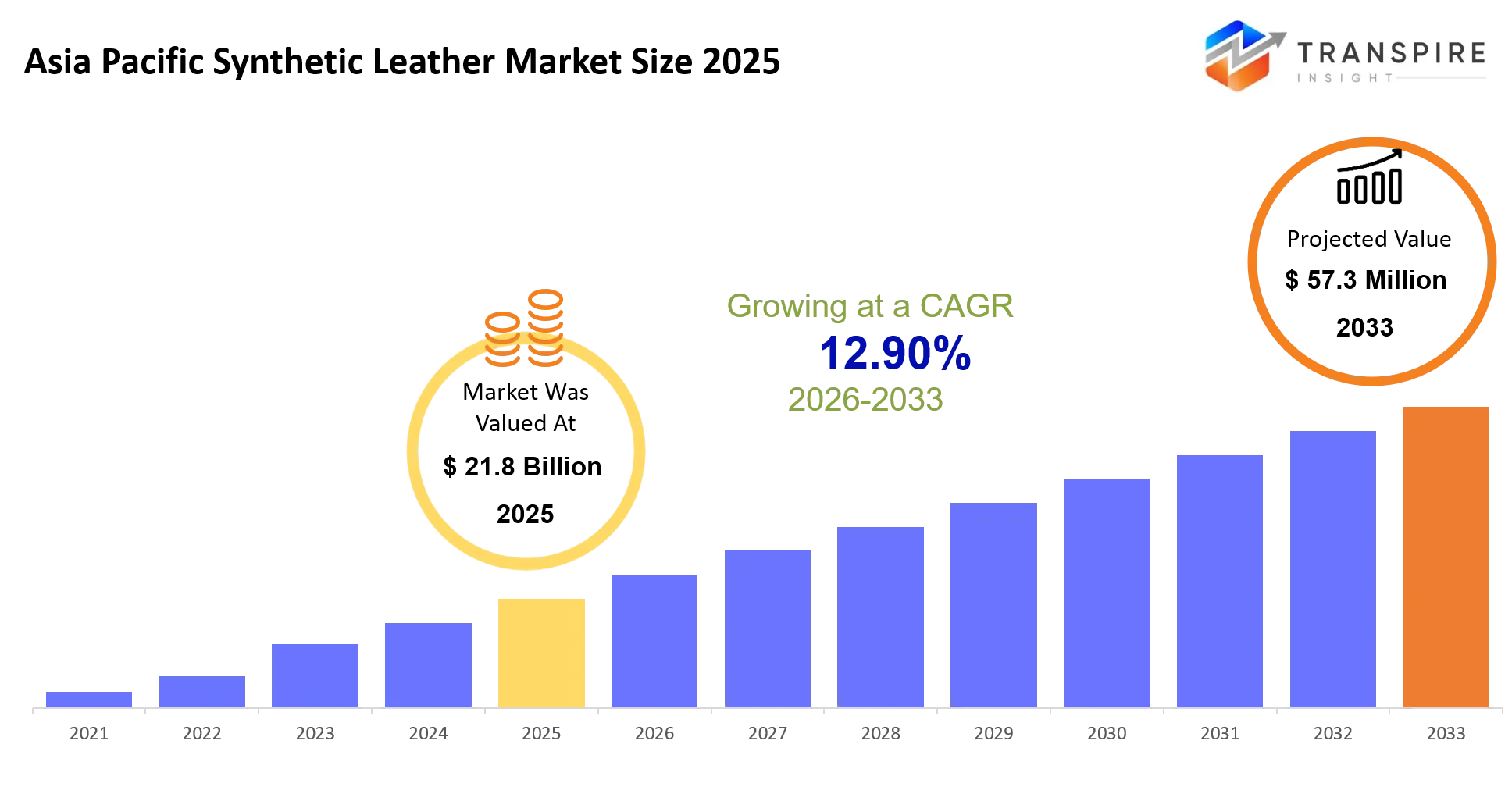
- Asia Pacific Synthetic Leather Market Size 2025: USD 21.8 Billion
- Asia Pacific Synthetic Leather Market Size 2033: USD 57.3 Million
- Asia Pacific Synthetic Leather Market CAGR: 12.90%
- Asia Pacific Synthetic Leather Market Segments: By Product Type (PU Leather, PVC Leather, Bio-Based Synthetic Leather, Microfiber Leather, Silicone Leather, Recycled Synthetic Leather, Composite Leather, Others); By Application (Footwear, Automotive Interiors, Furniture, Fashion Accessories, Sports Goods, Bags & Luggage, Upholstery, Others); By Distribution Channel (Direct Sales, Distributors, Online Sales, Specialty Stores, OEM Supply, Export Channels, Retail Stores, Others); By End User (Automotive Industry, Footwear Manufacturers, Furniture Industry, Fashion Brands, Sports Equipment Makers, Bag Manufacturers, Interior Designers, Others)
To learn more about this report,  Download Free Sample Report
Asia Pacific Synthetic Leather Market Summary
The Asia Pacific Synthetic Leather Market was valued at USD 21.8 Billion in 2025. It is forecast to reach USD 57.3 Million by 2033. That is a CAGR of 12.90% over the period.
The Asia Pacific market for synthetic leather offers a reliable and cost-effective alternative to natural leather in industries like footwear, automobiles, furniture, bags and consumer goods. Producers favor this material for the consistent quality, design possibilities and easy maintenance that it provides, while avoiding the risks of fluctuating price and availability of animal skins. In the past few years the market has undergone structural change from conventional PVC-material based product towardsPU and bio synthetic leather due to demands by brands to achieve a smaller carbon footprint, reduced weight and to reach new levels of emission controls. The supply chain disruptions during the pandemic was one major catalyst for the transition from dependence on global suppliers to greater regional sourcing and development of manufacturing capacity within the region. These changes have altered market growth drivers. As the transition to electric vehicles gains momentum and the consumer product market moves towards high-end segments where sustainability practices and standards are also of critical importance synthetic leather producers are expanding their value-chain position, yielding higher profit potential through improved product differentiation across Asia Pacific.
Key Market Insights
- The Asia Pacific Synthetic Leather Market leads in the world by industry size with supportive manufacturing ecosystems and various end-use industries.
- China has taken the lion's share in the regional market share by more than half and expected to be 50%+ market share in 2025, and it's being attributed to integrated supply chains and larger scale production capability.
- The polyurethane synthetic leather holds the largest market share (approx. 60%) over the past few years, this is driven by superior flexibility and low-emission, which are the positioning of the higher quality range product.
- The second largest segment, PVC synthetic leather is primarily driven by the cost benefit for application of furniture (budget class) and accessory applications.
- Bio-based synthetic leather holds the fastest CAGR, the trend is likely to continue through the forecast period as manufacturers increasingly invest in renewable feed stocks and low-carbon solutions for their manufacturing.
- The footwear application is having an application segment with the second largest market share (approx. 40%) over years, it's supported by the manufacturing of sportswear & leisure footwear throughout the Asia Pacific regions.
- The automotive interiors segment has witnessed the fastest growing application segment and EV Manufacturers looking to have lightweight yet superior quality interiors, and it's predicted that will hold more significant growth rate through the forecast period.
- The consumer goods & furniture applications are having a considerable increase, brands and marketers are trying to have durability combined with attractive appearance and lower maintenance requirements.
- The footwear industry has remained as the largest end-user market segment with more than a third of the total regional revenue to be gained in 2025.
- The market for Asia Pacific Synthetic Leather Market is to be shaped with capacity additions, sustainable solution and digitalization for the period of forecast.
What are the Key Drivers, Restraints, and Opportunities in the Asia Pacific Synthetic Leather Market?
The number one growth driver is a substitution from real leather to engineered materials with cost advantage, steady supply, and enhanced design freedom. This trend was spurred by car manufacturers increasing production of electrical vehicles and shoe companies reducing the supplier dependency, following supply disruptions driven by the pandemic. The most popular engineered material currently gaining traction is polyurethane synthetic leather that allows high-end appearances along with superior durability and lower environmental impact compared to PVC materials. As the manufactures' capacity expands revenue growth will become more concentrated on higher value car interior segments and brand products compared to low-margin commodity applications.
The single most important challenge is dependency on petrochemical feedstocks for the whole industry. Polyurethane and PVC manufacturing remain dependent on derivatives of crude oil, causing instability of raw material prices and pressures on margins for the companies. This structural constraint is difficult to overcome swiftly, as the industry requires new supply networks, modified manufacturing processes, and major capital outlays for alternatives such as bio-based materials. Therefore, uncertainty of price continues to delay purchases and restrict profit. This is especially evident for smaller companies in the sector.
The subsequent phase of development is based on bio-based and recycled synthetic leather technologies. Investment into plant-based PU, recycled polyester backings, and solvent-free processes will result in superior product segments and healthy profit margins. India and Southeast Asia have become attractive manufacturing centers, driven by a growth in the automotive segment, growth in shoe exports, and sustainability mandates that provide further opportunities for sustainable market development in the longer term.
What Has the Impact of Artificial Intelligence Been on the Asia Pacific Synthetic Leather Market?
In synthetic leather manufacturing, the influence of AI and sophisticated digital technologies leads to more accurate processes, more uniform materials and enhanced operations. Vision systems that employ artificial intelligence are now commonly implemented by manufacturers for online inspection of defects on the surface of materials. These vision systems can identify imperfections, coating unevenness and variations in the color of materials in real time. This reduces the amount of waste material and inspection time in quality control and ensures that standards are met with greater ease.
Machine learning models have also started being incorporated into production scheduling and preventative maintenance operations. Through examination of machine vibration and temperature levels, as well as operational history, manufacturers are now able to predict equipment failures prior to their occurrence. This contributes to less down time and lower maintenance costs, as well as steadier production schedules. AI has also been used to optimize processes to help producers control curing temperatures, thickness of coating and use of chemicals more efficiently.
Digital twins and smart factory systems are starting to be adopted, increasing supply chain visibility and inventory planning across vast factory operations. However, significant financial constraints in the high cost of implementation and dispersed production processes limit the integration of artificial intelligence technology. Small and medium-sized producers still depend on aging machinery lacking adequate sensors and the communication backbone for intelligent control systems, leading to a slower integration of smart technology across the local market.
Key Market Trends
- Since 2020, manufacturers have ramped up the switch fromPVC to PU synthetic leather due to consumer demands for a more reduced emission footprint and a luxurious feel and look.
- China’s dominant manufacturing positions further strengthened in the aftermath of the pandemic, whereas India and Vietnam increased production capacity in a move aimed at reducing geographic concentration in supply.
- From 2021 onwards, footwear brands furthered their use of engineering synthetics to replace natural leather on account of stable cost, faster lead times and tunable texture properties.
- Automotive manufacturers increasingly integrated synthetics into interiors with the advent of electric vehicle adoption and growing demands for lighter interior components for efficiency.
- Bio-based synthetics transitioned from specialty application to commercial stage development with multiple players targeting more than 20% of renewable feedstock by 2030.
- Increased investments in solvent-free coating techniques were made by companies such as Kuraray, Toray Industries and Teijin in an attempt to align with tightened environmental regulations.
- Since 2022, AI based inspection systems have boosted adoption of digital manufacturing as it cut down surface defects and allowed production consistency even on a large-scale facility.
- Consumer demand for supply chain transparency has encouraged manufacturers to increase usage of recycled raw materials and carbon footprint disclosures across all products.
- Competitive behavior now entails strategic partnerships, wherein suppliers work directly with footwear and automotive brands on specific application based material needs.
Asia Pacific Synthetic Leather Market Segmentation
By Product Type:
A type of synthetic leather, characterized by softness and wide range of usage, like shoes, bags, interior of vehicles, etc. PVC Leather: it is the earliest synthetic leather, mainly use due to its cheap price, durable life and others. Bio-Based Synthetic Leather: manufacturers concern the environmental impact of products; bio-based synthetic leather is under study to decrease the emission during production and substitute the raw material.
Microfiber Leather:soft, strong and easy to process, it used in luxury goods; Silicone Leather: it's superior in resistance to stain, the cleaning and easy to maintain. Recycled Synthetic Leather and Composite Leather: reduce waste of materials, and controlling cost; Others: specialty materials; they were designed for various industries, such as industrial goods and specific use goods.
By Application:
This segment, with the benefit of its properties like durability, designability, cost-effectiveness, has a big application; Automotive Interiors: It used for Car Seat, Door Panel, and Car Trimmings etc; Furniture: it used for Sofa, Chair etc in Home and public areas because of its comfort, appearance and easiness in maintenance.
Fashion Accessories, Sport Goods, Bag & Luggage: continuous growth driven by market requirement for fashion trends, fashion styles, and fashion designs. Upholstery application and others(industrial and customized uses): because of it durability life and visual impression;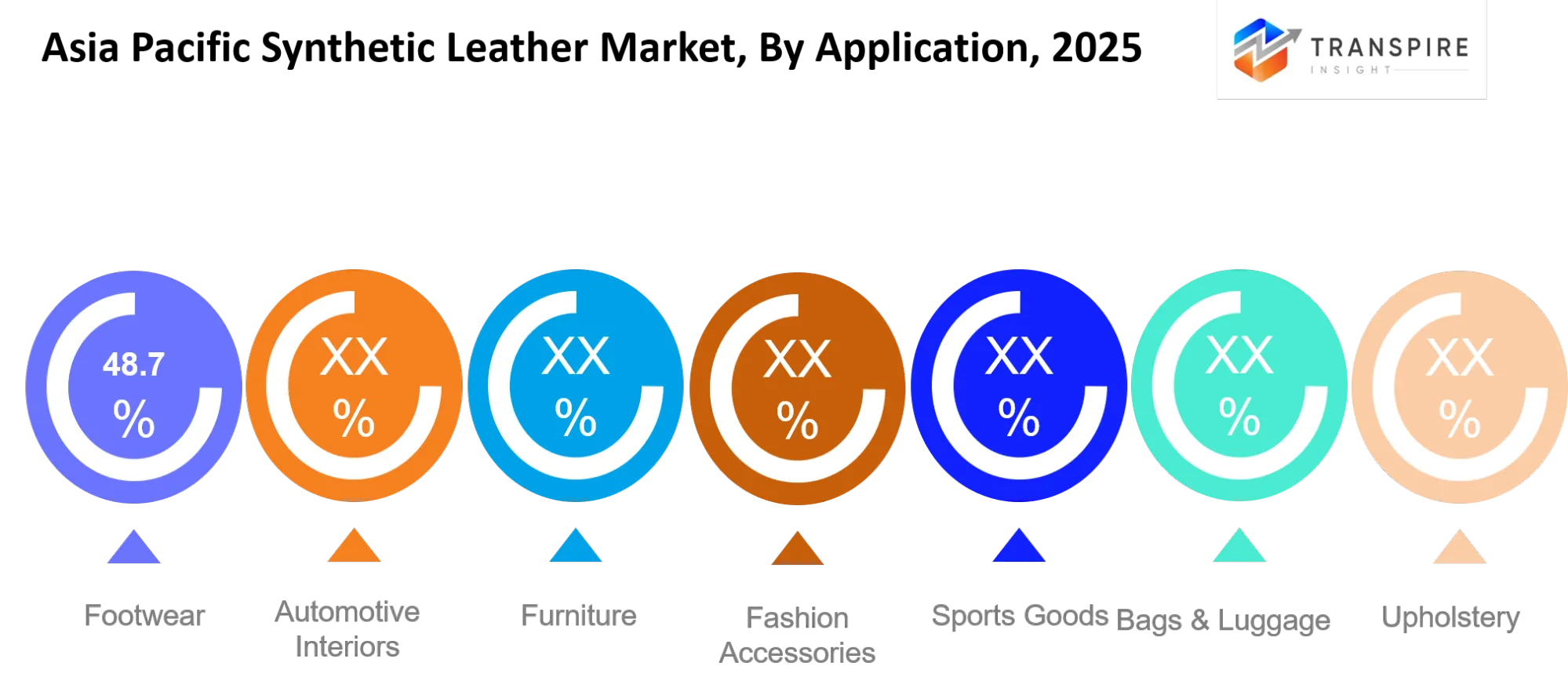
To learn more about this report, Download Free Sample Report
By Distribution Channel:
Direct Sales maintains long-term partnerships between manufacturers and major purchasers. Distributors further enhance regional accessibility and product availability across different countries. Online Sales remain growing in significance as web interfaces make products easier to compare and decide upon.
Specialty Stores emphasize quality materials and custom solutions. OEM Supply remains important for automotive and shoe production lines. Export Channels link producers at the regional level to international markets. Retail Stores and Others serve small businesses and local markets.
By End User:
Synthetic Leather is used in the Automotive industry for the lightweight durability of internal vehicle materials. It is also used by the Footwear manufacturers for a range of product diversity, affordability, and large-scale production capabilities. It is used by the Furniture industry as an appealing and easy-to-maintain option across numerous furniture classifications.
It is used by the Fashion brands to incorporate new textures and finishes into products and accessories. Sports equipment makers and bag makers utilize the product as a strength and design flexible material option. Interior Designers use it to add flexibility to both residential and commercial spaces, with Other users composed of other industrial and consumer end users.
What are the Key Use Cases Driving the Asia Pacific Synthetic Leather Market?
In the Asia Pacific region footwear remains the leading application for synthetic leather due to factors of design versatility, product durability, and manufacturing efficiency. Brands in sports and lifestyle shoes utilize the many textures and colors synthetics provide to deliver consistently manufactured products in high volume runs, maintaining the demand in key manufacturing nations such as India, Vietnam and China. The growth is set to continue throughout 2015.
The second and third leading applications in automotive interiors and furniture have begun to grow steadily as manufacturers within the automobile and furniture industries focus on attributes of easy care and stain resistance. Electrical automobile manufacturers are focusing on higher quality polyurethane and microfiber synthetic leather on their car seats and door panels, whilst commercial furniture providers adopt synthetics that will maintain durability for demanding public, hotel and office environments.
New applications are beginning to arise in sustainable and bio-based clothing accessories as well as in recycled synthetic leather products. New product developments for luxury lifestyle companies are moving forward on the introduction of new products using plant-based and recycled components which in turn has brought new and emerging demand across Asia.
|
Report Metrics |
Details |
|
Market size value in 2025 |
USD 21.8 Billion |
|
Market size value in 2026 |
USD 24.5 Billion |
|
Revenue forecast in 2033 |
USD 57.3 Million |
|
Growth rate |
CAGR of 12.90% from 2026 to 2033 |
|
Base year |
2025 |
|
Historical data |
2021 - 2024 |
|
Forecast period |
2026 - 2033 |
|
Report coverage |
Revenue forecast, competitive landscape, growth factors, and trends |
|
Regional scope |
Asia Pacific (India, China, Japan, Australia, South Korea, Rest of Asia Pacific) |
|
Key company profiled |
Kuraray, Toray Industries, Teijin, Asahi Kasei, Mayur Uniquoters, San Fang Chemical, FILWEL, Alfatex, Continental, Zhejiang Hexin, Wanhua Chemical, Fujian Polytech, H.R. Polycoats, Yantai Wanhua, Benecke-Kaliko |
|
Customization scope |
Free report customization (country, regional & segment scope). Avail customized purchase options to meet your exact research needs. |
|
Report Segmentation |
By Product Type (PU Leather, PVC Leather, Bio-Based Synthetic Leather, Microfiber Leather, Silicone Leather, Recycled Synthetic Leather, Composite Leather, Others); By Application (Footwear, Automotive Interiors, Furniture, Fashion Accessories, Sports Goods, Bags & Luggage, Upholstery, Others); By Distribution Channel (Direct Sales, Distributors, Online Sales, Specialty Stores, OEM Supply, Export Channels, Retail Stores, Others); By End User (Automotive Industry, Footwear Manufacturers, Furniture Industry, Fashion Brands, Sports Equipment Makers, Bag Manufacturers, Interior Designers, Others) |
Which Regions are Driving the Asia Pacific Synthetic Leather Market Growth?
With significant manufacturing capacity, integrated chemical supply chains, and robust export infrastructure, China is a dominating force in the Asia Pacific synthetic leather market. Broad industrial clusters linking raw material suppliers, coating manufacturers, footwear producers, and the automotive industry together ensure a well-connected production system that reduces costs and lead times. Growing government support for advanced manufacturing and cleaner production processes has also spurred investments in the production of polyurethane and bio-based synthetic leather. A combination of economies of scale, supportive government policies, and diversification across the end-use industry segments continue to propel China forward as a regional and global leader.
As the second most impactful market, Japan contributes significantly to the Asia Pacific synthetic leather market, although the growth trajectory is not similar to that of China; while the nation's synthetic leather market prioritizes quality and innovation over manufacturing scale, Japanese manufacturers are committed to producing luxury synthetic leather with superior durability, softness, and an excellent environmental profile, targeting the automotive interior segment, luxury and designer products as well as other high-end consumer goods segments. A relatively stable economic environment and substantial investments in research has further enabled manufacturers in the nation to develop leading-edge microfiber and solvent-free synthetic leather technologies. The steady supply of value-added materials, thereby, makes Japan a reliable region that contributes to the regional revenue as well as technological advancements in synthetic leather.
While India, being the quickest growing market, is gaining significance due to a considerable increase in footwear exports, rapid growth in the automotive industry, as well as expanding manufacturing investment. Several domestic and foreign players have been investing in the installation of new facilities in India since the last few years with a production-linked incentive scheme, and various industrial development initiatives have further accelerated the expansion of the market. Growing demand for low-cost premium quality synthetic leather coupled with improving logistical network is giving impetus to the rapid expansion of the India synthetic leather market. Thus, the given period 2026 to 2033 is expected to create an attractive opportunity in the industry for manufacturers, technology suppliers, and various investors.
Who are the Key Players in the Asia Pacific Synthetic Leather Market and How Do They Compete?
Moderate consolidation is observed in the Asia Pacific Synthetic Leather Market. Rather than price war, leading manufacturers are competing with their innovative materials, efficient production processes, and diverse applications. Instead of producing cheap alternative materials, manufacturers are increasingly producing premium quality materials that possess superior properties, higher environmental friendly values and design flexibility. Investment in eco-friendly production systems, digital manufacturing solutions and regional presence are expected to consolidate market share of the manufacturers and better cater the ever changing demands of consumers.
Kuraray emphasizes innovation and the leading position of premium synthetic materials and microfiber leather is the major one used for car interior, upscale and branded consumer goods application. Well research and development ability in complex polymer and material formulation help Kuraray distinguish itself from others in terms of quality and performance. The same business strategy is applied by Toray Industries by producing lightweight high-strength material and developing green production technology that reduces pollution from emissions.
Teijin provides eco-friendly and advanced fiber materials for automotive and industrial applications. San Fang Chemical Industry is very active in cooperation with fashion brands and footwear companies, thus providing speedy response to demands and customized material solutions. Mayur Uniquoters continuously seeks to increase its production and sales volume by exploring further export opportunities in a wide range of automotive seating, shoe, furnishings applications within the Asia Pacific region.
Company List
- Kuraray
- Toray Industries
- Teijin
- Asahi Kasei
- Mayur Uniquoters
- San Fang Chemical
- FILWEL
- Alfatex
- Continental
- Zhejiang Hexin
- Wanhua Chemical
- Fujian Polytech
- H.R. Polycoats
- Yantai Wanhua
- Benecke-Kaliko
Recent Development News
In October 2025, Pact secured funding of £16 million to scale production of its collagen-coated material designed to replace PVC-based and synthetic leather products. The investment will support new production lines in Europe and Asia, accelerating commercialization of lower-carbon alternatives for fashion, automotive, and interior applications.
Source https://www.thetimes.com/
In June 2025, Ultrafabrics released its 2025 Sustainability Report highlighting expanded use of recycled polyester and bio-based materials across collections including Volar Bio. The update reinforced the company's strategy to increase environmentally preferred content and strengthen adoption of sustainable synthetic leather materials across transportation, furniture, and premium consumer applications. Sourcehttps://home.myresourcelibrary.com/
What Strategic Insights Define the Future of the Asia Pacific Synthetic Leather Market?
Over the next 5-7 years, the structure of the Asia Pacific Synthetic Leather Market is evolving toward greater reliance on technology and sustainability as opposed to cost. Instead of relying purely on their cost advantages, companies will depend increasingly on high-performance PU compounds, bio-based materials and circular economy based manufacturing processes. The driver for this shift is the growing convergence between the increasing strictness of environmental regulations and the growth of electric vehicles in addition to brands who want transparent supply chains with minimal carbon footprints.
A hidden risk of the synthetic leather market is that it remains largely dependent on petroleum feedstocks. Fluctuation in the price of crude oil and scarcity of alternative raw materials at the commercial scale may pose a challenge to profit margins and restrict future investment in newer technologies. On the flip side, bio-based synthetic leather (utilizing plant based polymers as well as recycled components) is a rising opportunity. Companies should aim to take early advantage of this nascent trend, especially within regions of India and Southeast Asia, which have evolving manufacturing ecosystems. Investing in sustainable material technologies, as well as building a varied supply network will prove critical to a sustained competitive advantage.
Asia Pacific Synthetic Leather Market Report Segmentation
By Product Type
- PU Leather
- PVC Leather
- Bio-Based Synthetic Leather
- Microfiber Leather
- Silicone Leather
- Recycled Synthetic Leather
- Composite Leather
By Application
- Footwear
- Automotive Interiors
- Furniture
- Fashion Accessories
- Sports Goods
- Bags & Luggage
- Upholstery
By Distribution Channel
- Direct Sales
- Distributors
- Online Sales
- Specialty Stores
- OEM Supply
- Export Channels
- Retail Stores
By End User
- Automotive Industry
- Footwear Manufacturers
- Furniture Industry
- Fashion Brands
- Sports Equipment Makers
- Bag Manufacturers
- Interior Designers
Frequently Asked Questions
Find quick answers to common questions.
The Asia Pacific Synthetic Leather Market size is USD 57.3 Million in 2033.
Key Segments for the Asia Pacific Synthetic Leather Market are By Product Type (PU Leather, PVC Leather, Bio-Based Synthetic Leather, Microfiber Leather, Silicone Leather, Recycled Synthetic Leather, Composite Leather, Others); By Application (Footwear, Automotive Interiors, Furniture, Fashion Accessories, Sports Goods, Bags & Luggage, Upholstery, Others); By Distribution Channel (Direct Sales, Distributors, Online Sales, Specialty Stores, OEM Supply, Export Channels, Retail Stores, Others); By End User (Automotive Industry, Footwear Manufacturers, Furniture Industry, Fashion Brands, Sports Equipment Makers, Bag Manufacturers, Interior Designers, Others).
Major Asia Pacific Synthetic Leather Market Players are Kuraray, Toray Industries, Teijin, Asahi Kasei, Mayur Uniquoters, San Fang Chemical, FILWEL, Alfatex, Continental, Zhejiang Hexin, Wanhua Chemical, Fujian Polytech, H.R. Polycoats, Yantai Wanhua, Benecke-Kaliko.
The Current Asia Pacific Synthetic Leather Market size is USD 21.8 Billion in 2025.
The Asia Pacific Synthetic Leather Market CAGR is 12.90% from 2026 to 2033.
- Kuraray
- Toray Industries
- Teijin
- Asahi Kasei
- Mayur Uniquoters
- San Fang Chemical
- FILWEL
- Alfatex
- Continental
- Zhejiang Hexin
- Wanhua Chemical
- Fujian Polytech
- H.R. Polycoats
- Yantai Wanhua
- Benecke-Kaliko
About the Authors

Pankaj Ghogare Patil
I am Pankaj Ghogare Patil, a Senior Research Analyst at Transpire Insight, specializing in the Pharmaceutical, Chemicals & Materials, Healthcare IT, and Biotechnology industry. My expertise lies in conducting comprehensive market research, analyzing industry trends, evaluating competitive landscapes, and translating complex data into actionable insights. At Transpire Insight, I closely follow emerging technologies, regulatory developments, and market innovations to create accurate, well-researched, and informative content that helps businesses and professionals make informed decisions. I am committed to producing credible, evidence-based articles that reflect industry best practices while making technical topics accessible and valuable for a broad audience.

Chakradhar Khansole
Chakradhar serves as the Research Director at Transpire Insight, bringing over 8 years of experience in technology, innovation, and strategic market intelligence. He specializes in transforming complex market data into actionable business insights that enable organizations to make informed, growth-oriented decisions. Recognized for his strategic vision and analytical expertise, Chakradhar leads high-impact research initiatives, delivering comprehensive market assessments, competitive intelligence, and forward-looking industry analysis.
Recently Published Reports
-
May 2026
Healthcare Polymer Packaging Market
Healthcare Polymer Packaging Market Size, Share & Analysis Report By Packaging Type (Syringes, IV Bottles and Pouches, Clamshells, Blisters, Bottles & Jars, Containers, Tubes, IV Parental Packaging, Others), By Type (Regulated, Non-regulated), By Polymer Type (LDPE (Low-Density Polyethylene), HDPE (High-Density Polyethylene), Homo-polymer (Homo), Random Copolymer (Random), Block Copolymer (Block), PET, Polystyrene, Polyvinyl Chloride, Polyamide/EVOH, Others), and Geography (North America, Europe, Asia-Pacific, Middle East and Africa, South and Central America), 2021 - 2031
-
Apr 2026
Hydrophilic Tape (Waterstop) Market
Hydrophilic Tape (Waterstop) Market Size, Share & Analysis Report By Type (Bentonite-Based Hydrophilic Tape, Rubber-Based Hydrophilic Tape), By Application (Residential Buildings, Commercial Buildings, Infrastructure Projects), and Geography (North America, Europe, Asia-Pacific, Middle East and Africa, South and Central America), 2021 - 2031
-
Apr 2026
Metalens Market
Metalens Market Size, Share & Analysis Report By Type (Visible Light Metalens, and Infrared Metalens), By Application (Consumer Electronics, Automotive Electronics, Industrial, Medical, and Others), and Geography (North America, Europe, Asia-Pacific, Middle East and Africa, South and Central America), 2021 - 2031
-
Apr 2026
PBT Resin Market
PBT Resin Market Size, Share & Analysis Report By Type (Reinforced PBT Resin, Unreinforced PBT Resin), By Processing Method (Injection Molding, Extrusion, Blow Molding, Others), By End-User (Automotive, Electrical & Electronics, Consumer Appliances, Industrial Machinery, Medical Devices, Packaging, Others), and Geography (North America, Europe, Asia-Pacific, Middle East and Africa, South and Central America), 2021 - 2031