

Europe Equestrian Equipment Market Size & Forecast:
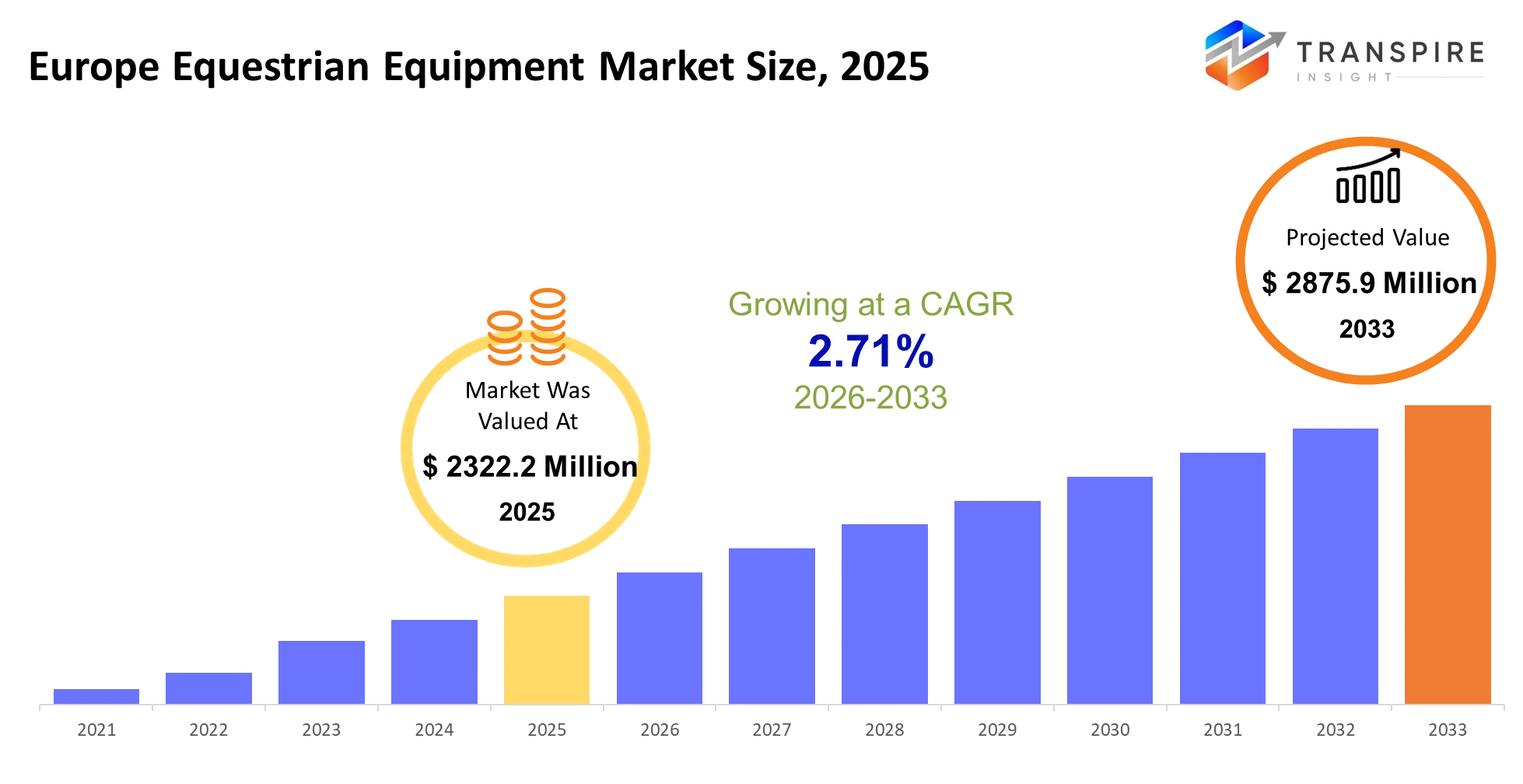
- Europe Equestrian Equipment Market Size 2025: USD 2322.2 Million
- Europe Equestrian Equipment Market Size 2033: USD 2875.9 Million
- Europe Equestrian Equipment Market CAGR: 2.71%
- Europe Equestrian Equipment Market Segments: By Type (Saddles, Bridles, Riding Apparel, Protective Gear, Others), By Application (Horse Riding, Racing, Training, Leisure Activities, Competitions, Others), By End-User (Professional Riders, Amateur Riders, Training Centers, Clubs, Horse Owners, Others), By Distribution (Online Stores, Specialty Stores, Retail Shops, Others).
To learn more about this report,  Download Free Sample Report
Europe Equestrian Equipment Market Summary:
The Europe Equestrian Equipment Market size is estimated at USD 2322.2 Million in 2025 and is anticipated to reach USD 2875.9 Million by 2033, growing at a CAGR of 2.71% from 2026 to 2033. The equestrian equipment market in Europe operates to protect both horses and riders during their training sessions and their athletic competitions and their recreational horseback riding activities. The company provides saddles and bridles and protective equipment and stable products which help equestrians to reduce their injury risk and establish better communication with their horses and achieve better outcomes during their riding activities which meet welfare standards.
The market has undergone a structural transformation during the last three to five years because customers now demand premium equipment which emphasizes animal welfare standards. Customers now select between ergonomically designed saddles and impact-resistant helmets and health monitoring smart wearables for their horses. The process has gained speed because organizations that oversee sports have implemented animal welfare rules which increase their monitoring activities.
The pandemic supply chain blockage uncovered the dangerous dependency on overseas leather and parts which became a major market trigger. European manufacturers created local supply chains because they turned to synthetic materials as their new production method. The organization faces immediate cost increases because of this decision yet it gains protection against supply interruptions which leads to better product delivery and increased use of advanced technology products.
Key Market Insights
- The market for equestrian equipment in Europe sees Western Europe as its major region because Western Europe holds more than 60% of the market share which will be maintained until 2025 because of its strong equestrian tradition and developed equestrian facilities.
- Northern Europe emerges as the fastest-growing region through 2030, supported by rising recreational riding and government-backed animal welfare initiatives
- The industry size shows its greatest value through 2025 because saddles and tack equipment create essential needs which all riding disciplines require.
- Rider apparel and protective gear represent the second-largest segment, driven by safety regulations and professional competition standards
- The fastest-growing market segment consists of smart equestrian equipment which includes wearable horse monitoring devices that will see major growth until 2030.
- The equestrian market receives its major share from sports and professional activities which together hold more than 50% of total market share in 2025 because competitive events and training needs drive demand.
- The leisure and recreational riding segment represents the fastest-growing application market because more people adopt riding as a lifestyle and rural tourism starts to increase.
- Professional riders and equestrian clubs lead the market, contributing approximately 55% share in 2025 because they maintain regular equipment replacement schedules.
- The end-user category of individual recreational riders shows rapid growth because people spend more money on their hobbies.
What are the Key Drivers, Restraints, and Opportunities in the Europe Equestrian Equipment Market?
The Europe equestrian equipment market experiences its main growth factor through enhanced rider safety and animal welfare regulations which all major equestrian nations have implemented. The Fédération Équestre Internationale and other governing bodies have established new safety requirements which demand upgraded helmet and body protector and saddle design safety standards. The combination of this regulatory push and liability concerns from riding schools and event organizers has created needs for more frequent certified gear replacements. Manufacturers achieve higher profits through their premium compliant products while clubs and professionals spend more money to protect themselves from disqualification and insurance problems.
The most persistent constraint is the high cost structure of quality equestrian equipment, particularly leather-based saddles and custom-fit gear. The production process depends on three essential elements: skilled craftsmanship, limited raw material substitutes, and fragmented supply chains which exist throughout Europe. Unlike mass-produced sporting goods, scaling remains difficult. The system creates two obstacles for new riders because it requires them to pay high entry fees and prevents expansion in price-sensitive regions which leads to adoption problems and limits market growth beyond established equestrian communities.
The strongest business potential resides in technology-integrated equipment which includes wearable sensors that monitor horse health and performance. Equisense and other companies are becoming successful through their development of training tools based on data analytics. The adoption of analytics by professional riders to enhance their performance and protect themselves from injuries has created new revenue opportunities which extend beyond standard equipment sales.
What Has the Impact of Artificial Intelligence Been on the Europe Equestrian Equipment Market?
The European equestrian equipment market starts to undergo transformation because artificial intelligence and advanced digital technologies create new possibilities through their ability to process data for tasks that equestrians used to perform manually. The combination of AI-enabled wearables with smart tack now enables automatic performance assessment together with health status evaluation. The devices that saddle and girth systems use to track horse movement and heart rate measurement capabilities show continuous operation, which enables trainers at riding schools to implement uniform horse management practices across all their students.
The development of machine learning models establishes new methods for accurate forecasting. The platforms study past training information to identify initial indicators of lameness together with fatigue and poor performance. The system enables stable managers and riders to take action before their horses reach the point of suffering injuries, which leads to better horse availability and decreased medical expenses. The insights gained through these methods provide direct benefits to athletes by enabling them to enhance their training efficiency, which leads to improved performance results and extended equipment lifespan.
Digital platforms use their operational functions to enhance stable management through their capacity to create automatic scheduling systems, monitor inventory levels, and ensure compliance with welfare regulations. The systems minimize administrative expenses while they improve traceability, which has become mandatory for both regulatory organizations and insurance companies.
The high costs of system integration together with the disjointed nature of data systems prevent organizations from fully implementing their solutions. The majority of smaller stables do not possess the necessary infrastructure or standard datasets which make it possible to create effective AI models, which restricts their ability to expand beyond professional and financially supported equestrian facilities.
Key Market Trends
- The period after 2022 experienced an increase in certified helmet usage across Europe because safety regulations received enhancements which made manufacturers change their product development methods.
- The use of smart riding equipment reached new heights after 2023 because sensor-enabled saddles helped trainers evaluate horse performance at professional training centers.
- The production of traditional leather saddles decreased because manufacturers started using synthetic materials after supply chain disruptions between 2021 and 2023 demonstrated the dangers of material price fluctuations.
- Western European equestrian clubs established new insurance liability requirements which required riding academies to start buying complete safety equipment packages.
- The period after 2022 saw digital stable management platforms increase their market presence while they helped mid-sized equestrian facilities achieve better stock management and lessened their need for manual tasks.
- Competitive equestrian sports organizations increasingly partnered with brands like Horseware Ireland for performance-focused gear innovation.
- E-commerce channels experienced fast expansion after 2020 which decreased customer need for local tack shops while driving up direct sales for premium brands.
- Professional riders now use data-driven training methods because AI-based tracking systems help them identify fatigue which leads to reduced injury rates.
- The sustainability-focused procurement rules which manufacturing companies adopted in 2024 required them to develop new equipment designs that use recyclable materials and lightweight composite materials.
Europe Equestrian Equipment Market Segmentation
By Type
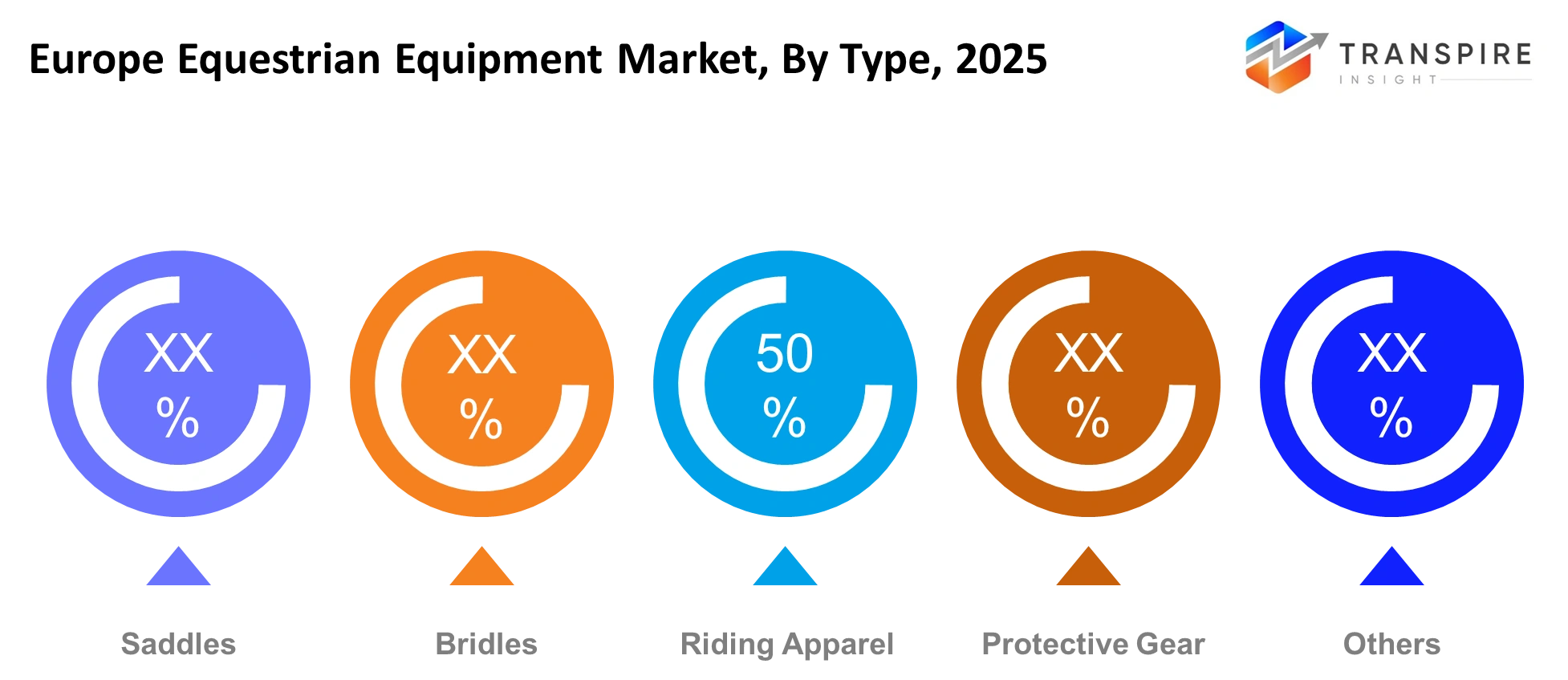
The saddles and bridles market dominates Europe equestrian equipment sales because riding apparel and protective gear and auxiliary accessories support their sales. The strongest market position for saddles exists because riders need durable ergonomic saddle designs which maintain rider control and provide horse comfort during all riding activities. The protective gear market expands at a faster rate because safety rules become more demanding for both competitive events and training sessions.
The professional and leisure riding communities experience growth which drives demand for riding apparel that uses performance fabrics and meets safety standards. Supply disruptions have created cost pressures which lead to material innovation that affects companies' sourcing practices. The European riding institutions will see manufacturers focus on lightweight composite materials and modular design solutions which protect animal welfare and enhance safety standards throughout upcoming years.
To learn more about this report, Download Free Sample Report
By Application
Western European countries which have deep cultural ties to equestrian sports use horse riding and competitive events as their main applications. The high demand for racing and professional competitions exists because performance results depend on both equipment quality and precise fit. The recreational riding activities of younger people together with the growing equestrian experiences which tourists enjoy show faster growth than other activities.
The establishment of safety standards together with the development of complete coaching systems has created a training center environment which mandates standardized equipment usage. The segment is shifting toward digital tracking integration for performance analysis. Future development will favor hybrid applications where recreational and professional standards converge which will increase demand for equipment that enables both casual riding and high-performance training.
By End-User
Professional riders and equestrian clubs represent the biggest market share because they frequently replace their equipment to meet competition-grade standards. Structured learning programs at training centers create ongoing demand because they require specific safety and performance equipment. The number of amateur riders and horse owners will increase because people in suburban and rural areas have more disposable income and spend their free time on multiple activities.
Equipment purchasing decisions at clubs become standardized because they establish equipment performance requirements. The increased understanding of injury prevention methods leads non-professional users to choose products which have received certification. The market segment will transform into personalized equipment which tracks performance metrics and manufacturers will use this to create premium products for institutional and individual customers.
By Distribution
The main distribution method through specialty stores stays in control because customers require professional assistance with their customized product needs for both their saddles and protective equipment. The retail market still supports beginner riders through its physical stores although customer buying habits now prefer online shopping. The fastest growth in online stores occurs because of two factors which include better product display technology and companies' ability to sell their products directly to customers through online platforms.
Digital channels are decreasing the need for physical middlemen because they enable customers to see product prices without any hidden costs. The distribution system continues to operate as a hybrid model because customers need to test their fitting-sensitive products in physical stores. The future expansion plans of the business will benefit from omnichannel systems which use digital channels for product discovery and physical stores to provide final product customization and build customer trust for expensive equipment sales.
What are the Key Use Cases Driving the Europe Equestrian Equipment Market?
European equestrian equipment market shows its highest demand through competitive horse riding together with organized equestrian sports which serve as primary use cases. The demand exists because governing bodies such as the Fédération Équestre Internationale enforce strict competition standards which require organizations to replace equipment frequently while maintaining safety compliance.
The secondary use case shows growth through training academies and recreational riding centers which obtain popularity among amateur riders and structured coaching programs. Standardized saddles and bridles together with protective gear need to exist in these environments because they protect users while enabling skill development, which leads to clubs and training institutions making bulk purchases.
The new use case defines itself through data analysis which tracks horse performance and develops riding therapy programs focused on rehabilitation. Professional stables now implement sensor-based equipment systems which enable them to monitor horse gait and fatigue, while therapeutic riding centers use specialized gear for physical and cognitive rehabilitation. The current applications remain under development, yet they will expand their presence because digital technology develops together with riding practices that focus on rider welfare throughout European equestrian facilities.
|
Report Metrics |
Details |
|
Market size value in 2025 |
USD 2322.2 Million |
|
Market size value in 2026 |
USD 2385.1 Million |
|
Revenue forecast in 2033 |
USD 2875.9 Million |
|
Growth rate |
CAGR of 2.71% from 2026 to 2033 |
|
Base year |
2025 |
|
Historical data |
2021 - 2024 |
|
Forecast period |
2026 - 2033 |
|
Report coverage |
Revenue forecast, competitive landscape, growth factors, and trends |
|
Regional scope |
Europe (Germany, United Kingdom, France, Italy, Spain and Rest of Europe) |
|
Key company profiled |
Ariat, Cavallo, Decathlon, Hermès, Pikeur, Charles Owen, Samshield, Weatherbeeta, HKM Sports Equipment, Kerrits, Horseware Ireland, Bucas, LeMieux, Stubben, Tredstep. |
|
Customization scope |
Free report customization (country, regional & segment scope). Avail customized purchase options to meet your exact research needs. |
|
Report Segmentation |
By Type (Saddles, Bridles, Riding Apparel, Protective Gear, Others), By Application (Horse Riding, Racing, Training, Leisure Activities, Competitions, Others), By End-User (Professional Riders, Amateur Riders, Training Centers, Clubs, Horse Owners, Others), By Distribution (Online Stores, Specialty Stores, Retail Shops, Others). |
Which Regions are Driving the Europe Equestrian Equipment Market Growth?
The European equestrian equipment market shows its highest market share through Western Europe which accessible its equestrian heritage and active animal protection laws and sports safety regulations. The professional riding community of Germany France and the Netherlands exists through their combined presence of numerous riders and riding academies and international competition venues. National federations maintain safety requirements through their strict enforcement which creates ongoing need for certified helmets and saddles and protective gear. The local manufacturing ecosystem enables production of high-quality leather and technical equipment through its established system. Western Europe maintains its market leadership because of its combined legal requirements and customer demand and specialized supplier network.
The Northern European market differs from Western Europe by presenting stable market conditions through its different market structure. Equestrian leisure and training equipment show different competition levels in Sweden Denmark and Finland because these countries have lower competition density but higher per-capita spending. The equipment replacement process maintains its regular pattern because consumers have strong buying power and animal welfare laws work effectively. The region depends on recreational riding activities and organized training programs instead of international competitions. The established demand patterns of Northern Europe create a steady revenue stream for manufacturers which results from its predictable demand patterns.
The fastest-growing area in Eastern Europe expands because of increased funding for sports facilities and the growth of equestrian tourism. The countries of Poland and Hungary have improved their riding schools and competition venues through financial support from both government bodies and private organizations. Youth rider involvement has increased because entry-level equipment has become more affordable.
Who are the Key Players in the Europe Equestrian Equipment Market and How Do They Compete?
The equestrian equipment market in Europe remains only partly divided because various international sports brands and specialized manufacturers and high-end niche producers compete at multiple pricing levels. Businesses that already operate in the market use their product uniqueness to maintain market share because customers value safety standards and material excellence and ergonomic patterns in their purchasing decisions. Companies now compete based on how they incorporate technological solutions into their riding equipment which includes performance materials and lightweight composite materials and horse tracking equipment. The ability to distribute products through specialized stores and online platforms determines how effectively a brand can reach customers and maintain their loyalty.
Decathlon implements a cost leadership approach by providing basic equestrian equipment through its private label brands which serve recreational riders and riding schools. The company achieves its competitive advantage through extensive retail product distribution combined with its in-house production capabilities which enable it to offer lower prices on saddles helmets and clothing. The company expands its operations by developing its omnichannel retail system and entering new Eastern European markets which choose to adopt its services because of their budget-friendly pricing.
Ariat International develops innovative products for riding boots and technical clothing that provides both durability and comfortable wear. Pikeur establishes itself as a unique brand through premium competition clothing that dominates both professional dressage and show jumping events throughout Europe. Horseware Ireland continues to grow its business through specialized horse rugs and stable equipment that use cutting-edge textile technology which helps the company develop high-performance horse protective equipment while establishing partnerships with equestrian clubs and global distributors.
Company List
- Ariat
- Cavallo
- Decathlon
- Hermès
- Pikeur
- Charles Owen
- Samshield
- Weatherbeeta
- HKM Sports Equipment
- Kerrits
- Horseware Ireland
- Bucas
- LeMieux
- Stubben
- Tredstep
Recent Development News
In March 2026, Decathlon expands aggressively in 2026 with new European stores and sports equipment distribution growth: Decathlon is strengthening its European footprint in 2026 through large-scale retail expansion and higher investment in sports equipment distribution networks. This expansion directly supports categories like equestrian gear, riding equipment, and outdoor sports supplies under its multi-brand ecosystem (Quechua, Fouganza, etc.).
Source: https://www.europapress.es
In April 2026, Decathlon reinvests rising 2026 revenues into sports equipment modernization and service expansion: Decathlon’s 2026 financial performance shows strong reinvestment into product development, store modernization, and service expansion. This includes continued development of durable sports equipment lines used across outdoor and equestrian-adjacent segments in Europe.
Source: https://einblicke.decathlon.de
What Strategic Insights Define the Future of the Europe Equestrian Equipment Market?
The European equestrian equipment market establishes its foundation through premium products which meet safety standards and use advanced technology to track performance and animal welfare compliance, which customers base their buying choices upon. The demand for integrated solutions that combine rider safety with horse health analytics and durable material innovation will increase as equestrian sports become more professionalized and welfare regulations become more stringent during the next 5 to 7 years. The new requirements benefit manufacturers who develop traditional equipment with digital intelligence while complying with certification requirements.
The organization faces hidden dangers because it relies on specific raw materials and needs certified experts from its network of skilled craftspeople. The leather supply chain disruptions together with the unavailability of skilled workers will create production delays which businesses will encounter before they see actual demand changes.
The market for AI-based equine rehabilitation equipment has expanded because veterinary clinics and training centers currently test sensor-based diagnostic equipment. Northern European equestrian institutions that adopted the technology early show potential for future expansion.
Market participants should establish modular product design as their primary focus because it enables organizations to upgrade through both analog and digital systems, which will help them maintain their market position during changing regulatory and performance standards.
Europe Equestrian Equipment Market Report Segmentation
By Type
- Saddles
- Bridles
- Riding Apparel
- Protective Gear
- Others
By Application
- Horse Riding
- Racing
- Training
- Leisure Activities
- Competitions
- Others
By End-User
- Professional Riders
- Amateur Riders
- Training Centers
- Clubs
- Horse Owners
- Others
By Distribution
- Online Stores
- Specialty Stores
- Retail Shops
- Others
Frequently Asked Questions
Find quick answers to common questions.
The approximate Europe Equestrian Equipment Market size for the market will be USD 2875.9 Million in 2033.
The key segments of the Europe Equestrian Equipment Market are By Type (Saddles, Bridles, Riding Apparel, Protective Gear, Others), By Application (Horse Riding, Racing, Training, Leisure Activities, Competitions, Others), By End-User (Professional Riders, Amateur Riders, Training Centers, Clubs, Horse Owners, Others), By Distribution (Online Stores, Specialty Stores, Retail Shops, Others).
Major players in the Europe Equestrian Equipment Market are Ariat, Cavallo, Decathlon, Hermès, Pikeur, Charles Owen, Samshield, Weatherbeeta, HKM Sports Equipment, Kerrits, Horseware Ireland, Bucas, LeMieux, Stubben, Tredstep.
The current market size of the Europe Equestrian Equipment Market is USD 2322.2 Million in 2025.
The Europe Equestrian Equipment Market CAGR is 2.71%.
- Ariat
- Cavallo
- Decathlon
- Hermès
- Pikeur
- Charles Owen
- Samshield
- Weatherbeeta
- HKM Sports Equipment
- Kerrits
- Horseware Ireland
- Bucas
- LeMieux
- Stubben
- Tredstep
Recently Published Reports
-
Apr 2026
Bottled Water Market
Bottled Water Market Size, Share & Analysis Report By Product Type (Still Bottled Water, Carbonated Bottled Water, Functional Bottled Water, and Others), By Packaging (PET, Cans, and Others), By Sales Channel (Supermarkets/Hypermarkets, Convenience Stores/Drug Stores, Grocery Stores/Club Stores, Foodservice, and Others) and Geography (North America, Europe, Asia-Pacific, Middle East and Africa, South and Central America), 2021 - 2032
-
Apr 2026
Color Cosmetic Packaging Market
Color Cosmetic Packaging Market Size, Share & Analysis Report By Application (Mascara Packaging, Liquid Packaging, and Liquid Face), By Type (Tubes & Bottles, Pens & Markers, Compacts & Containers, and Droppers & Pumps), and Geography (North America, Europe, Asia-Pacific, Middle East and Africa, South and Central America), 2021 - 2031
-
Apr 2026
External Microphone For Camera Market
External Microphone For Camera Market Size, Share & Analysis Report By Type (Shotgun Microphone, Lavalier Microphone, and Others), By Application (Digital Camera, Professional Video Camera, and Others), and Geography (North America, Europe, Asia-Pacific, Middle East and Africa, South and Central America), 2021 - 2031
-
Apr 2026
Foot Orthotic Insoles Market
Foot Orthotic Insoles Market Size, Share & Analysis Report By Type (Pre-fabricated, and Custom-made), By Material (Thermoplastic, Composite Carbon Fiber, and Others), By Distribution Channel (Drug Stores, Hospitals & Clinics, and Others), and Geography (North America, Europe, Asia-Pacific, Middle East and Africa, South and Central America), 2021 - 2031