

Asia Pacific Heated Tobacco Products Market Size & Forecast:
- Asia Pacific Heated Tobacco Products Market Size 2025: USD 9.4 Billion
- Asia Pacific Heated Tobacco Products Market Size 2033: USD 38.5 Billion
- Asia Pacific Heated Tobacco Products Market CAGR: 19.46%
- Asia Pacific Heated Tobacco Products Market Segments: By Product Type (Heat-Not-Burn Devices, Tobacco Sticks, Capsules, Accessories, Disposable Devices, Rechargeable Devices, Premium Devices, Others); By Distribution Channel (Convenience Stores, Tobacco Shops, Online Retail, Supermarkets, Duty Free Stores, Specialty Retailers, Vending Machines, Others); By Flavor (Regular Tobacco, Menthol, Fruit Flavors, Specialty Flavors, Herbal Flavors, Mint Flavors, Coffee Flavors, Others); By End User (Adults, Existing Smokers, Dual Users, Premium Consumers, Urban Consumers, Travelers, Lifestyle Consumers, Others).
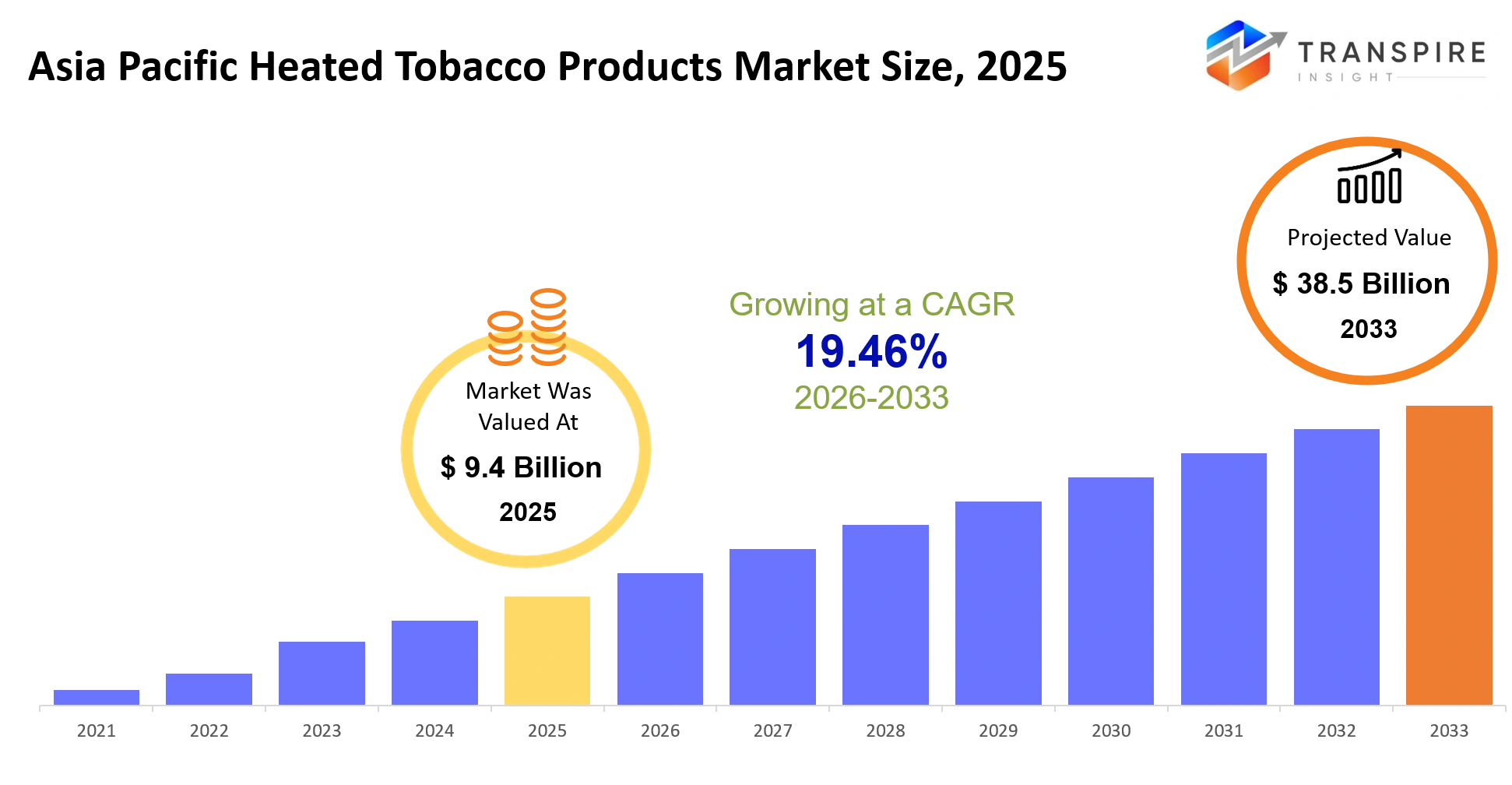
Asia Pacific Heated Tobacco Products Market Summary
The Asia Pacific Heated Tobacco Products Market was valued at USD 9.4 Billion in 2025. It is forecast to reach USD 38.5 Billion by 2033. That is a CAGR of 19.46% over the period.
The heated tobacco products market within Asia Pacific caters to smokers looking for nicotine delivery with less smoke, ash, and odor as an alternative to traditional cigarettes. While this product category allows the tobacco companies to retain adult smokers moving away from combustibles, it also provides retailers access to a high-value category that results in repeating purchases of devices and consumables. For the past five years, the structure of the cigarette-based product portfolio has transformed to smoke-free product ecosystems, which were spurred by the investments in own heating technology and high-end user experiences. Increasing regulations against the consumption of cigarettes and public health efforts accelerated the transformation while the retail space was reconfigured during the pandemic due to disruptions and a shift towards digital engagement and D2C sales models. Currently the system generates continued growth due to the ecosystem sales. While companies are extending the use of their devices to other products, expanding the flavors (where available) and adding a subscription based service model to sales and consumption, consumer stickiness and long-term recurring income stream becomes a reality.
Key Market Insights
- Japan has led the regional industry, accounting for over 45% of market share in 2025 owing to its early launch of products, and consumers' high acceptance.
- South Asia would continue to be the fastest growth rate market over 2025-2032, driven by urbanization, retail sophistication, and wider assortments of premium tobacco products.
- Bundles including device and tobacco sticks are the major product segments, with over 55% share of revenues owing to better customer retention.
- Tobacco consumables are the second-largest segment in revenue generation, which creates repetitive revenue streams and ensures market growth.
- Smart connected devices category growth is highest due to various smart features being adopted such as Bluetooth tracking, heating temperature settings, user insights on consumption behaviors.
- Specialty retail shops constitute almost half of the distribution channel market share, offering better product demonstration and high-value customer service.
- Online retail segments are gaining faster momentum with the prevalence of digital commerce, and direct-to-customer approaches in APAC.
- The Asia Pacific Heated Tobacco Products Market is further supported by the ongoing trend of premiumization, leading to higher average selling price (ASP) and stronger profitability.
- Key industry players such as Philip Morris International, Japan Tobacco International, British American Tobacco, KT&G, China Tobacco International, Imperial Brands, etc.
What are the Key Drivers, Restraints, and Opportunities in the Asia Pacific Heated Tobacco Products Market?
The strongest growth driver remains tobacco companies shifting their products away from combustible cigarettes towards their own smoke-free product portfolios, following tightened smoking bans, higher cigarette taxes and smoking prohibitions in key large economies such as Japan, South Korea and Australia. This led them to reinvest into their unique heating technologies, premium hardware and subscription-based sales models, establishing themselves on a more resilient and consistent tobacco stick selling basis with higher consumer retention, leading to profitability improvement throughout the regional nicotine industry.
Regulatory uncertainty, the greatest structural impediment in the market, hinders overall market progression, as tax frameworks, advertising rules and approval processes for heated tobacco devices differ across various countries within the APac region, meaning companies cannot normalize their launches and marketing efforts and thereby invest less. Dispersed regulatory rules also slow down investment in more high-potential markets with their associated increase in regulatory compliance costs and limited penetration rates for the devices, negatively impacting a stronger revenue growth on the mid-term perspective.
Next stages of growth occur in Southeast Asia where increasing household incomes and rapid expanding modern retail infrastructure has led tobacco manufacturers to invest more heavily in the area and develop their connected device capabilities with app connectivity, personal usage statistics and integrated loyalty programs to retain consumers and stimulate future sales beyond basic tobacco sales.
What Has the Impact of Artificial Intelligence Been on the Asia Pacific Heated Tobacco Products Market?
Advanced digital technologies and AI are transforming the AP HTP market, streamlining the manufacturing process, enhancing supply chain and better managing consumer relationship management. Manufacturers are increasingly relying on AI-enabled vision systems to check the production of tobacco sticks, and electric heating devices in real-time so as to decrease the proportion of defective articles and enhance product quality, thereby reducing manufacturing defects and elevating product quality. By utilizing the automated control systems, producers adjust the temperature calibration of HTP in the process of manufacturing, so as to decrease energy consumption, reduce the waste of raw material, increase the up-time of the production line and improve product efficiency by lowering production defects rate and enhancing product quality.
Moreover, the machine learning algorithms are used to conduct predictive maintenance to facilitate its operations among production sites, allowing the producers to monitor and track various signals such as equipment vibrations, temperature variations, and operation history so as to predict failure components. AI-enabled demand forecasting on the demand side would not only improve the level of inventory management of manufacturers, it can synchronize production schedules with consumers' purchasing habits so as to cut down stock out rate at retail channels as well.
Furthermore, digital technologies will also improve customer relationship management. A personalized mobile application can offer diagnostic service to the devices as well as product recommendations and personal usage statistics to the users. However, high cost and strict regulations on data privacy remain to be two big hurdles on AI utilization especially if the manufacturers were developing consumer analytics systems applicable for cross-country consumption.
Key Market Trends
- In an accelerating market driven since 2020 by billion dollar manufacturer redirects from cigarettes to heated tobacco portfolios, devices have been increasingly introduced across Japan, South Korea, and Southeast Asia.
- Japan evolved from an early mover into a benchmark market for the region, predicting 35%+ heated tobacco to cigarette total market share by 2025.
- Post-pandemic consumer priorities showed a dramatic shift towards higher-end devices featuring refined designs, rechargeable batteries, and personalized digital user experience.
- Divergent regulatory stances post-2021 in Asia Pacific steered away from regional launch strategies to customized country-specific pricing, marketing, and distribution methods.
- Rival firms Philip Morris International, British American Tobacco and Japan Tobacco accelerated product competition through their proprietary heating technology and closed-loop consumable systems.
- The decreasing dependence on the traditional channel for convenience stores since 2020, with increasing reliance on online channels and direct to consumer programs supported by loyalty and subscription systems.
- The manufacturers further enhanced device quality, decreased production flaws, and optimized tobacco stick inventory forecasts through artificial intelligence and smart manufacturing systems.
- Strategic development in Southeast Asia took precedence post-2022 through urbanization, increases in disposable income and a growing sophisticated premium retail system.
- Product development is now shifting from simpler heated devices to connected systems supported by Bluetooth integration, usage statistics, and control via a dedicated app.
Asia Pacific Heated Tobacco Products Market Segmentation
By Product Type:
The HNB devices utilize regulated heating systems to generate a nicotine aerosol without combustion. The tobacco stick is a designed consumable intended for HNB devices and capsules offer flavouring options. The accessories include chargers, cleaning tools and cases to enhance usability and longevity of the product.
The single-use aspect of the disposable device appeals to customers looking for low-maintenance options. Rechargeable devices also encourage repeat purchases. The premium devices offer higher performance heating technology, fashionable designs and smart features. There are also other formats available to suit different consumer needs and markets.

By Distribution Channel:
The major sales channel is Convenience stores because it's very easily accessible for purchase with high speed. Tobacco Shops offer in-depth product ranges and detailed information and guidance. Online Retail allows customers access to large product assortments and promotion events to meet new digital buying behaviour in urban cities.
Supermarkets offer product awareness with organized layout and display of different brands. Duty Free Shops offer products for traveling customers and luxury options. Specialty retailers provide unique brands and customer experiences. Vending machines offer automatic purchases in particular locations. Others include corner stores and region specific retailers.
By Flavor:
Regular Tobacco will continue to be in demand due to the familiar tastes and inherent characteristics. Menthol provides a cool sensation preferred by adults looking for an alternative with a milder finish. Fruit Flavors contribute sweetness and differentiation. Specialty Flavors combine novel ingredients to deliver distinct and different product experiences.
Herbal Flavors appeal due to their unique botanical taste and alternative sensations. Mint Flavors offer freshness and moderate flavor strengths. Coffee Flavors are popular for their rich roasted taste blended with tobacco characteristics, which are key to its premium positioning. Others include limited edition items and country-specific variants which will be added as per consumers and regulations.
By End User:
Adults are the major target consumer segment in the Asia Pacific Heated Tobacco Products Market as it is the legally eligible category and the established user-base for tobacco products. Current Smokers opt for heated products as a substitute for cigarettes, while Dual Users smoke both conventional and heated products based on the occasion and habits. Premium Consumers desire modern devices and superior flavors at an upper price bracket.
Urban Consumers drive the sales through modern outlets and digital interactions. Travelers tend to consume through duty free and airports. Lifestyle Consumers prioritize the design and the convenience as well as customisation. Others include incidental and emerging categories from emerging countries.
What are the Key Use Cases Driving the Asia Pacific Heated Tobacco Products Market?
The most prominent use case for heated tobacco products in the Asia Pacific region involves adult smokers using the products as daily substitutes for cigarettes. This market remains robust particularly in urban settings, where smoke-free policies for offices, restaurants and public facilities compel consumers to opt for heated devices that produce less smell and waste, while remaining constant with conventional cigarette usage patterns.
Secondary use cases include those for premium users and dual users, who switch between cigarettes and heated devices based on social contexts and traveling needs. Duty free outlets and specialty stores have taken center stage for sales, especially for traveling consumers who opt for small devices and cigarette-like flavored sticks due to ease of handling and portability.
New uses are also being introduced for connected heated devices that work with a mobile app to monitor use patterns and battery life. Manufacturers are also looking into personalized heating mechanisms and the customization of flavors, which could alter product usage experiences and attract younger adults to this category within the forecast period.
|
Report Metrics |
Details |
|
Market size value in 2025 |
USD 9.4 Billion |
|
Market size value in 2026 |
USD 11.09 Billion |
|
Revenue forecast in 2033 |
USD 38.5 Billion |
|
Growth rate |
CAGR of 19.46% from 2026 to 2033 |
|
Base year |
2025 |
|
Historical data |
2021 - 2024 |
|
Forecast period |
2026 - 2033 |
|
Report coverage |
Revenue forecast, competitive landscape, growth factors, and trends |
|
Regional scope |
Asia Pacific (India, China, Japan, Australia, South Korea, Rest of Asia Pacific) |
|
Key company profiled |
Philip Morris International, BAT, Japan Tobacco, KT&G, Imperial Brands, China Tobacco, Altria, Shenzhen FirstUnion, RELX, IQOS, Glo, Ploom, Lil, Jouz, PAX Labs. |
|
Customization scope |
Free report customization (country, regional & segment scope). Avail customized purchase options to meet your exact research needs. |
|
Report Segmentation |
By Product Type (Heat-Not-Burn Devices, Tobacco Sticks, Capsules, Accessories, Disposable Devices, Rechargeable Devices, Premium Devices, Others); By Distribution Channel (Convenience Stores, Tobacco Shops, Online Retail, Supermarkets, Duty Free Stores, Specialty Retailers, Vending Machines, Others); By Flavor (Regular Tobacco, Menthol, Fruit Flavors, Specialty Flavors, Herbal Flavors, Mint Flavors, Coffee Flavors, Others); By End User (Adults, Existing Smokers, Dual Users, Premium Consumers, Urban Consumers, Travelers, Lifestyle Consumers, Others). |
Which Regions are Driving the Asia Pacific Heated Tobacco Products Market Growth?
Japan holds the leading share of the Asia Pacific Heated Tobacco Products market due to early regulatory acceptance and high consumer adoption of smoke-free nicotine products. Japan has established a pro-commercialization landscape years ahead of many of its counterparts, enabling manufacturers to fine-tune product offerings and broaden their retail footprint. Extensive coverage from convenience stores, specialized tobacco shops, and digital sales channels ensure steady availability across urban and suburban areas, paving the way for manufacturers to roll out premium devices and new tobacco sticks in bulk while retaining customer loyalty.
South Korea is the second-largest regional driver of sales, but its growth stems less from first-time adoption and more from frequent device upgrades to premium models, continuous repurchase of tobacco sticks, and product innovation. Korean consumers have a clear predisposition for technically superior and technologically enhanced devices with improved heating mechanisms and personalization functions. A stable regulatory framework and continued commitment from global tobacco companies in the nation assure steady revenue flows and solidify its standing as a stable investment opportunity for the foreseeable future.
Southeast Asia is on a path to witness rapid expansion due to robust adoption from Indonesia, Malaysia, and the Philippines and the growing investments in smoke-free alternatives as their respective modern retail infrastructures expand. The rising incomes and shifting preferences of consumers have driven manufacturers to launch locally relevant products with flexible pricing over the past several years, and now, the sector sees greater investment in enhancing online sales capacity and forging regional partnerships to penetrate the market more effectively. These trends should ensure an attractive market for new entrants and investors from 2026 to 2033 as the industry grows more competitive and the consumer base expands.
Who are the Key Players in the Asia Pacific Heated Tobacco Products Market and How Do They Compete?
The Asia Pacific Heated Tobacco Products Market has a moderate level of concentration with a handful of global tobacco companies dominating sales revenues. Competition for a larger share of the heated tobacco products market revolves around heating technology, brand and product ecosystem, retail coverage, and ability to secure continued consumer base for periodic sales of tobacco consumables. Incumbents seek to retain market share with sustained research & development whereas regionally-focused companies seek to capture niche market segments and establish distribution networks with locally suitable products.
Philip Morris International benefits from a patent on heat-not-burn technology and offers a device-and-consumable linked ecosystem of product upgrades. An aggressive approach towards R&D, digital interaction with consumers, and continued marketing initiatives have garnered strong customer loyalty and widespread product adoption across multiple markets within the Asia Pacific. Japan Tobacco aims to capture share via localized flavor and product offerings to appeal to its highly receptive domestic consumer base, then seeks to selectively replicate its success across adjacent countries.
British American Tobacco leverages its innovative heating technologies along with multi-category nicotine portfolios allowing it to maintain a favorable competitive position across diverse regulatory frameworks. KT&G enjoys extensive brand recognition in South Korea but seeks to rapidly scale its distribution network with strategically targeted expansion partnerships across markets in Southeast Asia. Both these players have continued to make significant investments in premium offerings, online retail capabilities, and geographic expansion endeavors to cement their competitive advantage in the foreseeable future.
Company List
- Philip Morris International
- BAT
- Japan Tobacco
- KT&G
- Imperial Brands
- China Tobacco
- Altria
- Shenzhen FirstUnion
- RELX
- IQOS
- Glo
- Ploom
- Lil
- Jouz
- PAX Labs
Recent Development News
In May 2025, Japan Tobacco Inc. launched the Ploom AURA next-generation heated tobacco device along with EVO heated tobacco sticks in Japan. The launch expanded JT's premium smoke-free portfolio and strengthened competition in the Japanese heated tobacco segment, with overseas expansion planned after the domestic rollout.
Source: https://www.jt.com/
In February 2026, Japan Tobacco International stated that it would continue expanding its Ploom heated tobacco business despite upcoming tax changes in Japan that could increase product prices. The announcement highlighted JTI's long-term investment commitment to heated tobacco products after Ploom volumes increased more than 38% in 2025 and market share reached 14.4% in Japan.
Source: https://www.reuters.com/
What Strategic Insights Define the Future of the Asia Pacific Heated Tobacco Products Market?
Over the next five to seven years, the Asia Pacific Heated Tobacco Products Market will transform into a more tech and customer-centric industry in which growth will be driven less by traditional cigarette users and more through the development of integrated experiences including best-in-class devices, networked mobile applications, customizable flavors, and subscription based consumables, ultimately fueled by leading tobacco corporations’ strategic decision to establish smoke free revenue streams to generate sustained customer loyalty and repeat business.
The market's main risk, while often hidden, stems from its highly concentrated nature as few multinational companies control key heating technologies, patents and distribution channels, posing substantial hurdles to small players, as well as vulnerability to any regulatory or litigation fallout suffered by major players. Meanwhile, Southeast Asia continues to be an evolving opportunity for early investment from players prepared to develop localized product portfolios, digital consumer engagement channels and flexible pricing models prior to reaching market maturity.
Asia Pacific Heated Tobacco Products Market Report Segmentation
By Product Type
- Heat-Not-Burn Devices
- Tobacco Sticks
- Capsules
- Accessories
- Disposable Devices
- Rechargeable Devices
- Premium Devices
By Distribution Channel
- Convenience Stores
- Tobacco Shops
- Online Retail
- Supermarkets
- Duty Free Stores
- Specialty Retailers
- Vending Machines
By Flavor
- Regular Tobacco
- Menthol
- Fruit Flavors
- Specialty Flavors
- Herbal Flavors
- Mint Flavors
- Coffee Flavors
By End User
- Adults
- Existing Smokers
- Dual Users
- Premium Consumers
- Urban Consumers
- Travelers
- Lifestyle Consumers
Frequently Asked Questions
Find quick answers to common questions.
The Asia Pacific Heated Tobacco Products Market size is USD 38.5 Billion in 2033.
Key segments for the Asia Pacific Heated Tobacco Products Market are By Product Type (Heat-Not-Burn Devices, Tobacco Sticks, Capsules, Accessories, Disposable Devices, Rechargeable Devices, Premium Devices, Others); By Distribution Channel (Convenience Stores, Tobacco Shops, Online Retail, Supermarkets, Duty Free Stores, Specialty Retailers, Vending Machines, Others); By Flavor (Regular Tobacco, Menthol, Fruit Flavors, Specialty Flavors, Herbal Flavors, Mint Flavors, Coffee Flavors, Others); By End User (Adults, Existing Smokers, Dual Users, Premium Consumers, Urban Consumers, Travelers, Lifestyle Consumers, Others).
Major Asia Pacific Heated Tobacco Products Market players are Philip Morris International, BAT, Japan Tobacco, KT&G, Imperial Brands, China Tobacco, Altria, Shenzhen FirstUnion, RELX, IQOS, Glo, Ploom, Lil, Jouz, PAX Labs.
The Asia Pacific Heated Tobacco Products Market size is USD 9.4 Billion in 2025.
The Asia Pacific Heated Tobacco Products Market CAGR is 19.46% from 2026 to 2033.
- Philip Morris International
- BAT
- Japan Tobacco
- KT&G
- Imperial Brands
- China Tobacco
- Altria
- Shenzhen FirstUnion
- RELX
- IQOS
- Glo
- Ploom
- Lil
- Jouz
- PAX Labs
About the Authors

Chetan Dhatrak
I’m Chetan Dhatrak, a Senior Research Analyst at Transpire Insight, specializing in the Consumer Goods, Foods and Beverages industry. I focus on analyzing market trends, consumer behavior, competitive landscapes, and industry developments to deliver accurate, data-driven insights. My research at Transpire Insight is built on credible sources and in-depth analysis, helping businesses and readers better understand market dynamics, emerging opportunities, and evolving consumer preferences. I’m committed to creating reliable, well-researched content that supports informed decision-making and reflects the latest developments in the consumer goods and food & beverage sectors.

Chakradhar Khansole
Chakradhar serves as the Research Director at Transpire Insight, bringing over 8 years of experience in technology, innovation, and strategic market intelligence. He specializes in transforming complex market data into actionable business insights that enable organizations to make informed, growth-oriented decisions. Recognized for his strategic vision and analytical expertise, Chakradhar leads high-impact research initiatives, delivering comprehensive market assessments, competitive intelligence, and forward-looking industry analysis.
Recently Published Reports
-
Apr 2026
Bottled Water Market
Bottled Water Market Size, Share & Analysis Report By Product Type (Still Bottled Water, Carbonated Bottled Water, Functional Bottled Water, and Others), By Packaging (PET, Cans, and Others), By Sales Channel (Supermarkets/Hypermarkets, Convenience Stores/Drug Stores, Grocery Stores/Club Stores, Foodservice, and Others) and Geography (North America, Europe, Asia-Pacific, Middle East and Africa, South and Central America), 2021 - 2032
-
Apr 2026
Color Cosmetic Packaging Market
Color Cosmetic Packaging Market Size, Share & Analysis Report By Application (Mascara Packaging, Liquid Packaging, and Liquid Face), By Type (Tubes & Bottles, Pens & Markers, Compacts & Containers, and Droppers & Pumps), and Geography (North America, Europe, Asia-Pacific, Middle East and Africa, South and Central America), 2021 - 2031
-
Apr 2026
External Microphone For Camera Market
External Microphone For Camera Market Size, Share & Analysis Report By Type (Shotgun Microphone, Lavalier Microphone, and Others), By Application (Digital Camera, Professional Video Camera, and Others), and Geography (North America, Europe, Asia-Pacific, Middle East and Africa, South and Central America), 2021 - 2031
-
Apr 2026
Foot Orthotic Insoles Market
Foot Orthotic Insoles Market Size, Share & Analysis Report By Type (Pre-fabricated, and Custom-made), By Material (Thermoplastic, Composite Carbon Fiber, and Others), By Distribution Channel (Drug Stores, Hospitals & Clinics, and Others), and Geography (North America, Europe, Asia-Pacific, Middle East and Africa, South and Central America), 2021 - 2031