

Asia Pacific Fatty Alcohol Market Summary
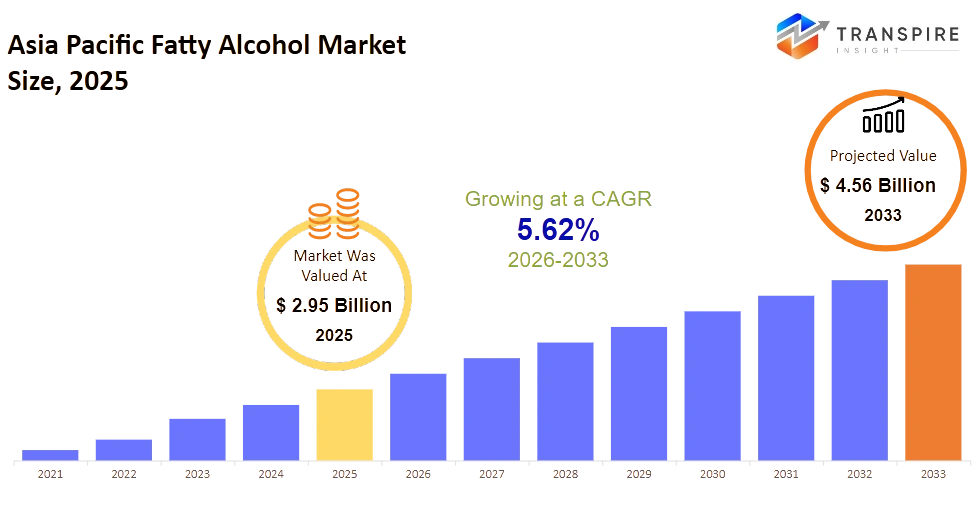
As per Transpire Insight Analysis, the Asia Pacific Fatty Alcohol Market size is estimated at USD 2.95 Billion in 2025 and is anticipated to reach USD 4.56 Billion by 2033, growing at a CAGR of 5.62% from 2026 to 2033.
The Asia Pacific Fatty Alcohol Market kind of allows a wide range of manufacturing work by bringing key ingredients to the table, for detergents, personal care items, industrial cleaning agents, lubricants, textile chemicals, and even pharmaceutical formulations. In real life fatty alcohols help producers tune product performance, keep formulations steady and reliable, and also back biodegradability while they stay aligned with shifting environmental plus quality rules across both everyday consumer use and industrial use. This piece has gotten even more relevant lately, because a lot of producers are trying to balance performance requirements with sustainability targets, and regulatory compliance, all in the same stretch of time.
Over the last five years, the direction has leaned more into bio based fatty alcohol production. That momentum is supported by investments in renewable feedstocks, and also by cleaner processing technologies. The turning point really accelerated after pandemic related supply chain problems revealed how delicate highly concentrated raw material sourcing can be, so manufacturers started diversifying procurement, and also tried to build stronger regional production capacity. At the same time consumer goods brands are reformulating their recipes, looking toward sustainability commitments, and many governments are nudging the market toward materials that carry a lower environmental footprint.In that environment fatty alcohol suppliers get room to lock in long term supply agreements, grow their value added product lineups and build more revenue through premium, specialty grade offerings, which feels like where the bigger opportunities are.
Asia Pacific Fatty Alcohol Market Size & Forecast:
- Asia Pacific Fatty Alcohol Market Size 2025: USD 2.95 Billion
- Expected Market Value 2033: USD 4.56 Billion
- Forecast CAGR: 5.62%
- Leading region in 2025: Southeast Asia
- Fastest Growing country: South Asia
- Key Profile: KLK OLEO, Wilmar International, Musim Mas, Sasol, Kao Corporation, Emery Oleochemicals, BASF, Godrej Industries, Procter & Gamble Chemicals, VVF LLC, IOI Oleochemical, Croda International, Shell Chemicals, Ecogreen Oleochemicals, Cargill
Key Market Insights
- In 2025 Southeast Asia kind of dominated the Asia Pacific Fatty Alcohol Market, holding around 42% market share, largely backed by integrated palm kernel oil supply chains, and export oriented production that stays very production focused.
- South Asia on the other hand is projected to be the fastest growing regional market through 2025–2033, mostly because home care manufacturing is expanding and investments in specialty chemical production keep increasing, at a pretty steady pace too.
- When it comes to product type Natural fatty alcohols took the lead with nearly 68% share in 2025, since manufacturers moved toward renewable feedstocks for premium formulations, and that trend is still sticking.
- Synthetic fatty alcohols stayed in the second largest slot, mainly supporting industrial lubricants and specialty surfactant uses, where stable chemical properties really matter and can’t drift around.
- Specialty high purity fatty alcohols are forecast to show the quickest growth up to 2033, driven by pharmaceutical needs, plus high end personal care formulations that demand tighter specs.
- For applications Detergents and surfactants dominated, with about 46% market share in 2025, supported by continuous household and institutional cleaning product production.
- Personal care applications are expected to be the fastest growing application area during the forecast period, as premium cosmetic formulations keep expanding across Asia Pacific, almost like it’s accelerating.
- Looking at end users, consumer goods manufacturers accounted for roughly 49% of demand in 2025, showing how much procurement comes from detergent and personal care producers.
- Meanwhile, pharmaceutical manufacturers are expected to be the fastest growing end user segment through 2033, sort of backed by higher utilization of specialty excipients and formulation ingredients and such, which is why people call it growth.
What are the Key Drivers, Restraints, and Opportunities in the Asia Pacific Fatty Alcohol Market?
The primary driver that seems to shape the market is the move toward renewable oleochemical feedstocks, pushed along by corporate sustainability targets and, also, tighter formulation requirements in consumer products. Big detergent and personal care manufacturers have already reformulated their offerings, to cut down on petroleum-derived ingredients while still hitting performance standards. That change, in turn, has helped companies sign longer term supply agreements for natural fatty alcohols, and it has also made the case for investments in integrated production facilities. As production ramps up more smoothly and feedstock integration keeps strengthening, manufacturers tend to win higher-value contracts and start widening their regional revenue streams.
The biggest restraint, though, still looks like feedstock price volatility, often tied to palm kernel oil availability, weather disturbances and sudden export policy changes. On top of that new production facilities need serious capital spend, and they take a few years before they reach commercial efficiency. From what Transpire Insight notes after reviewing regional procurement announcements and launch timing, supply chain concentration stays the main execution risk. Procurement uncertainty can drag timelines for expansion projects, squeezes producer margins, and then delays specialty product launches across a bunch of downstream industries.
A major opportunity sits in ramping up high-purity plus specialty fatty alcohol production, especially for pharmaceutical, cosmetic, and industrial performance chemical uses. Digital manufacturing, continuous processing methods,and the steady investments across India and Southeast Asia are making a more favorable situation for premium product development. Companies that blend renewable feedstocks with enhanced purification solutions could end up with higher-margin applications, and at the same time, they can cut back on their dependence on commodity-grade volumes . This kind of setup sort of helps everything move forward more efficiently, and it feels like the ecosystem is aligning in a practical way.
What Has the Impact of Artificial Intelligence Been on the Asia Pacific Fatty Alcohol Market?
Artificial intelligence and digital manufacturing technologies are kinda reshaping fatty alcohol production by boosting operational control across oleochemical processing plants, in a way that feels more precise than before. With AI-enabled monitoring, teams can keep checking reactor temperatures, pressure stability, how much energy is getting used, and even the raw material quality, so operators can hold tighter production tolerances and at the same time cut down waste. Machine learning models also make demand forecasting stronger, by blending procurement patterns with seasonal consumption, and bringing in downstream manufacturing signals from detergent and personal care sectors. With that kind of prediction, producers can sort inventories better, schedule maintenance ahead of equipment failures, and make smarter raw material purchasing calls.
Digital optimization has, in a way, helped support higher plant utilization , fewer unplanned stops, and more steady process behavior, even while still meeting the environmental and quality requirements. Automated inspection approaches can catch production deviations sooner than the usual manual monitoring does, so fewer off-spec batches show up and manufacturing efficiency, overall, tends to increase. Then supply chain analytics can make it a little easier to react faster when feedstock availability shifts across regional sourcing networks, which is kind of the whole point, really. Still, there are actual practical limits to AI adoption, like for example the integration part can get expensive fast, and legacy control systems are often kind of fragmented , so the data doesn’t always line up cleanly.Production data might also be inconsistent, and some older facilities just do not have solid digital infrastructure in place already. Because of that, many mid-sized producers end up needing a phased modernization path first , before advanced analytics can reliably demonstrate measurable improvements in daily operations.
Key Market Trends
- Bio-based fatty alcohol production really took off, kinda noticeably after 2021, with big makers putting more money into renewable feedstocks and then folding in oleochemical processing too, so it’s more integrated than before.
- In Southeast Asia, production leadership got stronger between 2022 and 2025, mostly because capacity expansion happened around palm kernel oil processing hubs, which is a bit of a practical move if you think about logistics.
- Personal care manufacturers also started leaning harder into premium specialty grades starting in 2023, and that helped regional suppliers offer better, higher value product mixes than they used to.
- After 2022, digital process monitoring became more common, it improved consistency of output and also helped cut manufacturing losses in large scale facilities, at least for the operators who adopted it properly.
- Then during the pandemic, disruptions showed procurement risks from concentrated sourcing so after that, companies tried diversifying feedstock sources more.
- BASF, KLK OLEO, and Wilmar International all expanded investments in specialty oleochemical technologies, partly to strengthen competitive positioning after 2023 and keep pace with others.
- Pharmaceutical formulations have been slowly incorporating higher-purity fatty alcohols since 2022, and that’s opened up steadier opportunities for specialty manufacturers that can meet tighter specs.
- Producers have also put more effort into continuous processing technologies over the last three years, mainly to boost energy efficiency and reduce production variability, because that unpredictability can get expensive.
- Export-oriented manufacturers are moving toward downstream integration rather than selling commodity intermediates, and profitability improves when there is more value-added production under the same roof, or at least within the same plan.
- Finally, sustainability reporting requirements rolling out across several regional markets continue to push traceable sourcing and certified renewable feedstock adoption, which everyone seems to be chasing now.
Asia Pacific Fatty Alcohol Market Segmentation
By Product Type :
Product segmentation kinda mirrors performance requirements across a few manufacturing industries. Pure and mid cut fatty alcohols take the biggest chunk, mainly because detergent as well as personal care makers need a steady quality and also dependable processing behaviors. Long chain fatty alcohols still pull strong demand in lubricants and specialty chemical mixtures, where consistency and endurance stay really important. Higher fatty alcohols keep showing up in smaller industrial segments that need tailored chemical properties.
Short chain fatty alcohols get used for certain chemical synthesis and industrial processing tasks, where particular molecular traits deliver production advantages. Bio based product development keeps pushing demand for premium grades in consumer oriented sectors. Ongoing investment in purification technologies helps improve product quality, and it also supports value added manufacturing. In general, product diversification should help suppliers handle shifting customer specifications and stay well positioned competitively.
By Source :
Natural sources account for the largest portion because palm kernel oil and coconut oil provide pretty dependable feedstocks, with long-standing regional supply routes. This steadiness in raw material availability makes it easier for bigger-scale production to keep moving along smoothly for detergents, cosmetics, and industrial chemicals even when demand does shift a bit, and you can still maintain that kind of rhythm.Synthetic sources are still used where a consistent chemical function is needed, and where production consistency has to be dependable in a very boring way. Meanwhile bio based alternatives keep growing as manufacturers align their product lines with sustainability goals, and with environmental expectations too.
On the production side, investments tend to focus on making feedstock use more flexible, and on lowering reliance on just one raw material source. Also, supply diversification adds operational toughness when commodity prices are doing that unpredictable roller coaster thing. New processing technologies help boost production efficiency, while still keeping product quality under control. In the end, balanced sourcing strategies should bring more stability across manufacturing operations, rather than leaving everything tied to one stream.
By Application :
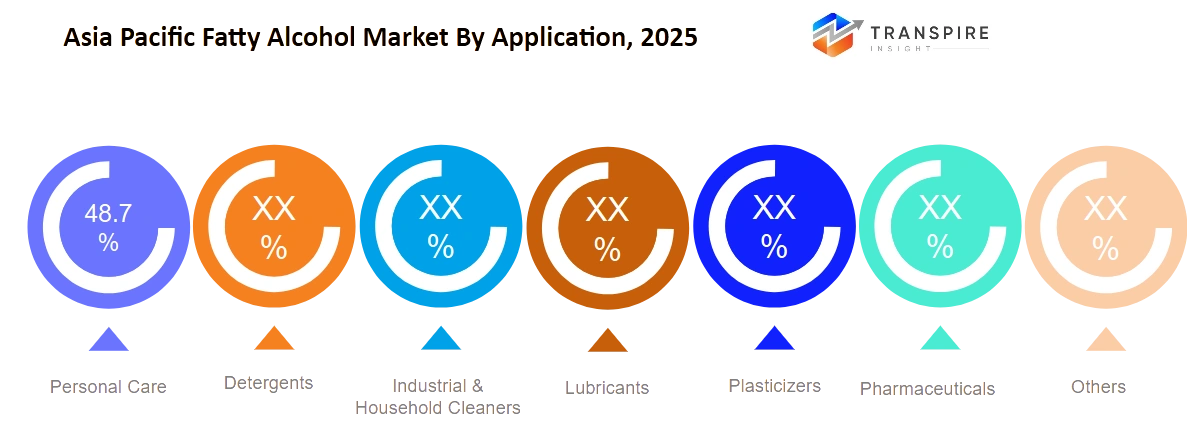
Detergents stay pretty much the main application, because fatty alcohols act as key components inside surfactants for household and institutional cleaning stuff. At the same time personal care keeps moving upward, through skincare, haircare, and cosmetic mixes that want mild plus stable ingredients . For industrial and household cleaners, consumption looks steady across commercial and manufacturing areas, pretty consistent over time. Meanwhile lubricants and plasticizers help out with specialized industrial tasks where dependable chemical behavior is required
On the pharmaceutical side things keep getting stronger too, with more use in excipients and formulation systems for drug production. Specialty formulations open the door for high purity product grades, and these often come with better commercial worth. Beyond that, product innovation backs new uses across premium consumer goods and also industrial chemicals. This kind of application diversity lowers reliance on any one downstream industry, and it also improves longer term market steadiness.
By End User :
The personal care industry seems to be the biggest end-user slice, mainly because cosmetic and hygiene product makers need high quality ingredients for everyday consumer stuff. Chemical manufacturers are still buying a lot of production volume for surfactants, emulsifiers, and more specialized formulation types. Pharmaceutical companies keep pushing utilization forward with advanced formulation technologies that insist on consistent product purity, or so the vendors say. Textile manufacturers stay pretty steady too, since processing agents are needed during fabric handling, treatment, and those finishing activities.
Industrial diversification helps consumption stay balanced across several sectors without leaning too hard on a single customer group. And when companies put more money into specialty manufacturing, it opens doors for premium product grades, with better profit margins overall. Also, quality certification, plus regulatory compliance, still counts a lot as a buying factor for industrial clients. Finally, those long-term supply agreements keep reinforcing trust and continuity between manufacturers and downstream industries.
By Distribution Channel :
Direct sales seems to take the largest share because those big industrial customers like long term supply contracts, stable pricing, and sort of hands on technical support directly from manufacturers. This particular channel helps with supply planning , and it also cuts down procurement uncertainty for the high volume buyers. Chemical distributors are still very relevant though, especially when you’re dealing with medium sized manufacturers, and also regional customers who want a more flexible purchasing quantity. In other words, the distribution network also helps with product availability across developing industrial markets.
Digital procurement systems keep getting better too, especially for order management, inventory visibility, and delivery coordination across the regional supply chains. At the same time distribution partners tend to offer technical assistance, logistics support, and localized inventory oversight, which makes customer service feel more responsive. Plus, when regional warehouses get expanded, delivery efficiency goes up , and industrial buyers experience shorter lead times. Overall, a balanced distribution strategy will likely keep opening wider market access, and it can strengthen commercial relationships, even as the landscape keeps shifting.
What are the Key Use Cases Driving the Asia Pacific Fatty Alcohol Market?
Household and institutional detergent manufacturing stays the biggest use case, mostly because surfactant producers still need fatty alcohols to keep cleaning performance steady, keep foaming stable and also make formulations feel consistent. Big consumer goods manufacturers end up buying very large quantities, often via long-term procurement agreements, so they can stay on a continuous production pace and also satisfy product quality requirements across different regional markets
Meanwhile, personal care manufacturers are using more of these materials in skin creams, shampoos, and conditioners. Here, formulation stability really matters, as does texture, and yes it’s kind of the whole point for many of those products. Pharmaceutical companies are additionally shifting toward higher-purity grades, since those feed into formulation ingredients that must behave reliably. On top of that, specialty chemical producers fold these inputs into industrial lubricants, with a clear bias toward performance driven applications
At the same time, new opportunities are popping up around bio-based specialty chemicals and advanced industrial formulations, especially those built to satisfy tougher environmental standards. High-performance coatings, biodegradable process chemicals, and specialty ingredients for premium cosmetic products are drawing investment, as manufacturers try to build differentiated portfolios and aim for stronger value creation during the forecast period
|
Report Metrics |
Details |
|
Market size value in 2025 |
USD 2.95 Billion |
|
Market size value in 2026 |
USD 3.11 Billion |
|
Revenue forecast in 2033 |
USD 4.56 Billion |
|
Growth rate |
CAGR of 5.62% from 2026 to 2033 |
|
Base year |
2025 |
|
Historical data |
2021 - 2024 |
|
Forecast period |
2026 - 2033 |
|
Report coverage |
Revenue forecast, competitive landscape, growth factors, and trends |
|
Regional scope |
Asia Pacific (India, China, Japan, Australia, South Korea, Rest of Asia Pacific) |
|
Key company profiled |
KLK OLEO, Wilmar International, Musim Mas, Sasol, Kao Corporation, Emery Oleochemicals, BASF, Godrej Industries, Procter & Gamble Chemicals, VVF LLC, IOI Oleochemical, Croda International, Shell Chemicals, Ecogreen Oleochemicals, Cargill . |
|
Customization scope |
Free report customization (country, regional & segment scope). Avail customized purchase options to meet your exact research needs. |
|
Report Segmentation |
By Product Type (Short Chain Fatty Alcohols, Pure & Mid-Cut Fatty Alcohols, Long Chain Fatty Alcohols, Higher Fatty Alcohols, Others); By Source (Natural, Synthetic, Bio-Based, Others); By Application (Personal Care, Detergents, Industrial & Household Cleaners, Lubricants, Plasticizers, Pharmaceuticals, Others); By End User (Personal Care Industry, Chemical Industry, Pharmaceutical Industry, Textile Industry, Others); By Distribution Channel (Direct Sales, Chemical Distributors, Others) |
Which Regions are Driving the Asia Pacific Fatty Alcohol Market Growth?
Southeast Asia is taking the lead with the biggest portion of the regional market, roughly 42% in 2025, and somehow that number keeps looking solid even when you zoom out. The reason usually comes down to solid palm oil processing infrastructure, plus supportive industrial policies, and export regulations that are already well set up. In practice, this has built a pretty effective production base for oleochemicals, and with integrated supply chains, major processing plants, and continuing investment from both global and regional manufacturers, production capacity keeps getting a boost, while day to day operations run more efficiently. With long term feedstock availability still in place, and downstream manufacturing expansion continuing, regional leadership is likely to remain in a strong position across the forecast period.
East Asia meanwhile shows up as the second largest regional contributor because demand is driven by advanced manufacturing more than feedstock availability alone. Industrial policies stay fairly stable, regulatory compliance remains consistent, and consumer goods production is resilient , so purchasing patterns across detergents, cosmetics, and specialty chemicals stay dependable. There’s also a strong research environment, which pushes development toward higher value specialty formulations, not just commodity based output. Because of these structural advantages , East Asia can keep functioning as a reliable source of steady revenue even when raw material prices move around a bit.
South Asia is expected to see the quickest growth in the 2026–2033 stretch, since investments in specialty chemicals, personal care manufacturing, and industrial production keep getting bigger. At the same time, government backing for domestic manufacturing and the chemical industry development, has helped push capacity additions forward and it strengthened regional supply networks as well. On top of that, more money going into pharmaceutical and consumer goods production has sped up demand for higher value oleochemical ingredients. So this momentum will likely open up appealing chances for manufacturers, technology providers, and investors who are hunting for long term expansion across these emerging industrial markets, in general.
Who are the Key Players in the Asia Pacific Fatty Alcohol Market and How Do They Compete?
Competition across the Asia Pacific Fatty Alcohol Market still looks kinda moderately consolidated, like the big integrated producers are going head to head with smaller regional specialty manufacturers, not entirely balanced though. Cost efficiency, feedstock integration, manufacturing know how, and dependable supply networks keep driving who wins. The established players keep trying to hold their ground via capacity growth and downstream integration. Meanwhile the specialty producers tend to chase premium uses, with higher margins and, well, more selective customers. Even the “simple” stuff matters, product quality, sustainability certifications, and long term customer agreements tend to sway industrial buyers when they purchase.
KLK OLEO boosts competitiveness with a vertically integrated setup, it helps with feedstock security and tighter cost control while they also ramp up specialty oleochemical capacity. Wilmar International takes a different angle by blending wide agricultural assets with downstream chemical manufacturing, so supply management feels more efficient and product availability feels broader too. Musim Mas keeps putting money into specialty oleochemical production and sustainable sourcing certifications, which makes the offering more attractive to multinational consumer goods makers.
Kao Corporation leans heavily into formulation innovation and higher performance ingredients for personal care as well as cleaning products, and that supports a more premium positioning across regional markets. BASF expands its advanced specialty chemical offerings through research investment and joint product development, enabling tailored formulations for both industrial and consumer uses. Taken together, these strategies improve competitive positioning by mixing technology progress, regional production scale ups, and diversified product portfolios that try to match how customer requirements evolve over time.
Company List
- KLK OLEO
- Wilmar International
- Musim Mas
- Sasol
- Kao Corporation
- Emery Oleochemicals
- BASF
- Godrej Industries
- Procter & Gamble Chemicals
- VVF LLC
- IOI Oleochemical
- Croda International
- Shell Chemicals
- Ecogreen Oleochemicals
- Cargill
Recent Development News
In February 2025, KLK OLEO established a new representative office in Mumbai, India as part of a regional expansion strategy. The investment strengthens customer support and distribution capabilities for oleochemical products across the fast-growing Indian market, supporting downstream fatty alcohol demand. Source https://www.klkoleo.com/
In July 2025, Kuala Lumpur Kepong Berhad (KLK) received the Gold1 Sustainability Rating from RAM Sustainability. The certification reinforces the company's sustainability credentials and strengthens its position with multinational customers seeking certified renewable oleochemical and fatty alcohol supply. Source https://www.klkoleo.com/
What Strategic Insights Define the Future of the Asia Pacific Fatty Alcohol Market?
In the Asia Pacific Fatty Alcohol Market, things are likely to head toward higher value, specialty output not just plain volume growth over the next five to seven years. Instead of a simple scale up, expansion will be bolstered by tighter links between renewable inputs, more refined purification approaches, and then downstream conversion into end products for personal care, pharmaceuticals, and specialty chemicals. You might not notice it at first but there is a smaller, less visible risk brewing too, the continued reliance on a handful of feedstock producing hubs where weather disruptions, shifts in export rules, or even agricultural limits can nudge costs fast and strain contract consistency .
Meanwhile, there is also the opportunity side. Pharmaceutical-grade and high-purity grades, plus their more careful formulations, are still somewhat underpenetrated, especially as India and parts of Southeast Asia keep expanding bets into advanced manufacturing plants. Market players should see gains by diversifying where they source feedstocks, putting money into specialty processing know-how, and building long term agreements with downstream manufacturers. That way they can improve resilience and also chase higher margin applications, rather than competing mainly on commodity pricing and margins that are already squeezed.
Asia Pacific Fatty Alcohol Market Report Segmentation
By Product Type
- Short Chain Fatty Alcohols
- Pure & Mid-Cut Fatty Alcohols
- Long Chain Fatty Alcohols
- Higher Fatty Alcohols
By Source
- Natural
- Synthetic
- Bio-Based
By Application
- Personal Care
- Detergents
- Industrial & Household Cleaners
- Lubricants
- Plasticizers
- Pharmaceuticals
By End User
- Personal Care Industry
- Chemical Industry
- Pharmaceutical Industry
- Textile Industry
By Distribution Channel
- Direct Sales
- Chemical Distributors
Frequently Asked Questions
Find quick answers to common questions.
The expected Asia Pacific Fatty Alcohol Market size for the market will be USD 4.56 Billion in 2033.
Key segments for the Asia Pacific Fatty Alcohol Market are By Product Type (Short Chain Fatty Alcohols, Pure & Mid-Cut Fatty Alcohols, Long Chain Fatty Alcohols, Higher Fatty Alcohols, Others); By Source (Natural, Synthetic, Bio-Based, Others); By Application (Personal Care, Detergents, Industrial & Household Cleaners, Lubricants, Plasticizers, Pharmaceuticals, Others); By End User (Personal Care Industry, Chemical Industry, Pharmaceutical Industry, Textile Industry, Others); By Distribution Channel (Direct Sales, Chemical Distributors, Others).
Major Asia Pacific Fatty Alcohol Market players are KLK OLEO, Wilmar International, Musim Mas, Sasol, Kao Corporation, Emery Oleochemicals, BASF, Godrej Industries, Procter & Gamble Chemicals, VVF LLC, IOI Oleochemical, Croda International, Shell Chemicals, Ecogreen Oleochemicals, Cargill.
The Asia Pacific Fatty Alcohol Market size is USD 2.95 Billion in 2025.
The Asia Pacific Fatty Alcohol Market CAGR is 5.62% from 2026 to 2033.
- KLK OLEO
- Wilmar International
- Musim Mas
- Sasol
- Kao Corporation
- Emery Oleochemicals
- BASF
- Godrej Industries
- Procter & Gamble Chemicals
- VVF LLC
- IOI Oleochemical
- Croda International
- Shell Chemicals
- Ecogreen Oleochemicals
- Cargill
About the Authors

Pankaj Ghogare Patil
I am Pankaj Ghogare Patil, a Senior Research Analyst at Transpire Insight, specializing in the Pharmaceutical, Chemicals & Materials, Healthcare IT, and Biotechnology industry. My expertise lies in conducting comprehensive market research, analyzing industry trends, evaluating competitive landscapes, and translating complex data into actionable insights. At Transpire Insight, I closely follow emerging technologies, regulatory developments, and market innovations to create accurate, well-researched, and informative content that helps businesses and professionals make informed decisions. I am committed to producing credible, evidence-based articles that reflect industry best practices while making technical topics accessible and valuable for a broad audience.

Chakradhar Khansole
Chakradhar serves as the Research Director at Transpire Insight, bringing over 8 years of experience in technology, innovation, and strategic market intelligence. He specializes in transforming complex market data into actionable business insights that enable organizations to make informed, growth-oriented decisions. Recognized for his strategic vision and analytical expertise, Chakradhar leads high-impact research initiatives, delivering comprehensive market assessments, competitive intelligence, and forward-looking industry analysis.
Recently Published Reports
-
May 2026
Healthcare Polymer Packaging Market
Healthcare Polymer Packaging Market Size, Share & Analysis Report By Packaging Type (Syringes, IV Bottles and Pouches, Clamshells, Blisters, Bottles & Jars, Containers, Tubes, IV Parental Packaging, Others), By Type (Regulated, Non-regulated), By Polymer Type (LDPE (Low-Density Polyethylene), HDPE (High-Density Polyethylene), Homo-polymer (Homo), Random Copolymer (Random), Block Copolymer (Block), PET, Polystyrene, Polyvinyl Chloride, Polyamide/EVOH, Others), and Geography (North America, Europe, Asia-Pacific, Middle East and Africa, South and Central America), 2021 - 2031
-
Apr 2026
Hydrophilic Tape (Waterstop) Market
Hydrophilic Tape (Waterstop) Market Size, Share & Analysis Report By Type (Bentonite-Based Hydrophilic Tape, Rubber-Based Hydrophilic Tape), By Application (Residential Buildings, Commercial Buildings, Infrastructure Projects), and Geography (North America, Europe, Asia-Pacific, Middle East and Africa, South and Central America), 2021 - 2031
-
Apr 2026
Metalens Market
Metalens Market Size, Share & Analysis Report By Type (Visible Light Metalens, and Infrared Metalens), By Application (Consumer Electronics, Automotive Electronics, Industrial, Medical, and Others), and Geography (North America, Europe, Asia-Pacific, Middle East and Africa, South and Central America), 2021 - 2031
-
Apr 2026
PBT Resin Market
PBT Resin Market Size, Share & Analysis Report By Type (Reinforced PBT Resin, Unreinforced PBT Resin), By Processing Method (Injection Molding, Extrusion, Blow Molding, Others), By End-User (Automotive, Electrical & Electronics, Consumer Appliances, Industrial Machinery, Medical Devices, Packaging, Others), and Geography (North America, Europe, Asia-Pacific, Middle East and Africa, South and Central America), 2021 - 2031