

Global Procurement Analytics Market Size & Forecast:
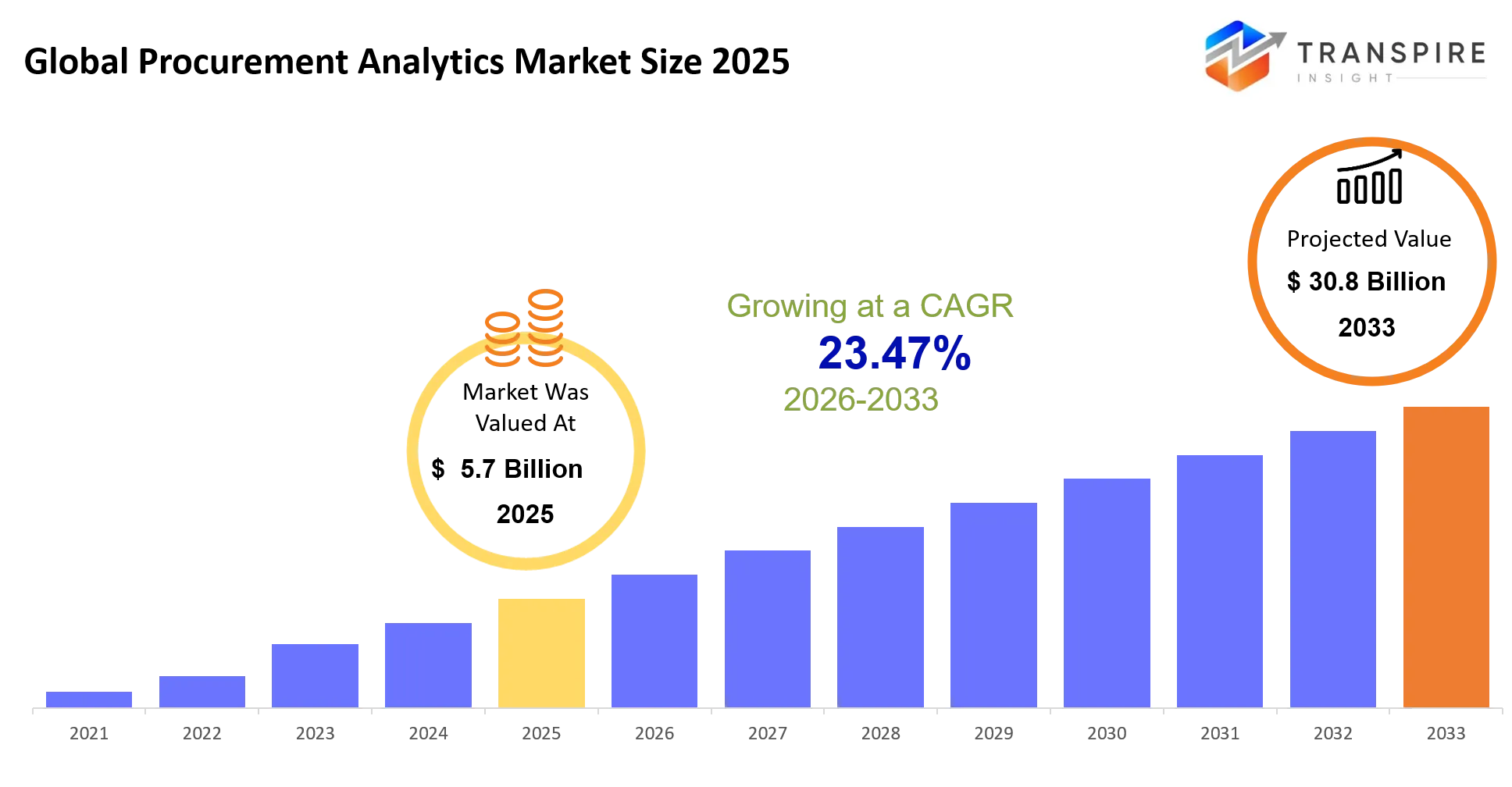
- Global Procurement Analytics Market Size 2025: USD 5.7 Billion
- Global Procurement Analytics Market Size 2033: USD 30.8 Billion
- Global Procurement Analytics Market CAGR: 23.47%
- Global Procurement Analytics Market Segments: By Type (Spend Analytics, Supplier Analytics, Contract Analytics, Risk Analytics, Predictive Analytics, Others); By Application (Retail, BFSI, Manufacturing, Healthcare, IT & Telecom, Others); By End-User (Large Enterprises, SMEs, Government Organizations, Others); By Deployment (Cloud-based, On-premise, Hybrid, Others)
Global Procurement Analytics Market Summary
As per Transpire Insight Analysis, the Global Procurement Analytics Market size is estimated at USD 5.7 Billion in 2025 and is anticipated to reach USD 30.8 Billion by 2033, growing at a CAGR of 23.47% from 2026 to 2033. At its core - this software sector turns massive piles of corporate purchase records, vendor invoices, and legal contracts into clean, actionable dashboards. Recently - a major structural shift saw supply chain teams ditch reactive, manual spreadsheets for automated, live data streams. This evolution was accelerated by a stark real-world trigger: severe disruptions in global shipping routes and sudden vendor bankruptcies. The resulting impact is a clear chain reaction. By feeding historical vendor behaviors and real-time shipping costs into predictive software, finance leaders can instantly catch hidden pricing spikes and localized vendor risks. Ultimately, this lets companies swap out unreliable suppliers and plug costly budgetary leaks before they hit the bottom line.
Key Market Insights
The Global Procurement Analytics Market is rapidly converting from a backward-looking operational logging method into a hyper-automated, agentic data intelligence system running across global supply frameworks. Fueled by severe disruptions in international supply chains and a cross-industry push to eliminate operational cash leaks, enterprise leaders are adopting AI-managed data pipelines to execute automated cost control and proactive supplier risk mapping at scale.
- Holding a commanding 57% market share, the spend analytics segment is eliminating corporate budgetary blind spots as enterprise giants deploy cloud-native ingestion suites from SAP and Coupa Software to classify transactional data across dozens of disconnected ERP systems automatically.
- Commanding a 40% market share, North America dictates international software standards as fortune-level entities and defense clusters integrate IBM's advanced data infrastructure to ensure strict regulatory compliance and build insulated domestic sourcing networks.
- Securing a substantial 27% slice of global industry demand, Europe acts as a highly stable secondary pillar, leaning heavily on Ivalua's and Jaggaer's unified architectures to track complex cross-border logistics and meet rigid ESG-linked vendor monitoring regulations.
- Representing 25% of the global footprint, Asia-Pacific is expanding at an industry-leading velocity with an individual CAGR of 15.3%, driven by massive commercial manufacturing setups across India and China installing localized, high-capacity automation platforms from Genpact.
- Accounting for 14% of overall industry value, the supplier analytics type is radically altering vendor tracking, utilizing intelligent profile enrichment systems from Zycus to score financial health metrics and predict contractor performance caps.
- Capturing a critical 10% market share, the contract analytics application is boosting corporate procedural enforcement, leveraging natural language parsing engines from Proactis to highlight hidden pricing obligations and monitor cross-tier compliance rates.
- Sustaining a vital 8% market presence, the risk analytics segment is expanding at an accelerated pace as procurement teams integrate Sievo's predictive disruption scoring modules to actively monitor supplier regional vulnerabilities and geopolitical shipping anomalies.
- Representing 6% of total industry demand while achieving a segment-leading CAGR of 16.1%, predictive analytics is driving the shift toward prospective decision-making, deploying SAS Institute’s forecasting engines to model dynamic market price shifts and raw material price trends.
- Comprising the remaining 5% share, specialized custom edge applications are emerging across mid-market categories, where flexible software setups from Rosslyn Data Technologies and SynerTrade are leveraged to clean tail-spend data arrays.
- Expanding at an overall market CAGR of 23.47%, the market’s massive scaling trajectory is anchored by a broader cloud-first deployment movement, pushing buyers away from heavy on-premise infrastructure setups toward multi-tenant SaaS environments that deliver real-time total cost of ownership visibility.
What Are the Key Drivers, Restraints, and Opportunities in the Global Procurement Analytics Market?
Driver
The global market is expanding rapidly due to a structural transition among enterprise organizations away from reactive spreadsheet reporting toward proactive, automated cash leak mitigation. This pivot was triggered by compounding inflation, localized vendor bankruptcies, and severe shipping corridor bottlenecks, which left supply chain teams with zero real-time cost visibility. Consequently, companies are heavily adopting automated data pipelines to unify disjointed transaction histories across multiple ERP systems, allowing finance leaders to isolate maverick corporate spending and instantly maximize supplier contract compliance.
In June 2026, leading procurement technology provider Ivalua officially updated its enterprise platform architecture to streamline multi-ERP data integration and cross-border vendor tracking. This strategic product enhancement introduces role-based validation workflows and automated supplier segmentation frameworks, providing international manufacturing and retail networks with a centralized, real-time analytics engine to accelerate compliance checking and protect structural operating margins from unexpected pricing anomalies.
Restraint
The chronic shortage of dedicated procurement-data engineers paired with hidden "Shadow IT" spending outside central ERP integration channels persistently limits wider market adoption. Because corporate spending data naturally resides in unstructured, dirty invoice formats spread across separate business segments, cleaning and categorizing these records requires rare, cross-disciplinary technical expertise. This structural data silo issue persists because decentralized teams continue to purchase localized software subscriptions independently, preventing automated analytics tools from establishing a single, comprehensive source of truth for total organizational spend.
Opportunity
The most lucrative commercial opportunity lies in deploying autonomous, agentic AI data orchestration layers capable of executing continuous, predictive risk monitoring. Integrating natural language parsing modules with live machine learning forecasting engines allows enterprise software platforms to move past backward-looking spend cubes and actively model forward-looking raw material price spikes. This advanced technical setup unlocks massive high-margin revenue streams from highly regulated verticals like BFSI, healthcare, and defense requiring instant, cross-tier ESG and supplier liability tracking without slow, manual auditing protocols.
What Has the Impact of Artificial Intelligence Been on the Global Procurement Analytics Market?
Artificial intelligence is changing how corporate finance and supply chain teams interact with raw enterprise data, moving procurement out of slow spreadsheets and into real-time action. Instead of spending weeks manually cleaning messy data, companies now use machine learning models to instantly sort, translate, and combine millions of scattered purchase records across completely different legacy ERP frameworks.
Down on the operational level, advanced data systems use automated classification algorithms to tag invoice histories with high category accuracy. On the forecasting side, these tools monitor supplier financial signals, regional weather shifts, and live shipping updates to flag supply chain bottlenecks and unexpected budget variances before they disrupt active operations. This continuous intelligence allows business leaders to enforce vendor contract compliance and intercept rogue, unapproved spending before it leaks vital corporate cash.
However, getting reliable answers out of these systems requires an immaculate data foundation. If a company's underlying databases are filled with duplicate invoices, missing details, or broken records, the AI will build its predictions on flawed data, leading to incorrect pricing recommendations that can strain vendor partnerships.
In May 2026, procurement analytics pioneer Sievo officially enhanced its core intelligence capabilities by rolling out its updated Sievo IQ system featuring advanced generative and agentic AI orchestration. By blending automated data cleansing with conversational KPI frameworks, this technological rollout allows enterprise clients to gain immediate spend visibility across sprawling multi-source software environments, shortening the traditional data-to-insight timeline from weeks down to a matter of minutes.
Key Market Trends
The procurement analytics landscape - undergoing a swift architectural shift from single-purpose, descriptive database indexing toward unified orchestration layers fueled by continuous intelligence. Driven by extreme fluctuations in cross-border trade margins and tightening regulatory oversight, corporate procurement departments are replacing historical, batch-processed spend logs with live data ecosystems that automate vendor compliance scoring and predictive risk mitigation simultaneously.
- Historically, category managers reviewed consolidated supplier invoices months after a purchase occurred, but purchasing teams are rapidly moving to live ERP-embedded pipelines that cross-check transactional data against contractual pricing parameters in real time.
- Instead of manually categorizing messy, unstructured invoice lines across separate regional business entities, enterprise data leaders are widely integrating self-learning classification models to map spending into standard taxonomies automatically.
- Traditional contract lifecycle tracking focused almost entirely on static metadata logging, but forward-looking corporate networks are aggressively adopting conversational natural language processing to extract hidden penalty clauses and volume discount thresholds from complex legal agreements.
- Rather than evaluating supply chain risk using isolated, subjective vendor questionnaires at fixed yearly intervals, global operational hubs are shifting toward automated multi-tier risk maps that continuously ingest geopolitical shipping alerts and macroeconomic market factors.
- Mid-market businesses that previously relied on heavy, high-overhead on-premise installations are rapidly moving to multi-tenant, cloud-native software architectures to avoid steep infrastructure costs and gain instant access to decentralized benchmarking data.
- Instead of treating corporate sustainability goals as simple, back-of-the-envelope marketing disclosures, regulatory compliance departments are implementing automated tracking software to measure granular carbon footprints across their entire tier-one and tier-two supplier networks.
- Finance executives are moving away from brute-force cost-reduction metrics, preferring to deploy smart anomaly detection systems that flag unapproved, out-of-contract spending behaviors the moment a requisition order is generated.
- Rather than executing static demand planning based exclusively on internal, historical inventory records, manufacturing logistics networks are deeply embedding multi-variable forecasting models to mirror shifting global raw material costs dynamically.
- To address intense internal labor shortages and an expanding volume of supplier interactions, operational risk teams are trading legacy, slow manual auditing loops for autonomous AI agents designed to handle routine vendor validation and onboarding workflows without human intervention.
- Local supply chain setups are completely overhauling how they interface with overseas entities, driving a widespread transition toward localized cloud nodes and automated cross-border database translations to eliminate regional data compliance and sovereignty bottlenecks.
Global Procurement Analytics Market Segmentation
By Type
Spend Analytics pulls in the lion's share of cash in this market, locking down a dominant 57% of all global revenue simply because cleaning, organizing, and classifying unstructured multi-source invoice data requires specialized, foundational extraction infrastructure. At the same time, Supplier Analytics captures 14%, Contract Analytics sits at 10%, Risk Analytics at 8%, Predictive Analytics holds 6%, and specialized custom modules comprise the remaining 5%. While spend tracking anchors the baseline, Predictive Analytics is growing incredibly fast, accelerating at an explosive, market-leading CAGR of 16.1%. The real reason behind this setup comes down to extreme raw material price volatility, sudden supplier bankruptcies, and the urgent corporate need to shift from reactive spreadsheet reviews to proactive cost forecasting. High-utility spend systems are absolutely essential to prevent hidden maverick spending and eliminate localized invoice leakage that drains corporate profit margins. On the flip side, Risk and Predictive Analytics platforms are evolving because of a massive behavioral push among chief procurement officers, forcing software vendors to source single-dashboard solutions that combine premium real-time geopolitical threat monitoring with forward-looking pricing models. Looking ahead, standard database indexing will merge completely with native automated processing and autonomous AI orchestration layers. Software suppliers will have no choice but to build out automated, closed-loop spend validation systems and predictive supply chain maps to hit tough international cross-border compliance and ESG reporting standards.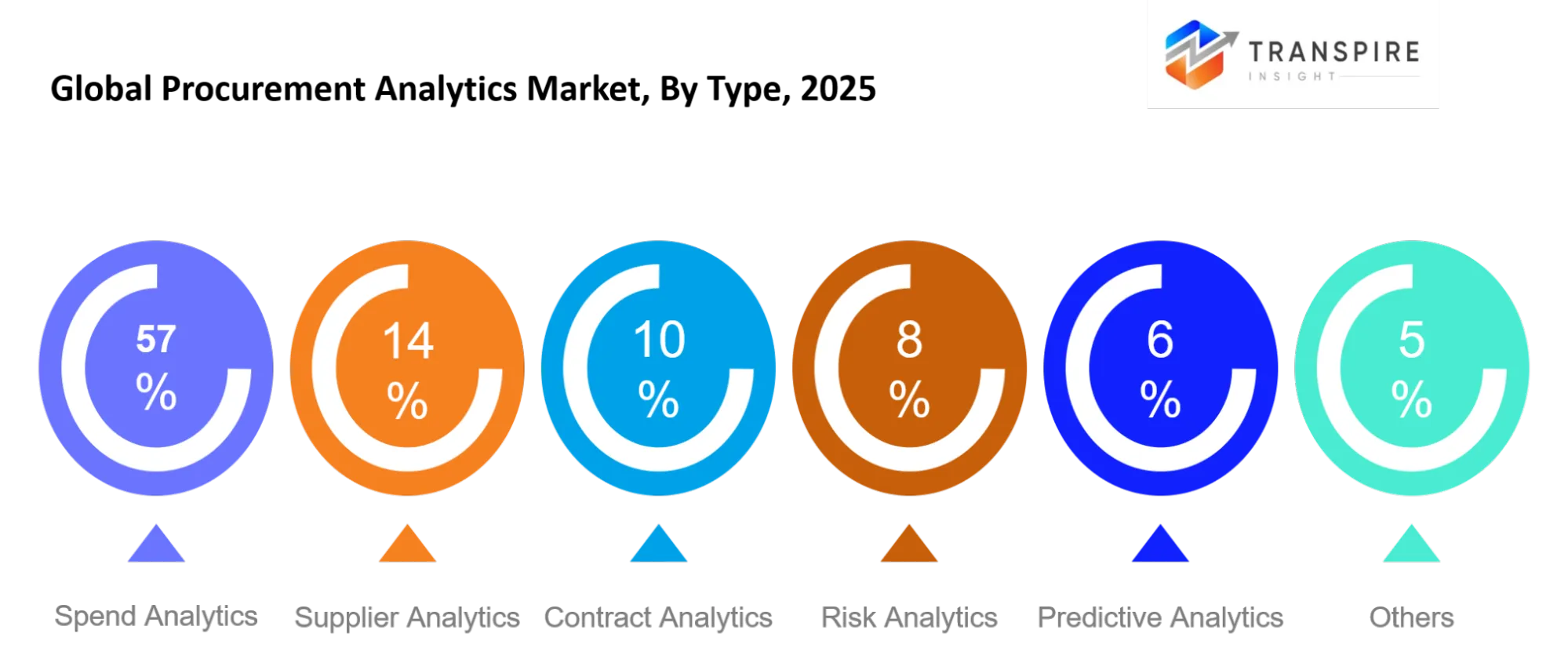
By Application
Manufacturing applications remain the absolute heavyweights of this industry due to the high volume of direct material transactions, followed closely by Retail, while BFSI, Healthcare, IT & Telecom, and specialized secondary fields shape the remaining application split. This massive concentration within product-heavy sectors is driven by global manufacturing conglomerates and retail groups buying enterprise software licenses and cloud infrastructure in massive volumes to manage complex, multi-tiered international bill-of-materials and fluctuating shipping logistics schedules. However, things are getting highly lucrative in the compliance-heavy sectors, where BFSI and Healthcare stand out as rapidly expanding pockets as procurement leaders demand stable, heavily guarded audit trails and deep sub-tier vendor risk profiles to prevent sudden operational shutdowns. Moving forward, everything software suppliers build will need to focus on native, multi-ERP integration capabilities and cross-functional spend tracking. System providers will have to balance two main engineering workloads: supplying massive, cost-efficient data cleansing architectures to traditional heavy industrial hubs while refining high-margin, agile compliance and contract compliance plugins for the rapidly expanding digital banking, insurance, and medical delivery networks.
By End-User
Large Enterprises remain the absolute anchor of day-to-day market demand, commanding the vast majority of contract values due to their massive, predictable aggregate spending and their urgent need to unify hundreds of disconnected legacy ERP databases. Meanwhile, Small and Medium Enterprises (SMEs) and Government Organizations are stepping in as high-value, fast-growing secondary end-users. The growth pattern here depends entirely on how quickly mid-market cloud deployment models mature and how strictly public entities need to track taxpayer fund allocations and green sourcing compliance metrics. Corporate giants rely on highly scalable, multi-tenant software contracts to enforce rigid procurement policy guidelines across global business units, while SMEs and public organizations seek accessible, plug-and-play dashboards to eliminate manual invoice entry bottlenecks. Moving forward, major platform and software vendors won't be able to survive just by selling isolated, static data cubes. Long-term success will mean locking down fully integrated contract and spend management systems. Software providers will need to bundle raw reporting tools with ongoing telemetry and external database-enrichment capabilities, offering built-in AI vendor verification, automated legal risk flagging, and real-time category spending alerts to meet changing corporate procurement demands.
By Deployment
Cloud-based deployments hold the clear market position as the preferred operational standard across the procurement landscape, capturing the peak share of ongoing enterprise software investments due to their rapid implementation timelines and minimal on-site maintenance requirements. On-premise setups remain active within highly regulated government, defense, and select banking infrastructure nodes where absolute internal data isolation is mandated, while Hybrid deployment models are accelerating rapidly among legacy enterprises that need to bridge old mainframe tracking systems with modern, cloud-native analytical tools. The unique growth logic driving cloud-first platforms is the urgent corporate demand for real-time visibility and instant access to external benchmarking data networks, which cannot be achieved through traditional, siloed infrastructure. Moving forward, the industry implication is a total shift toward composable cloud data architectures. Software providers will face intense pressure to engineer highly secure, low-code API connector frameworks, allowing enterprises to securely stream sensitive transactional logs into distributed analytical clouds without risking data sovereignty leaks or experiencing costly database synchronization delays.
What Are the Key Use Cases Driving the Global Procurement Analytics Market?
The foundational use case is real-time spend visibility and automated classification across direct and indirect cost centers. Large corporate teams apply automated classification algorithms to huge, unstructured datasets from hundreds of different ERP databases, creating an accurate view of spending that instantly highlights unapproved rogue purchases and contract pricing errors.
Beyond tracking basic historic invoices, application lines are expanding into strategic vendor risk management and contract compliance auditing within complex product-heavy fields like manufacturing and retail. Procurement systems continuously monitor live supplier financial tracking reports and global logistics networks, allowing operations leaders to model risk and swap out problematic, single-source vendors before raw material shortages hit active production floors.
An emerging use case focuses on automated carbon footprint monitoring and Scope 3 greenhouse gas reporting across decentralized international supply networks. To meet strict global environmental laws, modern sustainability divisions feed automated invoice data directly into carbon tracking calculators, scoring supplier green scores to systematically favor eco-friendly contractors during competitive corporate bidding events.
|
Report Metrics |
Details |
|
Market size value in 2025 |
USD 5.7 Billion |
|
Market size value in 2026 |
USD 7.04 Billion |
|
Revenue forecast in 2033 |
USD 30.8 Billion |
|
Growth rate |
CAGR of 23.47% from 2026 to 2033 |
|
Base year |
2025 |
|
Historical data |
2021 - 2024 |
|
Forecast period |
2026 - 2033 |
|
Report coverage |
Revenue forecast, competitive landscape, growth factors, and trends |
|
Regional scope |
United States; Canada; Mexico; United Kingdom; Germany; France; Italy; Spain; China; Japan; India; Australia; South Korea; Brazil; Argentina; South Africa; Saudi Arabia; United Arab Emirates |
|
Key company profiled |
SAP, Oracle, IBM, Coupa Software, Zycus, Jaggaer, GEP, Ivalua, Genpact, Proactis, Sievo, Rosslyn Data Technologies, SynerTrade, Basware, SAS Institute |
|
Customization scope |
Free report customization (country, regional & segment scope). Avail customized purchase options to meet your exact research needs. |
|
Report Segmentation |
By Type (Spend Analytics, Supplier Analytics, Contract Analytics, Risk Analytics, Predictive Analytics, Others); By Application (Retail, BFSI, Manufacturing, Healthcare, IT & Telecom, Others); By End-User (Large Enterprises, SMEs, Government Organizations, Others); By Deployment (Cloud-based, On-premise, Hybrid, Others) |
Which Regions Are Driving the Global Procurement Analytics Market Growth?
North America leads the Global Procurement Analytics Market, holding a dominant 40% share of total revenue. This top position is driven by the massive concentration of large multinational corporate headquarters and major financial hubs handling highly complex, multi-tiered transactional data. The region features advanced cloud data centers and rigid financial governance laws that penalize loose bookkeeping. To protect profit margins and meet corporate compliance rules, North American businesses are investing heavily in automated spend software to catch rogue corporate purchasing across their operations.
In May 2026 - spend management provider Coupa Software officially announced its strategic acquisition of AI-native orchestration platform Tonkean to accelerate automated transaction execution. This consolidation leverages Coupa's extensive 10 trillion dollar global trade dataset to embed agentic workflow automation across North American enterprise accounts, cutting intake cycle times by roughly half and eliminating manual friction points across complex corporate data pipelines. [https://www.coupa.com/newsroom/coupa-acquires-tonkean-to-accelerate-agentic-intake-and-orchestration-for-global-trade/]
Europe serves as a highly technical secondary pillar for the industry, securing a solid 27% of worldwide market revenue. While North American enterprises focus mostly on administrative cost-cutting, Europe’s market stability is tied directly to strict regulatory tracking and green sourcing mandates across major industrial economies like Germany and France. European manufacturing and retail firms consistently use unified data tracking to map carbon footprints and monitor supplier liability down to sub-tier vendors. This regulatory pressure forces steady software adoption, keeping regional businesses aligned with European Union transparency laws while protecting supply loops from sudden non-compliance penalties.
In February 2026 - digital procurement software provider JAGGAER officially delivered a comprehensive procurement digitalization framework for global entertainment operator Betsson Group. The technical deployment successfully consolidated and centralized over two thousand active corporate contracts and 130 million euros in managed organizational spend into a single source of truth, establishing real-time budget traceability while automating supplier compliance vetting across complex European operating environments.
The Asia-Pacific corridor has quickly emerged as the fastest-growing market globally, expanding at an industry-leading individual regional CAGR of 15.3% while holding a 25% share of international revenues. This rapid growth is fueled by aggressive industrial digitization - booming e-commerce markets, and the broad modernization of manufacturing networks across expanding hubs in India, China, and Southeast Asia. Instead of prioritizing corporate administrative overheads like Western companies, Asia-Pacific factories and digital tech firms are adopting cloud-hosted platforms to manage volatile raw material costs and build stable production schedules. Moving forward, software adoption in this territory will center on integrating flexible, cost-efficient analytics tools built to handle massive, changing supplier networks.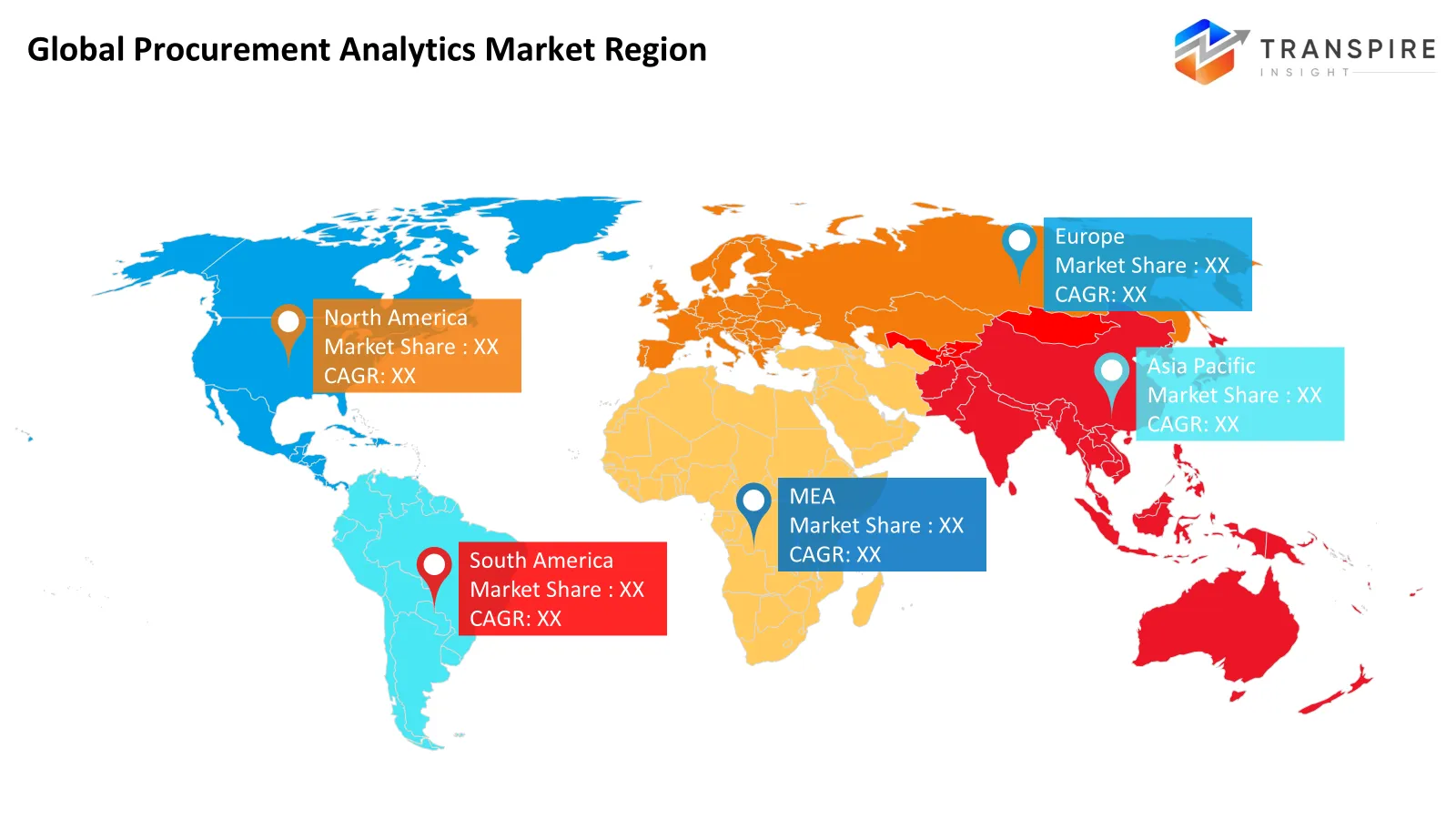
Who Are the Key Players in the Global Procurement Analytics Market and How Do They Compete?
The Global Procurement Analytics Market plays out as a fast-moving - tech-driven battlefield where software providers constantly fight over data ingestion speeds, category classification accuracy, and real-time dashboard responsiveness. Because modern corporations want hands-free automation, the goal is shifting away from just compiling retrofitted spend charts toward delivering complete, autonomous data orchestration layers that slot right into messy enterprise databases. To keep ahead, the biggest names are constantly revamping their natural language processing engines and scooping up smaller competitors to lock down regional footprints close to critical manufacturing, retail, and financial hubs.
SAP protects its market share by focusing entirely on deep enterprise resource planning integration, leaning heavily on high-margin, cloud-connected platforms like the SAP Business Technology Platform. The team maintains its industry edge by guarding a massive global customer base running core SAP instances, making it the default framework for corporate transaction tracking. When it comes to growing their footprint, they favor direct platform evolution like their February 2026 architectural upgrade to SAP Ariba, which embeds real-time analytics and intelligent bidding agents directly into day-to-day corporate workflows to eliminate custom third-party database connections entirely.
Meanwhile, Coupa Software takes a completely network-first angle, shaping its analytical tools directly around the collective behavior of its massive global trade community. They stand out by supplying an entire automated spend pipeline, matching historical invoice records with advanced machine learning models trained on a massive 10 trillion dollar transactional data asset. Instead of chasing single-system installations, they grow by aggressive market consolidation like their May 2026 acquisition of Tonkean and Rossum, which allows them to install smart intake agents straight into enterprise networks to catch rogue spending before it ever hits the ledger.
Company List
- SAP
- Oracle
- IBM
- Coupa Software
- Zycus
- Jaggaer
- GEP
- Ivalua
- Genpact
- Proactis
- Sievo
- Rosslyn Data Technologies
- SynerTrade
- Basware
- SAS Institute
Recent Development News
In June 2026 - spend management platform provider Coupa Software officially released its collaborative Business Spend Index (BSI) report developed alongside the MIT Data Science Lab. This analytical tool applies machine learning algorithms directly to Coupa's active, community-generated 10 trillion dollar business-to-business transaction database. The index processes hard procurement data rather than subjective sentiment surveys, giving corporate finance officers a clear way to forecast industry-specific category cost changes and economic supply shifts up to 90 days in advance. [https://www.coupa.com
In February 2025 - enterprise software provider SAP SE officially expanded its procurement portfolio with the general availability of the SAP Spend Control Tower solution. This cloud-native analytics application runs on the SAP Business Technology Platform (BTP) - utilizing built-in machine learning models to automatically group, clean, and harmonize scattered supplier invoices coming from both internal ERP lines and outside third-party databases. The framework establishes an automated, unified dataset that lets financial controllers flag unapproved maverick spending and track supplier diversity metrics without deep manual spreadsheet prep. [https://news.sap.com
In September 2025 - procurement and supply chain consulting specialist INVERTO, a subsidiary of Boston Consulting Group (BCG), officially opened its first Middle East operational hub in Riyadh, Saudi Arabia. This geographic expansion blends specialized, data-driven supply chain analytics consulting with localized regional logistics information. The targeted presence gives large enterprise corporations and expanding public entities across the Gulf region the strategic framework required to audit structural raw material sourcing channels, identify category cost-saving opportunities, and navigate shifting cross-border import regulations. [https://www.consultancy-me.com
What Strategic Insights Define the Future of the Global Procurement Analytics Market?
The procurement analytics landscape is rapidly shifting toward autonomous, agentic data pipelines that move beyond simple historical spend dashboards to execute real-time workflow corrections. A critical hidden risk in this progression is data-schema drift, where unstructured invoice variations from multi-tier global supplier networks bypass fragile machine learning classification rules, creating systemic reporting blind spots and flawed automated contract audits.
Conversely, an exceptional emerging opportunity lies in the deployment of continuous, cross-border predictive risk telemetry that layers localized logistical bottlenecks with real-time vendor financial-health metrics. To capitalize on this shift, enterprise data leaders must discard isolated software procurement models. Instead, they should execute unified cloud-native architectures that bundle multi-source data ingestion engines with automated schema mapping tools, locking down the deep, end-to-end trace visibility required to protect corporate margins and handle volatile supply networks smoothly.
key segmentaion are:
By Type
- Spend Analytics
- Supplier Analytics
- Contract Analytics
- Risk Analytics
- Predictive Analytics
- Others
By Application
- Retail
- BFSI
- Manufacturing
- Healthcare
- IT & Telecom
- Others
By End-User
- Large Enterprises
- SMEs
- Government Organizations
- Others
By Deployment
- Cloud-based
- On-premise
- Hybrid
- Others
Regional Outlook
North America
- United States
- Canada
- Mexico
Europe
- Germany
- United Kingdom
- France
- Spain
- Italy
- Rest of Europe
Asia Pacific
- Japan
- China
- Australia & New Zealand
- South Korea
- India
- Rest of Asia Pacific
South America
- Brazil
- Argentina
- Rest of South America
Middle East & Africa
- Saudi Arabia
- United Arab Emirates
- South Africa
- Rest of the Middle East & Africa
Frequently Asked Questions
Find quick answers to common questions.
The Global Procurement Analytics Market size was valued at USD 5.7 Billion in 2025 and is poised to reach USD 30.8 Billion by 2033, expanding at a 23.47% CAGR.
Key segments for the Global Procurement Analytics Market are By Type (Spend Analytics, Supplier Analytics, Contract Analytics, Risk Analytics, Predictive Analytics, Others); By Application (Retail, BFSI, Manufacturing, Healthcare, IT & Telecom, Others); By End-User (Large Enterprises, SMEs, Government Organizations, Others); By Deployment (Cloud-based, On-premise, Hybrid, Others).
Growth is primarily driven by the increasing integration of artificial intelligence and machine learning technologies to automate spend classification, alongside a rising enterprise-wide demand for real-time supply chain transparency and proactive vendor risk management.
The global market is led by major manufacturers including SAP, Oracle, IBM, Coupa Software, Zycus, Jaggaer, GEP, Ivalua, Genpact, Proactis, Sievo, Rosslyn Data Technologies, SynerTrade, Basware, SAS Institute.
North America holds a dominant 40% share of global revenue because of its high concentration of large multinational corporate headquarters handling complex multi-tier transactions, advanced data center infrastructure, and rigid financial governance regulations that demand strict spending compliance.
Exceptional commercial opportunities exist in deploying continuous, cross-border predictive risk telemetry that layers localized logistical bottlenecks with real-time vendor financial-health metrics, alongside integrating unified automated schema mapping engines to automatically harmonize unstructured data pipelines across diverse supplier networks.
- SAP
- Oracle
- IBM
- Coupa Software
- Zycus
- Jaggaer
- GEP
- Ivalua
- Genpact
- Proactis
- Sievo
- Rosslyn Data Technologies
- SynerTrade
- Basware
- SAS Institute
About the Authors

Mayur Shinde
I am Mayur Shinde, a Senior Research Analyst at Transpire Insight, specializing in the Automotive & Transportation and Information & Communication Technology (ICT) Industry. My work focuses on analyzing emerging market trends, technological advancements, competitive landscapes, and industry developments to deliver accurate, data-driven insights. I am passionate about transforming complex market information into clear, actionable content that helps businesses, professionals, and decision-makers stay informed and make confident strategic decisions.

Chakradhar Khansole
Chakradhar serves as the Research Director at Transpire Insight, bringing over 8 years of experience in technology, innovation, and strategic market intelligence. He specializes in transforming complex market data into actionable business insights that enable organizations to make informed, growth-oriented decisions. Recognized for his strategic vision and analytical expertise, Chakradhar leads high-impact research initiatives, delivering comprehensive market assessments, competitive intelligence, and forward-looking industry analysis.
Recently Published Reports
-
Apr 2026
3D Optical Profiler Market
3D Optical Profiler Market Size, Share & Analysis Report By Type (Desktop 3D Optical Profiler, and Portable 3D Optical Profiler), By Technology (Confocal Technology, and White Light Interference), By End-Use Industry (Manufacturing, Research Institutions, Automotive, Aerospace and Defense, Medical Devices, and Other), and Geography (North America, Europe, Asia-Pacific, Middle East and Africa, South and Central America), 2021 - 2031
-
Apr 2026
Depth Sensor Market
Depth Sensor Market Size, Share & Analysis Report By Type (Infrared Depth Sensors, Time-of-Flight (ToF) Sensors, Stereo Vision Sensors, Structured Light Sensors, Ultrasonic Depth Sensors), By Application (Automotive, Robotics, Gaming, Consumer Electronics, Industrial Automation, Healthcare, Security & Surveillance, Others), By End Users (Automotive Manufacturers, Consumer Electronics Companies, Healthcare Providers, Industrial Companies, Security Agencies, Gaming Companies, Robotics Companies, Others), and Geography (North America, Europe, Asia-Pacific, Middle East and Africa, South and Central America), 2021 – 2031
-
Apr 2026
Digital Manufacturing Market
Digital Manufacturing Market Size, Share & Analysis Report By Component (Hardware, Software, and Services), By Technology (Robotics, 3D Printing, Internet of Things (IoT), and Others), By Application (Automotive and Transportation, Aerospace and Defense, Consumer Electronics, Industrial Machinery, and Others), By Process Type (Computer-Based Designing, Computer-Based Simulation, Computer 3D Visualization, Analytics, and Others), and Geography (North America, Europe, Asia-Pacific, Middle East and Africa, South and Central America), 2021 – 2031
-
Apr 2026
Digital Visa Services Market
Digital Visa Services Market Size, Share & Analysis Report By Type (Individual Travelers, Group Travelers), By Application (Tourism, Business Travel, Others), and Geography (North America, Europe, Asia-Pacific, Middle East and Africa, South and Central America), 2021 – 2031