

Asia Pacific Esports Market Summary
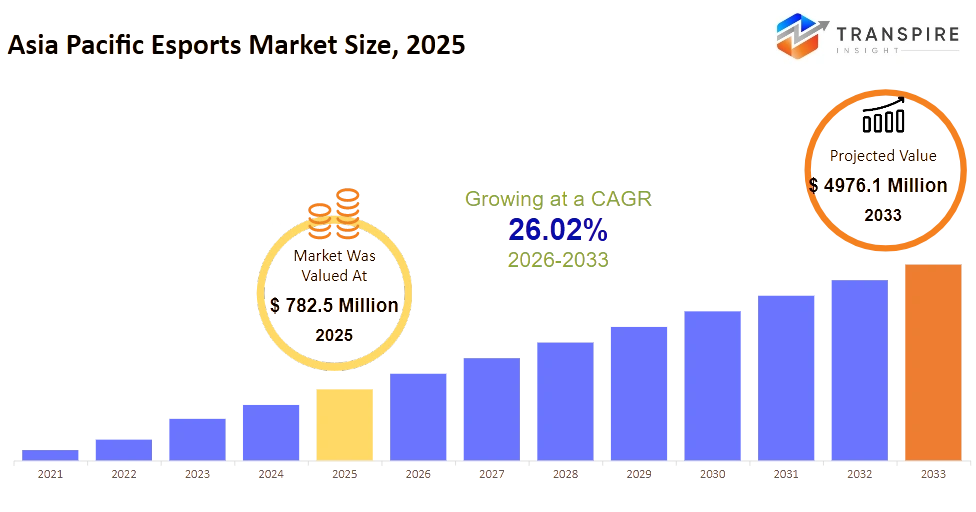
As per Transpire Insight Analysis the Asia Pacific Esports Market size is estimated at USD 782.5 Million in 2025 and is anticipated to reach USD 4976.1 Million by 2033, growing at a CAGR of 26.02% from 2026 to 2033.
The Asia Pacific Esports Market links game publishers, tournament organizers, streaming platforms , sponsors, and media firms through competitive gaming that pulls in money from ads, media rights , ticket sales, merchandise, and all that extra digital participation. It also lets brands tap into really active online crowds while still building legit work paths for players, content creators, and event operators , you know the usual ecosystem.
In the last three to five years, things shifted from separate, standalone tournaments to more blended entertainment arrangements, sort of like live streaming plus mobile gaming plus competitions that run like franchises rather than one-offs. Then COVID-19 hit and basically became a big trigger, speeding up digital entertainment watching and bringing more people into online tournaments across the region, even where it was not that common before.
With broadband networks getting better, cloud gaming services becoming steadier, and smartphone performance improving, engagement stopped feeling so random and started being more stable. That stability encouraged advertisers and investors to put in bigger budgets. Now this stronger commercial base helps organizers lock in longer term agreements , open up additional income avenues, and push esports closer to mainstream sports and entertainment lineups.
Asia Pacific Esports Market Size & Forecast:
- Asia Pacific Esports Market Size 2025: USD 782.5 Million
- Expected Market Value 2033: USD 4976.1 Million
- Forecast CAGR: 26.02%
- Leading region in 2025: China
- Fastest Growing region: India
- Key Profile: Tencent, Riot Games, Valve, Activision Blizzard, Electronic Arts, Krafton, Garena, ESL Gaming, BLAST, DreamHack, Huya, DouYu, YouTube Gaming, Twitch, NetEase Games
Key Market Insights
- China really dominated the Asia Pacific esports industry, with around 41% market share in 2025, this was backed by fairly mature gaming ecosystems and heavy publisher spending too.
- India is still expected to be the fastest growing regional market during 2025–2033, mostly because smartphone gaming keeps spreading , affordable internet access improves, and the tournament ecosystem keeps widening as well, kinda like a positive feedback loop.
- When it comes to product and service categories, sponsorship plus advertising showed up as the biggest chunk, close to 34% market share in 2025, and it seemed to come from stronger brand involvement across pro competitions, not just casual marketing.
- Media rights landed as the second-largest revenue slice, as broadcasters and streaming platforms went after exclusive tournament content across multiple Asia Pacific markets, so players and viewers basically had less choice but better access to certain events.
- Streaming and digital content services are also set to grow the fastest through 2033, driven by cloud distribution, multilingual broadcasts, and more premium subscription models popping up over time.
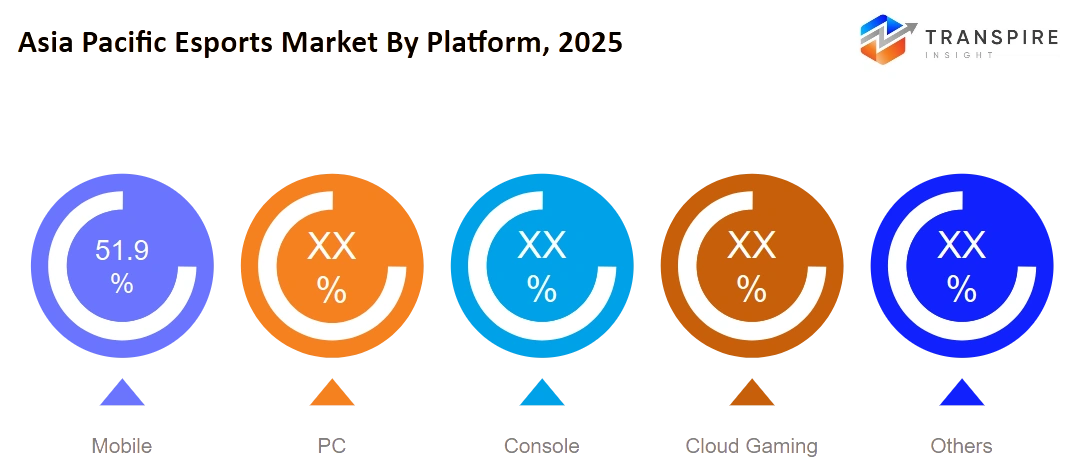
- Mobile esports alone accounted for roughly 58% market share in 2025, helped by wider smartphone penetration and those competitive mobile gaming ecosystems that keep getting refined.
- PC esports will likely see the most rapid application expansion across the forecast window, because premium tournaments keep increasing, plus high-value sponsorship agreements keep stacking up.
- Professional esports organizations held nearly 46% of end user revenue in 2025, supported by league participation, sponsorship contracts, and merchandise activity that’s more organized than before.
- Individual content creators and independent competitive players will become the fastest-growing end-user segment by 2033, mainly thanks to creator monetization , and live streaming platforms that keep adding new ways to earn.
What are the Key Drivers, Restraints, and Opportunities in the Asia Pacific Esports Market?
The strongest growth driver is this shift toward mobile-first competitive gaming, sorta powered by affordable 5G connectivity plus cloud infrastructure and better smartphone performance. As network quality keeps improving latency drops, and the live viewing experience gets much smoother. Publishers now bring out tournaments that can reach millions, without leaning on expensive gaming hardware. Sponsors answer by upping their advertising spend, because audience engagement is actually measurable across streaming platforms. So the whole chain kinda lifts media rights revenue , tournament participation, and also more commercial partnerships across the region.
The biggest structural restraint is fragmented regulation, covering how esports is recognized, what online gaming policies allow, and how digital monetization is handled across multiple countries. Tournament operators still have to meet different licensing rules, taxation setups , and broadcasting requirements, before they expand regionally. That whole process slows down league launches , and it delays sponsorship agreements too. And based on the Transpire Insight review of regional procurement announcements and launch schedules, supply chain concentration stays the primary execution risk. All these constraints, kind of quietly suppress the upside, by postponing investments and limiting cross-border tournament integration.
The most promising opportunity is still sitting in AI-powered broadcasting , virtual production, and cloud gaming infrastructure. Regional bets on edge computing and hyperscale data centers are quietly bringing streaming latency down, and at the same time they’re making it easier to host bigger concurrent audiences. India and Southeast Asia look especially good for expansion too, since broadband coverage , digital payments adoption, and publisher investment are all improving in tandem . As these things keep unfolding, they should unlock fresh advertising formats, more interactive fan engagement , premium subscriptions, and better data-guided sponsorship models.
What Has the Impact of Artificial Intelligence Been on the Asia Pacific Esports Market?
Artificial intelligence is kind of transforming competitive gaming, by quietly automating tournament operations, broadcast production player monitoring, and even how the audience is kept interested. AI systems manage scheduling, they can detect cheating behavior real time , they moderate live chat, and they generate multilingual highlights with less manual effort then you’d expect. Machine learning also looks at player performance, predicts server traffic, and basically forecasts audience demand ahead of the big tournaments , so organizers can put computing resources where they actually matter, more efficiently.
Meanwhile streaming platforms use recommendation engines to boost viewer retention, and publishers go further with predictive analytics to adjust event timing and marketing campaigns across different countries. All of this improves operational efficiency, reduces broadcast delays, strengthens platform uptime, and trims infrastructure costs via dynamic resource allocation. On top of that, AI-assisted content generation helps speed up highlight creation and it supports personalized fan experiences , which then opens more monetization opportunities for advertisers and media partners.
Still, widespread implementation is not effortless, because integration costs stay high and digital infrastructure is uneven in several emerging economies. Smaller tournament organizers often struggle to access quality datasets needed for accurate predictive models, and inconsistent network performance can mess with algorithm reliability during live competitions. As AI capabilities keep getting better, competitive gaming ecosystems will probably become more automated, more data-driven, and more commercially efficient , though balanced investment in infrastructure and cybersecurity will remain important for sustained growth.
Key Market Trends
- After 2022, mobile esports kind of overtook a lot of the older PC style competitions across several countries, it was supported by affordable flagship smartphones and the slow but steady expanding of 5G coverage in different regions.
- Between 2021 and 2025, franchise league investments kept speeding up, which made sponsorship revenue more predictable, not that it was perfect, and it also pulled in more long-term publisher involvement, kind of like a stronger signal for the future.
- Tencent and Riot Games also kept building out regional tournament ecosystems, with localized competitions and that helped audience engagement, then later it opened more media rights opportunities too.
- On the tech side, cloud gaming infrastructure spending has reduced latency since 2023 , so more people can join in without needing premium gaming hardware and the whole setup feels less demanding.
- Now there are AI powered production tools that basically automate highlights, multilingual commentary, and moderation, lowering operating costs while still improving broadcast consistency in a pretty measurable way.
- India showed up as one of the fastest changing eSports landscapes after 2022, aided by expanding creator economies, digital payments that make transactions easier, and a competitive mobile gaming scene that keeps growing.
- Also, regional sponsors started shifting budgets away from traditional sports and toward esports from roughly 2021 through 2025, they were attracted by measurable digital engagement metrics, not just vague brand buzz.
- Live streaming platforms introduced premium memberships and more interactive viewing features, which strengthened recurring revenue and audience retention around major tournaments.
- And since 2023, tournament organizers have been leaning harder into advanced analytics, so they can optimize schedules, forecast audiences better, and improve how sponsor campaigns perform.
Asia Pacific Esports Market Segmentation
By Revenue Source :
Media Rights generated the biggest chunk of revenue, because broadcasters and streaming platforms kept grabbing exclusive tournament content with longer term agreements. Then sponsorship came not far behind, with global and regional brands pushing higher marketing budgets toward competitive gaming audiences, aiming for more trackable engagement, you know. Advertising also kept steady momentum, powered by digital campaigns, promotions tied to live events, and in-stream placements that reached solid viewer numbers.
As for Merchandise and Tickets, they did well too, mostly from larger in person tournaments and stronger fan participation across major cities. Publisher Fees helped keep organized competitions running via licensing arrangements, and official league operations. Streaming Revenue grew along with premium subscriptions, digital tipping, and exclusive content that’s been getting more acceptance, while the Others bucket covered licensing and extra commercial income that overall made the revenue mix more diversified.
By Game Genre :
MOBA games kind of held the leading position, mainly because there were established tournament ecosystems, pretty loyal player communities, and publisher-backed competitions that kept participation consistent across a few countries. Battle Royale games landed in the second-largest share, mostly due to mobile accessibility plus frequent content updates, which in turn boosted engagement. FPS titles kept pulling in pro teams via international tournaments and those competitive league setups that feel a bit more structured.
Sports and Strategy games stayed steady too, because dedicated communities stuck around, and the competitions were organized enough to keep people involved. Fighting Games kept expanding through regional championships and community-driven events, with online audiences slowly getting bigger. The Others category covered emerging genres that will probably gain from new game launches, publisher investments and expanding competitive ecosystems during the forecast period, pretty much.
By Platform :
MOBA games kind of held the leading position, mostly because there were established tournament ecosystems, pretty loyal player communities, and publisher-backed competitions that kept participation steady across a few countries. Battle Royale titles landed in the second-largest share, mostly due to mobile accessibility plus frequent content updates, which in turn boosted the level of engagement. FPS games kept pulling in pro teams through international tournaments, and those competitive league setups that feel a bit more structured too.
Sports and Strategy stayed fairly steady as well, because dedicated communities kept showing up , and the competitions were organized enough to keep people involved. Fighting Games kept expanding via regional championships and community-driven events, with online audiences slowly getting bigger. The Others category covered emerging genres that will probably benefit from new game launches , more publisher investments, and expanding competitive ecosystems during the forecast period, pretty much.
By End User :
Proffesional Players kinda represented the leading end user segment because structured leagues, sponsorship agreements, and tournament prize pools created steady income paths. Casual Gamers made up the second-largest segment by nurturing player communities, boosting content interaction, and keeping the game popular across digital platforms. Tournament Organizers kept pushing broader event portfolios via regional collaborations and bigger competitive schedules.
Viewers will stay the fastest growing category as streaming quality, multilingual broadcasts, and interactive features lead to more prolonged engagement, and honestly it adds up over time. Sponsors also continued upping their investment because digital campaigns deliver quantifiable audience results across several platforms. The Others group covered coaches, analysts, and support service providers, who in practice strengthened the whole esports ecosystem.
By Streaming Platform :
YouTube Gaming kinda held the top spot with broad regional access, solid creator networks, and a pretty steady live streaming setup. Then Huya and DouYu stayed pretty strong too, mainly because they kept targeting the established gaming crowd in China, plus they pushed exclusive tournament broadcasts , which helped them keep mindshare. Twitch kept at it by leaning into more engaging esports content and covering international tournaments, so the whole platform feel kept getting stronger over time.
Nimo TV also grew its regional visibility, especially by backing mobile-first creators and running localized competitive events across Southeast Asia. Platform investment in artificial intelligence , like personalized recommendations and more interactive watching features, should help raise audience retention and also boost ad performance. As for the Others category, it mostly covered newer streaming services. Those will likely expand by grabbing regional partnerships, rolling out creator programs, and continuing tech improvements, though the pace might be uneven.
What are the Key Use Cases Driving the Asia Pacific Esports Market?
The largest use case kind of comes from professional competitive tournaments that are backed by sponsorships, media rights, and live streaming, honestly. Game publishers, tournament organizers, broadcasters, and global brands put money into these events because when you get big audiences you end up with stronger advertising value, better premium content opportunities and also longer commercial partnerships that help keep revenue generation consistent.
Secondary applications are still expanding, especially through educational institutions and corporate organizations, you know. Universities use competitive gaming to draw in student participation and to build campus leagues, while businesses run branded tournaments and employee engagement programs, which in turn strengthens digital marketing campaigns and community interaction.
More emerging applications include cloud-based competitive gaming, plus virtual production for live tournaments. Telecom providers, cloud infrastructure companies, and technology investors are funding these efforts as low-latency networks and advanced streaming capabilities make things more accessible. Over time, these applications will create new monetization models and allow wider regional participation across the forecast period, too.
|
Report Metrics |
Details |
|
Market size value in 2025 |
USD 782.5 Million |
|
Market size value in 2026 |
USD 986.1 Million |
|
Revenue forecast in 2033 |
USD 4976.1 Million |
|
Growth rate |
CAGR of 26.02% from 2026 to 2033 |
|
Base year |
2025 |
|
Historical data |
2021 - 2024 |
|
Forecast period |
2026 - 2033 |
|
Report coverage |
Revenue forecast, competitive landscape, growth factors, and trends |
|
Regional scope |
Asia Pacific (India, China, Japan, Australia, South Korea, Rest of Asia Pacific) |
|
Key company profiled |
Tencent, Riot Games, Valve, Activision Blizzard, Electronic Arts, Krafton, Garena, ESL Gaming, BLAST, DreamHack, Huya, DouYu, YouTube Gaming, Twitch, NetEase Games . |
|
Customization scope |
Free report customization (country, regional & segment scope). Avail customized purchase options to meet your exact research needs. |
|
Report Segmentation |
By Revenue Source (Media Rights, Sponsorship, Advertising, Merchandise & Tickets, Publisher Fees, Streaming Revenue, Others); By Game Genre (MOBA, Battle Royale, FPS, Sports, Strategy, Fighting Games, Others); By Platform (PC, Mobile, Console, Cloud Gaming, Others); By End User (Professional Players, Casual Gamers, Tournament Organizers, Viewers, Sponsors, Others); By Streaming Platform (YouTube Gaming, Twitch, Huya, DouYu, Nimo TV, Others) |
Which Regions are Driving the Asia Pacific Esports Market Growth?
China stayed the biggest regional market, with around 41% market share in 2025. There was strong government oversight , plus really advanced digital infrastructure and broad 5G reach that helped everything run at scale—like big tournaments and regular commercial operations. Major game publishers, streaming platforms, esports organizations, and technology companies kept putting money into professional leagues, broadcast production and event facilities. Overall, the steady push on digital infrastructure and content development should keep China in the leading spot during the whole forecast window.
Japan sat in second place as the regional market, mainly because consumers still spend a lot on gaming and the digital policies stayed fairly stable, so companies could plan farther ahead. Higher purchasing power basically encouraged publishers and tournament organizers to launch more premium contests, with commercial returns that feel reliable. Well established entertainment firms, hardware manufacturers, and content creators then helped keep a balanced ecosystem, without having to chase rapid expansion all the time. With predictable investment patterns and mature gaming communities, Japan kept looking like a dependable revenue source across multiple types of business models.
India kind of emerged as the fastest moving regional market after, improvements in mobile connectivity, cheaper smartphones , and digital payments adoption, which kinda made it easier for more people to join competitive gaming in the first place. There was also strong investment in telecom infrastructure, plus wider internet access, so tournament organizers could reach bigger audiences across both metro areas and more emerging cities, at the same time. Then the whole creator economy expansion along with extra publisher investment , kind of sped up commercial chances for streaming platforms and esports orgs. Overall, growth during 2026–2033 will likely generate appealing opportunities for fresh entrants, technology providers , advertisers , and long-term investors that want scalable digital entertainment businesses.
Who are the Key Players in the Asia Pacific Esports Market and How Do They Compete?
Competition stayed moderately consolidated, mostly because a limited group of publishers, tournament operators, and streaming platforms basically controlled the most valuable gaming ecosystems and media rights , you know. Technology innovation, exclusive game ownership, content ecosystems, and regional distribution networks were the main “fuel” for competition. Meanwhile, established companies kept guarding their market share via franchise leagues, upgrades to their digital platforms, and longer-term commercial partnerships, but newer businesses leaned into creator platforms and localized tournament services , trying to pull in fresh audiences.
Tencent improved its competitive position by leaning into exclusive game publishing, plus integrated digital services and steady investment in regional esports leagues , so players would stay around longer. Riot Games took a different route by building franchise-style competition formats, running organized professional leagues, and rolling out regular game updates that helped keep audience retention steady and made partnerships easier. Garena concentrated on Southeast Asia by stitching together localized content, regional tournaments, and community engagement programs that fit local player preferences and even advertiser expectations more closely.
KRAFTON pushed competitive gaming forward by putting money behind PUBG Esports , running international events and building stronger regional collaborations, which helped increase audience reach across several countries. Meanwhile MOONTON Games leaned hard into mobile esports by growing professional leagues and backing grassroots contests, so they could nurture up coming players. NetEase Games kept doubling down on esports oriented titles , improving publishing muscle and using regional expansion strategies that made sure content stayed available longer, and also boosted commercial growth in a more steady way.
Company List
- Tencent
- Riot Games
- Valve
- Activision Blizzard
- Electronic Arts
- Krafton
- Garena
- ESL Gaming
- BLAST
- DreamHack
- Huya
- DouYu
- YouTube Gaming
- Twitch
- NetEase Games
Recent Development News
In January 2026, Tencent Esports and the Olympic Council of Asia (OCA) announced a 10-year strategic partnership, making Tencent Esports the Official Esports Technology Partner of the OCA. The agreement expands cooperation beyond event support into technology standards, competition systems, and ecosystem development for Asian esports, strengthening long-term regional infrastructure. Source https://www.tencent.com/
In May 2026, Tencent signed multi-year partnership agreements with the Services Export Promotion Council (SEPC) and the Game Developer Association of India (GDAI) to support gaming and AVGC talent development in India. The commitment includes more than ₹100 million in resources for training, startup support, and ecosystem development, reinforcing India's esports and game development capabilities. Source https://www.tencent.com/
What Strategic Insights Define the Future of the Asia Pacific Esports Market?
The Asia Pacific Esports Market is expected to shift toward a more merged digital entertainment ecosystem, where competitive gaming, streaming, artificial intelligence, cloud infrastructure and data-led fan engagement kind of work together as linked commercial platforms, not really as separate businesses. Ongoing investment in low-latency networks, mobile technology and higher-value digital content will push this change at a structural level and help revenue look more predictable going forward. There’s also a risk that is a bit less obvious , because market concentration can matter a lot: a smaller set of publishers often controls many of the highest-value game titles and competitive ecosystems, which can lower the flexibility for tournament organizers and for newer entrants too. At the same time, a notable opening could come from cloud-native esports platforms in India and Southeast Asia, since broader digital infrastructure and better internet access should enable fresh competition formats. Companies in the space will likely do well by forging partnerships across publishers, telecom providers and streaming platforms, while also putting resources early into AI-driven content creation and audience analytics, so their long-term competitive position stays stronger.
Asia Pacific Esports Market Report Segmentation
By Revenue Source
- Media Rights
- Sponsorship
- Advertising
- Merchandise & Tickets
- Publisher Fees
- Streaming Revenue
By Game Genre
- MOBA
- Battle Royale
- FPS
- Sports
- Strategy
- Fighting Games
By Platform
- PC
- Mobile
- Console
- Cloud Gaming
By End User
- Professional Players
- Casual Gamers
- Tournament Organizers
- Viewers
- Sponsors
By Streaming Platform
- YouTube Gaming
- Twitch
- Huya
- DouYu
- Nimo TV
Frequently Asked Questions
Find quick answers to common questions.
The expected Asia Pacific Esports Market size for the market will be USD 4976.1 Million in 2033.
Key segments for the Asia Pacific Esports Market are By Revenue Source (Media Rights, Sponsorship, Advertising, Merchandise & Tickets, Publisher Fees, Streaming Revenue, Others); By Game Genre (MOBA, Battle Royale, FPS, Sports, Strategy, Fighting Games, Others); By Platform (PC, Mobile, Console, Cloud Gaming, Others); By End User (Professional Players, Casual Gamers, Tournament Organizers, Viewers, Sponsors, Others); By Streaming Platform (YouTube Gaming, Twitch, Huya, DouYu, Nimo TV, Others) .
Major Asia Pacific Esports Market players are Tencent, Riot Games, Valve, Activision Blizzard, Electronic Arts, Krafton, Garena, ESL Gaming, BLAST, DreamHack, Huya, DouYu, YouTube Gaming, Twitch, NetEase Games .
The Asia Pacific Esports Market size is USD 782.5 Million in 2025.
The Asia Pacific Esports Market CAGR is 26.02% from 2026 to 2033.
- Tencent
- Riot Games
- Valve
- Activision Blizzard
- Electronic Arts
- Krafton
- Garena
- ESL Gaming
- BLAST
- DreamHack
- Huya
- DouYu
- YouTube Gaming
- Twitch
- NetEase Games
About the Authors

Chetan Dhatrak
I’m Chetan Dhatrak, a Senior Research Analyst at Transpire Insight, specializing in the Consumer Goods, Foods and Beverages industry. I focus on analyzing market trends, consumer behavior, competitive landscapes, and industry developments to deliver accurate, data-driven insights. My research at Transpire Insight is built on credible sources and in-depth analysis, helping businesses and readers better understand market dynamics, emerging opportunities, and evolving consumer preferences. I’m committed to creating reliable, well-researched content that supports informed decision-making and reflects the latest developments in the consumer goods and food & beverage sectors.

Chakradhar Khansole
Chakradhar serves as the Research Director at Transpire Insight, bringing over 8 years of experience in technology, innovation, and strategic market intelligence. He specializes in transforming complex market data into actionable business insights that enable organizations to make informed, growth-oriented decisions. Recognized for his strategic vision and analytical expertise, Chakradhar leads high-impact research initiatives, delivering comprehensive market assessments, competitive intelligence, and forward-looking industry analysis.
Recently Published Reports
-
Apr 2026
Bottled Water Market
Bottled Water Market Size, Share & Analysis Report By Product Type (Still Bottled Water, Carbonated Bottled Water, Functional Bottled Water, and Others), By Packaging (PET, Cans, and Others), By Sales Channel (Supermarkets/Hypermarkets, Convenience Stores/Drug Stores, Grocery Stores/Club Stores, Foodservice, and Others) and Geography (North America, Europe, Asia-Pacific, Middle East and Africa, South and Central America), 2021 - 2032
-
Apr 2026
Color Cosmetic Packaging Market
Color Cosmetic Packaging Market Size, Share & Analysis Report By Application (Mascara Packaging, Liquid Packaging, and Liquid Face), By Type (Tubes & Bottles, Pens & Markers, Compacts & Containers, and Droppers & Pumps), and Geography (North America, Europe, Asia-Pacific, Middle East and Africa, South and Central America), 2021 - 2031
-
Apr 2026
External Microphone For Camera Market
External Microphone For Camera Market Size, Share & Analysis Report By Type (Shotgun Microphone, Lavalier Microphone, and Others), By Application (Digital Camera, Professional Video Camera, and Others), and Geography (North America, Europe, Asia-Pacific, Middle East and Africa, South and Central America), 2021 - 2031
-
Apr 2026
Foot Orthotic Insoles Market
Foot Orthotic Insoles Market Size, Share & Analysis Report By Type (Pre-fabricated, and Custom-made), By Material (Thermoplastic, Composite Carbon Fiber, and Others), By Distribution Channel (Drug Stores, Hospitals & Clinics, and Others), and Geography (North America, Europe, Asia-Pacific, Middle East and Africa, South and Central America), 2021 - 2031