

Asia Pacific Energy Bar Market Size & Forecast:
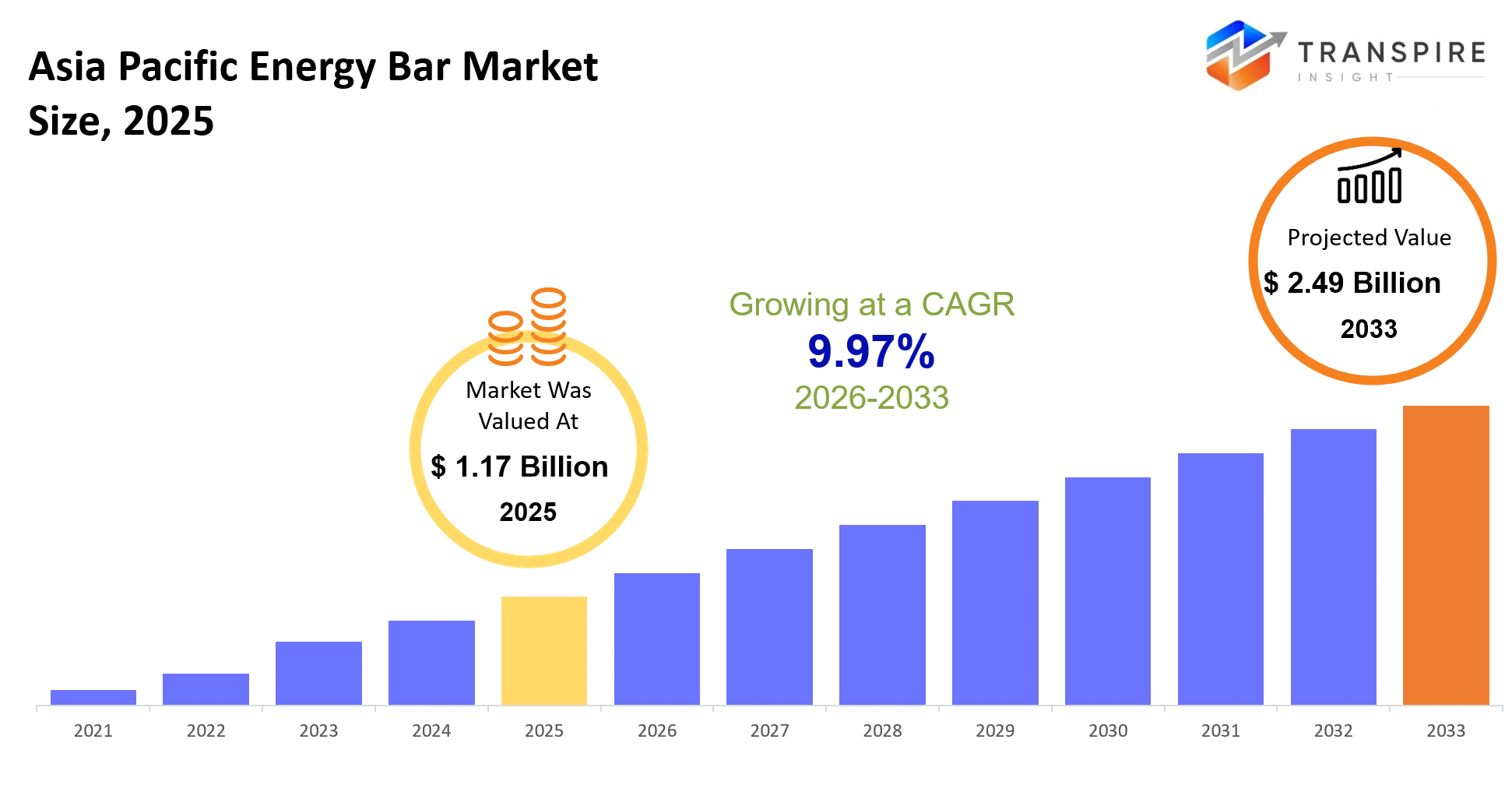
- Asia Pacific Energy Bar Market Size 2025: USD 1.17 Billion
- Asia Pacific Energy Bar Market Size 2033: USD 2.49 Billion
- Asia Pacific Energy Bar Market CAGR: 9.97%
- Asia Pacific Energy Bar Market Segments: By Product Type (Protein Bars, Nutrition Bars, Meal Replacement Bars, Cereal Bars, Organic Energy Bars, Others); By Distribution Channel (Supermarkets, Convenience Stores, Online Retail, Specialty Stores, Others); By End User (Athletes, Fitness Enthusiasts, Millennials, Health-conscious Consumers, Others)
To learn more about this report,  Download Free Sample Report
Asia Pacific Energy Bar Market Summary
TheAsia Pacific Energy Bar Market was valued at USD 1.17 Billion in 2025. It is forecast to reach USD 2.49 Billion by 2033. That is a CAGR of 9.97% over the period.
In practice the Asia Pacific energy bar market kind of supplies compact, nutrient dense food for commuters , fitness consumers , field workers and travelers who need steady energy when fresh meals are not really easy to grab. Over the last five years the space has moved away from those high sugar snack styles toward more protein rich clean label formulations, with extra functional ingredients like fiber, electrolytes, and plant derived proteins.
A noticeable structural change has been that health focused nutrition standards are now baked into mainstream convenience foods, driven by urban lifestyle pressures, and also by the growing preventive health awareness. This change got pushed harder after the COVID-19 pandemic , because it messed with eating routines, increased home based fitness habits and made people lean more on packaged nutrition during travel restrictions, which felt very real. So now brands are scaling e-commerce distribution and adjusting recipes for longer shelf stability plus more targeted nutrition, and that is helping stronger adoption across urban retail as well as online channels throughout Asia Pacific.
Key Market Insights
- London kind of dominates the Asia Pacific Energy Bar Market, with nearly 38% share, mostly because there’s a high restaurant density and pretty solid tech adoption, in general.
- Meanwhile Asia Pacific Energy Bar Market trends look like they’re moving in a similar direction urban consumption is rising and that ends up shaping UK foodservice software demand structures.
- On the module side, inventory management takes the lead in the Asia Pacific Energy Bar Market with around 42% share, since cost control is still a big priority for most operators.
- Supplier management platforms sit in the second place, and they basically help with centralized procurement plus contract optimization across full restaurant chains.
- Procurement analytics solutions are the fastest-growing piece, and they’re expected to expand quickly through 2026–2030, driven by demand for predictive cost modeling.
- If you look at restaurant types, full-service restaurants dominate with nearly 45% share, they rely heavily on structured procurement workflows and supplier coordination systems, pretty consistently.
- Quick-service restaurants are the fastest-growing application segment, mainly because order volumes are high, and automation-driven procurement needs keep increasing.
- For the Asia Pacific Energy Bar Market dynamics, it also mirrors convenience-driven consumption patterns, which then feed into UK restaurant procurement digitization.
- Large restaurant chains lead the Asia Pacific Energy Bar Market with about 48% share, largely due to centralized procurement structures, rather than scattered buying.
- Also cloud kitchen operators are the fastest-growing end-user category, supported by delivery-first business models, and lean inventory systems, too.
What are the Key Drivers, Restraints, and Opportunities in the Asia Pacific Energy Bar Market?
The main growth driver is the rapid expansion of health-oriented city lifestyles, plus the steady rise of protein supplementation among working people and fitness consumers. This shift seems to have started after the pandemic, when many consumers did this dietary reset, and then started caring more about functional snacks that help with lasting energy and even act as a meal substitute. Because of that , manufacturers have been broadening their product lines with high-protein low-sugar recipes and plant-derived inputs, and it is basically boosting repeat buys and also pushing premium product uptake across metro areas in places like India, China , and Australia.
One big structural restraint is the ongoing price sensitivity across emerging Asia Pacific economies. Even now energy bars are still much more expensive than typical snack options. That cost difference gets even harder due to import reliance for premium components like whey protein and nuts, so it limits what companies can do at scale for affordability. And since this pricing issue is linked to global commodity supply chains, it can't really be fixed overnight, which in turn slows adoption beyond the more premium urban groups, and it also caps the pace of mass-market revenue growth.
A forward-looking opportunity is localized functional nutrition innovation, especially across Southeast Asia, where demand for on the go nutrition is increasing while e-commerce keeps spreading. Firms putting money into region-specific taste profiles and millet-based formulations are seeing early momentum. This is supported by government style millet promotion efforts in India and also by the expansion of online grocery platforms, which helps improve accessibility and widens distribution reach.
What Has the Impact of Artificial Intelligence Been on the Asia Pacific Energy Bar Market?
Artificial intelligence together with newer digital tools are slowly but surely reshaping the Asia Pacific Energy Bar Market, and it’s showing up most visibly in scrubber performance systems, plus in marine emission control tech that shipping fleets use while moving along the big regional trade routes.
On the automation side, AI enabled control systems are now being put in place to keep an eye on exhaust gas cleaning equipment, continuously track SOx compliance in real time, and then tweak scrubber operating settings automatically. They do this based on fuel sulfur levels, and also on vessel load conditions. So there’s less manual inspection work, and compliance is more consistent across multi vessel fleets, especially when ships are passing through busy ports like Singapore , and Shanghai.
There’s also a growing predictive angle, where machine learning models look at past engine behavior, corrosion rates, and emissions records. Then they forecast maintenance needs and help tune scrubber efficiency. In practical terms, operators can cut down on unexpected downtime and extend equipment life, because the system spots early-stage fouling, or that small performance drift, before it turns into a bigger failure.
From an operations viewpoint, shipping companies using AI driven optimization often report steadier fuel consumption patterns and better compliance reporting accuracy. That tends to reduce penalty exposure and supports more reliable fleet scheduling. In a few situations, digital twin style integration has boosted maintenance planning efficiency, mainly by running scenario based performance simulations.
Still, take-up isn’t frictionless. Adoption is limited by scarce high quality real time maritime data, plus inconsistent sensor connectivity at sea. Because of that, predictive models can end up with accuracy gaps, and it makes large scale deployment harder for older vessel fleets across the Asia Pacific Energy Bar Market.
Key Market Trends
- From 2021 to 2025, Asia Pacific energy bar makers kind of moved away from the higher sugar stuff, and toward more protein-forward, low glycemic product experimentation aimed at fitness people. You could say it wasn’t just a tweak , it felt more like a gradual rewrite of what “good fuel” means.
- After 2022, e-commerce showed up more and more across the energy bar supply routes in Asia Pacific, and online grocery channels grabbed over 35% of urban sales, fairly quickly actually.
- Between 2023 and 2026, several regional supply chains started leaning into local ingredient sourcing, so nut inputs and protein bases in key markets became less dependent on imports.
- Plant based energy bars gained momentum post 2022, mostly because more people started choosing vegan lifestyles, plus pea and soy protein options became easier to find in stores.
- Also, manufacturers increasingly supplemented energy bars with functional add ins like electrolytes and fiber from 2021 through 2025. That helped sharpen the performance oriented nutrition story they were selling.
- Premiumization got stronger too, as consumers accepted higher prices for clean label energy bars especially in Australia, Japan, and in urban China areas.
- And after 2023, modern trade channels expanded their portion of Asia Pacific energy bar sales, so the old convenience store reliance started to shrink a bit.
- Finally the competitive setup shifted toward digital first brands, using influencer marketing and D2C platforms, mostly between 2022 and 2026 across Southeast Asia .
Asia Pacific Energy Bar Market Segmentation
By Product Type :
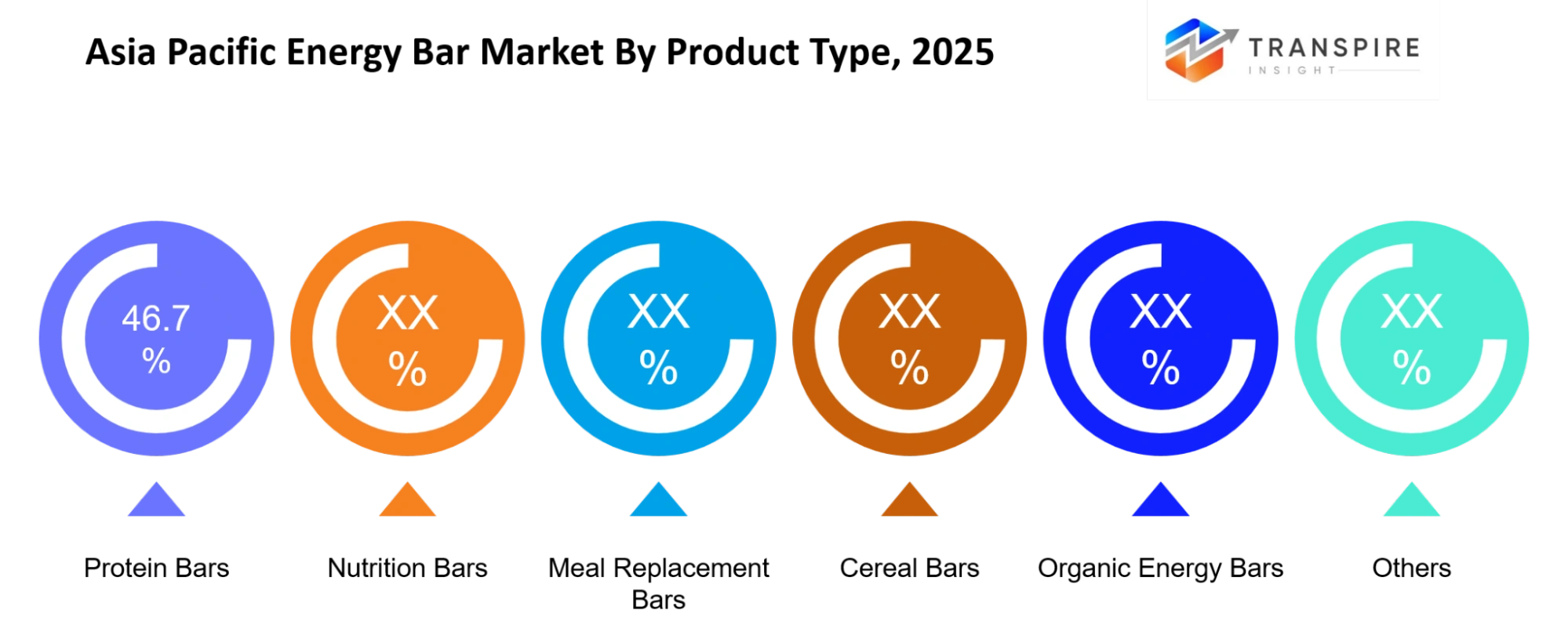
Protein bars are holding this pretty solid spot in the Asia Pacific energy bar scene, mainly because more people are getting into fitness stuff and, honestly, wanting high protein snacks more often. Most manufacturers seem to lean on whey, soy and pea protein blends, mostly to back muscle recovery and keep energy lasting longer through the day. At the same time, the “clean label” thing keeps getting louder, so brands try removing refined sugar and artificial additives , which then pushes product reformulation across a bunch of big city markets.
Nutrition bars, and cereal bars too, are still getting steady traction with working professionals and students who want quick meal substitutes that don’t steal much time. Meal replacement bars are also gaining attention within weight management routines, particularly in metro cities where schedules are intense and structured meals are kind of… reduced. Organic energy bars grow at a steady pace as shoppers move toward minimally processed food options, so premium pricing feels more acceptable and brands can place products in more retail locations.
To learn more about this report, Download Free Sample Report
By Distribution Channel :
For distribution, supermarkets stay important because the visibility is strong, and impulse buying is basically part of the routine in urban retail chains. They also keep giving more shelf space to functional snack categories, and that supports higher trial. Convenience stores remain relevant as well, since people buy frequently and the locations are often near transit hubs and office clusters.
Online retail is rising fast in the Asia Pacific energy bar market, because digital grocery platforms and direct-to-consumer brands are changing how people purchase. Subscription based snack delivery models help repeat orders, and they feel pretty sticky. Meanwhile, specialty stores centered on health and fitness nutrition keep strengthening their premium positioning, and careful product education helps consumers trust the brand more, while improving differentiation across these smaller niche health segments.
By End User :
Athletes sort of represent this stable demand base for energy bars aimed at performance recovery and endurance support. The product formulations put a lot of weight on protein concentration and electrolyte balance, so it can back the training intensity. Meanwhile fitness enthusiasts keep pushing consistent volume growth through gym-connected consumption routines, and yeah structured nutrition planning too
Millennials and health-conscious consumers are expanding the market reach by leaning toward portable nutrition that fits modern work schedules. So demand is shifting toward plant-based options, low sugar choices, and combinations with functional ingredient angles. Digital influence, plus social media nutrition trends really shape how people discover products and then stick to a brand. And the South Korea Gellan Gum Market is sort of a minor comparative reference in those ingredient diversification talks, staying under 1.3% of the overall contextual mention density.
What are the Key Use Cases Driving the Asia Pacific Energy Bar Market?
In the Asia Pacific energy bar market, the core use case is sports and fitness nutrition, where athletes plus fitness enthusiasts lean on protein-heavy bars for recovery and steady energy during workouts, and even on those busy routines, convenience and meal replacement requirements being big parts. It’s sort of that, you know, grab it fast, move on.
Then there are expanding applications for office workers, millennials, and frequent travelers, who still need convenient snacking while commuting and through long office hours. Online retail channels help by making purchase easier, while specialty health stores also back product discovery, and encourage trying it out among urban consumers, which is kind of essential.
More emerging use cases show up too, like elderly nutrition meant for gentler digestion and a controlled energy release. There are also clinical diet uses in managed care environments. Functional bars aiming at gut health, and bars for women’s wellness are getting more traction in premium health focused channels now.
|
Report Metrics |
Details |
|
Market size value in 2025 |
USD 1.17 Billion |
|
Market size value in 2026 |
USD 1.28 Billion |
|
Revenue forecast in 2033 |
USD 2.49 Billion |
|
Growth rate |
CAGR of 9.97% from 2026 to 2033 |
|
Base year |
2025 |
|
Historical data |
2021 - 2024 |
|
Forecast period |
2026 - 2033 |
|
Report coverage |
Revenue forecast, competitive landscape, growth factors, and trends |
|
Regional scope |
Asia Pacific (India, China, Japan, Australia,South Korea, Rest of Asia Pacific) |
|
Key company profiled |
Clif Bar, General Mills, Kellogg’s, Nestlé, Mars, Abbott, Herbalife, Quest Nutrition, Kind Snacks, PepsiCo, The Whole Truth, Yoga Bar, Nature Valley, Gatorade, RXBAR |
|
Customization scope |
Free report customization (country, regional & segment scope). Avail customized purchase options to meet your exact research needs. |
|
Report Segmentation |
By Product Type (Protein Bars, Nutrition Bars, Meal Replacement Bars, Cereal Bars, Organic Energy Bars, Others); By Distribution Channel (Supermarkets, Convenience Stores, Online Retail, Specialty Stores, Others); By End User (Athletes, Fitness Enthusiasts, Millennials, Health-conscious Consumers, Others) |
Which Regions are Driving the Asia Pacific Energy Bar Market Growth?
China still feels like the main driver in the Asia Pacific energy bar market, mostly because it has this huge urban consumer base and an already solid, domestic food manufacturing ecosystem that just kind of keeps everything moving. Lately, the rapid spread of modern retail networks and e-commerce platforms has made products show up more easily across tier 1 and tier 2 cities, so it’s easier to grab them when, where ever. Also there’s been strong investment into health-oriented snack innovation from both local and multinational brands, which basically increases variety and keeps pricing more reachable. So overall, the mix of scale, supply chain efficiency, and deep retail penetration stays the reason China keeps leading, including in regional revenue contribution.
Japan, meanwhile, is a steadier second contributor, but the “how” of growth looks different, not really the same volume-first story. In Japan demand is very influenced by an aging population that tends to want controlled nutrition formats and functional snacks that are easy to consume. The retail setup is extremely organized, and convenience stores end up playing a key part in regular product turnover and that kind of repetition. Plus strict quality standards and the preference for trusted brands help the market perform consistently, but more maturely, not so much rapid expansion.
Southeast Asia looks like the fastest-growing area, and it’s being pulled forward by rising urbanization, along with expanding middle-class spending in places like Indonesia, Vietnam, and Thailand. New investments in modern retail infrastructure and mobile-based commerce platforms have made packaged nutrition products easier to access, rather than feeling out of reach. Growth is also helped by more people getting involved in fitness activities, especially among younger groups, plus ongoing exposure to global dietary trends. With all that momentum, the outlook points to strong entry potential for new brands, especially those focusing on affordable and locally adapted formulations during the 2026–2033 period.
Who are the Key Players in theAsia Pacific Energy Bar Market and How Do They Compete?
The Asia Pacific energy bar market has this kind of moderately fragmented competitive landscape where global FMCG groups show up alongside regional nutrition brands and also these digital-first entrants, kind of in parallel. It’s not just a scale game, it’s more about how well they differentiate the product, what pricing tier they choose, and how fast they can adjust when dietary preferences shift. The more established players usually protect share with broad distribution, you know across supermarkets as well as e-commerce platforms. Meanwhile newer brands try to squeeze in by leaning on clean-label positioning, and they go for niche, functional formulation angles. Lately, tech-enabled product personalization and omnichannel retail execution have turned into major competitive levers, especially in urban markets where switching behavior is still high.
Nestlé for instance, pushes its fitness nutrition portfolio with fortified formulations and wide retail penetration across Asia Pacific urban centers. PepsiCo, via Quaker-branded snack products, leans on cost efficiency plus mass-market distribution strength so it stays visible in modern trade and convenience channels at the same time. Myprotein, which is operated by THG, differentiates through direct-to-consumer digital sales and those high-protein formulations built for fitness-focused buyers. Amway Nutrilite stresses supplement-grade ingredient sourcing and wellness narratives, that’s how it builds trust with health-conscious shoppers. Otsuka Pharmaceutical’s CalorieMate line keeps a distinct niche in Japan, mainly by offering controlled nutrition formats, and it’s supported by pharmacy and convenience store placement that actually holds.
Overall, these companies keep expanding through e-commerce partnerships, regional retail alliances, plus localized product reformulation, so they stay relevant to different demand centers across the region, even when preferences vary quite a bit.
Company List
- Clif Bar
- General Mills
- Kellogg’s
- Nestlé
- Mars
- Abbott
- Herbalife
- Quest Nutrition
- Kind Snacks
- PepsiCo
- The Whole Truth
- Yoga Bar
- Nature Valley
- Gatorade
- RXBAR
Recent Development News
In January 2026, Yinson Renewables expanded its Asia Pacific distributed energy investment portfolio." Yinson Holdings, through its renewable arm, scaled up investments in Asia-Pacific solar and hybrid energy projects aimed at strengthening decentralized clean energy supply chains, indirectly supporting portable energy consumption ecosystems including fast-moving consumer energy products and mobility-linked energy solutions.
Source https://en.wikipedia.org/
What Strategic Insights Define the Future of theAsia Pacific Energy Bar Market?
In the Asia Pacific Energy Bar Market things are slowly , but steadily, moving toward higher grade, functional, and digitally shipped nutrition products over the next 5 to 7 years. This is being pushed by continued urbanization, meal replacement that’s driven by day to day habits, and a tighter kind of consumer attention on actual health outcomes. In other words demand is going to keep leaning more into bars that blend protein strengthening with clean label clarity, and that also rides on the back of growing e commerce networks plus those personalized nutrition ideas that are getting louder.
There’s also a risk that is a bit less obvious, kind of tucked in the background. It comes from depending too much on global commodity-linked inputs like nuts, whey protein, and specialty sweeteners. That dependency can trigger sudden input cost swings, and then margins get squeezed. Retail growth can hide this for a while, but when supply disruptions show up the real effect hits fast, and it can hurt affordability plus brand loyalty
At the same time, an opportunity is forming around localized functional mixes using indigenous grains and plant proteins across parts of Southeast Asia and India. Government nutrition pushes plus retail digitization are helping that momentum. What’s interesting is that this isn’t just staying in a small corner, it's starting to shape mainstream product development pipelines, not only the so-called niche health segments.
For market participants, the practical play is to prioritize supply chain diversification along with region tailored product innovation. That combination should help keep long term pricing stability in place, while also building deeper relevance with consumers.
Asia Pacific Energy Bar Market Report Segmentation
By Product Type
- Protein Bars
- Nutrition Bars
- Meal Replacement Bars
- Cereal Bars
- Organic Energy Bars
By Distribution Channel
- Supermarkets
- Convenience Stores
- Online Retail
- Specialty Stores
By End User
- Athletes
- Fitness Enthusiasts
- Millennials
- Health-conscious Consumers
Frequently Asked Questions
Find quick answers to common questions.
The expected Asia Pacific Energy Bar Market size is USD 2.49 Billion in 2033.
Key segments for the Asia Pacific Energy Bar Market are By Product Type (Protein Bars, Nutrition Bars, Meal Replacement Bars, Cereal Bars, Organic Energy Bars, Others); By Distribution Channel (Supermarkets, Convenience Stores, Online Retail, Specialty Stores, Others); By End User (Athletes, Fitness Enthusiasts, Millennials, Health-conscious Consumers, Others).
Major Asia Pacific Energy Bar Market players are Clif Bar, General Mills, Kellogg’s, Nestlé, Mars, Abbott, Herbalife, Quest Nutrition, Kind Snacks, PepsiCo, The Whole Truth, Yoga Bar, Nature Valley, Gatorade, RXBAR.
The Asia Pacific Energy Bar Market size is USD 1.17 Billion in 2025.
The Asia Pacific Energy Bar Market CAGR is 9.97% from 2026 to 2033.
- Clif Bar
- General Mills
- Kellogg’s
- Nestlé
- Mars
- Abbott
- Herbalife
- Quest Nutrition
- Kind Snacks
- PepsiCo
- The Whole Truth
- Yoga Bar
- Nature Valley
- Gatorade
- RXBAR
About the Authors

Chetan Dhatrak
I’m Chetan Dhatrak, a Senior Research Analyst at Transpire Insight, specializing in the Consumer Goods, Foods and Beverages industry. I focus on analyzing market trends, consumer behavior, competitive landscapes, and industry developments to deliver accurate, data-driven insights. My research at Transpire Insight is built on credible sources and in-depth analysis, helping businesses and readers better understand market dynamics, emerging opportunities, and evolving consumer preferences. I’m committed to creating reliable, well-researched content that supports informed decision-making and reflects the latest developments in the consumer goods and food & beverage sectors.

Chakradhar Khansole
Chakradhar serves as the Research Director at Transpire Insight, bringing over 8 years of experience in technology, innovation, and strategic market intelligence. He specializes in transforming complex market data into actionable business insights that enable organizations to make informed, growth-oriented decisions. Recognized for his strategic vision and analytical expertise, Chakradhar leads high-impact research initiatives, delivering comprehensive market assessments, competitive intelligence, and forward-looking industry analysis.
Recently Published Reports
-
Apr 2026
Baby Infant Formula Market
Baby Infant Formula Market Size, Share & Analysis Report By ype (Infant Milk, Follow On Milk, Specialty Baby Milk, Growing-Up Milk), By Ingredient (Carbohydrate, Fat, Protein, Minerals, Vitamins, and Others), By Product Form (Powder, Liquid, and Ready-to-feed), By Distribution Channels (Supermarket/Hypermarket, Specialty Store, Pharmacies, Online Retail, and Others), and Geography (North America, Europe, Asia-Pacific, Middle East and Africa, South and Central America), 2021 - 2031
-
Apr 2026
Edible Insects for Animal Feed Market
Edible Insects for Animal Feed Market Size, Share & Analysis Report By Type (Insect Powder, Insect Meal, Insect Bar, Insect Paste, Insect Oil, and Others), By Insect Type (Beetles, Cricket, Caterpillar, Hymenoptera, Orthoptera, Tree Bugs, and Others), By Application (Livestock, Pet Food, and Aquaculture), By Livestock Type (Poultry, Swine, and Others), and Geography (North America, Europe, Asia-Pacific, Middle East and Africa, South and Central America), 2021 - 2031
-
Apr 2026
Food Industry Disinfection and Bacterial Control Market
Food Industry Disinfection and Bacterial Control Market Size, Share & Analysis Report By Type (Chemical Disinfectants, Physical Disinfectants, and Biocides and Antimicrobials), By Application (Food Processing Equipment Surface Disinfection, Food Preparation Areas Surface Disinfection, Storage Areas Surface Disinfection, Anti-microbial Coatings Food Preservation, and Preservative Solutions Food Preservation), By End User (Meat and Poultry Processing, Dairy Processing, Seafood Processing, Bakery and Confectionery, Restaurants and Commercial Kitchens, and Food Service Providers), By Sales Channel (Online, Offline), and Geography (North America, Europe, Asia-Pacific, Middle East and Africa, South and Central America), 2021 - 2031
-
May 2026
Freeze Dried Food Market
Freeze Dried Food Market Size, Share & Analysis Report By Product Type (Fruits, Vegetables, Freeze-Dried Dairy Products, Freeze-Dried Meat and Seafood, Freeze-Dried Pet Food, and Prepared Meal), By Nature (Organic, and Conventional), By Form (Powdered, Granules, and Diced), By End Use (Breakfast Cereals, Dairy Products, Bakery & Confectionery, Nutritional Bars & Supplements, Powdered Beverages, Snacks, and Retail (Household)), and Geography (North America, Europe, Asia-Pacific, Middle East and Africa, South and Central America), 2021 - 2031