
Asia Pacific Electronic Skin Market Size & Forecast:
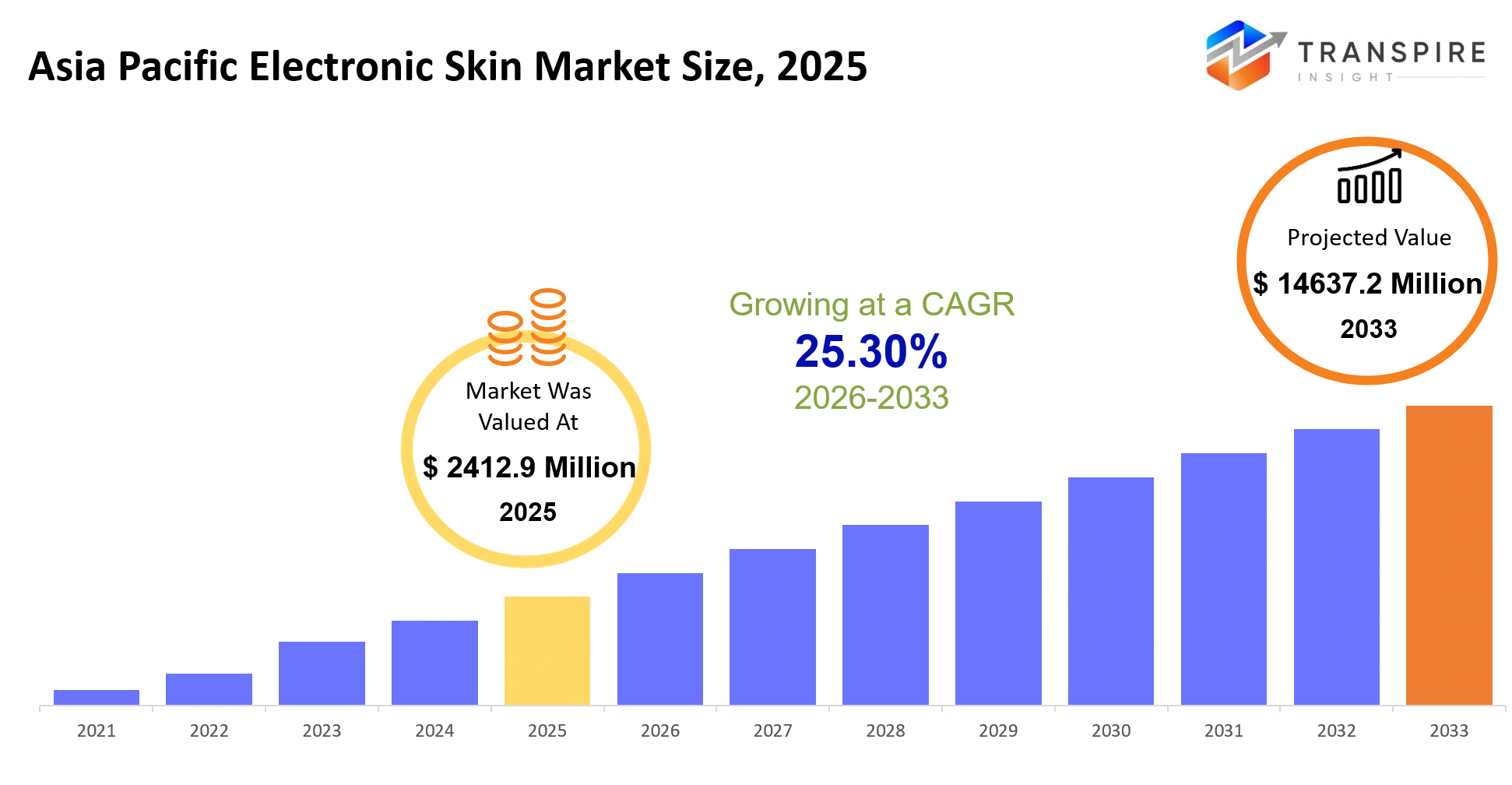
- Asia Pacific Electronic Skin Market Size 2025: USD 2412.9 Million
- Asia Pacific Electronic Skin Market Size 2033: USD 14637.2 Million
- Asia Pacific Electronic Skin Market CAGR: 25.30%
- Asia Pacific Electronic Skin Market Segments: By Component (Stretchable Circuits, Sensors, Conductive Inks, Flexible Batteries, Wearable Patches, Others); By Application (Healthcare Monitoring, Prosthetics, Robotics, Sports Monitoring, Consumer Electronics, Others); By Technology (Printed Electronics, Nanotechnology, Flexible Electronics, Bioelectronics, Others); By End User (Healthcare Providers, Research Institutes, Robotics Industry, Consumers, Others).
To learn more about this report,  Download Free Sample Report
Asia Pacific Electronic Skin Market Summary
The Asia Pacific Electronic Skin Market was valued at USD 2412.9 Million in 2025. It is forecast to reach USD 14637.2 Million by 2033. That is a CAGR of 25.30% over the period.
The Asia Pacific Electronic Skin Market kinda tackles a pretty practical challenge across healthcare, robotics, and advanced manufacturing too—basically helping machines, prosthetics, and wearable gadgets sense pressure, temperature, motion, and that kind of touch in a way that looks a lot like human skin. With this, patient monitoring gets better, human machine interaction stays safer and smoother, and industrial automation can get more precise.
In the last five years , the whole thing has moved from mostly research driven development to actual commercial rollout. You now see flexible, stretchable sensor platforms getting paired with AI based analytics and wireless connectivity. A big push was the COVID 19 pandemic, it sped up spending on remote health monitoring tools and it made clear the need for continuous real-time physiological information collection outside typical clinic walls.
Right now, growth is coming from the overlap of flexible electronics, newer advanced materials, and smarter sensing systems. As sensor performance keeps improving and the production costs start lowering, electronic skin is gradually moving into more medical uses, more robotics use cases, and even consumer scenarios. That, in turn, creates additional revenue paths and helps adoption at a larger scale across the region’s tech ecosystem.
Key Market Insights
- China is pretty much running the Asia Pacific Electronic Skin Market, with an estimated 35–40% slice in 2025 , mainly because of its strong electronics manufacturing abilities.
- At the same time, those government backed innovation initiatives across Asia Pacific keeps pushing commercialization forward for next generation electronic skin techs, even if the pace feels uneven in different places.
- Stretchable electronic skin sensors seem to be leading everything, they’re around 45% of total industry revenue in 2025.
- After that, pressure sensing electronic skin is still the second biggest part, largely due to how often it shows up in healthcare monitoring , and also in prosthetics.
- And the multi functional electronic skin platforms, those are the fastest growing segment through 2030, because they pull together pressure sensing, temperature sensing, and motion sensing , all in one setup, which is kind of the whole point.
- Flexible nano material sensor technologies keep gaining market share, even if the improvements are small—performance and durability go up, you know.
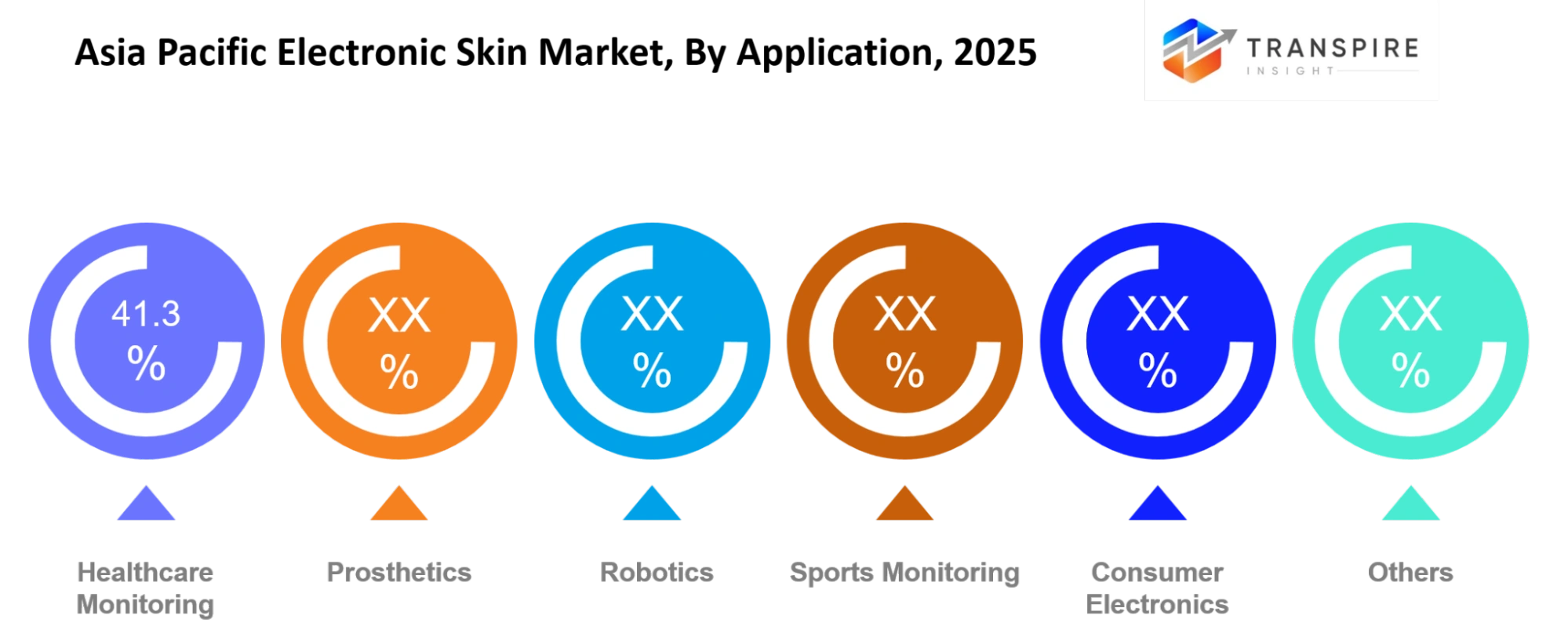
- In the healthcare space things are leading most of all, in fact nearly 40% of the Asia Pacific Electronic Skin Market revenue in 2025 is coming from medical uses.
- Wearable patient monitoring systems also stay a big thing for adoption, not only across hospitals, but also for home-care environments.
- Robotics looks like the fastest growing application segment, and it’s backed by investments in collaborative robots, plus intelligent automation too.
- Prosthetics and rehabilitation devices are starting to show up as high value application categories in a number of developed Asian economies.
What are the Key Drivers, Restraints, and Opportunities in the Asia Pacific Electronic Skin Market?
The main force pushing the Asia Pacific Electronic Skin Market, is basically the meeting point of flexible electronics, improved nanomaterials, and digital healthcare infrastructure, kinda all at once. Lately, upgrades in graphene, conductive polymers, and stretchable sensor methods have made sensing more precise and at the same time brought down production costs. That kind of shift lets companies actually roll out electronic skin for wearable health monitors, prosthetic devices, plus robotic systems. And since clinicians are moving toward continuous body signal tracking, electronic skin solutions end up opening fresh revenue sources for device makers, while also helping the market get deeper into both medical and industrial use cases.
Still, the biggest brake is the sheer complexity plus the expense of producing at a large scale. Electronic skin systems depend on higher-grade materials, careful fabrication processes, and very strict quality checks. The problems are kind of structural because the production ecosystem, the supplier web, and the manufacturing know-how do not show up quickly or easily. So, commercialization tends to take longer compared with older, more conventional sensors, which then hurts affordability and slows down adoption in settings where budgets are tight, like some healthcare institutions and many industrial buyers. In other words, even with strong technological promise, the market often sees delayed revenue timing.
A big future opportunity kind of sits in the middle of integrating electronic skin with AI-powered robotics, and also with next-generation human-machine interfaces. Like, Countries such as Japan and South Korea are increasing investments in service robots, rehabilitation technologies and intelligent manufacturing systems, at a noticeable pace. Electronic skin that comes with multi-modal sensing abilities can give real-time tactile feedback and that helps robots interact with people in a safer way, plus more accurate motions too. Since robotics deployment keeps expanding across healthcare , logistics, and manufacturing, this kind of merging should unlock a fresh commercial growth phase and it will likely widen the addressable market for advanced electronic skin solutions quite a bit.
What Has the Impact of Artificial Intelligence Been on the Asia Pacific Electronic Skin Market?
Artificial intelligence and more advanced digital technologies are really boosting the capabilities and commercial meaning of the Asia Pacific electronic skin market. AI enabled electronic skin systems are now often able to handle big streams of sensor information in real time, so wearable devices, robotic platforms, and prosthetic systems can automatically make sense of pressure, temperature, movement, and touch like signals, without needing someone to stand by all the time. In healthcare, smarter sensor networks can continuously track physiological signals and then notify clinicians when unusual behavior shows up, so patient management gets smoother and the amount of manual monitoring drops.
At the same time, machine learning models are pushing electronic skin technologies toward stronger forecasting. By looking at past sensor readings along with live outputs, these models can predict how the device will perform, catch early signs of sensor wear down, and adjust or tune calibration schedules before a failure happens. For robotics, predictive algorithms support better object recognition and more precise tactile response. This, in turn, helps make human machine interaction safer, and also lowers the chances of frequent stoppages, less downtime overall. Together, these trends lead to higher system dependability, reduced upkeep costs, and steadier performance in both medical and industrial settings.
Still, there is a main snag left in place: finding enough high-quality training data gathered across a wide range of everyday conditions. Electronic skin systems can run in many different places, across different people, and in different jobs, which makes it hard to build AI models that stay accurate every time. This data issue keeps slowing down big deployments, and it makes integration feel more complicated for manufacturers, and also for the end users.
Key Market Trends
- Since 2020, manufacturers have kinda drifted away from single-function pressure sensors toward more multifunctional electronic skin, that can measure temperature, motion and touch all at once, in one surface i guess.
- After the pandemic, healthcare organizations started adopting continuous physiological monitoring a bit more, because remote patient management and connected medical devices gained momentum.
- From 2021 to 2025, AI integration went from small pilot experiments to commercial offerings, which let systems do real time signal interpretation, plus predictive performance analytics, faster than before maybe.
- Chinese electronics manufacturers have pushed harder into flexible semiconductor and sensor production, and that strengthens local supply chains, while also cutting down import dependence.
- In Japan and South Korea, robotics developers increasingly built in tactile sensing systems to make collaborative human-robot work safer.
- Also, research partnerships between universities and companies have become more usual after 2022, and that seems to speed up commercialization timelines for electronic skin platforms based on advanced nanomaterials.
- Buyers are leaning toward wireless and cloud-connected sensing systems now, which basically shows a wider turn toward data-driven healthcare along with industrial automation ecosystems.
- On the materials side, progress has moved from conventional conductive films to graphene and nanocomposite structures, those improve durability, flexibility, and sensing accuracy.
- Competition has shifted as well , not just products but ecosystems too, with companies like Samsung Electronics and LG Electronics pursuing collaborations spanning healthcare, robotics, and wearable technology.
- Since 2023, manufacturers have been focusing more intensely on energy-efficient sensor architectures, so battery life lasts longer and long duration monitoring applications can run.
Asia Pacific Electronic Skin Market Segmentation
By Component :
Stretchable circuits are basically the base layer for a lot of electronic skin systems , because these circuits can bend and stretch and sorta adapt to whatever surface they meet without completely losing function. At the same time , sensors are the main part for detecting pressure, temperature , motion and touch , so the electronic skin can gather useful info in real time. Over the years , upgrades in sensor exactness have pushed electronic skin deeper into healthcare , robotics and wearable tech uses, which is kind of a big deal for practical deployment.
Conductive inks help with making flexible, light electronic bits because they let the circuit paths get printed onto different substrates. Then you have flexible batteries , they bring portable power, but still can bend and fit different forms. Wearable patches are commonly used for tracking and monitoring health, since they tend to be comfortable and easy to use. Beyond that , other elements like communication modules and protective materials support device performance , durability, and even better connectivity across different working conditions, kind of keeping everything steady.
By Application :
Healthcare monitoring is a big application space since electronic skin can continuously observe vital signs , body temperature, and physical activity without much fuss. In practice, doctors and healthcare facilities lean on these systems for patient monitoring both inside, and outside clinics, depending on the situation. Adoption keeps growing too as healthcare keeps shifting toward connected, and more data driven care models.
Prosthetics also gain a lot from electronic skin because it delivers sensory feedback, and that kind of input helps improve functionality and the everyday user experience. On the robotics side, tactile sensing lets machines manage safer contact with objects and also with people. In sports, electronic skin style solutions back performance tracking and injury prevention using near real time data capture. For consumer tech, electronics makers are increasingly folding these materials or related techniques into wearable devices, though other uses are still showing up across industrial setups, or in more specialized scenarios.
To learn more about this report, Download Free Sample Report
By Technology :
Printed electronics technology kind of helps with cost-effective making of electronic skin because circuits and sensors can be printed right on flexible substrates . This way it feels easier to do bigger manufacturing runs while also cutting down material waste , and honestly the whole production complexity becomes less of a pain. And as the methods keep improving, printed electronics keeps getting a stronger foothold for commercial use across several industries , not just one.
Nanotechnology adds extra sensitivity , durability , and overall performance since it uses advanced materials but at a microscopic level. Flexible electronics then means the device can keep working even when it’s bending or stretching during use, like it doesn’t just “give up” as soon as you move. Bioelectronics link biological systems with electronic components , which opens the door for better healthcare options and more continuous monitoring. Plus other technologies help the innovation keep going by boosting energy efficiency , connectivity, and general reliability of the device , overall.
By End User :
Healthcare providers are a pretty big end-user set , because electronic skin can help with patient observation, remote tracking, and rehabilitation programs in a more steady way. Hospitals , clinics, and medical centers keep looking at better sensing technologies that may improve patient care delivery and also the daily efficiency in operations. As these tools keep syncing with digital health systems , the adoption in this segment keeps getting stronger
Research institutes also matter , since they work on new materials sensing approaches, and device structures that push commercial use forward. On top of that , the robotics industry is using electronic skin to raise machine awareness and interaction abilities, especially across industrial and service spaces. At the same time consumers are adopting wearable devices that include electronic skin functions for health follow-up and daily activity tracking. There are also other end users , like specialized industrial organizations and technology developers, who are checking out new business chances across the Asia Pacific Electronic Skin Market.
What are the Key Use Cases Driving the Asia Pacific Electronic Skin Market?
Healthcare monitoring is one of the key application areas fueling the growth of the Asia Pacific Electronic Skin Market. Clinics, hospitals and telemedicine solution providers are using electronic skin sensors to measure and monitor the vital signs, body movement and physical status of the patients and their responses for the constant assessment. This application has the highest demand because healthcare facilities are looking for better ways to assess the patients at home and non-clinical locations in a constant manner.
Robotics and prosthetics are also the important emerging applications. Robotics firms are using tactile sensing to enhance the safety and accuracy of robots in industrial automation tasks. Prosthetics developers have started utilizing electronic skin in the development of prosthetics to provide sensory feedback. The newer applications of this technology have come to the fore in the form of smart rehabilitation systems and new kinds of human-machine interfaces.
R&D centers and technology developers are in the process of designing electronic skin to provide support for neurological rehabilitation, virtual reality systems, as well as smart wearables. With increase in the sensors performance and decrease in the integration cost, it is anticipated that new commercial opportunities will evolve during the forecast period.
|
Report Metrics |
Details |
|
Market size value in 2025 |
USD 2412.9 Million |
|
Market size value in 2026 |
USD 3018.6 Million |
|
Revenue forecast in 2033 |
USD 14637.2 Million |
|
Growth rate |
CAGR of 25.30% from 2026 to 2033 |
|
Base year |
2025 |
|
Historical data |
2021 - 2024 |
|
Forecast period |
2026 - 2033 |
|
Report coverage |
Revenue forecast, competitive landscape, growth factors, and trends |
|
Regional scope |
Asia Pacific (India, China, Japan, Australia, South Korea, Rest of Asia Pacific) |
|
Key company profiled |
MC10, Xenoma, VivaLNK, Panasonic, Samsung Electronics, LG Electronics, Philips, DuPont, 3M, ABB, Siemens, Medtronic, GE Healthcare, Flex, Molex. |
|
Customization scope |
Free report customization (country, regional & segment scope). Avail customized purchase options to meet your exact research needs. |
|
Report Segmentation |
By Component (Stretchable Circuits, Sensors, Conductive Inks, Flexible Batteries, Wearable Patches, Others); By Application (Healthcare Monitoring, Prosthetics, Robotics, Sports Monitoring, Consumer Electronics, Others); By Technology (Printed Electronics, Nanotechnology, Flexible Electronics, Bioelectronics, Others); By End User (Healthcare Providers, Research Institutes, Robotics Industry, Consumers, Others). |
Which Regions are Driving the Asia Pacific Electronic Skin Market Growth?
East Asia is the largest region in the Asia Pacific Electronic Skin Market and is dominated by China, Japan, and South Korea. A well-established electronics manufacturing industry and semiconductor capabilities have helped drive large-scale investment in research into flexible materials over the years. The large number of government-backed innovation initiatives and commercialization support programs that were put in place over the years have helped in quickly translating electronic skin technologies out of lab environments and into relevant healthcare and robotic applications. The rich ecosystem of component suppliers, research institutes, technology companies, and device makers in East Asia will continue to be the reason for regional leadership.
Japan is the second-largest region, although the growth dynamics of the region as compared to the East Asian market overall are somewhat different. Instead of economies of scale in manufacturing, Japan's second largest region position benefits from constant investment into robotics, medical equipment and precision engineering. Well-established partnerships between industry, healthcare organizations and research institutes help support steady adoption of advanced sensor technologies. Steady innovation support makes Japan a steady source of revenue in the market regardless of somewhat slower expansion. India is the fastest-growing market in the region due to the increased digitization of healthcare and the increasing volume of medical equipment manufactured.
Additionally, higher investment into wearable technologies has also pushed the growth of the Indian market and given electronic skin devices improved commercialization potential with the advent of government support policies aimed at promoting domestic electronics manufacturing and modernization of healthcare facilities. Increasing adoption of remote patient monitoring solutions, coupled with smart healthcare platforms, is creating new application opportunities for electronic skin devices. Technology developers, manufacturing partners, and investors will have the opportunity to capture high-growth application opportunities from 2026 through 2033.
Who are the Key Players in the Asia Pacific Electronic Skin Market and How Do They Compete?
The electronic skin market in the Asia Pacific is moderately fragmented as technology providers, leading electronics manufacturers, and specialty materials companies compete with each other across various application areas. It is estimated that technology innovation will be the core competitive basis of the electronic skin market due to performance, flexibility, sensitivity, and robustness which drives market acceptance. Major electronics firms compete on scale and research strengths whereas innovative start-ups will compete on differentiated sensing capabilities and materials. However, as commercial applications mature, patents, industry expertise, and integration will become major competitive advantages.
Samsung Electronics utilizes high performance flexible electronics technologies, wearability components and sensor integration to achieve competitive advantage by leveraging expertise and capabilities in semiconductor technology as well as scaled up mass production in order to quick commercialization of newly developed technologies. Research collaborations and investment toward leading edge medical applications and wearables are strengthening its competitive position in this market. LG Electronics achieves competitive advantage in the applications of integrating sensing systems and consumer electronics due to strength in flexible display technology and connected devices.
Sony Corporation employs advanced imaging, sensor technology and miniaturization capabilities to build its strength in electronic skin solutions, which enables development of miniaturized sensing system with high responsiveness in applications of medical care, industry, and etc.Panasonic Holdings focuses on strengthening its position in the industry by emphasizing advanced materials, energy technology, and healthcare solution, to support reliability for long-term application. Huawei Technologies are leveraging its capability in digital healthcare and connecting technology, also by applying the advanced sensing technique and intelligent control, to get a large advantage in terms of electronic skin system which integrates into a broad smart health and smart devices solution.
Company List
- MC10
- Xenoma
- VivaLNK
- Panasonic
- Samsung Electronics
- LG Electronics
- Philips
- DuPont
- 3M
- ABB
- Siemens
- Medtronic
- GE Healthcare
- Flex
- Molex
Recent Development News
In January 2026, Amorepacific launched and unveiled its Skinsight™ electronic skin platform at CES 2026. The MIT co-developed wearable e-skin platform combines an ultra-thin sensor patch, Bluetooth module, and AI application to analyze real-time skin-aging signals, strengthening commercialization of electronic skin technologies in the Asia-Pacific beauty-tech sector.
Source: https://stories.amorepacific.com
What Strategic Insights Define the Future of the Asia Pacific Electronic Skin Market?
The Asia Pacific Electronic Skin Market is heading toward an era of integrated sensing systems in which value will no longer solely reside in the sensor hardware, but in a combination of artificial intelligence, novel materials, wireless connectivity and real-time analytics. Applications that demand on-going human-machine interaction are expected to grow fastest in the next 5-7 years, most notably the healthcare, rehabilitation, and intelligent robotic fields, due to their demands for systems that can accurately and intelligently interpret and react to physical input.
One lesser obvious risk is a market dependence on a relatively concentrated supply of advanced materials and unique semiconductor components. Reduced material availability or an export embargo could limit time to market and drive up costs, despite high end-user demand.
An emerging opportunity is biointegrated electronic skin used for neurological rehabilitation, and in the next generation of prosthetic limbs; especially with increased healthcare innovation initiatives in India and Southeast Asia. Industry participants should seek to create application-specific, difficult-to-replicate platforms by forming partnerships between materials suppliers, healthcare professionals, and AI developers, so as to realize sustained commercial success.
Asia Pacific Electronic Skin Market Report Segmentation
By Component
- Stretchable Circuits
- Sensors
- Conductive Inks
- Flexible Batteries
- Wearable Patches
By Application
- Healthcare Monitoring
- Prosthetics
- Robotics
- Sports Monitoring
- Consumer Electronics
By Technology
- Printed Electronics
- Nanotechnology
- Flexible Electronics
- Bioelectronics
By End User
- Healthcare Providers
- Research Institutes
- Robotics Industry
- Consumers
Frequently Asked Questions
Find quick answers to common questions.
The expected Asia Pacific Electronic Skin Market size is USD 14637.2 Million in 2033.
Key segments for the Asia Pacific Electronic Skin Market are By Component (Stretchable Circuits, Sensors, Conductive Inks, Flexible Batteries, Wearable Patches, Others); By Application (Healthcare Monitoring, Prosthetics, Robotics, Sports Monitoring, Consumer Electronics, Others); By Technology (Printed Electronics, Nanotechnology, Flexible Electronics, Bioelectronics, Others); By End User (Healthcare Providers, Research Institutes, Robotics Industry, Consumers, Others).
Major Asia Pacific Electronic Skin Market players are MC10, Xenoma, VivaLNK, Panasonic, Samsung Electronics, LG Electronics, Philips, DuPont, 3M, ABB, Siemens, Medtronic, GE Healthcare, Flex, Molex.
The Asia Pacific Electronic Skin Market size is USD 2412.9 Million in 2025.
The Asia Pacific Electronic Skin Market CAGR is 25.30% from 2026 to 2033.
- MC10
- Xenoma
- VivaLNK
- Panasonic
- Samsung Electronics
- LG Electronics
- Philips
- DuPont
- 3M
- ABB
- Siemens
- Medtronic
- GE Healthcare
- Flex
- Molex
About the Authors

Avinash Kumar
I’m Avinash Kumar, a Senior Research Analyst at Transpire Insight, with expertise in the Electronics and Semiconductor and Energy & Power industry. My work focuses on analyzing emerging technologies, market trends, industry developments, and innovation across these sectors. I specialize in transforming complex technical and market insights into clear, research-backed content that helps professionals, businesses, and decision-makers stay informed. Through continuous industry research and data-driven analysis, I strive to deliver accurate, reliable, and practical perspectives on the latest advancements shaping the semiconductor and energy landscape.

Chakradhar Khansole
Chakradhar serves as the Research Director at Transpire Insight, bringing over 8 years of experience in technology, innovation, and strategic market intelligence. He specializes in transforming complex market data into actionable business insights that enable organizations to make informed, growth-oriented decisions. Recognized for his strategic vision and analytical expertise, Chakradhar leads high-impact research initiatives, delivering comprehensive market assessments, competitive intelligence, and forward-looking industry analysis.
Recently Published Reports
-
Apr 2026
Fiber Optic Faceplates Market
Fiber Optic Faceplates Market Size, Share & Analysis Report By Type (< 300 mm2, 300-350 mm2, and > 350 mm2, By Application (Night Vision, Holographic Imaging, Medical, and Others), and Geography (North America, Europe, Asia-Pacific, Middle East and Africa, South and Central America), 2021 - 2031
-
Apr 2026
High Temperature Superconductors Market
High Temperature Superconductors Market Size, Share & Analysis Report By Type (1G HTS, and 2G HTS), By Application (Power Cable, Fault Current Limiter, and Transformer), and Geography (North America, Europe, Asia-Pacific, Middle East and Africa, South and Central America), 2021 - 2031
-
Apr 2026
Industrial Plugs and Socket Market
Industrial Plugs and Socket Market Size, Share & Analysis Report By Type (Industrial Plugs, Industrial Sockets), By Current (Up to 32 A, 32 to 125 A, Above 125 A), By Protection (Dustproof and Splash Proof, Waterproof, Explosion Proof), By End User (Heavy Industries, Oil and Gas, Chemicals and Pharmaceuticals, Power Generation, Others), and Geography (North America, Europe, Asia-Pacific, Middle East and Africa, South and Central America), 2021 - 2031
-
Apr 2026
InGaAs Avalanche Photodiodes Market
InGaAs Avalanche Photodiodes Market Size, Share & Analysis Report By Type (1100 - 1700 nm, and 1000 - 1600 nm), By Application (Missile Warning System, Muzzle Flash Detection, Wafer Defect Inspection, Laser Rangefinders, and Others), and Geography (North America, Europe, Asia-Pacific, Middle East and Africa, South and Central America), 2021 - 2031