

Asia Pacific Dental Loupe Market Summary
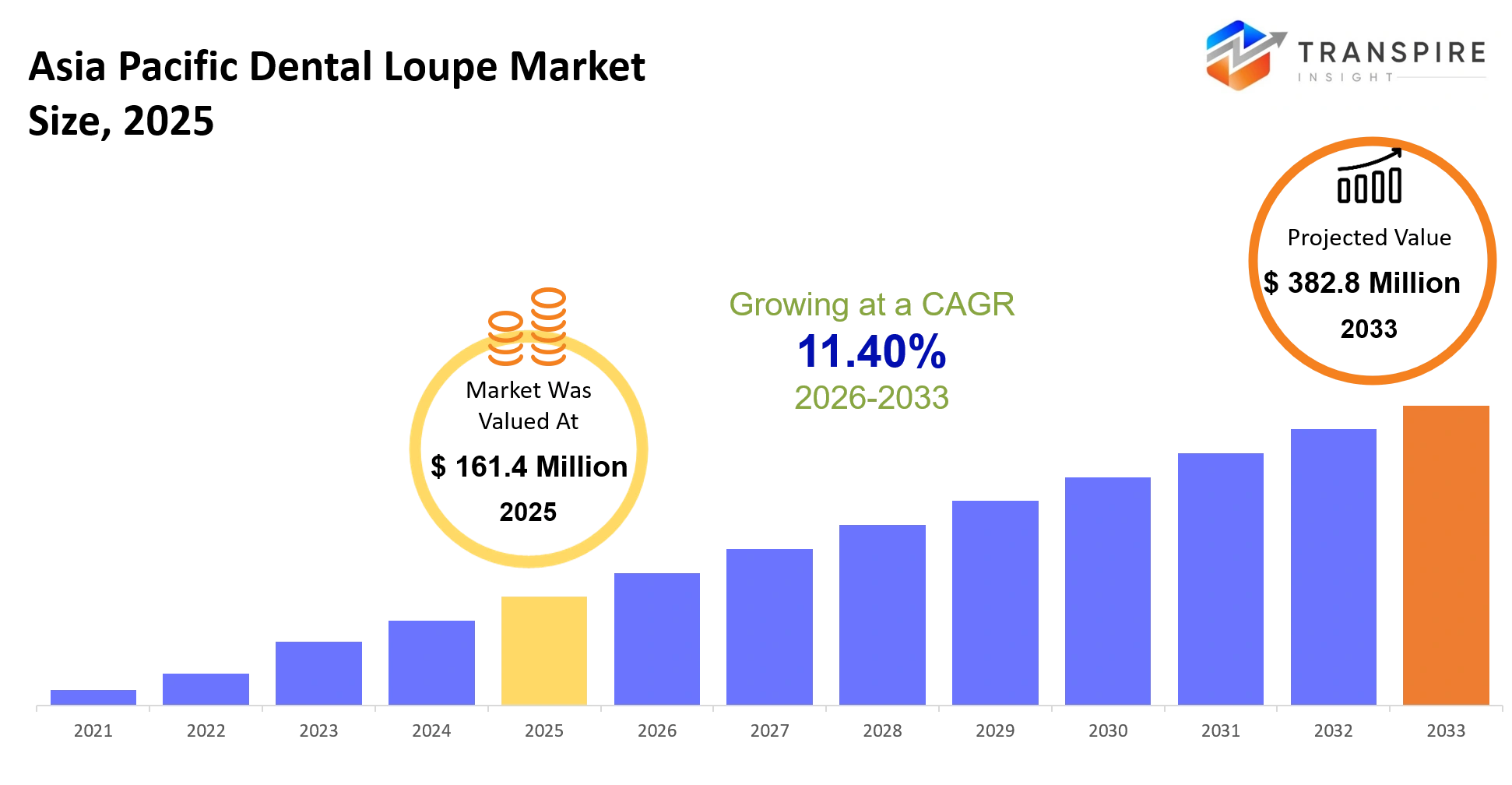
As per Transpire Insight Analysis the Asia Pacific Dental Loupe Market size is estimated at USD 161.4 Million in 2025 and is anticipated to reach USD 382.8 Million by 2033, growing at a CAGR of 11.40% from 2026 to 2033.
Dental loupes let clinicians do restorative, surgical, and diagnostic work with more visual precision, sort of, while also easing neck and back strain during those long sessions. In practice, they have turned into this vital productivity aid for modern dental setups , because they boost clinical accuracy, keep treatment results more consistent, and improve practitioner ergonomics. Over the last five years, the market seems to have moved away from older optical magnification styles toward lightweight ergonomic versions, often with integrated LED illumination and digital workflow compatibility. After the COVID-19 pandemic , the rebound in elective dental procedures happened quickly, and that pushed clinics into faster equipment replacement, since many of them wanted better visualization systems for improved efficiency and patient flow. That change has also nudged manufacturers to offer tuned magnification options, better optical quality, and more comfortable frames. With dental groups expanding across Asia Pacific and more advanced procedures becoming common , spending on premium visualization equipment keeps supporting market revenue, but also helps maintain higher clinical standards and, in the long run, sustained practitioner productivity.
Asia Pacific Dental Loupe Market Size & Forecast:
- Asia Pacific Dental Loupe Market Size 2025: USD 161.4 Million
- Expected Market Value 2033: USD 382.8 Million
- Forecast CAGR: 11.40%
- Leading region in 2025:
- Fastest Growing region:
- Key Profile: Carl Zeiss Meditec, Orascoptic, SurgiTel, Heine Optotechnik, Univet, Designs for Vision, Admetec, Keeler, Zumax Medical, DenMat, Leica Microsystems, PeriOptix, ExamVision, SheerVision, Rose Micro Solutions
Key Market Insights
- The Asia Pacific Dental Loupe Market is forecast to go past USD 382.8 million by 2033, and it kind of shows the strong pickup of ergonomic optical gear across dental clinics.
- East Asia stays in the lead, with an estimated about 42% market share in 2025, backed by more advanced dental infrastructure and a steady routine of replacing equipment, period.
- South Asia should see the quickest expansion over 2026–2033, mostly pushed by private dental clinic spending and a noticeable rise in specialist practices.
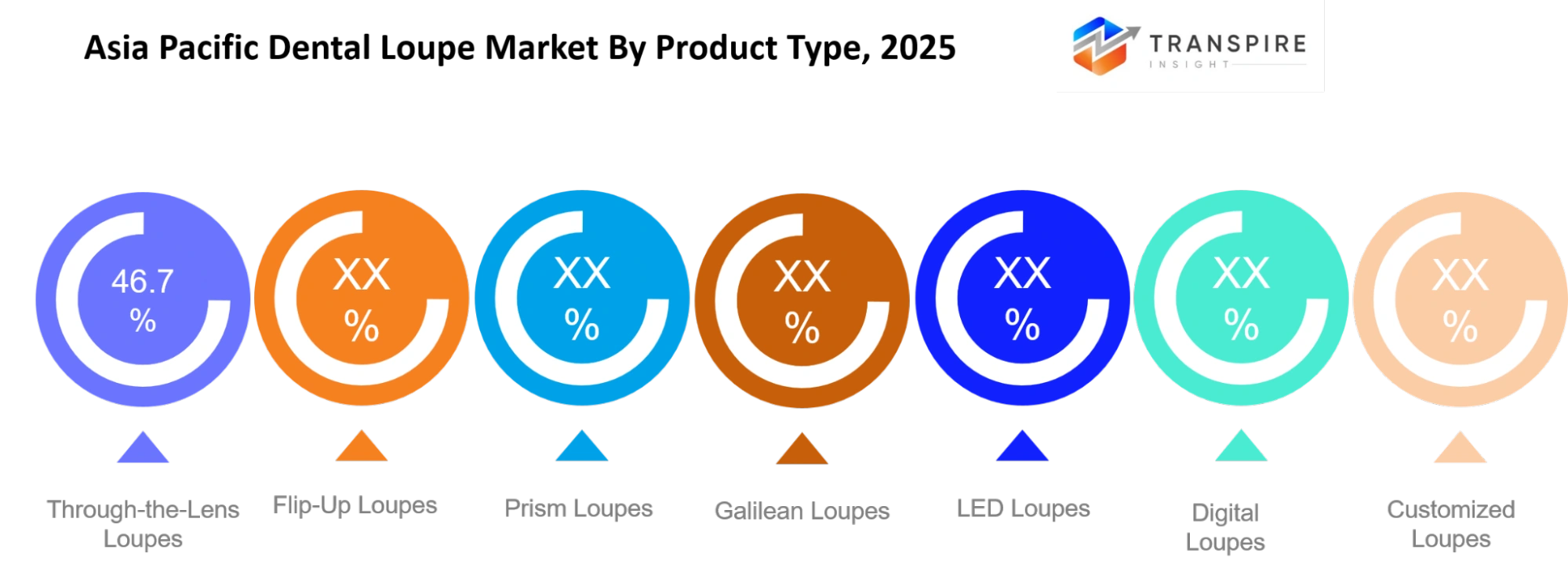
- In terms of products, Through-the-Lens, (TTL) loupes are currently leading the scene with roughly 48% market share , mainly because of better optical alignment and lightweight build quality.
- Digital dental loupes are also the fastest-moving product type heading toward 2033, supported by the spread of digital dentistry and imaging integration.
- General dentistry makes up nearly 46% of total applications, while implantology and microsurgical procedures keep picking up market share, slowly but surely.
- Dental clinics bring in around 68% of end-user revenue, while dental hospitals and academic institutions keep raising procurement budgets, somewhat consistently.
- Key manufacturers—Orascoptic, Designs for Vision, Carl Zeiss Meditec, HEINE Optotechnik, Univet, and SurgiTel—are concentrating on ergonomic innovation, lighter materials, and tailored optical solutions.
- Strategic tie-ups with dental education institutes as well as regional distributors have helped products get deeper penetration across the emerging Asia Pacific economies.
- Manufacturers are leaning harder into differentiation via adjustable magnification, built-in LED illumination, premium optics, and customized fitting services, which helps their competitive position.
What are the Key Drivers, Restraints, and Opportunities in the Asia Pacific Dental Loupe Market?
The most powerful growth driver seems to be the move toward precision oriented, minimally invasive dentistry across Asia Pacific. As more clinicians adopt implantology, endodontics, cosmetic dentistry, and microsurgery style procedures, they’re basically asking for better visualization, because usual clinical lighting just doesn’t deliver consistently. At the same time, ergonomic expectations inside dental practices have become kinda more critical, since many practitioners are trying to cut down on musculoskeletal disorders linked with long sessions. All that, ends up pushing organizations to spend more on premium visualization gear, which in turn boosts equipment sales and also makes replacement cycles feel stronger.
The main structural issue is still the fairly high upfront acquisition cost for premium dental loupes, plus the fact that individualized fitting is needed. There’s also clinician training involved, and that part complicates everything a bit. Better optical assemblies often demand customized working distances, a deliberate magnification selection, and ergonomic tweaks that fit the person. Because of that purchasing decisions aren’t as straightforward as they are for standard dental instruments. Smaller standalone clinics, and even brand new practices, often postpone these investments, which slows penetration in more price sensitive markets and caps overall revenue growth.
The clearest future opportunity sits in connecting dental loupes with digital dentistry ecosystems. A growing number of manufacturers are rolling out solutions that work alongside intraoral cameras, digital treatment planning, augmented visualization, and wireless illumination technologies. Markets such as India, China, and parts of Southeast Asia keep expanding private dental chains and specialty clinics that use advanced digital workflows, so the demand feels like it has room to keep rising.
What Has the Impact of Artificial Intelligence Been on the Asia Pacific Dental Loupe Market?
Artificial intelligence is, slowly but steadily, reshaping the Asia Pacific dental visualization ecosystem by adding digital clinical intelligence alongside advanced optical gear, rather than “replacing” the loupe itself. In practice, AI imaging software looks over intraoral scans and radiographs and then, kind of like an attentive assistant, points out anatomical patterns, possible lesions, and where treatment margins may need attention, all before the actual clinical procedures begin. For clinicians relying on high-magnification loupes, this helps them work with more confidence and with a bit more uniformity in what happens from one appointment to the next.
Machine learning also plays a role in predictive workflow tuning. It studies things like treatment durations, case complexity, and even equipment usage across multi-clinic dental networks, then suggests smoother sequences. When it’s paired with digital treatment planning software, the combined effect is usually less procedural back-and-forth, better appointment scheduling efficiency, and stronger clinical documentation. Some manufacturers are even experimenting with augmented reality guidance and smart visualization platforms, where real-time patient imaging gets merged with a magnified clinical viewpoint, helping clinicians execute more accurate restorative work and implant steps.
On the operational side, digital integration tends to lower the need for treatment revisions, upgrades documentation quality, and boosts chairside output, while also supporting more standardized clinical results across bigger dental organizations. That said, AI uptake is still held back by a few stubborn realities such as high implementation costs, interoperability issues between imaging platforms and practice management systems, and a limited supply of standardized regional datasets needed to train very accurate clinical algorithms. So, even though the technology is maturing, these obstacles keep adoption slower for smaller dental practices.
Key Market Trends
- Since 2020, Through-the-Lens loupe adoption has been going up kind of steadily, and now it’s taking close to 48% of product demand, mainly because clinicians care about optical precision more than anything and, well, the lighter weight part matters too, as always.
- Integrated LED illumination is basically now a norm in premium lines, it improves procedural visibility and can also reduce how much clinicians rely on overhead lighting, during longer sessions.
- Digital dentistry adoption has sped up across private dental chains, which pushes compatibility between visualization equipment, intraoral scanners, and treatment planning software, so everything plays nicer together.
- Over the latest product rounds, manufacturers trimmed product weight by about 15–25% using carbon fiber, titanium, and advanced composite frame materials, which sounds technical but it really shows in daily use.
- Since 2021, customized ergonomic fitting services have expanded quite a lot, clinics want to reduce practitioner musculoskeletal fatigue, and also support better long-term productivity, for the same team.
- Orascoptic, Carl Zeiss Meditec, HEINE Optotechnik, and Univet still keep rolling out premium optical technologies, especially with enhanced field depth and sharper image clarity.
- Dental education institutions are also weaving loupe-based clinical training into their programs more often, which tends to encourage earlier adoption among dentists that are graduating and then stepping into private practice.
- Distribution is shifting away from a single centralized approach, toward regional dealer partnerships, hands-on clinical demonstrations, and digital sales platforms across many emerging Asia Pacific economies.
- With implantology and cosmetic dentistry workloads still rising, buyers keep leaning toward higher magnification systems, typically between 3.0× and 4.5×, for finer detail and better control.
- Premium manufacturers are now competing more through personalized optical customization, quicker delivery timelines, and integrated digital accessories, rather than trying to win only on price, alone.
Asia Pacific Dental Loupe Market Segmentation
By Product Type
Through-the-Lens Loupes are still the go to, mainly because the optical alignment stays locked in, so you get a wider field of view and your posture stays more steady during those clinical steps. Then there are Flip-Up Loupes, they let you adjust the positioning a bit and they are easier to share across several users, so setup is pretty straightforward especially in training rooms. Prism Loupes can push higher magnification, with better depth perception too, which makes tougher restorative work or surgical tasks feel less bothersome. Galilean Loupes keep doing the everyday job for routine examinations and general treatments , since they’re light in build and priced in a way that fits normal clinic needs.
LED Loupes help by bringing bright, concentrated illumination right to the treatment area, so you rely less on overhead lighting, and everything looks clearer. Digital Loupes go further with image capture, documentation, and they fit into digital dental workflows, adding extra value for more advanced practices. Customized Loupes are where personalization shows up , like tuned working distance, frame selection, and optical alignment adjustments, which can really help comfort during longer appointments. Other options include specialty optical designs made for niche clinical needs, plus educational programs and research work, where unusual magnification or a specific ergonomic configuration gives practical benefits, for sure.
By Magnification
The 2.0x–2.5x category supports routine examinations, preventive care, and restorative procedures by providing a broad viewing area, with minimal adjustment. The 3.0x–3.5x range balances magnification and field depth , making selection common for restorative dentistry, prosthodontics, and implant procedures. The 4.0x–4.5x category delivers more visible detail for precision-driven treatments that need accurate preparation and finishing. Above 5.0x magnification it’s typically for advanced microsurgical procedures where small anatomical structures really need exceptional visibility and clinical accuracy.
Adjustable magnification systems let clinicians shift between different clinical tasks quickly without swapping equipment, so flexibility improves through the whole workday. Variable zoom technology supports continuous magnification changes for procedures where the visual needs keep shifting during treatment. High-precision loupes bring excellent optical clarity, less distortion, and stronger depth perception for demanding specialist work. There are also other options, including specialized optical setups intended for research purposes, educational demonstrations, and tailored clinic preferences where standard magnification ranges may not provide the exact performance that is wanted.
By Application
General Dentistry counts as the biggest application really, because every day you need visual accuracy for routine checks, restorative work, cavity preparation, and those preventive treatments that kinda rely on consistency. Endodontics leans on stronger magnification, in order to locate root canals, then do the cleaning and shaping with that extra precision. Orthodontics also uses magnification, mostly so bracket placement is better, wire adjustments stay on track, and monitoring is easier during the whole correction plan that takes a while, sometimes a lot. Periodontics gets a lot of mileage from detailed viewing during soft tissue care, scaling, grafting procedures, and periodontal surgeries, since tissue handling has to stay careful and controlled.
Oral Surgery really needs high quality visualization for tooth extractions, implant placement, and other involved surgical work, where small errors can affect treatment outcomes directly, not in some theoretical way. Cosmetic Dentistry uses enhanced optics to help with veneer placement, crown preparation, and aesthetic restorations, these cases demand accurate finishing, and you can’t just “guess” the details. Dental Education supports clinical training too, it helps students build correct posture and more exact treatment techniques from early professional practice. Others includes forensic dentistry, public health programs, military dental services, and specialized clinical fields, where enhanced visualization improves procedural quality and overall professional performance.
By Distribution Channel
Direct Sales still count as an important route, mainly because manufacturers can walk through product demonstrations, arrange customized fitting, handle warranty support, and keep up after-sales service via dedicated sales teams. Dental Equipment Distributors help push the market outward too, by supplying optical products to private clinics, hospitals and specialty practices in both big cities and smaller regional areas. Online Retail keeps getting more acceptance, since digital platforms make it easier to compare products, see a wider range of models, and find competitive pricing on common optical equipment. Specialty Dental Stores also matter, they back up buying choices with professional guidance, product trials, and recommendations that are tuned to the real clinical requirements.
Hospital Procurement is crucial for bulk purchasing across public and private healthcare institutions, where standardized equipment policies sort out what gets procured. Dealers improve regional coverage through local inventory, technical assistance, and maintenance support, which tends to increase customer confidence after the purchase is done. Dental Exhibitions open a kind of doorway for manufacturers to showcase new technologies, run live product demonstrations, and build relationships with dental professionals and institutional buyers. Others then cover academic procurement programs, government tenders, cooperative purchasing organizations, and independent resellers, who usually serve smaller healthcare facilities as well as educational institutions.
By End User
Dental Clinics take the biggest portion, pretty much because routine checkups, restorative work, implant procedures, and those cosmetic add ons, all need dependable magnification every day in the chair, so clinicians can stay precise . Hospitals lean on advanced optical equipment during multidisciplinary oral surgery, trauma management, and harder dental procedures, usually with dedicated surgical teams that really know how to coordinate . Academic Institutes also buy visualization systems for teaching students , clinical education, and faculty research , and they tend to push early use of ergonomic working approaches . Dental Laboratories use magnification while making crowns, doing prosthetic finishing, checking implant parts, and handling precision restoration tasks where the smallest details directly affect the overall product quality.
Ambulatory Surgical Centers keep putting money into equipment, mainly since outpatient dental surgeries are getting more popular across multiple Asia Pacific healthcare systems. Research Institutes rely on advanced optical systems for clinical investigations, material testing and for enabling new dental technologies, and different treatment methods. Government Hospitals strengthen procurement through public healthcare modernization programs, which help widen access to quality dental services for bigger patient groups. There are also Others like military health facilities, charitable dental organizations, mobile dental units, correctional healthcare services, and community outreach programs, and all of them need dependable visualization gear to work properly.
What are the Key Use Cases Driving the Asia Pacific Dental Loupe Market?
General dentistry sort of is the main use case because restorative work , cavity preparation, preventive care , and routine examinations all need solid visualization every single day in clinical practice. When magnification quality is high the whole thing feels smoother , it boosts treatment accuracy, tends to lower operator fatigue, and helps deliver more consistent clinical outcomes across busy dental clinics.
Implantology plus cosmetic dentistry keep growing too, since private specialty clinics keep investing in upgraded visualization hardware for implant placement, veneer preparation, and those aesthetic restorations that demand careful detail. Academic institutes are doing their part as well, they also bring in ergonomic magnification instruments during hands on education, so that future dental professionals can develop precise technique from the very start, during professional training.
Digital dentistry is starting to look like an emerging opportunity, especially with the way it can connect intraoral imaging, electronic treatment records, and improved clinical planning systems. During the forecast period research organizations and specialty centers keep testing smart optical options and digital visualization platforms, they want tools that make clinical workflows feel more connected and more efficient.
|
Report Metrics |
Details |
|
Market size value in 2025 |
USD 161.4 Million |
|
Market size value in 2026 |
USD 179.8 Million |
|
Revenue forecast in 2033 |
USD 382.8 Million |
|
Growth rate |
CAGR of 11.40% from 2026 to 2033 |
|
Base year |
2025 |
|
Historical data |
2021 - 2024 |
|
Forecast period |
2026 - 2033 |
|
Report coverage |
Revenue forecast, competitive landscape, growth factors, and trends |
|
Regional scope |
United States; Canada; Mexico; United Kingdom; Germany; France; Italy; Spain; Denmark; Sweden; Norway; China; Japan; India; Australia; South Korea; Thailand; Brazil; Argentina; South Africa; Saudi Arabia; United Arab Emirates |
|
Key company profiled |
Carl Zeiss Meditec, Orascoptic, SurgiTel, Heine Optotechnik, Univet, Designs for Vision, Admetec, Keeler, Zumax Medical, DenMat, Leica Microsystems, PeriOptix, ExamVision, SheerVision, Rose Micro Solutions |
|
Customization scope |
Free report customization (country, regional & segment scope). Avail customized purchase options to meet your exact research needs. |
|
Report Segmentation |
By Product Type (Through-the-Lens Loupes, Flip-Up Loupes, Prism Loupes, Galilean Loupes, LED Loupes, Digital Loupes, Customized Loupes, Others); By Magnification (2.0x–2.5x, 3.0x–3.5x, 4.0x–4.5x, Above 5.0x, Adjustable Magnification, Variable Zoom, High-Precision Loupes, Others); By Application (General Dentistry, Endodontics, Orthodontics, Periodontics, Oral Surgery, Cosmetic Dentistry, Dental Education, Others); By Distribution Channel (Direct Sales, Dental Equipment Distributors, Online Retail, Specialty Dental Stores, Hospital Procurement, Dealers, Dental Exhibitions, Others); By End User (Dental Clinics, Hospitals, Academic Institutes, Dental Laboratories, Ambulatory Surgical Centers, Research Institutes, Government Hospitals, Others) |
Which Regions are Driving the Asia Pacific Dental Loupe Market Growth?
East Asia takes the biggest slice of the regional market, simply because advanced healthcare infrastructure, a high dentist density and fairly common adoption of digital dentistry, keep encouraging ongoing spend on premium visualization tools. Japan, China, and South Korea keep pushing clinical expectations forward via modernization of dental practices, and that makes many clinics swap older optical devices for ergonomic, high-performance loupes. The region also benefits from solid manufacturing capabilities, proven distribution channels, and a close kind of collaboration between equipment providers and dental institutions. Because of all that, product availability stays pretty steady. And when you add continuous investment in specialist dentistry, implantology, and restorative care, the long-term leadership looks even more locked in.
Oceania holds a more stable portion thanks to mature healthcare systems, consistent private dental budgets, and established professional training norms. Australia and New Zealand stand out a bit from East Asia because expansion relies less on manufacturing scale, and more on routine equipment replacement along with steady uptake of premium products. With strong purchasing power and broad acceptance of ergonomic clinical methods, many dentists tend to upgrade their optical gear on normal replacement schedules. Also, dependable regulatory rules and continual investments by private dental groups create predictable income streams for manufacturers.
South Asia is projected to grow the quickest over the forecast period, mainly as private dental chains expand fast and specialty dental services become easier to access. India is driving this movement with rising investments in modern dental clinics, higher enrollment in dental education, and broader use of digital treatment technologies.
Who are the Key Players in the Asia Pacific Dental Loupe Market and How Do They Compete?
Competition is still pretty moderately fragmented, like you’ve got international optical specialists, but also some smaller manufacturers, that spend most of their effort on customized solutions. In practice, the main deciding points aren’t only price, it’s more product quality, ergonomic performance, optical clarity, how well they can customize, and also distributor support. The manufacturers keep putting money into things like lightweight materials, integrated illumination, and digital workflow compatibility—so they can stand out, and also keep customers longer.
Carl Zeiss Meditec goes for premium optical engineering, backed by advanced visualization technologies that are used in both dental and surgical applications. They lean on integration with digital workflow platforms and high quality ZEISS optics, and that’s what separates them from the field, while it also helps adoption in advanced clinical environments. Orascoptic leans heavily into ergonomic innovation, with adjustable magnification systems, lightweight frames, and posture centered optical designs that reduce clinician fatigue over time. They keep developing products, and expanding visualization technologies too, which supports deeper penetration into specialist dental practices.
HEINE Optotechnik competes with precision German engineering, plus high performance illumination systems that boost image quality during complicated procedures. Univet differentiates using a lightweight Italian frame design, custom fitting options, and solid ergonomic performance for longer clinical sessions. Designs for Vision stays strong by offering customized optical configurations, durable construction, and personalized fitting services, aimed at experienced clinicians who care about long service life and dependable visual performance.
Company List
• Carl Zeiss Meditec
• Orascoptic
• SurgiTel
• Heine Optotechnik
• Univet
• Designs for Vision
• Admetec
• Keeler
• Zumax Medical
• DenMat
• Leica Microsystems
• PeriOptix
• ExamVision
• SheerVision
• Rose Micro Solutions
Recent Development News
In March 2025, Carl Zeiss Meditec launched the redesigned ZEISS EyeMag Family at IDS 2025. The updated medical loupes introduced enhanced optics, lightweight frame options, and digital workflow compatibility, strengthening the company's dental visualization portfolio.https://www.zeiss.com
What Strategic Insights Define the Future of the Asia Pacific Dental Loupe Market?
Over the next stretch, the market seems to inch toward really customized, ergonomically tuned, and digitally linked visualization systems, as more dental practices roll out advanced treatment workflows and precision-first procedures. In the long run, growth will likely lean less on the standard magnification items, and more on premium options that actually talk to digital imaging, treatment planning, plus clinical documentation platforms.
Still, there’s one kind of quiet risk here, it’s the reliance on top tier optical components and specialized manufacturing. That can leave suppliers feeling the impact if supply chains get tangled, and it can also raise production costs a bit.
On the other hand, there’s a fairly solid chance showing up: smart visualization setups that blend optical magnification with augmented reality guidance, along with digital case management. This looks especially relevant inside fast expanding private dental networks across South Asia.
For manufacturers and investors , the smart move is to deepen regional distribution partnerships, grow customization services, and keep putting money into digital integration capabilities so they get real, durable separation from the usual traditional optical performance.
Asia Pacific Dental Loupe Market Report Segmentation
By Product Type
• Through-the-Lens Loupes
• Flip-Up Loupes
• Prism Loupes
• Galilean Loupes
• LED Loupes
• Digital Loupes
• Customized Loupes
• Others
By Magnification
• 2.0x–2.5x
• 3.0x–3.5x
• 4.0x–4.5x
• Above 5.0x
• Adjustable Magnification
• Variable Zoom
• High-Precision Loupes
• Others
By Application
• General Dentistry
• Endodontics
• Orthodontics
• Periodontics
• Oral Surgery
• Cosmetic Dentistry
• Dental Education
• Others
By Distribution Channel
• Direct Sales
• Dental Equipment Distributors
• Online Retail
• Specialty Dental Stores
• Hospital Procurement
• Dealers
• Dental Exhibitions
• Others
By End User
• Dental Clinics
• Hospitals
• Academic Institutes
• Dental Laboratories
• Ambulatory Surgical Centers
• Research Institutes
• Government Hospitals
• Others
Frequently Asked Questions
Find quick answers to common questions.
The expected Asia Pacific Dental Loupe Market size for the market will be USD 382.8 Million in 2033.
Key segments for the Asia Pacific Dental Loupe Market are By Product Type (Through-the-Lens Loupes, Flip-Up Loupes, Prism Loupes, Galilean Loupes, LED Loupes, Digital Loupes, Customized Loupes, Others); By Magnification (2.0x–2.5x, 3.0x–3.5x, 4.0x–4.5x, Above 5.0x, Adjustable Magnification, Variable Zoom, High-Precision Loupes, Others); By Application (General Dentistry, Endodontics, Orthodontics, Periodontics, Oral Surgery, Cosmetic Dentistry, Dental Education, Others); By Distribution Channel (Direct Sales, Dental Equipment Distributors, Online Retail, Specialty Dental Stores, Hospital Procurement, Dealers, Dental Exhibitions, Others); By End User (Dental Clinics, Hospitals, Academic Institutes, Dental Laboratories, Ambulatory Surgical Centers, Research Institutes, Government Hospitals, Others).
Major Asia Pacific Dental Loupe Market players are Carl Zeiss Meditec, Orascoptic, SurgiTel, Heine Optotechnik, Univet, Designs for Vision, Admetec, Keeler, Zumax Medical, DenMat, Leica Microsystems, PeriOptix, ExamVision, SheerVision, Rose Micro Solutions.
The Asia Pacific Dental Loupe Market size is USD 161.4 Million in 2025.
The Asia Pacific Dental Loupe Market CAGR is 11.40% from 2026 to 2033.
• Carl Zeiss Meditec
• Orascoptic
• SurgiTel
• Heine Optotechnik
• Univet
• Designs for Vision
• Admetec
• Keeler
• Zumax Medical
• DenMat
• Leica Microsystems
• PeriOptix
• ExamVision
• SheerVision
• Rose Micro Solutions
About the Authors

Pankaj Ghogare Patil
I am Pankaj Ghogare Patil, a Senior Research Analyst at Transpire Insight, specializing in the Pharmaceutical, Chemicals & Materials, Healthcare IT, and Biotechnology industry. My expertise lies in conducting comprehensive market research, analyzing industry trends, evaluating competitive landscapes, and translating complex data into actionable insights. At Transpire Insight, I closely follow emerging technologies, regulatory developments, and market innovations to create accurate, well-researched, and informative content that helps businesses and professionals make informed decisions. I am committed to producing credible, evidence-based articles that reflect industry best practices while making technical topics accessible and valuable for a broad audience.

Chakradhar Khansole
Chakradhar serves as the Research Director at Transpire Insight, bringing over 8 years of experience in technology, innovation, and strategic market intelligence. He specializes in transforming complex market data into actionable business insights that enable organizations to make informed, growth-oriented decisions. Recognized for his strategic vision and analytical expertise, Chakradhar leads high-impact research initiatives, delivering comprehensive market assessments, competitive intelligence, and forward-looking industry analysis.
Recently Published Reports
-
Apr 2026
AI in Diabetic Retinopathy Market
AI in Diabetic Retinopathy Market Size, Share & Analysis Report By Type (Screening AI Systems, Diagnostic AI Systems, and Predictive AI Models), By Application Segment (Hospitals, Ophthalmology Clinics, Diagnostic Centers, and Research and Development), and Geography (North America, Europe, Asia-Pacific, Middle East and Africa, South and Central America), 2021 - 2031
-
Apr 2026
Psychometric Tests Market
Psychometric Tests Market Size, Share & Analysis Report By Type (Personality Tests, Ability/Aptitude Tests, Skill/Knowledge Tests, and Others), By Application (Talent Acquisition and Talent Management), and Geography (North America, Europe, Asia-Pacific, Middle East and Africa, South and Central America), 2021 – 2031
-
Apr 2026
Rare Biological Sample Collection Market
Rare Biological Sample Collection Market Size, Share & Analysis Report By Type (Isolation Kits & Reagent, Blood Collection Tubes, and Others), By Application (Oncology, Transcriptomics, Pharmacogenomics, and Others), and Geography (North America, Europe, Asia-Pacific, Middle East and Africa, South and Central America), 2021 – 2031
-
Jul 2026
Diabetic Retinopathy Market
Diabetic Retinopathy Market Size, Share & Analysis Report By Type (Proliferative Diabetic Retinopathy, and Diabetic Macular Edema (DME)), By Treatment Type (Anti VEGF Drug, Steroid Implants, Laser Surgeries, and Vitrectomy), and Geography (North America, Europe, Asia-Pacific, Middle East and Africa, South and Central America), 2021 – 2031
Our Clients







