
Asia Pacific Computer Aided Engineering Market Size & Forecast:
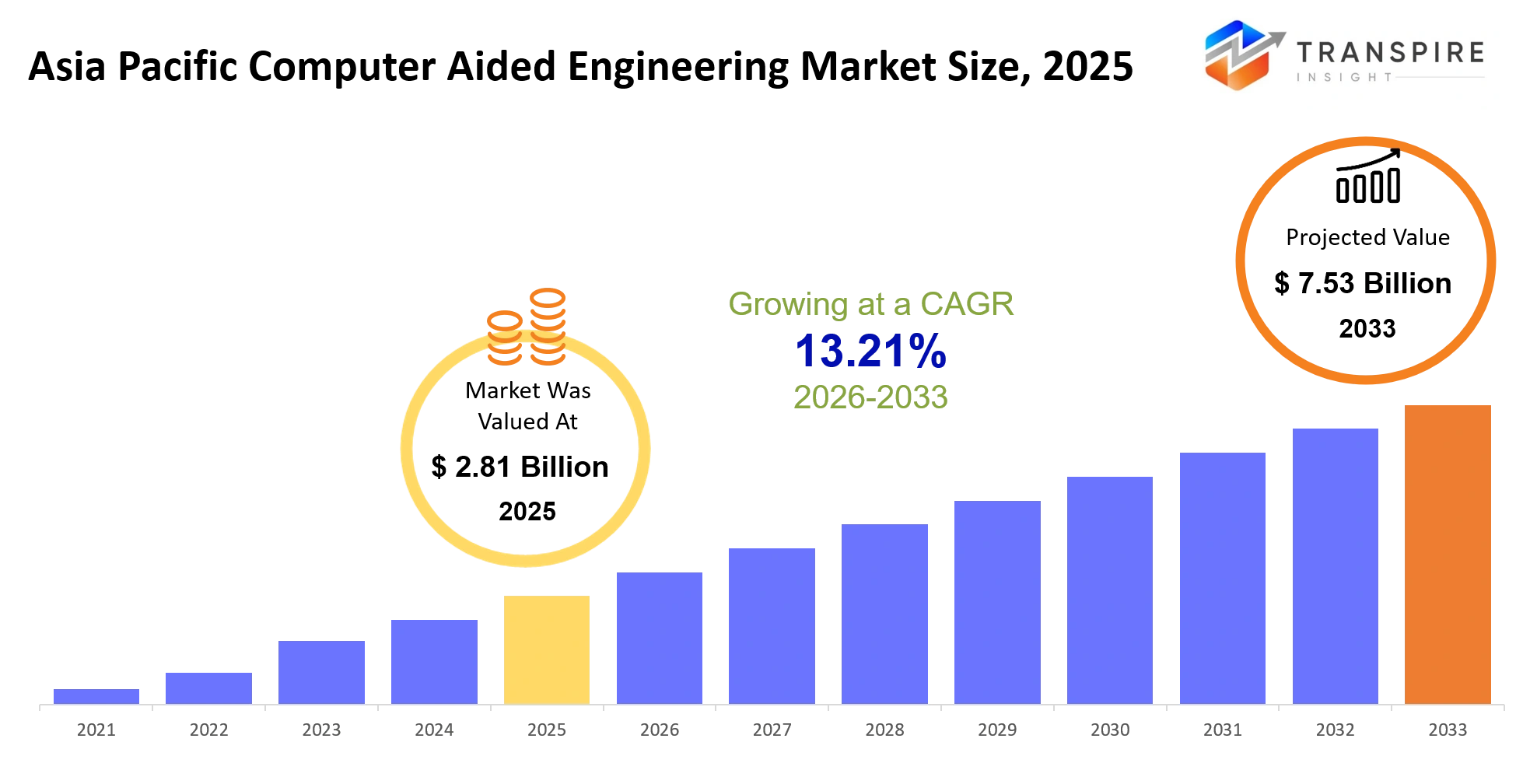
- Asia Pacific Computer Aided Engineering Market Size 2025: USD 2.81 Billion
- Asia Pacific Computer Aided Engineering Market Size 2033: USD 7.53 Billion
- Asia Pacific Computer Aided Engineering Market CAGR: 13.21%
- Asia Pacific Computer Aided Engineering Market Segments: By Component (Software, Services, Simulation Tools, Optimization Tools, Visualization Tools, Others); By Deployment (Cloud-Based, On-Premise, Hybrid, Others); By Application (Automotive Design, Aerospace Design, Industrial Equipment, Electronics, Construction, Others); By End User (Automotive, Aerospace, Manufacturing, Electronics, Others).
To learn more about this report,  Download Free Sample Report
Asia Pacific Computer Aided Engineering Market Summary
The Asia Pacific Computer Aided Engineering Market was valued at USD 2.81 Billion in 2025. It is forecast to reach USD 7.53 Billion by 2033. That is a CAGR of 13.21% over the period.
In the Asia Pacific region, computer aided engineering is mostly used to check how products, ships, and industrial systems will act under real stress, before anything gets actually built in a factory. That approach helps lower expensive prototyping work, plus it reduces the chance of failures in fields like automotive, aerospace, and maritime engineering, and honestly it feels like everyone learned that the hard way. In the last five years, though, the whole market moved away from desktop based simulation, and more toward cloud enabled high performance computing setups that plug in AI driven solvers, and also digital twin workspaces. Somehow this shift, kind of structural but also practical, has squeezed the design timelines, and it lets engineering groups that are spread across locations collaborate in real time, even when bandwidth is not perfect.
One clear trigger was COVID-19 supply chain disruption; it pushed manufacturers and shipbuilders to speed up remote design validation and virtual prototyping because waiting around became risky. At the same time, tougher emissions and safety regulations in places like Japan, China, and South Korea made simulation-led compliance a stronger necessity, not just a nice option. So, as a consequence, many companies are investing more heavily in CAE tools in order to cut down on physical testing expenses, and also to get to market faster across complicated engineering programs, no matter how the program is organized.
Key Market Insights
- China seems to dominate the Asia Pacific Computer Aided Engineering Market, with almost 34% share in 2025, mostly because big scale industrial and automotive digitalization programs keep rolling out, in a pretty relentless way.
- India is the quickest moving region between 2025–2032, and that pace is tied to aerospace expansion along with government supported manufacturing modernization efforts, not just one factor.
- Simulation software is leading the Asia Pacific Computer Aided Engineering Market, taking roughly 48% share in 2025, mainly as design validation becomes routine, everywhere you look.
- Finite element analysis tools still sit in the second spot by share, since fundamental structural testing stays essential through most engineering workflows, even when teams try to speed things up.
- Cloud based CAE platforms are the fastest growing segment from 2025 to 2032, driven by the rising need for on demand, scalable computing power, and everyone wants fewer bottlenecks.
- Automotive and transportation use cases basically dominate, with about 41% share, mainly because electrification and the need for lightweight vehicle design, kinda line up with the demand.
- Aerospace simulation is the fastest-growing application slice, since regional aircraft production is pushing more, and defense R&D expands quickly too, it seems.
- Manufacturing companies are leading the Asia Pacific Computer Aided Engineering Market, holding roughly 46% share, driven by product optimization requirements that keep coming.
- Energy and maritime engineering firms show swift growth as offshore infrastructure, plus ship design complexity, keeps increasing and getting more intricate.
What are the Key Drivers, Restraints, and Opportunities in the Asia Pacific Computer Aided Engineering Market?
The primary driver of the Asia Pacific Computer Aided Engineering Market, is a kind of shift toward virtual product validation, pushed by these high-cost prototyping setups in automotive, aerospace, and maritime engineering. You see regulatory pressure on safety and emissions compliance in Japan, China, and South Korea, and that has forced firms to adopt a simulation-first design workflow. As a result it cuts down on the physical testing cycles , and that directly improves time-to-market too, which boosts software licensing and cloud subscription revenue across CAE platforms. It also lets engineering teams run multi-physics simulations at scale, and yes, that tends to enhance product accuracy and overall performance outcomes.
One major structural restraint though , is the heavy computational infrastructure demand for advanced simulations especially for cloud and HPC-enabled CAE workloads. A lot of mid-sized manufacturers in emerging Asia Pacific economies still don’t have real access to high-performance computing resources, or skilled simulation engineers. So this creates a stubborn adoption gap, like a slowdown in full scale digital engineering transformation, and it also restricts recurring software monetization in markets where budgets are tight.
A significant opportunity sits in AI-integrated digital twin ecosystems for smart manufacturing and maritime systems. For example, countries such as India and Vietnam are ramping up investment in Industry 4.0 infrastructure. That supports real time simulation of production lines, and even vessel performance. With that, teams can keep optimizing design and operations, which unlocks fresh subscription-based CAE service models, and expands long term revenue potential.
What Has the Impact of Artificial Intelligence Been on the Asia Pacific Computer Aided Engineering Market?
Artificial intelligence is transforming the Asia Pacific Computer Aided Engineering Market , by putting automation into simulation workflows and generally cutting down on the manual model tuning work. AI–driven solvers are now optimizing mesh creation , boundary condition setup , and the whole design iteration rhythm, so engineering turnaround time gets faster, especially in automotive and aerospace design settings. In maritime and industrial systems, AI is also showing up in scrubber performance systems, and in exhaust gas cleaning technology, it helps model emissions behavior under shifting operating conditions. That, in turn , improves how well regulatory compliance gets checked, even when the situation is messy.
Machine learning models beef up predictive strengths by forecasting structural fatigue, thermal stress , and system degradation before any failure actually happens. That supports predictive maintenance plans across manufacturing plants, and also offshore engineering assets, which tends to raise uptime and lower unexpected operational disruptions. Many companies say they see better efficiency across simulation cycles and reduced development costs, largely because automated scenario testing and optimized design exploration do most of the heavy lifting.
That said, AI adoption in the Asia Pacific Computer Aided Engineering Market is still held back , mainly by limited access to high quality labeled engineering datasets and the integration headaches with older CAE systems. For maritime use cases, model accuracy can drop when real sea state variability kicks in, and this can reduce reliability in mission critical simulations .
Key Market Trends
- Engineering firms have kind of moved away from standalone desktop simulation tools, to cloud based platforms and you can see that, with more than 40% adoption growth since 2021 across Asia Pacific manufacturing hubs.
- Automotive OEMs also cut physical prototyping by almost 30% from 2020 to 2025, then they basically replaced it with validation workflows that are simulation led across vehicle design programs, not just a small tweak either.
- Aerospace manufacturers started adding digital twin models more and more after 2022 , so they can run real time performance testing and shorten design iteration cycles a lot, which is pretty noticeable in practice.
- Meanwhile in China and Japan, regulatory emissions rules pushed maritime and industrial firms to switch to CAE driven compliance modeling, instead of manual calculation methods , ever since 2021.
- Siemens Digital Industries Software and Ansys then expanded AI assisted simulation tools after 2023 , and that sped up solver automation, while also trimming computation time for complicated engineering models.
- Over in the Asia Pacific CAE market, cloud migration jumped sharply after pandemic disruptions , because companies wanted remote collaboration and distributed engineering teams to work together, without the friction.
- Semiconductor and electronics manufacturers went toward multi physics simulation between 2022 and 2025, mostly to tackle heat dissipation issues inside miniaturized device architectures.
- India and Southeast Asia saw rapid CAE adoption after 2023 , driven by government backed manufacturing programs and also increased foreign direct investment in industrial engineering sectors.
- And because simulation workloads got way more complex, high performance computing demand surged, so enterprises leaned into hybrid cloud-HPC architectures, for scalable engineering computation that actually holds up.
Asia Pacific Computer Aided Engineering Market Segmentation
By Component :
Software kind of forms the core of the Asia Pacific Computer Aided Engineering Market, it helps enable virtual testing, design validation and performance prediction across a bunch of industries. The simulation tools, plus optimization tools work together so companies can cut down on the whole physical prototyping thing. And then visualization tools assist engineers to see stress, heat and flow behavior, even when the model is pretty complex , which is often the case anyway.
There are also services around this , like implementation , training, system integration for enterprise users who are moving into CAE platforms. What’s happening in demand is changing too, it’s shifting from basic license based models to cloud connected software ecosystems . A lot of that growth is tied to the rising use of AI enabled simulation and a tighter link between design software and real time engineering data , basically faster feedback loops.
By Deployment :
Cloud based deployment is expanding strongly in the Asia Pacific Computer Aided Engineering Market, mainly because remote engineering workflows keep becoming normal, and because computing needs can scale up and down. With cloud systems, simulation cycles can run faster and collaboration becomes easier between design teams that are spread out. Still, on premise systems stay relevant , especially for security sensitive industries where control matters a lot.
Hybrid deployment is also on the rise as enterprises try to balance control with flexibility. Migration toward cloud platforms sped up after supply chain disruptions and remote work shifts, so the timing became kind of unavoidable. Adoption is also being boosted by demand for high performance computing access without having to pour money into large infrastructure right away.
By Application :
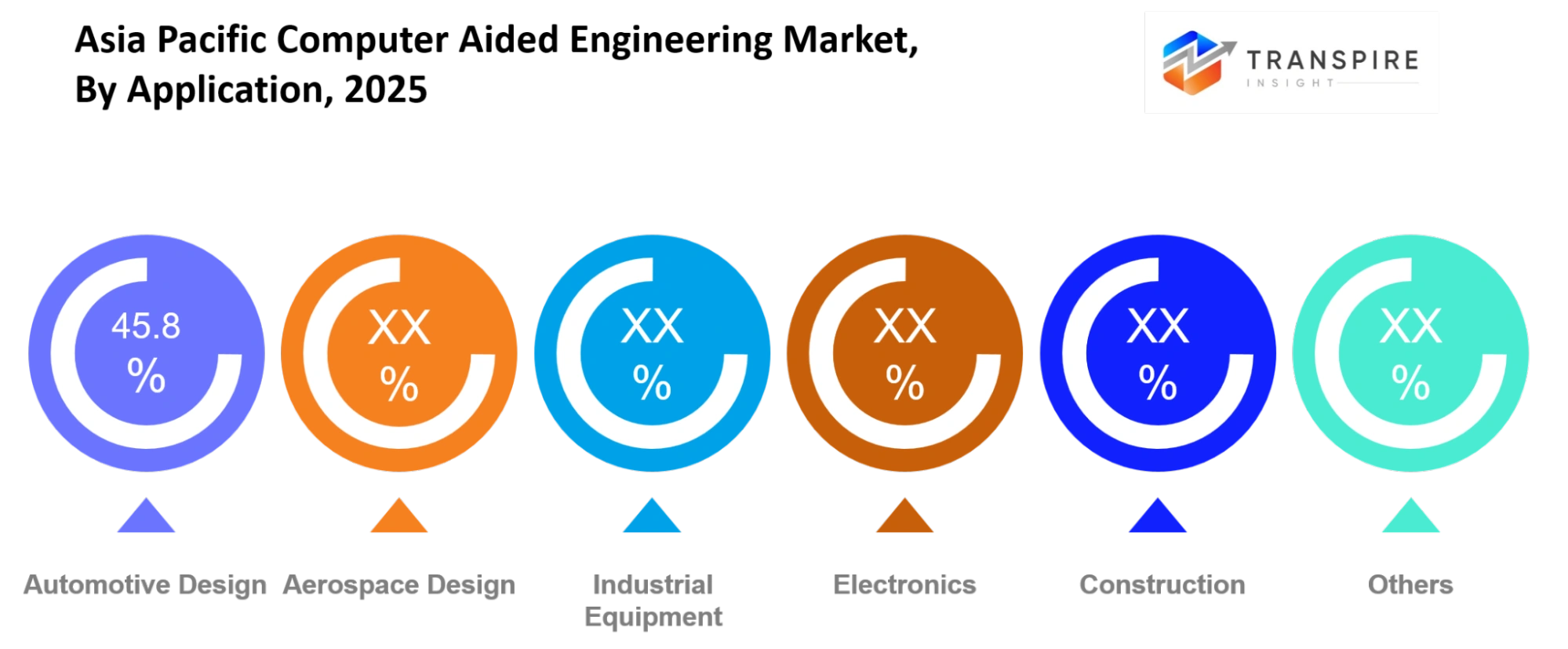
In the Asia Pacific Computer Aided Engineering Market, automotive design is still one of the top use cases, pushed from electric vehicle development and lightweight material engineering. Aerospace design, it leans hard on simulation for structural safety and performance trials before anything even reaches production, or at least that is how it usually goes.
Industrial equipment plus electronics are also growing, because miniaturization and heat management demands keep getting stricter. Construction meanwhile is up too, due to structural modeling and safety compliance, and it feels like more teams need that model based verification. Across all these areas there’s this clear shift toward digital twin integration and less dependence on prototypes, and honestly it’s reshaping the whole engineering workflow routine.
To learn more about this report, Download Free Sample Report
By End User :
If you look at the end users, automotive end users still take the lead in the Asia Pacific CAE Market, with attention on vehicle safety testing, aerodynamics, plus battery system optimization. Aerospace end users use CAE for aircraft performance modeling and material stress analysis, before they grant production approval stages, no shortcuts.
Manufacturing companies are also stepping up adoption, mainly to raise production efficiency and cut down design mistakes. Electronics firms apply CAE for thermal control and more compact device design, keeping systems stable in tight spaces. Overall growth across end users is being supported by an increased focus on cost reduction and faster product development cycles, which keeps everyone moving, even if the schedule feels tight.
What are the Key Use Cases Driving the Asia Pacific Computer Aided Engineering Market?
In the Asia Pacific Computer Aided Engineering Market the dominant use case is sorta product design validation for automotive and industrial manufacturing, where simulation just kind of takes over from costly physical prototyping. Engineers typically use CAE tools to check structural strength , thermal behavior, and aerodynamics before anything goes into production. With this, the whole workflow helps cut down failure risk and also shortens development cycles, which means faster rollout of complex vehicles as well as machinery in those pretty competitive markets
There are also expanded use cases in aerospace performance testing and in electronics thermal management, especially when you look at OEMs and semiconductor manufacturers. Aerospace organizations depend on simulation for safety certification , plus material stress analysis. Meanwhile electronics companies use CAE to handle heat dissipation in compact high power devices , and that helps a lot as designs get more intricate over time
Looking ahead, emerging use cases start with digital twin integration for smart factories and predictive simulation for maritime emission systems. Shipbuilders and energy operators are beginning to model near real time vessel performance, including emissions behavior to comply with tougher environmental rules and to improve operational efficiency, even when conditions change quickly
|
Report Metrics |
Details |
|
Market size value in 2025 |
USD 2.81 Billion |
|
Market size value in 2026 |
USD 3.16 Billion |
|
Revenue forecast in 2033 |
USD 7.53 Billion |
|
Growth rate |
CAGR of 13.21% from 2026 to 2033 |
|
Base year |
2025 |
|
Historical data |
2021 - 2024 |
|
Forecast period |
2026 - 2033 |
|
Report coverage |
Revenue forecast, competitive landscape, growth factors, and trends |
|
Regional scope |
Asia Pacific (India, China, Japan, Australia, South Korea, Rest of Asia Pacific) |
|
Key company profiled |
ANSYS, Siemens Digital Industries, Dassault Systemes, Altair, Autodesk, Hexagon, PTC, Bentley Systems, ESI Group, MSC Software, COMSOL, Cadence, Synopsys, MathWorks, Aveva. |
|
Customization scope |
Free report customization (country, regional & segment scope). Avail customized purchase options to meet your exact research needs. |
|
Report Segmentation |
By Component (Software, Services, Simulation Tools, Optimization Tools, Visualization Tools, Others); By Deployment (Cloud-Based, On-Premise, Hybrid, Others); By Application (Automotive Design, Aerospace Design, Industrial Equipment, Electronics, Construction, Others); By End User (Automotive, Aerospace, Manufacturing, Electronics, Others). |
Which Regions are Driving the Asia Pacific Computer Aided Engineering Market Growth?
China kinda leads the Asia Pacific Computer Aided Engineering Market, mainly because it has a huge industrial base, strong state backed manufacturing policies, and pretty strict compliance requirements around engineering. You can see it in automotive, aerospace, and heavy machinery production, which keep generating demand for simulation-led design validation or so. Also the government pushes advanced manufacturing plus digital engineering, so both state-owned and private enterprises end up adopting CAE more often. And there is this decent ecosystem too—software vendors, engineering talent, and high performance computing infrastructure— that really locks in that leadership role.
Japan, meanwhile, looks more stable and mature as a contributor to the Asia Pacific CAE Market. That’s largely tied to its precision engineering culture, and the long term habit of putting money into industrial R&D. But rather than scaling up like China, Japan leans into high reliability engineering for automotive safety systems, robotics, and advanced materials. Quality and safety standards are enforced consistently, so CAE usage stays steady across the industries that already have it. Plus, manufacturers working with technology providers keeps the growth ongoing but in a controlled way, you know not too sudden.
India is the fastest growing part in the Asia Pacific Computer Aided Engineering Market, and it feels driven by rapid industrialization, plus more aerospace and automotive design activity. New investments in manufacturing corridors, and defense modernization programs, have boosted simulation adoption, with pretty visible momentum. At the same time, more engineering services firms, along with cloud based infrastructure, make advanced CAE tools easier to reach. So this creates pretty strong entry opportunities for global vendors, especially ones with scalable cloud platforms, and cost efficient simulation options, that are designed for easier deployment.
Who are the Key Players in the Asia Pacific Computer Aided Engineering Market and How Do They Compete?
The Asia Pacific Computer Aided Engineering Market has a sort of semi-consolidated shape, where big global software players kinda lead the space, and cloud native simulation tools slowly start to tweak the way competitors show up. In the middle of all that, the fight seems to revolve around AI enabled simulation fidelity, cloud scalability, and subscription based rollout paths more than older licensing habits. So, vendors are pushing to stitch in digital twin features plus on demand high performance computing access, while a bunch of regional manufacturers are turning to more adaptable SaaS engineering platforms when they buy, you know.
Siemens Digital Industries Software, builds stitched together digital twin ecosystems that connect design and factory operations, which boosts uptake in major automotive centers. Ansys sticks to high fidelity physics simulation engines, and those get used across aerospace and automotive validation. Dassault Systèmes leans into teamwork via its 3DEXPERIENCE platform, letting cloud based multi user design spaces work together. Together these companies expand across Asia Pacific mostly through OEM relationships, plus cloud migrations that kinda swap out legacy licensing for subscription based entry.
Altair Engineering highlights high performance computing optimization and lightweight design suites, especially for simulation heavy sectors. Autodesk aims at mid market manufacturers with cloud CAD and simulation tools so product development moves quicker. Hexagon AB supports industrial digitization through metrology systems and sensor linked simulation solutions, tying real world measurement to modeling. Overall, they grow by doing cloud upgrades, regional partnerships, and offering engineering answers that match specific industries across Asia Pacific.
Company List
- ANSYS
- Siemens Digital Industries
- Dassault Systemes
- Altair
- Autodes
- Hexagon
- PTC
- Bentley Systems
- ESI Group
- MSC Software
- COMSOL
- Cadence
- Synopsys
- MathWorks
- Aveva
Recent Development News
In January 2026, Siemens Digital Industries Software expanded its cloud-based simulation portfolio through upgraded AI-assisted CAE capabilities. The update improved multi-domain engineering workflows and strengthened integration with digital twin environments across automotive and industrial users.
Source: https://www.siemens.com
In March 2026, Dassault Systèmes entered a strategic collaboration with multiple Asian automotive OEMs to expand its 3DEXPERIENCE simulation ecosystem across electric vehicle development programs. The partnership strengthened cloud adoption for large-scale distributed engineering teams.
Source: https://www.3ds.com
What Strategic Insights Define the Future of the Asia Pacific Computer Aided Engineering Market?
The Asia Pacific Computer Aided Engineering Market is kinda moving, structurally toward fully cloud-native, AI-augmented simulation ecosystems where engineering decisions are going to rely more on virtual validation than physical testing. This change is mostly driven by tighter product development timelines, and rising system complexity in automotive and aerospace, plus that constant push to reduce engineering failure costs, like really continuously. Over the next 5–7 years, CAE platforms will increasingly blend with digital twin environments, so you get a more or less continuous design-to-operations feedback loop and not just a one off review.
But there is another risk that is less obvious, vendor concentration. In that case a small group of global software providers basically controls critical simulation infrastructure. That creates dependency risks for manufacturers if pricing models shift, or if platform access gets restricted, even slightly. It can also end up slowing innovation diversity across the smaller engineering ecosystems, which is kinda not ideal.
At the same time, a clear opportunity is edge-enabled simulation for smart factories in Southeast Asia. Localized high-speed computation there reduces reliance on centralized cloud systems. That will matter as manufacturing spreads across Vietnam, Thailand, and Indonesia, and folks try to keep latency low. Market participants should therefore prioritize interoperable, modular CAE platforms that integrate cleanly with digital twin setups and cloud HPC hybrids, so they stay ready for long term adoption.
Asia Pacific Computer Aided Engineering Market Report Segmentation
By Component
- Software
- Services
- Simulation Tools
- Optimization Tools
- Visualization Tools
By Deployment
- Cloud-Based
- On-Premise
- Hybrid
By Application
- Automotive Design
- Aerospace Design
- Industrial Equipment
- Electronics
- Construction
By End User
- Automotive
- Aerospace
- Manufacturing
- Electronics
Frequently Asked Questions
Find quick answers to common questions.
The Asia Pacific Computer Aided Engineering Market size is USD 7.53 Billion in 2033.
Key segments for the Asia Pacific Computer Aided Engineering Market are By Component (Software, Services, Simulation Tools, Optimization Tools, Visualization Tools, Others); By Deployment (Cloud-Based, On-Premise, Hybrid, Others); By Application (Automotive Design, Aerospace Design, Industrial Equipment, Electronics, Construction, Others); By End User (Automotive, Aerospace, Manufacturing, Electronics, Others).
Major Asia Pacific Computer Aided Engineering Market players are ANSYS, Siemens Digital Industries, Dassault Systemes, Altair, Autodesk, Hexagon, PTC, Bentley Systems, ESI Group, MSC Software, COMSOL, Cadence, Synopsys, MathWorks, Aveva.
The Asia Pacific Computer Aided Engineering Market size is USD 2.81 Billion in 2025.
The Asia Pacific Computer Aided Engineering Market CAGR is 13.21% from 2026 to 2033.
- ANSYS
- Siemens Digital Industries
- Dassault Systemes
- Altair
- Autodes
- Hexagon
- PTC
- Bentley Systems
- ESI Group
- MSC Software
- COMSOL
- Cadence
- Synopsys
- MathWorks
- Aveva
About the Authors

Mayur Shinde
I am Mayur Shinde, a Senior Research Analyst at Transpire Insight, specializing in the Automotive & Transportation and Information & Communication Technology (ICT) Industry. My work focuses on analyzing emerging market trends, technological advancements, competitive landscapes, and industry developments to deliver accurate, data-driven insights. I am passionate about transforming complex market information into clear, actionable content that helps businesses, professionals, and decision-makers stay informed and make confident strategic decisions.

Chakradhar Khansole
Chakradhar serves as the Research Director at Transpire Insight, bringing over 8 years of experience in technology, innovation, and strategic market intelligence. He specializes in transforming complex market data into actionable business insights that enable organizations to make informed, growth-oriented decisions. Recognized for his strategic vision and analytical expertise, Chakradhar leads high-impact research initiatives, delivering comprehensive market assessments, competitive intelligence, and forward-looking industry analysis.
Recently Published Reports
-
Apr 2026
3D Optical Profiler Market
3D Optical Profiler Market Size, Share & Analysis Report By Type (Desktop 3D Optical Profiler, and Portable 3D Optical Profiler), By Technology (Confocal Technology, and White Light Interference), By End-Use Industry (Manufacturing, Research Institutions, Automotive, Aerospace and Defense, Medical Devices, and Other), and Geography (North America, Europe, Asia-Pacific, Middle East and Africa, South and Central America), 2021 - 2031
-
Apr 2026
Depth Sensor Market
Depth Sensor Market Size, Share & Analysis Report By Type (Infrared Depth Sensors, Time-of-Flight (ToF) Sensors, Stereo Vision Sensors, Structured Light Sensors, Ultrasonic Depth Sensors), By Application (Automotive, Robotics, Gaming, Consumer Electronics, Industrial Automation, Healthcare, Security & Surveillance, Others), By End Users (Automotive Manufacturers, Consumer Electronics Companies, Healthcare Providers, Industrial Companies, Security Agencies, Gaming Companies, Robotics Companies, Others), and Geography (North America, Europe, Asia-Pacific, Middle East and Africa, South and Central America), 2021 – 2031
-
Apr 2026
Digital Manufacturing Market
Digital Manufacturing Market Size, Share & Analysis Report By Component (Hardware, Software, and Services), By Technology (Robotics, 3D Printing, Internet of Things (IoT), and Others), By Application (Automotive and Transportation, Aerospace and Defense, Consumer Electronics, Industrial Machinery, and Others), By Process Type (Computer-Based Designing, Computer-Based Simulation, Computer 3D Visualization, Analytics, and Others), and Geography (North America, Europe, Asia-Pacific, Middle East and Africa, South and Central America), 2021 – 2031
-
Apr 2026
Digital Visa Services Market
Digital Visa Services Market Size, Share & Analysis Report By Type (Individual Travelers, Group Travelers), By Application (Tourism, Business Travel, Others), and Geography (North America, Europe, Asia-Pacific, Middle East and Africa, South and Central America), 2021 – 2031