
Asia Pacific Computational Photography Market Summary
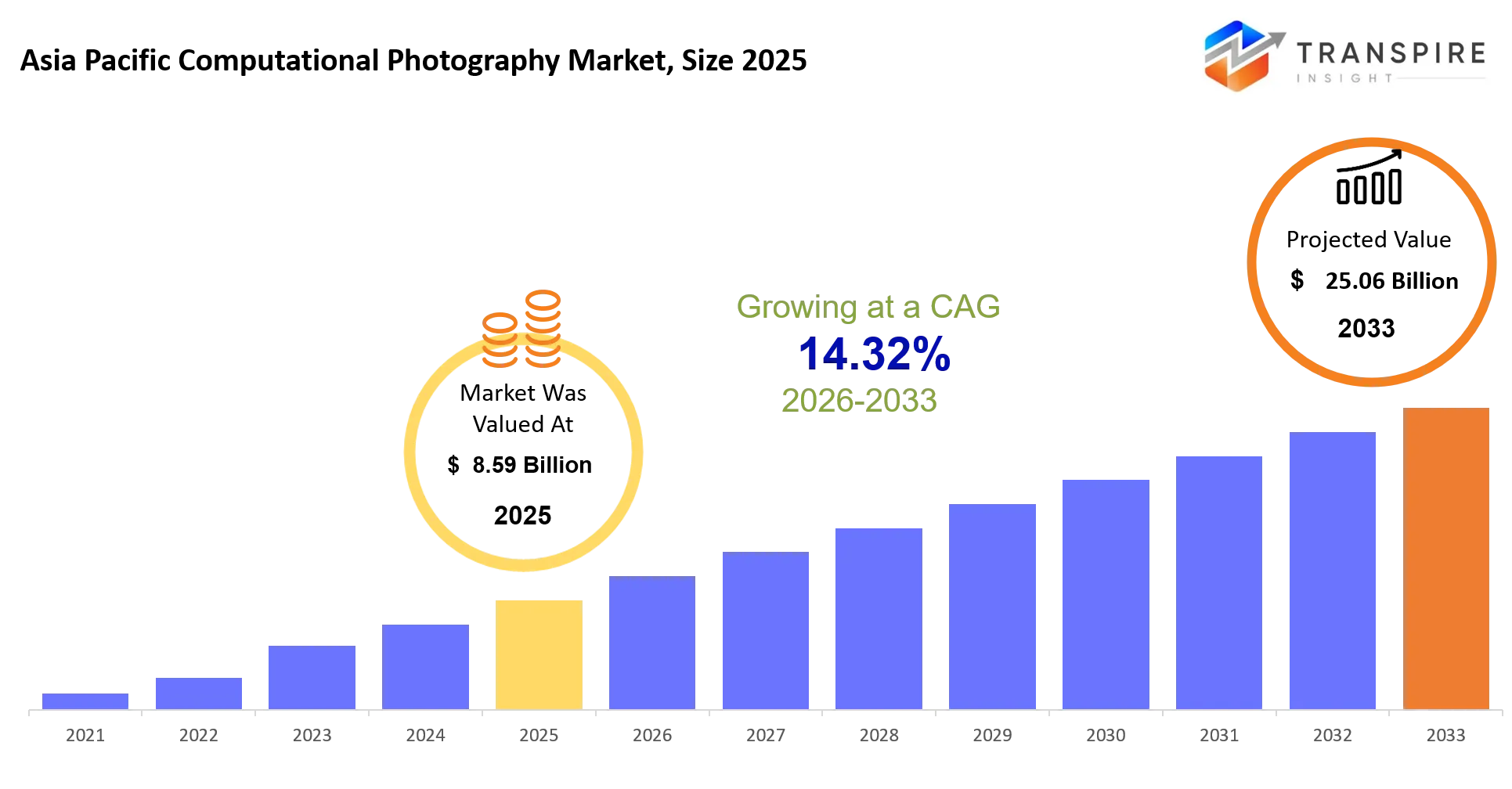
As per Transpire Insight Analysis, the Asia Pacific Computational Photography Market size is estimated at USD 8.59 Billion in 2025 and is anticipated to reach USD 25.06 Billion by 2033, growing at a CAGR of 14.32% from 2026 to 2033.
The Asia Pacific Computational Photography Market lets smartphones, automotive cameras, drones, surveillance setups and industrial imaging devices make images that are sharper and more detailed using a mix of advanced software and camera hardware. Instead of only leaning on bigger sensors, computational methods help with low light work better, zooming, depth mapping, and real time image processing. So manufacturers can bring out premium imaging, even if they are not really increasing hardware cost that much.
Over the last five years, it feels like the whole market moved away from camera upgrades that are mostly hardware driven, and into AI powered imaging algorithms that are put right inside edge devices. The quick rise of on-device artificial intelligence, pushed along by semiconductor supply chain changes after the pandemic, made companies focus on optimizing software based imaging abilities. This shift has cut down on the need for costly optical components, while also pushing new uses in consumer electronics, automotive safety, healthcare imaging and industrial inspection. And, as a result, there are more solid commercial openings for software developers, chipset suppliers, and device manufacturers across the region.
Asia Pacific Computational Photography Market Size & Forecast:
- Asia Pacific Computational Photography Market Size 2025: USD 8.59 Billion
- Expected Market Value 2033: USD 25.06 Billion
- Forecast CAGR: 14.32%
- Leading region in 2025: China
- Fastest Growing region: India
- Key Profile: Apple, Samsung Electronics, Google, Sony, Canon, Nikon, Qualcomm, NVIDIA, Xiaomi, OPPO, Vivo, Huawei, MediaTek, Adobe, Fujifilm
Key Market Insights
- In 2025, China kind of dominated the Asia Pacific Computational Photography Market with about 43% share, this was backed by solid smartphone manufacturing , AI chipset work, and camera module innovation that keeps getting refined over time.
- For India, 2025–2033 looks like the period when it will grow the quickest, mainly because premium smartphone demand is rising, local electronics manufacturing is expanding, and the AI software ecosystem is getting more mature, kind of, step by step.
- When you look at the product segment, smartphone computational photography was the top part with almost 58% market share in 2025. Flagship devices and mid range models both started using smarter AI imaging features, and the pace didn’t really slow down after that.
- After that, automotive computational imaging solutions took second place. This segment seems supported by ADAS rollouts and also smarter camera integration across passenger vehicles.
- Industrial and machine vision imaging is expected to be the fastest grower through 2033, likely because factory automation keeps increasing, and AI powered inspection systems are becoming more common than before.
- On the application side, consumer electronics stayed in front with roughly 61% share in 2025. This matches the trend where computational imaging keeps getting built in phones and tablets, not just as an extra feature but more like standard behavior.
- In terms of usage areas, automotive safety and ADAS is forecast to expand the fastest through 2025–2033. That growth is being pushed by autonomous driving investments , plus regulatory safety requirements that don’t seem optional.
- For end users, smartphone manufacturers were pretty clearly the leading group in 2025, sitting at about 55% market share, mostly because premium camera differentiation and AI enabled software updates.
- Healthcare imaging providers are expected to become the fastest growing end user category by 2033, since AI assisted diagnostic imaging helps to improve clinical workflows, and keeps things moving faster across hospitals.
What are the Key Drivers, Restraints, and Opportunities in the Asia Pacific Computational Photography Market?
The main growth driver is basically that quick move away from hardware-centered cameras toward AI-enabled imaging software, you know. Dedicated neural processing units, more capable mobile chipsets, and edge AI computing have cut down image processing latency, while also bumping up low-light performance and object recognition. Smartphone brands now seem to compete more through software innovation rather than just focusing on sensor size. That kind of shift has made product upgrade cycles shorter and it has boosted sales of premium devices too. And it’s not only consumer stuff/automotive makers plus industrial equipment suppliers have also picked up intelligent imaging platforms, which opens up revenue opportunities that go beyond the usual electronics market.
Still, the biggest restraint is the fact that advanced semiconductor manufacturing, along with image sensor production, is concentrated in a rather small supplier group. On top of that, building proprietary imaging algorithms needs serious investment, not only in AI training datasets but also in specialised engineering talent. Those capabilities cannot be repeated fast, or copied overnight. Product launches may slip when advanced chip availability tightens up, or when software validation drags on and extends development timelines a bit more than planned. Based on a Transpire Insight review of regional procurement announcements along with launch schedules, this supplier concentration continues to look like the primary execution risk. Overall, it leads to slower commercial deployment and deferred revenue across multiple application sectors.
There’s a real, kinda major chance in edge AI imaging for things like autonomous mobility , healthcare diagnostics, robotics, and industrial automation. Lately, fresh investments are going into AI accelerators , plus dedicated imaging processors, and also multimodal vision models, which is helping real time image enhancement happen without having to rely on the cloud so much. At the same time India, South Korea, Japan, and parts of Southeast Asia keep pushing forward with semiconductor design capabilities, and smart manufacturing spend, not just talking about it. Overall this mix should put regional companies in a good spot to commercialise more advanced computational imaging across a bunch of high value industries.
What Has the Impact of Artificial Intelligence Been on the Asia Pacific Computational Photography Market?
Artificial intelligence has kind of transformed computational photography, from regular image enhancement software into an intelligent vision platform that now supports consumer electronics, healthcare , automotive systems, and industrial automation. With AI in the loop, models automatically optimize exposure, colour reproduction, noise reduction , plus object segmentation and scene recognition, usually without anyone needing manual adjustments or fiddling. In fact, manufacturers are doing more and more automation for image calibration and software optimization during device production, which makes results more consistent, and also reduces the engineering time they would’ve spent otherwise.
Machine learning also brings predictive optimisation, where it studies user behaviour, environmental lighting, hardware performance, and even the imaging workload itself. Then imaging processors continuously adjust camera parameters, aiming to get better quality while simultaneously lowering power usage. In places like industrial inspection and autonomous driving, AI vision systems can anticipate image degradation and tune the processing pipelines before accuracy starts slipping. Overall, these features boost operational efficiency, reduce processing delays, and help connected devices make more reliable real time decisions.
Digital imaging platforms also make it easier for faster software updates, so manufacturers can enhance camera performance without swapping hardware. That extends product value and generally lowers lifecycle costs, especially for enterprise users. That said, AI adoption still hits some real obstacles. Building accurate models usually needs extensive image datasets collected across lots of lighting, weather, and environmental conditions. Integration costs are still high for specialised industrial deployments, and advanced AI processors keep adding system complexity and development expenditure even though semiconductor efficiency keeps improving.
Key Market Trends
- From 2021 into 2025, AI image processing basically replaced hardware-only camera upgrades on a lot of premium phones, and it did that by boosting low light capture, plus computational zoom that looks steadier and clearer.
- Around the same time, Edge AI processors started running more image enhancement right on the device, so there was less need for the cloud, and by 2025 that also helped with privacy plus real time responsiveness, even when the network is kinda spotty.
- After 2022, car makers also pushed computational vision into ADAS platforms, faster than before, and that widened the market beyond just consumer gadgets.
- On the chip side, semiconductor vendors rolled out dedicated neural processing engines, which cut image processing latency down a lot and it helps energy efficiency too, especially in those flagship mobile models where the battery always matters . A bit.
- Since 2023, multi camera fusion has basically become the norm across premium smartphones, so phones can deliver better portrait shots, stronger night scenes, and even more convincing ultra wide frames.
- In factories, industrial inspection systems are now more and more mixing computational imaging with machine vision and well, that makes defect detection more accurate across electronics manufacturing lines.
- Phone brands like Apple, Samsung Electronics, Xiaomi, OPPO, and vivo keep pouring resources into proprietary AI imaging processors , because they want tighter product differentiation, not only larger specs on paper.
- In healthcare, imaging developers use computational photography techniques to make diagnostic images clearer , while also lowering repeat scans during clinical workflows, which is good for both time and patient comfort.
- Meanwhile, regional semiconductor investments across India, Japan, South Korea, and Taiwan are also strengthening local AI imaging capability, and lowering long term dependency on outside technology sources.
- Then in 2024 to 2025, generative AI image enhancement became a real commercial trend, so advanced editing features started showing up directly on mobile devices without continuous cloud processing, like it’s baked in.
Asia Pacific Computational Photography Market Segmentation
By Technology :
AI image processing is kinda in the lead these days, because more advanced algorithms can boost the image quality while still avoiding big hardware changes. HDR imaging keeps getting attention too, it helps with better exposure balance, notably in those hard lighting situations you see on smartphones, and also in automotive cameras. Multi frame processing is being adopted fast as well, since multiple shots taken within milliseconds can lead to a cleaner and sharper result. Image fusion, plus super resolution work in the same direction, they mix different data sources and push out finer details, which sounds simple but it actually matters a lot.
Depth mapping also keeps gaining traction in facial recognition, augmented reality , and portrait photography, and in industrial imaging it’s useful for more accurate object measurement. Ongoing investment into dedicated AI processors and neural engines will likely enable faster image processing, with less power use. And yeah, software based imaging innovation will stay a major competitive lever, because manufacturers want premium camera output from intelligent processing, rather than paying for expensive hardware upgrades.
By Device :
Smartphones basically take up the biggest slice because premium, and mid range devices increasingly lean on software based photography tricks. Camera quality still remains one of the top reasons people buy, so manufacturers keep rolling out advanced computational imaging not just in one segment but across several price bands. Digital cameras, though, still matter a lot for professional users who want bigger sensors and a bunch of specialised photography functions, even if they are not the mainstream choice anymore. Then there are drone makers, they add intelligent imaging systems to sharpen aerial mapping, inspections, and surveillance performance, kind of quietly but consistently.
Meanwhile in automotive, cameras keep getting wider support as advanced driver assistance systems grow, which opens more chances for real time image analysis on the move. AR and VR devices are doing the same kind of shift too, using computational imaging to help with spatial awareness, and cleaner object recognition. And with more money flowing into wearable devices and smart vision platforms, adoption will likely spread further in the next few years across both consumer uses, and enterprise setups, depending on what people need in practice.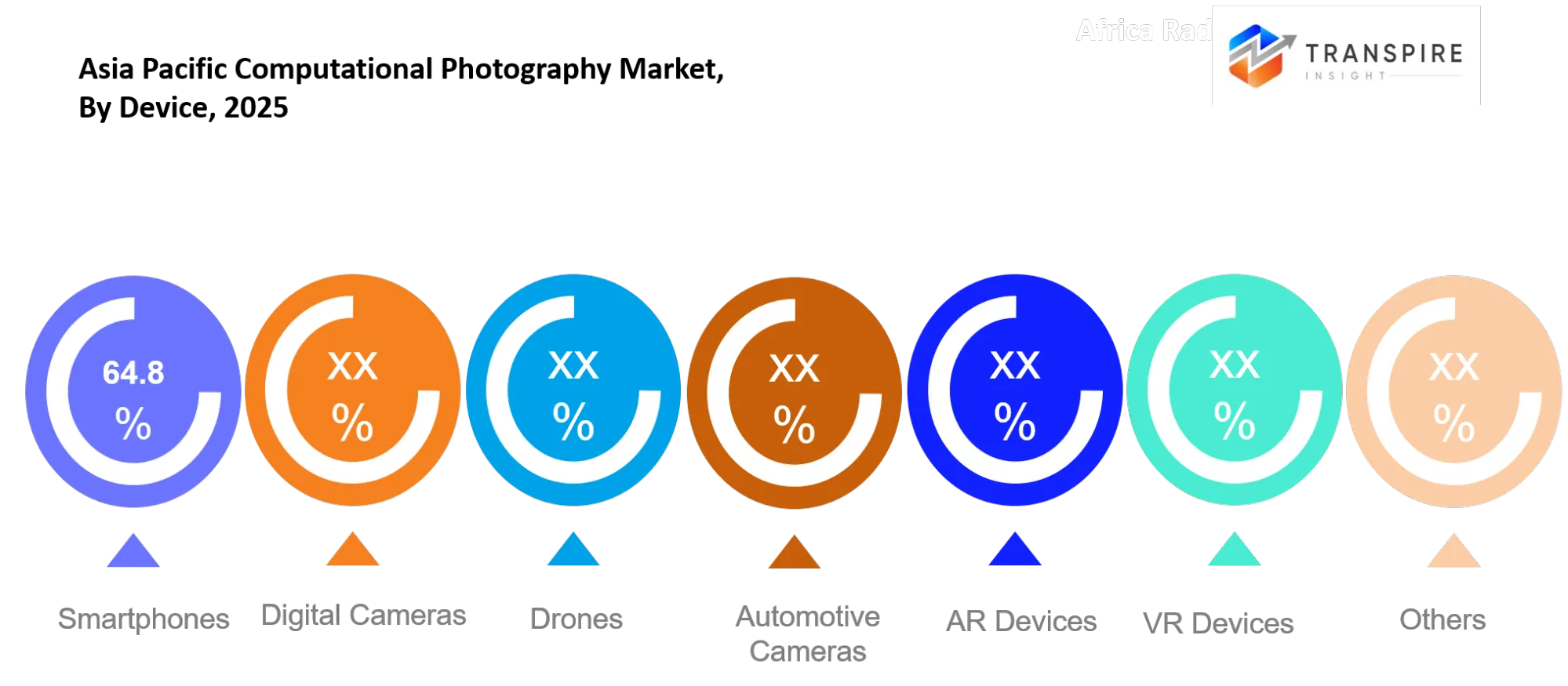
By Application :
Consumer photography is still sort of the main use case, because software enhancement really does boost image quality on everyday phones and tablets . Features like portrait modes, night photography, and smart scene optimisation keep pulling people in who want near professional results from small devices . On the other hand automotive vision has also grown quite a bit, since intelligent cameras help with lane detection , collision avoidance , and even driver monitoring systems .
In healthcare imaging, clearer visuals matter, and that clarity helps clinicians move faster and make better clinical decisions , it supports quicker diagnosis too. Security and surveillance setups are getting more and more reliant on intelligent image enhancement, especially for facial recognition and low light monitoring . Meanwhile industrial inspection keeps expanding, mostly because automated quality control needs dependable visual analysis with little to no waiting time or extra processing delays.As the software keeps improving, practical adoption should widen across manufacturing , logistics , agriculture, and public safety throughout the forecast period .
By End User :
Consumer electronics pull in the most revenue, mainly because smartphones, tablets, and wearable devices keep introducing advanced imaging features, kinda like it’s always one more upgrade. In general product differentiation leans more and more on software capabilities, improving picture quality without really touching hardware. Automotive manufacturers are doing the same thing too as intelligent vision systems become basically required for vehicle safety, plus the whole autonomous driving development track. Healthcare organisations also keep moving forward with advanced imaging technologies, in order to boost diagnostic accuracy and operational efficiency.
Then media and entertainment companies get a boost from better content creation tools, those tools cut down editing time while still keeping high image quality. Industrial users keep investing in intelligent imaging for inspection tasks and process automation across their manufacturing facilities. Overall, the wider digital transformation happening across multiple sectors should keep opening up longer term commercial chances for imaging technology providers.
By Deployment :
On-device processing ends up leading the deployment story, because doing the image work locally gives quicker response times while also boosting privacy and cutting down on internet reliance. Dedicated AI processors now handle more advanced image enhancement right inside smartphones, automotive cameras, and industrial gear, which sounds simple but it really changes the whole pipeline. Meanwhile cloud based processing still pulls its weight for uses that need huge data storage and heavier computing muscle. In practice, hybrid deployment models stitch both worlds together, local processing plus cloud analytics, so you can keep the speed and performance up and still stay scalable.
Enterprise teams are leaning toward hybrid setups more and more, since the imaging tasks that matter most need near instant processing, and then the longer term historical analysis is where cloud infrastructure really shines. As semiconductor performance keeps improving, and edge AI computing gets stronger, local processing will keep expanding across multiple industries. And of course cloud platforms remain important for those large datasets, shared workflows, and ongoing software model updates, even when the everyday work happens on-device.
What are the Key Use Cases Driving the Asia Pacific Computational Photography Market?
Consumer photography still feels like the main use case, mostly because smartphone makers lean on advanced imaging software to sort of stand apart between their premium and mid-range lines. Mobile brands are putting real effort into stronger low-light performance, sharper portrait effects, and AI-enhanced image quality, aiming at buyers who want that professional looking result… but don’t really want to carry extra camera gear.
At the same time, automotive vision and healthcare imaging keep broadening. Vehicle manufacturers are folding intelligent cameras into driver assistance systems, and hospitals are refining diagnostic imaging workflows too. Industrial inspection is also getting more traction, since producers need dependable visual analysis to catch production defects, and then push better quality control across automated plants.
New openings are starting to show up in augmented reality devices, plus autonomous robotics, where intelligent image processing helps with spatial recognition and real time decisions. Smart agriculture and infrastructure inspection look promising in the long run as organizations roll out drones and edge-based imaging systems, to improve monitoring accuracy while reducing manual field work, a lot of teams are trying to do that more now.
|
Report Metrics |
Details |
|
Market size value in 2025 |
USD 8.59 Billion |
|
Market size value in 2026 |
USD 9.82 Billion |
|
Revenue forecast in 2033 |
USD 25.06 Billion |
|
Growth rate |
CAGR of 14.32% from 2026 to 2033 |
|
Base year |
2025 |
|
Historical data |
2021 - 2024 |
|
Forecast period |
2026 - 2033 |
|
Report coverage |
Revenue forecast, competitive landscape, growth factors, and trends |
|
Regional scope |
Asia Pacific (India, China, Japan, Australia, South Korea, Rest of Asia Pacific) |
|
Key company profiled |
Apple, Samsung Electronics, Google, Sony, Canon, Nikon, Qualcomm, NVIDIA, Xiaomi, OPPO, Vivo, Huawei, MediaTek, Adobe, Fujifilm . |
|
Customization scope |
Free report customization (country, regional & segment scope). Avail customized purchase options to meet your exact research needs. |
|
Report Segmentation |
By Technology (AI Image Processing, HDR Imaging, Multi-Frame Processing, Depth Mapping, Image Fusion, Super Resolution, Others); By Device (Smartphones, Digital Cameras, Drones, Automotive Cameras, AR/VR Devices, Others); By Application (Consumer Photography, Automotive Vision, Healthcare Imaging, Security & Surveillance, Industrial Inspection, Others); By End User (Consumer Electronics, Automotive, Healthcare, Media & Entertainment, Industrial, Others); By Deployment (On-Device Processing, Cloud-Based Processing, Hybrid, Others) |
Which Regions are Driving the Asia Pacific Computational Photography Market Growth?
China is looking at roughly 43% of the regional market in 2025 , so it stays the biggest country across Asia Pacific. With heavy government support behind semiconductor production, artificial intelligence work, and high end electronics manufacturing, computational imaging tech has been adopted more quickly in the commercial world. There’s also a fairly mature setupsmartphone makers, image sensor suppliers, chipset developers, and software firms all together that makes domestic innovation easier, while still allowing large scale output. As investment keeps flowing into AI processors, premium consumer devices, and intelligent automotive platforms, this leading position should hold through the whole forecast window.
Japan, meanwhile, shows up as the second largest contributor, mainly because long term spending in precision electronics and imaging technology tends to create steady market conditions, not just fast volume growth. Ongoing industrial strategies, dependable research support, and strong manufacturing norms help companies keep improving products for consumer electronics, automotive imaging , and even healthcare applications. Also, close coordination between component suppliers and original equipment manufacturers helps prevent supply issues, so production plans can stay on track. Put together, Japan’s technical depth plus its more consistent investment rhythm makes it a dependable source of recurring revenue in several application areas.
India is set to show the quickest growth from 2026 to 2033 , mainly because domestic electronics manufacturing , semiconductor initiatives and digital infrastructure spending keep getting larger. The production linked incentive programmes, plus the steady rise in investment for smartphone manufacturing , have really helped lock in the country’s position within the regional electronics supply chain. At the same time, wider use of AI enabled gadgetsespecially across healthcare, industrial automation, and auto use cases is opening more commercial pathways that go past just consumer electronics. All of this momentum should bring in solid prospects for technology providers, component manufacturers, software developers, and investors who are looking for long term expansion across the region.
Who are the Key Players in the Asia Pacific Computational Photography Market and How Do They Compete?
Competition in the Asia Pacific Computational Photography Market is somewhat moderately consolidated, mostly because not many big global technology players steer advanced imaging processors, software optimisation, and those premium camera ecosystems. For the most part technology innovation is still the main driver, but lately software performance, AI algorithms, and semiconductor know-how tend to matter more than raw hardware specs by themselves. Even so, older manufacturers keep defending their market share by ongoing research spending, though specialised imaging software teams, plus a few AI-focused firms, are pushing in extra features that sort of flip how products are set apart.
Apple leans into computational photography by tightly tying together its custom silicon, neural processing, and the actual camera software, so image optimization can run smoothly across the same hardware platform, without much friction. Samsung Electronics uses advanced image sensors paired with proprietary AI processing, aiming to lift image quality, while also widening the premium smartphone portfolio across Asia Pacific. Sony instead differentiates with stacked CMOS sensor technology, and it also supplies advanced imaging components to several smartphone manufacturers, which gives it an edge on both component sales, and on consumer electronics too.
Xiaomi, seems to strengthen overall competitiveness by leaning on partnerships that up the game in mobile photography, while also pushing broader premium smartphone portfolios across different regional markets. OPPO keeps putting money into imaging processors that are dedicated, plus software optimization tweaks, so portrait shots, night imaging, and video performance get betterstill not just hinging on larger camera sensors. vivo meanwhile continues to expand its own imaging technologies via research partnerships and fresh camera innovations, to back that premium device positioning and at the same time strengthen competitiveness across high-growth markets in Asia.
Company List
- Apple
- Samsung Electronics
- Sony
- Canon
- Nikon
- Qualcomm
- NVIDIA
- Xiaomi
- OPPO
- Vivo
- Huawei
- MediaTek
- Adobe
- Fujifilm
Recent Development News
In April 2026, Leica Camera AG and Gpixel announced a strategic partnership to co-develop a next-generation custom image sensor for future Leica cameras. The collaboration is expected to advance computational imaging performance and strengthen innovation in high-end imaging technologies. Source https://petapixel.com/
In April 2026, OPPO launched the Find X9 Ultra globally with an advanced AI-powered camera system featuring dual 200 MP sensors and upgraded computational photography capabilities. The launch expanded OPPO's flagship imaging portfolio beyond China and intensified competition in premium mobile imaging. Source https://www.t3.com/
What Strategic Insights Define the Future of the Asia Pacific Computational Photography Market?
Over the next five to seven years, the Asia Pacific Computational Photography Market will sort of move past smartphone camera enhancement and turn into a wider intelligent imaging platform, supporting automotive vision, healthcare diagnostics, industrial automation, and even spatial computing. Like, the big momentum is coming from edge artificial intelligence and dedicated imaging processors. They’ll help do faster image analysis right on the device, with less power use, and better data privacy too, which is kind of the point.
There is also a risk that is more quiet than obvious: the continued dependence on a limited group of advanced semiconductor manufacturers, and image sensor suppliers. If there is any production disruption there, it could delay product launches despite the fact that end-market demand stays strong.
At the same time, an emerging opportunity shows up with AI-powered imaging for robotics and smart manufacturing across India and Southeast Asia, especially as industrial digitalisation keeps accelerating. Market participants will likely benefit the most if they invest in proprietary imaging software, build regional semiconductor partnerships, and develop application-specific solutions, rather than leaning on hardware differentiation alone, too much.
Asia Pacific Computational Photography Market Report Segmentation
By Technology
- AI Image Processing
- HDR Imaging
- Multi-Frame Processing
- Depth Mapping
- Image Fusion
- Super Resolution
By Device
- Smartphones
- Digital Cameras
- Drones
- Automotive Cameras
- AR/VR Devices
By Application
- Consumer Photography
- Automotive Vision
- Healthcare Imaging
- Security & Surveillance
- Industrial Inspection
By End User
- Consumer Electronics
- Automotive
- Healthcare
- Media & Entertainment
- Industrial
By Deployment
- On-Device Processing
- Cloud-Based Processing
- Hybrid
Frequently Asked Questions
Find quick answers to common questions.
The Expected Asia Pacific Computational Photography Market size for the Market will be USD 25.06 Billion in 2033.
Key segments for the Asia Pacific Computational Photography Market are By Technology (AI Image Processing, HDR Imaging, Multi-Frame Processing, Depth Mapping, Image Fusion, Super Resolution, Others); By Device (Smartphones, Digital Cameras, Drones, Automotive Cameras, AR/VR Devices, Others); By Application (Consumer Photography, Automotive Vision, Healthcare Imaging, Security & Surveillance, Industrial Inspection, Others); By End User (Consumer Electronics, Automotive, Healthcare, Media & Entertainment, Industrial, Others); By Deployment (On-Device Processing, Cloud-Based Processing, Hybrid, Others).
Major Asia Pacific Computational Photography Market players are Apple, Samsung Electronics, Google, Sony, Canon, Nikon, Qualcomm, NVIDIA, Xiaomi, OPPO, Vivo, Huawei, MediaTek, Adobe, Fujifilm.
The Current Asia Pacific Computational Photography Market size is USD 8.59 Billion in 2025.
The Asia Pacific Computational Photography Market CAGR is 14.32% from 2026 to 2033.
- Apple
- Samsung Electronics
- Sony
- Canon
- Nikon
- Qualcomm
- NVIDIA
- Xiaomi
- OPPO
- Vivo
- Huawei
- MediaTek
- Adobe
- Fujifilm
About the Authors

Avinash Kumar
I’m Avinash Kumar, a Senior Research Analyst at Transpire Insight, with expertise in the Electronics and Semiconductor and Energy & Power industry. My work focuses on analyzing emerging technologies, market trends, industry developments, and innovation across these sectors. I specialize in transforming complex technical and market insights into clear, research-backed content that helps professionals, businesses, and decision-makers stay informed. Through continuous industry research and data-driven analysis, I strive to deliver accurate, reliable, and practical perspectives on the latest advancements shaping the semiconductor and energy landscape.

Chakradhar Khansole
Chakradhar serves as the Research Director at Transpire Insight, bringing over 8 years of experience in technology, innovation, and strategic market intelligence. He specializes in transforming complex market data into actionable business insights that enable organizations to make informed, growth-oriented decisions. Recognized for his strategic vision and analytical expertise, Chakradhar leads high-impact research initiatives, delivering comprehensive market assessments, competitive intelligence, and forward-looking industry analysis.
Recently Published Reports
-
Apr 2026
Fiber Optic Faceplates Market
Fiber Optic Faceplates Market Size, Share & Analysis Report By Type (< 300 mm2, 300-350 mm2, and > 350 mm2, By Application (Night Vision, Holographic Imaging, Medical, and Others), and Geography (North America, Europe, Asia-Pacific, Middle East and Africa, South and Central America), 2021 - 2031
-
Apr 2026
High Temperature Superconductors Market
High Temperature Superconductors Market Size, Share & Analysis Report By Type (1G HTS, and 2G HTS), By Application (Power Cable, Fault Current Limiter, and Transformer), and Geography (North America, Europe, Asia-Pacific, Middle East and Africa, South and Central America), 2021 - 2031
-
Apr 2026
Industrial Plugs and Socket Market
Industrial Plugs and Socket Market Size, Share & Analysis Report By Type (Industrial Plugs, Industrial Sockets), By Current (Up to 32 A, 32 to 125 A, Above 125 A), By Protection (Dustproof and Splash Proof, Waterproof, Explosion Proof), By End User (Heavy Industries, Oil and Gas, Chemicals and Pharmaceuticals, Power Generation, Others), and Geography (North America, Europe, Asia-Pacific, Middle East and Africa, South and Central America), 2021 - 2031
-
Apr 2026
InGaAs Avalanche Photodiodes Market
InGaAs Avalanche Photodiodes Market Size, Share & Analysis Report By Type (1100 - 1700 nm, and 1000 - 1600 nm), By Application (Missile Warning System, Muzzle Flash Detection, Wafer Defect Inspection, Laser Rangefinders, and Others), and Geography (North America, Europe, Asia-Pacific, Middle East and Africa, South and Central America), 2021 - 2031