
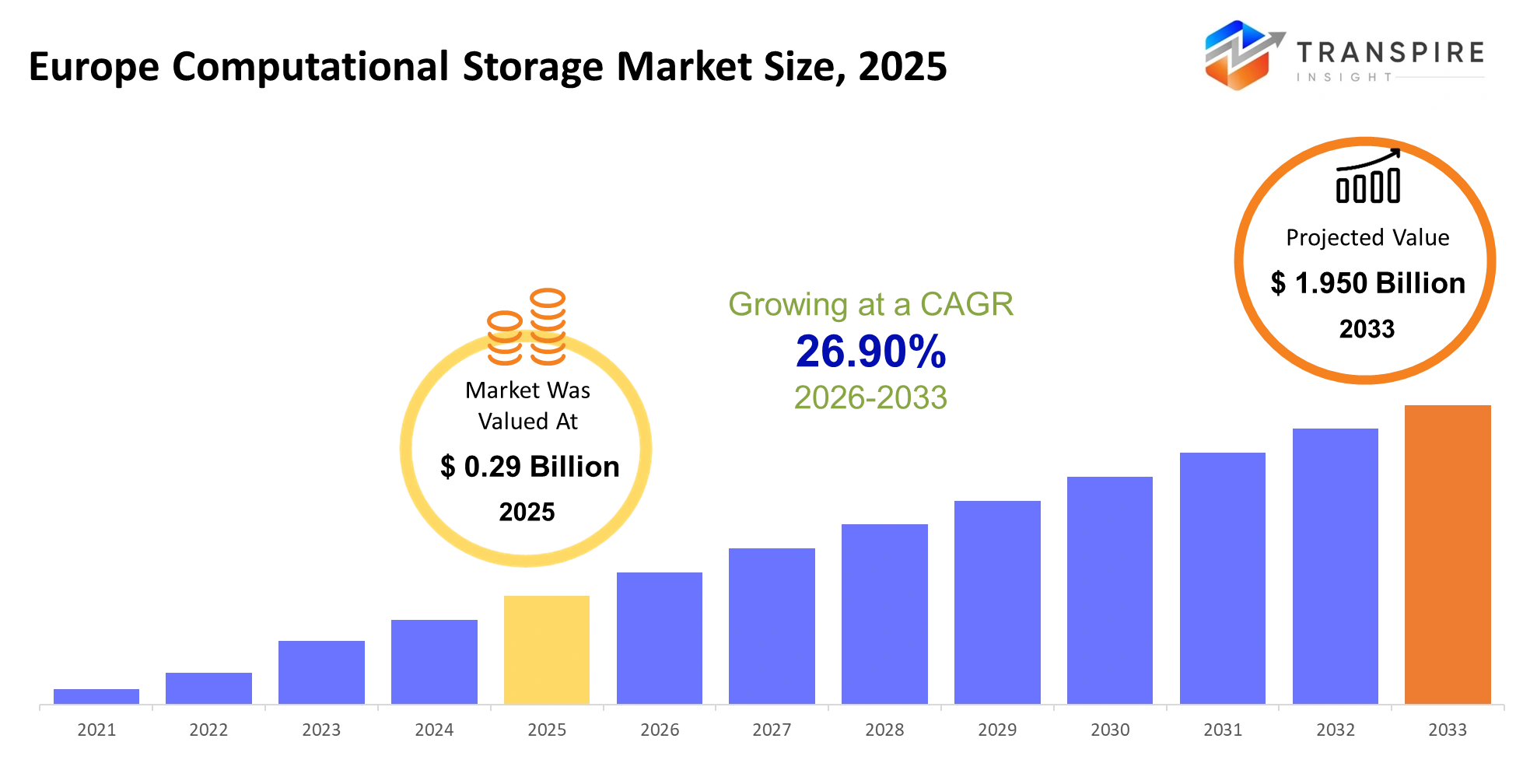
Europe Computational Storage Market Size & Forecast:
- Europe Computational Storage Market Size 2025: USD 0.29 Billion
- Europe Computational Storage Market Size 2033: USD 1.950 Billion
- Europe Computational Storage Market CAGR: 26.90%
- Europe Computational Storage Market Segments: By Type (SSD-based, HDD-based, Hybrid Storage, NVMe Storage, Smart Storage, Others); By Application (Data Centers, AI Workloads, HPC, Cloud Computing, Edge Computing, Others); By End-User (IT Companies, Cloud Providers, Enterprises, Telecom, Research Institutes, Others); By Component (Storage Drives, Processors, Controllers, Software, Memory, Others).
To learn more about this report,  Download Free Sample Report
Europe Computational Storage Market Summary:
The Europe Computational Storage Market size is estimated at USD 0.29 Billion in 2025 and is anticipated to reach USD 1.950 Billion by 2033, growing at a CAGR of 26.90% from 2026 to 2033. The Europe computational storage market in the advanced data infrastructure sector will be affected by the trend of performing operations on data at its source location, which will minimize latency and power consumption. Businesses will require faster analysis of their data without transporting huge volumes of data, specifically for the sectors of finance, healthcare, and edge. Increased data sovereignty laws in Europe will prompt businesses to keep computations closer to home, thereby affecting architectural decisions. Hardware will be further improved, whereby future generations of storage systems will perform computations directly from storage units.
What Has the Impact of Artificial Intelligence Been on the Europe Computational Storage Market?
The rapid evolution of artificial intelligence technology is already impacting the operation of the europe computational storage market, forcing its members towards making prompt decisions based on the data. The integration of artificial intelligence into the europe computational storage market environment would mean the introduction of systems capable of analyzing data directly in storage layers and, hence, minimize latency. Artificial intelligence would also enhance market research and data analysis through machine learning models that will be able to recognize patterns in data usage and workflow as well as predict potential performance issues.
Additionally, the integration of artificial intelligence into the europe computational storage market application would result in higher production efficiency and smart automation of hardware and software infrastructure. It would become possible through integrating processing capacity into storage devices in order to automate the process of data flows optimization. Predictive capabilities would also ensure a decrease in costs related to the production and operation of hardware components. At the same time, the market will reflect increasing popularity of intelligent and self-managing storage solutions.
With growing competition, the use of artificial intelligence in Europe’s computational storage market strategy will foster innovation and differentiation. Businesses will utilize machine learning to customize data services, enhance system resiliency, and achieve a competitive advantage in high-performance computing systems.
Key Market Trends & Insights:
- Western Europe accounts for over 45% market share in 2025 due to extensive cloud computing infrastructure and digitalization of enterprises.
- Northern Europe has the highest CAGR during 2025–2030 because of a high level of edge computing and sustainable growth of data centers.
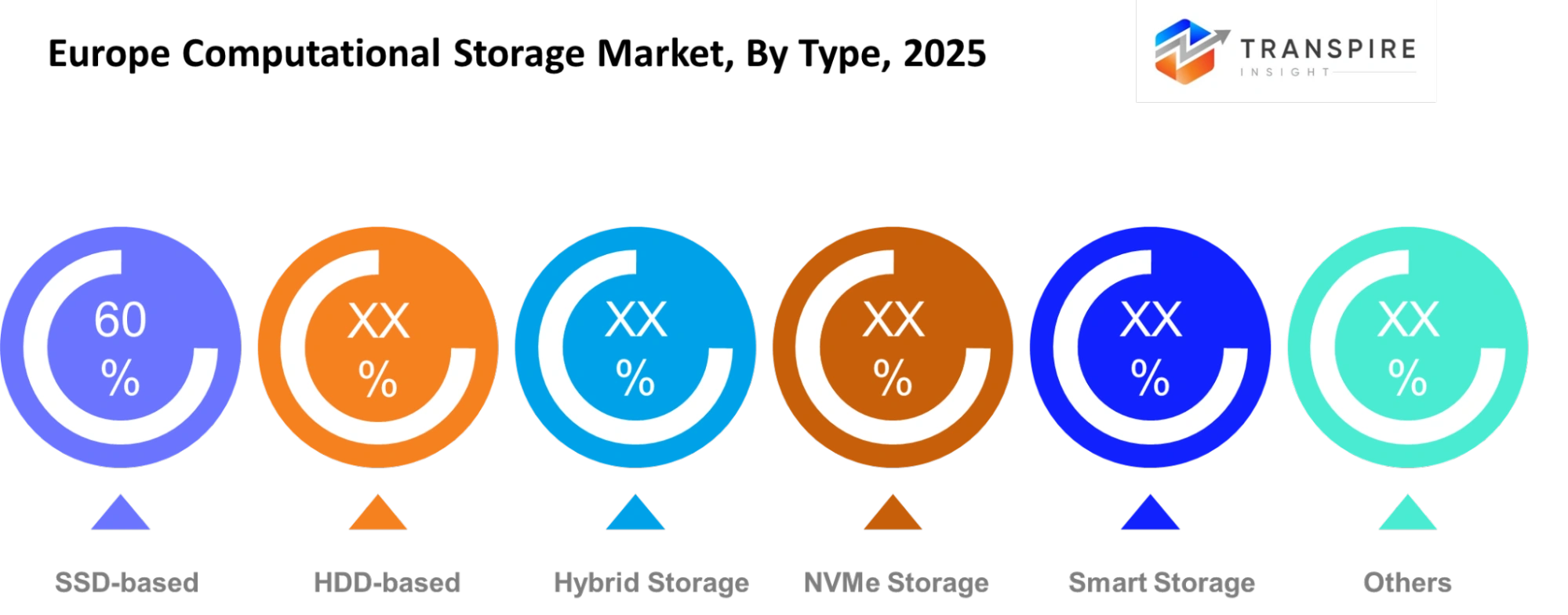
- Computational storage based on SSDs takes the leading market position with nearly 55% share because of high speed and low latency.
- The next leading solution is HDD-based computational storage, which is the most widely used because of its economic aspect and large volumes of stored data.
- The segment of smart storage accelerators experiences the highest growth rate between 2025 and 2030 due to the need for AI and HPC tasks.
- Data analytics and real-time processing take more than 40% share because of fast results and reduction of time in transferring data.
- The fastest-growing segment is related to AI-based applications that are increasingly used in various areas thanks to machine learning algorithms.
- IT & Telecommunications industry accounts for nearly 35% of the target market because of massive data exchange and processing.
- The healthcare industry and banking & finance will experience rapid growth due to using computational storage for their real-time data needs.
Europe Computational Storage Market Segmentation
By Type
The SSD based storage solution will be adopted because of its high speed of data processing and low latency that would help with real-time analysis and enterprise use cases. HDD based storage will still be used in environments where there is need for low-cost storage as it will accommodate large amounts of data in such environments. Hybrid storage will offer a combination of both speed and capacity in order to optimize performance. NVMe storage will become more popular due to increased speed of interfaces in order to increase the speed of data transfer.
This part will exhibit a trend towards performance based systems that will rely on efficiency and fast operation for adoption. Organizations will look for storage models that will be capable of accommodating all types of data in their operations. This will be made possible by advances in embedded processing.
To learn more about this report, Download Free Sample Report
By Application
Data centers will continue to dominate applications since organizations will centralize large amounts of data management in an efficient manner. AI applications will grow fast, as machine learning will involve rapid data processing and computing power in devices. HPC will make use of computational storage to lower latency and increase parallel processing. Cloud computing applications will leverage high-end storage for managing distributed loads efficiently. Edge computing will gain momentum due to local data processing that will lessen dependence on central infrastructure.
Application trends will become increasingly consistent with real-time and data-intensive processing. Companies will strive to minimize data transmission time and system response time. Expansion in AI and edge computing applications will drive the evolution of storage in decentralized systems.
By End-User
Companies dealing in IT will be dominating in terms of use, owing to the requirement of having an efficient combination of data storage and analytics. Cloud services will see an increased demand as the need arises for scalable and efficient infrastructure. The use will be made by enterprises for the purpose of optimizing their internal functioning. In addition, use can be seen in the telecommunication industry where there is a need for better processing of data to facilitate growth.
The demands of users will move towards technology that will enable them to perform as well as provide cost efficiency. The increase in data will prompt companies to look at ways to ensure that processing takes place fast. This is because competitiveness requires organizations to make use of their data efficiently.
By Component
The storage drive will serve as the base of computational storage systems with the incorporation of processing capacity within hardware. The processor will facilitate computations from within the hardware. The controller will help to direct the flow of information and coordinate between components. The software component will be significant in coordinating activities. Memory chips will facilitate rapid access to data during processing activities.
Component development will determine the capacity that computational storage systems will have. Seamless integration between the hardware and software component will enhance the operations of the system. Processing capacity within the storage units will be the area of innovation while still remaining energy efficient. Market trends will be determined by the effectiveness of the components in working together to meet future demands.
What are the Main Challenges for the Europe Computational Storage Market Growth?
There are several key issues regarding technical integration and operation that will pose an obstacle for the development of the europe computational storage market. Namely, introducing computing capability into the storage devices will result in performance balancing problems during their heavy utilization. The stability of systems and their compatibility with existing information technology systems will be complicated, as organizations will have to reconfigure their architecture to maximize the potential offered by computational storage solutions. Finally, the europe computational storage market will experience scalability problems due to the shortage of sophisticated semiconductors.
There is yet another problem related to the manufacturing and deployment of computational storage in the europe computational storage market. As far as the creation of advanced storage devices with built-in computing capability implies precision, it will raise manufacturing costs and make such equipment less affordable for medium-sized organizations. Compliance with regulations concerning the usage of hardware in each country of Europe, especially data management practices, will hinder deployment processes.
Adoption issues will define the europe computational storage market as numerous businesses will not have the necessary resources and knowledge to adopt such sophisticated technology. A lack of awareness and qualified personnel in computational storage and artificial intelligence architecture will be barriers to adoption. Small companies will experience financial issues that will prevent them from adopting the new storage technology, thus creating a divide between the early adopters and other participants in the market.
Other technologies such as cloud computing and high performance computing will present competition for the europe computational storage market. Price concerns and unclear ROI will be some of the factors that will determine purchase decisions.
Regional Insights
The market for computational storage in Europe will show different performance levels across its main economies because digital infrastructure and business adoption rates vary between regions. Western Europe will keep its strong market position because of its existing data center infrastructure and its adoption of new storage solutions. Northern Europe will experience continuous growth because of its green data management methods and cloud technology usage.
The market will experience changes because of regulatory systems which will require organizations to protect their data through localized storage and compliance with security rules. The Central and Eastern European region will progress toward higher technology acceptance as spending on information technology infrastructure increases. The local market will depend on how prepared businesses are and how well they understand technology which will determine its overall development.
Western Europe will lead the market because businesses invest heavily in IT infrastructure while international tech companies establish offices throughout the region. The countries of Germany and France will lead cloud technology acceptance because their advanced cloud platforms support data-based business operations. Northern Europe will build momentum through the development of environmentally sustainable data centers and edge computing technologies.
There will be a slow but sure growth trend in the Southern and Eastern regions because more industries will implement digitalization efforts. Infrastructure development and investments will contribute significantly to boosting the adoption rate. There will be no gaps among the regions over time because of greater knowledge about computational storage.
Recent Development News
In April 2026, IBM expanded its enterprise cloud and AI portfolio with additional government-authorized solutions, strengthening its position in secure data infrastructure services across Europe.
Source: https://www.stocktitan.net
In April 2026, OneStream completed its acquisition by Hg in a $6.4 billion deal, marking a major private equity transaction that reshaped enterprise software and data management capabilities.
Source: https://www.stocktitan.net
|
Report Metrics |
Details |
|
Market size value in 2025 |
USD 0.29 Billion |
|
Market size value in 2026 |
USD 0.368 Billion |
|
Revenue forecast in 2033 |
USD 1.950 Billion |
|
Growth rate |
CAGR of 26.90% from 2026 to 2033 |
|
Base year |
2025 |
|
Historical data |
2021 - 2024 |
|
Forecast period |
2026 - 2033 |
|
Report coverage |
Revenue forecast, competitive landscape, growth factors, and trends |
|
Regional scope |
Europe (Germany, United Kingdom, France, Italy, Spain, Rest of Europe) |
|
Key company profiled |
Samsung, Intel, Western Digital, Seagate, Micron, Kioxia, NVIDIA, IBM, Dell, HP, Cisco, NetApp, Pure Storage, Marvell, Broadcom. |
|
Customization scope |
Free report customization (country, regional & segment scope). Avail customized purchase options to meet your exact research needs. |
|
Report Segmentation |
By Type (SSD-based, HDD-based, Hybrid Storage, NVMe Storage, Smart Storage, Others); By Application (Data Centers, AI Workloads, HPC, Cloud Computing, Edge Computing, Others); By End-User (IT Companies, Cloud Providers, Enterprises, Telecom, Research Institutes, Others); By Component (Storage Drives, Processors, Controllers, Software, Memory, Others). |
How Can New Companies Establish a Strong Foothold in the Europe Computational Storage Market?
The new entrants who want to establish themselves in the European computational storage market should target specific market segments which experience rising demand but have minimal competition. The healthcare and manufacturing and smart cities sectors will provide immediate market possibilities because their operations require enhanced data processing capabilities and nearby data analysis functions. The market demand will drive companies to achieve growth by developing solutions that address particular business challenges, which include immediate medical evaluations and production facility automation and city information system control.
The novel entrants in the computational storage landscape of Europe will apply innovative techniques in order to build unique market positioning. New firms will be required to develop unique products, such as AI-based storage components or edge computing technology that reduces latency. Machine learning and predictive analysis, when combined, will enable companies to achieve significant performance improvements. The companies Nyriad and ScaleFlux demonstrate how technology development can solve high-performance computing problems while attracting enterprise customers.
The European computational storage market will experience increased market entry through strategic partnerships. The company will gain access to established distribution channels and technical expertise through its partnerships with cloud providers and data center operators and semiconductor companies. The partnerships will enable companies to accelerate their business development while establishing themselves as trustworthy organizations in an environment that experiences rapid technological change.
The distinction between technology and cost efficiency will determine the future of the europe computational storage market. Those companies which can manage to strike a balance between all these factors will hold an advantage over their competitors.
Key Europe Computational Storage Market Company Insights
The European computational storage market will maintain its competitive balance through three factors which include technological advances, pricing methods, and the need for organizations to process data effectively. The main focus for established companies will become the combination of processing capabilities with storage solutions to achieve faster performance and shorter response times. Companies will determine their market success through their ability to deliver effective performance results while maintaining cost-effective operations .
Technology providers will create new solutions which will disrupt current industry operations by introducing advanced technologies for data-intensive systems. The need for systems that can grow and adapt will shape how products are developed. Organizations will face continuous development needs which stem from competitive pressure to improve their hardware and software systems so that all their business applications will function better and more reliably.
Top companies will develop their organizations through product development which will focus on creating AI-powered storage systems and edge processing solutions. The organization will develop its service capabilities through strategic partnerships which involve cloud service providers and data center operators. The organization will maintain its technological edge over its rivals through ongoing investments in research and development activities.
New market entrants will disrupt established companies by providing them with budget-friendly specialized solutions which meet their specific needs. The ability to gain a competitive edge requires businesses to develop unique capabilities which include delivering better performance and higher scalability and simpler system integration. The market will experience heightened competition as companies develop advanced storage solutions to meet enterprise storage needs.
Company List
- Samsung
- Intel
- Western Digital
- Seagate
- Micron
- Kioxia
- NVIDIA
- IBM
- Dell
- HP
- Cisco
- NetApp
- Pure Storage
- Marvell
- Broadcom
What are the Key Use-Cases Driving the Growth of the Europe Computational Storage Market?
The europe computational storage market develops because data-heavy applications need faster processing and less data transfer between systems. In healthcare, real-time imaging analysis and genomic sequencing will benefit from processing data directly within storage systems, improving speed and accuracy. Financial services will also use this method to identify fraudulent activities and monitor high-frequency trading operations because traders need to make quick decisions within milliseconds. These applications are directly strengthening adoption across critical sectors.
The europe computational storage market will help manufacturing and automotive industries through its support of smart factory operations and autonomous systems. Industrial IoT environments will create vast data streams which require instant processing at their point of origin to enable predictive maintenance while minimizing equipment downtime. Similarly, connected vehicles will depend on low-latency data handling for navigation and safety systems, driving demand for embedded computational capabilities.
The europe computational storage market will grow through enterprise and cloud environments because organizations search for effective solutions to handle extensive data collections. Computational storage will be adopted in data centers to boost their analytics processes while reducing bandwidth costs. The edge computing sector will become an important growth area, particularly within smart cities, owing to improved data processing that will lead to better traffic control, surveillance, and energy efficiency.
Trends like AI-based analytics and machine learning will add more importance to the europe computational storage market. The implementation of these technologies by organizations will help them achieve faster results and boost their efficiency.
Europe Computational Storage Market Report Segmentation
By Type
- SSD-based
- HDD-based
- Hybrid Storage
- NVMe Storage
- Smart Storage
- Others
By Application
- Data Centers
- AI Workloads
- HPC
- Cloud Computing
- Edge Computing
- Others
By End-User
- IT Companies
- Cloud Providers
- Enterprises
- Telecom
- Research Institutes
- Others
By Component
- Storage Drives
- Processors
- Controllers
- Software
- Memory
- Others
Frequently Asked Questions
Find quick answers to common questions.
The approximate Europe Computational Storage Market size for the market will be USD 1.950 Billion in 2033.
Key segments for the Europe Computational Storage Market are By Type (SSD-based, HDD-based, Hybrid Storage, NVMe Storage, Smart Storage, Others); By Application (Data Centers, AI Workloads, HPC, Cloud Computing, Edge Computing, Others); By End-User (IT Companies, Cloud Providers, Enterprises, Telecom, Research Institutes, Others); By Component (Storage Drives, Processors, Controllers, Software, Memory, Others).
Major Europe Computational Storage Market players are Samsung, Intel, Western Digital, Seagate, Micron, Kioxia, NVIDIA, IBM, Dell, HP, Cisco, NetApp, Pure Storage, Marvell, Broadcom.
The Europe Computational Storage Market size is USD 0.29 Billion in 2025.
The Europe Computational Storage Market CAGR is 26.90%.
- Samsung
- Intel
- Western Digital
- Seagate
- Micron
- Kioxia
- NVIDIA
- IBM
- Dell
- HP
- Cisco
- NetApp
- Pure Storage
- Marvell
- Broadcom
Recently Published Reports
-
Apr 2026
3D Optical Profiler Market
3D Optical Profiler Market Size, Share & Analysis Report By Type (Desktop 3D Optical Profiler, and Portable 3D Optical Profiler), By Technology (Confocal Technology, and White Light Interference), By End-Use Industry (Manufacturing, Research Institutions, Automotive, Aerospace and Defense, Medical Devices, and Other), and Geography (North America, Europe, Asia-Pacific, Middle East and Africa, South and Central America), 2021 - 2031
-
Apr 2026
Depth Sensor Market
Depth Sensor Market Size, Share & Analysis Report By Type (Infrared Depth Sensors, Time-of-Flight (ToF) Sensors, Stereo Vision Sensors, Structured Light Sensors, Ultrasonic Depth Sensors), By Application (Automotive, Robotics, Gaming, Consumer Electronics, Industrial Automation, Healthcare, Security & Surveillance, Others), By End Users (Automotive Manufacturers, Consumer Electronics Companies, Healthcare Providers, Industrial Companies, Security Agencies, Gaming Companies, Robotics Companies, Others), and Geography (North America, Europe, Asia-Pacific, Middle East and Africa, South and Central America), 2021 – 2031
-
Apr 2026
Digital Manufacturing Market
Digital Manufacturing Market Size, Share & Analysis Report By Component (Hardware, Software, and Services), By Technology (Robotics, 3D Printing, Internet of Things (IoT), and Others), By Application (Automotive and Transportation, Aerospace and Defense, Consumer Electronics, Industrial Machinery, and Others), By Process Type (Computer-Based Designing, Computer-Based Simulation, Computer 3D Visualization, Analytics, and Others), and Geography (North America, Europe, Asia-Pacific, Middle East and Africa, South and Central America), 2021 – 2031
-
Apr 2026
Digital Visa Services Market
Digital Visa Services Market Size, Share & Analysis Report By Type (Individual Travelers, Group Travelers), By Application (Tourism, Business Travel, Others), and Geography (North America, Europe, Asia-Pacific, Middle East and Africa, South and Central America), 2021 – 2031