
Asia Pacific Closed-Loop Spinal Cord Stimulation Device Market Size & Forecast:
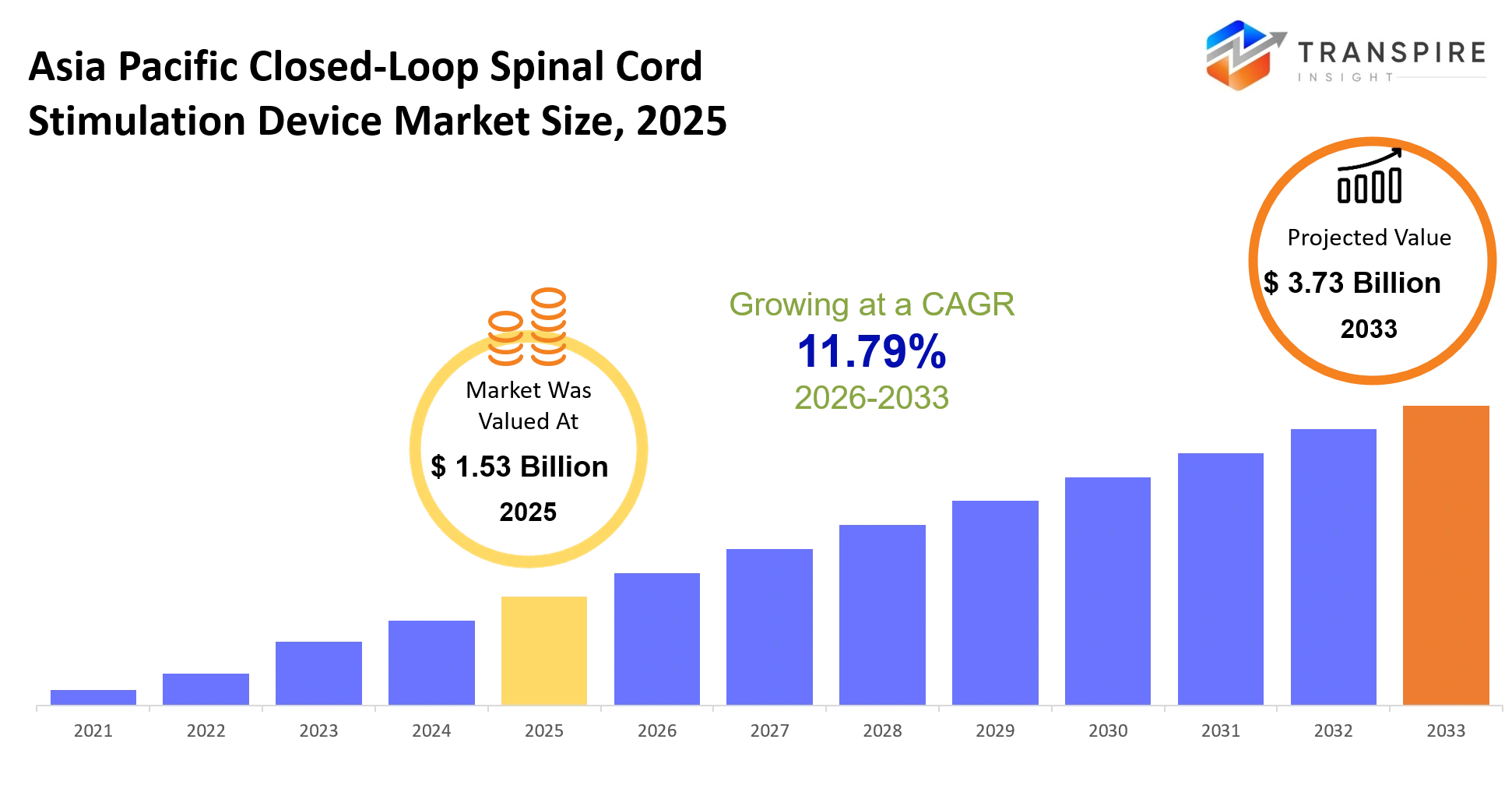
- Asia Pacific Closed-Loop Spinal Cord Stimulation Device Market Size 2025: USD 1.53 Billion
- Asia Pacific Closed-Loop Spinal Cord Stimulation Device Market Size 2033: USD 3.73 Billion
- Asia Pacific Closed-Loop Spinal Cord Stimulation Device Market CAGR: 11.79%
- Asia Pacific Closed-Loop Spinal Cord Stimulation Device Market Segments: By Product Type (Rechargeable Neurostimulators, Non-Rechargeable Neurostimulators, Implantable Pulse Generators, External Controllers, Leads & Electrodes, Programming Systems, Accessories, Others); By Application (Chronic Pain Management, Failed Back Surgery Syndrome, Complex Regional Pain Syndrome, Neuropathic Pain, Degenerative Disc Disease, Post-Surgical Pain, Cancer Pain Management, Others); By Technology (Closed-Loop Systems, Adaptive Stimulation Systems, AI-Assisted Neurostimulation, Wireless Neurostimulation, Bluetooth-Enabled Systems, Real-Time Feedback Systems, Smart Implant Systems, Others); By End User (Hospitals, Specialty Pain Clinics, Ambulatory Surgical Centers, Neurosurgery Centers, Rehabilitation Centers, Research Institutes, Academic Hospitals, Others); By Distribution Channel (Direct Sales, Medical Device Distributors, Hospital Procurement, Specialty Suppliers, Online Procurement, Government Tenders, OEM Partnerships, Others).
Asia Pacific Closed-Loop Spinal Cord Stimulation Device Market Summary
The Asia Pacific Closed-Loop Spinal Cord Stimulation Device Market was valued at USD 1.53 Billion in 2025. It is forecast to reach USD 3.73 Billion by 2033. That is a CAGR of 11.79% over the period.
The Asia Pacific Closed-Loop Spinal Cord Stimulation Device Market was valued at USD 1.53 billion in 2025 , and it is projected to hit USD 3.73 billion by 2033. In general , content intelligence platforms let enterprises turn huge amounts of messy, unstructured material into useful, practical insights by automating things like content classification, search , governance, personalization, and compliance. Across banking, retail, healthcare, manufacturing, and media, more organizations are now leaning on these solutions. They do it to boost customer engagement, while also cutting down on the costly, hands-on work involved in managing content.
In the last five years, the whole market seems to move away from strictly rule based content management. Instead it trends toward AI driven semantic analysis , plus generative AI assisted workflows. After the COVID-19 pandemic, hybrid work setups and digital customer engagement grew fast, so investments followed. Companies started wanting intelligent content platforms that can manage distributed data securely. And as organizations produce really, significantly more digital content , they increasingly need automated intelligence instead of manual processing. This shift helps operational efficiency , makes regulatory compliance easier, and supports more tailored experiences, which then shows up as higher enterprise software spending and steady long-term recurring subscription revenue across the Asia Pacific region.
Key Market Insights
- East Asia really kinda dominates the Asia Pacific Closed-Loop Spinal Cord Stimulation Device Market , with around 46% market share in 2025, largely backed by advanced enterprise digitalization, which basically keeps things moving.
- Southeast Asia is projected to be the fastest-growing regional market all the way through 2033 , since cloud infrastructure investments ramp up by more than 15% each year.
- Cloud-based content intelligence platforms lead the pack at nearly 68% market share , helped by scalable deployment and lower infrastructure costs, overall.
- Hybrid deployment sits in second place with roughly 22% share , especially where regulated financial institutions and government agencies operate.
- AI-powered semantic search and generative content analytics are expected to be the fastest-growing solution category from 2025 to 2033, honestly.
- Customer experience management brings in about 34% of application revenue, so it stays the most dominant enterprise use case.
- Regulatory compliance and content governance solutions are also set to grow quickest, as data privacy regulations keep expanding across Asia Pacific.
- Big enterprises contribute close to 71% of total market revenue, while SME adoption keeps accelerating via SaaS subscription models, steadily.
- Microsoft, IBM, OpenText, Adobe, Oracle, and Google Cloud continue strengthening their competitive positions through AI innovation , regional cloud expansion, plus strategic enterprise partnerships.
- Vendors are increasingly folding in generative AI, multilingual natural language processing, and predictive analytics to boost automation accuracy, while also differentiating their enterprise content intelligence platforms.
What are the Key Drivers, Restraints, and Opportunities in the Asia Pacific Closed-Loop Spinal Cord Stimulation Device Market?
The strongest driver of market expansion is, well, the rapid enterprise adoption of generative AI combined with intelligent automation across digital business operations. Now organizations manage exponentially larger volumes of emails, contracts, customer conversations, images, videos and other knowledge assets than traditional enterprise content management systems can efficiently, or really even comfortably, process. The arrival of large language models and AI-powered semantic analytics has noticeably improved document comprehension , automated tagging, sentiment analysis, and knowledge discovery. In practice, these abilities cut down on manual workload, speed up decision making, and raise employee output, which makes enterprises more likely to expand their spending on content intelligence software and cloud-based subscription services.
Still, data privacy regulations, fragmented enterprise data environments, and legacy IT infrastructure remain the market’s most stubborn structural barriers. A lot of organizations keep business content across disconnected repositories, and as a result, integration becomes technically complex, and it is also expensive. Banking, healthcare, and government in particular need strict governance on sensitive information, before they even deploy AI-powered platforms. Those implementation headaches stretch deployment timelines, push consulting costs upward, and slow down organization-wide adoption, so revenue realization lags even if demand for the technology stays strong.
There’s also a pretty clear growth opportunity in multilingual AI content intelligence, aimed at Asia Pacific’s linguistically diverse business environment. Enterprises increasingly want platforms that can accurately handle English , Chinese, Japanese, Korean, Hindi, Thai, Bahasa Indonesia and other regional languages all inside a single workflow.
What Has the Impact of Artificial Intelligence Been on the Asia Pacific Closed-Loop Spinal Cord Stimulation Device Market?
Artificial intelligence has, like, fundamentally reshaped content intelligence, so organizations can automate document classification, metadata creation, sentiment tracking, content moderation and knowledge extraction with very little human involvement. Today’s AI models can work with both structured and unstructured enterprise information at the same time, which means businesses are able to sort millions of documents, customer interactions, videos and emails faster than typical content management systems. Natural language processing also lifts multilingual search quality, so enterprises can function across multiple Asia Pacific markets with less friction.
Meanwhile, machine learning models keep watching user behavior, content performance, and internal workflows to suggest the most relevant information, anticipate content demand, and fine tune digital experiences. With predictive analytics, teams can move toward proactive compliance monitoring by spotting sensitive material before it goes live, and also by catching governance risks early. AI assisted automation further cuts down document processing turnaround, trims administrative workload, boosts how quickly people find knowledge, and brings operating expenses down, all while enabling quicker business decisions.
Still, AI adoption hits practical walls. A lot of organizations run on fragmented legacy systems, with inconsistent data formats, and this reduces model accuracy once deployment happens. On top of that there are the high implementation costs, the lack of AI know how, tricky integration needs, and different regional rules around data privacy. These issues keep slowing down broad enterprise rollouts especially for mid-sized organizations, where digital transformation budgets are limited .
Key Market Trends
- Enterprises were moving away from keyword style search, toward AI driven semantic comprehension, so content discovery accuracy went up around 30–40% inside huge digital libraries, you know the big ones where everything is scattered.
- Cloud native deployments started beating the old on prem setups, and by 2025 cloud platforms were nearly 68% of brand new enterprise deployments, not, like, every single time but still pretty much.
- After 2023, generative AI adoption jumped pretty fast, letting teams automate content creation, do summarization, generate metadata, and sort of run enterprise knowledge management with less manual effort than before.
- Financial services companies ramped up spending on intelligent compliance platforms as privacy rules got tighter across Japan, Singapore, Australia, and India.
- Microsoft, IBM, Adobe, OpenText, Oracle, and Google Cloud kept pushing growth in their AI enabled enterprise content lineups, relying on product innovation and putting money into regional cloud investments.
- Companies also leaned harder into multilingual natural language processing, so they could handle business documents across multiple Asian languages inside one kind of unified enterprise workflow.
- On the buying side, preferences shifted from perpetual licenses to subscription based SaaS offerings, partly because the AI models keep improving, and deployment costs usually stay lower, which is a real factor.
- Competition in the industry is now much more about AI accuracy, enterprise security, interoperability, plus how well everything plugs into existing productivity and collaboration ecosystems.
- Meanwhile manufacturing and healthcare teams sped up intelligent document automation to cut down administrative burden and still keep operational consistency and regulatory compliance in check.
- Vendors increasingly blend predictive analytics with knowledge graphs, and add conversational AI assistants too, aiming to turn enterprise content into real time business intelligence.
Asia Pacific Closed-Loop Spinal Cord Stimulation Device Market Segmentation
By Product Type
Rechargeable Neurostimulators see faster adoption, mostly because long battery life means less frequent replacement procedures, and that in turn reduces the long run treatment cost, for many patients. Non-Rechargeable Neurostimulators still make sense in cases where energy needs are lower and when the expected therapy horizon is shorter. Implantable Pulse Generators are basically the heart of spinal cord stimulation systems. They deliver controlled electrical impulses, which assist with managing persistent pain, day to day. External Controllers let doctors and patients fine tune the therapy settings in a safe way, and they also help keep things personalized for pain management.
Leads & Electrodes matter a lot, because they transmit the electrical signals with accuracy toward targeted nerves, so the placement quality is a big deal for the final outcomes. Programming Systems help clinicians adjust stimulation parameters based on clinical response and patient comfort, rather than using a one size fits all approach. Accessories cover implantation, upkeep, charging, and daily operation, so overall device usability improves. Others can include specialized parts and newer product variations that are created for specific clinical requirements, and these variations expand treatment options across different patient groups.

By Application
Chronic Pain Management still seems to be the main application because spinal cord stimulation is broadly used for long lasting pain relief in people who don’t really respond well to the usual, conventional therapies. Failed Back Surgery Syndrome also adds a lot to demand since post surgical complications often call for more advanced neuromodulation support, and that part is pretty common in practice. Complex Regional Pain Syndrome and Neuropathic Pain conditions push adoption too, especially when the nerve related pain turns into a persistent issue and becomes hard to address. Degenerative Disc Disease further supports the whole trend, partly because spinal disorders are rising alongside aging populations and more sedentary lifestyles.
Post Surgical Pain management is getting more traction now , as clinicians lean toward minimally invasive options for recovery support and for lowering opioid dependence. Cancer Pain Management keeps expanding as palliative care programs include neuromodulation to support better patient comfort. There are also other categories, like uncommon and mixed pain conditions, where the stimulation approach needs to be customized based on the individual response. Overall application demand looks like it is shifting toward advanced, technology driven pain control methods that help quality of life, and also reduce long term medication dependency.
By Technology
Closed-Loop Systems are leading the adoption curve because real time feedback makes stimulation accuracy better, it also helps tune the therapy based on how the patient is actually responding . Adaptive Stimulation Systems back this up by allowing more fluid changes in pain patterns, and they keep relief more steady without needing constant clinical readjustments. AI assisted Neurostimulation is picking up speed since machine learning models can refine signal delivery and support better longer term treatment outcomes.
Wireless Neurostimulation also matters, it eases surgical complexity by cutting down on wired connections and it tends to improve comfort during everyday moving around . Bluetooth enabled Systems then add remote tweaking through secure mobile integration so accessibility grows for patients and clinicians alike. Real Time Feedback Systems boost therapy precision further, by constantly checking physiological signals and tuning stimulation levels on the fly. Smart Implant Systems pull in advanced sensors plus automated controls, which can improve efficiency and personalization of care.
Other directions are showing up too, including hybrid technologies that blend several stimulation methods, with the aim of raising reliability, improving safety, and strengthening long term pain management results across different patient populations .
By End User
Hospitals basically end up taking the leading portion in adoption, since spinal cord stimulation procedures need advanced surgical setup, very skilled neurosurgeons, and those post op monitoring facilities that really cannot be skipped. Specialty Pain Clinics are also growing steadily, more people seem to want focused chronic pain care, and they like the minimally invasive kind of therapy options too. Ambulatory Surgical Centers are starting to gain traction , mainly because stays are shorter and the overall procedures tend to be more cost-effective, so access feels easier for spinal cord stimulation implantation. Neurosurgery Centers matter a lot as well , because their know how supports the complex spinal and nerve related interventions.
Then there are Rehabilitation Centers, they back up long term recovery and help fine tune therapy after the device is implanted, so patients can properly adapt to stimulation based pain control. Research Institutes do a lot in pushing forward the hardware innovation and running clinical trials, especially for next generation neurostimulation technologies. Academic Hospitals add value through training programs, clinical validation, and early rollout of advanced systems. And then the “others” category includes multi-specialty healthcare facilities that kind of fold spinal cord stimulation into broader pain management programs, that helps wider clinical acceptance , and usually leads to better patient outcomes across different care environments.
By Distribution Channel
Direct Sales lead distribution works because manufacturers keep pretty close ties with hospitals and specialty clinics, so they can handle device customization, keep clinical training running, and also provide post-implant service support. Medical Device Distributors tend to matter a lot when it comes to expanding coverage into tier-2 and tier-3 healthcare facilities, which helps increase access to spinal cord stimulation systems. Hospital Procurement channels are still a must for bulk purchasing choices, particularly inside big healthcare networks that standardize neuromodulation therapies across departments. Specialty Suppliers meanwhile back up the focused availability of newer stimulation devices in neurosurgery-oriented centers ,and pain management clinics.
Online Procurement is slowly expanding too, since digital healthcare purchasing platforms make equipment ordering easier, plus comparison across different suppliers. Government Tenders have a big say in adoption across public healthcare systems, where chronic pain management programs get institutional funding. OEM Partnerships strengthen supply chains by letting device manufacturers team up with regional healthcare providers for more localized production and service support. Other routes exist as well, like niche procurement pathways used by research institutions and private specialty facilities that need tailored spinal cord stimulation solutions for clinical studies, and advanced care protocols.
What are the Key Use Cases Driving the Asia Pacific Closed-Loop Spinal Cord Stimulation Device Market?
The main use case is basically chronic pain management, where spinal cord stimulation is used for people who dont respond to medication, or physical therapy, so they end up needing that kind of help. This kind of demand is especially strong in neurosurgery centers as well as hospitals dealing with ongoing neuropathic and post surgical pain. And because there are growing opioid restrictions in a lot of clinical settings, clinicians are pushed toward pain control methods that rely more on devices, which in turn makes adoption feel more normal inside routine care routes.
Beyond that, the expanding applications cover failed back surgery syndrome and complex regional pain problems, and in those areas specialty pain clinics are reporting more patient inflow. These situations often need advanced neuromodulation support, and they are more frequently handled in ambulatory surgical centers, mainly because recovery takes less time, and the overall procedural burden stays lower. Rehabilitation centers also matter here, since follow up care becomes kind of critical when therapy has to be optimized and when the device is expected to keep working well over the long term.
On the newer side, emerging use cases include cancer related pain management, plus degenerative spinal disorders that are treated through early stage intervention programs. Academic hospitals, along with research institutes, are already testing adaptive stimulation and AI assisted approaches, so the goal is tighter nerve targeting. In the long run, these applications may spread into outpatient care networks as device programming gets more automated, and the whole process becomes more patient friendly.
|
Report Metrics |
Details |
|
Market size value in 2025 |
USD 1.53 Billion |
|
Market size value in 2026 |
USD 1.71 Billion |
|
Revenue forecast in 2033 |
USD 3.73 Billion |
|
Growth rate |
CAGR of 11.79% from 2026 to 2033 |
|
Base year |
2025 |
|
Historical data |
2021 - 2024 |
|
Forecast period |
2026 - 2033 |
|
Report coverage |
Revenue forecast, competitive landscape, growth factors, and trends |
|
Regional scope |
Asia Pacific (India, China, Japan, Australia, South Korea, Rest of Asia Pacific) |
|
Key company profiled |
Medtronic, Abbott Laboratories, Boston Scientific, Saluda Medical, Nevro, Mainstay Medical, Nalu Medical, Biotronik, LivaNova, Synapse Biomedical, Integer Holdings, Cirtec Medical, Soterix Medical, NeuroPace, Stimwave Technologies. |
|
Customization scope |
Free report customization (country, regional & segment scope). Avail customized purchase options to meet your exact research needs. |
|
Report Segmentation |
By Product Type (Rechargeable Neurostimulators, Non-Rechargeable Neurostimulators, Implantable Pulse Generators, External Controllers, Leads & Electrodes, Programming Systems, Accessories, Others); By Application (Chronic Pain Management, Failed Back Surgery Syndrome, Complex Regional Pain Syndrome, Neuropathic Pain, Degenerative Disc Disease, Post-Surgical Pain, Cancer Pain Management, Others); By Technology (Closed-Loop Systems, Adaptive Stimulation Systems, AI-Assisted Neurostimulation, Wireless Neurostimulation, Bluetooth-Enabled Systems, Real-Time Feedback Systems, Smart Implant Systems, Others); By End User (Hospitals, Specialty Pain Clinics, Ambulatory Surgical Centers, Neurosurgery Centers, Rehabilitation Centers, Research Institutes, Academic Hospitals, Others); By Distribution Channel (Direct Sales, Medical Device Distributors, Hospital Procurement, Specialty Suppliers, Online Procurement, Government Tenders, OEM Partnerships, Others). |
Which Regions are Driving the Asia Pacific Closed-Loop Spinal Cord Stimulation Device Market Growth?
China is leading the Asia Pacific spinal cord stimulation market, mainly because it has a massive patient base plus things keep expanding, like tertiary hospitals are growing fast, and there’s heavy backing in neurosurgical infrastructure. The government led healthcare modernization plans keep rolling on , which in practice improves the reach of advanced pain management tools. On top of that , local production capability is rising and more clinicians are choosing imported neurostimulation systems, so overall clinical access looks stronger across most major city hubs.
Japan stays pretty steady, also quite technically mature, with high health care spending behind it and an early take up of precision medical devices. There’s a clear emphasis on caring for an aging population, so chronic pain treatment options stay in steady demand. The regulatory rules are strict though, which means spinal cord stimulation gets integrated in a controlled way, usually in specialized hospitals and academic medical centers, but it still keeps moving at a reliable pace.
India is showing up as the fastest growing area because awareness of minimally invasive pain therapies is climbing , and private health care infrastructure keeps expanding. Improvements in hospital networks and neurosurgical skills are pushing procedure adoption upward. Also, medical tourism is getting stronger, and cost sensitive treatment models are spreading, which is basically speeding up demand. This combination should create notable opportunities for device manufacturers from 2026 to 2033.
Who are the Key Players in the Asia Pacific Closed-Loop Spinal Cord Stimulation Device Market and How Do They Compete?
The spinal cord stimulation market seems fairly consolidated still, but there’s a lot of real competition going on between the established neurotechnology firms. What people chase most is product innovation, like making devices smaller, extending battery longevity, keeping MRI compatibility intact and advancing closed-loop stimulation. So basically this is the main battleground. Companies also lean hard into clinical evidence generation, plus physician training, and then the usual regulatory approvals so hospitals and specialty pain clinics in Asia Pacific actually adopt these systems.
Medtronic sits with a fairly wide clinical footprint, offering implantable neurostimulation systems with long battery life and very solid global distribution. They tend to tighten their stance via hospital partnerships, and by continuing upgrades in closed-loop stimulation technologies, aiming for better patient specific pain control outcomes.
Boston Scientific fights with wave-based stimulation approaches, and the idea is improving precision for pain relief while also boosting patient comfort. Their push across Asia Pacific is largely supported by physician training programs, and collaborations with tertiary hospitals when the pain cases are more complicated.
Abbott Laboratories differentiates by emphasizing MRI-compatible spinal cord stimulation systems and recharge solutions that feel easier for patients. They also expand using integrated digital health platforms, which enable remote monitoring and therapy adjustments. That angle is meant to improve long term treatment adherence.
Nevro concentrates on high-frequency stimulation systems, intended to dial down paresthesia effects and help patients stay more comfortable and tolerant. Their growth plan leans on expanding clinical evidence, plus targeted entry into emerging Asia Pacific healthcare markets, usually through specialty pain clinics and distributor partnerships.
Company List
- Medtronic
- Abbott Laboratories
- Boston Scientific
- Saluda Medical
- Nevro
- Mainstay Medical
- Nalu Medical
- Biotronik
- LivaNova
- Synapse Biomedical
- Integer Holdings
- Cirtec Medical
- Soterix Medical
- NeuroPace
- Stimwave Technologies
Recent Development News
In June 2026, Liqvd Asia announced strategic expansion focused on artificial intelligence adoption and acquisitions. The company aimed to improve content efficiency and personalization for brands while scaling its digital content intelligence operations ahead of its SME IPO.
Source: https://m.economictimes.com
In March 2026, India’s media and entertainment ecosystem expanded AI-driven content analytics adoption across production and distribution workflows. This shift improved multilingual content creation efficiency and reduced production costs, accelerating enterprise use of content intelligence tools in Asia Pacific markets.
Source: https://m.economictimes.com
What Strategic Insights Define the Future of the Asia Pacific Closed-Loop Spinal Cord Stimulation Device Market?
Asia Pacific spinal cord stimulation market is kinda moving toward digitally integrated, patient- specific neuromodulation systems with AI based programming and remote monitoring working in the background. The growth likely depends more and more on whether companies can blend clinical precision with scalable outpatient treatment models, especially across these emerging healthcare systems. You’ll see demand shift toward minimally invasive , data-driven therapies because many providers want to lower long-term opioid dependence, and also reduce hospital load, sort of at the same time.
There is also a risk that is not immediately obvious: tighter regulatory frameworks around implantable devices, plus stronger cybersecurity requirements for connected stimulation systems. That combination could slow product approvals a bit, and also push compliance costs higher than expected. Meanwhile, a big chance is starting to show up in AI enabled closed loop stimulation, that adjusts in real time to how the patient’s nerve response actually behaves, and it seems especially relevant in high-growth areas like India, and Southeast Asia. The players that manage to pair solid clinical validation with affordable digital ecosystems will probably end up with the better longer term positioning overall.
Asia Pacific Closed-Loop Spinal Cord Stimulation Device Market Report Segmentation
By Product Type
- Rechargeable Neurostimulators
- Non-Rechargeable Neurostimulators
- Implantable Pulse Generators
- External Controllers
- Leads & Electrodes
- Programming Systems
- Accessories
- Others
By Application
- Chronic Pain Management
- Failed Back Surgery Syndrome
- Complex Regional Pain Syndrome
- Neuropathic Pain
- Degenerative Disc Disease
- Post-Surgical Pain
- Cancer Pain Management
- Others
By Technology
- Closed-Loop Systems
- Adaptive Stimulation Systems
- AI-Assisted Neurostimulation
- Wireless Neurostimulation
- Bluetooth-Enabled Systems
- Real-Time Feedback Systems
- Smart Implant Systems
- Others
By End User
- Hospitals
- Specialty Pain Clinics
- Ambulatory Surgical Centers
- Neurosurgery Centers
- Rehabilitation Centers
- Research Institutes
- Academic Hospitals
- Others
By Distribution Channel
- Direct Sales
- Medical Device Distributors
- Hospital Procurement
- Specialty Suppliers
- Online Procurement
- Government Tenders
- OEM Partnerships
- Others
Frequently Asked Questions
Find quick answers to common questions.
The expected Asia Pacific Closed-Loop Spinal Cord Stimulation Device Market size for the market will be USD 3.73 Billion in 2033.
Key segments for the Asia Pacific Closed-Loop Spinal Cord Stimulation Device Market are By Product Type (Rechargeable Neurostimulators, Non-Rechargeable Neurostimulators, Implantable Pulse Generators, External Controllers, Leads & Electrodes, Programming Systems, Accessories, Others); By Application (Chronic Pain Management, Failed Back Surgery Syndrome, Complex Regional Pain Syndrome, Neuropathic Pain, Degenerative Disc Disease, Post-Surgical Pain, Cancer Pain Management, Others); By Technology (Closed-Loop Systems, Adaptive Stimulation Systems, AI-Assisted Neurostimulation, Wireless Neurostimulation, Bluetooth-Enabled Systems, Real-Time Feedback Systems, Smart Implant Systems, Others); By End User (Hospitals, Specialty Pain Clinics, Ambulatory Surgical Centers, Neurosurgery Centers, Rehabilitation Centers, Research Institutes, Academic Hospitals, Others); By Distribution Channel (Direct Sales, Medical Device Distributors, Hospital Procurement, Specialty Suppliers, Online Procurement, Government Tenders, OEM Partnerships, Others).
Major Asia Pacific Closed-Loop Spinal Cord Stimulation Device Market players are Medtronic, Abbott Laboratories, Boston Scientific, Saluda Medical, Nevro, Mainstay Medical, Nalu Medical, Biotronik, LivaNova, Synapse Biomedical, Integer Holdings, Cirtec Medical, Soterix Medical, NeuroPace, Stimwave Technologies.
The Asia Pacific Closed-Loop Spinal Cord Stimulation Device Market size is USD 38489.2 Billion in 2025.
The Asia Pacific Closed-Loop Spinal Cord Stimulation Device Market CAGR is 11.79% from 2026 to 2033.
- Medtronic
- Abbott Laboratories
- Boston Scientific
- Saluda Medical
- Nevro
- Mainstay Medical
- Nalu Medical
- Biotronik
- LivaNova
- Synapse Biomedical
- Integer Holdings
- Cirtec Medical
- Soterix Medical
- NeuroPace
- Stimwave Technologies
About the Authors

Pankaj Ghogare Patil
I am Pankaj Ghogare Patil, a Senior Research Analyst at Transpire Insight, specializing in the Pharmaceutical, Chemicals & Materials, Healthcare IT, and Biotechnology industry. My expertise lies in conducting comprehensive market research, analyzing industry trends, evaluating competitive landscapes, and translating complex data into actionable insights. At Transpire Insight, I closely follow emerging technologies, regulatory developments, and market innovations to create accurate, well-researched, and informative content that helps businesses and professionals make informed decisions. I am committed to producing credible, evidence-based articles that reflect industry best practices while making technical topics accessible and valuable for a broad audience.

Chakradhar Khansole
Chakradhar serves as the Research Director at Transpire Insight, bringing over 8 years of experience in technology, innovation, and strategic market intelligence. He specializes in transforming complex market data into actionable business insights that enable organizations to make informed, growth-oriented decisions. Recognized for his strategic vision and analytical expertise, Chakradhar leads high-impact research initiatives, delivering comprehensive market assessments, competitive intelligence, and forward-looking industry analysis.
Recently Published Reports
-
Apr 2026
AI in Diabetic Retinopathy Market
AI in Diabetic Retinopathy Market Size, Share & Analysis Report By Type (Screening AI Systems, Diagnostic AI Systems, and Predictive AI Models), By Application Segment (Hospitals, Ophthalmology Clinics, Diagnostic Centers, and Research and Development), and Geography (North America, Europe, Asia-Pacific, Middle East and Africa, South and Central America), 2021 - 2031
-
Apr 2026
Psychometric Tests Market
Psychometric Tests Market Size, Share & Analysis Report By Type (Personality Tests, Ability/Aptitude Tests, Skill/Knowledge Tests, and Others), By Application (Talent Acquisition and Talent Management), and Geography (North America, Europe, Asia-Pacific, Middle East and Africa, South and Central America), 2021 – 2031
-
Apr 2026
Rare Biological Sample Collection Market
Rare Biological Sample Collection Market Size, Share & Analysis Report By Type (Isolation Kits & Reagent, Blood Collection Tubes, and Others), By Application (Oncology, Transcriptomics, Pharmacogenomics, and Others), and Geography (North America, Europe, Asia-Pacific, Middle East and Africa, South and Central America), 2021 – 2031
-
Jul 2026
Diabetic Retinopathy Market
Diabetic Retinopathy Market Size, Share & Analysis Report By Type (Proliferative Diabetic Retinopathy, and Diabetic Macular Edema (DME)), By Treatment Type (Anti VEGF Drug, Steroid Implants, Laser Surgeries, and Vitrectomy), and Geography (North America, Europe, Asia-Pacific, Middle East and Africa, South and Central America), 2021 – 2031
Our Clients







