
Asia Pacific Clean Beauty Market Size & Forecast:
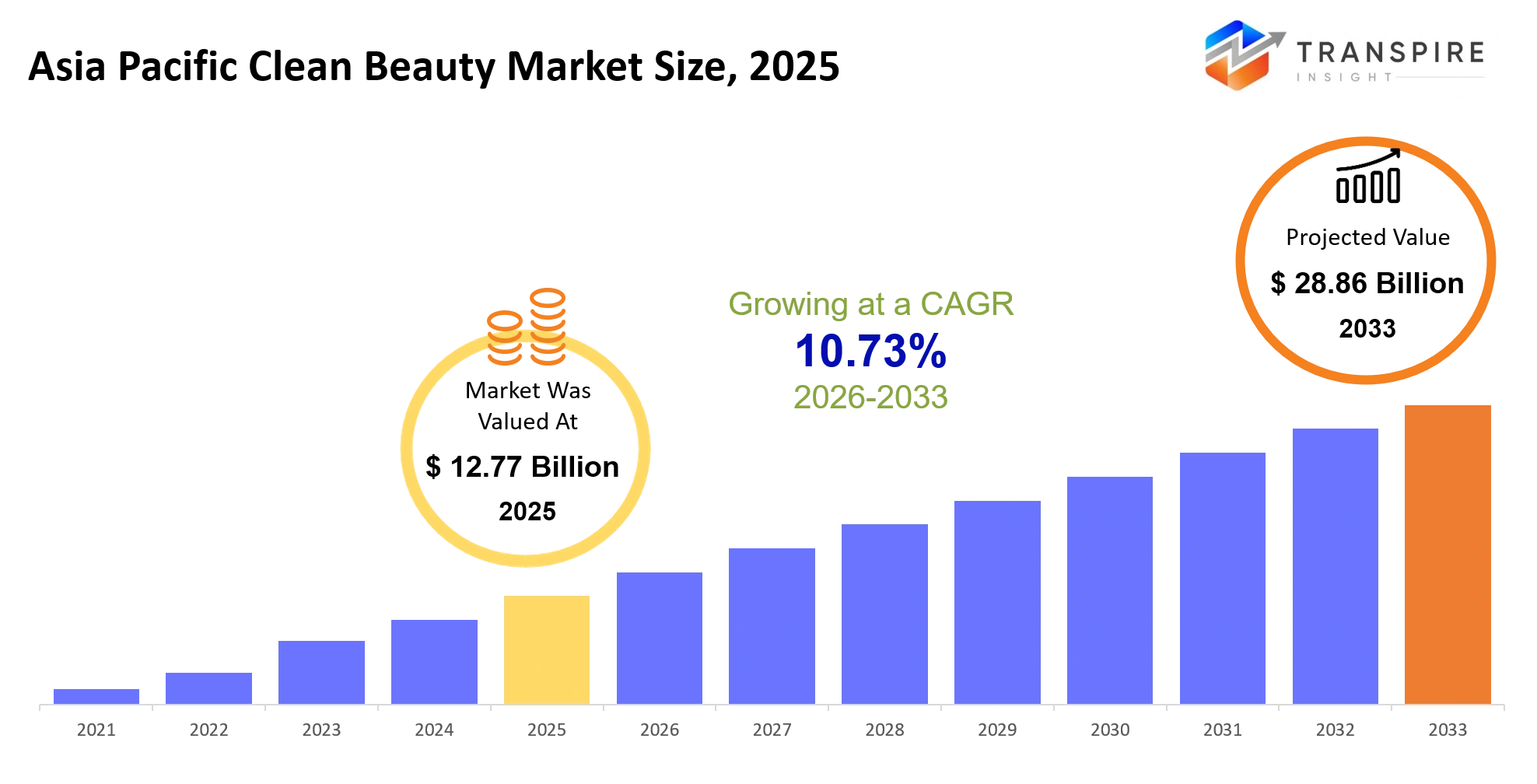
- Asia Pacific Clean Beauty Market Size 2025: USD 12.77 Billion
- Asia Pacific Clean Beauty Market Size 2033: USD 28.86 Billion
- Asia Pacific Clean Beauty Market CAGR: 10.73%
- Asia Pacific Clean Beauty Market Segments: By Product Type (Skincare, Haircare, Makeup, Fragrances, Bath & Body Products, Sun Care, Others); By Ingredient Type (Organic, Natural, Vegan, Cruelty-Free, Plant-Based, Others); By Distribution Channel (Online Retail, Specialty Stores, Supermarkets, Pharmacies, Others); By End User (Women, Men, Teenagers, Premium Consumers, Others).
Asia Pacific Clean Beauty Market Summary
The Asia Pacific Clean Beauty Market was valued at USD 12.77 Billion in 2025. It is forecast to reach USD 28.86 Billion by 2033. That is a CAGR of 10.73% over the period.
The Asia Pacific Clean Beauty market acts as a replacement layer in the personal care supply chain, by requiring brands to reformulate cosmetics in order to meet demand to remove questionable synthetic ingredients while ensuring efficacy, regulatory compliance and retail readiness in various legislative environments. Essentially, it enables manufacturers and retailers to fulfill the increasing demand for higher levels of ingredient disclosure, while enabling them to re-position brand portfolios into both value added and export ready tiers.
Over the past 3-5 years, the Asia Pacific Clean Beauty market has fundamentally transformed from marketing-driven "natural" claims into compliance driven formulation engineering, with supporting Biotech-derived active ingredients and end to end ingredient tracking systems. Triggers for the accelerated reform, include tightening of cosmetic safety and labeling standards in significant markets including China and India and COVID-19 based supply chain shocks that revealed vulnerability of many global manufacturers who source raw materials as single-source chemical inputs. This has shifted procurement criteria towards guaranteed sourcing and reformulated ready brand offerings, thus intensifying competition in the brand space and increasing investments in R&D driven clean formulations.
Key Market Insights
- The Asia Pacific Clean Beauty Market's 2025 growth will be mainly driven by biotech activities replacing synthetic preservatives within premium skincare product formulations.
- Clean Beauty brands within the APAC will be moving toward comprehensive ingredient traceability mechanisms, resulting in increased regulatory acceptance and higher retail shelf placements.
- In 2025 Japan and South Korea account for nearly 38% of the share on account of their sophisticated R&D ecosystems in cosmetics and the growing demand for premium skincare.
- Southeast Asia is forecast to be the most rapid region (2025-2030) on the account of the growing purchasing power of the middle-class as well as its fast e-commerce beauty penetration.
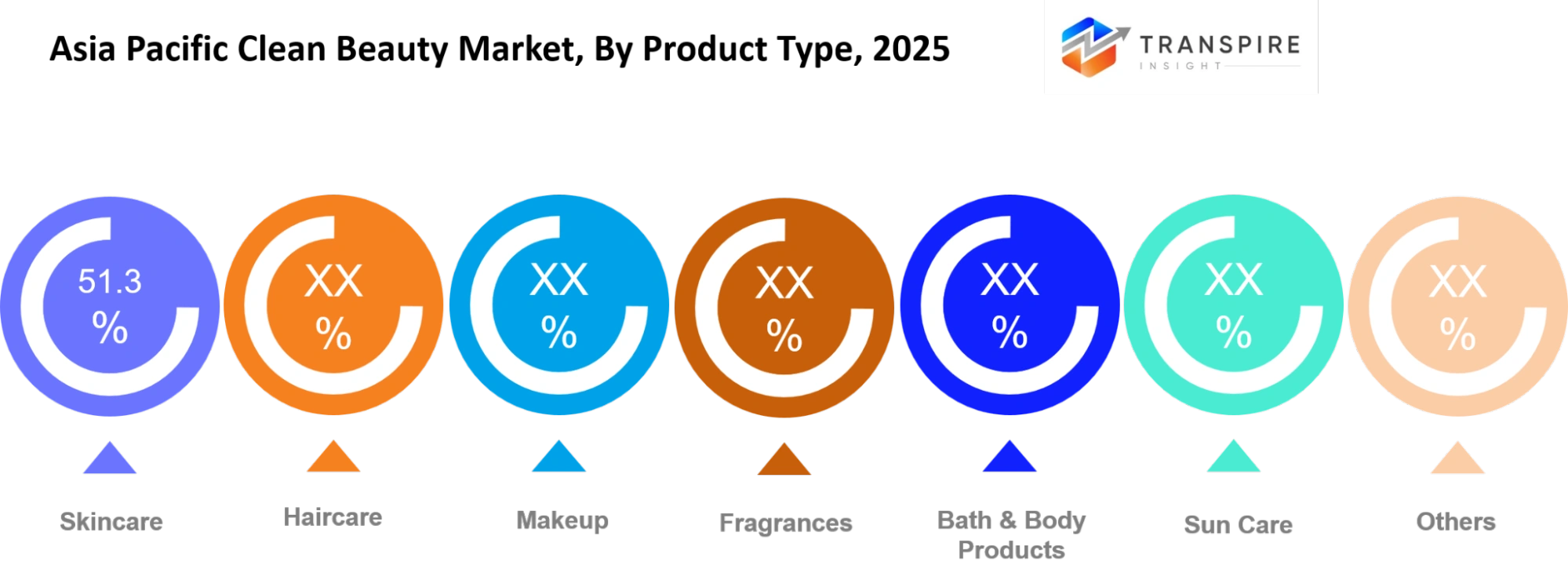
- Skincare will remain as the largest segment, accounting for about 55% of the share in 2025 on the account of frequent repurchase cycles of products and growing demand in the dermatology sector.
- The second-largest segment, Haircare products benefit from innovations driven by the need for sulfate free, scalp health products in the urban segments.
- The highest growth product category for the 2024-2030 timeframe will be the usage of functional skincare actives and serums, owing to the rapid pace of development.
- Almost 60% of the application usage comes from Facial care due to the high demand for Anti-aging products and pollution protective formulations.
- Sunscreen and barrier protective products is the fastest growing application area driven by growing awareness among consumers about UV protection needs in cities in APAC.
- Women form the majority of the consumers, with the share being >70%, and Male grooming category is the fastest growing category.
What are the Key Drivers, Restraints, and Opportunities in the Asia Pacific Clean Beauty Market?
The strongest drivers of the Asia Pacific Clean Beauty Market are the stricter cosmetic safety regulations and the retailers' exclusion lists for ingredients, in major APAC markets. This has propelled brands to reformulate existing product lines using clean and traceable ingredients, which drives R&D investment while also paving the way for the emergence of premium products with higher profit margins. This becomes a prerequisite for market entry, rather than a source of competition, which spurs product adoption across global and regional manufacturers.
A key challenge remains the cost and technical difficulty in reforming old formulations into clean labels while maintaining product integrity and sensorial properties. It is a challenge based on structural limitations; mid-tier manufacturers in APAC typically do not have formulation facilities and certified raw materials readily available, which slows down development time and product uniformity. As a result, revenue growth is partially restrained in low-cost markets where reformulation costs do not justify the investment.
The development of an opportunity is fueled by the emergence of AI formulation design and bio-fermentation, especially in Korea and Japan. These allow for accelerated development of plant activities with defined performance and consistent product characteristics, shortening market access for clean beauty products. With early pilot investment in APAC innovation hubs, this functionality is poised to open up the future path for scalability of science-backed products in the Asia Pacific Clean Beauty Market.
What Has the Impact of Artificial Intelligence Been on the Asia Pacific Clean Beauty Market?
The influence of AI is also expanding into product formulation, personalization, and supply chain optimization across the Asian Pacific Clean Beauty Market. Formulations platforms using AI to predict ingredient interactions have begun to streamline the development of clean label skin care product formulas and limit the need for trial and error laboratory development; it has cut formulation times by 20-30% in forward thinking R&D facilities.
Machine learning algorithms have enhanced demand planning and inventory management within clean beauty product lines, thereby decreasing overproduction and raw material waste and other operational costs for cosmetic brands. Furthermore, consumer analytics through AI and other predictive tools are allowing brands to gain insights on ingredient trends throughout the APAC region to enhance product-market fit, thereby boosting conversion rates for digital clean beauty sales channels.
On an operational level, automation is enhancing the monitoring of compliance regulations by mapping ingredient sources with changing ingredient regulatory databases, which lessens the chances for labeling errors and recalls. A barrier is that integrating AI systems throughout much of the region's segmented manufacturing landscape (particularly for small- and medium-sized manufacturers) is a prohibitively expensive task and inconsistent quality of supplier-reported data compromises predictability and its use for new botanical or biotech raw materials.
Key Market Trends
- Clear Beauty formulation trends were led from natural claims to regulatory compliant redesign by cosmetic manufacturers in APAC post-2022.
- Bio-engineered ingredients grew at a pace and replaced sensitive botanical actives in premium, high efficacy skincare in Japan and South Korea post-2023.
- Ingredient traceability systems shifted from value-add compliance tools to mandatory regulatory compliance requirements driven by stricter retailer supply-chain audits from 2024 to 2026.
- AI formulation labs at L'Oreal expanded in Asia post-2023 leading to faster development of clear-labeled skincare products.
- Clear-label formulations driven by ingredient restrictions and export compliance mandates emerged from SE Asia cosmetic manufacturing hubs in 2024.
- Sulfate free and paraben free claims for hair care became mainstream from 2022 due to heightened consumer concern over scalp health and awareness generated from dermatologist endorsements.
- Ingredient transparency requirements became stricter for retailers in China and India, leading to mass-market cosmetic reformulation from 2023.
- Biotech pipelines for skincare at Shiseido advanced significantly, with focus on clean categories in premium product positioning from 2023.
- Direct to consumer clean beauty brands began to seize market share post-2024 through digital transparency tools and ingredient marketing platforms.
- Sustainable packaging implementation increased from 2023 driven by increasing brand adoption of the circular economy and plastic reduction commitments.
Asia Pacific Clean Beauty Market Segmentation
By Product Type :
The skincare sector has the strongest market standing within the Asia Pacific Clean Beauty Market on account of increasing consumer focus on skin protection, repair and a daily regimen. Consumers in urban areas have an increasing preference for soft, skin-friendly formulations to substitute a lot of the standard chemical-laden cosmetics.
Hair care as well as sun care categories are witness to stable growth with an ever-increasing preference for sulfate-free shampoos and preventive sunscreens among consumers. Makeup as well as bath & body care is witness to growing preference due to manufacturers switching to skin-safe ingredients and reformulating for sensitive user segments.
By Ingredient Type :
Organic as well as plant-based ingredients see high acceptance within the Asia Pacific Clean Beauty Market due to a number of producers focusing on the use of natural, safely procured alternatives to chemical additives which not only facilitates clean labeling but also builds a stronger foundation of consumer trust among the health-conscious buyers.
Acceptance for vegan and cruelty-free formulation brands witness higher favorability due to changing consumer morality and more stringent requirements imposed by the retailer listings, with a steady growth being witnessed for natural ingredient usage with increased regulations against chemical transparency as well as authenticity assurance across cosmetics.
By Distribution Channel :
The Asia Pacific Clean Beauty market is led by online retail growth. The rise of online retail offers ease of product comparison, checking of ingredient lists and access to an ever growing array of brands. The role of social media and its influence on beauty products has further consolidated buying trends towards e-commerce and online retail platforms.
Specialty stores and pharmacies maintain their role in encouraging confidence-based shopping especially where dermatological endorsement is a factor in product buying decisions. Supermarkets continue to be strong distribution channels for everyday goods, but increasingly, clean beauty products opt for direct to consumer distribution models to encourage wider product margins and greater engagement with consumers.
By End User :
Women continue to be the largest group of end-users for clean beauty products in the Asia Pacific market owing to a greater predisposition to using skincare and a habit of using the products on a daily basis. Premium segment consumers also contribute to strong demand for sophisticated clean product formulations.
Growing trends in male grooming can also be observed owing to increased awareness of skin and hair care products in metropolitan areas. Interest in safer cosmetic products is also growing among teenage consumers who are fast adopting and seeking preventive skincare solutions.
What are the Key Use Cases Driving the Asia Pacific Clean Beauty Market?
The central use case within the Asia Pacific Clean Beauty market involves daily skincare for protection against pollution, UV and sensitive skin concerns within the increasingly rapidly urbanizing Asian Pacific cities, which are being heavily influenced by demand for safe, regulated formulations with less irritation potential and adherence to more stringent ingredient regulations throughout retail networks.
Extended use cases range from dermatological skincare recommendations, scalp and male grooming trends becoming more prominent within metropolitan areas, particularly with increases in ingredient safety awareness, and acceptance from a younger consumer demographic across retail and clinical environments.
Newer use cases such as biotech-fermented actives, AI driven personalized skincare, and post-partum / clinical recovery products that are at early acceptance stages within key premium beauty innovation hubs of Japan and Korea.
|
Report Metrics |
Details |
|
Market size value in 2025 |
USD 12.77 Billion |
|
Market size value in 2026 |
USD 14.14 Billion |
|
Revenue forecast in 2033 |
USD 28.86 Billion |
|
Growth rate |
CAGR of 10.73% from 2026 to 2033 |
|
Base year |
2025 |
|
Historical data |
2021 - 2024 |
|
Forecast period |
2026 - 2033 |
|
Report coverage |
Revenue forecast, competitive landscape, growth factors, and trends |
|
Regional scope |
Asia Pacific (India, China, Japan, Australia, South Korea, Rest of Asia Pacific) |
|
Key company profiled |
The Body Shop, L'Oréal, Estée Lauder, Unilever, Procter & Gamble, Tata Harper, Drunk Elephant, RMS Beauty, ILIA Beauty, Biossance, Innisfree, Amorepacific, Mamaearth, Plum, Forest Essentials. |
|
Customization scope |
Free report customization (country, regional & segment scope). Avail customized purchase options to meet your exact research needs. |
|
Report Segmentation |
By Product Type (Skincare, Haircare, Makeup, Fragrances, Bath & Body Products, Sun Care, Others); By Ingredient Type (Organic, Natural, Vegan, Cruelty-Free, Plant-Based, Others); By Distribution Channel (Online Retail, Specialty Stores, Supermarkets, Pharmacies, Others); By End User (Women, Men, Teenagers, Premium Consumers, Others). |
Which Regions are Driving the Asia Pacific Clean Beauty Market Growth?
East Asia still tops the Asia Pacific Clean Beauty market, driven by stringent regulatory practices and advanced research capabilities for cosmetics within Japan, South Korea and China. Governments have implemented increasingly tighter controls over ingredient safety and quality pushing for validated clean formulations and clearer product labeling, while strong existing cosmetics research labs and contract manufacturers facilitate rapid development and testing of cosmetic products, high value sales is also fueled by robust urban demand for premium skincare products in this region.
The Southeast Asian region is a relatively stable and reliable performer in the Asia Pacific Clean Beauty market, propelled by expanding retail infrastructure and consistent demand for personal care products. As opposed to East Asia, expansion of this market is driven by gradual implementation of regulatory practices and increasing disposable incomes in developing nations; Countries like Indonesia, Thailand and Vietnam continue to exhibit stable growth driven by growing pharmacy, and e-commerce distribution channels.
The South Asian region led by India emerges as the fastest growing market for clean beauty within Asia Pacific due to rapidly urbanizing population and increasing consumer awareness of ingredient safety driven by recent regulatory action on cosmetics. Growing popularity of online retail and influencer driven consumer education is hastening product penetration across urban Indian cities. Growing domestic investment in manufacturing as well as expansion of international brands into the space is further increasing accessibility of clean formulations at multiple price points, the region is also expected to witness growing investor interest from 2026 to 2033 owing to its scale and increasing compliance infrastructure.
Who are the Key Players in the Asia Pacific Clean Beauty Market and How Do They Compete?
The competitive landscape of the Asia Pacific clean beauty market is moderately consolidated at the top of the hierarchy with a significant chunk of large international players competing with smaller indie brands across the spectrum; large multinational corporations continue to rely on the strength of their R&D infrastructure, stringent regulatory compliances, while smaller brands capitalize on niches and the transparency of their ingredient lists. Formulation development, organic certification and a digital approach to consumer engagement are critical competitive parameters; the market is increasingly driven by companies which can effectively integrate the power of clean science with production scalability.
L'Oral leverages technology and research to build clean formulations and expedite product safety validation in the Asian region using its state-of-the-art research facilities, Shiseido continues to grow its market share with advanced biotech-based skincare formulations backed by strong brand loyalty in Japan and increasing proliferation of premium anti-aging clean beauty formulations, Amorepacific’s focus on the Korean beauty pipeline is propelling the expansion of clean beauty products in Southeast Asian markets through rapid digital launches while Unilever's focus remains on mass market outreach and incorporating sustainability in its existing personal care formulations across its brand portfolio; Kao Corporation is expanding its offering of clinically tested clean beauty formulations backed by dermatology-based products across Japan and neighboring APAC nations.
Company List
- The Body Shop
- L'Oréal
- Estée Lauder
- Unilever
- Procter & Gamble
- Tata Harper
- Drunk Elephant
- RMS Beauty
- ILIA Beauty
- Biossance
- Innisfree
- Amorepacific
- Mamaearth
- Plum
- Forest Essentials
Recent Development News
In February 2026, Indie Lee Botanicals launched by American Exchange Group and Indie Lee introduced an affordable clean beauty line under $25. The range expanded accessibility of clean formulations by using simpler natural ingredients and reducing reliance on expensive clinical testing.
Source: https://www.vogue.com/
In April 2025, L'Oréal launched its L’AcceleratOR sustainability accelerator program with a €100 million investment commitment. The initiative supports startups working on clean ingredients, circular packaging, and carbon reduction technologies across the beauty supply chain.
Source: https://www.vogue.com/
What Strategic Insights Define the Future of the Asia Pacific Clean Beauty Market?
The Asia Pacific Clean Beauty Market is seeing a systematic shift towards science-led formulation ecosystems where compliance, biotech, and digital traceability become the main competitive differentiator rather than branding. In the next 5-7 years, growth will be powered by increasingly strict ingredient controls by China, India, and South Korea and safety demands from retailers will dictate continuous reformulation. This trend will support a greater proportion of strong R&D-powered, vertically integrated supply chain players.
A more subtle risk to the ecosystem stems from dependence on the limited supply of certified biotech and plant-based raw material vendors, a scenario which is likely to lead to price volatility and difficulty scaling product lines if supply disruptions arise. Simultaneously, an abundant opportunity will emerge in bridging AI-aided ingredient discovery and fermentation-derived activities, especially in Japan and South Korea where innovation ecosystems are mature enough to scale commercially.
Players can capitalize on the market shift by investing in building localized ingredient supply networks and developing AI-powered formulation platforms to reduce development times and achieve sustainable compliance leadership.
Asia Pacific Clean Beauty Market Report Segmentation
By Product Type
- Skincare
- Haircare
- Makeup
- Fragrances
- Bath & Body Products
- Sun Care
By Ingredient Type
- Organic
- Natural
- Vegan
- Cruelty-Free
- Plant-Based
By Distribution Channel
- Online Retail
- Specialty Stores
- Supermarkets
- Pharmacies
By End User
- Women
- Men
- Teenagers
- Premium Consumers
Frequently Asked Questions
Find quick answers to common questions.
The Asia Pacific Clean Beauty Market size is USD 28.86 Billion in 2033.
Key segments for the Asia Pacific Clean Beauty Market are By Product Type (Skincare, Haircare, Makeup, Fragrances, Bath & Body Products, Sun Care, Others); By Ingredient Type (Organic, Natural, Vegan, Cruelty-Free, Plant-Based, Others); By Distribution Channel (Online Retail, Specialty Stores, Supermarkets, Pharmacies, Others); By End User (Women, Men, Teenagers, Premium Consumers, Others).
Major Asia Pacific Clean Beauty Market players are The Body Shop, L'Oréal, Estée Lauder, Unilever, Procter & Gamble, Tata Harper, Drunk Elephant, RMS Beauty, ILIA Beauty, Biossance, Innisfree, Amorepacific, Mamaearth, Plum, Forest Essentials.
The Asia Pacific Clean Beauty Market size is USD 12.77 Billion in 2025.
The Asia Pacific Clean Beauty Market CAGR is 10.73% from 2026 to 2033.
- The Body Shop
- L'Oréal
- Estée Lauder
- Unilever
- Procter & Gamble
- Tata Harper
- Drunk Elephant
- RMS Beauty
- ILIA Beauty
- Biossance
- Innisfree
- Amorepacific
- Mamaearth
- Plum
- Forest Essentials
About the Authors

Chetan Dhatrak
I’m Chetan Dhatrak, a Senior Research Analyst at Transpire Insight, specializing in the Consumer Goods, Foods and Beverages industry. I focus on analyzing market trends, consumer behavior, competitive landscapes, and industry developments to deliver accurate, data-driven insights. My research at Transpire Insight is built on credible sources and in-depth analysis, helping businesses and readers better understand market dynamics, emerging opportunities, and evolving consumer preferences. I’m committed to creating reliable, well-researched content that supports informed decision-making and reflects the latest developments in the consumer goods and food & beverage sectors.

Chakradhar Khansole
Chakradhar serves as the Research Director at Transpire Insight, bringing over 8 years of experience in technology, innovation, and strategic market intelligence. He specializes in transforming complex market data into actionable business insights that enable organizations to make informed, growth-oriented decisions. Recognized for his strategic vision and analytical expertise, Chakradhar leads high-impact research initiatives, delivering comprehensive market assessments, competitive intelligence, and forward-looking industry analysis.
Recently Published Reports
-
Apr 2026
Bottled Water Market
Bottled Water Market Size, Share & Analysis Report By Product Type (Still Bottled Water, Carbonated Bottled Water, Functional Bottled Water, and Others), By Packaging (PET, Cans, and Others), By Sales Channel (Supermarkets/Hypermarkets, Convenience Stores/Drug Stores, Grocery Stores/Club Stores, Foodservice, and Others) and Geography (North America, Europe, Asia-Pacific, Middle East and Africa, South and Central America), 2021 - 2032
-
Apr 2026
Color Cosmetic Packaging Market
Color Cosmetic Packaging Market Size, Share & Analysis Report By Application (Mascara Packaging, Liquid Packaging, and Liquid Face), By Type (Tubes & Bottles, Pens & Markers, Compacts & Containers, and Droppers & Pumps), and Geography (North America, Europe, Asia-Pacific, Middle East and Africa, South and Central America), 2021 - 2031
-
Apr 2026
External Microphone For Camera Market
External Microphone For Camera Market Size, Share & Analysis Report By Type (Shotgun Microphone, Lavalier Microphone, and Others), By Application (Digital Camera, Professional Video Camera, and Others), and Geography (North America, Europe, Asia-Pacific, Middle East and Africa, South and Central America), 2021 - 2031
-
Apr 2026
Foot Orthotic Insoles Market
Foot Orthotic Insoles Market Size, Share & Analysis Report By Type (Pre-fabricated, and Custom-made), By Material (Thermoplastic, Composite Carbon Fiber, and Others), By Distribution Channel (Drug Stores, Hospitals & Clinics, and Others), and Geography (North America, Europe, Asia-Pacific, Middle East and Africa, South and Central America), 2021 - 2031