
Asia Pacific Chemical Distribution Market Summary
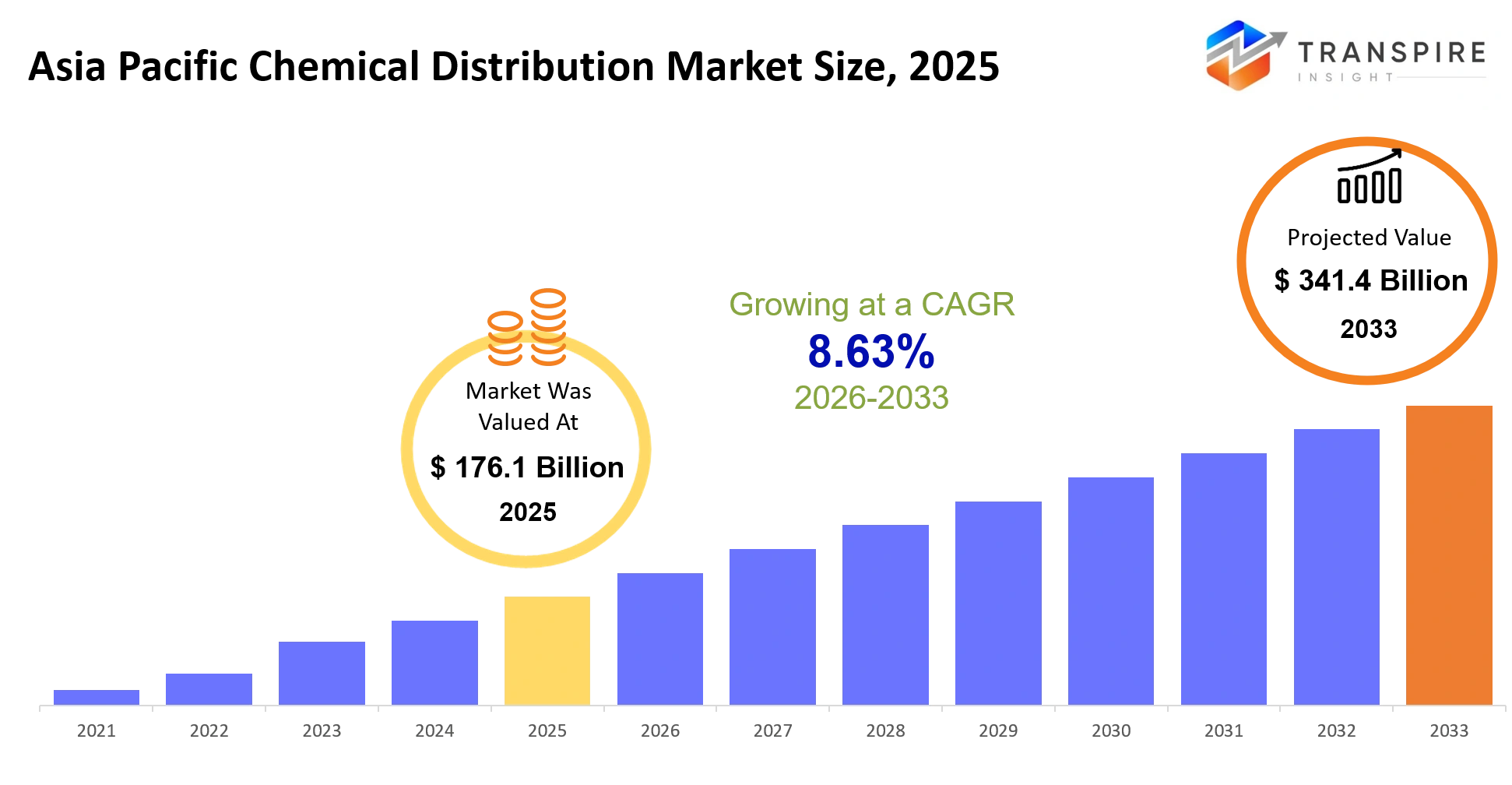
As per Transpire Insight Analysis the Asia Pacific Chemical Distribution Market size is estimated at USD 176.1 Billion in 2025 and is anticipated to reach USD 341.4 Billion by 2033, growing at a CAGR of 8.63% from 2026 to 2033.
The Asia Pacific Chemical Distribution Market, in a way keeps industrial supply chains moving by linking chemical producers with the manufacturers who need dependable sourcing, storage, regulatory care, and on time delivery. Through this kind of distribution, industries like automotive, electronics, pharmaceuticals, construction, and food processing end up getting specialty chemicals and also commodity chemicals, without having to keep huge procurement networks or hold inventories themselves. Over the last five years though, the whole scene has sort of leaned more toward digital procurement platforms, logistics that are more integrated, and value added technical services. That shift helps distributors boost supply visibility and stay compliant, while also cutting the delivery lead times down.
And then, after the COVID-19 pandemic there were more supply chain disruptions, plus some regional trade realignments, which made manufacturers want to diversify suppliers, and then also lean into local inventory strategies. So distributors have been growing warehousing capacity, building stronger regional partnerships, and offering customized service packages, bit by bit. In the end, this evolution seems to be building tighter customer relationships , improving supply resilience, and even letting distributors take on higher value contracts across several industrial sectors, throughout the Asia Pacific region.
Asia Pacific Chemical Distribution Market Size & Forecast:
- Asia Pacific Chemical Distribution Market Size 2025: USD 176.1 Billion
- Expected Market Value 2033: USD 341.4 Billion
- Forecast CAGR: 8.63%
- Leading region in 2025: China
- Fastest Growing region: India
- Key Profile: Brenntag, Univar Solutions, DKSH, IMCD, Azelis, Barentz, Nexeo Plastics, Tricon Energy, Helm AG, Biesterfeld, Connell, Ravago, Redox, Marubeni Corporation, Mitsui & Co.
Key Market Insights
- China kind of dominated the Asia Pacific Chemical Distribution Market, around 46% market share in 2025, mostly because it has really extensive manufacturing capacity, and those integrated chemical supply chains that just keep moving.
- For 2025–2033, India should be the quickest moving regional market, you know, as specialty chemical output ramps up , alongside pharmaceutical manufacturing and more industrial investments that keep widening.
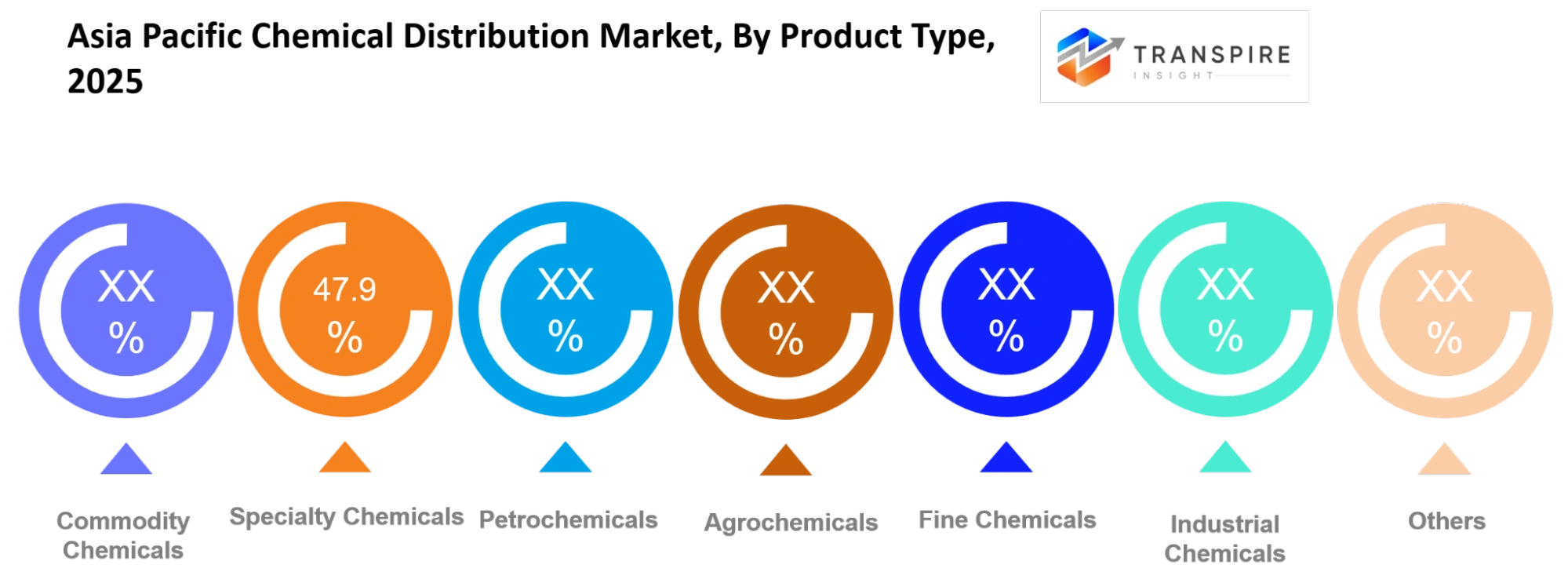
- In terms of products, commodity chemicals took the lead with roughly 58% market share in 2025, mainly since the big volume manufacturing industries need distribution networks that are steady, and cost efficient.
- Then specialty chemicals sat as the second-largest segment, helped by the expansion of electronics, pharmaceuticals, coatings, and personal care production across economies in Asia Pacific.
- Specialty chemicals are also forecast to be the fastest growing thing through 2033 as distributors broaden technical support, formulation services, plus regulatory compliance capabilities.
- Looking at applications, manufacturing uses were in front at about 48% market share in 2025, driven by continued procurement from automotive, electronics, construction, and industrial processing facilities.
- Meanwhile, pharmaceutical manufacturing is expected to grow the quickest through 2033, because chemical sourcing under regulation, along with quality assurance expectations, keeps getting tighter.
- For end users, industrial manufacturing stayed on top with nearly 44% market share in 2025, since diversified production plants tend to depend on stable chemical supply agreements.
- And pharmaceutical companies are projected to be the fastest-growing end-user category through 2033 as regional drug production capacity and contract manufacturing investments keep accelerating, kind of in tandem.
What are the Key Drivers, Restraints, and Opportunities in the Asia Pacific Chemical Distribution Market?
The main growth thing, like the strongest driver, comes from manufacturing diversification throughout Asia Pacific. A bunch of multinational companies have moved production past a single-country sourcing model, mainly after supply chain disruptions , and also due to those geopolitical trade changes. On top of that, governments rolled out investment incentives for electronics, pharmaceuticals, and specialty chemicals, which basically makes the whole market feel a bit more “pull” than before. As a result, procurement turned more complicated, so manufacturers started outsourcing the inventory management, regulatory compliance, and even logistics to specialized distribution partners. Distribution companies then grabbed more profitable , higher-value deals by bundling warehousing, technical support, and digital procurement services, which in turn helps revenue growth across multiple industrial segments.
The biggest drag though is that regulatory compliance is still fragmented across many Asia Pacific jurisdictions. Chemical registration, labeling, transport, and environmental rules don’t really line up from country to country, so you can’t just run one standardized operating model and call it done. Distributors end up keeping separate documentation systems , certifications, and compliance teams, and that slows customer onboarding down, plus it delays product introductions. From the Transpire Insight review of regional procurement announcements and launch timetables, supply chain concentration stays the key execution risk. These structural issues end up pressing margins down , pushing commercial launches out , and raising operating costs that, realistically, can’t be removed quickly.
The most promising opportunity is in digital chemical distribution that is backed by artificial intelligence, cloud platforms and regional warehouse automation, maybe like some hybrid thing. Industrial customers are starting to expect real time inventory visibility, automated documentation, and predictive replenishment instead of the usual order processing, you know. When you invest in smart logistics infrastructure across India and Southeast Asia it creates favorable setup for distributors to stretch beyond basic supply and add more value, actually. Firms that blend digital procurement with technical consulting plus localized inventory management will likely boost customer retention while opening the door to higher-margin specialty chemical opportunities.
What Has the Impact of Artificial Intelligence Been on the Asia Pacific Chemical Distribution Market?
Artificial intelligence along with digital technologies are kinda reshaping chemical distribution through Asia Pacific, mainly by doing automation in inventory upkeep, warehouse routines , transport strategy, and even regulatory papers. AI driven platforms keep looking at stock heights , shipment progress, hazardous material processing, and compliance documents, so there is less manual work, and at the same time the operational records get more reliable. Machine learning tools then sift through procurement trails, production timelines, seasonal demand patterns, plus logistics limits, to predict chemical needs in a more precise way. In the end distributors can rearrange stock placement with better timing, and reduce those annoying moments when shelves run empty.
These forecasting abilities also help with warehouse use, and with delivery direction. That means distributors can bring transportation expenses down and also shorten the time from order to delivery. On top of that, digital supply chain platforms give customers real-time insight into what is in inventory, how shipments are moving, and which compliance files are ready. That visibility supports procurement speed, and it makes cooperation with suppliers smoother. A number of distributors have gone further and set up cloud based customer portals, where quotations are generated automatically, technical documentation is organized, and orders are handled in a more routine manner. All those changes end up boosting warehouse output, pushing inventory turnover upward, strengthening regulatory adherence, and trimming operating costs.
Still, AI rollout has some practical boundaries, you know. Connecting AI with older enterprise systems stays expensive, and when data quality is fragmented across suppliers or regional operations, forecasting gets less accurate. Smaller distributors, meanwhile, often just lack the budget to invest, so wide adoption of advanced digital tools happens slower than expected.
Key Market Trends
- Since 2022, distributors have kind of pushed forward digital procurement platforms that cut down on the manual ordering stuff and also make inventory visibility much better across multiple country supply lines.
- From 2021 to 2025, the regional warehousing investments grew very fast right after pandemic disruptions, so delivery became quicker and inventory resilience looked stronger.
- Specialty chemical distribution has been gaining a lot of traction since 2023, mainly because electronics and pharmaceutical manufacturing have shifted toward higher-value formulations, not just the usual ones.
- More and more companies now bundle logistics with technical consulting, laboratory support, and compliance services, like they want to differentiate beyond simple commodity distribution by 2025, not only move product around.
- India and Southeast Asia pulled in major distribution investments between 2023 and 2026 , as manufacturers diversified production away from the traditional hubs.
- Since 2022, environmental regulations have also nudged distributors to tighten hazardous chemical handling, improve traceability systems, and keep digital compliance documentation more solid.
- Brenntag, IMCD, Azelis, and DKSH have expanded their regional acquisitions , plus partnership approaches , to strengthen specialty chemical portfolios throughout Asia Pacific.
- Cloud-enabled supply chain platforms are increasingly being used for predictive inventory planning , and that lowers procurement delays while customer service performance improves.
- Also, customers have moved toward multi-supplier sourcing strategies since 2021 , which reduces reliance on any single country procurement and , in turn , strengthens regional distribution networks.
Asia Pacific Chemical Distribution Market Segmentation
By Product Type :
Commodity chemicals take a major chunk of the pie, because manufacturing outfits need big, steady volumes for day to day output. Demand stays pretty stable from construction, automotive, and industrial processing, so distribution keeps running smoothly across different regional markets, more or less. Specialty chemicals are still pushing forward too, as electronics, pharmaceutical, and personal care producers want stronger performance in their formulations, plus they insist on tough quality standards .
Petrochemicals stay a cornerstone for plastics, engineered synthetic materials, and industrial feedstocks, and that keeps the long term business chances alive. Agrochemicals, meanwhile, ride the wave of farming modernization and the push for higher crop productivity, especially across multiple Asia Pacific markets. Fine chemicals are getting more acceptance in pharma manufacturing and in advanced production lines where purity levels matter a lot. Industrial chemicals keep a steady pull from heavy industries, and the other product groups handle smaller , more specific manufacturing needs, using specialized formulations and tuned distribution services.
By Distribution Channel :
Direct distribution keeps showing up for large industrial customers that basically need long term supply agreements and dependable delivery timetables. Then there is third party distribution, it helps manufacturers chase broader market coverage without really expanding their own internal logistics operations, you know, the whole thing. Warehouse distribution also matters , because it makes inventory easier to keep on hand and it cuts down the delivery lead times for customers who run continuous production schedules. Import and export distribution still counts too, since regional trade actually supports the movement of raw materials as well as finished chemical products.
Online distribution is getting more attention lately, mainly because digital procurement platforms make it simpler to choose products, follow orders, and handle documentation management. At the same time, investments in digital systems help improve purchasing efficiency and shrink the administrative burden for both buyers and distributors. Other distribution models fit particular industry needs, where customized logistics, technical handling, or local know how creates extra business value.
By End User :
Automotive manufacturing still counts as a major end user, because the production process needs coatings adhesives , lubricants, plastics, and more specialty materials, and those get delivered via established distribution networks. Construction activities also keep purchasing going for industrial chemicals used in cement additives, coatings , waterproofing products, and insulation materials, so it does not really stop. Pharmaceutical manufacturing keeps expanding too, since stricter quality standards push for dependable sourcing and controlled chemical handling in general, more and more. Electronics production adds another steady stream since specialty chemicals are needed for semiconductors, displays, and precision components, which is basically always on demand.
Food and beverage processing depends on approved chemicals for cleaning, processing, and packaging use cases while staying within regulatory compliance. Agriculture supports constant consumption of crop protection products and other chemical inputs throughout farming operations, year after year. Other industries create extra openings, but only when specialized manufacturing processes can rely on stable supply chains and technical distribution services, not just a random wholesaler.
By Service Type :
Warehousing still feels like the core thing here, because safe storage helps protect product quality ,and also keeps customer deliveries on time. Logistics services tend to refine transportation planning and they push supply chain efficiency across both domestic and international markets. When the services get blended together, you can end up with tailored formulations that fit specific industrial needs, yet it doesn’t really add production complexity for customers. Packaging services, on the other hand, boost product safety ,improve handling efficiency and keep things aligned with regulatory compliance while stuff is moving.
Technical support keeps growing in value too, since manufacturers often need help with product selection, practical application guidance and the compliance documentation that comes along with it. Inventory management services are also important, they help customers keep production steady while lowering excess stock levels and avoiding procurement delays. And the other service offerings really help nurture relationships by giving flexible solutions that support day to day operational efficiency ,and long term business partnerships.
By Enterprise Size :
Big companies make up a noticeable share, mostly because their wide distribution routes, financial robustness, and streamlined logistics setups can handle chemical sales at really high volume. Also, many keep long term supplier agreements and they have the cash to invest, so they manage to extend operations into more areas and add value-added services, you know. Medium sized firms still push hard to stay visible, they often target specialized industries with flexible supply arrangements and customer attentive support. Smaller players, on the other hand, usually fight with local demand, and they pitch customized distribution services for those niche uses.
When medium and small organizations expand, it’s helped by digital procurement platforms and better transport infrastructure popping up across several Asia Pacific economies. On top of that, competition basically forces people to put money into inventory handling, regulatory compliance, and technical know-how, which then leads to better customer loyalty. Other company types also matter, but mostly through regional operations that are built around unusual industrial needs, and through localized supply chain demands, if that makes sense.
What are the Key Use Cases Driving the Asia Pacific Chemical Distribution Market?
Manufacturing still seems like the biggest use case, because chemical distributors supply essential raw materials that lets production lines keep moving, you know, without interruption. Automotive manufacturers , construction material producers , and industrial processors depend on scheduled deliveries, inventory support , and regulatory handling, in order to keep output steady while also trimming procurement complexity, and even lowering storage costs some.
Pharmaceutical production is also growing, as distributors provide controlled sourcing, quality documentation, and compliant handling for sensitive ingredients , it’s pretty important there. Electronics manufacturers likewise lean on specialized distribution partners to lock down high-purity chemicals that are needed for semiconductor fabrication, display manufacturing, and precise component assembly, all under strict quality standards that cannot really slip.
Battery material supply chains and advanced semiconductor manufacturing are starting to look like emerging opportunities with solid long-term promise. Regional investment tied to electric vehicle production, energy storage , and higher-value electronics will likely generate demand for specialized distribution services, with a mix of technical expertise, traceability, and secure logistics, for regulated plus high-performance chemical products.
|
Report Metrics |
Details |
|
Market size value in 2025 |
USD 176.1 Billion |
|
Market size value in 2026 |
USD 191.3 Billion |
|
Revenue forecast in 2033 |
USD 341.4 Billion |
|
Growth rate |
CAGR of 8.63% from 2026 to 2033 |
|
Base year |
2025 |
|
Historical data |
2021 - 2024 |
|
Forecast period |
2026 - 2033 |
|
Report coverage |
Revenue forecast, competitive landscape, growth factors, and trends |
|
Regional scope |
Asia Pacific (India, China, Japan, Australia, South Korea, Rest of Asia Pacific) |
|
Key company profiled |
Brenntag, Univar Solutions, DKSH, IMCD, Azelis, Barentz, Nexeo Plastics, Tricon Energy, Helm AG, Biesterfeld, Connell, Ravago, Redox, Marubeni Corporation, Mitsui & Co. . |
|
Customization scope |
Free report customization (country, regional & segment scope). Avail customized purchase options to meet your exact research needs. |
|
Report Segmentation |
By Product Type (Commodity Chemicals, Specialty Chemicals, Petrochemicals, Agrochemicals, Fine Chemicals, Industrial Chemicals, Others); By Distribution Channel (Direct Distribution, Third-Party Distribution, Online Distribution, Warehouse Distribution, Import & Export Distribution, Others); By End User (Automotive, Construction, Pharmaceuticals, Food & Beverage, Agriculture, Electronics, Others); By Service Type (Warehousing, Logistics, Blending, Packaging, Technical Support, Inventory Management, Others); By Enterprise Size (Large Enterprises, Medium Enterprises, Small Enterprises, Others). |
Which Regions are Driving the Asia Pacific Chemical Distribution Market Growth?
China makes up roughly 46% of the Asia Pacific Chemical Distribution Market, so yeah it ends up being the main regional player. A mix of strong industrial policies, a lot of transport infrastructure , and already solid chemical regulations helps production move smoothly and also keeps nationwide distribution activities running efficiently. Then you also have big manufacturing clusters, integrated ports, chemical parks, plus continued funding from local and global suppliers, which kinda reinforces the whole regional supply chain. Looking ahead, the steady buildout of specialty chemicals, electronics , and advanced manufacturing should keep China in the lead during the forecast period.
Japan is next, as the second-largest regional contributor, mostly because business growth leans more on high-value manufacturing rather than just chasing bigger production volume. There are also strict regulatory requirements, logistics networks that actually hold up, and industrial policies that stay fairly stable, so chemical distributors can plan without too much surprise. Over the long term, investments in automotive, electronics, and precision manufacturing help lock in consistent purchasing patterns across multiple industries. Because of that stable industrial setup, distributors still get dependable revenue chances even while wider regional supply chains are gradually diversifying.
India is set to show the most rapid growth between 2026 and 2033, as industrial expansion , manufacturing incentives and logistics investments are reshaping chemical purchasing networks. The production-linked incentive programs, plus industrial corridor development and warehouse modernization have nudged producers to broaden their own domestic output capability. At the same time, the fast rise in pharmaceuticals, specialty chemicals and electronics manufacturing keeps opening fresh chances for distribution firms that also bring technical support services. Overall, this momentum should translate into compelling expansion prospects for investors and brand-new market entrants, who are looking for sustained growth across higher-value industrial sectors.
Who are the Key Players in the Asia Pacific Chemical Distribution Market and How Do They Compete?
Competition across the Asia Pacific Chemical Distribution Market is still, sort of moderately fragmented, not fully consolidated, because big global distributors run head to head with both regional specialists and domestic suppliers. In other words, the competitive angle now looks less like “price only” and more like service strength, where they can cover, how good the digital procurement platforms are, plus the quality of technical support. Most well known players keep growing their warehouse footprint, and they also widen specialty chemical portfolios, while regional distributors counter with a more localized customer approach ,and also with industry specific knowledge.
Brenntag stands out by tying together integrated logistics, hands on technical application support, and digital procurement tools that make industrial sourcing feel less complicated. IMCD leans heavily into specialty chemicals, with formulation laboratories and technical consulting that assist customers in speeding up product development. DKSH, for its part, boosts positioning via wide distribution networks and regulatory knowhow, which is useful for market access across several Asia Pacific countries.
Azelis keeps moving forward too, mainly through acquisitions that expand specialty product breadth and also reinforce regional laboratory capabilities. Univar Solutions meanwhile puts energy into digital platforms, supply chain streamlining, and value added services, with the goal of improving customer visibility and procurement efficiency. Taken together, these moves let distributors deepen long term customer ties, push further into higher margin specialty chemical segments, and adjust faster when industrial purchasing requirements shift around.
Company List
- Brenntag
- Univar Solutions
- DKSH
- IMCD
- Azelis
- Barentz
- Nexeo Plastics
- Tricon Energy
- Helm AG
- Biesterfeld
- Connell
- Ravago
- Redox
- Marubeni Corporation
- Mitsui & Co.
Recent Development News
In May 2025, Azelis signed an agreement to acquire S. Amit Group in India. The acquisition strengthened Azelis' specialty chemical distribution network in pharmaceuticals, agriculture, and CASE markets while expanding technical capabilities and regional market access.
Source: https://www.azelis.com/
In June 2025, IMCD acquired Trichem Healthcare Private Limited, Trichem Lifesciences Limited, and Chemistry & Health FZ LLC. The acquisition accelerated IMCD's pharmaceutical distribution business in India and expanded its portfolio of specialty ingredients and technical services for regulated healthcare markets.
Source: https://www.imcdgroup.com/
What Strategic Insights Define the Future of the Asia Pacific Chemical Distribution Market?
The Asia Pacific Chemical Distribution Market is likely moving toward those more integrated supply chain platforms, like combining digital purchasing, technical assistance, regulatory compliance,and also local inventory handling instead of just sending out products, like the old model. As specialty manufacturing grows, and when semiconductor output, battery materials, plus pharmaceutical investments keep expanding, distributors will have more room to offer services with added value, which helps to lock in longer term customer ties.
There’s also a risk that is less obvious, sort of hiding in plain sight, related to how concentrated some suppliers are for critical specialty chemicals. If something goes wrong at just a small number of production sites it can ripple across the region, affecting availability, pricing, and how well contracts get fulfilled, even if the overall market fundamentals look healthy.
At the same time, there’s an emerging chance that could grow around distribution services for battery chemicals and advanced electronic materials. This will likely happen as new manufacturing investments spread across India and into Southeast Asia. Players that go early into specialized storage infrastructure, digital traceability tools, regulatory knowledge, and even technical laboratories will be in a stronger position to win premium contracts and form more resilient supply networks in the next several years.
Asia Pacific Chemical Distribution Market Report Segmentation
By Product Type
- Commodity Chemicals
- Specialty Chemicals
- Petrochemicals
- Agrochemicals
- Fine Chemicals
- Industrial Chemicals
By Distribution Channel
- Direct Distribution
- Third-Party Distribution
- Online Distribution
- Warehouse Distribution
- Import & Export Distribution
By End User
- Automotive
- Construction
- Pharmaceuticals
- Food & Beverage
- Agriculture
- Electronics
By Service Type
- Warehousing
- Logistics
- Blending
- Packaging
- Technical Support
- Inventory Management
By Enterprise Size
- Large Enterprises
- Medium Enterprises
- Small Enterprises
Frequently Asked Questions
Find quick answers to common questions.
The expected Asia Pacific Chemical Distribution Market size for the market will be USD 341.4 Billion in 2033.
Key segments for the Asia Pacific Chemical Distribution Market are By Product Type (Commodity Chemicals, Specialty Chemicals, Petrochemicals, Agrochemicals, Fine Chemicals, Industrial Chemicals, Others); By Distribution Channel (Direct Distribution, Third-Party Distribution, Online Distribution, Warehouse Distribution, Import & Export Distribution, Others); By End User (Automotive, Construction, Pharmaceuticals, Food & Beverage, Agriculture, Electronics, Others); By Service Type (Warehousing, Logistics, Blending, Packaging, Technical Support, Inventory Management, Others); By Enterprise Size (Large Enterprises, Medium Enterprises, Small Enterprises, Others).
Major Asia Pacific Chemical Distribution Market players are Brenntag, Univar Solutions, DKSH, IMCD, Azelis, Barentz, Nexeo Plastics, Tricon Energy, Helm AG, Biesterfeld, Connell, Ravago, Redox, Marubeni Corporation, Mitsui & Co.
The Asia Pacific Chemical Distribution Market size is USD 176.1 Billion in 2025.
The Asia Pacific Chemical Distribution Market CAGR is 8.63% from 2026 to 2033.
- Brenntag
- Univar Solutions
- DKSH
- IMCD
- Azelis
- Barentz
- Nexeo Plastics
- Tricon Energy
- Helm AG
- Biesterfeld
- Connell
- Ravago
- Redox
- Marubeni Corporation
- Mitsui & Co.
About the Authors

Pankaj Ghogare Patil
I am Pankaj Ghogare Patil, a Senior Research Analyst at Transpire Insight, specializing in the Pharmaceutical, Chemicals & Materials, Healthcare IT, and Biotechnology industry. My expertise lies in conducting comprehensive market research, analyzing industry trends, evaluating competitive landscapes, and translating complex data into actionable insights. At Transpire Insight, I closely follow emerging technologies, regulatory developments, and market innovations to create accurate, well-researched, and informative content that helps businesses and professionals make informed decisions. I am committed to producing credible, evidence-based articles that reflect industry best practices while making technical topics accessible and valuable for a broad audience.

Chakradhar Khansole
Chakradhar serves as the Research Director at Transpire Insight, bringing over 8 years of experience in technology, innovation, and strategic market intelligence. He specializes in transforming complex market data into actionable business insights that enable organizations to make informed, growth-oriented decisions. Recognized for his strategic vision and analytical expertise, Chakradhar leads high-impact research initiatives, delivering comprehensive market assessments, competitive intelligence, and forward-looking industry analysis.
Recently Published Reports
-
May 2026
Healthcare Polymer Packaging Market
Healthcare Polymer Packaging Market Size, Share & Analysis Report By Packaging Type (Syringes, IV Bottles and Pouches, Clamshells, Blisters, Bottles & Jars, Containers, Tubes, IV Parental Packaging, Others), By Type (Regulated, Non-regulated), By Polymer Type (LDPE (Low-Density Polyethylene), HDPE (High-Density Polyethylene), Homo-polymer (Homo), Random Copolymer (Random), Block Copolymer (Block), PET, Polystyrene, Polyvinyl Chloride, Polyamide/EVOH, Others), and Geography (North America, Europe, Asia-Pacific, Middle East and Africa, South and Central America), 2021 - 2031
-
Apr 2026
Hydrophilic Tape (Waterstop) Market
Hydrophilic Tape (Waterstop) Market Size, Share & Analysis Report By Type (Bentonite-Based Hydrophilic Tape, Rubber-Based Hydrophilic Tape), By Application (Residential Buildings, Commercial Buildings, Infrastructure Projects), and Geography (North America, Europe, Asia-Pacific, Middle East and Africa, South and Central America), 2021 - 2031
-
Apr 2026
Metalens Market
Metalens Market Size, Share & Analysis Report By Type (Visible Light Metalens, and Infrared Metalens), By Application (Consumer Electronics, Automotive Electronics, Industrial, Medical, and Others), and Geography (North America, Europe, Asia-Pacific, Middle East and Africa, South and Central America), 2021 - 2031
-
Apr 2026
PBT Resin Market
PBT Resin Market Size, Share & Analysis Report By Type (Reinforced PBT Resin, Unreinforced PBT Resin), By Processing Method (Injection Molding, Extrusion, Blow Molding, Others), By End-User (Automotive, Electrical & Electronics, Consumer Appliances, Industrial Machinery, Medical Devices, Packaging, Others), and Geography (North America, Europe, Asia-Pacific, Middle East and Africa, South and Central America), 2021 - 2031