

Asia Pacific Ceramic Microspheres Market Size & Forecast:
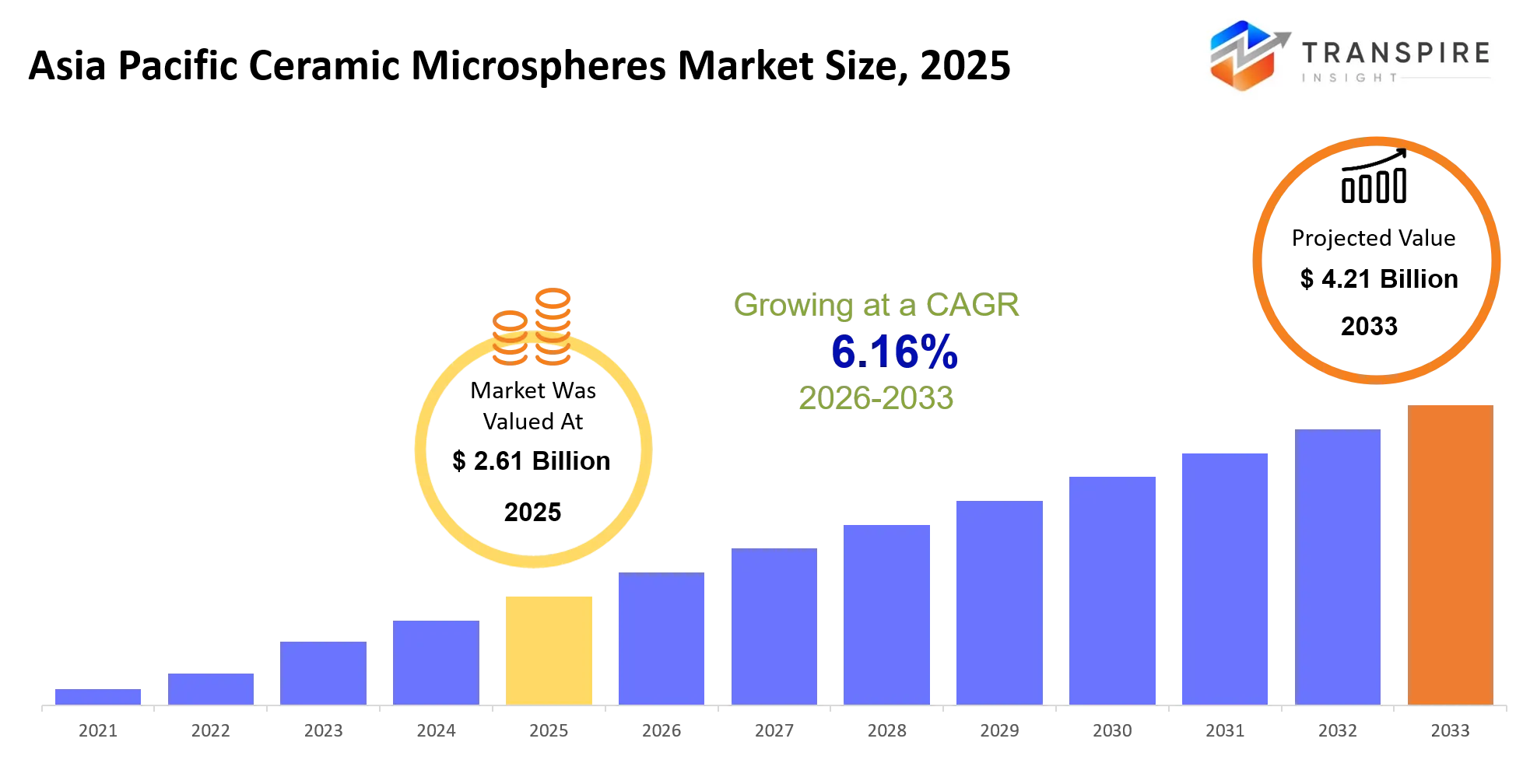
- Asia Pacific Ceramic Microspheres Market Size 2025: USD 2.61 Billion
- Asia Pacific Ceramic Microspheres Market Size 2033: USD 4.21 Billion
- Asia Pacific Ceramic Microspheres Market CAGR: 6.16%
- Asia Pacific Ceramic Microspheres Market Segments: By Type (Hollow Ceramic Microspheres, Solid Ceramic Microspheres, Alumina Microspheres, Silica Microspheres, Zirconia Microspheres, Others); By Application (Paints & Coatings, Oil & Gas, Construction Materials, Automotive Components, Aerospace, Others); By End User (Construction, Automotive, Energy, Manufacturing, Aerospace & Defense, Others); By Size (Below 50 Microns, 50–100 Microns, 100–200 Microns, Above 200 Microns, Others)
To learn more about this report,  Download Free Sample Report
Asia Pacific Ceramic Microspheres Market Summary
The Asia Pacific Ceramic Microspheres Market was valued at USD 2.61 Billion in 2025. It is forecast to reach USD 4.21 Billion by 2033. That is a CAGR of 6.16% over the period.
The Asia Pacific ceramic microspheres market kind of does a useful job, it helps manufacturers lighten the load, boost thermal insulation, reinforce durability, and reduce the amount of material used across coatings, construction materials, plastics, automotive parts, and even marine uses. In simple terms, swapping in ceramic microspheres for heavier conventional fillers lets products come out stronger and more energy efficient, and it usually doesn’t require major redesigns or anything dramatic.
In the last five years, the direction of the market has changed a bit, moving away from “just pick the cheapest filler” thinking toward performance engineered materials. These are tuned for lightweighting, heat management, and longer service life for assets. One big trigger was the blend of pandemic-era supply chain hitches and rising energy costs, so companies had to rework products around material efficiency and day to day operating savings. And meanwhile, tougher environmental rules and energy efficiency requirements helped push adoption of newer coatings and composites that include ceramic microspheres. That all together has made the whole value story clearer, so usage keeps expanding across industrial production lines, and it opens up fresh revenue streams for suppliers serving infrastructure, transport, and specialty manufacturing.
Key Market Insights
- China kind of dominates the Asia Pacific Ceramic Microspheres Market, and it has the biggest regional share because it has such broad manufacturing, plus construction , all tied together.
- In 2025, China was estimated to hold around 35–40% of the market, and this is backed by solid demand from coatings , plastics, and industrial composites , actually.
- Hollow ceramic microspheres take the lead too, they account for more than 55% of market revenue in 2025, mostly due to better weight reduction and insulation style results.
- Also, hollow ceramic microspheres are the quickest-growing segment through 2030, because more and more companies are using them in high-performance composites and coatings.
- Meanwhile, product innovation is steadily lifting compressive strength and thermal stability, so the overall reachable market gets bigger across multiple industries.
- Paints and coatings are kind of steering the whole market, about 30–35% of total demand in 2025, mostly because insulation needs and durability requirements are getting stronger.
- Construction materials still stay really relevant as an application stream, mostly due to the rising adoption in lightweight concrete and these energy efficient building products.
- Then there are advanced composite materials, they are the fastest growing part, backed by demand from automotive, marine, and industrial manufacturing.
- Ceramic microspheres are used more and more to boost how products perform, while also trimming down raw material consumption and this overall component weight.
- For end users, construction and infrastructure dominate the demand profile, taking close to 30% of market consumption in 2025, like it’s pretty steady and hard to ignore.
What are the Key Drivers, Restraints, and Opportunities in the Asia Pacific Ceramic Microspheres Market?
The most compelling force pushing the Asia Pacific ceramic microspheres market forward is kind of the manufacturing pivot toward lighter weight yet better performing materials. This change picked up speed once automakers , industrial makers and construction material suppliers started dealing with higher energy expenses and tougher efficiency goals. Ceramic microspheres help with weight reduction, thermal shielding, and also stronger mechanical behavior, but usually without needing major process overhauls. Because of that, producers are able to use less raw material and cut transportation outlays while still improving the end product, not just “slightly” but in a practical way. That whole value story has then broadened adoption in coatings, engineered plastics, composites and construction goods, which also supports revenue expansion for the microsphere suppliers.
The biggest limiting factor is really the restricted availability of advanced production capacity plus the technical difficulty involved in making high-quality ceramic microspheres that keep a consistent particle size and reliable strength features. It’s a structural issue, since setting up production sites asks for major capital outlays, specific machinery, and real process know-how, and that kind of expertise is not built overnight. The supply squeeze that follows tends to keep pricing higher in a few target uses, and it can slow uptake in cost-conscious industries. So, in the end, some manufacturers keep on relying on conventional fillers, even though ceramic microspheres offer clear performance advantages.
A big growth chance is hiding in advanced composite materials that get used in electric vehicles, renewable energy gear, and in those next generation infrastructure builds. Like China, India, and South Korea are putting serious money into lightweight manufacturing methods, and also those high performance material routes. Ceramic microspheres, kind of act as a lever for strength to weight ratios, plus they help with thermal handling too. And as these industries start pushing volumes up and up, the suppliers that can craft microsphere formulations for a specific application are likely to grab the next wave of expansion.
What Has the Impact of Artificial Intelligence Been on the Asia Pacific Ceramic Microspheres Market?
Artificial intelligence and advanced digital technologies are really sort of reshaping ceramic microsphere manufacturing, by making process control more consistent, pushing up production efficiency and also improving quality, in a steadier way. More and more manufacturers are leaning on AI based monitoring setups to automate big parts of the workflow, like furnace temperatures, the conditions for particle formation, and the raw material feed rates. These systems are constantly reviewing operational signals, then they tune the production parameters on the fly, which lowers process drift and usually boosts yield.
At the same time machine learning is getting used for predictive maintenance across kilns, grinding systems and even material handling equipment. These tools can spot early hints of wear, so operators can cut down on surprise stoppages , and they also help in extending the useful life of the equipment. In a few high end plants predictive analytics is also used to manage production timing and inventory levels, so costs drop while the product stays pretty stable in quality.
Then digital twins and simulation platforms add another layer for product development. Manufacturers can model particle motion, density traits, and thermal performance before they even scale up, so the whole development cycle shortens and material waste goes down too.
Still AI adoption is held back by a couple issues, mainly the high implementation costs and the limited access to strong historical production data. Many facilities are stuck with split up legacy systems, so integration becomes hard, like adding a new brain into an old body. But as digital infrastructure gets better across the region, AI enabled manufacturing should turn into a bigger competitive advantage within the ceramic microspheres industry.
Key Market Trends
- Since 2021, automaker producers have drifted toward lighter composite formulations, and in that process they’re adding more ceramic microsphere content in vehicle parts plus battery-adjacent use cases, sort of, more often than before.
- Between 2020 and 2025, construction material makers also started swapping out usual mineral fillers with engineered microspheres, mainly to push better insulation, and to lower structural weight without overcomplicating the process.
- After pandemic-era supply problems showed how fragile some regional specialty material supply chains could be, Chinese suppliers expanded their local production capacity, even while demand was kinda bouncing around.
- Coatings companies have been leaning into multifunctional mixes, so they can gain thermal insulation together with durability, rather than treating cost reduction like it’s the only goal.
- Starting around 2022, industrial buyers looked at overall lifecycle savings more closely, and this has sped up adoption of performance fillers that cut down the amount of material you actually need.
- At the same time, manufacturers have been using digital process-control systems along with AI-based quality monitoring, to help keep particle consistency tighter, and to reduce production losses that used to slip through.
- Competition has moved away from just volume-driven pricing, and more toward application specific product design, meaning suppliers now pitch customized microsphere grades for particular industries.
- In India, industrial manufacturers picked up faster adoption after infrastructure spending increased demand for lightweight construction materials, and for coatings that work with newer technologies.
- Since 2023, several regional producers have increased their research budgets to develop higher strength microspheres, aimed at electric vehicles plus renewable energy equipment.
- Worldwide players, including 3M and PQ Corporation, have been strengthening technical partnerships too, trying to lock in long term presence in higher value industrial applications.
Asia Pacific Ceramic Microspheres Market Segmentation
By Type :
Hollow ceramic microspheres sort of take an important place in the Asia Pacific Ceramic Microspheres Market, mostly because of low density, thermal insulation traits ,and the usual weight reduction benefits. Buyers keep looking for them across coatings, construction materials, and also in automotive use cases, where material efficiency, plus long lasting durability, are the big requirements. Solid ceramic microspheres are then the go to option when higher strength, better wear resistance, and dimensional stability start to matter more. In general these kinds of materials help industrial products improve their overall performance while they’re working under tough operating conditions.
Alumina microspheres are appreciated for hardness, thermal resistance, and mechanical strength, so they fit nicely into high temperature applications. Silica microspheres are often chosen for lightweight formulations and for smoother, better processing performance. Zirconia microspheres tend to be preferred when applications need real toughness and strong resistance against abrasion. There are also other ceramic microsphere types that match more specialized industrial needs ,so manufacturers can customize products across many production sectors.
By Application :
Paints and coatings end up being a major use area, mostly because ceramic microspheres can boost insulation, durability, and overall surface behavior. When you add them into coating formulas , it can also help cut down material mass, but still keep the final product quality about where it should be. In oil and gas, ceramic microspheres show up in drilling fluids, cementing work, and a bunch of other steps where strength and stability have to stay in check. Construction materials keep benefiting too, with those lighter properties along with better thermal behavior.
In the automotive sector, ceramic microspheres are increasingly built into components to support vehicle mass reduction and efficiency targets . Aerospace teams also rely on them for advanced composites and special parts, since the strength-to-weight ratio matters a lot there. Beyond that, you’ll find them in industrial equipment, marine goods, and engineered materials that need a blend of toughness , thermal control, and cost effectiveness all together.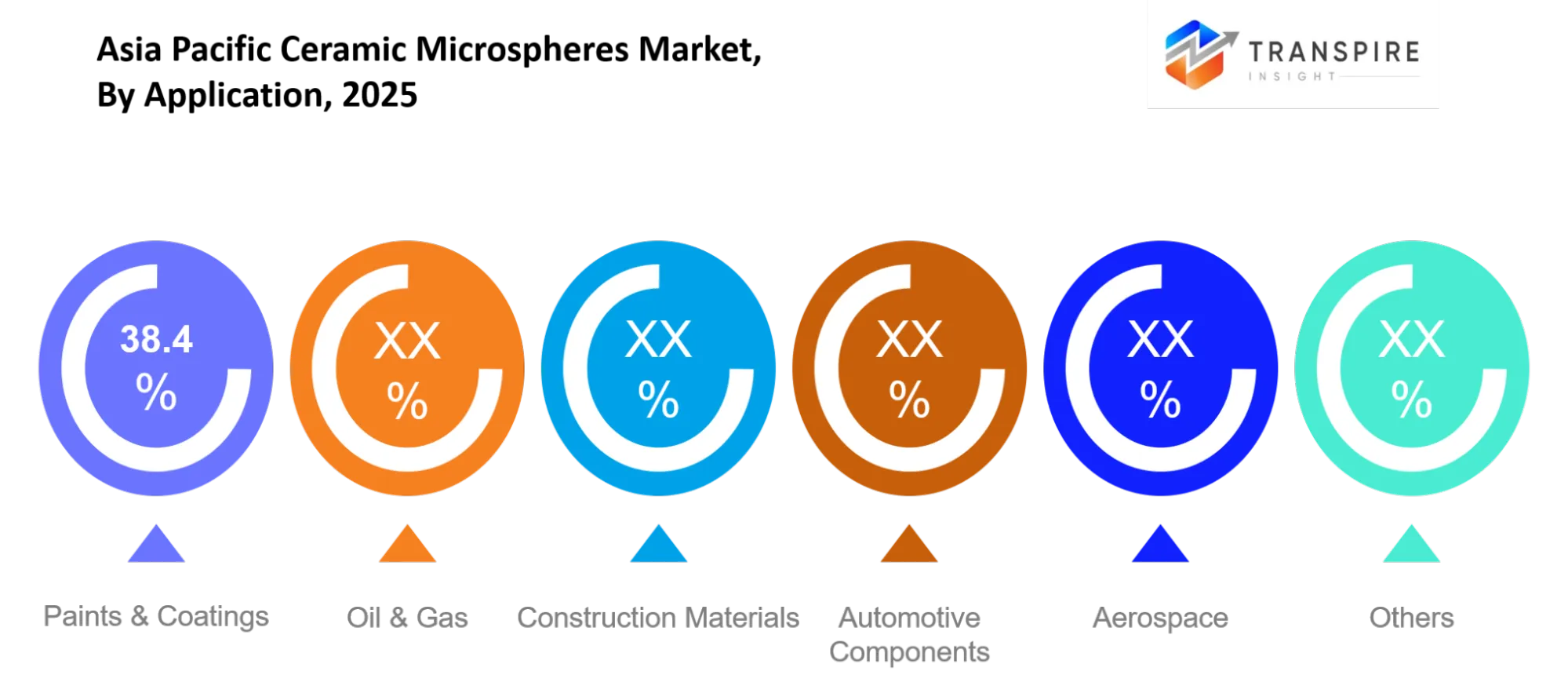
To learn more about this report, Download Free Sample Report
By End User :
In a lot of cases the construction sector is still a top end user, mainly because ceramic microspheres are used across lightweight concrete, insulation materials, and even performance coatings. They kind of help with structural efficiency , and they also support energy saving building designs, which sounds simple but matters. Meanwhile the automotive industry keeps pushing adoption because manufacturers are trying to reduce overall vehicle weight and also raise operating efficiency. Energy related industries too, they rely on ceramic microspheres for equipment and infrastructure work, especially where thermal resistance and durability are expected at the same time.
On the manufacturing side, companies apply ceramic microspheres throughout a wide set of products. You’ll see them in plastics, coatings, composites and also industrial components, not just one category. Aerospace and defense organizations take things further by using advanced ceramic materials where reliability and performance standards are high, no compromises. Other end users include transportation , infrastructure and various specialty industrial segments that want material enhancement plus long term operational advantages.
By Size :
Microspheres under 50 microns are usually picked when people want a smooth surface finish, more precise formulation work, and a very even particle spread. The 50–100 microns group gives a sort of middle ground between how well things perform and how easily the material can be processed, so it often works across a lot of different industrial tasks. Demand for these ranges stays quite solid in coatings, plastics, and composite materials, mainly because consistency matters a great deal.
The 100–200 micron segment is frequently used in cases where you need a higher volume contribution, plus improved lightweight benefits. Particles above 200 microns are selected for specialized industrial procedures where bigger particle frameworks bring certain functional gains. The other size brackets then handle particular customer preferences, and application driven targets, letting manufacturers tune their products based on technical requirements and what the end user really needs.
What are the Key Use Cases Driving the Asia Pacific Ceramic Microspheres Market?
In the Asia Pacific Ceramic Microspheres Market, the biggest part of demand is linked to paints and coatings that go into construction and industrial sites. Ceramic microspheres, in practice, help with thermal insulation, lower the overall coating mass, and make coatings tougher. Because of that combination, building owners and plant operators are able to scale back on routine maintenance and still push energy efficiency forward, so coatings stay the most well-known use.
At the same time, adoption is also moving forward in automotive manufacturing, and in energy-related sectors. Vehicle brands tend to use ceramic microspheres inside lightweight composite components, aiming for better efficiency and to support electrification roadmaps. Meanwhile, within the energy space, these materials show up in specialized parts and insulation setups, where they have to tolerate harsh working conditions.
New openings are starting to appear in renewable energy equipment and also in advanced infrastructure projects. Companies are looking at ceramic microspheres for high-performance composite structures tied to wind power systems, and for next generation construction materials. As investment continues to tilt toward lightweight yet thermally efficient engineered products, more commercial chances are expected to roll out during the whole forecast period.
|
Report Metrics |
Details |
|
Market size value in 2025 |
USD 2.61 Billion |
|
Market size value in 2026 |
USD 2.77 Billion |
|
Revenue forecast in 2033 |
USD 4.21 Billion |
|
Growth rate |
CAGR of 6.16% from 2026 to 2033 |
|
Base year |
2025 |
|
Historical data |
2021 - 2024 |
|
Forecast period |
2026 - 2033 |
|
Report coverage |
Revenue forecast, competitive landscape, growth factors, and trends |
|
Regional scope |
Asia Pacific (India, China, Japan, Australia, South Korea, Rest of Asia Pacific) |
|
Key company profiled |
3M, Potters Industries, Trelleborg, Momentive, AkzoNobel, Zeeospheres, Dennert, Sigmund Lindner, Omya, Reslab, Cospheric, Mo-Sci, Chase Corp, Ceno Technologies, EKO Export |
|
Customization scope |
Free report customization (country, regional & segment scope). Avail customized purchase options to meet your exact research needs. |
|
Report Segmentation |
By Type (Hollow Ceramic Microspheres, Solid Ceramic Microspheres, Alumina Microspheres, Silica Microspheres, Zirconia Microspheres, Others); By Application (Paints & Coatings, Oil & Gas, Construction Materials, Automotive Components, Aerospace, Others); By End User (Construction, Automotive, Energy, Manufacturing, Aerospace & Defense, Others); By Size (Below 50 Microns, 50–100 Microns, 100–200 Microns, Above 200 Microns, Others) |
Which Regions are Driving the Asia Pacific Ceramic Microspheres Market Growth?
China still feels like the dominant player in the Asia Pacific Ceramic Microspheres Market, mainly because there is a huge manufacturing base, very long industrial supply chains, and a strong footing in coatings, construction materials, and engineered composites. There is also government backing for advanced materials work, and that has basically pushed more local production plus follow-on investment in special industrial inputs. You can sort of see it as a tight web, raw material providers, processors, research groups, and end use manufacturers, all connected. This makes the ecosystem pretty integrated even when requirements change. Overall, that mix of scale, technical know how, and downstream pull keeps China in the leadership role across the region.
Japan comes next as the second largest contributor, but the way the market grows is a bit different. It is less about sheer manufacturing size, more about steady investment in high performance materials, precision manufacturing, and product quality norms. Demand stays fairly steady in automotive, electronics, and other industrial uses where the requirements are tough, and supplier relationships tend to be long term. Because Japan leans into reliability and technical worth, it keeps generating stable market revenue even when the broader economy feels uncertain.
India is slowly but steadily looking like the fastest growing market, infrastructure development and industrial expansion, plus domestic manufacturing programs are making more room for advanced materials. In recent times, investments in transportation networks industrial corridors, and construction projects have raised the demand for materials that are lighter and also thermally sensible. At the same time automotive manufacturers are pushing broader usage of advanced composites and engineered parts, so the demand for ceramic microspheres keeps getting boosted. Looking at 2026–2033, this kind of momentum should pull in fresh investments, nudge local production expansion, and open some promising entry routes for suppliers who want to step into high-growth markets.
Who are the Key Players in the Asia Pacific Ceramic Microspheres Market and How Do They Compete?
Competition in the Asia Pacific Ceramic Microspheres Market is sort of moderately fragmented, with big specialty materials companies playing against regional manufacturers too, and smaller niche suppliers as well. Mostly the fight shows up in product performance and particle consistency, but also in technical support, and in how well a vendor can actually hit application-specific needs. Even though the established manufacturers keep defending their market share, they do it using research, and production scale, while newer suppliers seem to lean toward very specific industrial uses, where customization has more value than just raw volume. In general, technology progress and application know-how have started to matter more than price by itself, because end users want materials that boost efficiency, and improve overall product performance, not only cheaper inputs.
3M is active in advanced hollow microsphere technologies that aim to reduce weight while still keeping structural performance solid. They stand out thanks to a lot of materials research, plus application engineering strength, which helps customers plug microspheres into more complicated manufacturing workflows. Their growth emphasis is on product innovation and close collaboration with industrial customers who are working on next generation composite materials, so it’s less about “selling a lot” and more about building solutions together.
PQ Corporation really competes using specialty inorganic know how, and they keep a broad portfolio that touches many industrial sectors at once. Omya, for its part, leans on solid distribution channels plus material solutions that are tuned for each customer, so their footprint in the region gets stronger. Dennert Poraver stands out with lightweight filler technologies made for construction and also for industrial use, sort of the kind you would expect when you want bulk reduction and stable behavior. Meanwhile AkzoNobel benefits from tight alignment with coatings innovation, which lets them put advanced microsphere solutions right inside performance focused coating systems. Together, these moves help the companies grow lasting customer ties, and they also reinforce their competitive position across a range of end use industries.
Company List
- 3M
- Potters Industries
- Trelleborg
- Momentive
- AkzoNobel
- Zeeospheres
- Dennert
- Sigmund Lindner
- Omya
- Reslab
- Cospheric
- Mo-Sci
- Chase Corp
- Ceno Technologies
- EKO Export
Recent Development News
In March 2025, Nouryon launched Expancel® XS200 microspheres. The new extra-small microsphere grade was introduced for interior decorative paints, enabling weight reduction while maintaining surface quality and durability, supporting broader adoption of lightweight microsphere technologies in coatings applications.Source https://www.nouryon.com/
In January 2025, Brenntag Specialties extended its exclusive distribution partnership with3M for 3M Glass Bubbles. The agreement expanded distribution coverage to France and the Iberian Peninsula, strengthening market access for lightweight hollow microsphere technologies used in coatings, plastics, and construction materials. Source https://www.european-coatings.com/
What Strategic Insights Define the Future of the Asia Pacific Ceramic Microspheres Market?
The Asia Pacific Ceramic Microspheres Market seems to be moving into something more specialized , and more performance driven, over the next five to seven years. In practice growth is likely to come less from plain volume consumption and more from advanced manufacturing uses. The core reason is the continued move toward lightweight yet thermally efficient, high-performance materials across electric vehicles , renewable energy setups, industrial equipment, and the next wave of infrastructure projects. When end users start caring more about lifecycle performance and material optimization, suppliers that bring real technical know-how will usually take a larger portion of the market value.
There is also a quieter kind of risk that people don’t always notice. It’s the fact that high quality production capacity and specialized raw material supply are somewhat concentrated. So if there are any supply interruptions or if new capacity expansion doesn’t land fast enough, the resulting price swings could slow adoption in industries that are very cost sensitive. On top of that, technology substitution is still on the table, since other lightweight fillers keep getting better.
An emerging opportunity is the use of ceramic microspheres in advanced battery systems and thermal management components, especially across China , India, and South Korea. Players in the market should push for application specific product development and set up partnerships with composite, automotive, and energy equipment manufacturers. That way they can lock in long term growth chances before these regions become more competitive.
Asia Pacific Ceramic Microspheres Market Report Segmentation
By Type
- Hollow Ceramic Microspheres
- Solid Ceramic Microspheres
- Alumina Microspheres
- Silica Microspheres
- Zirconia Microspheres
By Application
- Paints & Coatings
- Oil & Gas
- Construction Materials
- Automotive Components
- Aerospace
By End User
- Construction
- Automotive
- Energy
- Manufacturing
- Aerospace & Defense
By Size
- Below 50 Microns
- 50–100 Microns
- 100–200 Microns
- Above 200 Microns
Frequently Asked Questions
Find quick answers to common questions.
The Expected Asia Pacific Ceramic Microspheres Market size is USD 4.21 Billion in 2033.
Key Segments for the Asia Pacific Ceramic Microspheres Market are By Type (Hollow Ceramic Microspheres, Solid Ceramic Microspheres, Alumina Microspheres, Silica Microspheres, Zirconia Microspheres, Others); By Application (Paints & Coatings, Oil & Gas, Construction Materials, Automotive Components, Aerospace, Others); By End User (Construction, Automotive, Energy, Manufacturing, Aerospace & Defense, Others); By Size (Below 50 Microns, 50–100 Microns, 100–200 Microns, Above 200 Microns, Others).
Major Asia Pacific Ceramic Microspheres Market Players are 3M, Potters Industries, Trelleborg, Momentive, AkzoNobel, Zeeospheres, Dennert, Sigmund Lindner, Omya, Reslab, Cospheric, Mo-Sci, Chase Corp, Ceno Technologies, EKO Export.
The Current Asia Pacific Ceramic Microspheres Market size is USD 2.61 Billion in 2025.
The Asia Pacific Ceramic Microspheres Market CAGR is 6.16% from 2026 to 2033.
- 3M
- Potters Industries
- Trelleborg
- Momentive
- AkzoNobel
- Zeeospheres
- Dennert
- Sigmund Lindner
- Omya
- Reslab
- Cospheric
- Mo-Sci
- Chase Corp
- Ceno Technologies
- EKO Export
About the Authors

Pankaj Ghogare Patil
I am Pankaj Ghogare Patil, a Senior Research Analyst at Transpire Insight, specializing in the Pharmaceutical, Chemicals & Materials, Healthcare IT, and Biotechnology industry. My expertise lies in conducting comprehensive market research, analyzing industry trends, evaluating competitive landscapes, and translating complex data into actionable insights. At Transpire Insight, I closely follow emerging technologies, regulatory developments, and market innovations to create accurate, well-researched, and informative content that helps businesses and professionals make informed decisions. I am committed to producing credible, evidence-based articles that reflect industry best practices while making technical topics accessible and valuable for a broad audience.

Chakradhar Khansole
Chakradhar serves as the Research Director at Transpire Insight, bringing over 8 years of experience in technology, innovation, and strategic market intelligence. He specializes in transforming complex market data into actionable business insights that enable organizations to make informed, growth-oriented decisions. Recognized for his strategic vision and analytical expertise, Chakradhar leads high-impact research initiatives, delivering comprehensive market assessments, competitive intelligence, and forward-looking industry analysis.
Recently Published Reports
-
May 2026
Healthcare Polymer Packaging Market
Healthcare Polymer Packaging Market Size, Share & Analysis Report By Packaging Type (Syringes, IV Bottles and Pouches, Clamshells, Blisters, Bottles & Jars, Containers, Tubes, IV Parental Packaging, Others), By Type (Regulated, Non-regulated), By Polymer Type (LDPE (Low-Density Polyethylene), HDPE (High-Density Polyethylene), Homo-polymer (Homo), Random Copolymer (Random), Block Copolymer (Block), PET, Polystyrene, Polyvinyl Chloride, Polyamide/EVOH, Others), and Geography (North America, Europe, Asia-Pacific, Middle East and Africa, South and Central America), 2021 - 2031
-
Apr 2026
Hydrophilic Tape (Waterstop) Market
Hydrophilic Tape (Waterstop) Market Size, Share & Analysis Report By Type (Bentonite-Based Hydrophilic Tape, Rubber-Based Hydrophilic Tape), By Application (Residential Buildings, Commercial Buildings, Infrastructure Projects), and Geography (North America, Europe, Asia-Pacific, Middle East and Africa, South and Central America), 2021 - 2031
-
Apr 2026
Metalens Market
Metalens Market Size, Share & Analysis Report By Type (Visible Light Metalens, and Infrared Metalens), By Application (Consumer Electronics, Automotive Electronics, Industrial, Medical, and Others), and Geography (North America, Europe, Asia-Pacific, Middle East and Africa, South and Central America), 2021 - 2031
-
Apr 2026
PBT Resin Market
PBT Resin Market Size, Share & Analysis Report By Type (Reinforced PBT Resin, Unreinforced PBT Resin), By Processing Method (Injection Molding, Extrusion, Blow Molding, Others), By End-User (Automotive, Electrical & Electronics, Consumer Appliances, Industrial Machinery, Medical Devices, Packaging, Others), and Geography (North America, Europe, Asia-Pacific, Middle East and Africa, South and Central America), 2021 - 2031