
Europe Ultra-High Temperature Ceramics Market Size & Forecast:
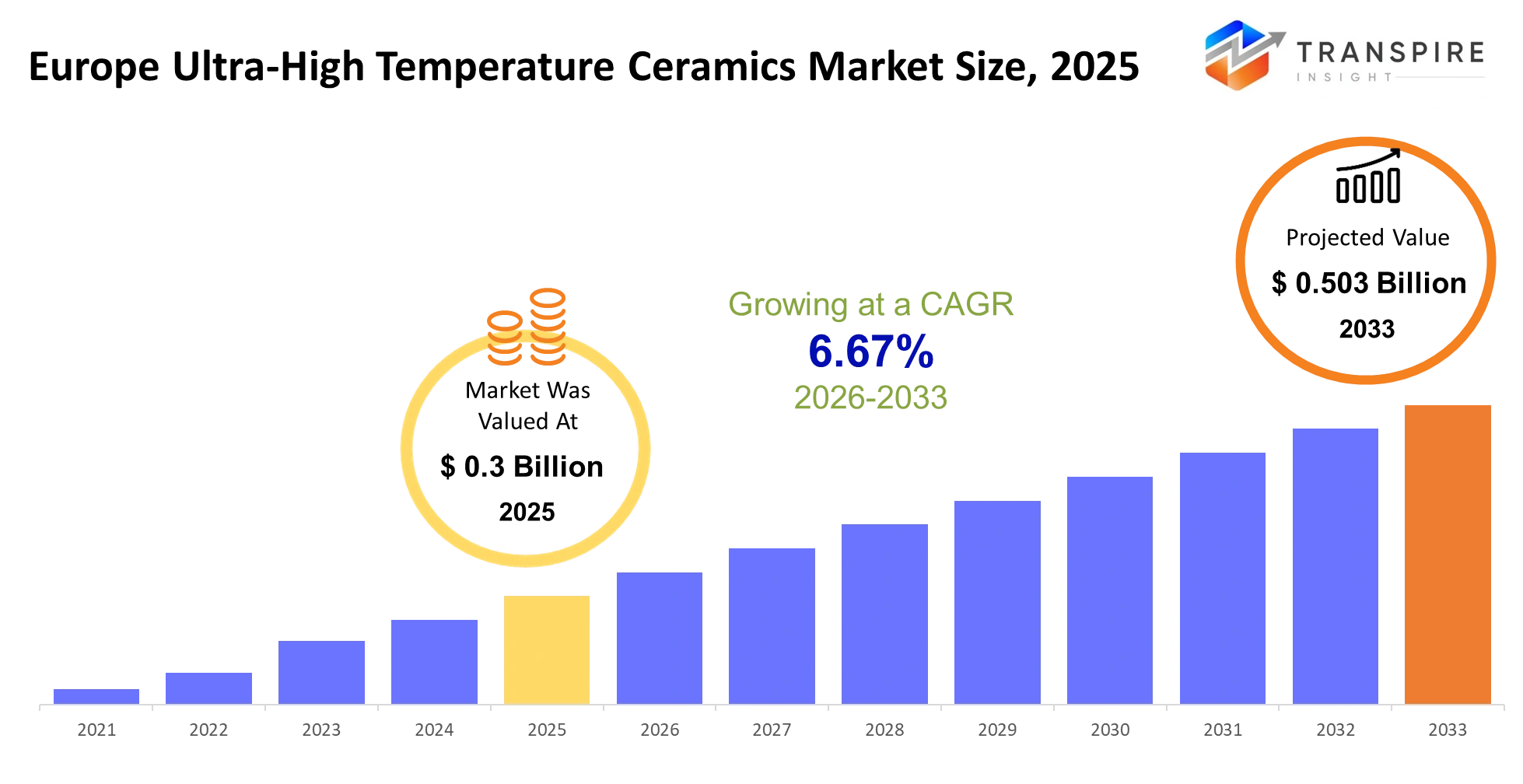
- Europe Ultra-High Temperature Ceramics Market Size 2025: USD 0.3 Billion
- Europe Ultra-High Temperature Ceramics Market Size 2033: USD 0.503 Billion
- Europe Ultra-High Temperature Ceramics Market CAGR: 6.67%
- Europe Ultra-High Temperature Ceramics Market Segments: By Type (Carbides, Borides, Nitrides, Composites, Oxides, Hybrid Ceramics, Others); By Application (Aerospace, Defense, Energy, Automotive, Electronics, Nuclear, Others); By End-User (Aerospace Industry, Defense Sector, Industrial Sector, Research Institutes, Energy Sector, Others); By Form (Coatings, Bulk Materials, Powders, Fibers, Sheets, Others).
To learn more about this report,  Download Free Sample Report
Europe Ultra-High Temperature Ceramics Market Summary
The Europe Ultra-High Temperature Ceramics Market was valued at USD 0.3 Billion in 2025. It is forecast to reach USD 0.503 Billion by 2033. That is a CAGR of 6.67% over the period.
The Europe Ultra-High Temperature Ceramics Market supports real-world engineering needs which occur when metals lose their strength at extreme heat conditions present in jet propulsion systems and hypersonic defense components and gas turbines and high-efficiency industrial furnaces. The materials provide structural integrity abilities that extend beyond 1,500°C which makes them vital for aerospace engines and advanced energy systems that experience continuous thermal stress.
The past 3–5 years have witnessed a complete transition away from conventional superalloys toward ceramic matrix composites because next-generation propulsion systems demand lighter components which offer better heat resistance. The European Union defense modernization programs experienced increased funding for hypersonic missile and aerospace research and development after 2022 geopolitical tensions escalated. The pandemic caused supply chain disruptions which revealed the industry dependence on imported high-performance powders thus prompting Europe to establish local advanced ceramic manufacturing facilities.
The implementation started from specialized aerospace testing but currently has moved to broad industrial use especially for turbine efficiency improvements and thermal barrier coating applications. The current situation has resulted in two outcomes because it has increased procurement volumes while it has secured permanent supplier agreements which establish advanced ceramics as an essential material type for high-temperature engineering applications in Europe.
Key Market Insights
- The Europe Ultra-High Temperature Ceramics Market in 2025 will be 45% controlled by Western Europe which exists because France and Germany function as aerospace manufacturing centers.
- The regional cluster in Germany will experience the fastest growth until 2030 because of additive manufacturing investments and defense modernization programs.
- The Europe Ultra-High Temperature Ceramics Market currently operates with carbides as its primary segment which holds more than 38% market share because of their exceptional thermal resistance properties used in propulsion systems.
- The material segment of hybrid ceramic composites exhibits the highest growth rate until 2030 because aerospace industry demands lightweight structures which offer multiple functions.
- The aerospace industry leads the market with almost 50% share because of turbine efficiency improvements and the development of hypersonic vehicles.
- The energy sector applications experience their most rapid growth in the EU decarbonization initiatives which focus on gas turbines and high-efficiency combustion systems.
- Aerospace OEMs hold the largest end-user market share at 42% because of their contracts for long-term material qualification and their defense procurement processes.
- The fastest-growing end-user group for ceramic coatings expands from industrial and energy operators who adopt these coatings as replacements for traditional refractory materials.
- Companies achieve faster competitive advantages through their development of ceramic matrix composite technology and their establishment of aerospace partnerships and their creation of European high-temperature material production facilities.
- Strategic partnerships between defense organizations and turbine original equipment manufacturers build qualification pathways while they speed up market introduction times throughout the European Ultra-High Temperature Ceramics Market.
What are the Key Drivers, Restraints, and Opportunities in the Europe Ultra-High Temperature Ceramics Market?
The Europe Ultra-High Temperature Ceramics Market expands because financial investments for hypersonic defense systems and next-generation aerospace propulsion programs receive increasing funding. NATO member states started military modernization programs after 2022, which led France Germany and the United Kingdom to spend more on defense and buy additional carbide and nitride thermal protection materials. Aerospace Original Equipment Manufacturers like Airbus and Rolls-Royce increased their testing activities for ceramic matrix components, which they use to assess turbine efficiency improvements at temperatures exceeding 1,500°C. Advanced ceramics suppliers who operate in the aerospace supply chain have achieved stable revenue streams because the industry now requires shorter qualification periods and higher production volumes.
The primary obstacle to progress exists because companies need to pay extremely high costs for processing and qualifying ultra-high temperature ceramics. Mid-sized manufacturers face difficulties in production because they need specialized furnaces and controlled environments to implement sintering and densification and defect control processes. The certification process for aerospace and defense applications requires more than five years to complete, which results in delayed product introduction and decreased immediate revenue generation. Organizations need to conduct extensive physical testing, which creates a structural barrier that prevents them from simulating material behavior at extreme temperatures and testing their innovation work.
Additive manufacturing of ceramic matrix composites through 3D printing applications receives major investment backing from government programs in Germany and France because these programs support industrial 3D printing development. Companies such as Safran are investing in powder-based printing for turbine components which allows them to create complex designs while using less raw materials. The aerospace and energy industries will increase their use of additive manufacturing techniques because these methods will decrease production lead times by 30 percent when production processes reach better consistency.
What Has the Impact of Artificial Intelligence Been on the Europe Ultra-High Temperature Ceramics Market?
Artificial intelligence and advanced digital systems are transforming production and performance optimization in the Europe Ultra-High Temperature Ceramics Market through their implementation in aerospace-grade manufacturing and high-temperature industrial processing. Manufacturers use machine learning models to enhance carbide and nitride production through real-time furnace temperature profile adjustments which decrease defect rates and produce consistent material quality. Computer vision systems detect micro-cracks and porosity during inspection stages which enhances quality yield and decreases rework cycles in ceramic matrix composite production lines.
Predictive maintenance tools analyze vibration, thermal load, and equipment wear data from high-temperature furnaces and plasma spray systems, helping manufacturers reduce unplanned downtime by an estimated 10 to 20 percent in advanced facilities. Energy optimization algorithms increase kiln efficiency through their ability to decrease energy usage by 8 to 12 percent in controlled environments. AI-driven monitoring systems enhance compliance with EU industrial standards through their ability to forecast particulate load and filter degradation patterns in emission control systems that use ceramic-based filters for industrial exhaust treatment.
The system analysis shows that implementation of the system is restricted because organizations need more high-quality training data to handle extreme thermal processes. The production process variability between different facilities leads to reduced model accuracy while the expensive integration process of legacy furnace systems prevents smaller manufacturers from implementing complete system deployment.
Key Market Trends
- European defense programs increased their hypersonic testing budgets after 2022 which led to ceramics becoming essential for developing missile thermal protection systems that defense contractors now use in their work.
- Additive manufacturing expanded its scope from 2021 onwards by enabling the production of ultra-high temperature ceramics through 3D printing methods which create complex aerospace components from powder materials.
- EU decarbonization policies drove turbine efficiency upgrades which resulted in higher demand for ceramic coatings used in gas turbines by energy operators from 2020 onwards.
- Material suppliers shifted from carbide-heavy portfolios toward hybrid ceramic composites after 2023 because aerospace demanded lighter thermal-resistant structures.
- European aerospace OEMs increased their use of ceramic matrix composites after 2022 which led to them reducing metal alloy usage in advanced propulsion systems.
- European supply chains developed stronger local networks after 2021 disruptions which led ceramic powder manufacturers to build more production facilities while decreasing their need for imports.
- The nuclear sector began adopting ceramic insulation materials from 2020 onward which replaced traditional refractories in high-temperature reactor systems that operate throughout France and Germany.
- Defense contractors established boride-based ceramics as a standard material after 2023 which enhanced missile nose cone erosion resistance while decreasing maintenance needs.
Europe Ultra-High Temperature Ceramics Market Segmentation
By Type:
The European Ultra-High Temperature Ceramics Market maintains its dominant market position because ceramic materials achieve superior mechanical strength and exceptional thermal protection. The aerospace and defense industry requires thermal protection systems that need carbide materials because these systems protect against extreme heat and sustain heavy erosion. Nitrides extend their market position because high-temperature electronics require electrical insulation properties. The market positions of oxides and borides remain moderate because their manufacturing processes require complex procedures and expensive resources, whereas the market for composites and hybrid ceramics has niche applications that are growing because of specific performance needs.
The demand for hypersonic systems and advanced propulsion environments drives growth for carbides and nitrides because these applications require thermal stability that exceeds what conventional alloys can provide. Oxides find their main applications in environments with high oxidation rates, but their market expansion remains restricted because of their brittle nature. The design flexibility of hybrid ceramics and composites enables engineers to adjust material properties according to their specific engineering requirements.
The market prediction shows carbide and nitride materials will maintain their current market value while hybrid ceramics will experience faster growth because they serve various functional needs. Material developers will focus on enhancing processing methods to minimize defects, while investors will support production facilities that can produce scalable carbide and composite materials for aerospace usage.
By Application:
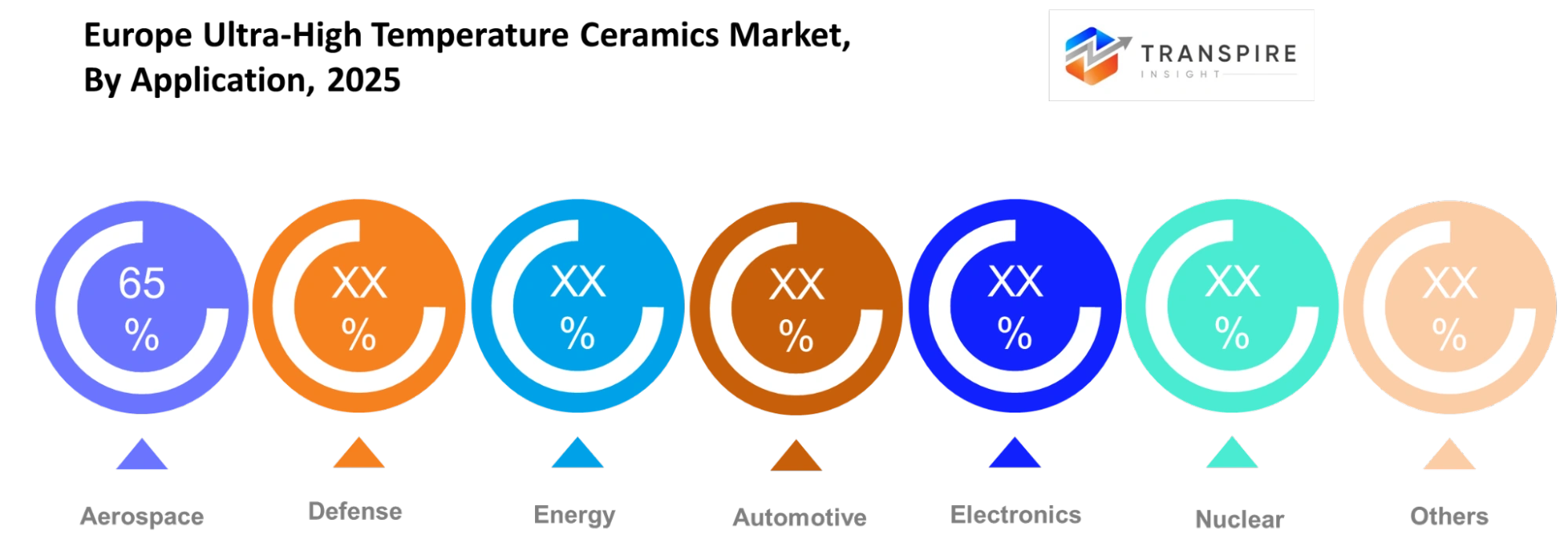
The Europe Ultra-High Temperature Ceramics Market shows its highest demand in aerospace applications because it requires thermal shielding systems together with turbine components and propulsion structures. The defense applications of the market develop because of hypersonic missile systems and high-speed re-entry defense technologies.Energy applications experience continuous growth through the implementation of gas turbines and advanced combustion systems, while the electronics and nuclear industries maintain their focus on developing essential technologies.
The aerospace and defense sectors experience expansion because of rising funding for advanced propulsion technology research which demands materials that endure extreme aerodynamic heating conditions. Energy applications expand through power generation efficiency enhancement projects, while automotive industry growth remains restricted because high costs and production system compatibility issues prevent mass adoption.
Aerospace and defense industries will maintain their role as performance leaders which will drive advancements in thermal shock resistance and structural integrity development. Energy and nuclear applications will gradually expand as efficiency regulations tighten. Developers will focus on cross-application material standardization, while buyers will prioritize lifecycle durability over initial cost constraints.
To learn more about this report, Download Free Sample Report
By End-User:
The European Ultra-High Temperature Ceramics Market shows its primary end-user segment through the aerospace industry because of its extensive use in both propulsion systems and structural elements. Defense sector follows with strong procurement linked to strategic weapon systems and high-temperature armor technologies. Industrial sector maintains moderate adoption through furnace linings and high-wear processing equipment, while research institutes contribute smaller but innovation-critical demand.
The aerospace and defense sectors experience customer base growth through their permanent modernization programs and their current efforts to develop products with better thermal performance under extreme conditions. Energy sector demand rises through turbine efficiency upgrades and carbon reduction initiatives. The industrial sector adopts technology at a constant rate because organizations need to control their expenses which restricts their ability to grow fast like other important industries do.
Aerospace and defense sectors will determine material performance standards through their ongoing research until research institutes succeed in developing next-generation ceramic materials. The industrial and energy sectors will begin to use ultra-high temperature ceramics as their manufacturing costs start to decrease. Defense procurement cycles and aerospace qualification standards will determine how suppliers organize their production activities.
By Form:
The European Ultra-High Temperature Ceramics Market relies on coatings because they serve as essential components for thermal barrier systems used in turbine and aerospace component applications. The market for bulk materials maintains stable market presence because extreme heat environments need structural components which drive demand. The market for powders controls upstream supply chains because they provide support for additive manufacturing and sintering processes but the market for fibers and sheets exists as specialized markets which experience increasing demand.
The demand for surface protection which prevents oxidation and thermal degradation in propulsion systems drives the growth of coatings products. The powder market experiences growth because additive manufacturing technologies create new possibilities for producing complex shapes while using materials efficiently. Lightweight thermal shielding systems use fiber and sheet materials which face challenges that prevent their widespread use because of difficulties in manufacturing.
Coatings and powders will drive material development in aerospace and energy fields according to future industry predictions. Bulk materials will maintain their essential structural function while high-performance lightweight systems will start using more fibers and sheets. Material suppliers will focus on developing scalable processes that produce consistent results while buyers will seek materials that work with advanced manufacturing systems during their production process.
What are the Key Use Cases Driving the Europe Ultra-High Temperature Ceramics Market?
Aerospace propulsion and hypersonic defense systems drive the adoption of ultra-high temperature ceramics throughout Europe because these applications require materials that can withstand extreme heat while maintaining structural integrity for their engine nozzles and thermal shields and leading-edge components at high Mach velocities. The systems become vital components of future military and space spacecraft.
The new use cases extend to gas turbines which power advanced energy systems and high-temperature industrial furnaces that operate in metallurgy and chemical processing. The applications achieve their efficiency improvements and better operational life which results in decreased maintenance requirements for both industrial operators and energy utilities throughout Europe.
The market for fusion energy reactor components and 3D printing of complex ceramic components for space systems is currently developing. The initial applications of the technology use fast prototyping methods to achieve temperature resistance which will help them establish their product existence in the future.
|
Report Metrics |
Details |
|
Market size value in 2025 |
USD 0.3 Billion |
|
Market size value in 2026 |
USD 0.32 Billion |
|
Revenue forecast in 2033 |
USD 0.503 Billion |
|
Growth rate |
CAGR of 6.67% from 2026 to 2033 |
|
Base year |
2025 |
|
Historical data |
2021 - 2024 |
|
Forecast period |
2026 - 2033 |
|
Report coverage |
Revenue forecast, competitive landscape, growth factors, and trends |
|
Regional scope |
Europe (Germany, United Kingdom, France, Italy, Spain, Rest of Europe) |
|
Key company profiled |
3M, CoorsTek, Saint-Gobain, CeramTec, Kyocera, Morgan Advanced Materials, NGK Spark Plug, Schunk Group, Rauschert, Blasch Precision Ceramics, Lancer Systems, Ultramet, ZIRCAR Ceramics, Haydale, Advanced Ceramics Manufacturin. |
|
Customization scope |
Free report customization (country, regional & segment scope). Avail customized purchase options to meet your exact research needs. |
|
Report Segmentation |
By Type (Carbides, Borides, Nitrides, Composites, Oxides, Hybrid Ceramics, Others); By Application (Aerospace, Defense, Energy, Automotive, Electronics, Nuclear, Others); By End-User (Aerospace Industry, Defense Sector, Industrial Sector, Research Institutes, Energy Sector, Others); By Form (Coatings, Bulk Materials, Powders, Fibers, Sheets, Others). |
Which Regions are Driving the Europe Ultra-High Temperature Ceramics Market Growth?
The Europe Ultra-High Temperature Ceramics market shows Western Europe as its leading market because France Germany and the United Kingdom maintain extensive aerospace and defense manufacturing operations. The defense modernization programs and space programs establish public procurement frameworks which generate ongoing requirements for advanced thermal-resistant materials. The organization establishes its market leadership position through dedicated research and development centers which operate through universities and corporate research facilities that develop ceramic materials for hypersonic and propulsion system applications. The established certification processes together with strict regulatory enforcement mechanisms create a system that requires material suppliers to operate within established aerospace supply chains for extended periods.
Southern Europe maintains its role as a stability-driven region which develops industrial applications in Italy and Spain because these countries depend on energy infrastructure development and existing manufacturing facilities modernization instead of defense activities. The region functions as a base for industrial refurbishment which operates according to schedules while Western European countries depend on their advanced aerospace requirements. The investment behavior of shipowners and industrial operators results in gradual investments which prioritize cost control thus developing a consistent yet less unpredictable market need for high-temperature ceramic products. The region maintains stability which provides essential financial support to companies during periods when defense procurement activities experience seasonal declines.
The regional cluster which experiences the fastest growth across the world exists between Northern Europe and Eastern Europe because Poland and the Nordic countries and the Baltic states build their defense systems according to NATO standards while they simultaneously modernize their industrial systems. The defense industry has increased its spending together with infrastructure security expenditures which directly boost the demand for advanced materials that aerospace and energy resilience applications require. The growth of this market region depends on investment cycles which enable catch-up strategies instead of using incremental upgrades that Western markets need. Early suppliers will find between 2026 and 2033 to establish their base because this period allows them to gain long-term contracts through their work with procurement systems and developing local supply chains.
Who are the Key Players in the Europe Ultra-High Temperature Ceramics Market and How Do They Compete?
The European ultra-high temperature ceramics market exhibits a moderately consolidated competitive environment because global firms maintain market dominance while specialized companies can enter the market through aerospace and defense sectors. The primary competition between companies exists because their materials engineering capabilities and certification standards determine their products' performance under extreme thermal and mechanical stress, which most applications require. The existing companies use tighter operational connections with their aerospace and energy and industrial system customers to maintain market share while they spend money on advanced manufacturing technologies to defend against competition from nimble startup companies.
Saint-Gobain competes through vertically integrated materials production, which enables its control over raw ceramic formulations and scalable manufacturing capabilities to establish long-term contracts with aerospace and industrial customers. CeramTec provides differentiated products through precision-engineered ceramic components, which serve medical and aerospace and thermal system applications while maintaining strong certification credentials for European regulated industries. Morgan Advanced Materials builds its competitive advantage through specialized high-temperature solutions, which it develops for specific thermal management needs of energy and defense customers. Kyocera expands in Europe through its development of additive manufacturing technology and advanced silicon carbide ceramics, which will enable its entry into next-generation hypersonic and energy markets. CoorsTek expands its business through engineering partnerships that focus on specific applications, especially in aerospace testing environments where customized material performance creates switching costs that help retain customers.
Company List
- 3M
- CoorsTek
- Saint-Gobain
- CeramTec
- Kyocera
- Morgan Advanced Materials
- NGK Spark Plug
- Schunk Group
- Rauschert
- Blasch Precision Ceramics
- Lancer Systems
- Ultramet
- ZIRCAR Ceramics
- Haydale
- Advanced Ceramics Manufacturing
Recent Development News
In November 2025, KYOCERA Fineceramics Europe GmbH showcased conventionally and 3D-printed silicon-infiltrated silicon carbide (SiSiC) components at Space Tech Expo Europe 2025. The demonstration reinforced industrial readiness of UHTC-adjacent materials for aerospace systems and highlighted accelerating adoption of additive manufacturing for extreme-environment components in Europe.
Source: https://europe.kyocera.com/uploads/eu/Press_information_Kyocera_Space_Tech_Expo_2025.pdf (Kyocera Europe).
In February 2026, KYOCERA Fineceramics Europe GmbH received the BSFZ seal of approval for R&D focused on additive manufacturing of large-format SiSiC components. The recognition signals institutional support for scaling advanced ceramic production, strengthening Europe’s capability in next-generation high-temperature applications.
Source: https://europe.kyocera.com/products/fineceramic_components/news/2025/ (Kyocera Europe).”
What Strategic Insights Define the Future of the Europe Ultra-High Temperature Ceramics Market?
In the upcoming 5 to 7 years the Europe Ultra-High Temperature Ceramics UHTC market will evolve from its current niche aerospace use toward becoming a fundamental material component for defense systems and energy transition technologies and advanced manufacturing processes. The existing technological demands of European countries who seek to achieve technological independence from their current military development needs and their upcoming need for industrial electric power operations drive this development forward. The material risk exists because essential materials operate under unstable conditions since producers depend on specific geographic areas for vital resources like zirconium and hafnium which limits their ability to expand operations despite market demand. The EU-supported research environments show that additive manufacturing of ceramic components for hypersonics and fusion energy projects has created a new business opportunity that is growing at a faster rate than traditional markets. Defense and energy original equipment manufacturers need to form vertically integrated partnerships as their main focus while developing scalable 3D ceramic printing technologies to achieve first market entry for upcoming advanced high-temperature system development.
Europe Ultra-High Temperature Ceramics Market Report Segmentation
By Type
- Carbides
- Borides
- Nitrides
- Composites
- Oxides
- Hybrid Ceramics
- Others
By Application
- Aerospace
- Defense
- Energy
- Automotive
- Electronics
- Nuclear
- Others
By End-User
- Aerospace Industry
- Defense Sector
- Industrial Sector
- Research Institutes
- Energy Sector
- Others
By Form
- Coatings
- Bulk Materials
- Powders
- Fibers
- Sheets
- Others
Frequently Asked Questions
Find quick answers to common questions.
The Europe Ultra-High Temperature Ceramics Market size is USD 0.503 Billion in 2033.
Key segments for the Europe Ultra-High Temperature Ceramics Market are By Type (Carbides, Borides, Nitrides, Composites, Oxides, Hybrid Ceramics, Others); By Application (Aerospace, Defense, Energy, Automotive, Electronics, Nuclear, Others); By End-User (Aerospace Industry, Defense Sector, Industrial Sector, Research Institutes, Energy Sector, Others); By Form (Coatings, Bulk Materials, Powders, Fibers, Sheets, Others).
Major Europe Ultra-High Temperature Ceramics Market players are 3M, CoorsTek, Saint-Gobain, CeramTec, Kyocera, Morgan Advanced Materials, NGK Spark Plug, Schunk Group, Rauschert, Blasch Precision Ceramics, Lancer Systems, Ultramet, ZIRCAR Ceramics, Haydale, Advanced Ceramics Manufacturing.
The Europe Ultra-High Temperature Ceramics Market size is USD 0.3 Billion in 2025.
The Europe Ultra-High Temperature Ceramics Market CAGR is 6.67% from 2026 to 2033.
- 3M
- CoorsTek
- Saint-Gobain
- CeramTec
- Kyocera
- Morgan Advanced Materials
- NGK Spark Plug
- Schunk Group
- Rauschert
- Blasch Precision Ceramics
- Lancer Systems
- Ultramet
- ZIRCAR Ceramics
- Haydale
- Advanced Ceramics Manufacturing
Recently Published Reports
-
Apr 2026
Healthcare Polymer Packaging Market
Healthcare Polymer Packaging Market Size, Share & Analysis Report By Packaging Type (Syringes, IV Bottles and Pouches, Clamshells, Blisters, Bottles & Jars, Containers, Tubes, IV Parental Packaging, Others), By Type (Regulated, Non-regulated), By Polymer Type (LDPE (Low-Density Polyethylene), HDPE (High-Density Polyethylene), Homo-polymer (Homo), Random Copolymer (Random), Block Copolymer (Block), PET, Polystyrene, Polyvinyl Chloride, Polyamide/EVOH, Others), and Geography (North America, Europe, Asia-Pacific, Middle East and Africa, South and Central America), 2021 - 2031
-
Apr 2026
Hydrophilic Tape (Waterstop) Market
Hydrophilic Tape (Waterstop) Market Size, Share & Analysis Report By Type (Bentonite-Based Hydrophilic Tape, Rubber-Based Hydrophilic Tape), By Application (Residential Buildings, Commercial Buildings, Infrastructure Projects), and Geography (North America, Europe, Asia-Pacific, Middle East and Africa, South and Central America), 2021 - 2031
-
Apr 2026
Metalens Market
Metalens Market Size, Share & Analysis Report By Type (Visible Light Metalens, and Infrared Metalens), By Application (Consumer Electronics, Automotive Electronics, Industrial, Medical, and Others), and Geography (North America, Europe, Asia-Pacific, Middle East and Africa, South and Central America), 2021 - 2031
-
Apr 2026
PBT Resin Market
PBT Resin Market Size, Share & Analysis Report By Type (Reinforced PBT Resin, Unreinforced PBT Resin), By Processing Method (Injection Molding, Extrusion, Blow Molding, Others), By End-User (Automotive, Electrical & Electronics, Consumer Appliances, Industrial Machinery, Medical Devices, Packaging, Others), and Geography (North America, Europe, Asia-Pacific, Middle East and Africa, South and Central America), 2021 - 2031