

Asia Pacific Camp Management Software Market Size & Forecast:
- Asia Pacific Camp Management Software Market Size 2025: USD 40.7 Million
- Asia Pacific Camp Management Software Market Size 2033: USD 95.9 Million
- Asia Pacific Camp Management Software Market CAGR: 11.31%
- Asia Pacific Camp Management Software Market Segments: By Deployment (Cloud-Based, On-Premise, Hybrid, SaaS, Private Cloud, Public Cloud, Multi-Tenant Platforms, Others); By Component (Software, Professional Services, Managed Services, Consulting Services, Training Services, Support & Maintenance, Integration Services, Others); By Application (Registration Management, Scheduling, Payment Processing, Staff Management, Attendance Tracking, Communication Management, Reporting & Analytics, Others); By Organization Type (Summer Camps, Educational Camps, Sports Camps, Religious Camps, Adventure Camps, Corporate Camps, Government Camps, Others); By End User (Educational Institutions, Sports Organizations, NGOs, Government Organizations, Private Camp Operators, Recreation Centers, Community Organizations, Others)
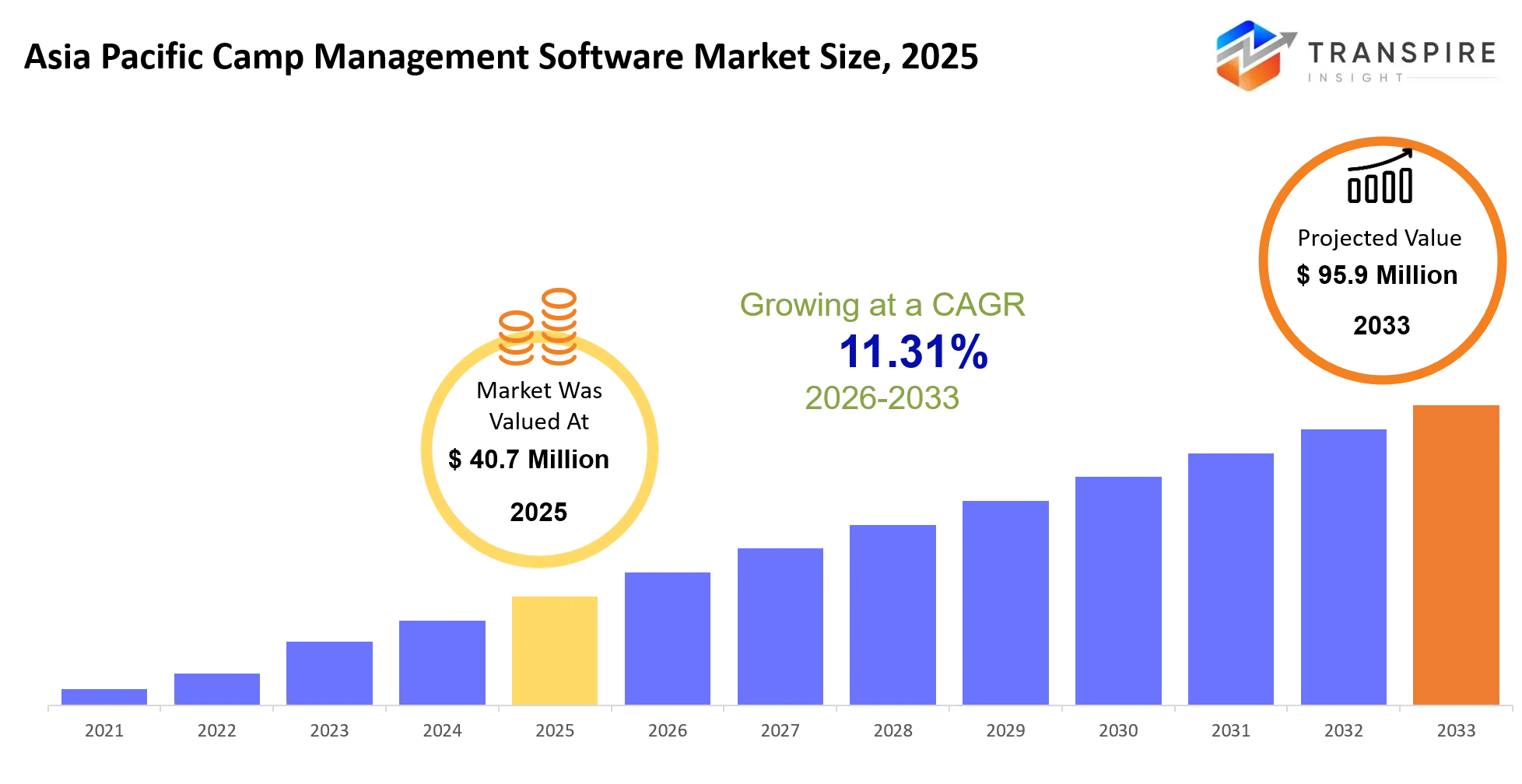
Asia Pacific Camp Management Software Market Summary
The Asia Pacific Camp Management Software Market was valued at USD 40.7 Million in 2025. It is forecast to reach USD 95.9 Million by 2033. That is a CAGR of 11.31% over the period.
The Asia Pacific Camp Management Software market sort of helps organizations handle every stage of camp operations , from online registration and collecting fees to staff scheduling, attendance tracking, health records, communication, and all that reporting, all in one digital place. Basically it takes the edge off admin work, cuts down on manual mistakes, and makes things feel smoother for camp organizers, parents, and the participants too.
In the last five years , this market has moved away from those stand-alone desktop tools and more toward cloud based , mobile first platforms that allow real-time teamwork across multiple sites. That shift really picked up after the COVID-19 pandemic. Camps leaned into digital registration, contactless check-in, and online messaging, because the safety and day to day operational needs were changing fast.
And as camps keep expanding their programs, plus participant numbers too, software companies are weaving in automation, analytics, and digital payment features to keep operations more streamlined. These upgrades help organizations lower operating costs, boost participant involvement, and open up recurring subscription revenue chances for software providers across the Asia Pacific region.
Key Market Insights
- Australia plus New Zealand basically held the Asia Pacific Camp Management Software Market pretty strong, around 34% market share in 2025, mainly because people just kept adopting the software faster.
- Southeast Asia is forecasted to show the quickest regional growth through 2033, backed up by more education technology investments, and also wider digital payment adoption , so yeah.
- Cloud-based software brought in about 62% of industry revenue in 2025 , which makes sense given lower deployment costs and the fact that teams can access it from a distance.
- Meanwhile, professional services stayed as the next biggest slice, close to 22% market share, and it’s driven by implementation, tailoring for specific needs, and integration work.
- AI-enabled SaaS platforms are expected to be the fastest-growing deployment area from 2025–2033, because they can improve scheduling, communication, and even operational automation stuff.
- For application revenue, registration and payment management made up nearly 30% in 2025, showing how the industry is moving toward digital enrollment flows rather than older processes.
- Also, attendance tracking and participant engagement applications are growing fast, as mobile check-in, and real time notifications keep becoming normal, standard operational features.
- Educational camps still lead the end-user groups at roughly 38% market share, while sports camps are seeing the quickest uptake of digital management platforms.
- Key firms like CampMinder, CampBrain, CampSite, ACTIVE Network, Sawyer, and Regpack keep pushing their positions stronger via cloud innovation, API integration, and regional partnerships, even when the market gets crowded.
- Vendors seem to win more edge by adding AI powered reporting, automated messaging tools, multilingual interfaces,and then expanding into up-and-coming education markets across Asia Pacific.
What are the Key Drivers, Restraints, and Opportunities in the Asia Pacific Camp Management Software Market?
The most powerful force behind market growth is maybe the rapid digitization of education, recreation, and youth development organizations all across Asia Pacific. Cloud computing is now a bit more affordable, meanwhile digital payment systems and mobile connectivity have improved a lot. Because of these changes, camp operators tend to swap manual administration for combined software platforms that cover registrations, attendance, payments, staffing, medical records, and also messages to parents. When the organizations start dealing with bigger participant numbers, centralized software helps by reducing admin workload, raising day to day operational precision and it can also open recurring subscription revenue for the solution providers.
A big structural hurdle still sits in the fragmented camp operator landscape across the region. A lot of small community camps, and seasonal organizations run with tight IT budgets, plus temporary staff, so bringing new software in can be tricky. Aligning with existing accounting systems, connecting payment gateways, and meeting local regulatory requirements often needs extra adjustments, and sometimes hands-on training too. Those added expenses push the decision timeline outward, especially for smaller operators, which then restricts broader market penetration and it slows recurring software revenue.
Artificial intelligence, together with continued cloud expansion in the region, looks like a real chance for further growth. AI enabled scheduling, analysis of participant patterns, automated customer support, and predictive enrollment forecasting give camps a way to fine tune staffing levels and improve participant experiences.
What Has the Impact of Artificial Intelligence Been on the Asia Pacific Camp Management Software Market?
Artificial intelligence is sort of reshaping the Asia Pacific camp management software industry, mostly because it automates a lot of the administrative stuff that used to take serious manual effort. With AI powered tools, teams can handle participant registrations more quickly, verify documents faster, and even suggest specific camp sessions based on age, or interests, or whatever fits best. It can also take over staff scheduling, and push out personalized updates via chatbots plus notification engines. In the end, the administrative load drops, while response time for parents and organizers feels a lot better.
There’s more too, because machine learning models help with predictive analytics. They can forecast enrollment levels, spot seasonal attendance rhythms, estimate what staffing will look like, and even guess payment completion rates. Those findings make it easier for camp operators to use resources more efficiently, avoid scheduling headaches, and do planning with less guesswork. Plus the analytics side can be used to judge program popularity and fine-tune future offerings, which often leads to better resource use and stronger participant retention.
On top of that, modern cloud platforms bring AI together with digital payment systems, attendance tracking, and reporting dashboards. This helps administrators make faster operational decisions, while also supporting compliance around participant safety and documentation requirements. A lot of organizations say they see real reductions in how long processing takes, and they notice communication runs more smoothly after adopting AI enabled platforms.
Still, AI adoption has limits in real life. Smaller camp operators often do not have enough historical operational data to train accurate predictive models, and tying AI into older, legacy software can demand a fairly large investment.
Key Market Trends
- Cloud deployments went up, kind of around 50% in 2021, and then over 60% by 2025. This effectively replaced the classic on‑premise camp administration setups, like, the whole manual kind of thing.
- AI-driven scheduling plus automated messages to participants started showing up as “normal” across many new software launches from 2024 into 2026. And yeah, it wasn’t just a feature here and there anymore, it was standard.
- Digital payment integration also grew pretty fast. Camps started using one integrated registration and financial management approach across Australia, India, and Southeast Asia, so the money flow is less fragmented, more cohesive.
- Mobile check-in and QR attendance controls cut down manual verification time by roughly 30–40% at bigger educational and sports camps, from what teams estimate.
- Vendors began adding multilingual interfaces more often to match a widening audience across India, Indonesia, Thailand, and Vietnam, which basically means fewer friction points for parents and staff.
- Brands like CampMinder, CampBrain, ACTIVE Network, Sawyer, and Regpack pushed API integrations faster, connecting into CRM systems, accounting tools, and learning management platforms without as much hassle.
- Subscription based SaaS pricing replaced the older perpetual licensing model. That shift made it easier for seasonal camp operators and small organizations to stay affordable, rather than paying everything upfront.
- Parents increasingly want real time alerts, digital medical records, and secure document sharing. Because of that expectation, software updates keep coming, almost continuously, to keep up.
- Strategic partnerships with payment providers and education technology companies became a go-to method for expansion, especially across emerging Asia Pacific markets, where local fit really matters.
- Meanwhile, data analytics moved away from backward looking reporting and more toward predictive enrollment forecasting plus operational planning, helping camps manage staffing efficiency and improve participant retention.
Asia Pacific Camp Management Software Market Segmentation
By Deployment
Cloud based deployment is now mostly the go to option, because centralized access kinda makes it easier for registration, scheduling, payment processing, attendance tracking, and the actual communication part from literally any place, as long as theres internet. Still, on premise deployment keeps working for organizations that really need direct control over their infrastructure , sensitive records, and how internal data gets managed. Hybrid deployment mixes things local with cloud capabilities, so operations stay flexible while certain data remains on internal servers.
SaaS solutions keep expanding too, since subscription pricing reduces the upfront investment and makes software updates feel less like a headache, more streamlined. Private cloud deployment is for teams with strict security privacy, and compliance expectations, especially around participant information and financial records. Public cloud deployment leans into scalability and cost efficiency, so expansion becomes way easier when peak camp seasons hit.
Multi tenant platforms let several organizations operate on shared infrastructure, but with separate databases and user environments, which helps vendors lower their operational expenses. And then, there are other setups like customized deployment models, made to fit specialized operational, regulatory, or organizational needs across different camp environments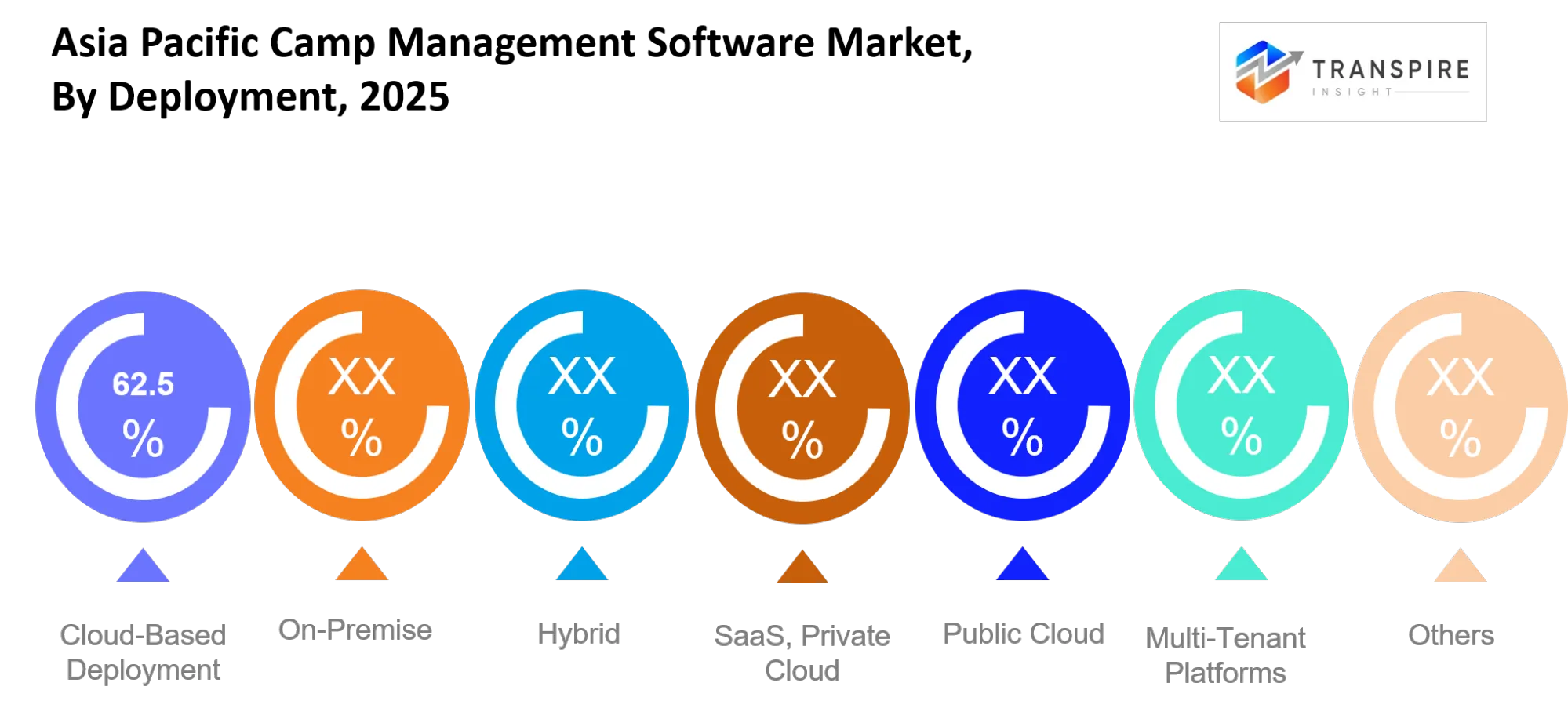
By Component
Software is kind of the heartbeat of camp management operations, because it links registration, scheduling, message delivery, check in tracking, payments, reporting, and those more admin tasks into one integrated platform. Professional Services then come in for the implementation setup configuration and even system tailoring, so the whole thing fits the operational reality of different camp types. Managed Services are more about keeping the platform steady day to day, using continuous monitoring, handling the infrastructure, and running technical administration , without letting things drift.
Consulting Services help organizations think through which deployment model makes sense, improve day to day workflows, and plan broader digital transformation initiatives. Training Services make sure administrators and operational staff can actually use the platform features well, which tends to boost efficiency and reduce silly but costly operational mistakes during daily routines.
Support & Maintenance keeps the software performing through recurring updates, troubleshooting, security upgrades, and technical assistance when something acts up. Integration Services connect the camp management platform with payment gateways, accounting tools, messaging systems, CRM solutions, and even learning platforms, so data moves cleanly between them. Others, meaning the extra stuff include additional technical help, custom development, migration assistance, and specialized service offerings, depending on what the organization needs, exactly.
By Application
Registration Management still counts as one of the key applications, because digital enrollment kinda simplifies admission for participants while also cutting down paperwork and all the manual processing stuff. Scheduling helps arrange camp activities, staff assignments, facilities, and day by day programs, so you get better operational coordination. Payment Processing allows secure online transactions, automated invoicing, and steady financial tracking, which in turn supports quicker revenue collection. Staff Management is there to help allocate responsibilities, watch availability, and keep workforce records consistent across different camp sessions.
Attendance Tracking handles participant presence using digital check in systems, which improves safety, gives stronger operational visibility, and makes the reporting more accurate. Communication Management strengthens the back and forth with parents, participants, instructors, and internal administrative teams using notifications, messaging, and announcements, everything stays connected. Reporting & Analytics takes operational data and turns it into actionable insights, to back up planning, financial review, and performance evaluation. Other parts include medical record management, transportation coordination, document storage, equipment allocation , and a few extra administrative functions that different camp organizations typically need.
By Organization Type
Summer Camps do take up a major share, since these seasonal programs need pretty efficient ways for participant registration, timing of activities, keeping track of lodging, and communication during short operating windows. Educational Camps tend to lean on digital platforms for arranging coursework, learning timelines, assessments and participant records, so everything is kept in order. Sports Camps usually depend on software in order to line up coaching sessions, track athlete attendance, handle facility allocation, and also build competition plans. Religious Camps typically use management platforms to coordinate volunteer work, arrange accommodation, manage event scheduling, and handle participant communication.
Adventure Camps, on the other hand, really need a centralized management setup for outdoors routines, equipment distribution, safety documentation, emergency contacts, and itinerary building, because things move fast out there. Corporate Camps commonly use digital solutions for employee development programs, leadership gatherings, and team-building activities, usually with structured scheduling so people can actually follow the plan. Government Camps implement management software to boost transparency, support reporting, streamline participant administration, and make better use of resources across public programs. Others cover specialized community, cultural, wellness, environmental, and recreational camps, where operational needs vary a lot depending on the organization’s goals, and how they choose to run things day to day.
By End User
Educational institutions end up taking a big share, because schools , colleges, and learning centers run camps pretty often and they really need smooth digital administration. Sports organizations also lean on management platforms for athlete registrations, training schedules, the whole event planning part, attendance, plus messaging across several programs. NGOs usually adopt camp management software to arrange their social outreach stuff, sort out volunteer coordination, keep participant records together, and keep the community engagement moving.
Government organizations then use digital systems to make administration faster, easier with documentation compliance and reporting, especially for public welfare and educational initiatives. Private camp operators are still switching to integrated platforms to make the customer experience feel better, automate daily operations, and handle many camp locations using centralized dashboards. Recreation centers depend on digital management solutions to line up seasonal activities , community programs, facility scheduling, and participant engagement in a more organized way.
Community organizations use software to simplify volunteer management, registrations, communication, and event coordination across local efforts. And then there are others too—nonprofit associations, wellness organizations, cultural institutions, and specialized program providers that need flexible management tools for their own kind of operational requirements.
What are the Key Use Cases Driving the Asia Pacific Camp Management Software Market?
Registration management is still kind of the main use case, because educational camps and private camp operators deal with big numbers of participants, but only during short enrollment windows. Digital registration platforms make the whole application trail easier to handle, they automate document checking, manage waiting lists, and bundle secure payment processing into one flow, so it feels smoother overall. With this setup, the organization usually spends less time on admin work, makes fewer mistakes , and delivers a better participant experience. That’s why registration management stays the largest application area across the market
Scheduling and attendance management meanwhile are getting more traction, especially with sports organizations and recreation centers that have to juggle several activities at once, plus instructors and venues. Automated scheduling cuts down on resource clashes, while digital attendance tools give real-time visibility into who is actually there , and how staff is being allocated. Also community groups and NGOs often like the centralized communication side of these systems, since it supports prompt notifications, consent forms, and program updates for participants and their families, without all the extra back-and-forth
On top of that, newer use cases are showing up like AI-assisted enrollment forecasting and digital health record management, mainly for camps that run specialized education sports and wellness programs. Predictive analytics supports organizers in estimating staffing needs, facility utilization, and participant demand before registration even opens. Looking ahead, integration with electronic medical records and wearable devices should expand further during the forecast period, because safety expectations are rising and personalized participant care is becoming more important
|
Report Metrics |
Details |
|
Market size value in 2025 |
USD 40.7 Million |
|
Market size value in 2026 |
USD 45.3 Million |
|
Revenue forecast in 2033 |
USD 95.9 Million |
|
Growth rate |
CAGR of 11.31% from 2026 to 2033 |
|
Base year |
2025 |
|
Historical data |
2021 - 2024 |
|
Forecast period |
2026 - 2033 |
|
Report coverage |
Revenue forecast, competitive landscape, growth factors, and trends |
|
Regional scope |
United States; Canada; Mexico; United Kingdom; Germany; France; Italy; Spain; Denmark; Sweden; Norway; China; Japan; India; Australia; South Korea; Thailand; Brazil; Argentina; South Africa; Saudi Arabia; United Arab Emirates |
|
Key company profiled |
CampMinder, CampBrain, UltraCamp, Active Network, Regpack, CampSite, Sawyer, Amilia, Jumbula, CampDoc, Omnify, Bookeo, TeamSnap, EZFacility, CircuiTree |
|
Customization scope |
Free report customization (country, regional & segment scope). Avail customized purchase options to meet your exact research needs. |
|
Report Segmentation |
By Deployment (Cloud-Based, On-Premise, Hybrid, SaaS, Private Cloud, Public Cloud, Multi-Tenant Platforms, Others); By Component (Software, Professional Services, Managed Services, Consulting Services, Training Services, Support & Maintenance, Integration Services, Others); By Application (Registration Management, Scheduling, Payment Processing, Staff Management, Attendance Tracking, Communication Management, Reporting & Analytics, Others); By Organization Type (Summer Camps, Educational Camps, Sports Camps, Religious Camps, Adventure Camps, Corporate Camps, Government Camps, Others); By End User (Educational Institutions, Sports Organizations, NGOs, Government Organizations, Private Camp Operators, Recreation Centers, Community Organizations, Others) |
Which Regions are Driving the Asia Pacific Camp Management Software Market Growth?
Australia alongside New Zealand sit as the frontrunner regional market, mainly because both places have fairly mature education technology landscapes and broad usage of digital administration tools across schools , recreation centers and youth organizations too. The cloud environment is strong , and digital payment penetration is high enough to let camp management platforms roll out quickly. On top of that, rules that stress participant safety, data privacy, and operational visibility push organizations to move away from hand-done admin work. There’s also this ongoing mix of universities, training providers, and private camp operators that keeps reinforcing that regional advantage .
Japan together with South Korea bring in steady market income, mostly by continuing to fund digital transformation and day to day operational streamlining rather than chasing aggressive expansion. In both countries, organizations tend to prefer dependable software suites that fold scheduling, messaging, payment handling and analytics into the enterprise stack they already use. With relatively stable economic conditions, plus long-term tech commitments, modernization happens in a calm, incremental way with minimal disruption. That measured uptake rhythm gives predictable revenue for vendors that focus on premium products, and yes—often highly customized setups .
India and parts of Southeast Asia are likely to show the quickest momentum from 2026 through 2033. Educational institutions, sports academies, and private camp operators are expected to speed up digital adoption. Better cloud infrastructure, wider internet reach, and government attention to digital learning are building the right conditions for software deployment, almost like it all lines up.
Who are the Key Players in the Asia Pacific Camp Management Software Market and How Do They Compete?
Competition still looks pretty fragmented, with specialized software providers going at it using technology, customer help, and that sort of industry specific functionality, not just price, which is kinda the baseline everyone expects. The longer standing vendors keep building on customer relationships via cloud based platforms, while newer players roll out flexible subscription options, plus faster deployment services, which makes decision makers feel like things move quicker. These days, it’s product innovation, smooth integrations, and user experience that really sway purchasing choices as organizations hunt for complete digital management solutions, all in one place.
CampMinder kind of stands out because it offers end to end operational management that’s built for residential and seasonal camps, and it bundles registration, messaging, reporting, and administrative support into one platform, without the usual patchwork. CampBrain leans toward very adaptable enterprise type setups for organizations that run multiple camps or have more complicated program structures, and it’s backed by stronger reporting plus operational flexibility. ACTIVE Network , instead, leans on broad integration across recreation, sports, and community management tools, so organizations can handle camps along with other recreational programs from a single environment.
Regpack competes with flexible registration and payment operations, supporting customized pricing frameworks and participant journeys. Sawyer, meanwhile, focuses on a more family friendly booking experience, plus mobile accessibility, so it tends to fit educational programs and activity providers that serve younger participants.
Company List
- CampMinder
- CampBrain
- UltraCamp
- Active Network
- Regpack
- CampSite
- Sawyer
- Amilia
- Jumbula
- CampDoc
- Omnify
- Bookeo
- TeamSnap
- EZFacility
- CircuiTree
Recent Development News
In February 2025, Regpack launched new AI-driven custom pricing packages for subscription-based organizations. The enhancement enabled camps and program providers to create flexible enrollment packages while improving pricing management and participant onboarding.http://www.tmcnet.com
In May 2026, CampDoc announced an integration with ACTIVE Network's ACTIVENet platform. The partnership automated participant registration and health record synchronization, reducing administrative workload and improving operational readiness for camps and youth programs.http://www.globenewswire.com
What Strategic Insights Define the Future of the Asia Pacific Camp Management Software Market?
The market is moving toward smart cloud platforms that kinda blend onboarding, payment management, participant engagement, health records, and predictive analytics into one unified SaaS environment. That bigger structural change is being backed by ongoing digital transformation across schools, sports entities, and community program operators, all trying to find solutions that are scalable and quietly remove administrative clutter while pushing day to day efficiency. Over the next five to seven years, artificial intelligence and workflow automation will stop being treated like premium perks and will instead show up as standard stuff, more or less.
One less talked about worry is how much some orgs are getting tied to a small set of software ecosystems and cloud infrastructure providers. If vendor concentration keeps climbing, switching later can get expensive and organizations may lose flexibility, especially when they need specialized operational workflows. Meanwhile, multilingual AI assistants and predictive enrollment planning still feel underdeveloped across a lot of emerging Asia Pacific markets, so there’s a real opening for vendors who can localize properly for regional expectations. Companies should lean into open integration frameworks, put serious effort into cybersecurity, and offer localized SaaS, while also widening partnerships with education technology providers and digital payment platforms to keep their competitiveness strong long term.
Asia Pacific Camp Management Software Market Report Segmentation
By Deployment
• Cloud-Based
• On-Premise
• Hybrid
• SaaS
• Private Cloud
• Public Cloud
• Multi-Tenant Platforms
• Others
By Component
• Software
• Professional Services
• Managed Services
• Consulting Services
• Training Services
• Support & Maintenance
• Integration Services
• Others
By Application
• Registration Management
• Scheduling
• Payment Processing
• Staff Management
• Attendance Tracking
• Communication Management
• Reporting & Analytics
• Others
By Organization Type
• Summer Camps
• Educational Camps
• Sports Camps
• Religious Camps
• Adventure Camps
• Corporate Camps
• Government Camps
• Others
By End User
• Educational Institutions
• Sports Organizations
• NGOs
• Government Organizations
• Private Camp Operators
• Recreation Centers
• Community Organizations
• Others
Frequently Asked Questions
Find quick answers to common questions.
The Expected Asia Pacific Camp Management Software Market size for the Market will be USD 95.9 Million in 2033.
Key Segments for the Asia Pacific Camp Management Software Market are By Deployment (Cloud-Based, On-Premise, Hybrid, SaaS, Private Cloud, Public Cloud, Multi-Tenant Platforms, Others); By Component (Software, Professional Services, Managed Services, Consulting Services, Training Services, Support & Maintenance, Integration Services, Others); By Application (Registration Management, Scheduling, Payment Processing, Staff Management, Attendance Tracking, Communication Management, Reporting & Analytics, Others); By Organization Type (Summer Camps, Educational Camps, Sports Camps, Religious Camps, Adventure Camps, Corporate Camps, Government Camps, Others); By End User (Educational Institutions, Sports Organizations, NGOs, Government Organizations, Private Camp Operators, Recreation Centers, Community Organizations, Others).
Major Asia Pacific Camp Management Software Market Players are CampMinder, CampBrain, UltraCamp, Active Network, Regpack, CampSite, Sawyer, Amilia, Jumbula, CampDoc, Omnify, Bookeo, TeamSnap, EZFacility, CircuiTree.
The Current Asia Pacific Camp Management Software Market size is USD 40.7 Million in 2025.
The Asia Pacific Camp Management Software Market CAGR is 11.31% from 2026 to 2033.
- CampMinder
- CampBrain
- UltraCamp
- Active Network
- Regpack
- CampSite
- Sawyer
- Amilia
- Jumbula
- CampDoc
- Omnify
- Bookeo
- TeamSnap
- EZFacility
- CircuiTree
About the Authors

Mayur Shinde
I am Mayur Shinde, a Senior Research Analyst at Transpire Insight, specializing in the Automotive & Transportation and Information & Communication Technology (ICT) Industry. My work focuses on analyzing emerging market trends, technological advancements, competitive landscapes, and industry developments to deliver accurate, data-driven insights. I am passionate about transforming complex market information into clear, actionable content that helps businesses, professionals, and decision-makers stay informed and make confident strategic decisions.

Chakradhar Khansole
Chakradhar serves as the Research Director at Transpire Insight, bringing over 8 years of experience in technology, innovation, and strategic market intelligence. He specializes in transforming complex market data into actionable business insights that enable organizations to make informed, growth-oriented decisions. Recognized for his strategic vision and analytical expertise, Chakradhar leads high-impact research initiatives, delivering comprehensive market assessments, competitive intelligence, and forward-looking industry analysis.
Recently Published Reports
-
Apr 2026
3D Optical Profiler Market
3D Optical Profiler Market Size, Share & Analysis Report By Type (Desktop 3D Optical Profiler, and Portable 3D Optical Profiler), By Technology (Confocal Technology, and White Light Interference), By End-Use Industry (Manufacturing, Research Institutions, Automotive, Aerospace and Defense, Medical Devices, and Other), and Geography (North America, Europe, Asia-Pacific, Middle East and Africa, South and Central America), 2021 - 2031
-
Apr 2026
Depth Sensor Market
Depth Sensor Market Size, Share & Analysis Report By Type (Infrared Depth Sensors, Time-of-Flight (ToF) Sensors, Stereo Vision Sensors, Structured Light Sensors, Ultrasonic Depth Sensors), By Application (Automotive, Robotics, Gaming, Consumer Electronics, Industrial Automation, Healthcare, Security & Surveillance, Others), By End Users (Automotive Manufacturers, Consumer Electronics Companies, Healthcare Providers, Industrial Companies, Security Agencies, Gaming Companies, Robotics Companies, Others), and Geography (North America, Europe, Asia-Pacific, Middle East and Africa, South and Central America), 2021 – 2031
-
Apr 2026
Digital Manufacturing Market
Digital Manufacturing Market Size, Share & Analysis Report By Component (Hardware, Software, and Services), By Technology (Robotics, 3D Printing, Internet of Things (IoT), and Others), By Application (Automotive and Transportation, Aerospace and Defense, Consumer Electronics, Industrial Machinery, and Others), By Process Type (Computer-Based Designing, Computer-Based Simulation, Computer 3D Visualization, Analytics, and Others), and Geography (North America, Europe, Asia-Pacific, Middle East and Africa, South and Central America), 2021 – 2031
-
Apr 2026
Digital Visa Services Market
Digital Visa Services Market Size, Share & Analysis Report By Type (Individual Travelers, Group Travelers), By Application (Tourism, Business Travel, Others), and Geography (North America, Europe, Asia-Pacific, Middle East and Africa, South and Central America), 2021 – 2031