
Asia Pacific Cafe Market Size & Forecast:
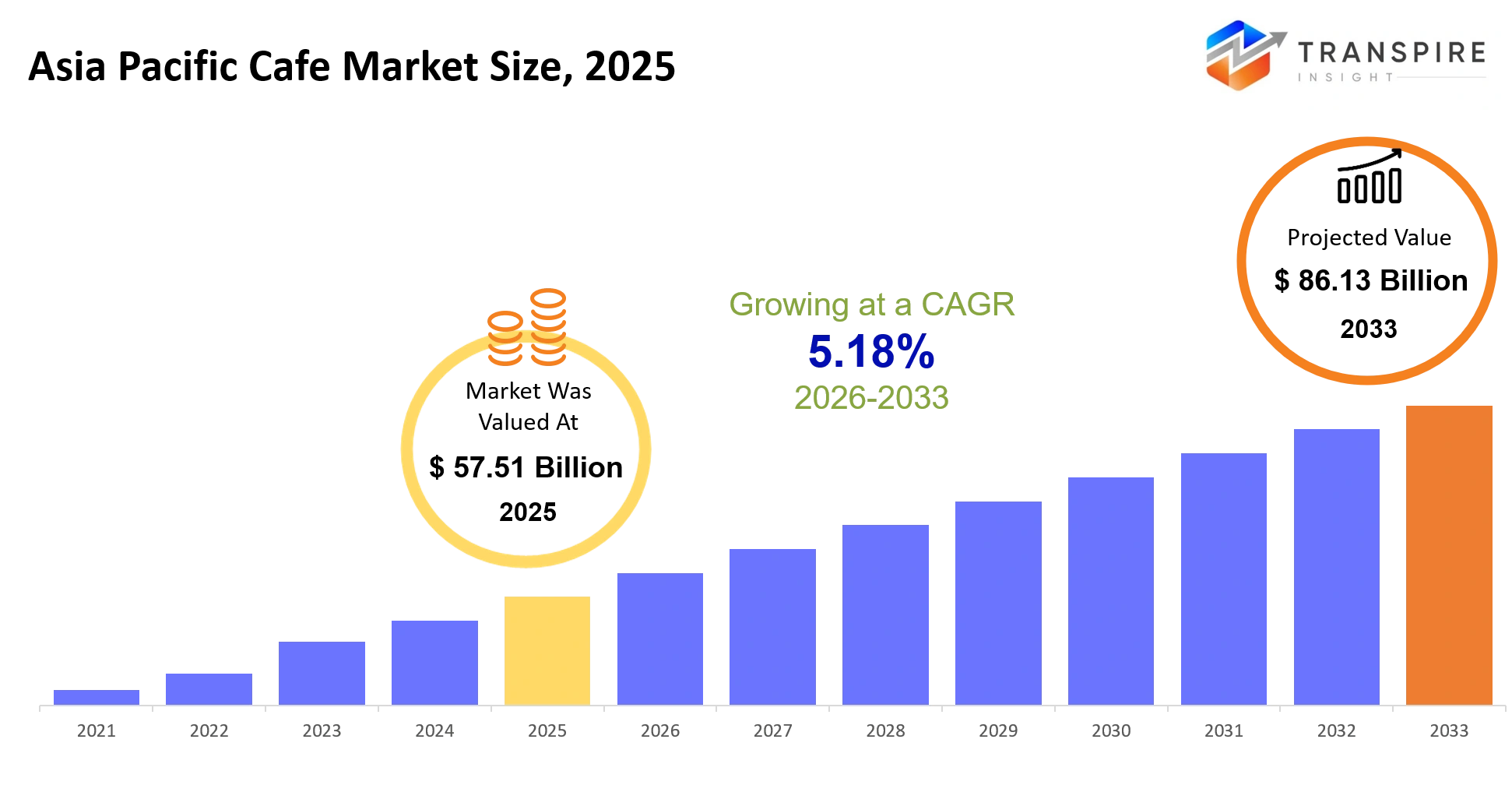
- Asia Pacific Cafe Market Size 2025: USD 57.51 Billion
- Asia Pacific Cafe Market Size 2033: USD 86.13 Billion
- Asia Pacific Cafe Market CAGR: 5.18%
- Asia Pacific Cafe Market Segments: By Cafe Type (Coffee Cafes, Specialty Cafes, Bakery Cafes, Quick Service Cafes, Theme Cafes, Premium Cafes, Co-working Cafes, Others); By Product Offering (Coffee Beverages, Tea Beverages, Bakery Products, Snacks, Desserts, Sandwiches, Ready-to-Eat Meals, Others); By Service Type (Dine-In, Takeaway, Drive-Thru, Home Delivery, Mobile Ordering, Self-Service Kiosks, Subscription Services, Others); By Ownership (Chain Cafes, Independent Cafes, Franchise Cafes, Boutique Cafes, Hotel Cafes, Airport Cafes, Campus Cafes, Others); By End User (Students, Working Professionals, Families, Tourists, Senior Citizens, Business Travelers, Remote Workers, Others).
Asia Pacific Cafe Market Summary
The Asia Pacific Cafe Market was valued at USD 57.51 Billion in 2025. It is forecast to reach USD 86.13 Billion by 2033. That is a CAGR of 5.18% over the period.
In practice, the Asia Pacific Cafe Market kind of supports big scale fuel switching in coal heavy power plants and industrial boilers, by letting biomass act more like coal in the way it’s handled, stored, and burned. So it becomes a workable decarbonization route for utilities that can’t switch to electrification right away, not yet. Over the last 3–5 years, the market has moved in a more structural direction, from small pilot style bioenergy tests to long-term supply deals that are tied to utilities. A big reason is torrefaction tech getting better, which boosts energy density and also cuts down the whole moisture sensitivity issue.
One of the main triggers, is the tightening of industrial emissions rules across Japan and South Korea. That pressure pushed many utilities toward co-firing low carbon solid fuels, instead of doing full plant retrofits. At the same time, maritime fuel prices stayed jumpy during the post pandemic supply chain hiccups, and that made energy buyers diversify what they buy, and how they plan. This, in a roundabout way, helped keep demand steadier for black pellets. As a result, procurement habits have shifted, buyers now lean more toward long run fuel reliability and compliance fit rather than chasing the lowest short term fuel cost, and that’s what’s been reinforcing commercial take up across the region.
Key Market Insights
- In the Asia Pacific Cafe Market, Japan and South Korea basically keep the demand in their hands, pushed by coal phase down , co-firing requirements from power utilities.
- China meanwhile is showing up as the quickest scaling adoption place, largely because of industrial decarbonization pilots and a plan to diversify biomass imports, so the whole supply feels steadier.
- When it comes to where these black pellets actually get used, power generation still leads the way, and it makes up most of the consumption in coal co-firing systems. Industrial heating is, however, the fastest moving application area, helped along by tougher emissions limits coming through in cement and steel production
- On the end user side, utility companies hold the dominant share, mainly because of long term fuel procurement agreements that help with compliance consistency, or at least that’s the idea. Industrial manufacturers are growing faster, since carbon pricing pressures are pushing firms toward faster fuel switching decisions
- Supply chains are also getting more local, as governments try to encourage regional biomass sourcing, to reduce exposure from import dependency risks. At the technology level, torrefaction improvements by players like Mitsubishi Heavy Industries and Andritz are boosting pellet energy density and making transport more efficient.
- You can also see strategic partnerships stacking up between utilities and suppliers—Marubeni Corporation and Itochu Corporation are examples—locking in long duration feedstock contracts.
- And bioenergy producers, such as Drax Group and Enviva, are expanding export capacity, to keep pace with the industrial demand growth across the Asia Pacific.
What are the Key Drivers, Restraints, and Opportunities in the Asia Pacific Cafe Market?
The main driver in the Asia Pacific Cafe Market is, overall, tightening requirements for industrial emissions compliance in coal-reliant economies such as Japan and South Korea. Regulatory pressure, under national carbon neutrality roadmaps, has effectively pushed utilities toward co-firing approaches rather than jumping straight into complete plant replacement. That change bumps up black pellets demand because they can be used within the existing coal framework with only minimal retrofitting, allowing faster compliance while still keeping baseload electricity steadier. Because of this procurement cycles have moved toward multi-year biomass supply agreements, and that gives producers better revenue predictability, more or less.
The biggest restraint is still the high production cost, tied to torrefaction and densification technology. Black pellet processing calls for specialized thermal treatment and additional energy input, so it becomes much more expensive than conventional coal, and even more costly than standard white pellets. This cost gap is pretty structural, and it narrows price competitiveness, especially in locations where coal subsidies still linger. It slows the transition at scale, and keeps adoption mostly to regulated programs or pilot driven utility trials, which then suppresses wider commercial ramp-up.
A key opportunity is showing up in port-based biomass import hubs being developed across Southeast Asia. Nations like Vietnam and Indonesia are putting money into integrated storage and pellet handling infrastructure, to back export focused biomass supply chains. That setup gives suppliers a more scalable entry point, letting them serve Japan and South Korea through regional aggregation centers, while lowering logistics expenses and improving overall supply dependability.
What Has the Impact of Artificial Intelligence Been on the Asia Pacific Cafe Market?
Artificial intelligence is gradually getting better at boosting operational efficiency across the Asia Pacific Cafe Market, mostly by fine tuning fuel handling , combustion tuning, and supply chain coordination inside utility systems. In coal co-firing setups, AI based control systems are now used to tweak feed rates and combustion ratios in real time, which helps thermal efficiency and also cuts down unburned carbon losses. That kind of approach tends to support steadier performance too, especially when plants switch between coal and biomass based fuels like black pellets.
At the same time, predictive analytics models are being rolled out more often for maintenance planning on fuel handling hardware, like grinders, conveyors, and boilers. They spot wear patterns, then estimate failure risk, so unexpected downtime drops and plant availability goes up. In a few pilot utilities, machine learning driven emission tracking has also improved compliance accuracy, by estimating NOx and CO₂ output while fuel blends change.
Still, take-up is a bit held back, because real time data isn’t always available from distributed power stations or shipping logistics platforms. Offshore and cross border biomass supply routes frequently don’t have continuous connectivity , so model accuracy ends up being weaker. On top of that, high integration costs slow everything down, particularly for older coal plants that need a lot of digital retrofitting before the AI systems can run properly .
Key Market Trends
- Japan sort of accelerated co-firing adoption during 2024–2026, while trying to cut coal reliance via more structured biomass blending mandates in thermal power plant operations.
- South Korean utilities did a similar move but on the contract side, they expanded long-term procurement agreements which helped hold up the Asia Pacific Cafe Market demand even when coal prices keep swinging around, in these cycles.
- In 2025 torrefaction efficiency gains showed up, and that helped reduce pellet moisture variability too, so combustion stayed steadier across industrial boiler setups.
- Meanwhile in 2026 , several Southeast Asian biomass export hubs expanded their logistics capacity, which lowered transport expenses for regional pellet trade flows, and yeah it made shipments smoother.
- In 2025 industrial cement producers started moving away from coal toward black pellets, mainly to satisfy tighter carbon intensity thresholds. Sumitomo Corporation also expanded its biomass trading activities, kind of tightening cross border supply chain integration across the Asia Pacific region.
- Oji Holdings leaned into forestry-based pellet feedstock production investments, aiming to secure sustainable biomass sourcing over the long run.
- Also, in China, utilities increased pilot-scale black pellet trials in 2026, which points to early-stage fuel diversification in coal-heavy provinces.
- Then in 2025 the expansion of carbon pricing across regional markets shifted buying behavior, nudging procurement toward lower-emission fuel alternatives.
- Finally, strategic partnerships between global suppliers and Asian utilities intensified, and that improved technology transfer along with supply reliability across the Asia Pacific Cafe Market.
Asia Pacific Cafe Market Segmentation
By Cafe Type
Coffee Cafes kinda play a big role in how demand shows up in the Asia Pacific Cafe Market , especially when you look at cities , because the energy needs there are pretty steady. So, fuel switching stuff happens more often in the commercial zones around those cafes. Now Specialty Cafes and Premium Cafes seem to line up better with high-efficiency energy setups, since those places often run upgraded heating or processing gear, and it tends to need reliable fuel performance to keep things smooth. Bakery Cafes and Quick Service Cafes rely on consistent thermal energy for baking and food prep, and that kind of need indirectly nudges cleaner solid fuel alternatives into the bigger supporting industries. Theme Cafes and Co-working Cafes do contribute smaller but still steady amounts , since they basically keep drawing power through the whole day. Others , too, add something through mixed-format operations , where energy needs stay flexible across these long service cycles
Chain Coffee Cafes and Franchise Cafes make the demand pattern feel more organized , which helps companies plan fuels over the long haul in the Asia Pacific Cafe Market. Independent Cafes and Boutique Cafes are usually more up-and-down, depending on the neighborhood and how large the operation is. Hotel Cafes and Airport Cafes bring stable, high-volume energy requirements, mainly because they run continuously and get huge footfall. Campus Cafes , plus other institutional arrangements, create predictable demand windows tied to academic or organizational timetables. That predictability then improves planning efficiency for the energy supply systems connected to the Asia Pacific Cafe Market , in a more practical way overall.
By Product Offering
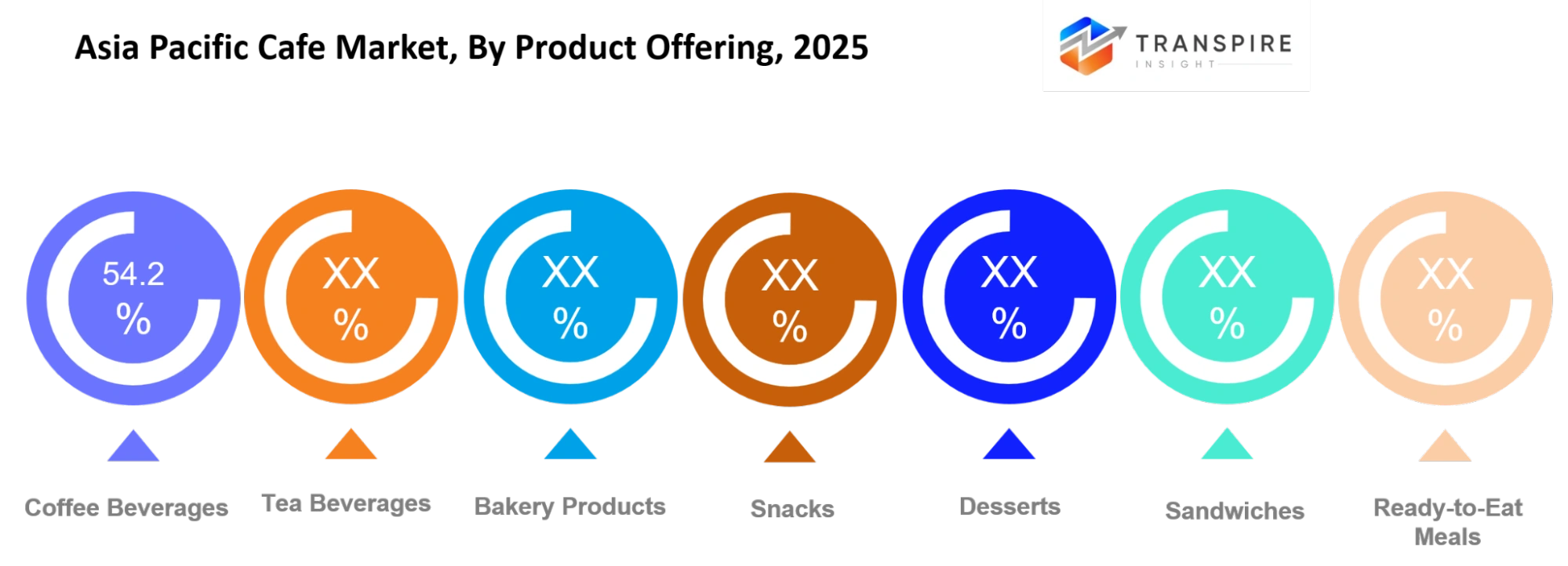
Coffee Beverages and Tea Beverages create this kind of continuous thermal energy needs across service environments, and that in turn indirectly shifts fuel demand patterns, which is connected to the Asia Pacific Cafe Market helping production systems. Meanwhile Bakery Products push for steady heat control during baking, so that tends to increase reliance on stable combustion systems inside industrial food preparation units. Snacks and Desserts tend to use moderate energy, mainly when packaged food production facilities are involved. Sandwiches and Ready-to-Eat Meals need consistent processing and heating cycles, and because of that they keep demand feeling steady across energy-intensive preparation lines. Others like mixed food offerings, keep a more flexible but still continuous energy usage flow across the operations.
Large-scale food manufacturing tied to Coffee Beverages and Ready-to-Eat Meals looks to have stronger alignment with long-duration energy consumption cycles, in the Asia Pacific Cafe Market. Tea processing plus beverage packaging systems also create stable industrial heat requirements. Bakery-focused production units form a noticeable slice, mainly because the ovens run continuously. Snack and dessert manufacturing adds more incremental demand from batch-based processing systems. And then institutional food production under hotels, airports, campuses, further reinforces consistent energy usage patterns across the segment.
By Service Type
Dine-In services create this pretty steady operational energy pull from lighting, cooking, and HVAC, which kinda indirectly helps keep industrial energy behavior stable, tied to the Asia Pacific Cafe Market. Meanwhile Takeaway and Drive-Thru need shorter but more intense energy bursts, especially when rush hour shows up. Home Delivery leans on centralized prep units that keep energy use even all day, not too spiky. Mobile Ordering and Self-Service Kiosks, they boost how efficiently staff can work but they also push higher backend processing energy requirements. Then there are other setups, like hybrid service models, that mix multiple dining and delivery formats in one go.
Subscription Services also matter because they form dependable demand cycles, which helps energy supply systems plan more calmly, connected to the Asia Pacific Cafe Market. Drive-Thru and Takeaway, they drive up peak-load energy consumption inside compact time windows. Home Delivery kitchens tend to hold steady operational loads, since production stays centralized. Mobile Ordering platforms raise the digital processing energy needs in the background, while Self-Service Kiosks improve order flow efficiency, sort of smoothing things out. Overall, when the services are diversified across different operational formats, the energy demand patterns become more consistent, not all over the place.
By Ownership
Chain Cafes and Franchise Cafes kinda push a more structured operational setup, which helps keep the energy consumption pretty predictable and tied to the Asia Pacific Cafe Market. Meanwhile Independent Cafes can swing around a lot , it depends on their size and what local demand is doing. Boutique Cafes run a moderate level of energy, but they stay fairly steady because their customized service format doesn’t really change that much. Hotel Cafes and Airport Cafes basically run non stop, so the energy requirements are more stable over long hours, all day and night. Campus Cafes and other institutional setups create a sort of cyclical demand, following academic timetables and organizational rhythms.
Hotel Cafes and Airport Cafes usually show the most stability in energy usage, mainly because they’re open 24 hours and they get a faster customer turnover. Chain Cafes roll out the same style of energy systems to multiple sites , which tends to improve efficiency in energy planning. Franchise Cafes back scalable operations with consistent service playbooks. Independent Cafes bring flexibility, but the demand pattern is less predictable. Campus Cafes and other institutional ownership models help lock in these consumption cycles that match the long term energy supply planning system for the Asia Pacific Cafe Market , sort of like a steady schedule rather than sudden changes.
By End User
Students and Working Professionals basically form the big consumption base, so they end up creating steady demand cycles that kinda shape the operational energy patterns, tied to the Asia Pacific Cafe Market. Households drive consistent usage, especially during peak hours in the urban service areas. Meanwhile tourists and business travelers bring short-term spikes in demand, because they move around a lot and they’re buying service consumption fast. Senior Citizens keep a more stable yet slightly lower intensity pattern, not as dramatic. Remote workers add a middle-of-the-day consistency, due to flexible schedules, which makes the whole thing smoother in practice.
Among them working professionals are still the strongest demand group since their daily routine-based consumption feels very repeatable. Students, on the other hand, show cyclical demand that follows the academic timetable. Tourists and business travelers tend to cause seasonal and event-driven fluctuations, not exactly uniform. Families keep a stable baseline across several service types, and they’re usually the least erratic. Remote workers and others increase usage in mid-day and off-peak windows, this ends up supporting smoother energy distribution patterns across operational systems that relate to the Asia Pacific Cafe Market.
What are the Key Use Cases Driving the Asia Pacific Cafe Market?
So, the main thing steering the Asia Pacific Cafe Market is coal co-firing at utility-scale thermal power plants , especially across Japan and South Korea. In those places the old coal setup is already there, so the switch happens little by little, not with full plant replacement, at least not yet. This use basically takes the lead in demand, because it can lower emissions directly while keeping the grid steady, like in baseload electricity systems, where reliability matters a lot.
There are also broader applications showing up, like industrial heat in cement and steel making. Many operators use black pellets as part of their routine upgrades, mainly to satisfy increasingly tight carbon intensity standards, tied to national decarbonization rules. Big factories and large industrial consumers tend to choose these setups, since it helps reduce overall compliance expenses , and it also helps them dodge carbon penalties.
Newer use cases are still forming too. For example district heating networks in colder regions, plus some auxiliary fuel roles in port-based energy systems. These are still pretty early in the timeline, but the signal looks strong as governments keep pushing localized low-carbon energy hubs throughout Asia Pacific.
|
Report Metrics |
Details |
|
Market size value in 2025 |
USD 57.51 Billion |
|
Market size value in 2026 |
USD 60.49 Billion |
|
Revenue forecast in 2033 |
USD 86.13 Billion |
|
Growth rate |
CAGR of 5.18% from 2026 to 2033 |
|
Base year |
2025 |
|
Historical data |
2021 - 2024 |
|
Forecast period |
2026 - 2033 |
|
Report coverage |
Revenue forecast, competitive landscape, growth factors, and trends |
|
Regional scope |
United States; Canada; Mexico; United Kingdom; Germany; France; Italy; Spain; Denmark; Sweden; Norway; China; Japan; India; Australia; South Korea; Thailand; Brazil; Argentina; South Africa; Saudi Arabia; United Arab Emirates |
|
Key company profiled |
Starbucks, Costa Coffee, Luckin Coffee, Tim Hortons, Pacific Coffee, Café Coffee Day, The Coffee Bean & Tea Leaf, Doutor Coffee, Tully's Coffee, Gloria Jean's Coffees, Blue Bottle Coffee, Komeda Coffee, Arabica, Cotti Coffee, McCafé. |
|
Customization scope |
Free report customization (country, regional & segment scope). Avail customized purchase options to meet your exact research needs. |
|
Report Segmentation |
By Cafe Type (Coffee Cafes, Specialty Cafes, Bakery Cafes, Quick Service Cafes, Theme Cafes, Premium Cafes, Co-working Cafes, Others); By Product Offering (Coffee Beverages, Tea Beverages, Bakery Products, Snacks, Desserts, Sandwiches, Ready-to-Eat Meals, Others); By Service Type (Dine-In, Takeaway, Drive-Thru, Home Delivery, Mobile Ordering, Self-Service Kiosks, Subscription Services, Others); By Ownership (Chain Cafes, Independent Cafes, Franchise Cafes, Boutique Cafes, Hotel Cafes, Airport Cafes, Campus Cafes, Others); By End User (Students, Working Professionals, Families, Tourists, Senior Citizens, Business Travelers, Remote Workers, Others). |
Which Regions are Driving the Asia Pacific Cafe Market Growth?
Japan is basically leading the Asia Pacific Cafe Market , mostly because of the tough coal phase-down policies and also the strong “we will switch” style utility commitments toward biomass co-firing. In practice, the government backed decarbonization programs kinda nudge power producers to lock in long-term pellet supply agreements early, so they do not get stuck later. On top of that, the port and handling infrastructure is already pretty advanced which makes it easier to bring biomass in from global suppliers without too much friction. With the big utility players in place , plus steady regulatory enforcement, the whole thing turns into a sort of mature demand ecosystem that keeps consumption fairly consistent. All of this is why Japan ends up as the biggest revenue contributor across the region.
South Korea comes next as a fairly stable contributor, and it has heavy import dependency which is tied directly to energy security. But, unlike Japan , South Korea’s momentum looks more like industrial resilience plus careful energy diversification, rather than aggressive coal exit deadlines. The power utilities keep investing in incremental biomass blending programs , aiming to meet emissions targets while also keeping costs stable. And because government oversight stays consistent, the adoption patterns are predictable enough for suppliers to plan ahead. So overall, South Korea functions like a reliable mid-tier demand hub with long-term consumption that does not swing too much.
Meanwhile, Southeast Asia is moving the fastest, largely because of fresh investment in biomass export terminals and pellet handling infrastructure. Vietnam and Indonesia both expanded port based logistics capacity during 2025–2026, specifically to support international supply chains. Also, new policy incentives for renewable fuel exports have pulled more industrial participants into the picture. That combination opens up strong entry opportunities for suppliers who want export driven growth between 2026 and 2033.
Who are the Key Players in the Asia Pacific Cafe Market and How Do They Compete?
In the Asia Pacific Cafe Market, competition feels sort of moderately fragmented , not super consolidated though. You see a blend of global biomass suppliers, trading houses , and technology providers all pushing different angles like cost efficiency, production scale and supply reliability. What matters for positioning is less “ just pricing ” and more the ability to secure sustainable feedstock, whether the torrefaction technology really performs efficiently, and then the whole long term utility contract situation. Older energy trading firms usually defend their slice by keeping tight control of logistics, while newer entrants try to stand out with improved pellet quality, along with emissions performance standards that look better on paper.
Drax Group competes because it’s vertically integrated, from biomass sourcing all the way to big scale pellet production. The edge it leans on is control over the supply chains and certified sustainable feedstock, which then helps it win long term utility agreements across Asia. They also keep expanding by building export partnerships with Asian utilities that want a stable fuel supply for decarbonization goals, kind of a reliable pathway.
Enviva, on the other hand, is centered on cost efficient pellet production plus long term offtake contracts with industrial buyers. Their differentiation looks tied to having large export infrastructure and maintaining consistent pellet quality standards over time. Growth there depends heavily on upgrading port capacity and then locking in long term supply agreements with Asian importers who need continuity.
Mitsubishi Heavy Industries adds pressure via torrefaction technology innovation, specifically efforts that improve pellet energy density and combustion efficiency. Where they stand out is in engineering integration with utility systems, so it’s not just the pellet itself but the fit with how utilities run. Their progress tends to come through partnerships with Japanese power companies aimed at co firing deployment, which is a pretty direct route.
Marubeni Corporation plays more as a trading and investment partner, securing cross border biomass supply agreements rather than doing everything alone. Its advantage is basically global logistics reach, plus strong contract structuring that supports long term utility commitments.
Company List
- Starbucks
- Costa Coffee
- Luckin Coffee
- Tim Hortons
- Pacific Coffee
- Café Coffee Day
- The Coffee Bean & Tea Leaf
- Doutor Coffee
- Tully's Coffee
- Gloria Jean's Coffees
- Blue Bottle Coffee
- Komeda Coffee
- Arabica
- Cotti Coffee
- McCafé
Recent Development News
July 2026 – Yolk Cafe announced the expansion of its café business with a new outlet in Brooklyn Park, Adelaide, while Dino's also revealed a second location in Lockleys, reflecting continued growth in the Australia café sector and increasing demand for neighborhood café concepts.
Source: https://www.adelaidenow.com
March 2026 – Allegra World Coffee Portal reported that the East Asia branded coffee shop market continues to expand rapidly, driven by strong growth in local café chains across China, Southeast Asia, Japan, and South Korea, creating significant opportunities for café operators in the Asia Pacific region.
Source: https://www.worldcoffeeportal.com
March 2025 – Perfect Daily Grind reported that Asia has become one of the world's fastest-growing café and specialty coffee markets, with rising consumer demand, premiumization, and increasing coffee events across countries such as China, India, Vietnam, and Indonesia fueling café industry expansion.
Source:https://perfectdailygrind.com
What Strategic Insights Define the Future of the Asia Pacific Cafe Market?
The Asia Pacific Cafe Market seems to be moving toward deeper integration with national decarbonization frameworks, where long term fuel contracts and infrastructure backed biomass supply chains will end up defining competitiveness. Growth is going to lean more on how efficiently suppliers line up with utility scale co firing programs, not just spot market trading, and this is happening as governments tighten emissions compliance timelines, a bit more each year.
There’s also a less visible risk tucked underneath, feedstock concentration, because relying on a limited set of forestry and agricultural residues can trigger price volatility ,and even supply bottlenecks when global demand keeps rising. Meanwhile competition from other renewable solutions , like green hydrogen for industrial heat, might slowly reshape long term demand expectations, over time.
One emerging opportunity that stands out is port based biomass aggregation hubs across Southeast Asia, these can cut logistics costs and make cross border fuel standardization much smoother. Companies that put money in these hubs early, and lock in integrated supply contracts with utilities will likely improve their long term stance across the 2026–2033 period, overall.
Asia Pacific Cafe Market Report Segmentation
By Cafe Type
- Coffee Cafes
- Specialty Cafes
- Bakery Cafes
- Quick Service Cafes
- Theme Cafes
- Premium Cafes
- Co-working Cafes
- Others
By Product Offering
- Coffee Beverages
- Tea Beverages
- Bakery Products
- Snacks
- Desserts
- Sandwiches
- Ready-to-Eat Meals
- Others
By Service Type
- Dine-In
- Takeaway
- Drive-Thru
- Home Delivery
- Mobile Ordering
- Self-Service Kiosks
- Subscription Services
- Others
By Ownership
- Chain Cafes
- Independent Cafes
- Franchise Cafes
- Boutique Cafes
- Hotel Cafes
- Airport Cafes
- Campus Cafes
- Others
By End User
- Students
- Working Professionals
- Families
- Tourists
- Senior Citizens
- Business Travelers
- Remote Workers
- Others
Frequently Asked Questions
Find quick answers to common questions.
The expected Asia Pacific Cafe Market size for the market will be USD 86.13 Billion in 2033.
Key segments for the Asia Pacific Cafe Market are By Cafe Type (Coffee Cafes, Specialty Cafes, Bakery Cafes, Quick Service Cafes, Theme Cafes, Premium Cafes, Co-working Cafes, Others); By Product Offering (Coffee Beverages, Tea Beverages, Bakery Products, Snacks, Desserts, Sandwiches, Ready-to-Eat Meals, Others); By Service Type (Dine-In, Takeaway, Drive-Thru, Home Delivery, Mobile Ordering, Self-Service Kiosks, Subscription Services, Others); By Ownership (Chain Cafes, Independent Cafes, Franchise Cafes, Boutique Cafes, Hotel Cafes, Airport Cafes, Campus Cafes, Others); By End User (Students, Working Professionals, Families, Tourists, Senior Citizens, Business Travelers, Remote Workers, Others).
Major Asia Pacific Cafe Market players are Starbucks, Costa Coffee, Luckin Coffee, Tim Hortons, Pacific Coffee, Café Coffee Day, The Coffee Bean & Tea Leaf, Doutor Coffee, Tully's Coffee, Gloria Jean's Coffees, Blue Bottle Coffee, Komeda Coffee, Arabica, Cotti Coffee, McCafé.
The Asia Pacific Cafe Market size is USD 57.51 Billion in 2025.
The Asia Pacific Cafe Market CAGR is 5.18% from 2026 to 2033.
- Starbucks
- Costa Coffee
- Luckin Coffee
- Tim Hortons
- Pacific Coffee
- Café Coffee Day
- The Coffee Bean & Tea Leaf
- Doutor Coffee
- Tully's Coffee
- Gloria Jean's Coffees
- Blue Bottle Coffee
- Komeda Coffee
- Arabica
- Cotti Coffee
- McCafé
About the Authors

Chetan Dhatrak
I’m Chetan Dhatrak, a Senior Research Analyst at Transpire Insight, specializing in the Consumer Goods, Foods and Beverages industry. I focus on analyzing market trends, consumer behavior, competitive landscapes, and industry developments to deliver accurate, data-driven insights. My research at Transpire Insight is built on credible sources and in-depth analysis, helping businesses and readers better understand market dynamics, emerging opportunities, and evolving consumer preferences. I’m committed to creating reliable, well-researched content that supports informed decision-making and reflects the latest developments in the consumer goods and food & beverage sectors.

Chakradhar Khansole
Chakradhar serves as the Research Director at Transpire Insight, bringing over 8 years of experience in technology, innovation, and strategic market intelligence. He specializes in transforming complex market data into actionable business insights that enable organizations to make informed, growth-oriented decisions. Recognized for his strategic vision and analytical expertise, Chakradhar leads high-impact research initiatives, delivering comprehensive market assessments, competitive intelligence, and forward-looking industry analysis.
Recently Published Reports
-
Apr 2026
Baby Infant Formula Market
Baby Infant Formula Market Size, Share & Analysis Report By ype (Infant Milk, Follow On Milk, Specialty Baby Milk, Growing-Up Milk), By Ingredient (Carbohydrate, Fat, Protein, Minerals, Vitamins, and Others), By Product Form (Powder, Liquid, and Ready-to-feed), By Distribution Channels (Supermarket/Hypermarket, Specialty Store, Pharmacies, Online Retail, and Others), and Geography (North America, Europe, Asia-Pacific, Middle East and Africa, South and Central America), 2021 - 2031
-
Apr 2026
Edible Insects for Animal Feed Market
Edible Insects for Animal Feed Market Size, Share & Analysis Report By Type (Insect Powder, Insect Meal, Insect Bar, Insect Paste, Insect Oil, and Others), By Insect Type (Beetles, Cricket, Caterpillar, Hymenoptera, Orthoptera, Tree Bugs, and Others), By Application (Livestock, Pet Food, and Aquaculture), By Livestock Type (Poultry, Swine, and Others), and Geography (North America, Europe, Asia-Pacific, Middle East and Africa, South and Central America), 2021 - 2031
-
Apr 2026
Food Industry Disinfection and Bacterial Control Market
Food Industry Disinfection and Bacterial Control Market Size, Share & Analysis Report By Type (Chemical Disinfectants, Physical Disinfectants, and Biocides and Antimicrobials), By Application (Food Processing Equipment Surface Disinfection, Food Preparation Areas Surface Disinfection, Storage Areas Surface Disinfection, Anti-microbial Coatings Food Preservation, and Preservative Solutions Food Preservation), By End User (Meat and Poultry Processing, Dairy Processing, Seafood Processing, Bakery and Confectionery, Restaurants and Commercial Kitchens, and Food Service Providers), By Sales Channel (Online, Offline), and Geography (North America, Europe, Asia-Pacific, Middle East and Africa, South and Central America), 2021 - 2031
-
May 2026
Freeze Dried Food Market
Freeze Dried Food Market Size, Share & Analysis Report By Product Type (Fruits, Vegetables, Freeze-Dried Dairy Products, Freeze-Dried Meat and Seafood, Freeze-Dried Pet Food, and Prepared Meal), By Nature (Organic, and Conventional), By Form (Powdered, Granules, and Diced), By End Use (Breakfast Cereals, Dairy Products, Bakery & Confectionery, Nutritional Bars & Supplements, Powdered Beverages, Snacks, and Retail (Household)), and Geography (North America, Europe, Asia-Pacific, Middle East and Africa, South and Central America), 2021 - 2031