
Asia Pacific Bamboo Furniture Market Size & Forecast:
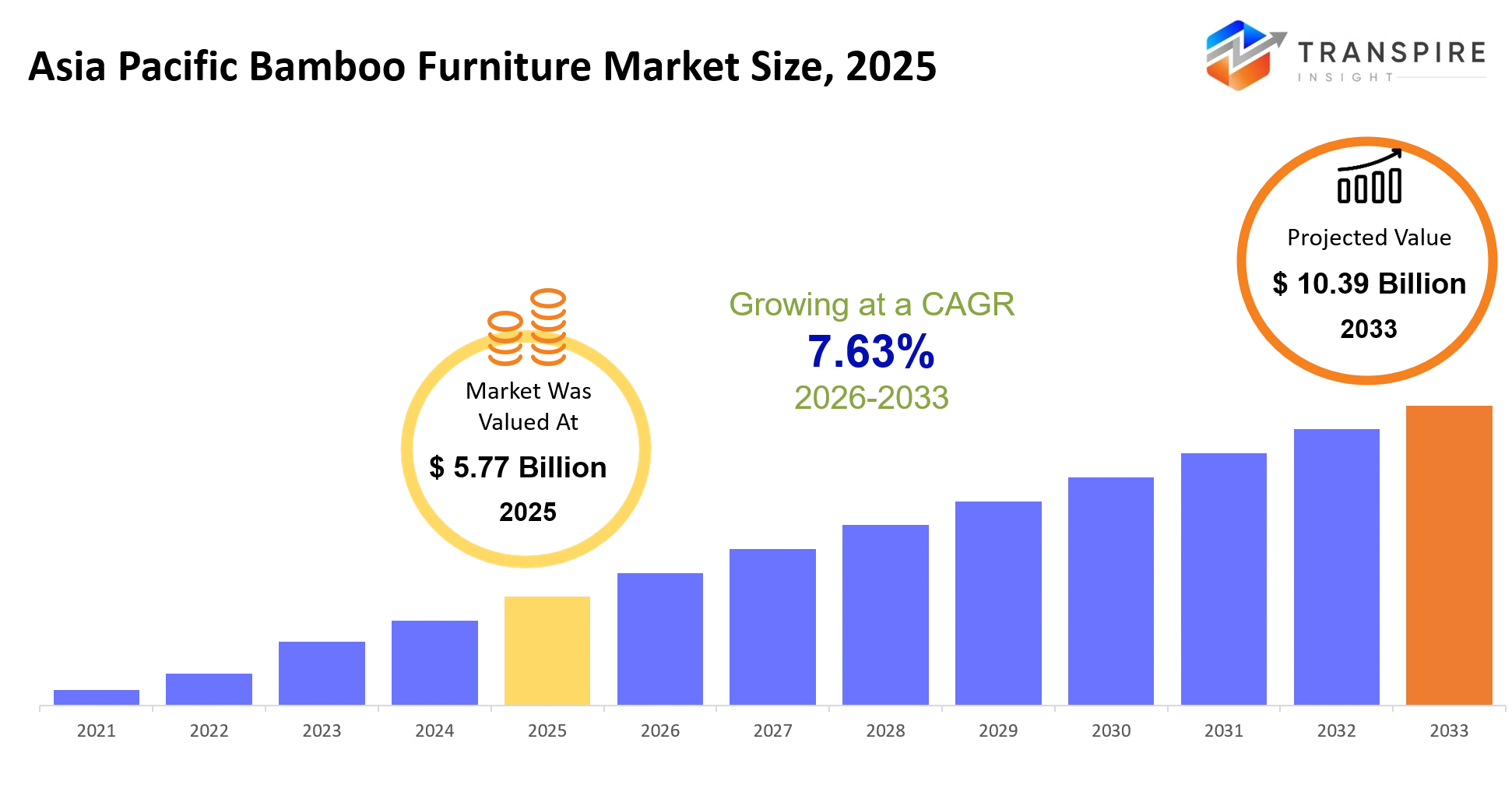
- Asia Pacific Bamboo Furniture Market Size 2025: USD 5.77 Billion
- Asia Pacific Bamboo Furniture Market Size 2033: USD 10.39 Billion
- Asia Pacific Bamboo Furniture Market CAGR: 7.63%
- Asia Pacific Bamboo Furniture Market Segments: By Product Type (Chairs, Tables, Beds, Cabinets, Sofas, Shelves, Outdoor Furniture, Others); By Application (Residential, Commercial, Hospitality, Office Spaces, Outdoor Areas, Retail Stores, Institutional Buildings, Others); By Distribution Channel (Online Retail, Furniture Stores, Specialty Stores, Direct Sales, Hypermarkets, Brand Outlets, Distributors, Others); By End User (Households, Hotels, Offices, Restaurants, Retailers, Educational Institutions, Government Facilities, Others).
Asia Pacific Bamboo Furniture Market Summary
The Asia Pacific Bamboo Furniture Market was valued at USD 5.77 Billion in 2025. It is forecast to reach USD 10.39 Billion by 2033. That is a CAGR of 7.63% over the period.
From the commercial reality perspective, Asia Pacific bamboo furniture is a sustainable offering and can provide lightweight durable and fast-growing furnishing solutions for homes, hotels, offices, outdoors etc, when a cost effective substitute to hardwoods with reasonable amount of durability, design and rigidity could not be achieved from others. Within last 3-5 years, the market has changed its structure to "purchase by sustainability requirement," more buyers, especially in the case of hotels and hospitality developers in Asia, demand to buy certified and engineered bamboo furniture products, rather than traditional handmade ones, as influenced by COVID-19 triggered the supply disruption in global hardwood and furniture, forcing hotels and designers to purchase their needs locally in Asia. In parallel to the rapid enactment of stricter environmental policies in China, India and Southeast Asia, along with enterprise's ESG requirement, has spurred replacement of traditional slow-growing hardwoods. This transition has ultimately increased production scale and improved delivery time, thus enhancing the opportunity for commercial application and improving revenue predictability in organized bamboo furniture manufacture.
Key Market Insights
- Asia Pacific nearly occupied the largest market share, about 68%, in Asia Pacific Bamboo Furniture Market by 2025, considering the manufacturing clusters of China, India and Vietnam.
- The South East Asian region witnessed the highest growth rate by 2025-2032, attributing to export-oriented bamboo processing industries and the low-cost manufacturing systems.
- Chair & seating solutions nearly occupied one third (34%) of the market share because of the high usage at the resident and the commercial level for city construction projects.
- Tables & storage furniture segment occupies the second largest market share by virtue of the growing modular interiors requirement in the workplace and the hospitality sectors.
- Engineered Bamboo Panels are predicted to witness the highest growth rate by 2032, attributing to high scalability production and required standardization within the Asia Pacific Bamboo Furniture Market.
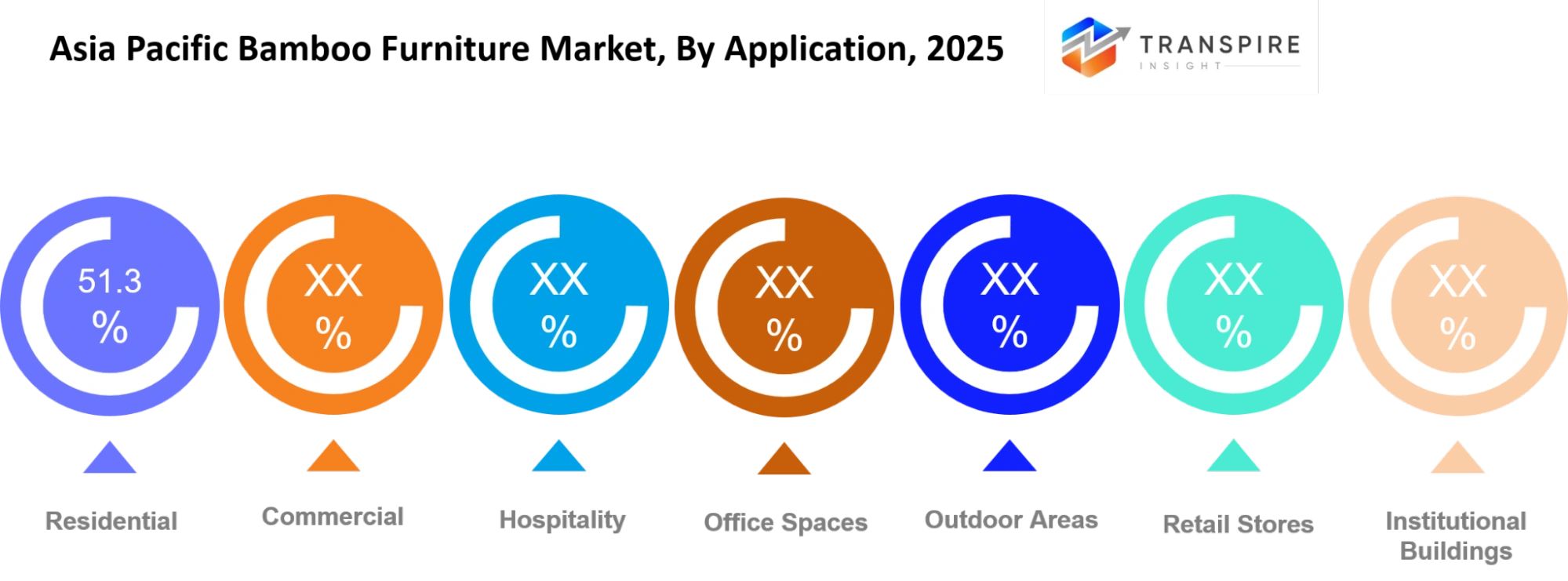
- Household usage represents the leading application at approximately 52% share in 2025 due to an increase in residential development in urban areas and miniaturization of living design.
- The Furnishing of lodging and ecologic resorts appears to be the most promising sector due to sustainable tourism infrastructure growth within Southeast Asia.
- The highest proportion in the Asia Pacific Bamboo Furniture Market is held by homeowners and end consumers, with a share of about 48% due to economical prices and flexibility in design.
- Commercial end-users, which include resorts and shared office space, appear to be the fastest developing sector, influenced by ESG-based procurement decisions.
What are the Key Drivers, Restraints, and Opportunities in the Asia Pacific Bamboo Furniture Market?
Increased government regulation for controlled sustainable construction procurement is the dominant driver of the Asia Pacific Bamboo Furniture Market. China, India and Southeast Asia Governments have made stricter controls on the use of timber in construction thereby channeling the suppliers and builders towards bamboo as the scalable and viable alternative. The replacement demand stimulated through policies has increased orders from the hospitality sector, residential and office interior segments thereby enhancing revenue stability for manufacturers.
The inconsistency of standardization for the bamboo processing across small and medium producers, having smaller volumes is the major restriction faced by this market. Varying methods in treatments, finishing and durability hinder the use in high-ended commercial segment projects that demand longer durability life cycle for assurance. This structural limitation impedes enterprise level procurement as it hinders the development of strong pricing power.
Engineering of the bamboo composites combined with automated manufacturing processes is the dominant opportunity for the Asia Pacific Bamboo Furniture Market. Vietnam and Indonesia are witnessing large investments from the government in the establishment of large volume manufacturing plants that produce raw bamboo into panel form. This standardized product format provides an entry to the high margin European and North American export market.
What Has the Impact of Artificial Intelligence Been on the Asia Pacific Bamboo Furniture Market?
Overall, AI is slowly yet steadily enhancing productivity and coordination within the Asia Pacific Bamboo Furniture Market. Manufacturers use AI assisted design systems for creating more optimized designs to utilize raw bamboo resources better by modeling precise cuts and load distribution analysis. High-output manufacturing units have been installing machine learning systems to improve productivity by tracking CNC machines and their condition, thereby preventing major maintenance failures. These systems have been seen to increase up-time in manufacturing units by up to 10-15% as compared to manual maintenance processes.
Moreover, AI based forecasting tools are enabling suppliers to stock inventory according to seasons of construction and hospitality purchasing cycles thus minimizing over-production and costs of warehousing and inventory management. On the logistical end, various routing algorithms have been installed on transport systems to enable greater logistical efficiency in the delivery of bamboo furniture exports around the Asian countries.
However, issues like the high cost of implementation and lack of uniform digital infrastructure in manufacturing units, especially small enterprises, have been limiting its adoption and utilization. A majority of manufacturing units use semi-manual processes thus failing to record data points necessary to implement AI systems and obtain more accurate and reliable output. Thus the scalability of such an AI system around Asia Pacific is still fragmented.
Key Market Trends
- Makers shifted from handmade bamboo products to automated lines with CNC machines from 2021-2025; this boosted the quality consistency and production scale.
- Since 2020, stringent government regulations concerning hardwood logging have been implemented across China and India, prompting commercial purchases toward certified bamboo supply agreements.
- Nearly 35% increase of bamboo furniture acquisition by hospitality chains between 2022-2025, driven by ESG requirements and green building certifications.
- Export-focused bamboo processing bases were established/ expanded in Vietnam and Indonesia post-2021; this cut down over-reliance on Chinese-centric supply chains.
- 2023 onward saw mainstream integration of bamboo furniture catalogs on digital interior design platforms, enabling faster online B2B purchasing for APAC projects.
- Unstable global timber prices from 2021-2023 steered developers into long-term bamboo supply contracts with local manufacturers.
- IKEA amplified its collection of bamboo-based items in its APAC outlets from 2023 onward, building mainstream familiarity with the material for sustainability.
- After 2022, the surge in demand for modular furniture and high urban population density made lightweight bamboo products a preferred alternative to hardwood furniture.
- A move towards automated finishing processes occurred in Godrej Interio and other manufacturers in the region from 2022, to decrease over-dependence on human labor and enhance the quality standards of export items.
Asia Pacific Bamboo Furniture Market Segmentation
By Product Type:
Chairs, tables, beds, cabinets, sofas, shelves, outdoor furniture, etc made out of bamboo are moving consistently toward standardizing the manufacturing process. Chairs and tables have an upward trend since they are being utilized in everyday life in homes and workplaces. Demand for outdoor furniture will continue to increase as more urban landscaping projects and hospitality spaces will be incorporated with lightweight and durable bamboo construction.
Manual processes will start transforming to machine-based fabrication. Homes and urban housings show an increase in adopting beds and cabinets because space efficient products are still in demand in such places. Sofas and shelving will be introduced more because living modular designs are expanding more in the cities. Outdoor furniture will increase at a much higher rate as the environmentally conscious constructions and lower product replacement cycles will be applied.
By Application:
Residential consumption is the top application for bamboo furniture and is also driven by growing urban housing construction. Offices and retail will begin to integrate the product more in their interiors. Hospitality establishments, hotels and resorts use the products to adhere with eco-labeling standards for buildings.
Offices use a rising amount of modular bamboo products which allow various kinds of room layouts. Retailers make good use of bamboo products due to its aesthetic values. Other buildings such as institutional institutions, school institutions, and public areas increase their usage of the product due to its durability and control cost features. Outdoor use also rises as many landscaping projects will begin to incorporate the product.
By Distribution Channel:
The online channel sees a swift growth as consumers increasingly turn to electronic catalogs and ordering systems to select bamboo furniture. Furniture stores see sustained growth driven by physical inspection of products and consultation. Category stores focus on value-added collections of bamboo furniture and direct selling channels facilitate stronger supplier-to-project links in the bulk buying segments.
Hypermarkets and brand outlets contribute to increased exposure for the mass-market segment and distributor networks effectively link manufacturers to local consumers in the Tier 2 and Tier 3 cities. Online channels facilitate better comparison and a decreased time between selection and purchase. However, the offline channel is still critical for project-based bulk buying to support large scale construction projects in commercial and hospitality segments.
By End User:
Households is the largest consumer segment, helping consumers equip homes economically both in the urban and suburban areas. Hotels and restaurants, responding to environmental considerations and regular renovation requirements, significantly increase usage. Offices employ bamboo furniture for ease of remodeling and for providing efficient yet cost-effective work environments.
Retailers are likely to utilize bamboo furniture as décor elements and for setting up their showroom displays. Education institutions look forward to utilization of bamboo furniture for ease of maintenance and its high durability, and the government also considers adopting the use in its public infrastructure projects. The growing popularity in each sector indicates a shift towards efficient, lightweight, and eco-friendly furniture with better design aspects.
What are the Key Use Cases Driving the Asia Pacific Bamboo Furniture Market?
Residential housing represents the largest and main application for Asia Pacific Bamboo Furniture Market. Development of urban apartments and the need of light and space-saving furniture have increased the use. The demand from homeowners stems from its affordability, its durability and easy cleaning while space is limited in small dwellings. Architects and interior contractors use bamboo for its quick assembly and versatile design capability in housing projects.
Commercial offices and hotels have increasingly applied bamboo furniture as companies begin implementing ESG policies and "green" building labels, in the purchase decision process. Hotels and restaurants now integrate bamboo furniture into their decor to achieve the company's green targets and flexibility in interior design. The retail industry is also adopting bamboo furniture displays for their cheap costs and the versatility to create, reconstruct displays easily for their displays.
Growing applications and use cases for bamboo furniture are eco-tourism resorts and co-living spaces, where sustainable decor is a priority from design to interiors. Its application for institutions like schools and public spaces is also gaining traction due to government-supported sustainability programs that promote the use of renewable materials in facility refurbishment projects.
|
Report Metrics |
Details |
|
Market size value in 2025 |
USD 5.77 Billion |
|
Market size value in 2026 |
USD 6.21 Billion |
|
Revenue forecast in 2033 |
USD 10.39 Billion |
|
Growth rate |
CAGR of 7.63% from 2026 to 2033 |
|
Base year |
2025 |
|
Historical data |
2021 - 2024 |
|
Forecast period |
2026 - 2033 |
|
Report coverage |
Revenue forecast, competitive landscape, growth factors, and trends |
|
Regional scope |
Asia Pacific (India, China, Japan, Australia, South Korea, Rest of Asia Pacific) |
|
Key company profiled |
IKEA, Greenington, MOSO Bamboo, Haiku Designs, Bamboo Village, Smith & Fong, Dasso Group, Muji, Nitori, VivaTerra, Bamcore, EcoPlanet Bamboo, Jiangxi Feiyu, Tine K Home, Bamboo Studio. |
|
Customization scope |
Free report customization (country, regional & segment scope). Avail customized purchase options to meet your exact research needs. |
|
Report Segmentation |
By Product Type (Chairs, Tables, Beds, Cabinets, Sofas, Shelves, Outdoor Furniture, Others); By Application (Residential, Commercial, Hospitality, Office Spaces, Outdoor Areas, Retail Stores, Institutional Buildings, Others); By Distribution Channel (Online Retail, Furniture Stores, Specialty Stores, Direct Sales, Hypermarkets, Brand Outlets, Distributors, Others); By End User (Households, Hotels, Offices, Restaurants, Retailers, Educational Institutions, Government Facilities, Others). |
Which Regions are Driving the Asia Pacific Bamboo Furniture Market Growth?
China dominates the Asia Pacific Bamboo Furniture Market because of its immense cultivation base and comprehensive manufacturing cluster, backed by efficient export logistics in major ports to allow bulk transport and global exportability. Governmental policies promoting sustainability and the shift away from hardwood have added momentum, along with a vast supplier network that enables bulk production at low costs and steady supply.
India is another significant player, primarily propelled by a steady pace of internal demand and increasing need for urban housing and residences. Its growth can be attributed more to domestic consumption than to export demand, as the regulatory support for sustainable materials has shown gradual, but uneven development. Unlike China, its manufacturing centers are more scattered and serve localized markets.
The growth of Vietnam and Indonesia is the most rapid due to trend in manufacturing decentralization and increased foreign investments into bamboo processing units; 2021 to 2025, numerous units of production have been shifted from China to Southeast Asia to capitalize on low labor costs and less expense for raw materials. This, coupled with augmented exportability at ports and favorable policies has helped in developing a stronger competitive network in the region and thus Southeast Asia is likely to be the growth destination for the new players from 2026 to 2033.
Who are the Key Players in the Asia Pacific Bamboo Furniture Market and How Do They Compete?
Asia Pacific Bamboo Furniture Market moderately fragmented-global brands and regional players competing on efficiency, new design, and certification. The global companies, with efficient large-scale operations, are setting standards for size-oriented productivity and uniformity of quality, while smaller players focus on niche bamboo designs and localized distribution. The emerging competitive trend will see a transition from competitive pricing toward certification driven procurement and design novelty in large contract assignments.
IKEA uses a global strategy, leveraging scale across conventional furniture ranges with wide-scale deployment of bamboo components and consistent global design systems to establish cost advantage. Godrej Interio strategically places itself in bulk buying contracts in office/institutional furniture by leveraging distribution strengths and office environment solutions for B2B procurement and demand. Nilkamal Limited positions its brand to address a wide array of consumers, including masses and mid-market urban and semi-urban customers, through affordability and broad-based distribution. Muji stands apart from competition on the back of minimalist and aesthete design offering. Shenzhen Sunon Furniture relies on a broad base of large contracts and scaled exports to cover its demand across commercial clients in Asia Pacific.
Company List
- IKEA
- Greenington
- MOSO Bamboo
- Haiku Designs
- Bamboo Village
- Smith & Fong
- Dasso Group
- Muji
- Nitori
- VivaTerra
- Bamcore
- EcoPlanet Bamboo
- Jiangxi Feiyu
- Tine K Home
- Bamboo Studio
Recent Development News
In September 2025, Amwoodo announced a pre-series A funding round of approximately USD 4 million to scale its bamboo-based product manufacturing capacity. The company plans to expand production and strengthen partnerships with FMCG and hospitality clients, increasing adoption of bamboo alternatives across commercial supply chains.
Source: https://www.indiatimes.com/
In April 2025, Amwoodo secured funding of around $4 million to expand bamboo-based production capacity and strengthen B2B supply partnerships across sustainable consumer brands in Asia Pacific.
Source: https://www.timesofindia.indiatimes.com/
What Strategic Insights Define the Future of the Asia Pacific Bamboo Furniture Market?
Asia Pacific Bamboo Furniture Market is transitioning to a more integrated and industrialized approach. Instead of having splintered artisan supply chains, it will more likely utilize engineered bamboo products with modular manufacturing processes. This transition is spurred on by increasing stricter sustainable sourcing regulations, increasing density of urban housing supply and increasing demand from hotel and commercial real estate developers for verifiable and reproducible inputs.
Revenue growth over the next 5-7 years will focus on manufacturers able to automate large-scale production with quality control to be distributed across multiple export countries. The understated risk will be on reliance of supply from a handful of growing regions, where volatile weather conditions and competing land-use could lead to unexpected volatility and cost pressures.
However, the next opportunity to materialize will be bamboo high performance composites used in modular construction, which could be in high demand in fast growing prefab housing segments in Southeast Asia. It is essential that market players focus on both automated manufacturing processes and long-term raw material agreements with certified plantations to control prices and supply volatility.
Asia Pacific Bamboo Furniture Market Report Segmentation
By Product Type
- Chairs
- Tables
- Beds
- Cabinets
- Sofas
- Shelves
- Outdoor Furniture
By Application
- Residential
- Commercial
- Hospitality
- Office Spaces
- Outdoor Areas
- Retail Stores
- Institutional Buildings
By Distribution Channel
- Online Retail
- Furniture Stores
- Specialty Stores
- Direct Sales
- Hypermarkets
- Brand Outlets
- Distributors
By End User
- Households
- Hotels
- Offices
- Restaurants
- Retailers
- Educational Institutions
- Government Facilities
Frequently Asked Questions
Find quick answers to common questions.
The Asia Pacific Bamboo Furniture Market size is USD 10.39 Billion in 2033.
Key segments for the Asia Pacific Bamboo Furniture Market are By Product Type (Chairs, Tables, Beds, Cabinets, Sofas, Shelves, Outdoor Furniture, Others); By Application (Residential, Commercial, Hospitality, Office Spaces, Outdoor Areas, Retail Stores, Institutional Buildings, Others); By Distribution Channel (Online Retail, Furniture Stores, Specialty Stores, Direct Sales, Hypermarkets, Brand Outlets, Distributors, Others); By End User (Households, Hotels, Offices, Restaurants, Retailers, Educational Institutions, Government Facilities, Others).
Major Asia Pacific Bamboo Furniture Market players are IKEA, Greenington, MOSO Bamboo, Haiku Designs, Bamboo Village, Smith & Fong, Dasso Group, Muji, Nitori, VivaTerra, Bamcore, EcoPlanet Bamboo, Jiangxi Feiyu, Tine K Home, Bamboo Studio.
The Asia Pacific Bamboo Furniture Market size is USD 5.77 Billion in 2025.
The Asia Pacific Bamboo Furniture Market CAGR is 7.63% from 2026 to 2033.
- IKEA
- Greenington
- MOSO Bamboo
- Haiku Designs
- Bamboo Village
- Smith & Fong
- Dasso Group
- Muji
- Nitori
- VivaTerra
- Bamcore
- EcoPlanet Bamboo
- Jiangxi Feiyu
- Tine K Home
- Bamboo Studio
About the Authors

Chetan Dhatrak
I’m Chetan Dhatrak, a Senior Research Analyst at Transpire Insight, specializing in the Consumer Goods, Foods and Beverages industry. I focus on analyzing market trends, consumer behavior, competitive landscapes, and industry developments to deliver accurate, data-driven insights. My research at Transpire Insight is built on credible sources and in-depth analysis, helping businesses and readers better understand market dynamics, emerging opportunities, and evolving consumer preferences. I’m committed to creating reliable, well-researched content that supports informed decision-making and reflects the latest developments in the consumer goods and food & beverage sectors.

Chakradhar Khansole
Chakradhar serves as the Research Director at Transpire Insight, bringing over 8 years of experience in technology, innovation, and strategic market intelligence. He specializes in transforming complex market data into actionable business insights that enable organizations to make informed, growth-oriented decisions. Recognized for his strategic vision and analytical expertise, Chakradhar leads high-impact research initiatives, delivering comprehensive market assessments, competitive intelligence, and forward-looking industry analysis.
Recently Published Reports
-
Apr 2026
Bottled Water Market
Bottled Water Market Size, Share & Analysis Report By Product Type (Still Bottled Water, Carbonated Bottled Water, Functional Bottled Water, and Others), By Packaging (PET, Cans, and Others), By Sales Channel (Supermarkets/Hypermarkets, Convenience Stores/Drug Stores, Grocery Stores/Club Stores, Foodservice, and Others) and Geography (North America, Europe, Asia-Pacific, Middle East and Africa, South and Central America), 2021 - 2032
-
Apr 2026
Color Cosmetic Packaging Market
Color Cosmetic Packaging Market Size, Share & Analysis Report By Application (Mascara Packaging, Liquid Packaging, and Liquid Face), By Type (Tubes & Bottles, Pens & Markers, Compacts & Containers, and Droppers & Pumps), and Geography (North America, Europe, Asia-Pacific, Middle East and Africa, South and Central America), 2021 - 2031
-
Apr 2026
External Microphone For Camera Market
External Microphone For Camera Market Size, Share & Analysis Report By Type (Shotgun Microphone, Lavalier Microphone, and Others), By Application (Digital Camera, Professional Video Camera, and Others), and Geography (North America, Europe, Asia-Pacific, Middle East and Africa, South and Central America), 2021 - 2031
-
Apr 2026
Foot Orthotic Insoles Market
Foot Orthotic Insoles Market Size, Share & Analysis Report By Type (Pre-fabricated, and Custom-made), By Material (Thermoplastic, Composite Carbon Fiber, and Others), By Distribution Channel (Drug Stores, Hospitals & Clinics, and Others), and Geography (North America, Europe, Asia-Pacific, Middle East and Africa, South and Central America), 2021 - 2031