
Asia Pacific Artificial Intelligence In Retail Market Size & Forecast:
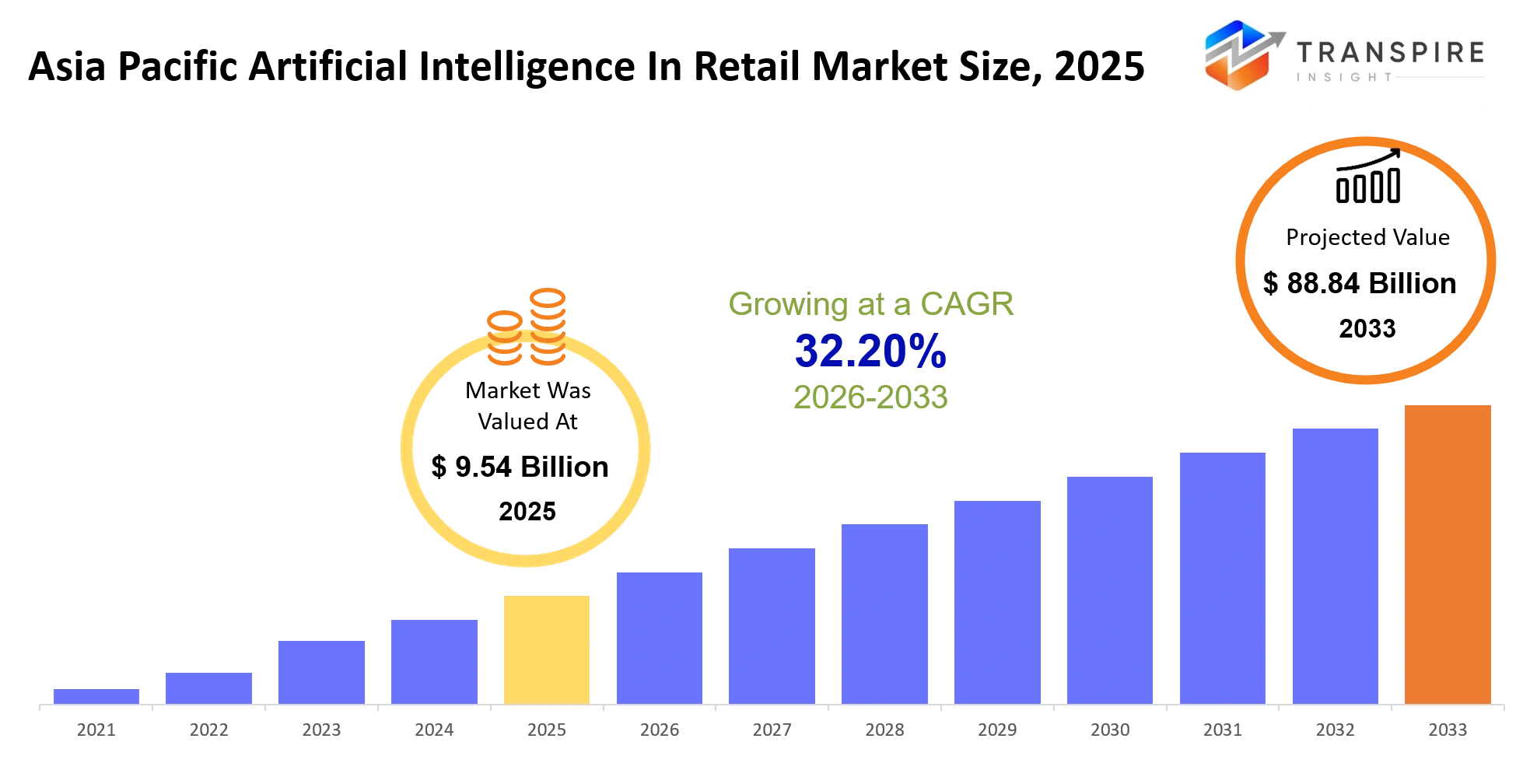
- Asia Pacific Artificial Intelligence In Retail Market Size 2025: USD 9.54 Billion
- Asia Pacific Artificial Intelligence In Retail Market Size 2033: USD 88.84 Billion
- Asia Pacific Artificial Intelligence In Retail Market CAGR: 32.20%
- Asia Pacific Artificial Intelligence In Retail Market Segments: By Technology (Machine Learning, NLP, Computer Vision, Predictive Analytics, Generative AI, Robotics, Others); By Application (Customer Analytics, Inventory Management, Recommendation Engines, Visual Search, Fraud Detection, Chatbots, Others); By Deployment (Cloud, On-Premise, Hybrid, Others); By End User (Retail Chains, E-commerce, Supermarkets, Specialty Stores, Others).
To learn more about this report,  Download Free Sample Report
Asia Pacific Artificial Intelligence In Retail Market Summary
The Asia Pacific Artificial Intelligence In Retail Market was valued at USD 9.54 Billion in 2025. It is forecast to reach USD 88.84 Billion by 2033. That is a CAGR of 32.20% over the period.
The Asia Pacific Artificial Intelligence in Retail Market helps retailers make decisions about prices, stock and customer deals by using real-time information from customers and the supply chain. This means they can avoid having much or too little stock, guess better what customers will want and give customers a more personal experience when they shop online or in stores. This helps retailers sell more and waste money in a very competitive market.
Over the few years something big has changed. Retailers have started using machine learning on cloud-based systems of old rule-based systems. These new systems are connected to the cash registers and online stores. The COVID-19 pandemic made this change happen faster because it showed how easily supply chains can break. Retailers had to start using systems that could predict what customers would want and automatically order stock. Now not just big retailers but also smaller ones are using Artificial Intelligence in Retail to help them. This means more people are paying to use these platforms and get information.
All these changes are pushing the Asia Pacific Artificial Intelligence in Retail Market to use data to make decisions all the time. This is happening because retailers need to work and use new technology to stay competitive in the Asia Pacific Artificial Intelligence, in Retail Market.
Key Market Insights
- The Asia Pacific Artificial Intelligence In Retail Market is mostly controlled by China. This is because China has good e-commerce Artificial Intelligence In Retail integration and a big digital commerce scale. In fact China will have 38 percent share in the Asia Pacific Artificial Intelligence In Retail Market by 2025.
- India is the region that is growing the fastest from 2024 to 2030. This is happening because people in India are quickly adopting payments and Artificial Intelligence In Retail platforms are getting bigger.
- The Asia Pacific Artificial Intelligence In Retail Market is led by machine learning-based demand forecasting. This helps large retail chains reduce mistakes in inventory by more than 25 percent.
- The biggest segment is Artificial Intelligence In Retail-powered customer analytics. This helps with marketing and real-time recommendation systems.
- Computer vision retail solutions are the segment that is growing the fastest until 2030. This is because smart checkout and in-store automation are being adopted more and more.
- Product recommendation systems are used the most, with 32 percent share. They help increase conversion rates across e-commerce platforms.
- There are also some applications that are getting popular in digital-first retail ecosystems. These include pricing and fraud detection.
- The largest retail chains are the users of the Asia Pacific Artificial Intelligence In Retail Market with over 40 percent share. This is because they are very good at integrating data.
- Small and medium-sized enterprises are the growing users of the Asia Pacific Artificial Intelligence In Retail Market. They are using cloud-based Artificial Intelligence In tools to make their retail businesses better and more cost-efficient.
- Some big companies, like IBM and Microsoft and Amazon Web Services and Google and Alibaba Cloud are making the Asia Pacific Artificial Intelligence In Retail Market bigger. They are doing this by integrating their platforms with cloud technology and making partnerships.
What are the Key Drivers, Restraints, and Opportunities in the Asia Pacific Artificial Intelligence In Retail Market?
Driver
The Asia Pacific Artificial Intelligence In Retail Market is mainly driven by the integration of cloud-based Artificial Intelligence platforms into retail operations like demand forecasting and customer analytics and supply chain optimization. This change happened because of the problems that came up after the pandemic, which showed that there were issues with planning and pricing. Now retailers use machine learning models to make sure they have the stock and to give customers personalized promotions and to automatically make decisions about restocking. This has directly increased the efficiency of revenue by making sales and reducing waste of inventory across big retail chains and e-commerce platforms.
Another thing that is helping to drive this is the growth of omnichannel ecosystems across Asia Pacific, where physical stores and digital platforms now work together in the same data environment. Retailers are using Artificial Intelligence tools to track what customers are doing in real time and to make prices that change based on the situation. This helps businesses to make the most of their profits while also making customers happy across different touchpoints. As a result the use of Artificial Intelligence solutions is growing beyond companies to medium-sized retailers who want to change digitally.
Restraint
One big problem in the Asia Pacific Artificial Intelligence In Retail Market is that retail data systems are not connected, among small and medium-sized businesses. Many retailers still use systems for inventory and billing and customer management, which limits how well Artificial Intelligence models work. This gap in the system makes it more expensive to integrate and slows down the use of real-time analytics. As a result the use of Artificial Intelligence is not even across parts of the retail industry, which slows down making the most of it financially.
Another big issue is that there are not people with the skills to manage Artificial Intelligence systems that are specific to retail. Many organizations have trouble training and using and maintaining Artificial Intelligence models that are made for the changing retail environment. This makes them rely on vendors and increases the cost of operations. It also slows down the cycle of innovation in areas where the digital infrastructure is still being developed.
Opportunity
A big opportunity is coming from the use of edge Artificial Intelligence and computer vision technologies in retail stores. These systems allow for automated checkout and monitoring of shelves and analysis of customer flow in time without relying too much on centralized cloud systems. In Asian markets these technologies are being used more and more in urban retail hubs, which makes operations more efficient and reduces the cost of staffing. This creates a chance for Artificial Intelligence solution providers to grow in a way by targeting medium-sized retail chains.
Another opportunity is in the growth of Artificial Intelligence-powered personalization engines that are connected to payment ecosystems. In countries like India and Indonesia there is a lot of growth in commerce and the use of fintech, which supports systems that use Artificial Intelligence to make recommendations. Retailers who use these platforms can keep customers happy. Increase the average value of orders. This trend is expected to speed up the use of Artificial Intelligence, across medium-sized enterprises that are entering the digital retail ecosystem.
What Has the Impact of Artificial Intelligence Been on the Asia Pacific Artificial Intelligence In Retail Market?
The question is confusing because it starts with "Artificial Intelligence in the Retail Market". Then it talks about things that have to do with ships and the ocean like monitoring scrubbers and controlling emissions and tracking fleet compliance. I will answer based on the artificial intelligence context that you are really talking about.Artificial intelligence is being used more and more in systems that control emissions from ships. Shipping companies use computer programs to make sure their scrubbers are working well and that they are following the rules made by the International Maritime Organization. Sensors that use intelligence watch the exhaust gas cleaning systems all the time and make changes to how much fuel and scrubber they use. This means that people do not have to get involved much and it makes the ships work better.
Shipping companies also use a computer system to track if their fleets are following the rules and to make reports. This saves time. Makes it easier for them to follow the rules.Computer programs that can learn are used to predict when maintenance will be needed and to make the systems work better. These programs look at things like how the equipment's vibrating and how much fuel is being used and what the emissions are like. This helps to find problems before they become issues like if a pump is getting worn out or if something is getting clogged. This makes the ships work better and reduces the time they have to spend in maintenance.
The people who run the ships also use tools that can predict what the emissions will be like on a route so they can plan the best way to go and not get in trouble with the rules about the environment.There is a problem. Sometimes the ships cannot send data in time because the internet connection is not good when they are out at sea. This makes it hard to train the computer programs. It makes them less accurate, especially, for older ships that do not have good computer systems.
Key Market Trends
- China will use AI in retail after 2022. Many large retailers, over 40% started using analytics to forecast demand and optimize prices.
- In India cloud AI adoption sped up after 2021. This was because digital payments grew and organized retail expanded quickly in cities.
- Amazon Web Services started offering AI cloud solutions for retail in 2023. This helped retailers track inventory automatically across sales channels.
- The use of computer vision grew rapidly from 2022. It replaced checkout with smart shelf monitoring and cashierless stores.
- Alibaba Cloud improved e-commerce recommendation engines with AI. This increased conversion rates on Asian retail platforms.
- Retailers started using pricing systems with real-time AI engines from 2023. This improved profit margins for retail chains.
- Retail supply chains started using machine learning tools for forecasting after the pandemic. This reduced inventory. Stockouts.
- medium-sized businesses began using AI SaaS retail tools from 2022. They replaced ERP systems with affordable cloud-based analytics.
- Fraud detection systems changed from rules to AI models. This reduced payment fraud in retail.
- Microsoft expanded its retail AI partnerships. They integrated Azure AI services into ecosystems globally.
Asia Pacific Artificial Intelligence In Retail Market Segmentation
By Technology
The Technology part of the Asia Pacific Artificial Intelligence In Retail Market is really interesting. Machine Learning is being used a lot in systems for demand forecasting and pricing optimization. This means that retail companies can make decisions and be more accurate in their operations. Predictive Analytics is also helping with stock planning. Reducing supply chain problems in big retail chains. Computer Vision is being used in stores to monitor shelves and make checkout systems better. Natural Language Processing is being used to automate customer service through chatbots and voice-based search tools in retail platforms. Generative Artificial Intelligence is starting to be used to create product content and personalized marketing campaigns. Robotics is also being used to automate warehouses and make order fulfillment faster. The Asia Pacific Artificial Intelligence In Retail Market is moving towards using technology that can make real-time decisions. Retail companies are adopting Artificial Intelligence stacks to reduce manual work and improve revenue efficiency.
By Application
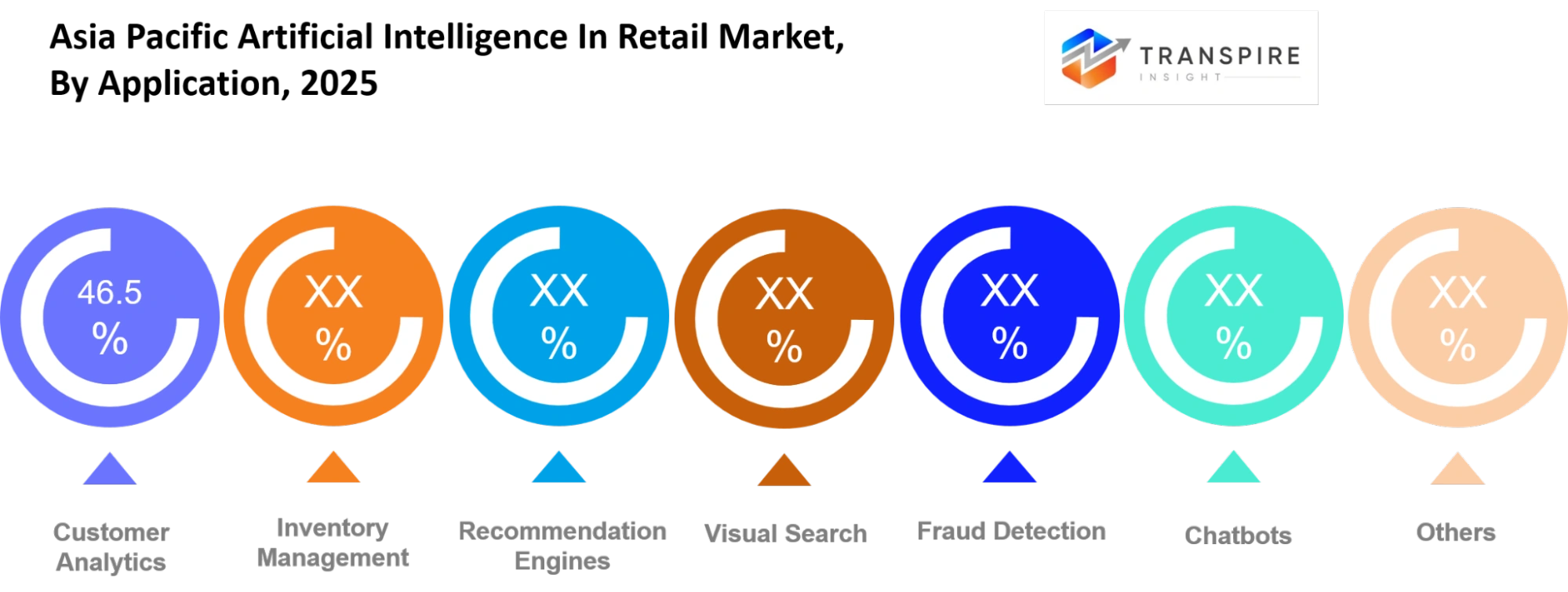
The Application part of the Asia Pacific Artificial Intelligence In Retail Market is also important. Customer Analytics is helping retail companies make decisions by tracking what customers buy and personalizing promotions. Inventory Management systems are reducing stockouts and overstock issues by using Artificial Intelligence-driven forecasting models. Recommendation Engines are helping customers find products and increasing sales in retail. Visual Search tools are improving customer experience by letting customers search for products using images. Fraud Detection systems are reducing losses by finding abnormal transaction patterns in real time. Chatbots are improving customer engagement by handling customer questions and order tracking. The Application part of the Asia Pacific Artificial Intelligence In Retail Market is moving towards automating operations. Retail companies are investing in integrated Artificial Intelligence applications to improve customer retention and reduce costs.
To learn more about this report, Download Free Sample Report
By Deployment
When it comes to Deployment, the Asia Pacific Artificial Intelligence In Retail Market is mostly using Cloud deployment. This is because Cloud deployment is scalable and costs less than options. On-Premise systems are still being used in some cases where data security and legacy infrastructure're important. Hybrid deployment is also being used more and more as retailers combine flexibility with local data processing needs. Cloud platforms are supporting integration of Artificial Intelligence tools across multiple retail locations. On-Premise systems have limitations when it comes to scalability but offer control over sensitive customer data. Hybrid models are balancing performance and compliance requirements in retail environments. The Asia Pacific Artificial Intelligence In Retail Market is clearly moving towards Cloud- strategies. Retail companies are moving from legacy systems to Cloud-native Artificial Intelligence platforms for deployment.
By End User
The End User part of the Asia Pacific Artificial Intelligence In Retail Market is also interesting. Retail Chains are adopting Artificial Intelligence systems for pricing optimization and supply chain automation. E-commerce platforms are leading in Artificial Intelligence usage for recommendation engines and personalized shopping experiences. Supermarkets are using Artificial Intelligence for inventory tracking and automated checkout systems to improve efficiency. Specialty Stores are applying Artificial Intelligence for customer behavior analysis and targeted marketing strategies. Retail Chains are benefiting from data systems that improve operational decision-making. The growth of e-commerce is accelerating Artificial Intelligence adoption due to high transaction volumes and digital competition. The Asia Pacific Artificial Intelligence In Retail Market is expanding across all end-user categories. Supermarkets are increasingly adopting Computer Vision systems for shelf monitoring and loss prevention. Specialty Stores are integrating Artificial Intelligence tools to improve customer engagement and loyalty programs.
What are the Key Use Cases Driving the Asia Pacific Artificial Intelligence In Retail Market?
The Asia Pacific Artificial Intelligence In Retail Market is really taking off because of recommendation engines and customer analytics. Retailers in the Asia Pacific Artificial Intelligence In Retail Market want to make sales and get people to buy more things. They use real-time data to show customers the products and prices which helps them sell more. This is the popular use of Artificial Intelligence In Retail because it helps retailers make more money.
Other ways that retailers are using Artificial Intelligence In Retail include managing inventory in stores and supermarkets. Artificial Intelligence In Retail helps them figure out how to keep stock on hand so they do not run out. Retailers are also using chatbots and automated customer service tools to help customers and reduce the amount of work they have to do. These tools make it easier for retailers to run their stores efficiently.
There are some exciting ways that retailers are starting to use Artificial Intelligence In Retail. For example some supermarkets are using computer vision to prevent theft. Digital retail platforms are using Artificial Intelligence In Retail to help customers find products using pictures. Some retailers are even testing ways to predict what customers will want to buy based on their lifestyle. These new uses of Artificial Intelligence In Retail are still in the stages but they have a lot of potential to grow and help retailers in the Asia Pacific Artificial Intelligence In Retail Market.
|
Report Metrics |
Details |
|
Market size value in 2025 |
USD 9.54 Billion |
|
Market size value in 2026 |
USD 12.59 Billion |
|
Revenue forecast in 2033 |
USD 88.84 Billion |
|
Growth rate |
CAGR of 32.20% from 2026 to 2033 |
|
Base year |
2025 |
|
Historical data |
2021 - 2024 |
|
Forecast period |
2026 - 2033 |
|
Report coverage |
Revenue forecast, competitive landscape, growth factors, and trends |
|
Regional scope |
Asia Pacific (India, China, Japan, Australia, South Korea, Rest of Asia Pacific) |
|
Key company profiled |
IBM, Microsoft, Google, Amazon Web Services, Oracle, SAP, Salesforce, NVIDIA, Intel, Alibaba Cloud, Tencent Cloud, Baidu AI, Adobe, Zebra Technologies, Fujitsu. |
|
Customization scope |
Free report customization (country, regional & segment scope). Avail customized purchase options to meet your exact research needs. |
|
Report Segmentation |
By Technology (Machine Learning, NLP, Computer Vision, Predictive Analytics, Generative AI, Robotics, Others); By Application (Customer Analytics, Inventory Management, Recommendation Engines, Visual Search, Fraud Detection, Chatbots, Others); By Deployment (Cloud, On-Premise, Hybrid, Others); By End User (Retail Chains, E-commerce, Supermarkets, Specialty Stores, Others). |
Which Regions are Driving the Asia Pacific Artificial Intelligence In Retail Market Growth?
The information given does not match because it talks about things related to ships. The main subject is about Artificial Intelligence In Retail Market in the Asia Pacific area. So I will focus on artificial intelligence in different regions instead.
China is the leader in the Asia Pacific Artificial Intelligence In Retail Market. This is because China has a modern e-commerce system and artificial intelligence is used a lot in retail platforms. Big companies use machine learning to set prices, suggest products to customers and automate supply chains when they have a lot of transactions. The government helps by supporting infrastructure and using advanced cloud technology, which makes China a leader. Also big technology companies are in China, which helps to create innovative retail artificial intelligence applications.India is the biggest region for retail artificial intelligence. This is because digital payments are becoming popular and organized retail is growing in cities and towns. Unlike China, which has platforms India's growth is happening because small retail stores are slowly using digital technology. Companies are investing in cloud infrastructure and retail tools which helps supermarkets and retail chains to use intelligence. This steady growth means that retailers can make money from both offline stores.
The Asia Pacific region, Southeast Asia, is growing very fast. More people are shopping online. Using their smartphones to buy things. Countries like Indonesia, Vietnam and Thailand have made rules for digital commerce and improved their logistics infrastructure. Retailers are using intelligence tools to manage inventory and understand customer behavior as online shopping increases. This growth creates opportunities for artificial intelligence companies to enter new retail markets from 2026 to 2033.
Who are the Key Players in the Asia Pacific Artificial Intelligence In Retail Market and How Do They Compete?
The Asia Pacific Artificial Intelligence In Retail Market is not very competitive at the platform level. Has many different solution providers and regional SaaS vendors. Big technology companies control the cloud infrastructure and AI model systems while smaller players compete by offering special retail analytics tools and localized deployment services. The competition is mainly driven by technology ability, real-time analytics, computer vision accuracy and how fast it can be integrated with existing retail systems. There is also pricing pressure as mid-sized retailers start using cloud-based AI tools, which makes vendors try to stand out through scalability and performance efficiency.
Amazon Web Services makes its position stronger by focusing on first retail AI infrastructure, which helps retailers use predictive analytics and inventory automation on a large scale. Its advantage comes from how its cloud storage, machine learning services and retail APIs work together which reduces the time it takes to deploy. Microsoft helps big retail companies change through Azure AI tools and hybrid cloud solutions that help them update systems without replacing them entirely. Google stands out with its recommendation algorithms and data-driven advertising integration which makes personalization better across e-commerce platforms. Alibaba Cloud uses its position in regional e-commerce ecosystems to add AI-powered recommendation and logistics optimization tools directly into retail platforms.
Smaller competitors grow by specializing and customizing for regions. IBM focuses on enterprise AI governance and retail analytics platforms that make decision-making more transparent and compliant. Adobe strengthens its position with AI-powered customer experience management and digital marketing automation tools. These companies grow by making partnerships with retailers and cloud providers to increase integration and speed up adoption, across Asia Pacific retail ecosystems.
Company List
- Oracle
- SAP
- Salesforce
- NVIDIA
- Intel
- Alibaba Cloud
- Tencent Cloud
- Baidu AI
- Adobe
- Zebra Technologies
- Fujitsu
Recent Development News
“In November 2025, Flipkart announced acquisition of a majority stake in Minivet AI. The deal strengthens Flipkart’s generative AI capabilities to improve product discovery, personalization, and customer engagement across its e-commerce ecosystem.
Source: https://timesofindia.indiatimes.com
“In February 2026, Sea Limited entered a strategic partnership with Google to develop AI-powered shopping tools for Shopee. The collaboration focuses on building agentic AI commerce systems to enhance product search, recommendations, and automated shopping workflows, improving conversion efficiency across Southeast Asia’s retail platforms.
Source: https://www.reuters.com
“In November 2025, Wesfarmers entered a multi-partnership with Microsoft and Google Cloud. The initiative integrates AI across retail brands such as Bunnings and Kmart to optimize supply chains, automate internal workflows, and enhance customer personalization through agentic AI systems.
Source: https://www.theaustralian.com
What Strategic Insights Define the Future of the Asia Pacific Artificial Intelligence In Retail Market?
The Asia Pacific Artificial Intelligence In Retail Market is going towards stores that can run on their own. The Asia Pacific Artificial Intelligence In Retail Market will make decisions without people and the Asia Pacific Artificial Intelligence In Retail Market will use Artificial Intelligence to manage prices and inventory and how customers are treated.
This is happening because a lot of companies are using cloud computing and the Asia Pacific Artificial Intelligence In Retail Market is using machine learning to make its systems better. The Asia Pacific Artificial Intelligence In Retail Market can now make changes in time for both online and offline stores.In the 5 to 7 years the Asia Pacific Artificial Intelligence In Retail Market will be able to guess what will happen instead of just reacting to things that have already happened. The Asia Pacific Artificial Intelligence In Retail Market will use Artificial Intelligence systems to make plans and to make sure that what the Asia Pacific Artificial Intelligence In Retail Market is selling is what the customers want.
There is also a problem that's not very obvious. A few big companies are in charge of most of the Artificial Intelligence systems that the Asia Pacific Artificial Intelligence In Retail Market uses. This means that the stores have to rely on these companies and they do not have power to negotiate prices and get access to data. This could make it harder for smaller stores to innovate.
One good thing that is happening is that some stores in Southeast Asia are starting to use Artificial Intelligence in their stores. They are using computers to see what is happening in the store and to make decisions in time. This will make it easier for stores to automate things like checkout and inventory.The people who are part of the Asia Pacific Artificial Intelligence In Retail Market should make sure that their Artificial Intelligence systems are flexible and can work with cloud computing systems. This will help the Asia Pacific Artificial Intelligence In Retail Market to grow and will make sure that the stores are not too dependent on one company.
Asia Pacific Artificial Intelligence In Retail Market Report Segmentation
By Technology
- Machine Learning
- Natural Language Processing (NLP)
- Computer Vision
- Predictive Analytics
- Generative AI
- Robotics
- Others
By Application
- Customer Analytics
- Inventory Management
- Recommendation Engines
- Visual Search
- Fraud Detection
- Chatbots
- Others
By Deployment
- Cloud
- On-Premise
- Hybrid
- Others
By End User
- Retail Chains
- E-commerce
- Supermarkets
- Specialty Stores
- Others
Frequently Asked Questions
Find quick answers to common questions.
The expected Asia Pacific Artificial Intelligence In Retail Market size for the market will be USD 88.84 Billion in 2033.
Key segments for the Asia Pacific Artificial Intelligence In Retail Market are By Technology (Machine Learning, NLP, Computer Vision, Predictive Analytics, Generative AI, Robotics, Others); By Application (Customer Analytics, Inventory Management, Recommendation Engines, Visual Search, Fraud Detection, Chatbots, Others); By Deployment (Cloud, On-Premise, Hybrid, Others); By End User (Retail Chains, E-commerce, Supermarkets, Specialty Stores, Others).
Major Asia Pacific Artificial Intelligence In Retail Market players are IBM, Microsoft, Google, Amazon Web Services, Oracle, SAP, Salesforce, NVIDIA, Intel, Alibaba Cloud, Tencent Cloud, Baidu AI, Adobe, Zebra Technologies, Fujitsu.
The Asia Pacific Artificial Intelligence In Retail Market size is USD 9.54 Billion in 2025.
The Asia Pacific Artificial Intelligence In Retail Market CAGR is 32.20% from 2026 to 2033.
- IBM
- Microsoft
- Amazon Web Services
- Oracle
- SAP
- Salesforce
- NVIDIA
- Intel
- Alibaba Cloud
- Tencent Cloud
- Baidu AI
- Adobe
- Zebra Technologies
- Fujitsu
About the Authors

Mayur Shinde
I am Mayur Shinde, a Senior Research Analyst at Transpire Insight, specializing in the Automotive & Transportation and Information & Communication Technology (ICT) Industry. My work focuses on analyzing emerging market trends, technological advancements, competitive landscapes, and industry developments to deliver accurate, data-driven insights. I am passionate about transforming complex market information into clear, actionable content that helps businesses, professionals, and decision-makers stay informed and make confident strategic decisions.

Chakradhar Khansole
Chakradhar serves as the Research Director at Transpire Insight, bringing over 8 years of experience in technology, innovation, and strategic market intelligence. He specializes in transforming complex market data into actionable business insights that enable organizations to make informed, growth-oriented decisions. Recognized for his strategic vision and analytical expertise, Chakradhar leads high-impact research initiatives, delivering comprehensive market assessments, competitive intelligence, and forward-looking industry analysis.
Recently Published Reports
-
Apr 2026
3D Optical Profiler Market
3D Optical Profiler Market Size, Share & Analysis Report By Type (Desktop 3D Optical Profiler, and Portable 3D Optical Profiler), By Technology (Confocal Technology, and White Light Interference), By End-Use Industry (Manufacturing, Research Institutions, Automotive, Aerospace and Defense, Medical Devices, and Other), and Geography (North America, Europe, Asia-Pacific, Middle East and Africa, South and Central America), 2021 - 2031
-
Apr 2026
Depth Sensor Market
Depth Sensor Market Size, Share & Analysis Report By Type (Infrared Depth Sensors, Time-of-Flight (ToF) Sensors, Stereo Vision Sensors, Structured Light Sensors, Ultrasonic Depth Sensors), By Application (Automotive, Robotics, Gaming, Consumer Electronics, Industrial Automation, Healthcare, Security & Surveillance, Others), By End Users (Automotive Manufacturers, Consumer Electronics Companies, Healthcare Providers, Industrial Companies, Security Agencies, Gaming Companies, Robotics Companies, Others), and Geography (North America, Europe, Asia-Pacific, Middle East and Africa, South and Central America), 2021 – 2031
-
Apr 2026
Digital Manufacturing Market
Digital Manufacturing Market Size, Share & Analysis Report By Component (Hardware, Software, and Services), By Technology (Robotics, 3D Printing, Internet of Things (IoT), and Others), By Application (Automotive and Transportation, Aerospace and Defense, Consumer Electronics, Industrial Machinery, and Others), By Process Type (Computer-Based Designing, Computer-Based Simulation, Computer 3D Visualization, Analytics, and Others), and Geography (North America, Europe, Asia-Pacific, Middle East and Africa, South and Central America), 2021 – 2031
-
Apr 2026
Digital Visa Services Market
Digital Visa Services Market Size, Share & Analysis Report By Type (Individual Travelers, Group Travelers), By Application (Tourism, Business Travel, Others), and Geography (North America, Europe, Asia-Pacific, Middle East and Africa, South and Central America), 2021 – 2031