
Germany Artificial Intelligence In Retail Market Size & Forecast:
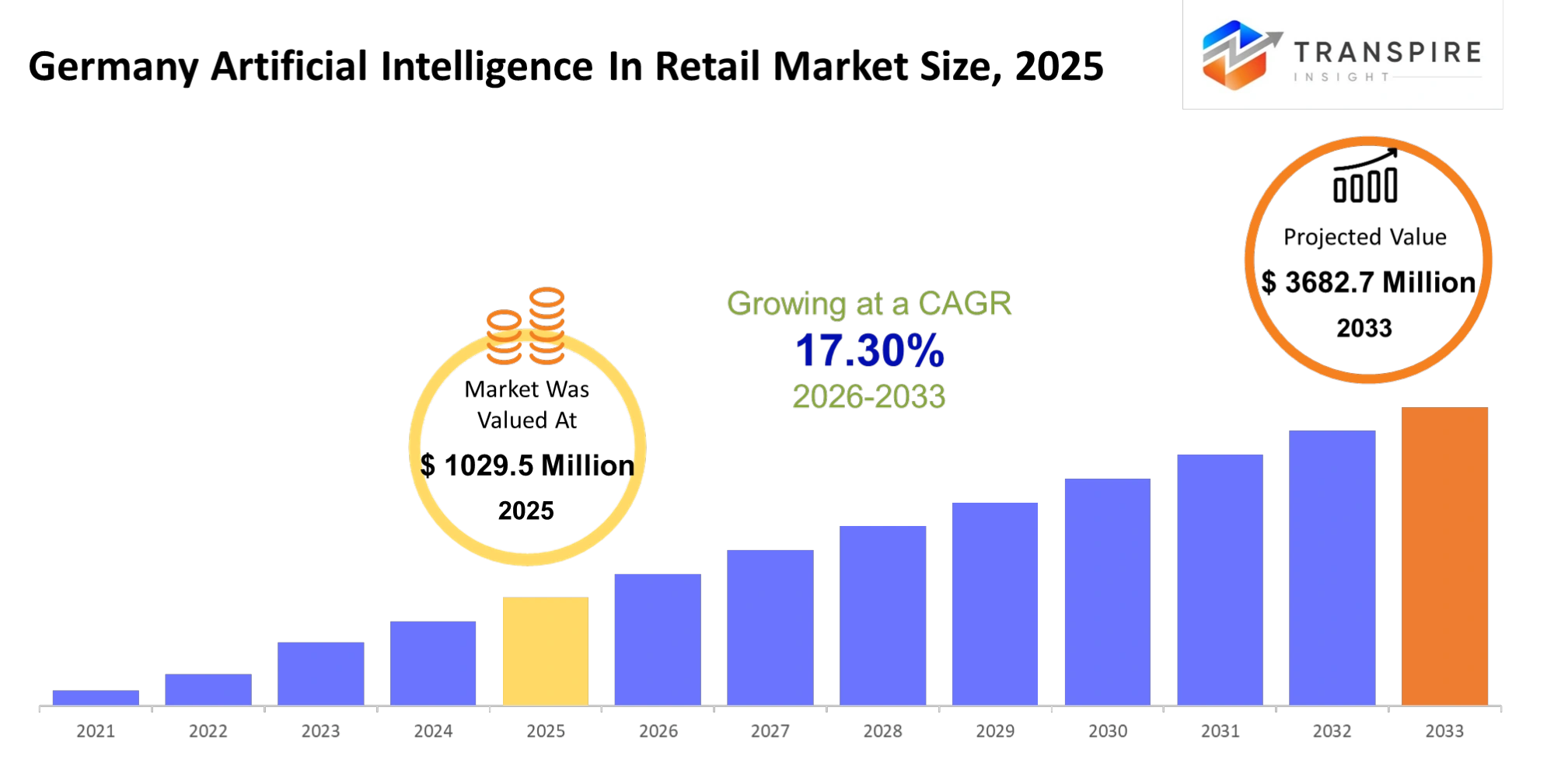
- Germany Artificial Intelligence In Retail Market Size 2025:USD 1029.5 Million
- Germany Artificial Intelligence In Retail Market Size 2033: USD 3682.7 Million
- Germany Artificial Intelligence In Retail Market CAGR: 17.30%
- Germany Artificial Intelligence In Retail Market Segments: By Component (Hardware, Software, Services), ByApplication (Customer Analytics, Inventory Management, Pricing Optimization, Recommendation Engines), By Deployment (Cloud, On-Premise).
To learn more about this report,  Download Free Sample Report
Germany Artificial Intelligence In Retail Market Summary:
Germany’s AI in the retail market is growing rapidly, expected to rise from about USD 1.03 billion in 2025 to USD 3.68 billion by 2033, driven by strong adoption of intelligent technologies. Retailers are using AI to predict customer behavior, optimize pricing, and improve overall shopping experiences while carefully balancing personalization with strict privacy regulations like GDPR. Technologies such as computer vision, predictive analytics, and automated checkout systems are transforming operations, while businesses increasingly integrate online and offline channels to meet customer demands for speed, accuracy, and transparency.
Key Market Trends & Insights:
- Germany Artificial Intelligence In Retail Market is expected to grow at a strong pace in the coming years. The value of the market is expected to grow significantly by 2033. This growth is expected to be driven by an increased focus on advanced technology in retail. Businesses are expected to depend more on data-driven systems to analyze customer shopping patterns and better systems for determining prices. At the same time, data protection rules are expected to play an important role in deciding how to handle customer data.
- Retail businesses in Germany are expected to increasingly depend on computer vision and predictive analytics to better manage day-to-day operations. These systems are expected to play an important role in better handling customer preferences, inventory management, and minimizing delays in operations. In addition to this, automated checkouts are also expected to receive more attention to minimize delays in operations and better manage retail operations.
- Another change that will be felt is a link between online and offline retail platforms. This will be done to create a shopping environment that allows people to easily move between different platforms. This will be done to meet the needs of the growing customer population, who are demanding faster and more efficient services. This will be done to meet this need.
- The role that people will play in retail will be affected by the intelligent systems that will be used. This will mean that people will be required to take on roles that are connected to intelligent systems rather than traditional roles. This will be done to make the market more efficient, meeting the requirements for growing this market.
Germany Artificial Intelligence In Retail Market Segmentation
By Component
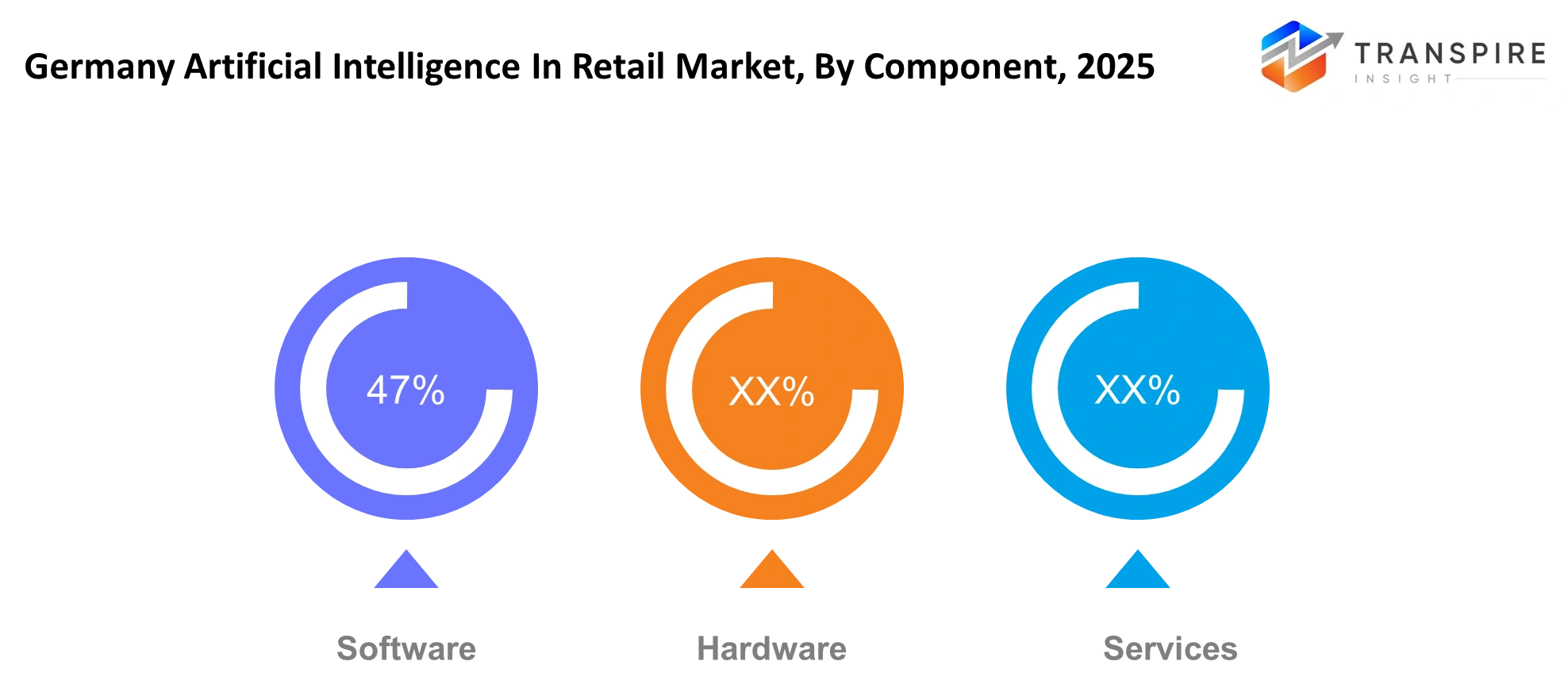
- Hardware: The hardware will be instrumental in collecting real-time data, as well as facilitating store automation. For instance, smart cameras, sensors, and edge computing devices will be instrumental in collecting customer data and ensuring optimal store planning.
- Software: The software will be instrumental in processing large amounts of data, as well as identifying patterns, forecasting trends, and interpreting customer behavior. For instance, AI-based software will be instrumental in helping retailers improve their strategies and ensure compliance with data privacy laws.
- Services: The services will be instrumental in integrating, maintaining, and updating intelligent systems, enabling retailers to comply with data privacy laws and run stores efficiently.
By Application
- Customer Analytics: Customer analytics would help retailers understand shopping behavior, preferences, and purchase patterns. AI tools would offer retailers valuable insights for better customer engagement, while also prioritising transparency and security.
- Inventory Management: AI-based predictive systems would help retailers maintain and manage their inventory levels. Retailers would ensure the timely availability of products, thus preventing situations where products are out of stock or vice versa.
- Pricing Optimization: Pricing optimization would enable retailers to set product prices according to demand and market conditions. AI-based pricing optimization would help retailers achieve better results while keeping in mind market conditions and demand.
- Recommendation Engines: Recommendation engines would enable retailers to offer their customers products based on their requirements and behavior. This would help retailers engage their customers better and increase sales.
By Deployment
- Cloud: The Germany artificial intelligence in the retail market will see more cloud-based solutions being adopted, as this will provide flexibility. The retailers will be able to access their data and tools through a virtual network, facilitating timely updates and collaboration. The issue of storage, security, and local regulations will be addressed.
- On-Premise: The Germany artificial intelligence in retail market will see on-premise solutions being adopted, as this will provide better control and security of data. The retailers will be able to store their sensitive information locally, while still enjoying intelligent processing.
To learn more about this report, Download Free Sample Report
Country Insights
Germany's artificial intelligence in retail market country insights would also take into account how regional differences and technology readiness would play a role in AI adoption and retail operations in Germany. Cities and regions would exhibit different levels of AI technology adoption depending on their infrastructure, consumer behavior, and technology compliance.
North Germany would see AI technology in retail operations in cities with well-established technology hubs and logistics. Retailers in this region would aim at incorporating AI technology, hardware and software into their operations for better efficiency and consumer experience.
South Germany would experience AI technology in retail operations in regions where industries and corporations are concentrated. Retailers in this region aim to incorporate AI technology into retail operations to improve efficiency and the consumer experience while complying with stringent data privacy regulations.
Recent Development News
Berlin AI startup raises funds to support retail operations: A Berlin-based AI startup that specializes in AI platforms for retail and other industries where frontline workers operate has raised 4 million euros to build and develop its AI-powered retail operations tools. The investment is crucial in helping retail operations and enhancing worker efficiency through AI technology.
Tech giant to expand its AI footprint in Germany: Google is opening a new AI development center in Berlin. The expansion is part of the growing interest among global tech companies in enhancing their AI capabilities in the German market. The centers act as hubs that promote innovation and can help the retail AI sector through enhanced tools and capabilities.
Germany to increase its AI infrastructure: The German government is planning to increase its domestic data centers’ capacity and its AI data processing capabilities by 4 and 4 times, respectively, by 2030. The expansion of its computing and storage capabilities is crucial in enhancing the use of AI tools within the retail sector.
|
Report Metrics |
Details |
|
Market size value in 2025 |
USD 1029.5 Million |
|
Market size value in 2026 |
USD 1205.6 Million |
|
Revenue forecast in 2033 |
USD 3682.7 Million |
|
Growth rate |
CAGR of 17.30% from 2026 to 2033 |
|
Base year |
2025 |
|
Historical data |
2021 – 2024 |
|
Forecast period |
2026 – 2033 |
|
Report coverage |
Revenue forecast, competitive landscape, growth factors, and trends |
|
Country scope |
Germany |
|
Key company profiled |
IBM Corporation, Microsoft Corporation, Google LLC, Amazon Web Services, SAP SE, Oracle Corporation, Salesforce Inc., NVIDIA Corporation, Intel Corporation, SAS Institute, C3.ai, H2O.ai, Zebra Technologies, Alibaba Cloud, Accenture PLC. |
|
Customization scope |
Free report customization (country, regional & segment scope). Avail customized purchase options to meet your exact research needs. |
|
Report Segmentation |
By Component (Hardware, Software, Services), By Application (Customer Analytics, Inventory Management, Pricing Optimization, Recommendation Engines), Deployment (Cloud, On-Premise). |
Key Germany Artificial Intelligence In Retail Market Company Insights Key insights:
The major companies operating in the German market for artificial intelligence in retail reveal that both technology and non-technology companies can play important roles in the implementation of AI tools and solutions in the German retail market. Large technology companies such as Google and SAP can help retailers across the German retail market to make use of AI tools and solutions to analyze customer behavior and make use of recommendation systems and other tools efficiently.
The focus of these companies will remain on implementing AI tools and solutions that comply with the stringent data privacy regulations of the German retail market. On the other hand, non-technology companies such as Bounti and other AI solution companies can help retailers across the German retail market to make use of AI tools and solutions to automate their daily operations and gain insights into customer behavior.
Germany Artificial Intelligence In Retail Market Companies
- IBM Corporation
- Microsoft Corporation
- Google LLC
- Amazon Web Services
- SAP SE
- Oracle Corporation
- Salesforce Inc
- NVIDIA Corporation
- Intel Corporation
- SAS Institute
- C3.ai
- H2O.ai
- Zebra Technologies
- Alibaba Cloud
- Accenture PLC.
Germany Artificial Intelligence In Retail Market Report Segmentation
By Component
- Hardware
- Software
- Services
By Application
- Customer Analytics
- Inventory Management
- Pricing Optimization
- Recommendation Engines
By Deployment
- Cloud
- On-Premise
Frequently Asked Questions
Find quick answers to common questions.
The Approximate size of the German Artificial Intelligence in Retail Market will be USD 3682.7 Million in 2033.
By Component (Hardware, Software, Services), By Application (Customer Analytics, Inventory Management, Pricing Optimization, Recommendation Engines), By Deployment (Cloud, On-Premise).
Major Germany Artificial Intelligence in Retail Market Players are IBM Corporation, Microsoft Corporation, Google LLC, Amazon Web Services, SAP SE, Oracle Corporation, Salesforce Inc., NVIDIA Corporation, Intel Corporation, SAS Institute, C3.ai, H2O.ai, Zebra Technologies, Alibaba Cloud, Accenture PLC.
The Current Germany Artificial Intelligence in Retail Market size is USD 1029.5 Million in 2025.
The Germany Health and Wellness Foods Market CAGR is 17.30%.
Recently Published Reports
-
Apr 2026
3D Optical Profiler Market
3D Optical Profiler Market Size, Share & Analysis Report By Type (Desktop 3D Optical Profiler, and Portable 3D Optical Profiler), By Technology (Confocal Technology, and White Light Interference), By End-Use Industry (Manufacturing, Research Institutions, Automotive, Aerospace and Defense, Medical Devices, and Other), and Geography (North America, Europe, Asia-Pacific, Middle East and Africa, South and Central America), 2021 - 2031
-
Apr 2026
Depth Sensor Market
Depth Sensor Market Size, Share & Analysis Report By Type (Infrared Depth Sensors, Time-of-Flight (ToF) Sensors, Stereo Vision Sensors, Structured Light Sensors, Ultrasonic Depth Sensors), By Application (Automotive, Robotics, Gaming, Consumer Electronics, Industrial Automation, Healthcare, Security & Surveillance, Others), By End Users (Automotive Manufacturers, Consumer Electronics Companies, Healthcare Providers, Industrial Companies, Security Agencies, Gaming Companies, Robotics Companies, Others), and Geography (North America, Europe, Asia-Pacific, Middle East and Africa, South and Central America), 2021 – 2031
-
Apr 2026
Digital Manufacturing Market
Digital Manufacturing Market Size, Share & Analysis Report By Component (Hardware, Software, and Services), By Technology (Robotics, 3D Printing, Internet of Things (IoT), and Others), By Application (Automotive and Transportation, Aerospace and Defense, Consumer Electronics, Industrial Machinery, and Others), By Process Type (Computer-Based Designing, Computer-Based Simulation, Computer 3D Visualization, Analytics, and Others), and Geography (North America, Europe, Asia-Pacific, Middle East and Africa, South and Central America), 2021 – 2031
-
Apr 2026
Digital Visa Services Market
Digital Visa Services Market Size, Share & Analysis Report By Type (Individual Travelers, Group Travelers), By Application (Tourism, Business Travel, Others), and Geography (North America, Europe, Asia-Pacific, Middle East and Africa, South and Central America), 2021 – 2031