

Asia Pacific ARM Microcontroller Market Size & Forecast:
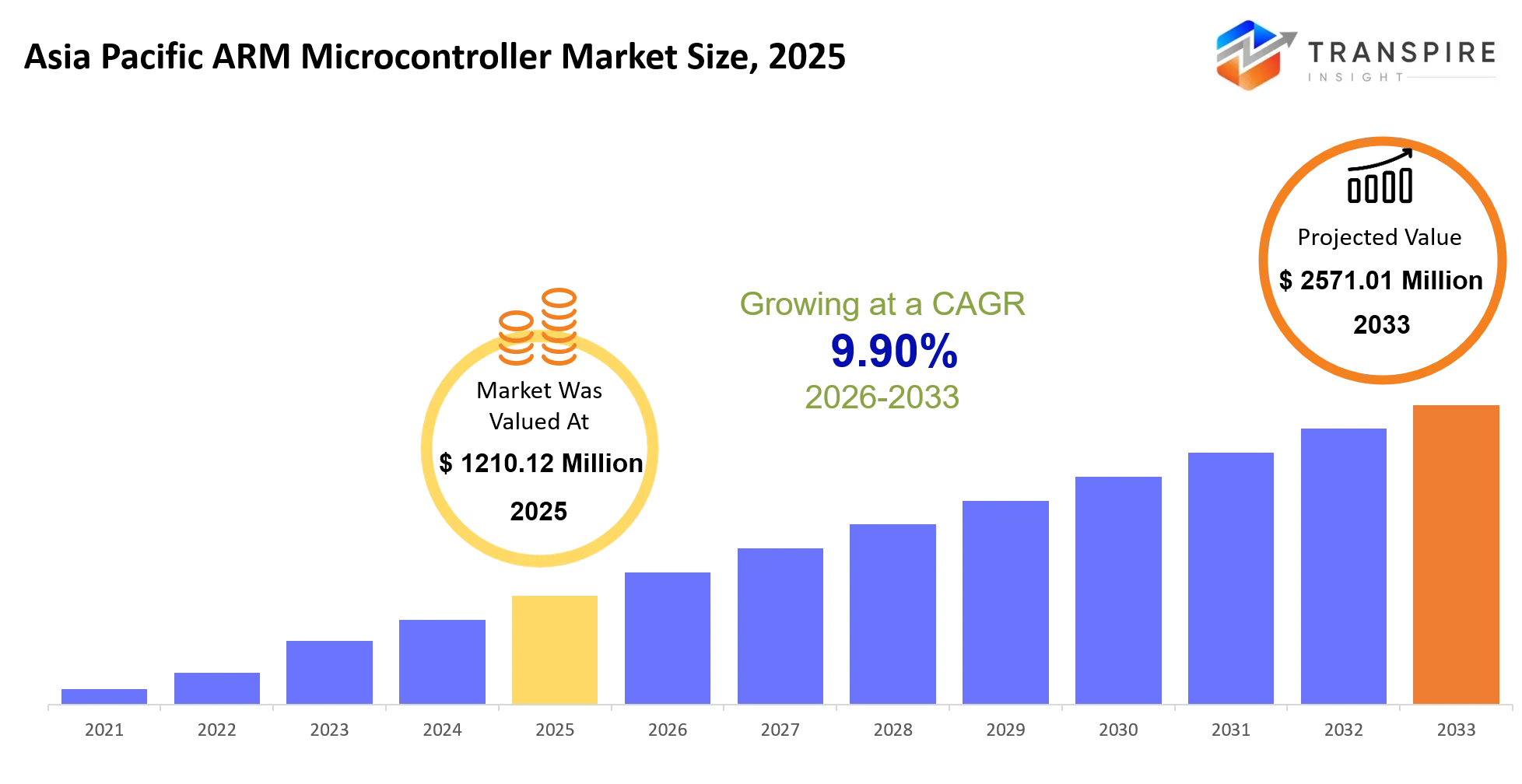
- Asia Pacific ARM Microcontroller Market Size 2025: USD 1210.12 Million
- Asia Pacific ARM Microcontroller Market Size 2033: USD 2571.01 Million
- Asia Pacific ARM Microcontroller Market CAGR: 9.90%
- Asia Pacific ARM Microcontroller Market Segments: By Product Type (32-bit ARM MCUs, 16-bit ARM MCUs, Low-power MCUs, High-performance MCUs, Others); By Application (Consumer Electronics, Automotive Electronics, Industrial Automation, IoT Devices, Healthcare Devices, Others); By End User (Electronics Industry, Automotive Industry, Industrial Sector, Others)
To learn more about this report,  Download Free Sample Report
Asia Pacific ARM Microcontroller Market Summary
The Asia Pacific ARM Microcontroller Market was valued at USD 1210.12 Million in 2025. It is forecast to reach USD 2571.01 Million by 2033. That is a CAGR of 9.90% over the period.
Across Asia Pacific, ARM microcontrollers end up inside all kinds of devices that quietly manage motion , sensing , and connectivity, in everything like factory robots, electric vehicles, smart meters, even maritime monitoring systems. They basically turn real world signals into accurate digital control so the equipment can run with lower energy use and more “thinking” at the edge. In the last 3–5 years the whole market has shifted in a more permanent way, moving away from older 8-bit and 16-bit setups toward 32-bit ARM Cortex-M platforms, mainly because people want edge-ready processing and built in connectivity at the same time.
One big trigger was the pandemic era semiconductor supply disruption, which forced manufacturers to redraw their products around what was actually available, plus those scalable ARM based ecosystems. And alongside that, electrification in transport plus fast industrial automation in China , Japan, and India made adoption pick up speed. So revenue opportunities have grown too, because OEMs are increasingly going with modular designs that shorten development cycles and keep it easier to deliver software defined functionality without too many rewrites.
Key Market Insights
- Asia Pacific is basically the major force in the Asia Pacific ARM Microcontroller Market with almost 48% share in 2025, and it’s mainly driven by China’s big scale electronics manufacturing ecosystem, you know.
- India pops up as the fastest-growing region during 2025–2030 because of automotive electronics focus and smart infrastructure investments that keep expanding, bit by bit.
- The 32-bit ARM Cortex-M microcontrollers are taking the lead, with a share of more than 60% in the Asia Pacific ARM Microcontroller Market. This is largely due to performance efficiency and overall workable design choices.
- Meanwhile the 16-bit legacy MCUs stay as the second-largest segment , mostly seen in cost-sensitive industrial control setups where budgets still matter.
- In terms of application, industrial automation owns about 34% of the share. That’s pushed forward by robotics, factory digitization, and predictive maintenance systems that are becoming more common.
- For the fastest-growing application slice, automotive electronics is accelerating the most, backed by EV architecture and ADAS integration across the Asia Pacific region.
- Consumer electronics keeps a steady expansion too, especially with the spread of smart home systems and wearable devices.
- For end-users, manufacturing remains on top and holds nearly 38% share in the Asia Pacific ARM Microcontroller Market.
- Automotive OEMs are the fastest-growing end-user group, largely because of quick EV adoption and software-defined vehicle platforms that keep rolling out.
- Healthcare devices are also rising strongly, fueled by portable diagnostics and the growing demand for connected medical equipment, in a noticeable way.
What are the Key Drivers, Restraints, and Opportunities in the Asia Pacific ARM Microcontroller Market?
Honestly the Asia Pacific ARM Microcontroller Market is being pushed mostly by the fast move toward electrified, and honestly more software-defined, systems in cars, factories, and everyday devices. A lot of this change started because 32-bit ARM Cortex-M designs brought lower cost but also stronger performance, so makers could bundle connectivity plus real-time control, and edge computing, into one chip. That’s why OEMs in China, Japan, and South Korea keep revisiting their product plans around ARM based MCUs, and it speeds up the adoption rhythm. It also keeps adding recurring demand where volumes are huge, and that’s the part everyone watches.
Still there’s a structural restraint that keeps showing up. The market remains tied to semiconductor supply chains that are kinda complicated, and they’re mostly centered in just a few fabrication hubs. This became painfully obvious during the global chip shortages, when lead times stretched out, and OEMs either delayed launches, or reworked the hardware to match whatever components were actually available. Since MCU production depends on advanced lithography and specific foundry capabilities, those capacity issues don’t get fixed quickly. So you get these repeating shortages, which end up hurting revenue capture even if the demand underneath looks strong.
On the opportunity side, a forward-looking edge AI expansion is starting to matter a lot for industrial automation and smart mobility. Places like India are putting money into smart manufacturing corridors and EV ecosystems, so the need shifts toward intelligent embedded control systems. In early trials, AI capable ARM MCUs are showing up in predictive maintenance and also in autonomous subsystems, which looks like a move toward more higher value compute-rich microcontroller architectures.
What Has the Impact of Artificial Intelligence Been on the Asia Pacific ARM Microcontroller Market?
Artificial intelligence is starting to reshape the Asia Pacific ARM microcontroller ecosystem, kinda turning the embedded controllers inside scrubber performance systems and industrial gear into real time decision engines. With ARM based MCUs, devices can take sensor signals from exhaust gas cleaning setups, then automatically tune flow rates, dosing levels, and pressure control behaviors, so there’s less need for hands-on adjustments during marine emission control work. On the fleet side, AI at the edge gathers voyage details and spits out automated summaries that match regulatory expectations, like IMO emissions standards, and related compliance rules.
More and more, machine learning models are getting used for predictive maintenance, they spot early hints of pump wear, fouling, or sensor drift in marine scrubbers before failures really show up. These approaches also help with emissions forecasting and fuel optimization, mainly by tying engine load patterns to prior performance records. In practice this can raise operational efficiency and reduce unexpected shutdowns by something like 10–15% in optimized deployments.
Still, uptake is held back, by spotty real time connectivity offshore, and by inconsistent sensor data quality. That combination makes model accuracy wobble in fast changing maritime conditions. And then there are the high integration costs, for AI capable microcontroller architectures, which in turn slows big rollouts across mid tier fleets.
Key Market Trends
- China’s dominance in the Asia Pacific ARM Microcontroller Market is kinda dispersing now, because Vietnam and India have been ramping up electronics manufacturing capacity since 2022.
- On the 8-bit and 16-bit side, MCU usage dropped pretty sharply after 2020 , and OEMs moved over to ARM Cortex-M platforms for better integration efficiency, sort of more streamlined than before.
- Since 2021, EV architecture changes really sped up ARM-based adoption in the automotive domain too. It’s basically replacing discrete control units with software-driven microcontroller networks and yeah that matters.
- On the industrial automation front, demand shifted toward predictive maintenance approaches, and ARM MCUs help run real-time sensor fusion across factory environments, instead of only doing basic monitoring.
- Also, between 2020 and 2022, semiconductor shortages hit hard. So manufacturers redesigned products around whatever ARM ecosystems were still obtainable, which in turn improved longer-term supply resilience , not just short-term fixes.
- Edge AI is another thing. After 2023, it got more embedded into microcontrollers, letting more localized decision-making happen in smart meters, robotics, and industrial control systems.
- Companies like Renesas Electronics and STMicroelectronics started expanding ARM-focused portfolios, to secure automotive as well as industrial design wins.
- India’s semiconductor push since 2023 further boosted local MCU demand, backed by government supported manufacturing incentives and EV ecosystem building.
- Meanwhile, consumer IoT devices have been trending toward ARM Cortex-based MCUs more and more, which supports better battery efficiency in wearables and smart home setups since 2021.
Asia Pacific ARM Microcontroller Market Segmentation
By Product Type :
The 32-bit ARM MCUs segment keeps a big role in the Asia Pacific ARM Microcontroller Market, mostly because they bring strong processing power, solid memory support and the ability to juggle more complicated applications. You can see these microcontrollers showing up in smart consumer products, industrial setups, automotive electronics, and a lot of connected technologies too. As intelligent products are being asked for more and more , with better overall performance, the shift toward 32-bit solutions keeps rising across the region.
Meanwhile, the 16-bit ARM MCUs segment is still relevant, especially where there is a need for a kind of balanced performance along with cost efficiency. Low-power MCUs are getting extra attention, driven by the growing wish for energy-saving devices, in particular portable electronics and battery-operated equipment. At the same time, high-performance MCUs are increasingly used in advanced industrial automation and automotive uses, where quick computation matters. The other segment is basically a mix of specialized microcontrollers made for narrower use cases, plus tailored electronic systems, designed around specific needs.
By Application :
Consumer electronics, kind of, are a major piece of the Asia Pacific ARM Microcontroller Market puzzle. ARM based microcontrollers get used a lot in smartphones, wearable gadgets, home appliances, gaming devices, and smart entertainment products. Because companies keep pushing product innovation, and because consumers want more connected, more feature rich devices, this part keeps growing across the region, mostly.
Automotive electronics are also a big deal here. Modern vehicles, really, lean more and more on electronic control systems, infotainment units, battery management systems, and safety tech. Industrial automation keeps stretching too, with ARM microcontrollers being plugged into machinery control and monitoring setups. Then IoT devices open up more chances, since connected sensors and smart devices are showing up everywhere. In healthcare, these microcontrollers go into monitoring equipment and diagnostic systems, and the rest category, the other segment, basically covers use cases across communication, security, and specialized electronic products.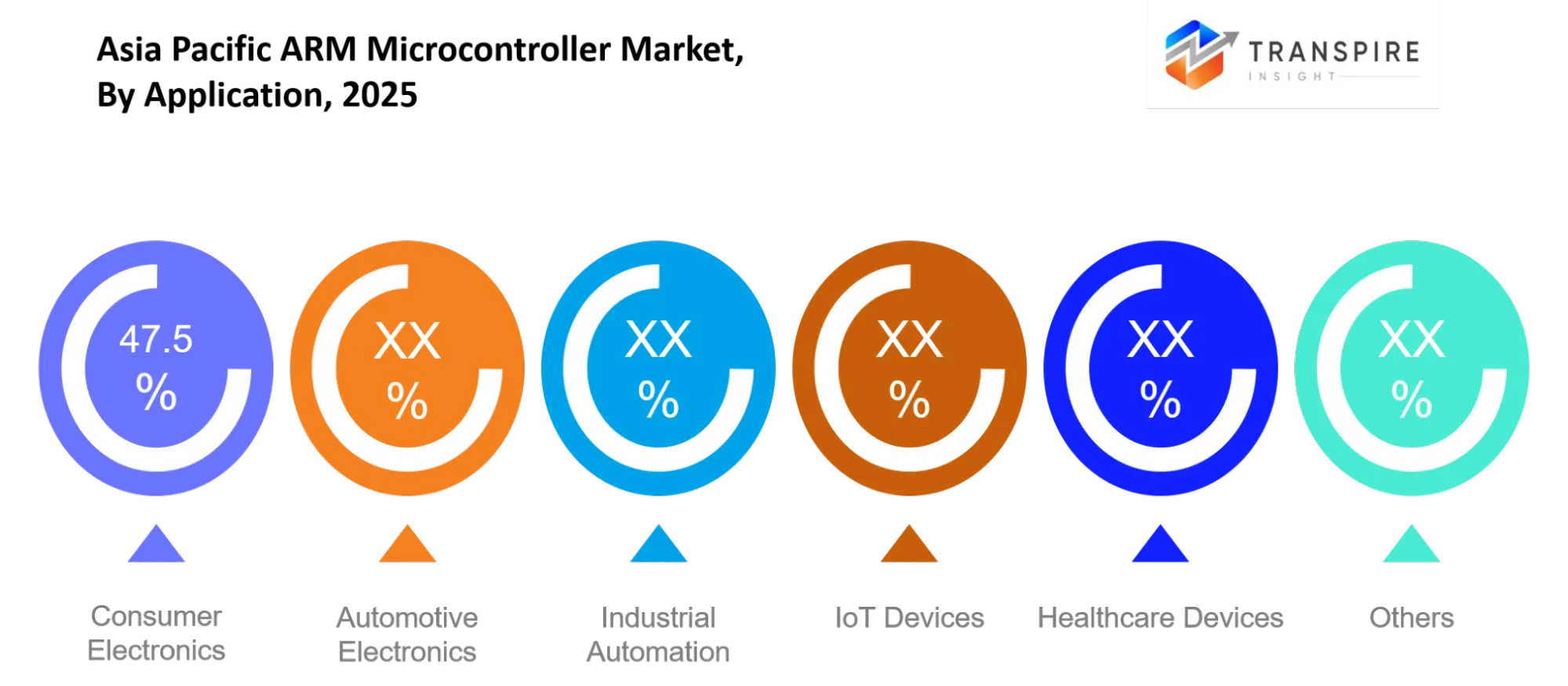
To learn more about this report, Download Free Sample Report
By End User :
In the Asia Pacific ARM Microcontroller Market , the electronics industry is basically the top end user segment because electronic devices are made and consumed at a high rate across a lot of the countries there. ARM microcontrollers back up many types of electronic products, they do this with efficient processing, reduced power use and pretty flexible integration style. Also, more funding into advanced electronics manufacturing is still pushing the demand from this group , so it keeps getting stronger.
At the same time, the automotive industry keeps pulling in ARM microcontrollers, since newer vehicles include more digital features and smarter control systems, basically. Meanwhile, the industrial sector leverages these microcontrollers for automation and process management, plus robotics and ongoing equipment surveillance, all aimed at raising operational efficiency. The remaining segment covers healthcare, telecommunications, energy administration, and several other emerging industries, where dependable and scalable microcontroller offerings are becoming more and more necessary, to enable modern electronic tasks.
What are the Key Use Cases Driving the Asia Pacific ARM Microcontroller Market?
Consumer electronics still seems like the main thing pulling demand in the Asia Pacific ARM microcontroller market. You can see it in the steady build up of smartphones, wearable devices, smart home gear , and connected appliances across the main manufacturing hubs like China, South Korea, Japan and Taiwan. It keeps the volume up in a very straightforward way. ARM microcontrollers are chosen a lot, largely because they deliver efficient processing, low power draw , and dependable output for small scale electronic products, even when space and energy budgets are kind of tight.
But it is not just home gadgets though. Demand is also pushing forward in automotive electronics and industrial automation. Vehicle makers are gradually putting in more advanced driver assistance features, digital instrument clusters , battery control units and infotainment systems, all of which lean on ARM based controllers. Meanwhile inside factories, operators are rolling out automation equipment and smart surveillance setups, to boost throughput and lower running costs, which sounds like the usual goal but it really matters day to day.
Then there are the newer, upcoming use cases too. Think edge AI devices and next generation healthcare monitoring equipment. Smart sensors that can do local processing are opening up fresh angles in connected infrastructure, and in industrial surroundings where latency is critical. Portable diagnostic tools, plus remote patient monitoring platforms, are also likely to grow. Healthcare providers are still trying to move toward faster and more streamlined digital care, so demand should follow that trend, pretty consistently.
|
Report Metrics |
Details |
|
Market size value in 2025 |
USD 1210.12 Million |
|
Market size value in 2026 |
USD 1327.51 Million |
|
Revenue forecast in 2033 |
USD 2571.01 Million |
|
Growth rate |
CAGR of 9.90% from 2026 to 2033 |
|
Base year |
2025 |
|
Historical data |
2021 - 2024 |
|
Forecast period |
2026 - 2033 |
|
Report coverage |
Revenue forecast, competitive landscape, growth factors, and trends |
|
Regional scope |
Asia Pacific (India, China, Japan, Australia,South Korea, Rest of Asia Pacific) |
|
Key company profiled |
ARM Holdings, STMicroelectronics, NXP Semiconductors, Renesas Electronics, Microchip Technology, Texas Instruments, Infineon Technologies, Qualcomm, Samsung Electronics, Toshiba, Cypress Semiconductor, MediaTek, Analog Devices, Silicon Labs, Espressif Systems |
|
Customization scope |
Free report customization (country, regional & segment scope). Avail customized purchase options to meet your exact research needs. |
|
Report Segmentation |
By Product Type (32-bit ARM MCUs, 16-bit ARM MCUs, Low-power MCUs, High-performance MCUs, Others); By Application (Consumer Electronics, Automotive Electronics, Industrial Automation, IoT Devices, Healthcare Devices, Others); By End User (Electronics Industry, Automotive Industry, Industrial Sector, Others) |
Which Regions are Driving the Asia Pacific ARM Microcontroller Market Growth?
East Asia is leading the Asia Pacific ARM Microcontroller Market, mostly because it has a strong semiconductor manufacturing base and a pretty deep electronics supply chain, you know the kind that actually keeps things moving. In China , Japan , South Korea , and Taiwan you’ll find large production sites tied to consumer electronics, automotive parts, and industrial equipment. These areas end up relying a lot on ARM based solutions, kind of like an invisible backbone. On top of that, government backing for advanced manufacturing, semiconductors, and digital technologies adds more fuel to market demand. There’s also this mature ecosystem chip designers, component vendors, contract manufacturers and research organizations staying connected, and that keeps the region in a dominant spot.
Southeast Asia, though, is more of a dependable contributor to market revenue. The growth patterns there are supported by different drivers than what you see in East Asia. For example Malaysia, Thailand, Vietnam, and Singapore usually benefit from stable foreign investment, plus electronics assembly operations that keep expanding. Steady industrial progress, and a slow but real adoption of automation technologies, creates solid demand for microcontrollers across many industries. Also, long term commitments from major global electronics manufacturers help keep things steady and allow continual technology upgrades.
South Asia is expected to be the fastest grower over the forecast window, mainly because rapid digitalization is happening, along with broader expansion of domestic electronics manufacturing. India, in particular, has rolled out production incentives and manufacturing programs that encourage local development of electronic devices and embedded systems. With smart infrastructure rolling out, connected devices increasing, and automotive electronics showing up in more places, ARM microcontroller suppliers get more openings. As these trends continue, the region should become even more attractive for companies entering the market and investors hunting for expansion opportunities, rather than just observing from afar.
Who are the Key Players in the Asia Pacific ARM Microcontroller Market and How Do They Compete?
In the Asia Pacific ARM Microcontroller Market, the competitive setup looks kinda moderately consolidated, like a mix of global semiconductor players and regional suppliers in the same space. You can see competition being pushed mostly by technology innovation, power efficiency, processing capability, and also long term supply reliability, not just price, which is almost never the only factor. The older, well established companies still try to hold market share via wide product catalogs and solid relationships with customers. Meanwhile the newer entrants tend to aim at more specialized scenarios, like IoT devices and smart industrial systems, where they can stand out faster. Being able to cover several end-use industries with scalable platform options stays the real differentiator.
Renesas Electronics seems to lean into application specific progress for automotive and industrial customers. Their strength is in the way microcontrollers, analog components, and connectivity solutions get integrated, so customers can build full system designs without too much rework. They keep growing by adding ecosystem partnerships and offering software development assistance, which makes deployment feel a lot smoother.
NXP Semiconductors, on the other hand, sets itself apart through security enhancements that are more advanced and through embedded processing capability. It’s also well positioned in automotive electronics and in connected device use cases, so expansion across Asia Pacific markets stays pretty steady and natural.
STMicroelectronics sort of leans into low-power , high performance microcontroller platforms, mainly for industrial automation and consumer electronics. They offer a lot of developer tools, plus software resources too which helps customers lower design complexity, even if it can feel a bit tangled at first. Microchip Technology plays a different card with wide product availability and long product life cycles, and that tends to be something industrial teams really value, especially when schedules get tight. Infineon Technologies, meanwhile, improves its market footprint via energy-efficient architectures and bigger investments in automotive electrification , opening doors for electric vehicles and more advanced mobility systems .
Company List
- ARM Holdings
- STMicroelectronics
- NXP Semiconductors
- Renesas Electronics
- Microchip Technology
- Texas Instruments
- Infineon Technologies
- Qualcomm
- Samsung Electronics
- Toshiba
- Cypress Semiconductor
- MediaTek
- Analog Devices
- Silicon Labs
- Espressif Systems
Recent Development News
In January 2026, Microchip Technology launched the PIC32CM PL10 microcontroller family, expanding its Arm Cortex-M0+ MCU portfolio. The launch strengthened options for low-power embedded and industrial designs, supporting continued adoption of Arm-based microcontrollers across Asia-Pacific manufacturing and IoT applications. Source https://www.microchip.com/
In January 2026, NXP Semiconductors introduced the MCX E31 Arm Cortex-M7-based microcontroller. The new MCU targeted demanding industrial, energy, and appliance applications, reinforcing the trend toward higher-performance Arm-based microcontrollers in Asia-Pacific embedded systems markets. Source https://www.nxp.com/
What Strategic Insights Define the Future of the Asia Pacific ARM Microcontroller Market?
The Asia Pacific ARM Microcontroller Market is drifting toward a future where smart processing is more and more stuck on the device itself, instead of leaning too much on one centralized place. There is growth in edge computing, industrial digitalization, software defined vehicles, and connected infrastructure, and all that will pull demand for microcontrollers that can juggle heavier workloads but still keep energy efficiency in check. As this happens, companies will push for tighter inclusion of artificial intelligence functions , plus connectivity bits , and also security capabilities inside smaller microcontroller designs.
There’s also a quieter risk that doesn’t get much attention, meaning market concentration across semiconductor manufacturing and advanced fabrication capacity. If everyone depends on only a few production locations and suppliers, it can bring supply interruptions, pricing stress and procurement headaches when geopolitical uncertainty shows up, or when capacity is running low.
At the same time there is an emerging opportunity, especially around AI enabled edge devices across South and Southeast Asia. Smart manufacturing and infrastructure modernization programs are accelerating there. So market players should put money into software ecosystems, development tools, and industry tailored solutions, rather than trying to win mostly on raw hardware performance. In the long run, value creation will hinge more on platform integration and application support than on specs alone.
Asia Pacific ARM Microcontroller Market Report Segmentation
By Product Type
- 32-bit ARM MCUs
- 16-bit ARM MCUs
- Low-power MCUs
- High-performance MCUs
By Application
- Consumer Electronics
- Automotive Electronics
- Industrial Automation
- IoT Devices
- Healthcare Devices
By End User
- Electronics Industry
- Automotive Industry
- Industrial Sector
Frequently Asked Questions
Find quick answers to common questions.
The Asia Pacific ARM Microcontroller Market size is USD 2571.01 Million in 2033.
Key Segments for the Asia Pacific ARM Microcontroller Market are By Product Type (32-bit ARM MCUs, 16-bit ARM MCUs, Low-power MCUs, High-performance MCUs, Others); By Application (Consumer Electronics, Automotive Electronics, Industrial Automation, IoT Devices, Healthcare Devices, Others); By End User (Electronics Industry, Automotive Industry, Industrial Sector, Others).
Major Asia Pacific ARM Microcontroller Market Players are ARM Holdings, STMicroelectronics, NXP Semiconductors, Renesas Electronics, Microchip Technology, Texas Instruments, Infineon Technologies, Qualcomm, Samsung Electronics, Toshiba, Cypress Semiconductor, MediaTek, Analog Devices, Silicon Labs, Espressif Systems.
The Current Asia Pacific ARM Microcontroller Market size is USD 1210.12 Million in 2025.
The Asia Pacific ARM Microcontroller Market CAGR is 9.90% from 2026 to 2033.
- ARM Holdings
- STMicroelectronics
- NXP Semiconductors
- Renesas Electronics
- Microchip Technology
- Texas Instruments
- Infineon Technologies
- Qualcomm
- Samsung Electronics
- Toshiba
- Cypress Semiconductor
- MediaTek
- Analog Devices
- Silicon Labs
- Espressif Systems
About the Authors

Avinash Kumar
I’m Avinash Kumar, a Senior Research Analyst at Transpire Insight, with expertise in the Electronics and Semiconductor and Energy & Power industry. My work focuses on analyzing emerging technologies, market trends, industry developments, and innovation across these sectors. I specialize in transforming complex technical and market insights into clear, research-backed content that helps professionals, businesses, and decision-makers stay informed. Through continuous industry research and data-driven analysis, I strive to deliver accurate, reliable, and practical perspectives on the latest advancements shaping the semiconductor and energy landscape.

Chakradhar Khansole
Chakradhar serves as the Research Director at Transpire Insight, bringing over 8 years of experience in technology, innovation, and strategic market intelligence. He specializes in transforming complex market data into actionable business insights that enable organizations to make informed, growth-oriented decisions. Recognized for his strategic vision and analytical expertise, Chakradhar leads high-impact research initiatives, delivering comprehensive market assessments, competitive intelligence, and forward-looking industry analysis.
Recently Published Reports
-
Apr 2026
Fiber Optic Faceplates Market
Fiber Optic Faceplates Market Size, Share & Analysis Report By Type (< 300 mm2, 300-350 mm2, and > 350 mm2, By Application (Night Vision, Holographic Imaging, Medical, and Others), and Geography (North America, Europe, Asia-Pacific, Middle East and Africa, South and Central America), 2021 - 2031
-
Apr 2026
High Temperature Superconductors Market
High Temperature Superconductors Market Size, Share & Analysis Report By Type (1G HTS, and 2G HTS), By Application (Power Cable, Fault Current Limiter, and Transformer), and Geography (North America, Europe, Asia-Pacific, Middle East and Africa, South and Central America), 2021 - 2031
-
Apr 2026
Industrial Plugs and Socket Market
Industrial Plugs and Socket Market Size, Share & Analysis Report By Type (Industrial Plugs, Industrial Sockets), By Current (Up to 32 A, 32 to 125 A, Above 125 A), By Protection (Dustproof and Splash Proof, Waterproof, Explosion Proof), By End User (Heavy Industries, Oil and Gas, Chemicals and Pharmaceuticals, Power Generation, Others), and Geography (North America, Europe, Asia-Pacific, Middle East and Africa, South and Central America), 2021 - 2031
-
Apr 2026
InGaAs Avalanche Photodiodes Market
InGaAs Avalanche Photodiodes Market Size, Share & Analysis Report By Type (1100 - 1700 nm, and 1000 - 1600 nm), By Application (Missile Warning System, Muzzle Flash Detection, Wafer Defect Inspection, Laser Rangefinders, and Others), and Geography (North America, Europe, Asia-Pacific, Middle East and Africa, South and Central America), 2021 - 2031