

Asia Pacific Accelerated Processing Unit Market Size & Forecast:
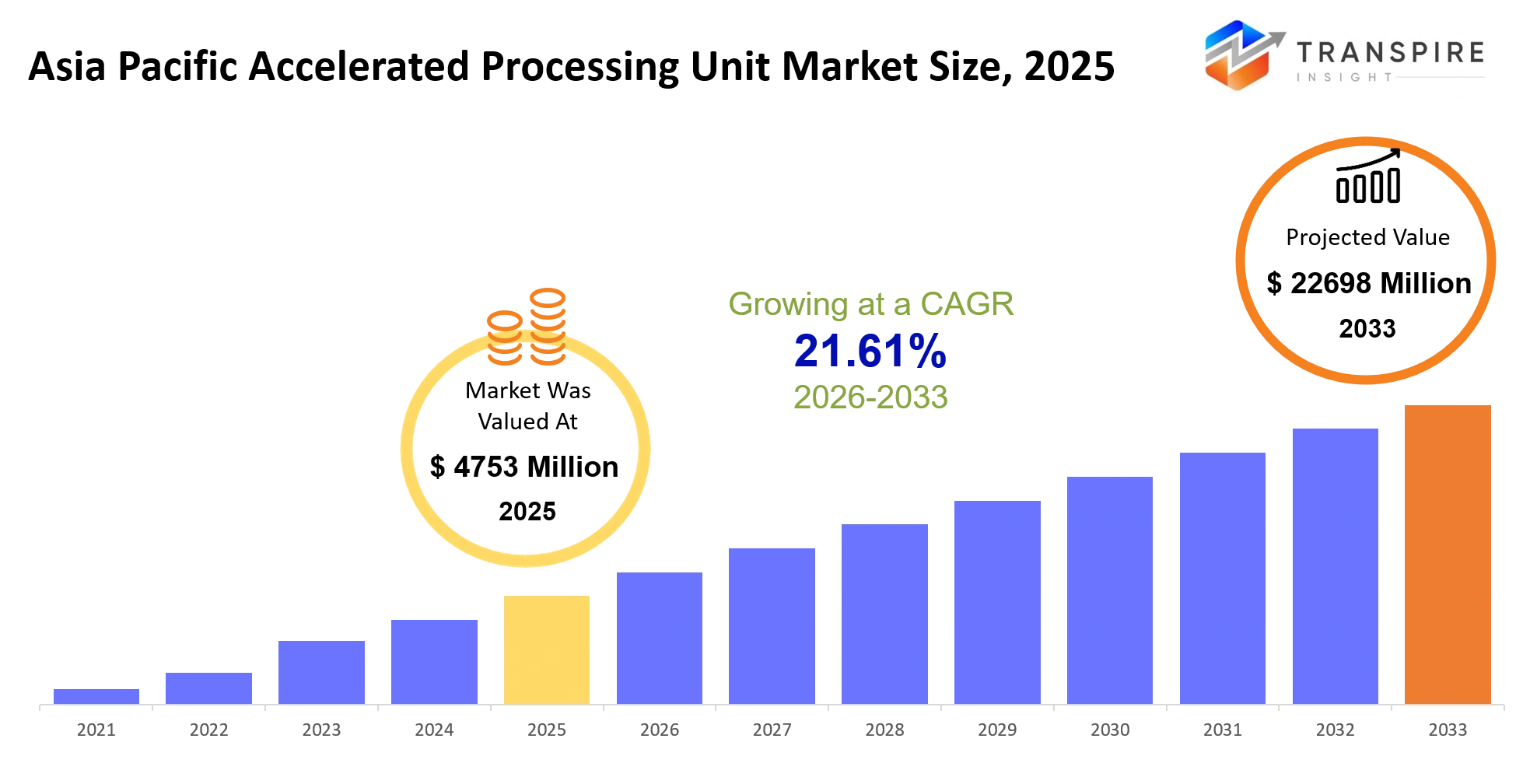
- Asia Pacific Accelerated Processing Unit Market Size 2025: USD 4753 Million
- Asia Pacific Accelerated Processing Unit Market Size 2033: USD 22698 Million
- Asia Pacific Accelerated Processing Unit Market CAGR: 21.61%
- Asia Pacific Accelerated Processing Unit Market Segments: By Product Type (Integrated APUs, Mobile APUs, Desktop APUs, Embedded APUs, Others); By Application (Gaming Systems, Consumer Electronics, Data Centers, Industrial Systems, Others); By End User (Consumers, Enterprises, OEMs, Others).
To learn more about this report,  Download Free Sample Report
Asia Pacific Accelerated Processing Unit Market Summary
The Asia Pacific Accelerated Processing Unit Market was valued at USD 4753 Million in 2025. It is forecast to reach USD 22698 Million by 2033. That is a CAGR of 21.61% over the period.
The Asia Pacific Accelerated Processing Unit (APU) market has kind of a central role in modern computing, because it combines CPU and GPU strengths into one chip so devices can run graphics, artificial intelligence tasks, gaming apps, and enterprise computing stuff more efficiently. At the same time it helps with lower power draw , and it keeps the hardware simpler than before. APUs are now showing up more and more across laptops , desktops, edge computing systems, industrial automation platforms, and all sorts of AI-enabled gadgets where you want performance with energy efficiency to sit together without too much conflict.
In the last five years, the whole market has shifted in a more structural direction toward AI-integrated computing. Manufacturers are putting dedicated neural processing units into the picture along with the more classic CPU and GPU designs, not as a nice side note but as a real baseline. Then generative AI apps showed up fast, and AI PCs basically acted like a spark, so investment in newer processor platforms across Asia Pacific started moving quicker than before. As both enterprises and everyday consumers adopt AI-enabled software, hardware vendors are also upgrading their computing architecture so local AI inference can happen, while graphics-heavy workloads still run smoothly. All of that is stretching device replacement cycles, bumping up semiconductor content per system, and basically opening up fresh revenue streams for processor makers throughout the region.
Key Market Insights
- Asia Pacific Accelerated Processing Unit Market growth is getting more and more tangled with AI PC shipments, and those shipments actually went past 100 million units globally in 2025.
- In East Asia, the market is still leading , roughly a 46% share in 2025, mostly because of semiconductor manufacturing leadership and all that practical knowhow.
- Meanwhile South Asia is showing the quickest expansion all the way through 2033, pushed by digital transformation efforts plus extra investments in electronics fabrication, factories, and related stuff.
- When it comes to products , consumer laptops are still the main item, bringing in about 38% of market revenue in 2025.
- Desktops are next, with desktop APUs holding the second-highest share as gaming and content creation workloads keep moving toward integrated AI acceleration.
- And embedded and edge AI APUs are expected to grow the quickest between 2026 and 2033, like, pretty consistently.
- For applications, AI-enabled personal computing is taking the lead with nearly 41% market share in 2025. Industrial automation, along with smart manufacturing, is the application category that’s expanding fastest across Asia Pacific.
- Enterprise and commercial buyers also matter a lot, they make up more than 34% of overall demand as companies roll out AI-ready computing infrastructure.
- Big names—AMD, Intel, NVIDIA, Qualcomm, Samsung Electronics, and MediaTek—are all chasing product novelty, tighter AI integration, and regional scaling plans.
- Across the board, manufacturers are increasingly competing via on-chip AI acceleration, improvements in power efficiency, and more advanced semiconductor packaging technologies, too.
- Finally, strategic collaborations between processor vendors and OEMs are speeding up real deployment of AI-capable notebooks, workstations and edge devices.
What are the Key Drivers, Restraints, and Opportunities in the Asia Pacific Accelerated Processing Unit Market?
Honestly the main push for market expansion seems to be this move away from the usual computing toward AI-enabled computing platforms. When AI PCs started showing up, plus more local AI inference applications and generative AI software, the processor expectations really shifted across both consumer setups and enterprise ones. As a result manufacturers are not just using standard components, they’re bundling neural processing units together with heavier graphics acceleration inside APUs. That setup supports real-time AI workloads, and in practice it has lifted average processor value. It also makes people upgrade devices sooner, so it feeds straight into higher market revenues.
But there is also a big brake on the whole thing, it’s the structural complexity of advanced semiconductor manufacturing. For leading-edge APUs, you need sophisticated process nodes, advanced packaging methods, and frankly a huge amount of capital investment. Only a limited set of foundries can produce these chips at scale and that naturally creates supply concentration risk. And you can’t fix this in a short time because fabrication plants take years for investment and development, like it’s not an overnight change. So even when product demand is there, supply constraints and production bottlenecks can slow launches and in turn reduce the market revenue that could have been captured.
Still, there’s a clear opportunity and it’s edge AI computing. A lot of industrial plants, autonomous systems, healthcare equipment and smart city infrastructure are increasingly looking for local AI processing, not something that depends on constant cloud connectivity. AI-enabled embedded APUs that are built for edge deployment can fit that gap. Meanwhile countries like India, Vietnam and Indonesia are growing their electronics manufacturing ecosystems along with digital infrastructure, which makes adoption easier and faster. Firms that build low-power AI processors tuned for edge scenarios will probably grab the next growth wave, or at least that’s how it looks from the current direction.
What Has the Impact of Artificial Intelligence Been on the Asia Pacific Accelerated Processing Unit Market?
Artificial intelligence has, in a very practical way, changed the whole role of APUs across home consumer gear, enterprise setups and industrial type computing. Nowadays APUs more often mash together CPU , GPU, and neural processing abilities right on the same chip. This means the device can run AI workloads on its own, local and more or less immediately, so theres less need to lean on cloud resources all the time. With that kind of setup, you start seeing real-time language processing, image creation, intelligent assistants, and predictive analytics kind of things working more smoothly.
And then there’s AI-driven automation, which is steadily boosting operational efficiency in manufacturing sites, data centers and edge computing zones. In many cases machine learning is used to tune how work is split between CPU and GPU resources, and that ends up helping with power efficiency too while also cutting down latency. Predictive maintenance is another big example, because AI models can watch processor health, keep track of thermal behavior and notice workload patterns. That reduces system downtime and makes reliability feel less like a guessing game.
At the same time, advanced APUs help with performance tuning, sort of by allocating resources on the fly based on what the application actually needs. Organizations usually see lower operational costs, better productivity, and quicker processing for AI-heavy tasks. In fact, AI-enabled processors are showing up in industrial automation systems, autonomous machines, and smart infrastructure efforts more and more often.
Still, AI adoption isn’t all smooth sailing. To bring in AI-capable hardware, organizations often need a fair amount of money, plus time for software ecosystems, developer tooling, and careful application tuning. On top of that, training data quality and compatibility with the existing computing infrastructure can become stumbling blocks. So even when the long term benefits are strong, the rollout can get slowed down by these real-world constraints.
Key Market Trends
- Since 2023, AI PC platforms kinda shifted the way buyers think, from pure graphics horsepower toward built in AI processing stuff, and it’s not just one change, more like a steady drift.
- In 2026 AMD broadened its Ryzen AI processor range, aiming for as much as 60 TOPS of AI compute for AI PCs.
- At the same time Qualcomm broadened Snapdragon X rollouts, and by 2026 more than 100 device designs are expected to appear, which is pretty telling.
- From 2024 to 2026, edge AI computing adoption picked up speed across industrial automation and autonomous systems, where decisions have to be quick, and the latency matters.
- OEMs also seem to favor integrated AI processors more often, mostly because they cut power use and make the hardware design less of a headache.
- Meanwhile, AI enabled enterprise laptops gained real traction as organizations rolled forward digital workplace modernization initiatives.
- Processor vendors keep pushing competition through NPU performance numbers, typically TOPS, instead of relying on the old style CPU benchmarks.
- Intel also leaned harder into integrated graphics and AI acceleration, with new Core Ultra plus Arc enabled platforms in 2026.
- Between 2023 and 2026, regional governments expanded semiconductor production incentives, which helped reinforce local supply chains.
- Finally, collaborations between processor developers and enterprise software providers grew more common, as AI workloads started moving from cloud setups to local devices, sort of closer to where the work actually happens.
Asia Pacific Accelerated Processing Unit Market Segmentation
By Product Type
Integrated APUs now account for a pretty big slice of processor adoption, mostly because one single chip can manage both computing and graphics tasks in a smoother way, and often with less fuss than separate parts. This steady uptake—especially across mainstream laptops and desktops—keeps pushing them forward in education settings, in business environments, and even in everyday home use. There is also the angle that lower power draw and reduced hardware complexity can really help device makers, even if they are trying to keep costs controlled.
On the mobile side, APUs are still picking up momentum, mainly due to the demand for lightweight devices that can handle multitasking, content creation, and AI-assisted applications without feeling sluggish. For desktop use, APUs are still kind of a key option for gaming, professional workloads, and multimedia processing, where people want that “just right” blend of performance and affordability. Embedded APUs, meanwhile, fit industrial gear, edge-computing setups and smarter control systems that need dependable processing. And when you see “Others”, that’s basically for specialized processor arrangements, built around unusual computing needs or more niche scenarios.
By Application
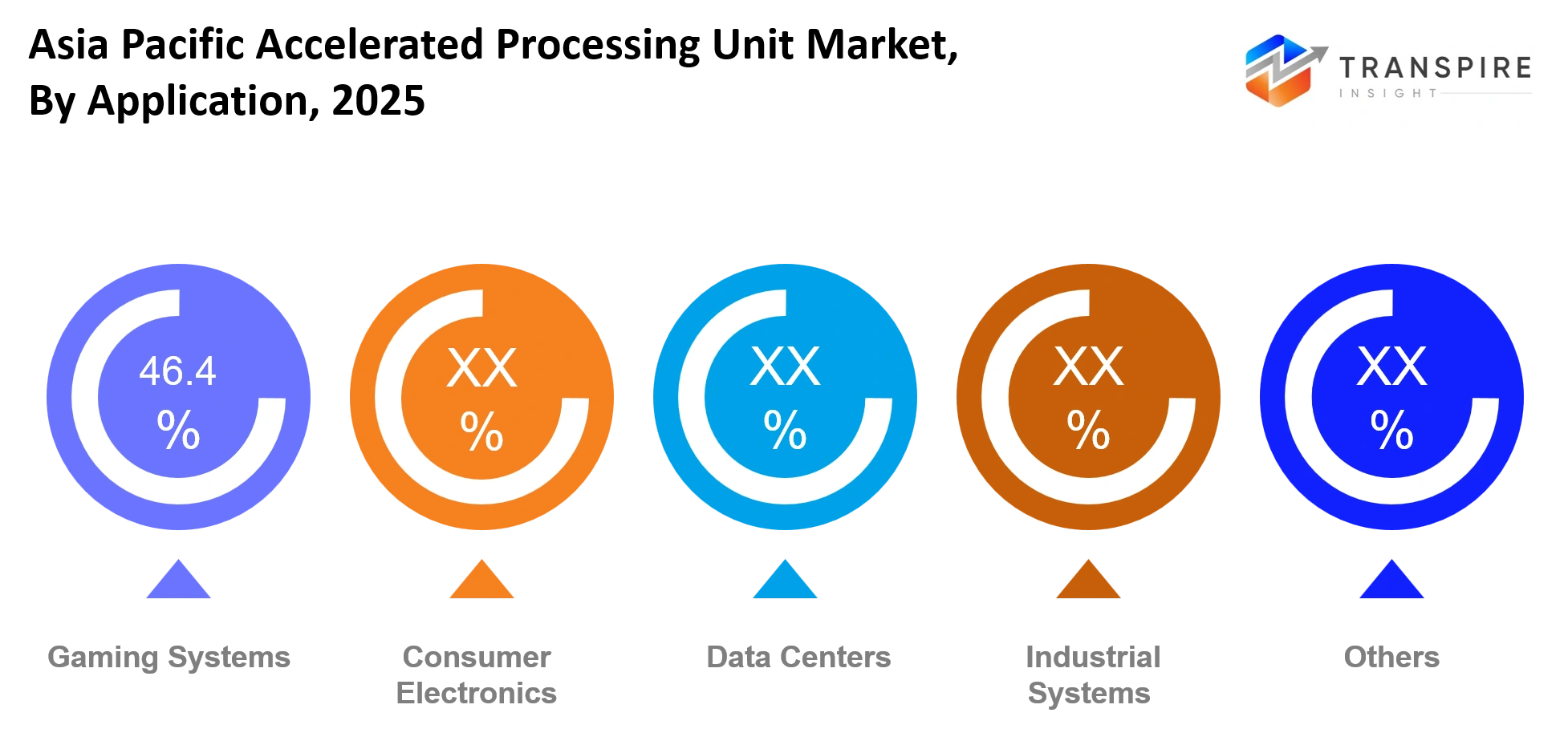
Gaming Systems are a big deal application area, mostly because modern games want efficient graphics processing , plus that responsive computing feel. With APU technology you can get smoother gameplay, and you often end up with less need for separate graphics hardware in a lot of setups . Growth tied to esports and general digital entertainment keeps pushing adoption in this segment too.
Consumer Electronics still keep steady demand, since laptops, tablets, and smart devices are everywhere, and they all want compact computing that is also energy-frugal. Data Centers are also moving toward accelerated processing tech, mainly to handle heavier workloads and AI style tasks faster. Industrial Systems benefit from stronger processing capability for automation and day to day operational control, while Others cover specialized cases—things built for newer computing environments and their odd performance requirements.
To learn more about this report, Download Free Sample Report
By End User
Consumers maintain a pretty major stake in the market because personal computing, entertainment, education, and remote work tasks all lean on processing platforms that actually perform well. The ongoing swap out of older devices also keeps pushing demand toward processors with better graphics ability, plus more capable AI functionality. On top of that, semiconductor firms keep innovating their products, and it kind of nudges people toward buying, across this whole slice.
Enterprises, meanwhile, lean on more advanced processing solutions for productivity software, analytics workloads, virtualization environments, and AI-driven business operations. OEMs slot APUs into a lot of different computing products, so there’s strong demand spread over laptops, desktops, and embedded devices too. Not to forget, there are also research groups, educational institutions, and specialized technology providers who need processing platforms tuned to particular operational needs, even if that means a narrower configuration.
What are the Key Use Cases Driving the Asia Pacific Accelerated Processing Unit Market?
Personal computing still seems to be the biggest use for APUs across the Asia Pacific region. People and businesses are using integrated processors more and more, like for AI-enabled laptops, work productivity tools, gaming machines, and all sorts of media tasks. Being able to pack graphics acceleration and general computing strength into just one chip, lowers the overall system cost a lot, also it helps with energy efficiency, in a very tangible way.
Right next to that, adjacent applications are picking up steam, especially in industrial automation and smart manufacturing. Factories roll out APU-powered edge devices for machine vision, visual checks for quality inspection, predictive maintenance, and process optimization. Schools and commercial companies too, use AI-ready APUs so they can run local AI processing and use digital collaboration features without too much friction.
Then there are newer patterns that keep showing up, such as autonomous robotics, smarter healthcare equipment, intelligent transport systems, and AI-driven edge servers. These kinds of projects need low-latency processing and local decision making, so there are fresh chances for advanced APUs tuned for real-time AI inference and industrial rollout.
|
Report Metrics |
Details |
|
Market size value in 2025 |
USD 4753 Million |
|
Market size value in 2026 |
USD 5770 Million |
|
Revenue forecast in 2033 |
USD 22698 Million |
|
Growth rate |
CAGR of 21.61% from 2026 to 2033 |
|
Base year |
2025 |
|
Historical data |
2021 - 2024 |
|
Forecast period |
2026 - 2033 |
|
Report coverage |
Revenue forecast, competitive landscape, growth factors, and trends |
|
Regional scope |
Asia Pacific (India, China, Japan, Australia, South Korea, Rest of Asia Pacific) |
|
Key company profiled |
AMD, Intel, Qualcomm, NVIDIA, Samsung Electronics, MediaTek, Broadcom, Marvell Technology, ASUS, Acer, Lenovo, HP, Dell Technologies, Toshiba, MSI. |
|
Customization scope |
Free report customization (country, regional & segment scope). Avail customized purchase options to meet your exact research needs. |
|
Report Segmentation |
By Product Type (Integrated APUs, Mobile APUs, Desktop APUs, Embedded APUs, Others); By Application (Gaming Systems, Consumer Electronics, Data Centers, Industrial Systems, Others); By End User (Consumers, Enterprises, OEMs, Others). |
Which Regions are Driving the Asia Pacific Accelerated Processing Unit Market Growth?
East Asia stays like the main regional market, mostly because it has a huge share of semiconductor manufacturing capacity, plus very advanced electronics production, and faster technology adoption. You can still see why China, Japan, and South Korea keep such strong roles, spanning semiconductor fabrication, device manufacturing, and consumer electronics. The region also has the kind of research and development spending that really compounds over time, and supply chain ecosystems that are already mature. All those things keep backing regional leadership when it comes to APU deployment and new innovation, even as things keep evolving.
Southeast Asia comes next as the second-largest driver of market revenue. But it’s a little different than East Asia, since here the momentum leans more toward electronics assembly, data center expansion, and enterprise digitalization. Countries like Singapore, Malaysia, and Thailand are often highlighted because they offer a fairly stable investment environment, along with technology infrastructure that keeps expanding. When cloud adoption, AI initiatives, and enterprise computing tools become consistent across industries, market demand stays strong, more or less reliably.
South Asia is expected to post the quickest growth through 2033. This outlook has been shaped by recent semiconductor initiatives , electronics manufacturing incentives, and digital infrastructure spending that has added more traction. India in particular is pulling in meaningful investment for electronics production, AI development, and data center capacity. That momentum, in turn, opens up appealing opportunities for processor manufacturers, OEMs, and investors who want exposure to these high-growth technology markets over the forecast period.
Who are the Key Players in the Asia Pacific Accelerated Processing Unit Market and How Do They Compete?
In the Asia Pacific Accelerated Processing Unit Market, competition feels moderately concentrated, like a few semiconductor giants still steer most of the technology direction and a big share of processor shipments. Firms tend to battle on a mix of AI acceleration, integrated graphics muscle, power efficiency, the surrounding software world, and their ties with device makers. Lately the push toward AI computing has made the pace faster, innovation cycles are more intense and product refresh schedules are getting shorter, almost too quickly.
AMD sets itself apart with its Ryzen AI design, where CPU and GPU roles blend with NPU capabilities, aimed at AI PCs and edge computing scenarios. In 2026, AMD widened its Ryzen AI 400 Series lineup, and it also boosted enterprise AI uptake via selective collaborations plus new embedded AI processor releases.
Intel is more focused on built-in AI acceleration, stronger graphics performance, and enterprise computing connections. Its Core Ultra along with Arc-enabled platforms are positioned for AI PCs, gaming builds, and professional workflows, while it leans heavily on broad OEM relationships.
Qualcomm tends to compete by leaning into power-saving ARM based computing platforms tuned for AI tasks. The Snapdragon X portfolio is largely about battery longevity, local AI execution, and Copilot+ PC features, and it keeps widening partnerships with major laptop brands.
NVIDIA, meanwhile, relies on its AI ecosystem, deep GPU know how, and software frameworks that help push accelerated computing into AI enabled personal devices and enterprise systems, not just lab setups or niche deployments.
Company List
- AMD
- Intel
- Qualcomm
- NVIDIA
- Samsung Electronics
- MediaTek
- Broadcom
- Marvell Technology
- ASUS
- Acer
- Lenovo
- HP
- Dell Technologies
- Toshiba
- MSI
Recent Development News
In March 2026, AMD launched the Ryzen AI 400 Series and Ryzen AI PRO 400 Series processors. The launch expanded AI-enabled PC capabilities across desktops, laptops, and mobile workstations, strengthening AMD’s position in the accelerated processing unit market and supporting broader adoption of on-device AI computing.
Source: http://www.amd.com
In January 2026, AMD and Tata Consultancy Services (TCS) entered a strategic partnership to accelerate enterprise AI adoption. The collaboration focuses on co-developing AI and GenAI solutions for hybrid cloud and edge environments, increasing demand for high-performance accelerated processing platforms across Asia Pacific enterprises.
Source: https://www.tcs.com
In January 2025, Qualcomm launched the Snapdragon X Platform as part of its Snapdragon X Series portfolio. The new platform brought AI-powered computing and Copilot+ PC capabilities to more affordable devices, expanding the addressable market for accelerated processing units and increasing competition in AI-enabled personal computing.
Source: https://www.qualcomm.com
What Strategic Insights Define the Future of the Asia Pacific Accelerated Processing Unit Market?
The Asia Pacific Accelerated Processing Unit Market is moving toward AI-native computing architecture where local intelligence becomes sort of a regular thing, not really a premium add-on. Under the hood, the real driver is the shift of AI workloads away from centralized cloud infrastructure and into personal devices, industrial systems, and also edge computing platforms. As companies push harder for lower latency, stronger privacy safeguards, and better energy discipline, the need for integrated AI processing keeps growing, almost like it’s just becoming expected.
One risk that gets ignored a bit too often is the rising concentration of advanced semiconductor fabrication capacity. When everyone relies on just a few fabrication facilities, it creates a weak point to geopolitical disruptions, trade restrictions, and supply problems that can end up hitting product availability and pricing.
On the opportunity side, something promising is industrial edge AI platforms deployed across manufacturing, healthcare, transportation, and autonomous setups. These uses are still underpenetrated, but they’re expected to turn into meaningful revenue engines during the next ten years.
Market participants should, in general, put their attention on AI software ecosystems and developer support tooling. Pure hardware performance is starting to matter less than the ability to provide end-to-end AI-enabled computing experiences across consumer, enterprise, and industrial spaces.
Asia Pacific Accelerated Processing Unit Market Report Segmentation
By Product Type
- Integrated APUs
- Mobile APUs
- Desktop APUs
- Embedded APUs
- Others
By Application
- Gaming Systems
- Consumer Electronics
- Data Centers
- Industrial Systems
- Others
By End User
- Consumers
- Enterprises
- OEMs
- Others
Frequently Asked Questions
Find quick answers to common questions.
The expected Asia Pacific Accelerated Processing Unit Market size for the market will be USD 22698 Million in 2033.
Key segments for the Asia Pacific Accelerated Processing Unit Market are By Product Type (Integrated APUs, Mobile APUs, Desktop APUs, Embedded APUs, Others); By Application (Gaming Systems, Consumer Electronics, Data Centers, Industrial Systems, Others); By End User (Consumers, Enterprises, OEMs, Others).
Major Asia Pacific Accelerated Processing Unit Market players are AMD, Intel, Qualcomm, NVIDIA, Samsung Electronics, MediaTek, Broadcom, Marvell Technology, ASUS, Acer, Lenovo, HP, Dell Technologies, Toshiba, MSI.
The Asia Pacific Accelerated Processing Unit Market size is USD 4753 Million in 2025.
The Asia Pacific Accelerated Processing Unit Market CAGR is 21.61% from 2026 to 2033.
- AMD
- Intel
- Qualcomm
- NVIDIA
- Samsung Electronics
- MediaTek
- Broadcom
- Marvell Technology
- ASUS
- Acer
- Lenovo
- HP
- Dell Technologies
- Toshiba
- MSI
About the Authors

Mayur Shinde
I am Mayur Shinde, a Senior Research Analyst at Transpire Insight, specializing in the Automotive & Transportation and Information & Communication Technology (ICT) Industry. My work focuses on analyzing emerging market trends, technological advancements, competitive landscapes, and industry developments to deliver accurate, data-driven insights. I am passionate about transforming complex market information into clear, actionable content that helps businesses, professionals, and decision-makers stay informed and make confident strategic decisions.

Chakradhar Khansole
Chakradhar serves as the Research Director at Transpire Insight, bringing over 8 years of experience in technology, innovation, and strategic market intelligence. He specializes in transforming complex market data into actionable business insights that enable organizations to make informed, growth-oriented decisions. Recognized for his strategic vision and analytical expertise, Chakradhar leads high-impact research initiatives, delivering comprehensive market assessments, competitive intelligence, and forward-looking industry analysis.
Recently Published Reports
-
Apr 2026
3D Optical Profiler Market
3D Optical Profiler Market Size, Share & Analysis Report By Type (Desktop 3D Optical Profiler, and Portable 3D Optical Profiler), By Technology (Confocal Technology, and White Light Interference), By End-Use Industry (Manufacturing, Research Institutions, Automotive, Aerospace and Defense, Medical Devices, and Other), and Geography (North America, Europe, Asia-Pacific, Middle East and Africa, South and Central America), 2021 - 2031
-
Apr 2026
Depth Sensor Market
Depth Sensor Market Size, Share & Analysis Report By Type (Infrared Depth Sensors, Time-of-Flight (ToF) Sensors, Stereo Vision Sensors, Structured Light Sensors, Ultrasonic Depth Sensors), By Application (Automotive, Robotics, Gaming, Consumer Electronics, Industrial Automation, Healthcare, Security & Surveillance, Others), By End Users (Automotive Manufacturers, Consumer Electronics Companies, Healthcare Providers, Industrial Companies, Security Agencies, Gaming Companies, Robotics Companies, Others), and Geography (North America, Europe, Asia-Pacific, Middle East and Africa, South and Central America), 2021 – 2031
-
Apr 2026
Digital Manufacturing Market
Digital Manufacturing Market Size, Share & Analysis Report By Component (Hardware, Software, and Services), By Technology (Robotics, 3D Printing, Internet of Things (IoT), and Others), By Application (Automotive and Transportation, Aerospace and Defense, Consumer Electronics, Industrial Machinery, and Others), By Process Type (Computer-Based Designing, Computer-Based Simulation, Computer 3D Visualization, Analytics, and Others), and Geography (North America, Europe, Asia-Pacific, Middle East and Africa, South and Central America), 2021 – 2031
-
Apr 2026
Digital Visa Services Market
Digital Visa Services Market Size, Share & Analysis Report By Type (Individual Travelers, Group Travelers), By Application (Tourism, Business Travel, Others), and Geography (North America, Europe, Asia-Pacific, Middle East and Africa, South and Central America), 2021 – 2031