

Asbestos Gloves Market Summary:
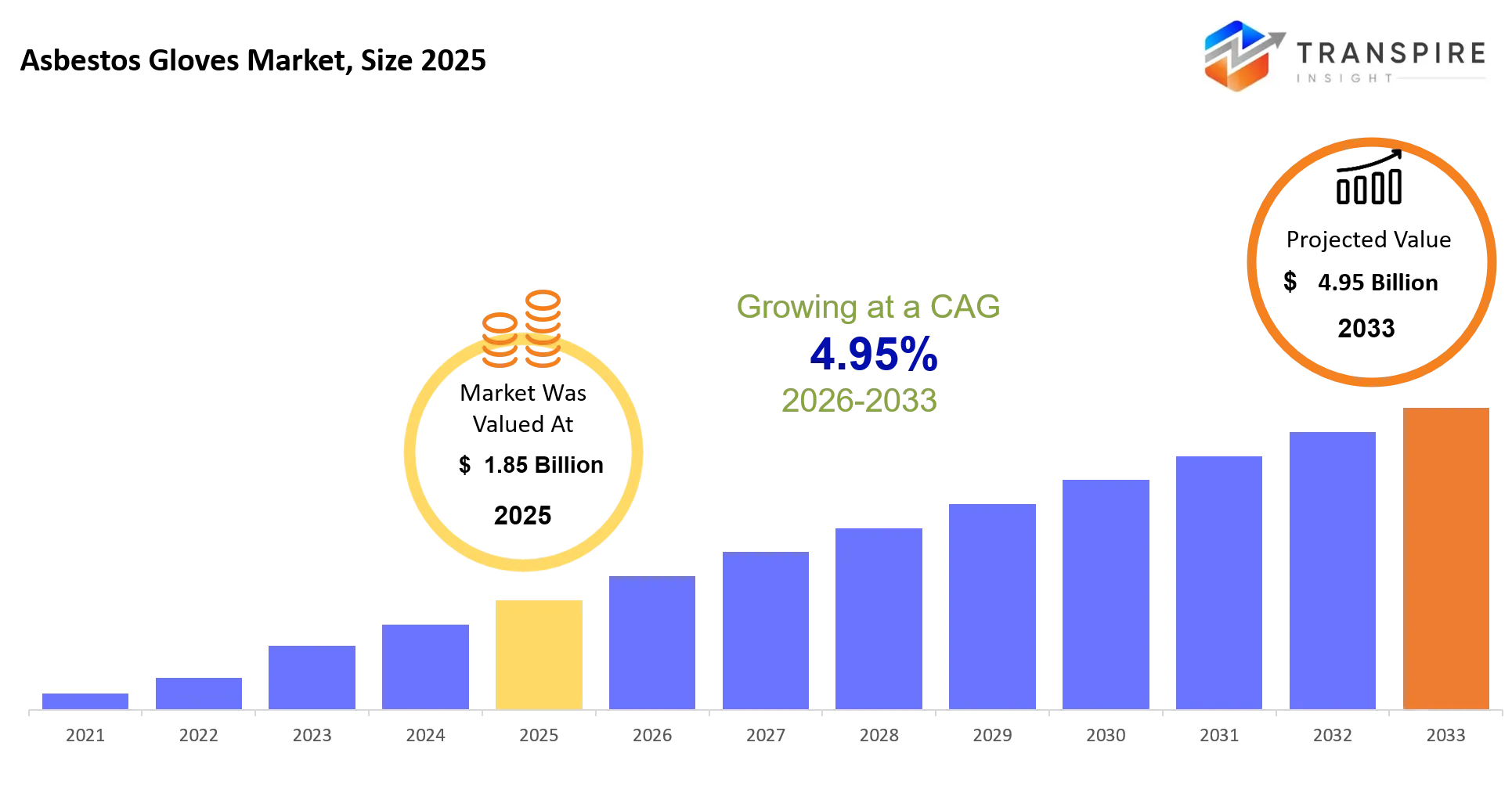
As per Transpire Insight Analysis, the Asbestos Gloves Market size is estimated at USD 1.26 Billion in 2025 and is anticipated to reach USD 1.85 Billion by 2033, growing at a CAGR of 4.95% from 2026 to 2033.
The worldwide asbestos gloves market is a supply of high-temperature protection devices for operators working with molten metals, hot glass, and in foundries or operating heat treatment furnace equipment exceeding the typical threshold of commercial personal protective equipment. During the last 3 to 5 years, the asbestos gloves market has transitioned from a wide range of industrial applications to a niche and compliance-driven business as tighter regulations in North America and Europe drove customers to shift toward aramid, aluminized, and silica-fibre alternatives. In response to the regulatory and safety specifications, a significant industry change has been the release of encapsulated and hybrid glove configurations, which exhibit fiber-free, leak-free performance with equal heat-insulative properties. Market fundamentals are driven by replacement demand in developing countries, legacy high-temperature industrial processes, and niche applications where the use of alternative materials remains prohibitively costly or energetically undesirable.
Asbestos Gloves Market Size & Forecast:
- Global Market Size 2025: USD 1.85 Billion
- Expected Market Value (2033): USD 4.95 Billion
- Forecast CAGR (2026–2033): 4.95%
- Leading Region in 2025: Asia Pacific
- Fastest Growing Region: Latin America
- Key Company Profiles: Honeywell, Ansell, MSA Safety, Lakeland Industries, Dräger, Uvex Safety, JSP Safety, Delta Plus Group, Saf-T-Gard, Magid Glove, Wells Lamont, National Safety Apparel, Protective Industrial Products, Superior Glove, Radians.
Key Asbestos Gloves Market Insights:
The market is moving away from the traditional asbestos-based heat protection products and towards compliance-based, hybrid heat protection products, with growth expected to be centred on niche high-temperature applications and emerging industrial heat protection hubs.
- Asia Pacific accounts for 39% of demand, with India having a $2 Billion asbestos ecosystem and 100+ production sites; China, Japan and South Korea differ on regulation versus innovation.
- 28% is in Europe, where manufacturers such as Ansell and Honeywell are favouring alternatives to asbestos that are REACH compliant, as bans in some countries become more stringent.
- North America is 24%, with revisions to OSHA and ANSI/ISEA 105-2024 propelling a faster pace of buyer transition to non-asbestos or encapsulated gloves.
- At 5%, Latin America is the fastest-growing region (9.8% CAGR), as Brazil and Mexico increase foundry and glass capacity, and source PPE at a lower cost.
- Middle East & Africa accounts for 4%, and the demand for high-temperature gloves is rising due to the industrial diversification projects in the Gulf.
- Heat Resistant Gloves is the leader at 43%, followed by Speciality Protective Gloves with 8.9% CAGR, as consumers increasingly seek task-specific, ergonomic gloves.
- As the kiln and moulding lines are modernized, Metal Processing leads the way, while Glass Manufacturing is speeding up the PPE upgrades.
- While Direct Sales and Industrial Safety Distributors continue to be dominant channels, Online B2B Platforms are taking market share as procurement becomes digital across multi-site operations.
- Pure Asbestos is still found in legacy systems, while Blended, Reinforced, Coated and Composite Materials are growing as fibre release is minimized and performance is enhanced.
What are the Key Drivers, Restraints, and Opportunities in the Asbestos Gloves Market?
Driver:
Market growth reflects ongoing demand in high-end use sectors including high temperature applications, metalworking, glassworks, and foundries where high thermal insulation performance and cost considerations are variables. The catalyst has been the recent ramp-up of heavy-industry capacity in APAC and ME, with more draconian enforcement of the PPE safety regulations requiring documented heat protection, which is spurring plants to buy certified gloves, providing consistent replacement orders and a premium for validated multi-layer materials ahead of volume saturation in these regulated markets.
Restraint:
Health and bans on asbestos are constraining this growth, especially in North America and Europe, where limits on occupational exposures and the severity of liability are necessitating the use of non-asbestos-based products by customers. As asbestos-related diseases like asbestosis and mesothelioma have prolonged latency periods, regulatory vigilance and insurance consciousness continue to constrain this market in mature economies.
Opportunity:
The hybrid lies in heat and flame-resistant gloves free of hazardous asbestos materials, integrating aramid fibres, aluminized textiles, and silica composites to optimize thermal resistance along a safer profile, i.e, vendors scaling up Indian/South Asia manufacture of coated, multi-layer gloves for Ceramics & Glass plants upgrading safety measures and seeking non- compromise heat resistance, are high-temperature, no-asbestos alternatives made by regional vendors who use high-tech coatings and Kevlar or aluminised fibreglass fabrics to address increased PPE restrictions while meeting lower price points.
What Has the Impact of Artificial Intelligence Been on the Asbestos Gloves Market?
AI's role remains indirect in this area, but materials manufacturers employ machine-learning models to find the fibre mixes, coating gauges, and stitch patterns that deliver the greatest heat resistance without the highest fibre release, speeding up the R&D cycle for hybrid gloves. In manufacturing, computer-vision-based inspection systems, which pass their results up to a quality software package, perform automated detection of defects like pinholes and delamination on woven and coated gloves, consistently and reliably, reducing scrap rates. Predictive applications utilize analytics overlays of glove use logs, incident reports, and environmental sensor data to predict when gloves will need replacing and identify task episodes that pose a high risk of causing injuries. On the operational front, AI-powered procurement sites assist safety directors in inventory status, compliance certificates, and disposal documentation across multi-site facilities, close audit gaps, and lower non-compliance costs.
Still, a critical hurdle of integration expense and data quality persists: numerous small foundries and glassworks have not converted processes to digital, and underutilized algorithms run less effectively without high-quality, structured data, delaying use in the SME space.
In March 2026, Intellinium launched an AI-driven smart footwear and connected PPE safety tracking integration product. This rollout enhances real-time worker telemetry and operational safety compliance tracking, bridging critical field-data gaps for industrial environments.
Key Asbestos Gloves Market Trends:
The market is shifting from using traditional asbestos to more modern, hybrid heat-protection products that are compliant, with growth expected in emerging industrial markets and niche high-temperature applications.
- The substitution of pure asbestos with aramid and aluminized composites has been driven by regulatory tightening in North America and Europe.
- Hybrid, encapsulated glove designs are making inroads as buyers weigh thermal protection against low fibre release.
- The anchor application is still metal processing, but glass manufacturing is the fastest growing due to improvements in kiln and moulding lines in PPE.
- Although woven constructions remain predominant, coated versions are growing as they offer additional chemical and moisture protection.
- Emerging economies (India, Southeast Asia) support replacement demand, favouring cost and legacy equipment, which favour asbestos.
- Safety procurement is moving to online platforms with compliance, disposal, and usage analytics for multi-site operations.
- Specialised gloves are being superseded by ergonomic gloves for particular tasks to enhance dexterity and comfort.
- Asbestos-free lines are being scaled, and transitional products are being offered for legacy users to help manufacturers future-proof their portfolios.
Asbestos Gloves Market Segmentation
By Product Type:
Heat Resistant Gloves dominate the market with a 43% share due to extensive use across foundries, steel plants, and furnace operations requiring continuous thermal protection. Welding Gloves account for 21%, serving fabrication and heavy engineering applications, while Foundry Gloves contribute 16% through molten metal handling. Industrial Safety Gloves represent 10%, supporting broader manufacturing environments. Speciality Protective Gloves, although holding 6%, record the fastest growth with an 8.9% CAGR as industries seek application-specific thermal protection. Multi-layer Asbestos Gloves have a 2% share, and Others are 2% share, addressing highly specialised industrial requirements.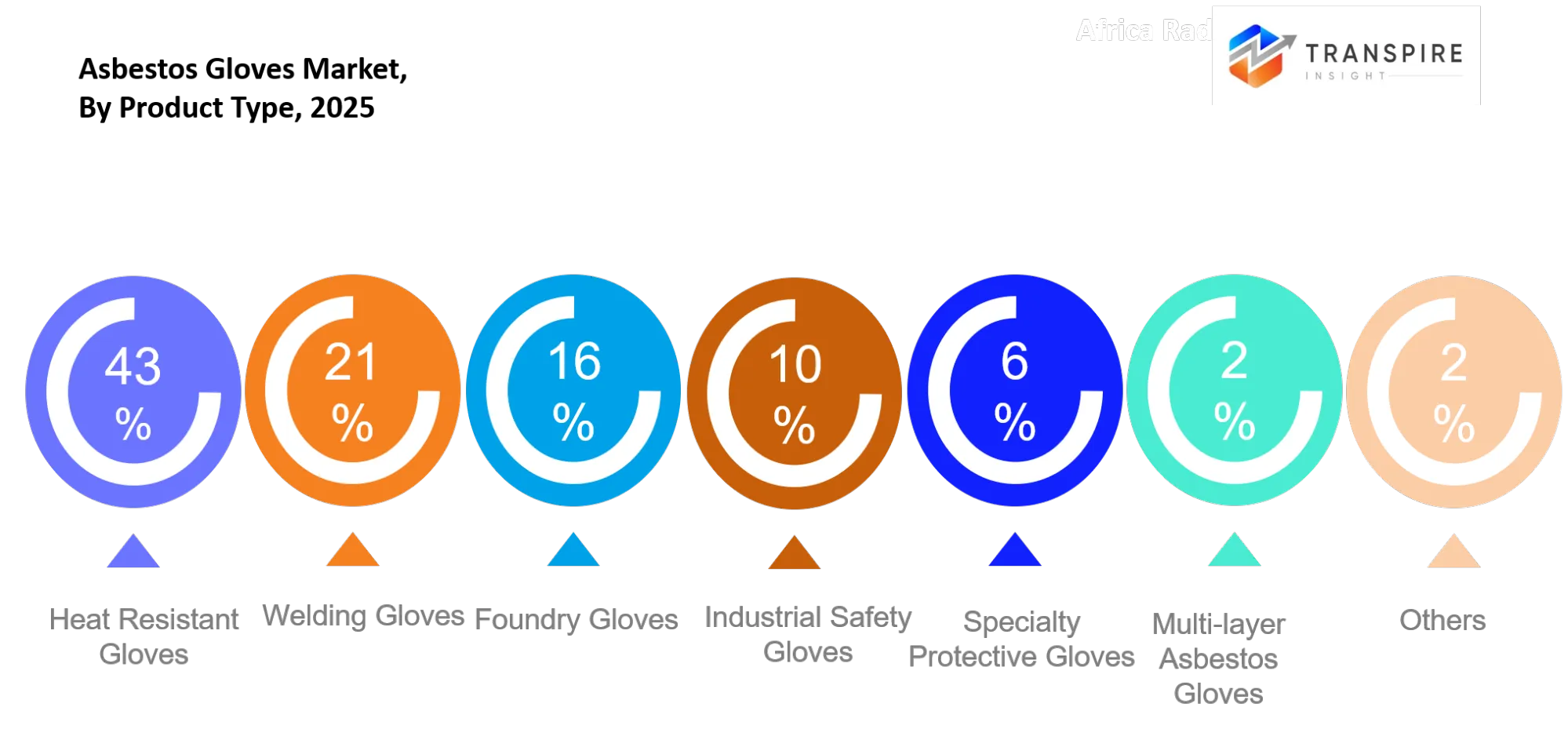
By Application:
Metalworking continues to be by far the most significant sector as ongoing exposure to intense heat demands the use of rated protective gloves. Foundries, glass works and welding work carry significant requirements; however, chemical works, maintenance, laboratories and other special applications are also in greater need of heat-resistant protective equipment (PE).
By End User:
The manufacturing industry is the biggest customer owing to a broad usage of high-temperature manufacturing processes worldwide. The Foundries and the glass industry sustain steady purchasing. The chemical industries, laboratories, research centres, and other industrial companies persist in introducing certified protective products to further improve safety adherence on production sites.
By Material:
Blended and reinforced asbestos materials are the main type of asbestos products being substituted for pure asbestos in recent years because of greater durability and lower fibre release. Coated asbestos and composite material technology is also proliferating where regulatory conditions allow, intending to increase worker safety in high-temperature environments.
By Distribution Channel:
Direct sales are the most common mode of procurement in the industrial world, mostly through long-term supply agreements. Industrial safety distributors would enhance the regional presence, while online B2B markets, wholesalers, export agents, and specialised industrial distributors would improve access to new manufacturing countries.
What are the Key Use Cases Driving the Asbestos Gloves Market?
The primary application is the protection of workers' hands at elevated temperatures in metalworking and foundries, where workers must manipulate molten metals, cast ingots, and work with furnace equipment under intense heat. This is still the leading application for heat-resistant gloves in heavy industry.
Broader applications such as glass making, ceramics and welding processes exist where kiln car handling, hot glass moving/transfer and fabrication processes need a stable thermal barrier solution with resistance to abrasion, operating performance and flexibility under extended high-temperature conditions.
New applications include industrial maintenance, refinery shutdowns and power plant maintenance in which multi-layer gloves protect workers on short timescales, high-heat operations while offering improved durability as industries move more consistently toward safer certified solutions.
|
Report Metrics |
Details |
|
Market size value in 2025 |
USD 1.26 Billion |
|
Market size value in 2026 |
USD 1.32 Billion |
|
Revenue forecast in 2033 |
USD 1.85 Billion |
|
Growth rate |
CAGR of 4.95% from 2026 to 2033 |
|
Base year |
2025 |
|
Historical data |
2021 - 2024 |
|
Forecast period |
2026 - 2033 |
|
Report coverage |
Revenue forecast, competitive landscape, growth factors, and trends |
|
Regional scope |
United States; Canada; Mexico; United Kingdom; Germany; France; Italy; Spain; Denmark; Sweden; Norway; China; Japan; India; Australia; South Korea; Thailand; Brazil; Argentina; South Africa; Saudi Arabia; United Arab Emirates |
|
Key companies profiled |
Honeywell, Ansell, MSA Safety, Lakeland Industries, Dräger, Uvex Safety, JSP Safety, Delta Plus Group, Saf-T-Gard, Magid Glove, Wells Lamont, National Safety Apparel, Protective Industrial Products, Superior Glove, Radians. |
|
Customization scope |
Free report customisation (country, regional & segment scope). Avail customised purchase options to meet your exact research needs. |
|
Report Segmentation |
By Product Type (Heat Resistant Gloves, Foundry Gloves, Industrial Safety Gloves, Welding Gloves, High-temperature Protective Gloves, Multi-layer Asbestos Gloves, Specialty Protective Gloves, Others); By Application (Metal Processing, Glass Manufacturing, Foundries, Welding, Chemical Processing, Industrial Maintenance, Laboratories, Others); By End User (Manufacturing Industry, Foundries, Glass Industry, Chemical Industry, Laboratories, Research Institutes, Others); By Material (Pure Asbestos, Blended Asbestos, Reinforced Asbestos, Coated Asbestos, Composite Materials, Others); By Distribution Channel (Direct Sales, Industrial Safety Distributors, Online B2B Platforms, Wholesalers, Exporters, Others) |
Which Regions are Driving the Asbestos Gloves Market Growth?
Asia Pacific is the strongest, representing 39% of global demand, supported by India's asbestos $2 Billion industrial infrastructure with more than 100 output locations, and lax rules that keep the region a low-cost base for manufacturing. Asia has an extensive, interconnected supply chain, aggressive heavy industry in China, and a huge pool of labour in the glass, metal, and ceramics industries that need cheap thermal insulation. Different policies eased regulations in South Asia, from tough bans in Japan and South Korea to a heat-resistant dual-market with both legacy asbestos gloves and new, asbestos-free ones. In July 2026, Saint-Gobain completed the acquisition of Phu My Innovative Materials in Vietnam. This action expanded their manufacturing footprint in the Asia-Pacific building solutions sector.
Europe has a 28% share and lags Asia Pacific but remains stable thanks to tough REACH and equal national asbestos bans, which benefit sellers of certified, non-asbestos alternatives. Its market is highly mature, innovation-driven and characterised by safety, sustainable, high-end products, with manufacturers such as Ansell and Honeywell paving the way to hybrids and encapsulates. Europe's high-level, regulated industrial base ends with reduced, asbestos-specific volumes but delivers premium, compliant products, thus creating a smaller, more secure and resilient market overall.
Latin America is the fastest-growing region at 5%, with an impressive 9.8% CAGR driven by Brazil and Mexico continuing to add foundry, steel and glass capacity. A series of recent industrial investments and infrastructure spend has driven up demand for high-temp PPE in this region, and price pressures dictate the use of asbestos-based or hybrid gloves rather than premium alternatives. As safety regulations tighten slowly here, there remains potential for glove suppliers to introduce cost-effective, compliant, multi-layer gloves to the region.
In April 2026, the Mexican government signed an Agreement for the promotion of the Mexican steel industry prioritizing domestic output. This policy boosts local heavy-industry activity, increasing near-term requirements for cost-effective, high-temperature protective gear. 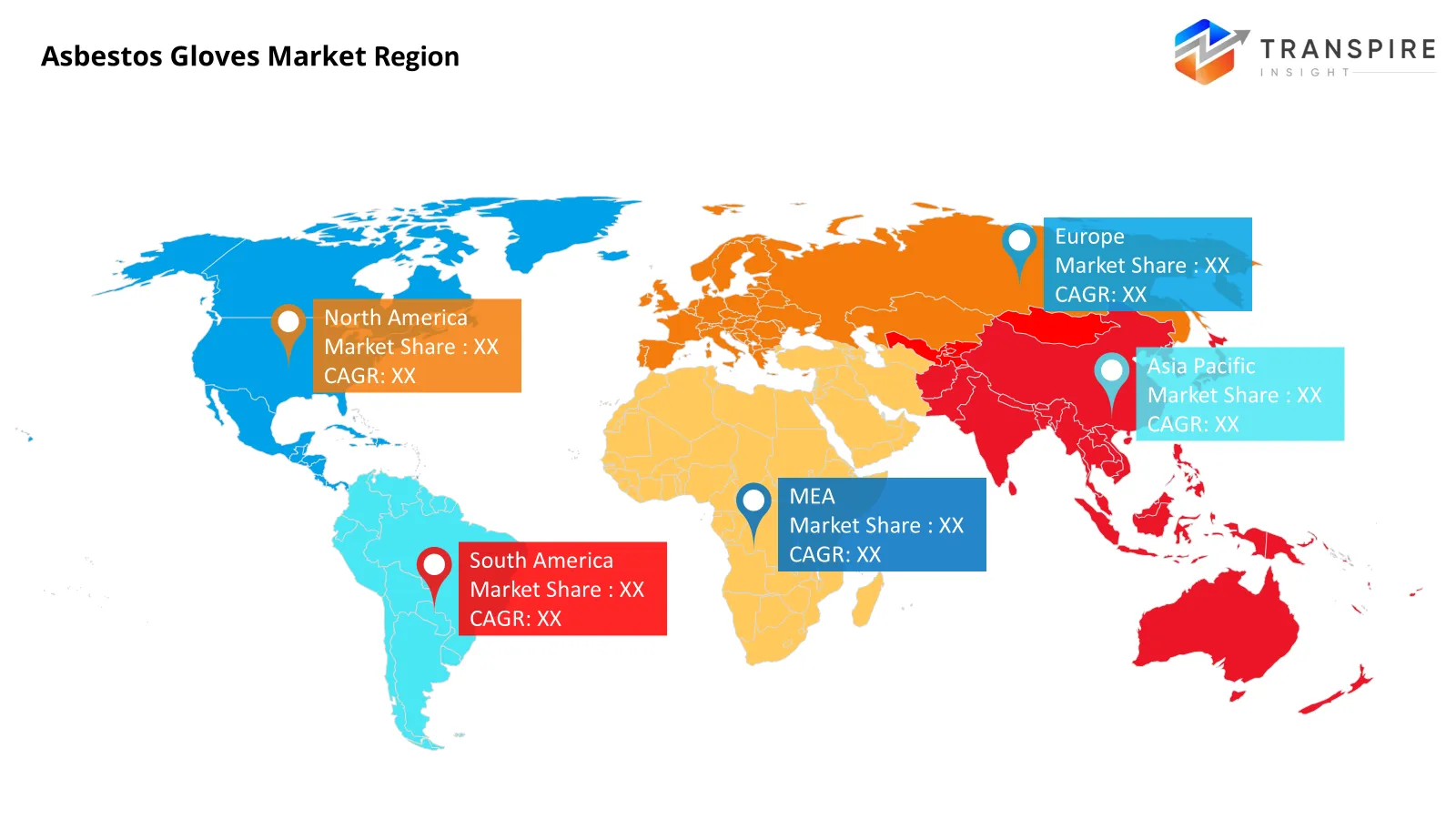
Who are the Key Players in the Asbestos Gloves Market and how do they Compete?
The global segment for asbestos gloves is moderately fragmented, with a combination of multinational leaders in the safety equipment industry and specialists in specific regions competing based on product performance, standards & regulations, and channel distribution.
Honeywell and Ansell focus on innovation with product differentiation by product ranges of non-asbestos and hybrid gloves reaching the most demanding standards (ANSI/ISEA and REACH). They also grow through a worldwide distribution network and strategic acquisitions, driven by strong demand for high-temperature PPE in NA, Europe and Asia Pacific. MSA Safety and Lakeland Industries target narrow, high-specification applications such as foundries and petrochemicals with coated and reinforced high thermal resistant gloves with less fibre release. Their growth stems from selling directly to the industries or long-term agreements with large manufacturers. Drger, Uvex Safety, Jsp Safety focus on developing compliant and ergonomic glove in accordance with the European and Middle East safety standards, growing through regional distributors; Delta Plus Group and Saf-T-Gard provide cost-efficient multi-layer solutions to the emerging markets; Magid Glove, Wells Lamont and National Safety Apparel focus on North American industrial buyers with task orientated and high durability gloves; Protective Industrial Products, Superior Glove, Radians, etc, can penetrate Asia Pacific and Latin America cost-conscious market segments through online B2B channels and regional manufacturing facilities.
Key Players are:
- Honeywell
- Ansell
- MSA Safety
- Lakeland Industries
- Dräger
- Uvex Safety
- JSP Safety
- Delta Plus Group
- Saf-T-Gard
- Magid Glove
- Wells Lamont
- National Safety Apparel
- Protective Industrial Products
- Superior Glove
- Radians
Recent Development News
- In January 2026, Ansell launched the TouchNTuff™ 93-800 disposable chemical protection glove. This deployment introduces a breakthrough multi-layer design leveraging MICROCHEM™ Chemical Barrier Technology to deliver a minimum of 15 minutes of acetone resistance, eliminating the operational need for workers to don multiple general-purpose heat or chemical gloves.
What Strategic Insights Define the Future of the Asbestos Gloves Market?
The market is moving to hybrid, asbestos-free heat-resistant gloves, where a combination of aramid, aluminised fabrics, and silica composites will optimise both thermal performance and safety. However, supply-chain concentration for high-performance fibres and coatings should be monitored closely given the risk of modest margin deterioration or announcement delays in a surfacing job-cost environment if trade barriers or logistics impasses become more painful. Companies also have an opportunity to leverage emerging AI-enabled quality inspection & predictive maintenance analytics to improve product consistency, cut scrap rates, and price at premium levels in highly regulated sectors. Directionally, the focus should be on modular, multi-layer gloves and establishing local supply sources for high-growth regions, particularly India, Southeast Asia, and Latin America, both to reduce supply risks and help meet demand from increasingly mature industrial infra end-users.
Key Segmentations are:
By Product Type
- Heat Resistant Gloves
- Foundry Gloves
- Industrial Safety Gloves
- Welding Gloves
- High-temperature Protective Gloves
- Multi-layer Asbestos Gloves
- Specialty Protective Gloves
- Others
By Application
- Metal Processing
- Glass Manufacturing
- Foundries
- Welding
- Chemical Processing
- Industrial Maintenance
- Laboratories
- Others
By End User
- Manufacturing Industry
- Foundries
- Glass Industry
- Chemical Industry
- Laboratories
- Research Institutes
- Others
By Material
- Pure Asbestos
- Blended Asbestos
- Reinforced Asbestos
- Coated Asbestos
- Composite Materials
- Others
By Distribution Channel
- Direct Sales
- Industrial Safety Distributors
- Online B2B Platforms
- Wholesalers
- Exporters
- Others
Regional Outlook
North America
- US
- Canada
- Mexico
- US
- Canada
Europe
- Germany
- UK
- France
- Italy
- Spain
- Rest of Europe
Asia Pacific
- China
- Japan
- India
- South Korea
- Australia
- Rest of Asia Pacific
South America
- Brazil
- Argentina
- Rest of South America
Middle East & Africa
- UAE
- Saudi Arabia
- Qatar
- South Africa
- Rest of the Middle East & Africa
Frequently Asked Questions
Find quick answers to common questions.
The Asbestos Gloves Market size was valued at USD 1.26 Billion in 2025 and is poised to reach USD 1.85 Billion by 2033, expanding at a 4.95% CAGR.
Key segments for the Asbestos Gloves Market are By Product Type (Heat Resistant Gloves, Foundry Gloves, Industrial Safety Gloves, Welding Gloves, High-temperature Protective Gloves, Multi-layer Asbestos Gloves, Specialty Protective Gloves, Others); By Application (Metal Processing, Glass Manufacturing, Foundries, Welding, Chemical Processing, Industrial Maintenance, Laboratories, Others); By End User (Manufacturing Industry, Foundries, Glass Industry, Chemical Industry, Laboratories, Research Institutes, Others); By Material (Pure Asbestos, Blended Asbestos, Reinforced Asbestos, Coated Asbestos, Composite Materials, Others); By Distribution Channel (Direct Sales, Industrial Safety Distributors, Online B2B Platforms, Wholesalers, Exporters, Others).
Growth is primarily driven by persistent demand in high-temperature industries, expanding industrial capacity in emerging economies, tightening occupational safety regulations that mandate certified heat-resistant PPE, and cost-effectiveness of asbestos-based gloves in price-sensitive markets.
The Asbestos Gloves Market is led by major manufacturers including Honeywell, Ansell, MSA Safety, Lakeland Industries, Dräger, Uvex Safety, JSP Safety, Delta Plus Group, Saf-T-Gard, Magid Glove, Wells Lamont, National Safety Apparel, Protective Industrial Products, Superior Glove, Radians.
Asia Pacific holds 39% of global demand, dominating through India’s $2 Billion asbestos ecosystem, over 100 production sites, dense supply chains, expanding heavy industry in China, and a large workforce in metal, glass, and ceramics requiring affordable thermal protection amid regulatory divergence across the region.
Opportunities include hybrid, asbestos-free heat-resistant gloves combining aramid and silica composites, AI-enabled quality inspection and predictive maintenance analytics, localization of production in India, Southeast Asia, and Latin America, and multi-layer, compliant glove designs for modernizing industrial buyers in emerging Markets.
- Honeywell
- Ansell
- MSA Safety
- Lakeland Industries
- Dräger
- Uvex Safety
- JSP Safety
- Delta Plus Group
- Saf-T-Gard
- Magid Glove
- Wells Lamont
- National Safety Apparel
- Protective Industrial Products
- Superior Glove
- Radians
About the Authors

Kartik bhong
I am Kartik Bhong, a Senior Research Analyst at Transpire Insight, specializing in the Packaging, Manufacturing, and Construction industry. My work focuses on analyzing market trends, emerging technologies, industry regulations, and competitive landscapes to deliver accurate, data-driven insights. I am passionate about transforming complex industry information into clear, practical content that helps businesses, professionals, and decision-makers stay informed and make confident strategic decisions. Through continuous research and a strong commitment to accuracy, I strive to create reliable, well-researched content that reflects the latest developments across these dynamic industries and supports the vision of Transpire Insight in delivering valuable market intelligence.

Chakradhar Khansole
Chakradhar serves as the Research Director at Transpire Insight, bringing over 8 years of experience in technology, innovation, and strategic market intelligence. He specializes in transforming complex market data into actionable business insights that enable organizations to make informed, growth-oriented decisions. Recognized for his strategic vision and analytical expertise, Chakradhar leads high-impact research initiatives, delivering comprehensive market assessments, competitive intelligence, and forward-looking industry analysis.
Recently Published Reports
-
Apr 2026
Handling and Lifting Equipment Market
Handling and Lifting Equipment Market Size, Share & Analysis Report By Product (Cranes and Hoists, Forklifts, Conveyor Systems, Aerial Work Platforms, Others), By Application (E-Commerce, Automotive and Railway, Food and Beverages, Aviation, Others), and Geography (North America, Europe, Asia-Pacific, Middle East and Africa, South and Central America), 2021 - 2031
-
Apr 2026
HVAC Equipment Market
HVAC Equipment Market Size, Share & Analysis Report By Heating Equipment Type (Boilers and Furnaces, Heat Pumps, and Unitary Heaters), By Ventilation Equipment (Air Handling Units, Humidifiers and Dehumidifiers, Air Filters, and Fan Coiling Units), By Air Conditioning Equipment (Unitary Air Conditioners, Room Air Conditioners, Packaged Terminal Air Conditioners, and Chillers), By End User (Commercial, Residential, Industrial, and others), and Geography (North America, Europe, Asia-Pacific, Middle East and Africa, South and Central America), 2021 – 2031
-
Apr 2026
Refrigeration Valves Market
Refrigeration Valves Market Size, Share & Analysis Report By Type (Solenoid Valves, Expansion Valves, Check Valves, Service Valves, Others), By Application (Commercial Refrigeration, Industrial Refrigeration, Transport Refrigeration, Residential Refrigeration, Air Conditioning Systems), By End User (Food and Beverage Industry, Pharmaceutical Industry, HVAC Industry, Chemical Industry, Others), and Geography (North America, Europe, Asia-Pacific, Middle East and Africa, South and Central America), 2021 – 2031
-
Apr 2026
E-Commerce Packaging Materials Market
E-Commerce Packaging Materials Market By Material Type (Corrugated Boxes, Paper & Paperboard, Foam & Cushioning Materials, Plastic Packaging, Flexible Packaging, Protective Packaging, Others), By Product(Primary Packaging, Secondary Packaging, Tertiary Packaging), By Packaging Function (Protective Packaging, Branding & Presentation Packaging, Transit & Logistic Packaging, Sustainable Packaging, Tamper Evidence Packaging), By End-User (Retail & Consumer Goods, Electronic Appliances, Food & Beverages, Healthcare & Pharmaceutical, Fashion & Apparel, Home & Furnishing, Others); By Industry Analysis, Size, Share, Growth, Trends, and Forecasts 2021-2033