
AI Image Recognition Market Summary:
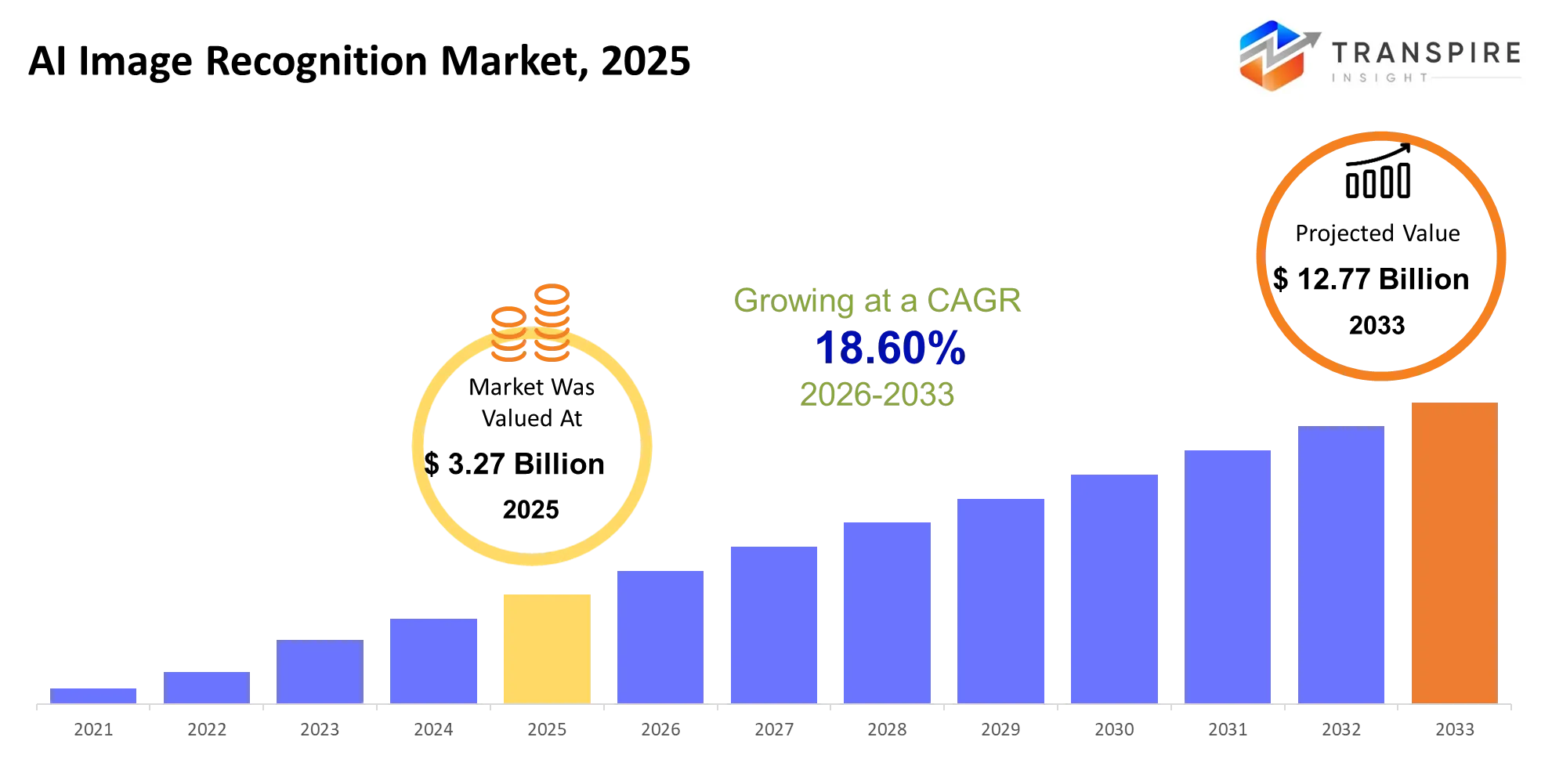
As per the Transpire Insight, The AI Image Recognition Market size is estimated at USD 3.27 billion in 2025 and is anticipated to reach USD 12.77 billion by 2033, growing at a CAGR of 18.60% from 2026 to 2033.
The AI Image Recognition market enables companies to convert camera streams, medical images, product images, and industrial videos into a line of business decisions. Those decisions could be rejecting faulty parts, flagging suspicious behaviour, authenticating identities, or prioritising radiology findings. In the past three to five years, the image recognition market has moved from cloud-based single-task image classifiers to multimodal, edge-based vision systems that analyse images and videos close to their sources. One key structural change is the proliferation of purpose-built AI accelerators and small edge devices that can minimize latency, bandwidth costs, and exposure of sensitive visual data. The strategic drivers of this change are labour shortages and the high cost of errors in manufacturing, logistics, retail, and healthcare. As companies automate inspection and surveillance workflows, AI recognition replaces repetitive manual review with continuous visual monitoring, increasing throughput, increasing traceability, and creating new service-based revenues for software, hardware, and integration. In addition, increased regulation of biometric systems is creating demand for auditable, human-controlled deployments.
AI Image Recognition Market Size & Forecast:
- Market Size 2025: USD 3.27 Billion
- Expected Market Value (2033): USD 12.77 Billion
- Forecast CAGR (2026-2033): 18.60%
- Leading Region in 2025: North America
- Fastest Growing Region: Asia Pacific
- Key Company Profiles: NVIDIA, Intel, Google, Microsoft, IBM, Amazon Web Services, Qualcomm, Sony, NEC, Cognex, Keyence, Basler, Teledyne Technologies, Zebra Technologies, SenseTime.
Key AI Image Recognition Market Insights:
The market is moving from a stand-alone recognition solution to edge-to-cloud visual-intelligence stacks, where the speed of a response, control of data, and integration of workflow become the key factors that drive the value of a contract. Vendors are going beyond generic object-detection accuracy to differentiate themselves with specialised hardware, multimodal models, and compliance-ready deployment.
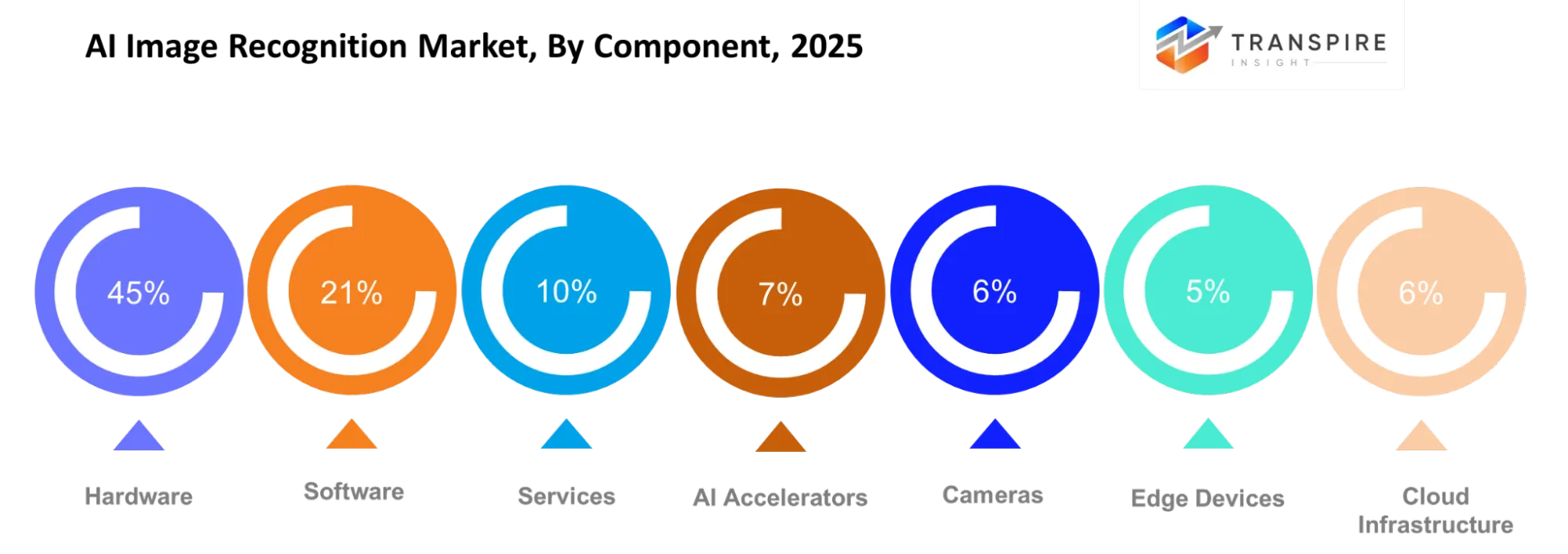
- NVIDIA continues to focus on hardware with 45.12% of the market, as it extends accelerated edge-to-cloud computing for multiple-camera, real-time vision workloads.
- Software, 21.00%, is going workflow-led, with Google and Microsoft adding vision capabilities to their cloud AI suites, promoting API-based uptake.
- Services, 10.00%, become relevant as IBM and Cognex assist enterprises in fine-tuning models, adding cameras and verifying results on the ground.
- AI accelerators, 7.00%, benefit from Qualcomm’s efficient on-device inference strategy, reducing latency in mobile, automotive, and smart-camera use.
- Cameras, 6.00%, are becoming intelligent endpoints, with Sony's pairing of advanced sensors and edge processing to achieve better machine vision quality.
- Edge devices, 5.00%, support local analytics, as Zebra strengthens vision-enabled warehouse and retail workflows where connectivity is variable.
- Cloud infrastructure, 4.00%, enables central training and model updates; AWS scales managed vision services for enterprises beyond pilots.
- Others, 1.88%, are specialist optics and integration tools, with Basler and Teledyne focusing on precision imaging for industrial and scientific applications.
- EU GPAI requirements are driving governance to become a buying criterion, with growing demands for documentation, transparency, and lifecycle controls.
What are the Key Drivers, Restraints, and Opportunities in the AI Image Recognition Market?
Driver:
The primary growth driver is the financial need to inspect more images and video than human teams can review consistently. Manufacturers now deploy machine vision to detect surface defects, missing components, and packaging errors in real time; retailers use camera analytics for shelf availability, queue management, and loss prevention. This shift was accelerated by labour constraints, e-commerce fulfilment pressure, and the growing volume of visual data generated by connected cameras. When recognition models are embedded in production lines or store operations, customers gain faster decisions, lower rework, fewer stockouts, and measurable shrinkage control, supporting spending on cameras, accelerators, software licences, cloud capacity, and integration services. Retail deployments increasingly combine shelf analytics, visual audits, planogram compliance, and visual search rather than treating image recognition as a stand-alone pilot.
Restraint:
Accuracy remains uneven outside controlled settings. Poor lighting, occlusion, camera-angle variation, unrepresentative training data, and edge-device compute limits can raise false alerts or missed detections. The issue persists because collecting labelled, legally usable, domain-specific visual data is expensive, while each site may require model retraining and validation. Biometric applications face an additional trust barrier: NIST’s ongoing testing continues to document demographic variation in face-recognition error rates across algorithms.
Opportunity:
The next value pool in the AI image recognition market will emerge from privacy-preserving edge vision and industry-specific multimodal models. On-device AI enables factories, hospitals, and smart-city operators to analyse visual data locally, transmitting only alerts or anonymised metadata to cloud platforms. This reduces latency, bandwidth costs, and data-exposure risks. Asia-Pacific manufacturing hubs offer strong demand for affordable inspection automation, while regulated European markets favour compliant, transparent deployments. Vendors that combine local-language interfaces, governance tools, and low-latency models will secure higher-value enterprise contracts.
What Impact Has Artificial Intelligence Had on the AI Image Recognition Market?
An image recognition application shifts from rule-based pattern matching to an adaptive visual decision system. The use of deep learning and convolutional neural networks allows defect detection, image classification, object detection, pattern recognition in cluttered scenes, and correlation of visual evidence with text, maintenance records, product catalogues, or clinical history by means of transformer or multimodal models. In industrial environments, AI can continuously compare products to normal acceptable visual standards and reject products before they hit downstream.
In the health sector, image-analysis tools can prioritise scans with abnormal findings so clinicians can allocate their limited review time to urgent cases. In logistics and retail, models can be trained to predict congestion, empty shelves, dwell time, and anomalous events from live video. The benefits include faster inspections, fewer manual checks, increased consistency in documentation, and predictive maintenance signals based on subtle visual changes. Challenges include resources needed for labelled datasets, cameras, edge processing hardware, model monitoring, cybersecurity and workflows; accuracy problems when real-world conditions fall outside the training data domain, human oversight, retraining, and audits for biometric and safety-related applications.
In September 2026, Ambarella partnered with Capgemini to accelerate the development and deployment of Edge and Physical AI solutions across logistics, retail, industrial automation, and healthcare.
Key AI Image Recognition Market Trends:
The market is shifting from standalone recognition tools to visual-intelligence platforms within the operational workflow where low latency, auditability, and domain accuracy are more important than generic benchmark scores. Edge processing and multimodal AI are altering the buying process: enterprises are looking for cameras plus AI systems, not just model licences.
- Cloud-first vision pilots are becoming hybrid, with companies keeping control of the model in the cloud but performing real-time inference at the edge.
- Industrial inspection is evolving from a set of rules to deep-learning anomaly detection, where systems can detect defects that were not previously encountered.
- The strategic component category of AI accelerators is emerging due to the need for lower power consumption and faster inference for real-time multi-camera analysis.
- Retail adoption has progressed beyond footfall to include shelf-gap detection, planogram validation, visual search, and loss-prevention analytics.
- While bias and privacy concerns are still a significant issue, facial recognition is moving beyond widespread surveillance applications to permissioned, auditable identity verification.
- Contextual questions are being asked instead of just object labels, as multimodal models are being used to tie images to text and sensor data.
- AI is being incorporated into medical imaging vendors' workflows with the intention of making them more useful for clinical triage, risk scoring, and other workflows, not as a diagnosis tool.
- While the amount of effort needed for preparing images for data remains high, Generative AI is helping to lower this burden by creating synthetic data and providing assistance for labelling.
- As AI governance becomes a requirement for buyers, they are looking for model monitoring, explainability, and human-override options.
- As robotics and autonomous systems grow, local vision inference is becoming more important, with the need for timely responses that cannot impact safety or productivity if the cloud is slow to respond.
AI Image Recognition Market Segmentation
Component:
Hardware holds 45.12% of the market, reflecting the essential role of cameras, processors, servers, and embedded systems in capturing and analysing visual data. Software accounts for 21.00%, supported by recurring demand for recognition models, analytics dashboards, APIs, and model-management platforms. Services represent 10.00%, as enterprises require integration, data annotation, workflow redesign, and ongoing model validation. AI accelerators hold 7.00%, cameras account for 6.00%, edge devices represent 5.00%, cloud infrastructure contributes 4.00%, and other components comprise 1.88%. Hardware will remain commercially important, but software and services should gain strategic value as deployments scale from equipment purchases to managed visual-intelligence operations.
Technology:
Deep Learning remains foundational to image recognition, while Machine Learning and Computer Vision support established recognition pipelines across enterprise applications. CNNs continue to provide efficient feature extraction for high-volume visual tasks, particularly where processing speed matters. Transformer Models are gaining relevance because they capture broader contextual relationships within images. Generative AI is expanding visual content interpretation, while Multimodal AI connects images with text and other data, enabling image-grounded reasoning, document understanding, and more context-aware recognition workflows.
Application:
Image Classification and Object Detection remain core workloads because they support automated identification, counting, and monitoring across industries. Facial Recognition continues expanding in controlled security environments, while Industrial Inspection improves defect detection and production consistency. Medical Imaging is using visual models to support screening and clinical prioritization, whereas Autonomous Systems require continuous environmental perception. Security & Surveillance increasingly combines detection with event analysis. Future adoption will favour applications where image outputs directly trigger operational decisions, reducing manual intervention and response time.
Deployment:
On-premises and Hybrid configurations remain important for organisations requiring greater control over sensitive imagery, infrastructure, and latency. Cloud deployment provides scalable computing and centralised model management, while Private Cloud supports controlled enterprise environments. Public Cloud enables faster access to vision services without extensive infrastructure investment. Multi-Cloud improves flexibility and reduces dependence on one provider, while Edge deployment supports real-time processing close to cameras and devices. Future architectures will increasingly balance inference costs, privacy, connectivity, latency, and continuous model updates.
End User:
Retail & E-Commerce uses image recognition for product discovery, shelf monitoring, checkout verification, and customer analytics. Healthcare applies visual models to medical-image analysis and clinical workflow prioritization, while Automotive uses perception technologies for driver assistance and autonomous functions. Manufacturing relies on automated inspection and quality monitoring, and Security uses recognition for event detection. Media & Entertainment applies visual search and content analysis, while Agriculture uses imagery for crop monitoring. Sector-specific models will increasingly improve accuracy and commercial relevance.
What are the Key Use Cases Driving the AI Image Recognition Market?
Manufacturing inspection is the core use case associated with the hardware-centric business model. Cameras, AI accelerators, and edge devices perform real-time inspection of components, welds, labels, packaging, and surface quality, helping manufacturers to pinpoint issues prior to the product leaving the manufacturing line.
Applications that can be built upon include retail shelf analytics, visual search, self-checkout verification, security event detection, healthcare scan triaging, and automotive perception applications-all via object detection and image classification that deliver business value such as fewer rejections, less shrinkage, better product on-shelf availability, and accelerated clinical triage.
Future use cases will include multimodal maintenance assistants that combine equipment imaging and service manual analysis, precision agriculture using drone photography to identify crop stress, and edge robotics that can identify and sort objects locally.
|
Report Metrics |
Details |
|
Market size value in 2025 |
USD 3.27 Billion |
|
Market size value in 2026 |
USD 3.87 Billion |
|
Revenue forecast in 2033 |
USD 12.77 Billion |
|
Growth rate |
CAGR of 18.60% from 2026 to 2033 |
|
Base year |
2025 |
|
Historical data |
2021 - 2024 |
|
Forecast period |
2026 - 2033 |
|
Report coverage |
Revenue forecast, competitive landscape, growth factors, and trends |
|
Regional scope |
United States; Canada; Mexico; United Kingdom; Germany; France; Italy; Spain; Denmark; Sweden; Norway; China; Japan; India; Australia; South Korea; Thailand; Brazil; Argentina; South Africa; Saudi Arabia; United Arab Emirates |
|
Key companies profiled |
NVIDIA, Intel, Google, Microsoft, IBM, Amazon Web Services, Qualcomm, Sony, NEC, Cognex, Keyence, Basler, Teledyne Technologies, Zebra Technologies, SenseTime. |
|
Customization scope |
Free report customisation (country, regional & segment scope). Available customised purchase options to meet your exact research needs. |
|
Report Segmentation |
Component (Hardware, Software, Services, AI Accelerators, Cameras, Edge Devices, Cloud Infrastructure, Others); Technology (Deep Learning, Machine Learning, Computer Vision, CNN, Transformer Models, Generative AI, Multimodal AI, Others); Application (Image Classification, Object Detection, Facial Recognition, Industrial Inspection, Medical Imaging, Autonomous Systems, Security & Surveillance, Others); Deployment (On-Premise, Cloud, Hybrid, Edge, Private Cloud, Public Cloud, Multi-Cloud, Others); End User (Retail & E-Commerce, Healthcare, Automotive, Manufacturing, Security, Media & Entertainment, Agriculture, Others). |
Which Regions are Driving the AI Image Recognition Market Growth?
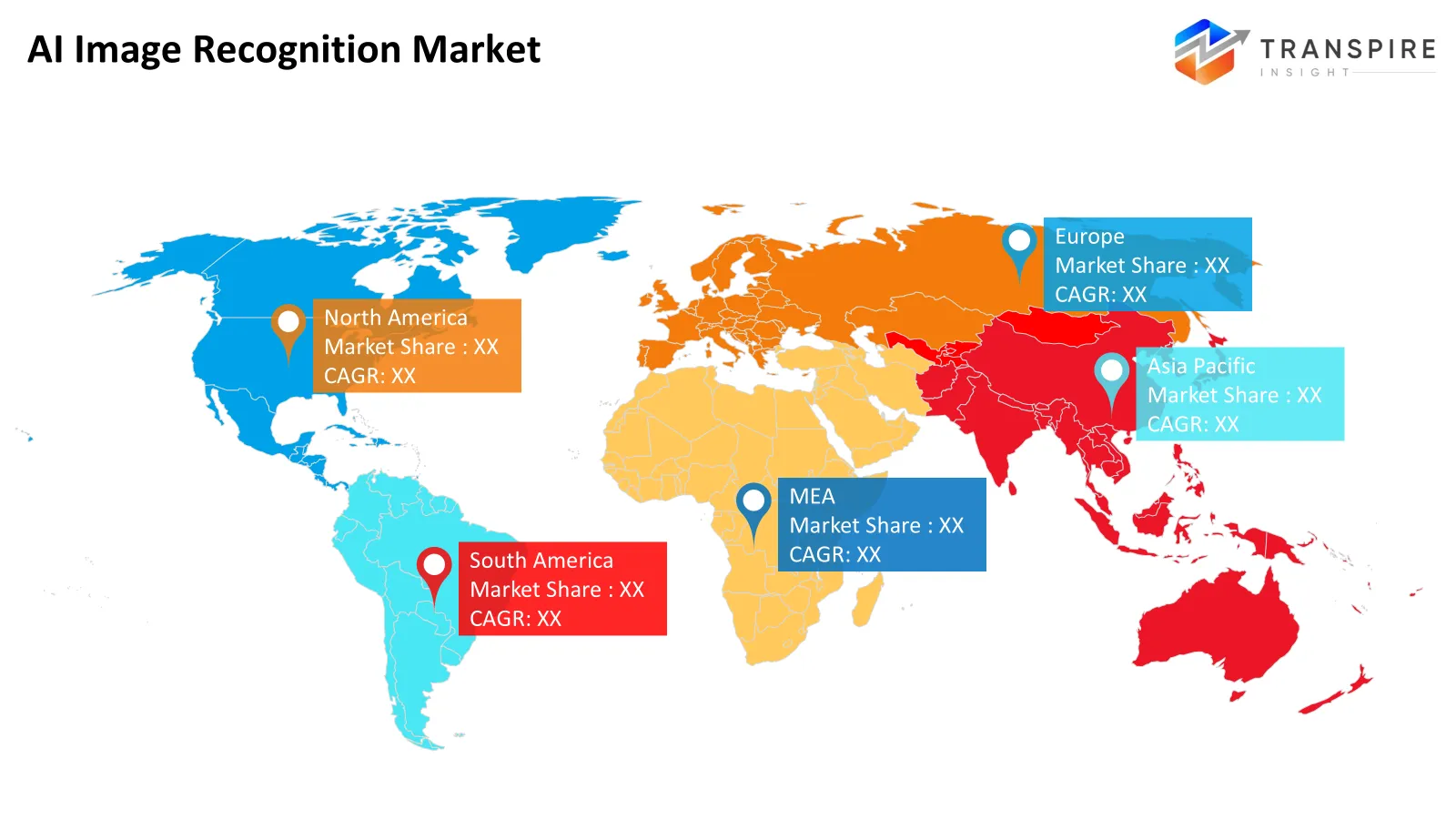
North America maintains a strong lead, with 27.35% of the market. Driven by hyperscale cloud infrastructure, semiconductor breakthroughs, and early enterprise automation uptake, North America has a high-penetration concentration of demand in retail, logistics, health, defence, and advanced manufacturing, where visual decision-making is a directly measurable operating expense. India, leveraging scale advantages, the presence of industry-leading giants such as NVIDIA, Microsoft, Google, Amazon Web Services, and Intel, and a large ecosystem for chips, model development, cloud deployment, and enterprise use, is an up-and-coming leader with great commercial potential.
In September 2026, NVIDIA officially agreed to acquire the leading open-source AI repository platform, Hugging Face, for approximately $12.93 billion. This monumental acquisition bridges the gap between hardware and community model deployment, giving NVIDIA a direct path to over 18 million developers and 200,000 enterprise organizations utilizing open-weight AI architectures across cloud frameworks.
https://blogs.nvidia.com/blog/nvidia-to-acquire-hugging-face/
Europe is an important regional market at 24.00% share, but its growth profile is different to that of platform-led growth seen in North America. Europe's adoption of technology is driven by automotive manufacturing, industrial automation, medical imaging and quality-control use cases rather than cloud-scale consumer use cases. Regulatory certainty provides reassurance, and the EU AI Act has increased the requirement for technical documentation, transparency, and governance capabilities for deployments of AI. Providers of general-purpose AI models have been under the relevant EU obligations since August 2025, cementing compliance-focused visual AI as a promising regional opportunity.
In January 2026, Siemens expanded its long-standing partnership with NVIDIA to develop the Industrial AI Operating System to revolutionise how customers design, engineer, and operate physical systems.
Asia-Pacific, holding 26.00% of the market, is the fastest-growing region with a projected 15.61% CAGR. Its acceleration reflects expanded smart-manufacturing investment, growing electronics production, smart-city programmes, and high-volume e-commerce operations. China, Japan, South Korea, India, and Southeast Asia are seeing a widening use of image recognition in factory inspection, digital payments, traffic analytics, agriculture, and retail fulfilment. Future opportunity lies in lower-cost edge devices and locally trained models that serve multilingual, high-density, and connectivity-variable operating environments. Latin America contributes 12.00%, while the Middle East and Africa account for 10.65%, with surveillance modernisation, logistics digitisation, and smart-infrastructure projects providing selective growth pathways.
In September 2026, IIEST, Shibpur partnered with TCS to launch a state-of-the-art centre of excellence in artificial intelligence. The collaboration advances applied research across key domains, including computer vision and image processing, to strengthen ties between higher education and the technology sector.
Who are the Key Players in the AI Image Recognition Market, and how do they compete?
Competition includes compute platforms, cloud artificial intelligence, enterprise software and niche vision vendors. Differentiation is increasingly based on inference efficiency, multimodal capabilities, deployment flexibility and vertical integration. NVIDIA and Intel focus on the breadth of infrastructure, while Google, Microsoft, IBM and AWS prioritise managed artificial intelligence and enterprise ecosystems. Qualcomm aims for power-efficient inference at the edge; Sony aims for sensor-driven differentiation.
NVIDIA leverages accelerated computing and its software ecosystems to support high-powered vision workloads. Intel emphasises scalable inference infrastructure and partnerships with industry. Google and Microsoft extend visual AI from cloud services to end-user workflows and endpoints. IBM aims for governed hybrid AI. AWS emphasises cloud-based services that lower deployment friction. Qualcomm emphasises power-efficient inference at the edge. Sony emphasises sensor-based differentiation. NEC and Sense Time focus on specialized visual intelligence. Cognex, Keyence, Basler, Teledyne Technologies and Zebra Technologies specialize in industrial inspection, sensing, cameras and automation workflows, and depend upon vertical solutions, integration partners and the customer base for growth. Sector expertise remains a key point of differentiation.
Key Players are:
- NVIDIA
- Intel
- Microsoft
- IBM
- Amazon Web Services
- Qualcomm
- Sony
- NEC
- Cognex
- Keyence
- Basler
- Teledyne Technologies
- Zebra Technologies
- SenseTime
Recent Development News
- In September 2026, Elsevier and LG AI Research announced a strategic partnership to embed chemistry-specific AI vision capabilities into literature curation workflows. This collaboration deploys advanced image recognition to instantly detect and extract visual substance data from scientific patents and journals at an unprecedented scale for the Reaxys discovery platform. https://www.bio-itworld.com/news/2026/09/23/elsevier--lg-ai-research-integrate-chemistry-specific-ai-vision
- In September 2026, Cognex agreed to acquire RealSense for approximately $500 million in cash. This transaction adds advanced 3D depth-sensing and autonomous robotic perception hardware to Cognex's industrial machine-vision portfolio, accelerating edge AI deployments across factory floors. https://iottechnews.com/news/cognex-realsense-acquisition-factory-edge-ai/
- In September 2026, Ambarella partnered with Ultralytics to enable Ultralytics YOLO computer-vision models on Ambarella CVflow-powered edge devices. The collaboration simplifies deployment of real-time object detection, image classification, segmentation, and related vision workloads on low-power edge AI hardware. https://www.globenewswire.com/news-release/2026/09/15/3362191/23306/en/ambarella-and-ultralytics-collaborate-to-bring-ultralytics-yolo-models-to-cvflow-powered-edge-devices.html
What Strategic Insights Define the Future of the AI Image Recognition Market?
The market is moving toward privacy-aware, edge-first visual intelligence. Consumers seek system integration where camera data turns into a prompt operational response, not a need to digest mountains of video data. Risk centres on model drift, as changes in lighting, design, camera placement, or pop. The demographics can lurk undetected-drifting accuracy leaves manufacturers vulnerable to false alarms and missed defects. The biggest opportunity involves vertical multimodal AI, which combines images with text, sensor data, maintenance logs, and operational guidelines. A factory model that identifies a defect, then links it to machine settings and previous service reports, delivers far more value than recognition alone. A strategic focus on domain-specific datasets, model monitoring, edge inference, and auditable human-override controls will be critical. Vendors should position these as outcome-based solutions-for example, less waste, faster claim processing, or fewer retail stockouts-and not as general-purpose recognition APIs. The European Union's directive on transparency and documentation underscores the commercial case for governed, auditable AI platforms.
Key Segmentations are:
Component
- Hardware
- Software
- Services
- AI Accelerators
- Cameras
- Edge Devices
- Cloud Infrastructure
- Others
Technology
- Deep Learning
- Machine Learning
- Computer Vision
- CNN
- Transformer Models
- Generative AI
- Multimodal AI
- Others
Application
- Image Classification
- Object Detection
- Facial Recognition
- Industrial Inspection
- Medical Imaging
- Autonomous Systems
- Security & Surveillance
- Others
Deployment
- On-Premise
- Cloud
- Hybrid
- Edge
- Private Cloud
- Public Cloud
- Multi-Cloud
- Others
End User
- Retail & E-Commerce
- Healthcare
- Automotive
- Manufacturing
- Security
- Media & Entertainment
- Agriculture
- Others
By Regional Analysis
North America
- US
- Canada
- Mexico
Europe
- Germany
- UK
- France
- Italy
- Spain
- Russia
- Rest of Europe
Asia Pacific
- China
- Japan
- India
- South Korea
- Australia
- Rest of Asia Pacific
South America
- Brazil
- Argentina
- Rest of South America
Middle East & Africa
- UAE
- Saudi Arabia
- Qatar
- South Africa
- Rest of the Middle East & Africa
Frequently Asked Questions
Find quick answers to common questions.
The AI image recognition market size was valued at USD 3.27 billion in 2025 and is poised to reach USD 12.77 billion by 2033, expanding at an 18.60% CAGR.
Key segments for the AI image recognition market are Component (Hardware, Software, Services, AI Accelerators, Cameras, Edge Devices, Cloud Infrastructure, Others); Technology (Deep Learning, Machine Learning, Computer Vision, CNN, Transformer Models, Generative AI, Multimodal AI, Others); Application (Image Classification, Object Detection, Facial Recognition, Industrial Inspection, Medical Imaging, Autonomous Systems, Security & Surveillance, Others); Deployment (On-Premise, Cloud, Hybrid, Edge, Private Cloud, Public Cloud, Multi-Cloud, Others); End User (Retail & E-Commerce, Healthcare, Automotive, Manufacturing, Security, Media & Entertainment, Agriculture, Others).
Growth is primarily driven by edge AI adoption, industrial automation, real-time visual inspection, expanding healthcare imaging applications, multimodal AI, and demand for faster, low-latency image processing.
The market is led by major manufacturers, including NVIDIA, Intel, Google, Microsoft, IBM, Amazon Web Services, Qualcomm, Sony, NEC, Cognex, Keyence, Basler, Teledyne Technologies, Zebra Technologies, and SenseTime.
North America holds 27.35% and influences market dynamics through advanced AI infrastructure, hyperscale cloud platforms, strong enterprise adoption, semiconductor capabilities, and early deployment across healthcare, manufacturing, retail, and autonomous systems.
Commercial opportunities include multimodal AI, privacy-preserving edge inference, AI-enabled medical imaging, predictive industrial inspection, smart robotics, precision agriculture, and domain-specific visual intelligence.
- NVIDIA
- Intel
- Microsoft
- IBM
- Amazon Web Services
- Qualcomm
- Sony
- NEC
- Cognex
- Keyence
- Basler
- Teledyne Technologies
- Zebra Technologies
- SenseTime
About the Authors

Mayur Shinde
I am Mayur Shinde, a Senior Research Analyst at Transpire Insight, specializing in the Automotive & Transportation and Information & Communication Technology (ICT) Industry. My work focuses on analyzing emerging market trends, technological advancements, competitive landscapes, and industry developments to deliver accurate, data-driven insights. I am passionate about transforming complex market information into clear, actionable content that helps businesses, professionals, and decision-makers stay informed and make confident strategic decisions.

Chakradhar Khansole
Chakradhar serves as the Research Director at Transpire Insight, bringing over 8 years of experience in technology, innovation, and strategic market intelligence. He specializes in transforming complex market data into actionable business insights that enable organizations to make informed, growth-oriented decisions. Recognized for his strategic vision and analytical expertise, Chakradhar leads high-impact research initiatives, delivering comprehensive market assessments, competitive intelligence, and forward-looking industry analysis.
Recently Published Reports
-
Apr 2026
3D Optical Profiler Market
3D Optical Profiler Market Size, Share & Analysis Report By Type (Desktop 3D Optical Profiler, and Portable 3D Optical Profiler), By Technology (Confocal Technology, and White Light Interference), By End-Use Industry (Manufacturing, Research Institutions, Automotive, Aerospace and Defense, Medical Devices, and Other), and Geography (North America, Europe, Asia-Pacific, Middle East and Africa, South and Central America), 2021 - 2031
-
Apr 2026
Depth Sensor Market
Depth Sensor Market Size, Share & Analysis Report By Type (Infrared Depth Sensors, Time-of-Flight (ToF) Sensors, Stereo Vision Sensors, Structured Light Sensors, Ultrasonic Depth Sensors), By Application (Automotive, Robotics, Gaming, Consumer Electronics, Industrial Automation, Healthcare, Security & Surveillance, Others), By End Users (Automotive Manufacturers, Consumer Electronics Companies, Healthcare Providers, Industrial Companies, Security Agencies, Gaming Companies, Robotics Companies, Others), and Geography (North America, Europe, Asia-Pacific, Middle East and Africa, South and Central America), 2021 – 2031
-
Apr 2026
Digital Manufacturing Market
Digital Manufacturing Market Size, Share & Analysis Report By Component (Hardware, Software, and Services), By Technology (Robotics, 3D Printing, Internet of Things (IoT), and Others), By Application (Automotive and Transportation, Aerospace and Defense, Consumer Electronics, Industrial Machinery, and Others), By Process Type (Computer-Based Designing, Computer-Based Simulation, Computer 3D Visualization, Analytics, and Others), and Geography (North America, Europe, Asia-Pacific, Middle East and Africa, South and Central America), 2021 – 2031
-
Apr 2026
Digital Visa Services Market
Digital Visa Services Market Size, Share & Analysis Report By Type (Individual Travelers, Group Travelers), By Application (Tourism, Business Travel, Others), and Geography (North America, Europe, Asia-Pacific, Middle East and Africa, South and Central America), 2021 – 2031