Aerospace Supply Chains Market Summary:
According to Transpire Insights, a detailed research report on the market reflects that the aircraft manufacturing and component supply chain segment dominates the Aerospace Supply Chains Market, accounting for approximately 67% of the total share worldwide. Boeing leads the market with approximately (around USD 66.5 billion) in annual revenue and an estimated 17-21% aerospace supply chain market influence, making it a leading contributor to market development, innovation, advanced aerospace supply chain solutions, expanding manufacturing capabilities, supplier network optimization, and overall market growth dynamics.
Market Snapshot
- Market Value (2025): USD 125.6 Billion.
- Expected Market Value (2026): USD 131.8 Billion.
- Estimated Market Value (2033): USD 182.5 Billion.
- Forecast CAGR (2026-2033): 4.80%.
- Leading Region in 2025: North America
- Second-largest Region: Europe
- Fastest Growing Region: Asia Pacific
Introduction
The aerospace supply chain in the world includes the network of suppliers, producers and transporters of raw materials and components combined with suppliers in different degrees of complexity. It consists of a well-planned system of all stages of creation of ready-for-flight hardware. Tier 4 is a manufacturing of raw materials and simple hardware (metal, plastic, ordinary electronics). Tier 3 is a making part for the aerospace industry simple in construction (pumps, simple mechanical valves). Tier 2 is a creation of structures consisting of several elements in a complex system of assembly. Tier 1 is a direct supplier to OEM companies providing the end product. Aerospace Supply Chain Market is being supported by initiatives based on the focus on cost optimization, supply chain resilience, and digital transformation. Aerospace manufacturers are looking for ways to reduce production and labor costs, for instance, by improving operational and purchasing processes in new aerospace centers with well-built production networks. Adoption of risk mitigation means like geographic diversification and multi-supplier framework helps minimize supply disruptions and cut dependency on single-source suppliers. In addition, the use of AI, IoT, predictive analytics, and advanced tracking technologies is enhancing demand forecasting, speeding up compliance with requests, and increasing visibility of supply chains.
For instance: Due to significant R&D expenditures, large original equipment manufacturers (OEMs) like Boeing and Lockheed Martin, and growing manufacturing demands, North America dominates the worldwide aerospace supply chain market. To combat persistent component shortages and manage record commercial order backlogs, major industry participants are investing billions in supplier networks, such as GE Aerospace's production and external tier supplier base.

Market Highlights: -
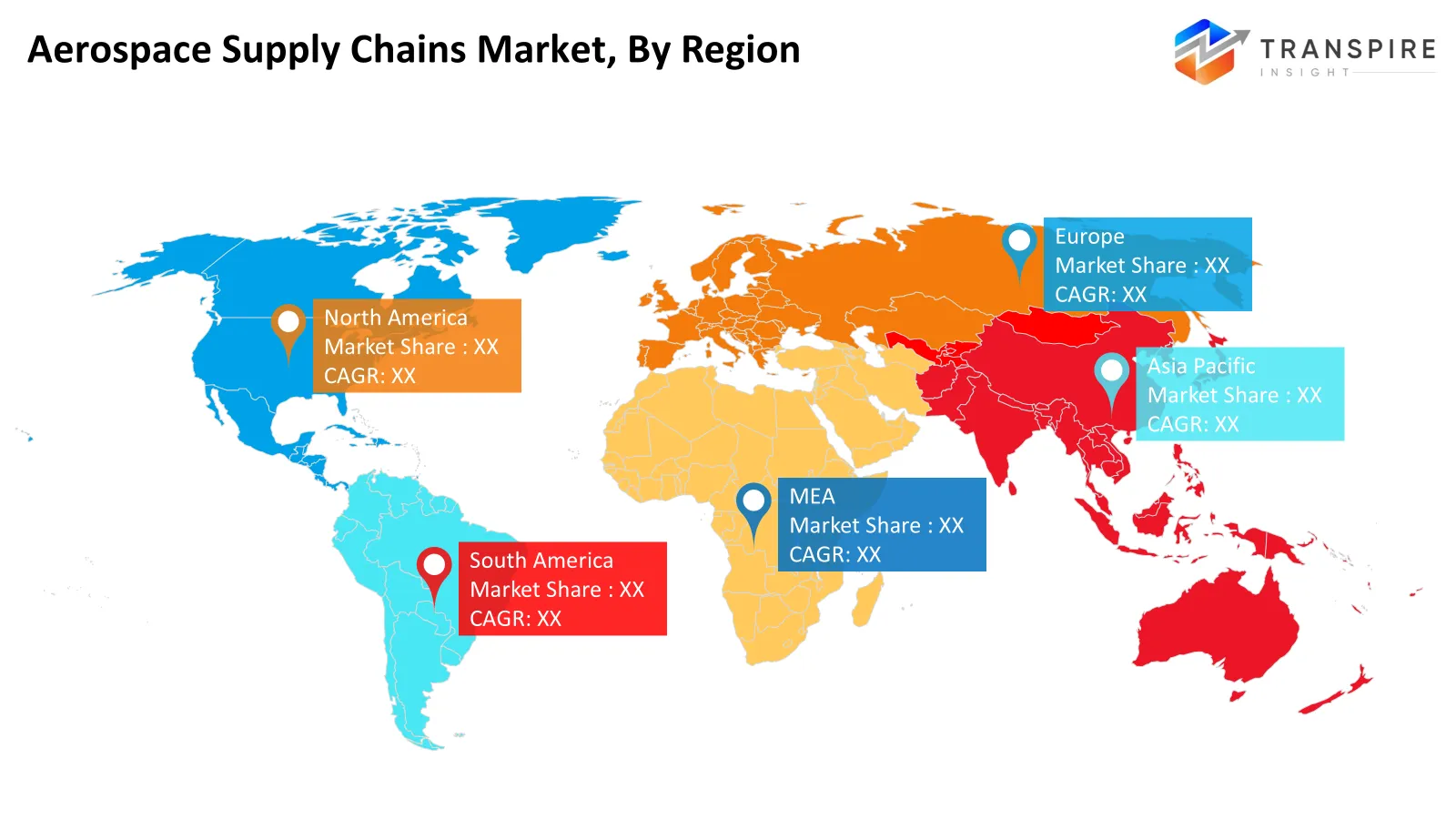
- North America is expected to grow at a rapid CAGR in the Aerospace Supply Chains Market by holding around 45% of the share during the forecast period.
- Europe is anticipated to hold around 27% share of the Aerospace Supply Chains Market over the predicted timeframe.
- Asia Pacific is anticipated to hold roughly 20% share of the Aerospace Supply Chains Market over the predicted timeframe.
- By component, the Airframes segment dominated the market and holds nearly 25% share in 2025 and is projected to grow at a substantial CAGR during the forecast period.
- By end user, the Airlines segment dominated the market and holds nearly 55% share in 2025 and is projected to grow at a substantial CAGR during the forecast period.
- By material, the Aluminium Alloys segment dominated the market and holds nearly 28% share in 2025 and is projected to grow at a substantial CAGR during the forecast period.
- and local frameworks: Around the globe governments are making moves in the form of policies such as aerospace manufacturing zones, raw materials competitiveness initiative, programs that help build resilience of supply chains, or incentives for research and development projects in the area. The goal of these policies is to create stronger domestic aviation ecosystems with the help of local suppliers development, better manufacturing processes, reduction in dependency of supply chains and overall competitiveness of regional aerospace industries.
How is Technology Driving Growth in the Aerospace Supply Chains Market?
Digital transformation is changing the Aerospace Supply Chains Market through efficiency, resilience, and operational visibility throughout the aerospace ecosystem. Digital twins and simulation technologies allow for virtual trials, advanced prototyping, and predictive scenario modeling; thus, making physical production faster and leading to a reduction in materials usage. Artificial intelligence (AI) and machine learning (ML) technologies help in inventory optimization, supply chain decision-making, as well as predicting supplier interruptions and maintenance issues in situ. With the help of IoT connectivity and real-time analytics, complete monitoring in the form of end-to-end traceability of components, suppliers, and logistics networks is done. In addition to that, automation and additive manufacturing make precision production easier, allowing for the creation of lightweight components, and speeding up the manufacturing process.
Market Drivers
The Aerospace Supply Chains Market is growing rapidly as air travel is rising, modernization of defense is nearing completion and the aerospace manufacturing sector is adapting to new changes. The growing networks of passenger and cargo transportation are forcing airlines to upgrade their fleet and renew their aircraft faster. The continuing geopolitical uncertainties have resulted in higher investments in defense and greater demand for advanced aircraft systems and components. The worn commercial and military equipment needs constant MRO and spare parts supply. Moreover, companies operating in the aerospace sector are implementing a strategy of expansion into the other regions, including India, to have a chance to use cheaper engineering and manufacturing resources. The growth of supply chains is also made possible due to the development of lightweight composites and hybrid-electric aircraft technologies. In the Aerospace Supply Chains Market, companies are utilizing strategic geographic diversification, operational enhancement, and supplier differentiation based on value. The development of production capabilities in several regions helps aerospace companies mitigate risks involving their supply chains, increase resilience, and ease obstacles stemming from specific regions. Advanced technology solutions, like instant tracking systems, digital twins, and forecasting analytics, improve inventory management, lower the amount of material waste, minimize time for production, and boost efficiency of operations. Besides, suppliers providing localized support, rapid prototyping options, and flexible manufacturing technologies gain competitive advantages while responding to changing demands of aircraft manufacturers and operators.
For Instance: -
- aerospace supply chains were severely affected by Russia's war in Ukraine, which resulted in significant changes to domestic manufacturing initiatives, regional investments, and the sourcing of raw materials. While Russia invests billions in domestic production, Western aircraft companies are reducing their reliance on Russian suppliers.
- Due to defense expansions, increased R&D, and regional sovereignty aspirations, Europe's aerospace supply chain business is growing quickly. Major GE Aerospace facility investments and an Intesa Sanpaolo SME credit agreement are important financial infusions; nonetheless, structural fragmentation among Tier-2/3 suppliers continues to be a barrier.
Restrain
The Aerospace Supply Chains Market has challenges, including a shortage of skilled labor, constraints on essential raw material availability, uncertainties associated with geopolitics, and interruptions in procurement networks. Lack of visibility over sub-tier suppliers and stringent rules and regulations increases. These contribute to lead times and production cost increases, as well as vulnerabilities in aerospace production and delivery processes.
Analysis of Prices and Consumer Behaviour
Aircraft components and parts supply chain management (aircraft parts supply chain management) dominates the aerospace supply chain solution market with about 55-60% market share (mainly driven by the demand from aircraft manufacturers, defense contractors, and MRO providers). The price of advanced aerospace supply chain solutions is expected to be 20-30% more than that of traditional logistics solutions because these solutions contain digital supply chain platforms, predictive analytics, automation, AI, and real-time tracking solutions for better performance. Close to 40-45% of aerospace supply chain investments are connected with such areas as digital transformations, logistics optimization, and advanced inventory management. The growth in the expenditures volume is caused by growing aircraft production, expansion of the fleet, supplier network complexity, and the demand for better supply chain visibility. Civil and defense aviation sectors account for around 75-80% of total aerospace supply chain demand. According to purchasing behavior analysis, around 60% of aerospace companies give priority to supplier reliability, quality compliance, delivery performance, and supply chain reliability. 30-35% of aerospace companies prefer entering into long-term procurement contracts and establishing strategic supplier partnership to mitigate sourcing risks, control expenses and procure the necessary aircraft parts and materials for their operations.
Top Companies in the Aerospace Supply Chains Market
- Boeing
- Airbus
- RTX Corporation
- GE Aerospace
- Safran
- Rolls-Royce
- Honeywell
- Spirit AeroSystems
- Leonardo
- GKN Aerospace
- Triumph Group
- Collins Aerospace
- BAE Systems
- Parker Hannifin
- Hexcel Corporation
Market Segmentation
The Aerospace Supply Chains Market share is divided into five categories: By component, supply chain stage, aircraft, end user and material.
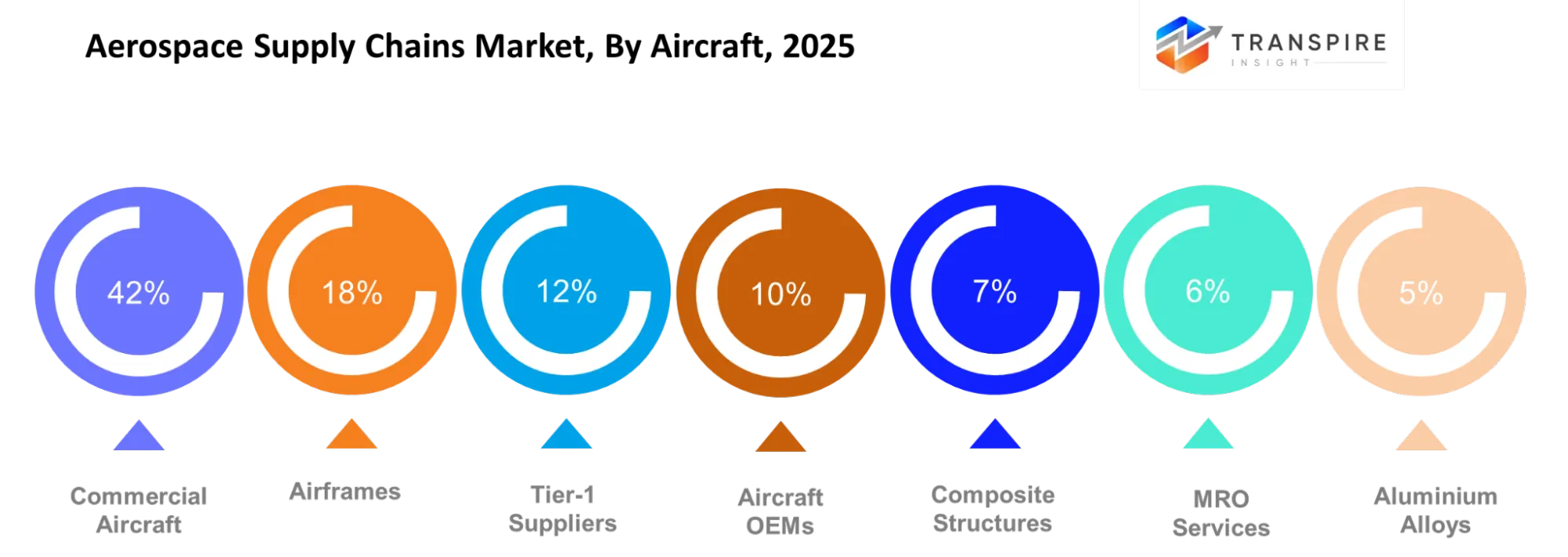
The Airframes dominated the market, accounting for nearly 25% in 2025 and is expected to rise at a significant CAGR during the forecast period.
The Aerospace Supply Chains Market is segmented by component into Airframes, Engines, Avionics, Landing Gear, Cabin Interiors, Electrical Systems, Composite Structures, Others. Among these, the Airframes segment dominated the market, accounting for nearly 25% in 2025 and expected to increase at a significant CAGR during the forecast period. The Airframes segment takes the lead in the Aerospace Supply Chains Market considering its large manufacturing value, wide application of advanced materials, and complicated supply chain networks. The manufacturing of aircraft is being increased, aircraft modernization programs are being implemented, demand for lightweight composites is on the rise, and an enormous number of maintenance, repair, and overhaul activities are giving rise to the need for the growth of the segment.
The Airlines dominated the market, accounting for nearly 55% in 2025, and is expected to rise at a significant CAGR during the forecast period.
The Aerospace Supply Chains Market is segmented by end user into Aircraft OEMs, Airlines, Defence Organizations, MRO Providers, Space Agencies, Leasing Companies, Government, Others. Among these, the Airlines segment dominated the market, accounting for nearly 55% in 2025 and expected to increase at a significant CAGR during the forecast period. The Airframes segment takes the lead in the Aerospace Supply Chains Market considering its large manufacturing value, wide application of advanced materials, and complicated supply chain networks. The manufacturing of aircraft is being increased, aircraft modernization programs are being implemented, demand for lightweight composites is on the rise, and an enormous number of maintenance, repair, and overhaul activities are giving rise to the need for the growth of the segment.
The Aluminium Alloys dominated the market, accounting for nearly 28% in 2025 and is expected to rise at a significant CAGR during the forecast period.
The Aerospace Supply Chains Market is segmented by material into Aluminium Alloys, Titanium Alloys, Composite Materials, Steel, Nickel Alloys, Advanced Ceramics, High-performance Polymers, Others. Among these, the Aluminium Alloys segment dominated the market, accounting for nearly 28% in 2025 and expected to increase at a significant CAGR during the forecast period. In the Aerospace Supply Chains Market, the Aluminium Alloys segment is in a leading position mainly because of its lightweight characteristic, the excellent ratio between strength and weight, corrosion prevention properties, and affordability. Its extensive application in construction of airplanes, growth of commercial aircraft production, modernization of airplane fleets, and higher demand for fuel-efficient aerospace parts are driving forces of the segment throughout the forecast period of the market.
Regional Segment Analysis of the Aerospace Supply Chains Market:
- North America (U.S., Canada, Mexico)
- Europe (Germany, France, U.K., Italy, Spain, Rest of Europe)
- Asia-Pacific (China, Japan, India, Rest of APAC)
- South America (Brazil and the Rest of South America)
- The Middle East and Africa (UAE, South Africa, Rest of MEA)
North America is the fastest-growing region in the Aerospace Supply Chains Market during the period, holding around 45% share.
North America is expected to grow at a rapid CAGR in the Aerospace Supply Chains Market holding around 45% share during the forecast period. The North America Aerospace Supply Chain Market is characterized by the presence of major players in the aircraft manufacturing domain, extensive investments in defense, and the presence of advanced aerospace suppliers. Various factors such as improved and innovative research and development capabilities, effective and skilled manufacturing infrastructure, increasing demand in commercial aviation, and a rapid shift to digital supply chain technologies continue to support the growth of the North American market over the years.
Europe is expected to grow at a rapid CAGR in the Aerospace Supply Chains Market, holding around 27% of the share during the forecast period
Europe is expected to grow at a rapid CAGR in the Aerospace Supply Chains Market holding around 27% share during the forecast period. The North America Aerospace Supply Chain Market is characterized by the presence of major players in the aircraft manufacturing domain, extensive investments in defense, and the presence of advanced aerospace suppliers. Various factors such as improved and innovative research and development capabilities, effective and skilled manufacturing infrastructure, increasing demand in commercial aviation, and a rapid shift to digital supply chain technologies continue to support the growth of the North American market over the years.
Asia Pacific is the fastest-growing region in the Aerospace Supply Chains Market during the period, holding roughly 20% share.
Asia Pacific is the fastest-growing region in the Aerospace Supply Chains Market during the forecast period, holding roughly 20% share during the forecast period. The Aerospace Supply Chains Market is growing the fastest in the Asia Pacific region owing to the increase in aircraft manufacturing, growing passenger air traffic, improvement in defense procurement, and massive investments in aerospace infrastructure. With developments in manufacturing capacities in China, India, and Japan, alongside the competitive cost of production and support from the government, the aerospace supply chain development and market growth in the region are enhanced.
Strategies for Market Growth in Non-Leading Regions:
The growing use of advanced aerospace supply chain management solutions will provide tremendous advantages to small and medium-sized aerospace manufacturers and suppliers in developing regions. The ability to locally produce certain parts, to establish regional aerospace component production, and to create localized supply chains will help reduce the reliance on imports, increase efficiency, and lower the costs of production and logistics. The establishment of partnerships with local aerospace manufacturers, suppliers of aviation parts, technology providers, logistics companies, and distributors will help improve market access for the players in the Aerospace Supply Chain Market. More education in aerospace production process, supply chain optimization, regulatory compliance, quality assurance, and digital supply chain management would be necessary to increase the knowledge of the players in the industry. Moreover, appropriate financing options, long-term supply contracts, and collaboration agreements will ensure that aerospace supply chain solutions are available to the companies in the industry.
Future Market Trends for the Aerospace Supply Chains Market: -
- Artificial Intelligence and Machine Learning: Automating quality checks, predicting maintenance, and optimizing industrial scheduling through the use of AI algorithms and agentic AI.
- Real-time Visibility Tools: Using digital twins and IoT tracking to manage high-rate assembly lines, monitor material flows, and lower shop-floor variability.
- Modular Automation: Repetitive machining of titanium and composites using smaller, modular automated setups instead of large, rigid robotic cells.
- Agentic AI and Analytics: Using AI to reduce factory rework, anticipates maintenance requirements and improve quality control.
- Real-Time Tracking: Combining data analytics with Internet of Things (IoT) sensors for predictive maintenance and end-to-end component visibility.
Recent Development
- In February 2026: The ePlane Company formed a partnership with HENSOLDT Avionics for avionics integration. Through this agreement, both companies will collaborate to design and implement a modern avionics system for the e200X electric vertical take-off and landing (eVTOL) airplane. Both companies are committed to developing advanced avionics solutions, including navigation, flight management systems, situational monitoring, and communication. They will also focus on boosting the aerospace supply chain ecosystem as well as supporting the process of designing next-generation aircraft.
- In July 2026: GrayMatter Robotics introduced a breakthrough solution capable of surface finishing powered by Physical AI. The aim is to address the challenge of the shortage of skilled workers and to enhance efficiency in manufacturing processes. The new solution allows for automated finishing of complicated aerostructures resulting in increased output, reduced reworks, and better stability in manufacturing. The advantage consists in supporting the Aerospace Supply Chains market by enhancing suppliers’ capacities, increasing speeds of production of aerospace components, and encouraging the use of intelligent automation technology.
- In July 2026: The ePlane Company made a groundbreaking announcement regarding its new partnership with Azista Composites for the supply of composite materials for its e200X electric vertical take-off and landing (eVTOL) aircraft. The partnership will support the production of state-of-the-art composite materials, including carbon fiber and glass fiber prepregs, for the airframe and radome production. The current partnership plays an important role in boosting the Aerospace Supply Chains Market by providing access to modern lightweight materials, creating exceptional supplier networks, promoting the production of aerospace components, and speeding up the production of state-of-the-art aircraft.
Market Segment
This study forecasts revenue at , regional and country levels from 2020 to 2033. Transpire Insights has segmented the Aerospace Supply Chains Market based on the below-mentioned segments:
Aerospace Supply Chains Market, By Component
- Airframes
- Engines
- Avionics
- Landing Gear
- Cabin Interiors
- Electrical Systems
- Composite Structures
- Others
Aerospace Supply Chains Market, By Supply Chain Stage
- Raw Material Suppliers
- Tier-1 Suppliers
- Tier-2 Suppliers
- OEM Manufacturing
- MRO Services
- Distribution & Logistics
- Aftermarket Services
- Others
Aerospace Supply Chains Market, By Aircraft Type
- Commercial Aircraft
- Military Aircraft
- Business Jets
- Helicopters
- UAVs
- Regional Aircraft
- Spacecraft
- Others
Aerospace Supply Chains Market, By End User
- Aircraft OEMs
- Airlines
- Defence Organizations
- MRO Providers
- Space Agencies
- Leasing Companies
- Government
- Others
Aerospace Supply Chains Market, By Material
- Aluminium Alloys
- Titanium Alloys
- Composite Materials
- Steel
- Nickel Alloys
- Advanced Ceramics
- High-performance Polymers
- Others
Aerospace Supply Chains Market, By Regional Analysis
North America
- US
- Canada
- Mexico
Europe
- Germany
- UK
- France
- Italy
- Spain
- Russia
- Rest of Europe
Asia Pacific
- China
- Japan
- India
- South Korea
- Australia
- Rest of Asia Pacific
South America
- Brazil
- Argentina
- Rest of South America
Middle East & Africa
- UAE
- Saudi Arabia
- Qatar
- South Africa
- Rest of the Middle East & Africa
Frequently Asked Questions
Find quick answers to common questions.
Increasing aircraft production, air travel demand, defense spending, digital technologies, and resilient supplier networks are driving aerospace supply chain market growth.
North America dominates with approximately 45% market share, supported by leading OEMs, defense investments, advanced manufacturing, and strong aerospace infrastructure.
The Airframes segment leads with nearly 25% market share, driven by aircraft production, lightweight materials, fleet modernization, and increasing MRO activities.
AI, IoT, automation, and digital twins improve visibility, forecasting, inventory management, predictive maintenance, and operational efficiency across aerospace supply chains.
Labor shortages, raw material constraints, geopolitical risks, supplier disruptions, regulatory compliance, and extended lead times challenge aerospace supply chain performance.
- Boeing
- Airbus
- RTX Corporation
- GE Aerospace
- Safran
- Rolls-Royce
- Honeywell
- Spirit AeroSystems
- Leonardo
- GKN Aerospace
- Triumph Group
- Collins Aerospace
- BAE Systems
- Parker Hannifin
- Hexcel Corporation
About the Authors

Tejashri Dhatrak
I am Tejashri Dhatrak, a Senior Research Analyst at Transpire Insight, specializing in the Aerospace and Defence sector. My work focuses on analyzing industry trends, defence technologies, market developments, and emerging innovations that shape the global aerospace and security landscape. At Transpire Insight, I research complex topics, evaluate credible sources, and transform technical insights into accurate, well-structured, and easy-to-understand content for industry professionals and decision-makers. My goal is to provide reliable, research-backed information that helps readers stay informed about defence capabilities, aerospace advancements, strategic developments, and the evolving dynamics of the global defence ecosystem.

Chakradhar Khansole
Chakradhar serves as the Research Director at Transpire Insight, bringing over 8 years of experience in technology, innovation, and strategic market intelligence. He specializes in transforming complex market data into actionable business insights that enable organizations to make informed, growth-oriented decisions. Recognized for his strategic vision and analytical expertise, Chakradhar leads high-impact research initiatives, delivering comprehensive market assessments, competitive intelligence, and forward-looking industry analysis.
Recently Published Reports
-
Apr 2026
Aerospace Fluoropolymers Market
Aerospace Fluoropolymers Market Size, Share & Analysis Report By Type (PTFE, FEP, PFA, ETFE, and Others), By Application (Electrical Insulation, Seals & Gaskets, Coatings, and Others), By End User (Commercial Aviation, Military Aviation, General Aviation, and Others), and Geography (North America, Europe, Asia-Pacific, Middle East and Africa, South and Central America), 2021 - 2031
-
Apr 2026
Airborne SATCOM System Market
Airborne SATCOM System Market Size, Share & Analysis Report By Type (SATCOM Terminals, Transceivers, Airborne Radio, Modems and Routers, SATCOM Radomes, and Other), By Application (Government and Defense and Commercial), and Geography (North America, Europe, Asia-Pacific, Middle East and Africa, South and Central America), 2021 – 2031
-
Apr 2026
Ship Leasing Market
Ship Leasing Market Size, Share & Analysis Report By Vessel Type (Container Ships, Bulk Carriers, Tankers, and Specialized Vessels), By Lease Duration (Short-Term Lease (Less than 1 year), Medium-Term Lease (1-5 years), and Long-Term Lease (More than 5 years)), By Lease Type (Bareboat Charter, Time Charter, Financial Lease, and Others), By End-User Industry (Oil and Gas, Manufacturing and Industrial, Automotive, Agriculture and Food, Retail and Consumer Goods, and Others), and Geography (North America, Europe, Asia-Pacific, Middle East and Africa, South and Central America), 2021 – 2031
-
Apr 2026
Thread Rolling Dies Market
Thread Rolling Dies Market Size, Share & Analysis Report By Type (Flat Thread Rolling Dies, Circular (Cylindrical) Dies, Tangential Thread Rolling Dies, Planetary Thread Rolling Dies, and Other Types), By Material Type (High-Speed Steel (HSS), Carbide, Tool Steel, Alloy Steel, and Other Specialized Alloys), By Distribution Channel (Direct Sales, Distributors and Dealers, and Online Platforms), By Application (Automotive Industry, Aerospace and Defense, Construction and Infrastructure, Industrial Machinery, Electronics and Electrical Components, Medical Devices, and Fastener Production), and Geography (North America, Europe, Asia-Pacific, Middle East and Africa, South and Central America), 2021 – 2031
Our Clients