

Europe Electric Vehicle Supply Equipment [EVSE] Market Summary
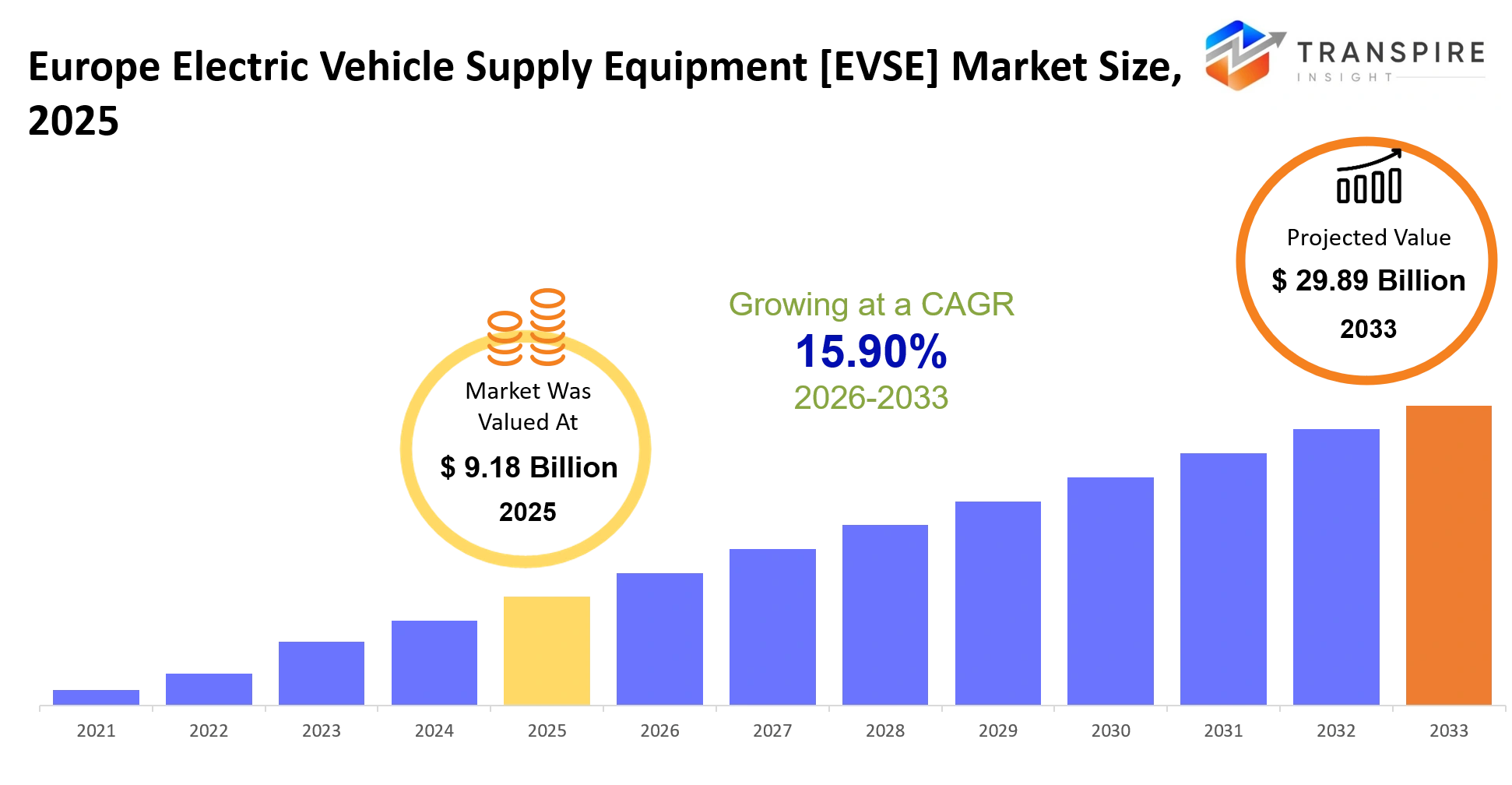
As per Transpire Insight Analysis the Europe Electric Vehicle Supply Equipment [EVSE] Market size is estimated at USD 9.18 Billion in 2025 and is anticipated to reach USD 29.89 Billion by 2033, growing at a CAGR of 15.90% from 2026 to 2033.
The Europe Electric Vehicle Supply Equipment (EVSE) Market kind of helps real life electric mobility happen, because it provides the charging infrastructure that lets passenger cars, commercial fleets , buses, and industrial vehicles keep running smoothly across cities along highways, at logistics hubs, and even at workplaces. When the charging networks stay dependable you get less headache from range limitations, stronger fleet utilization, and businesses plus public authorities can stitch electric transport into everyday work routines.
In the last three to five years this market has moved away from only installing basic charging points and it started leaning toward high power, connected, software enabled charging ecosystems instead. These setups support smart energy management and payment integration too , so honestly the entire experience feels more seamless. At the same time, tougher emissions rules all across the European Union and the Alternative Fuels Infrastructure Regulation, kept nudging extra infrastructure spending, and also widened charging coverage.
With charging availability getting more dependable and interoperable, fleet operators , companies, and consumers basically end up with more confidence about switching over to electric vehicles. That kind of confidence slowly turns into more reliable equipment sales, steadier service income, and longer range infrastructure investment, across the entire region, yeah, it just sort of snowballs.
Europe Electric Vehicle Supply Equipment [EVSE] Market Size & Forecast:
- Europe Electric Vehicle Supply Equipment [EVSE] Market Size 2025: USD 9.18 Billion
- Expected Market Value 2033: USD 29.89 Billion
- Forecast CAGR: 15.90%
- Leading region in 2025: Germany, the Netherlands, France, Norway, and the United Kingdom
- Fastest Growing region: Central and Eastern Europe, with Poland, Czech Republic, Hungary, Romania, and Slovakia
- Key Profile: ABB, Siemens, Schneider Electric, Shell Recharge, ChargePoint, EVBox, Wallbox, Alfen, Blink Charging, Tesla, Eaton, Tritium, Delta Electronics, Webasto, Legrand.
Key Market Insights
- Western Europe kind of dominated the Europe EVSE industry size, with something like 72% market share in 2025, led by Germany France the Netherlands, Norway and also the United Kingdom.
- Central and Eastern Europe will stay as the fastest-growing regional market during 2025–2033, mostly because of EU infrastructure funding, and also because more charging targets are being pushed at the national level.
- On the product side, AC charging equipment was the clear winner, holding nearly 62% market share in 2025, and that was mainly driven by all the residential , workplace, and destination charging that got installed.
- DC fast chargers ended up as the second-largest product segment, mainly due to highway corridors and commercial fleet operators expanding their high-power charging deployments.
- The ultra-fast DC chargers, those above 150 kW, should show the quickest growth through 2033, supported by heavy-duty transport needs and long-distance travel requirements.
- For the charging infrastructure side, public charging infrastructure accounted for roughly 58% market share in 2025, since governments plus private operators continued to expand accessible charging networks.
- As for applications, commercial fleet charging will be the fastest-growing through the forecast period, because logistics delivery and municipal transport fleets keep moving into electrification.
- Finally, the end-user segment was led by commercial operators and charge point operators, with close to 55% share in 2025, helped by network expansion and recurring utilization.
- Fleet operators are kinda expected to see the quickest growth through 2033, because electrification mandates are pushing things along and also with reduced operating costs across logistics and public transport services.
What are the Key Drivers, Restraints, and Opportunities in the Europe Electric Vehicle Supply Equipment [EVSE] Market?
The main force that’s, like really, pushing the market is Europe’s regulatory drive toward transport decarbonization. The Alternative Fuels Infrastructure Regulation and the national zero-emission mobility programs, sort of set off big time charging investment across highways , cities, and also at commercial sites. Battery electric vehicle registrations grew faster than charging availability in several countries, so governments and private operators started to speed up infrastructure rollouts. More charging points help loosen range limits and they also make people feel more certain when using the network. When charger utilization is higher you get recurring service income, which in turn encourages still more deployment of equipment across residential commercial and public locations.
Still, the biggest kind of structural snag is electricity grid constraints together with drawn-out permitting. Distribution network improvements need multi-year planning, utility sign offs, and major capital outlays before high-power stations can actually go live. From Transpire Insight’s look at regional procurement notices and launch timing, supply chain concentration keeps showing up as the key execution risk. These issues, in practice, stretch project commissioning timelines, they delay when revenue shows up, and they limit charger availability on high traffic corridors even though there are strong investment commitments.
The strongest opportunity is in combining ultra-fast charging with renewable power, battery storage ,and intelligent energy management platforms, like kind of linked together. Vehicle-to-grid tech, adaptive load balancing, and AI-enabled charging tuning will make better use of assets while cutting electricity costs and maybe even smoothing demand. Countries such as Poland , Spain, Italy, and Romania are pushing both public and private investment programs too, which is creating favorable conditions for new charging networks, software platforms, and energy services that will back up the next phase of industry expansion.
What Has the Impact of Artificial Intelligence Been on the Europe Electric Vehicle Supply Equipment [EVSE] Market?
Artificial intelligence is a kind of reshaping of EV charging infrastructure via intelligent oversight, automated asset management , and real time operational control. Lately, network operators are more and more using AI to supervise charger wellbeing, tune energy allocation, spot equipment faults early, and also automate compliance updates across thousands of linked charging sites. With advanced analytics in the mix, grid interaction gets better too , because AI helps balance charging loads when peak electricity demand shows up and it cuts down on energy losses at the same time.
Machine learning models can forecast charger failures before a full equipment breakdown happens. That means maintenance teams can swap parts proactively, rather than waiting for a sudden outage, which is just… messy. Predictive demand forecasting also helps operators see which areas should get new charging stations, so utilization becomes higher and the returns on investment look stronger. On top of that, AI optimizes charging schedules for commercial fleets, by considering electricity prices, plus vehicle availability, and also route planning, but all together not separately. Overall, these functions improve charger uptime, they boost operational efficiency, cut maintenance costs, and just make the customer experience smoother across those connected charging environments, in a sort of seamless way.
Still, adoption has some real, practical limits. For example, integrating AI platforms with legacy charging hardware utility systems , and multiple software standards takes a lot of investment and technical know how. Also data quality is not consistent across charging networks, so prediction accuracy can drop in tricky real world operating conditions. And then there are connectivity gaps in remote locations, they limit real time optimization , which slows down the larger roll out of AI enabled charging management across the European charging ecosystem.
Key Market Trends
- Since 2022, ultra fast chargers over 150 kW have spread pretty fast along Trans-European Transport Network corridors, to help with long distance electric mobility in a way that feels more seamless.
- Smart charging platforms are becoming more and more intertwined with renewable energy and battery storage, which helps grid stability.
- It also tends to lower operating costs for charging network operators, even when demand starts climbing.
- The Alternative Fuels Infrastructure Regulation basically kicked off quicker cross border infrastructure planning and, as a result, charging interoperability improved across European Union member states.
- For fleet charging, investments have moved toward depot based energy management systems, as logistics companies electrify delivery fleets. Also heavy commercial vehicles keep pushing the need for steadier power control.
- ABB E-mobility, Siemens, and Schneider Electric keep widening their software enabled charging portfolios, tying in cloud connectivity and predictive maintenance.
- Since 2023, roaming platforms have improved payment interoperability , so drivers can use multiple charging networks through unified digital services, without too much hassle in practice.
- On the manufacturing side, strategies increasingly favor modular charger designs. That makes upgrades simpler, and it cuts installation time while charging networks keep expanding.
- Utilities and charge point operators are also investing in dynamic load balancing, to handle higher electricity demand without waiting for immediate large scale grid expansion.
- And public private partnerships across Germany, France, Spain, Italy, and Poland keep speeding up regional charging coverage especially in transport corridors that were underserved before.
Europe Electric Vehicle Supply Equipment [EVSE] Market Segmentation
By Charger Type :
AC chargers keep taking the largest share, mainly because residential buildings , workplaces and commercial parking facilities tend to prefer affordable yet practical charging setups. DC fast chargers still keep solid market value, especially when they are rolled out along highways, in urban mobility hubs, and near retail places, where faster charging really boosts vehicle availability with less downtime. Ultra-fast chargers should see the quickest expansion too, since long-distance travel and commercial transport ask for higher charging speeds while also trying to cut down the waiting time. Smart chargers are gaining wider acceptance due to energy management features, these help with efficient electricity use and can also lower day to day operating costs.
Portable chargers stay in steady demand for emergency charging situations and temporary mobility needs, meanwhile wireless charging systems are starting to move beyond pilot efforts and toward more commercial testing in only selected locations. Bidirectional chargers open up new possibilities, they can support vehicle-to-grid style applications, which helps grid flexibility as well as energy balancing. Modular product designs also make a difference, because they simplify later capacity expansion and reduce the whole maintenance mess. Continuous technology upgrades will keep improving product performance over time, and they should raise the long-term infrastructure value as things evolve.
By Installation Type :
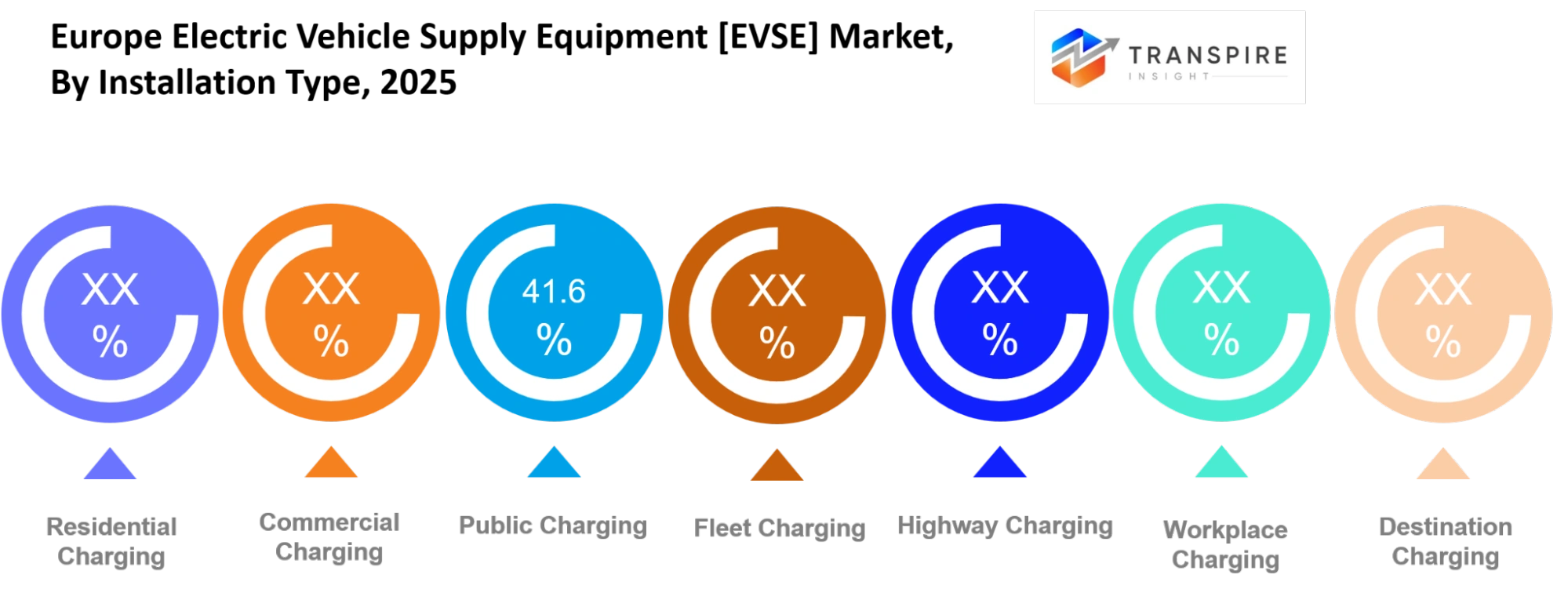
Public charging is still the leading installation category, basically because the overall infrastructure availability helps people with everyday mobility, tourism, and even cross-border trips. Commercial charging is not far behind—shopping centers, hospitality spaces and office buildings are rolling out charging access so they can pull in customers and employees, kinda in the same move. Fleet charging is likely to be the quickest to grow, since logistics companies, public transport operators, and delivery businesses are swapping conventional vehicles for electric ones. Highway charging keeps getting larger along key transport corridors to enable trouble free long-distance travel.
Residential charging stays pretty steady, mainly due to home charging convenience and those lower installation costs for individual vehicle owners. Workplace charging is also slowly gaining traction, it supports employee perks and it matches corporate sustainability aims even more or less. Destination charging is meanwhile spreading across hotels, recreational areas and entertainment venues where people tend to park longer, so the charging needs, kind of , fit better there.Overall, having more kinds of installations will make network access easier, and it should encourage more balanced infrastructure development across both urban and rural areas.
By Connector Type :
CCS leads the connector segment because broad compatibility with passenger vehicles and public charging facilities supports widespread deployment across European nations, or something like that. Type 2 connectors are still essential for AC charging setups in residential spaces , workplace areas, and commercial sites. Multi-standard connectors keep expanding because charging operators want broader vehicle matchability while reducing infrastructure duplication. Tesla connector adoption is growing thanks to wider network accessibility and ongoing interoperability programs, basically.
CHAdeMO still turns up in older charging networks, even when new installs keep drifting toward standards that are more broadly accepted. Wireless charging systems are still in play, kind of in development mode, with a slow commercial adoption in selected scenarios. Also the connector standardization aspect helps make cross-border charging simpler, and it boosts day to day convenience for drivers moving along regional transport corridors.Ongoing harmonization efforts should strengthen charging efficiency while lowering compatibility worries for vehicle owners and infrastructure operators.
By Deployment :
Networked systems account for the largest deployment share , because remote monitoring, payment integration, and operational management help raise charger utilization and overall service reliability. Fixed systems still stay common across public locations, commercial facilities, and residential developments, where permanent infrastructure gives steady support for long-term charging demand. Cloud connected systems are set to grow quickly via advanced analytics, remote diagnostics and software updates that make day to day operations more efficient. Smart grid systems are gaining ground too, by balancing electricity demand with what’s happening during charging activity.
Mobile systems handle temporary events, emergency situations, and far away locations where permanent infrastructure is limited or just not practical. Standalone systems keep showing up for smaller installs, where simple operational requirements and lower setup costs matter most. Modular systems make network expansion easier , since extra charging capacity can be added without doing a huge infrastructure overhaul. Digital connectivity will keep strengthening system performance, and also make maintenance planning more precise across charging networks.
By End User :
Commercial operators are basically the leading end-user group, since retail businesses, hospitality providers ,and parking operators keep expanding charging infrastructure for customer services, plus extra revenue openings. Charging service providers still show solid investment push, like network expansion and digital platform building, in a way that stays consistent. Fleet operators should see the quickest growth because logistics, municipal transport and corporate mobility programs are speeding up vehicle electrification, more or less. Automotive companies meanwhile tighten partnerships with infrastructure providers so people get better charging access, day to day.
Utilities are also putting more capital into grid modernization and energy management solutions, which helps the charging network expand without falling behind. Government organizations keep funding public infrastructure through national and regional mobility programs, improving charging accessibility across areas. Residential users keep showing steady involvement through home charging installations that ride along with vehicle ownership growth. Overall, more cooperation across industry participants will make infrastructure more available and help long term market development move forward in a more stable manner.
What are the Key Use Cases Driving the Europe Electric Vehicle Supply Equipment [EVSE] Market?
Public charging infrastructure is still the main use case, because when charging networks are accessible, day to day passenger mobility works better , also for regional journeys and urban travel. Municipal authorities, charging service providers, and commercial operators keep on investing in widely available charging points, to hit infrastructure targets and make sure charger access feels easier especially in densely populated areas.
At the same time , fleet charging and workplace charging are growing steadily, as logistics companies, public transport agencies, and big employers electrify their vehicle fleets. Distribution centers, corporate campuses, and delivery operators roll out dedicated charging setups to lower operational costs, while still keeping predictable charging routines and raising vehicle utilization.
New openings show up with bidirectional charging for energy handling, plus smart charging that connects with renewable power and battery storage. Utilities and industrial energy users are trialing these approaches, to improve grid flexibility, fine tune electricity usage, and prepare for future rules that will encourage distributed energy resources across European power networks.
|
Report Metrics |
Details |
|
Market size value in 2025 |
USD 9.18 Billion |
|
Market size value in 2026 |
USD 10.64 Billion |
|
Revenue forecast in 2033 |
USD 29.89 Billion |
|
Growth rate |
CAGR of 15.90% from 2026 to 2033 |
|
Base year |
2025 |
|
Historical data |
2021 - 2024 |
|
Forecast period |
2026 - 2033 |
|
Report coverage |
Revenue forecast, competitive landscape, growth factors, and trends |
|
Country scope |
Europe (Germany, United Kingdom, France, Italy, Spain and Rest of Europe) |
|
Key company profiled |
ABB, Siemens, Schneider Electric, Shell Recharge, ChargePoint, EVBox, Wallbox, Alfen, Blink Charging, Tesla, Eaton, Tritium, Delta Electronics, Webasto, Legrand. |
|
Customization scope |
Free report customization (country, regional & segment scope). Avail customized purchase options to meet your exact research needs. |
|
Report Segmentation |
By Charger Type (AC Chargers, DC Fast Chargers, Ultra-Fast Chargers, Portable Chargers, Wireless Chargers, Smart Chargers, Bidirectional Chargers, Others); By Installation Type (Residential Charging, Commercial Charging, Public Charging, Fleet Charging, Highway Charging, Workplace Charging, Destination Charging, Others); By Connector Type (CCS, CHAdeMO, Type 2, GB/T, Tesla Connector, Wireless Systems, Multi-Standard Connectors, Others); By Deployment (Fixed Systems, Mobile Systems, Networked Systems, Standalone Systems, Cloud Connected Systems, Smart Grid Systems, Modular Systems, Others); By End User (Residential Users, Commercial Operators, Fleet Operators, Utilities, Government Organizations, Automotive Companies, Charging Service Providers, Others). |
Which Regions are Driving the Europe Electric Vehicle Supply Equipment [EVSE] Market Growth?
Western Europe is holding that dominant position, roughly 72% of the regional market share because there is advanced charging infrastructure and high electric vehicle adoption in Germany , France , the Netherlands, Norway and the United Kingdom. The strong push from European Union climate policies, plus national incentive programs, and even mandatory charging infrastructure targets keep helping the whole thing scale up. Also there is a mature ecosystem where charging equipment manufacturers , software providers , utilities, automotive companies, and charge point operators are all working around each other, so you see continuous investment and a steady stream of technology upgrades. With network expansion happening alongside digital charging services, and public funding staying fairly stable, the region should keep leading across the forecast period.
Northern Europe stays the second-largest regional contributor mostly because the market develops from long-term policy consistency, not only from rapid infrastructure expansion. Sweden , Denmark , and Finland keep their regulatory frameworks predictable, the electricity networks reliable, and consumers generally open to electric mobility solutions. Because economic conditions are relatively stable, utilities, municipalities, and commercial property owners continue investing in charging infrastructure, without much market volatility. So this kind of balanced investment climate ends up creating dependable equipment sales and recurring service revenue for both public and private charging networks.
Central and Eastern Europe is, in a way, the most quick-growing regional market as Poland, Romania, Hungary, Slovakia, and the Czech Republic push ahead with charging infrastructure rollout through European funding plus national modernization plans, and you can almost see the speed in how projects are announced. In the meantime, new investments tied to transport corridors, public charging points, and commercial fleet electrification have given the whole region extra pull even outside the biggest metro areas, kind of beyond the “obvious” hubs.
At the same time, more automotive manufacturing activities and industrial electrification initiatives keep introducing new, very specific infrastructure needs across developing economies, not only in one sector but across the whole chain. The strong development expected between 2026 and 2033 should open up promising spaces for equipment manufacturers, software providers, installation firms, and for those long-term infrastructure investors too, who want stable payback cycles.
Who are the Key Players in the Europe Electric Vehicle Supply Equipment [EVSE] Market and How Do They Compete?
Competition across the Europe Electric Vehicle Supply Equipment (EVSE) market still looks pretty moderately fragmented, like global technology companies are competing next to specialized charging infrastructure providers, in a kind of uneven way. A lot of the positioning is shaped by things such as technology readiness, software integration, charging speed, network dependability, and then after-sales service , more than by price by itself. Meanwhile, established manufacturers keep pushing ahead with digital platforms and charging lineups, but newer participants are landing with more flexible deployment scenarios and cloud based management systems to grab the sort of opportunities that are still forming.
ABB E-mobility differentiates using high-power DC charging technology, plus the ability to roll it out at large scale for highway routes and commercial fleets. Siemens leans into combining charging infrastructure with smart grid integration and energy management software so customers can tune electricity consumption across multiple connected sites , not just one. Schneider Electric leans toward integrated building energy solutions, so the charging equipment connects with facility management systems. This ends up creating a more operationally efficient setup for commercial clients and such.
ChargePoint keeps expanding through software-led charging services, roaming partnerships, and subscription based network management that tends to lock in customer loyalty. Alfen builds leverage via modular charging systems and close work with utilities, especially when utilities are involved in grid modernization initiatives. EVBox keeps widening its connected charging offerings using remote monitoring, scalable hardware platforms, and partnerships that help deployment spread across commercial properties and public infrastructure through Europe.
Company List
- ABB
- Siemens
- Schneider Electric
- Shell Recharge
- ChargePoint
- EVBox
- Wallbox
- Alfen
- Blink Charging
- Tesla
- Eaton
- Tritium
- Delta Electronics
- Webasto
- Legrand
Recent Development News
In April 2026, ABB E-mobility launched the OM M-Series charging platform designed to improve charging infrastructure economics through scalable, high-performance EV charging technology. The launch strengthens next-generation charging deployments for commercial and public infrastructure projects, supporting broader EV charging expansion.
Soure: https://e-mobility.abb.com/
In January 2026, EVBox entered a strategic partnership with Dream Energy to deploy high-power EV charging infrastructure across France and other European markets. The collaboration expands ultra-fast charging availability while combining renewable energy with scalable charging networks, supporting regional electrification.
Source: https://evbox.com/
What Strategic Insights Define the Future of the Europe Electric Vehicle Supply Equipment [EVSE] Market?
Over the next five to seven years, the Europe Electric Vehicle Supply Equipment (EVSE) market will move beyond rapid charger rollout , and into more integrated charging ecosystems, that sort of blend energy management , software intelligence, grid interaction, and also high-power infrastructure. It seems this shift will be pushed by expanding commercial fleet electrification, stricter infrastructure demands , and a tighter link between charging networks and the electricity system itself.
There’s also a risk that is less obvious on the surface, market concentration is growing around a small set of hardware suppliers, and grid equipment manufacturers too. That kind of clustering could slow down infrastructure expansion, if component availability, or even regulatory approvals, become constrained or stall.
At the same time, there’s a real opportunity showing up in vehicle-to-grid services , especially where countries are investing heavily in renewable electricity and grid modernization. Firms that go early on interoperable platforms, scalable software, and utility partnerships , while aligning their products with the evolving European technical standards will likely be better placed to win long-term contracts. And they can earn more recurring, service based revenue, instead of leaning mainly on equipment sales.
Europe Electric Vehicle Supply Equipment [EVSE] Market Report Segmentation
By Charger Type
- AC Chargers
- DC Fast Chargers
- Ultra-Fast Chargers
- Portable Chargers
- Wireless Chargers
- Smart Chargers
- Bidirectional Chargers
By Installation Type
- Residential Charging
- Commercial Charging
- Public Charging
- Fleet Charging
- Highway Charging
- Workplace Charging
- Destination Charging
By Connector Type
- CCS
- CHAdeMO
- Type 2
- GB/T
- Tesla Connector
- Wireless Systems
- Multi-Standard Connectors
By Deployment
- Fixed Systems
- Mobile Systems
- Networked Systems
- Standalone Systems
- Cloud Connected Systems
- Smart Grid Systems
- Modular Systems
By End User
- Residential Users
- Commercial Operators
- Fleet Operators
- Utilities
- Government Organizations
- Automotive Companies
- Charging Service Providers
Frequently Asked Questions
Find quick answers to common questions.
The expected Europe Electric Vehicle Supply Equipment [EVSE] Market size for the market will be USD 29.89 Billion in 2033.
Key segments for the Europe Electric Vehicle Supply Equipment [EVSE] Market are By Charger Type (AC Chargers, DC Fast Chargers, Ultra-Fast Chargers, Portable Chargers, Wireless Chargers, Smart Chargers, Bidirectional Chargers, Others); By Installation Type (Residential Charging, Commercial Charging, Public Charging, Fleet Charging, Highway Charging, Workplace Charging, Destination Charging, Others); By Connector Type (CCS, CHAdeMO, Type 2, GB/T, Tesla Connector, Wireless Systems, Multi-Standard Connectors, Others); By Deployment (Fixed Systems, Mobile Systems, Networked Systems, Standalone Systems, Cloud Connected Systems, Smart Grid Systems, Modular Systems, Others); By End User (Residential Users, Commercial Operators, Fleet Operators, Utilities, Government Organizations, Automotive Companies, Charging Service Providers, Others).
Major Europe Electric Vehicle Supply Equipment [EVSE] Market players are ABB, Siemens, Schneider Electric, Shell Recharge, ChargePoint, EVBox, Wallbox, Alfen, Blink Charging, Tesla, Eaton, Tritium, Delta Electronics, Webasto, Legrand.
The Europe Electric Vehicle Supply Equipment [EVSE] Market size is USD 9.18 Billion in 2025.
The Europe Electric Vehicle Supply Equipment [EVSE] Market CAGR is 15.90% from 2026 to 2033.
- ABB
- Siemens
- Schneider Electric
- Shell Recharge
- ChargePoint
- EVBox
- Wallbox
- Alfen
- Blink Charging
- Tesla
- Eaton
- Tritium
- Delta Electronics
- Webasto
- Legrand
About the Authors

Mayur Shinde
I am Mayur Shinde, a Senior Research Analyst at Transpire Insight, specializing in the Automotive & Transportation and Information & Communication Technology (ICT) Industry. My work focuses on analyzing emerging market trends, technological advancements, competitive landscapes, and industry developments to deliver accurate, data-driven insights. I am passionate about transforming complex market information into clear, actionable content that helps businesses, professionals, and decision-makers stay informed and make confident strategic decisions.

Chakradhar Khansole
Chakradhar serves as the Research Director at Transpire Insight, bringing over 8 years of experience in technology, innovation, and strategic market intelligence. He specializes in transforming complex market data into actionable business insights that enable organizations to make informed, growth-oriented decisions. Recognized for his strategic vision and analytical expertise, Chakradhar leads high-impact research initiatives, delivering comprehensive market assessments, competitive intelligence, and forward-looking industry analysis.
Recently Published Reports
-
Apr 2026
ATV & UTV Market
ATV & UTV Market Size, Share & Analysis Report By Type (ATV, and UTV), By Variants (Less Than 400 CC, 400 CC To 800 CC, and More Than 800 CC), and Geography (North America, Europe, Asia-Pacific, Middle East and Africa, South and Central America), 2021 - 2031
-
Apr 2026
Automotive Central Gateway Module Market
Automotive Central Gateway Module Market Size, Share & Analysis Report By Type (Ethernet Central Gateway Module, CAN Central Gateway Module, LIN Central Gateway Module, and FlexRay), By Application (Powertrain Control, Body Control, Infotainment System, Advanced Driver Assistance Systems (ADAS), and Others), By End User (Passenger Vehicles, and Commercial Vehicles), and Geography (North America, Europe, Asia-Pacific, Middle East and Africa, South and Central America), 2021 - 2031
-
Apr 2026
Automotive Engine Oil Filter Market
Automotive Engine Oil Filter Market Size, Share & Analysis Report By Filter Type (Fuel Filter, Engine Oil Filter, Hydraulic Oil Filter, and Others), By Filter Media (Cellulose, Synthetic, and Micro), By Sales Channel (OEMs, and Aftermarket), By Vehicle Type (Passenger Cars, Light Commercial Vehicles, Heavy Duty Trucks, Buses and Coaches, and Off-road Vehicles), and Geography (North America, Europe, Asia-Pacific, Middle East and Africa, South and Central America), 2021 - 2031
-
Apr 2026
Automotive Parts Aluminium Die Casting Market
Automotive Parts Aluminium Die Casting Market Size, Share & Analysis Report By Production Process (Pressure Die Casting, Vacuum Die Casting, Squeeze Die Casting, Gravity Die Casting), By Application (Body Parts, Engine Parts, Transmission Parts, Battery And Related Components, Other Application Types), and Geography (North America, Europe, Asia-Pacific, Middle East and Africa, South and Central America), 2021 - 2031
Our Clients



