

Wooden Pallet Market Summary:
According to Transpire Insights, a detailed research report on the market reflects that the block wooden pallets product segment dominates the Wooden Pallet Market, accounting for over 69% of the total market share in 2023. CHEP leads the market with an estimated 25–30% wooden pallet market share, making it a leading contributor to Wooden Pallet Market development, innovation, advanced pallet pooling solutions, expanding manufacturing capabilities, and growth dynamics.
Market Snapshot
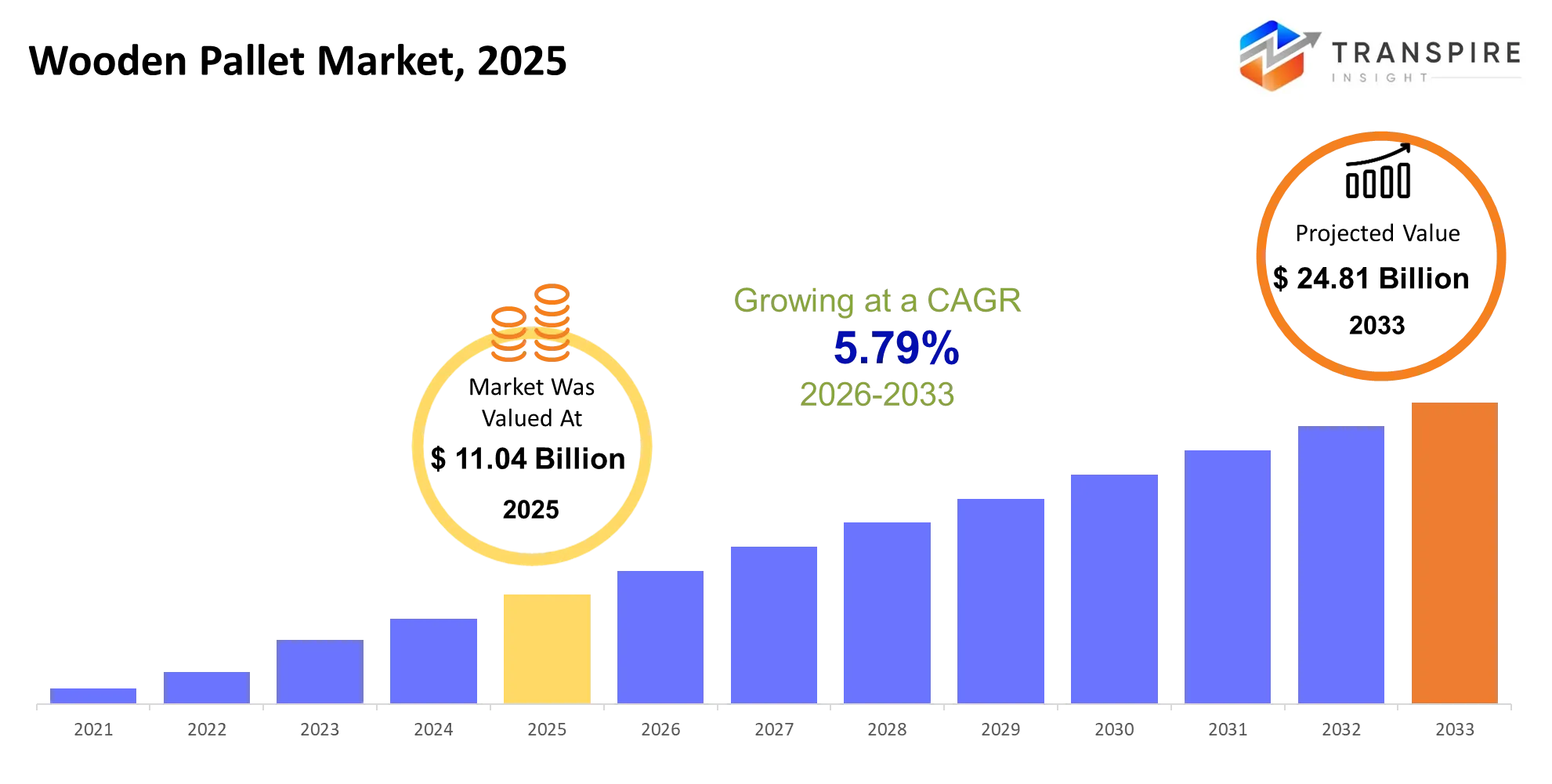
- Market Value (2025): USD 11.04 Billion.
- Expected Market Value (2026): USD 16.73 Billion.
- Estimated Market Value (2033): USD 24.81 Billion.
- Forecast CAGR (2026–2033): 5.79%
- Leading Region in 2025: Asia Pacific
- Second-largest Region: North America
- Fastest Growing Region: Europe
Introduction
The wooden pallet market is a part of the overall eco-system of international trade, production, repairing and recycling processes of pallet wooden forms, which are used to bear goods during the process of stacking, storage, warehousing, and transportation. That said, wooden pallets facilitate the safe lifting of heavy goods by means of equipment like lift trucks and pallet moving devices. The Wooden Pallet market has a number of inherent advantages that lead to its wide utilization throughout the supply chain. Cost efficiency helps reduce the purchasing, production, maintenance, and replacement of other shapes of pallets. The high durability and load-bearing ability of wooden pallets makes them suitable for transporting heavy and voluminous industrial goods. Simple repair of damaged planks or parts ensures longer useful life of pallets and reduces their acquisition prices. Wood is an eco-friendly, renewable, and recyclable product, which corresponds to the sustainability and circular economy requirements of the companies. All of these advantages increase the demand for these pallets in many fields of human activities including manufacturing, retail, food and beverage industry, pharmaceutical business, warehousing, and transportation.
For instance:-
The Pallet Market of North America is growing fast as investments in automated high-bay block pallets, advanced timber tracking systems, and effective recycling networks rise, propelled by the booming e-commerce industry and strict demands for cold-chain logistics.
Market Highlights: -
- Asia Pacific is anticipated to hold around 34% share of the Wooden Pallet Market over the predicted timeframe.
- North America is expected to grow at a rapid CAGR in the Wooden Pallet Market by holding around 32% of the share during the forecast period.
- Europe is anticipated to hold around 25% share of the Wooden Pallet Market over the predicted timeframe.
- By product type, the Stringer Pallets segment dominated the market and holds nearly 53% share in 2025 and is projected to grow at a substantial CAGR during the forecast period.
- By end user, the Food & Beverages segment dominated the market and holds nearly 27% share in 2025 and is projected to grow at a substantial CAGR during the forecast period.
- By application, the Transportation segment dominated the market and holds nearly 61% share in 2025 and is projected to grow at a substantial CAGR during the forecast period.
- PM Gati Shakti National Master Plan: This initiative boosts the logistics infrastructure in India and enhances multimodal connectivity, warehousing, and efficiency of the supply chain in order to cope with the increasing demand for standardized wooden pallets. Logistics digitalization will facilitate the utilization of technologies for pallet tracking by means of IoT and RFID solutions which will make asset visibility, inventory control, and work efficiency higher.
How is Technology Driving Growth in the Wooden Pallet Market?
Through automated production, digital monitoring, and sustainability-oriented innovations, technology is revolutionizing the Wooden Pallet Market. Sophisticated software and automated cutting solutions contribute to better material use, while robotic assembly helps to increase efficiency and mitigate labor shortages. Sensors enabled by IoT technology allow tracking of the pallets, such as their geographical location, temperature, level of humidity, and degree of shock exposure, which enhances asset management and visibility in supply chains. The smart pooling solutions provide logistics companies with tools for tracking how pallets are utilized, managing inventories, reducing losses, and improving lifecycle management. Digital route optimization allows for improving transportation planning and cutting costs associated with operations. In addition, the implementation of circular systems enables reuse and efficient use of resources, whereas automated heat treatment technologies ensure ISPM-15 compliance at all times, facilitating international shipping, and strengthening the sustainability of the supply chain.
|
Report Metrics |
Details |
|
Market size value in 2025 |
USD 11.04 Billion |
|
Market size value in 2026 |
USD 16.73 Billion |
|
Revenue forecast in 2033 |
USD 24.81 Billion |
|
Growth rate |
CAGR of 5.79% from 2026 to 2033 |
|
Base year |
2025 |
|
Historical data |
2021 - 2024 |
|
Forecast period |
2026 - 2033 |
|
Report coverage |
Revenue forecast, competitive landscape, growth factors, and trends |
|
Regional scope |
United States; Canada; Mexico; United Kingdom; Germany; France; Italy; Spain; Denmark; Sweden; Norway; China; Japan; India; Australia; South Korea; Thailand; Brazil; Argentina; South Africa; Saudi Arabia; United Arab Emirates |
|
Key company profiled |
Brambles Limited; Rehrig Pacific Company; Millwood Inc.; PECO Pallet; CABKA Group; Litco International Inc.; Craemer Group; LOSCAM; Falkenhahn AG; Menasha Corporation; PalletOne Inc.; Schoeller Allibert; Kamps Pallets; First Alliance Logistics; Nefab Group |
|
Customization scope |
Free report customization (country, regional & segment scope). Avail customized purchase options to meet your exact research needs. |
|
Report Segmentation |
Material Type (Softwood, Hardwood, Recycled Wood, Engineered Wood, Plywood, OSB, Composite Wood, Others); Treatment (Heat Treated, Kiln Dried, Chemical Treated, Methyl Bromide, Debarked, ISPM-15 Compliant, Untreated, Others); Product Type (Stringer Pallets, Block Pallets, Two-Way Entry, Four-Way Entry, Reversible, Non-Reversible, Winged, Custom); Load Capacity (Light-Duty, Medium-Duty, Heavy-Duty, Extra Heavy-Duty, Standard, Industrial, Export Grade, Custom); End User (Food & Beverages, Retail, Pharmaceuticals & Healthcare, Chemicals, Automotive, Manufacturing, Agriculture, Logistics & Warehousing); Application (Storage, Transportation, Export, Distribution, E-Commerce, Cold Chain, Manufacturing, Cross-Docking) |
Market Drivers
The growth of the e-commerce and logistics industries has led to rising demand for improved storage and material handling solutions; hence, this is a factor contributing to the growth of the wooden pallet market. Since the trend of warehouse automation has developed, wooden pallets that are durable, standardized, and suitable for automated warehousing are in demand. Stringent rules and regulations such as compliance with ISPM-15 add strength to the desire for the use of heat-treated pallets. In addition, sustainability initiatives promote the need for reusable, repairable, recyclable, and consolidated wooden pallet systems. Wooden pallets have various advantages that drive the development of the wooden pallet market. Their cost-effectiveness compared to plastic alternatives makes them appealing for industries that are driven by logistics processes. High structural strength and load-bearing capacity allow unloading of the large quantities of heavy industrial products successfully. Easy repairability makes it possible to replace or remanufacture damaged parts thus reducing lifecycle costs and facilitating the continued operation of pallets. Also, since they are biodegradable and recyclable, wooden pallets meet sustainability and circular economy requirements. Furthermore, modern designs of wooden pallets give the opportunity to utilize forklifts and automated material-handling systems out of the box thus increasing warehouse efficiency.
For Instance: -
- The British pallet industry is mainly influenced by the ongoing growth of trade, logistic services and warehouse automation success. Investments are aimed at sustainable circular economy innovations, automated recycling processes and pallet pooling techniques to boost efficiency, manage timber prices fluctuations and satisfy the increasing needs of the supply chain.
- The wooden packaging and pallet industry of Russia is supported by rich timber materials, which means that investments in production facilities are attracted. However, investors have to deal with ongoing problems associated with geopolitical embargo and changing logistics.
Restrain
There are some challenges that the Wooden Pallet Market experiences which include fluctuations in timber prices, issues in availability of raw material and interruptions in manufacturing process steps via supply chain. Competition from plastic wood, metal and fiberboard pallets leads to substitution pressure. Lack of employees becomes another factor limiting effectiveness of the production and distribution processes. Furthermore, high sustainability requirements have to be fulfilled, timber must be sourced responsibly, carbon emissions must be reduced and compliance with ISPM-15 must be achieved.
|
Driver |
Relative Impact on Growth (%) |
Geographic Relevance |
Impact Timeline |
Demand Strength |
Growth Mechanism |
Key Beneficiaries |
Major Constraint |
|
Driver 1: E-commerce and Logistics Expansion |
27% |
Asia-Pacific, North America, Europe |
Medium-term |
High |
Expands pallet demand across distribution networks |
Pallet manufacturers, logistics providers, retailers, 3PLs |
Timber prices and reverse-logistics inefficiencies |
|
Driver 2: Warehouse Automation and Standardized Pallets |
23% |
North America, Europe, Asia-Pacific |
Medium-term |
High |
Drives automation-compatible standardized pallet adoption |
Pallet manufacturers, automation vendors, warehouses |
High automation investment and specification requirements |
|
Driver 3: International Trade and ISPM-15 Compliance |
20% |
Global, especially major export hubs |
Long-term |
High |
Increases demand for compliant treated pallets |
Exporters, pallet producers, treatment providers |
Treatment costs and regulatory compliance complexity |
|
Driver 4: Sustainability, Recycling and Pallet Pooling |
17% |
Europe, North America, Asia-Pacific |
Long-term |
High |
Promotes reusable, repairable, and pooled pallet systems |
Pooling companies, recyclers, manufacturers, retailers |
Timber availability and collection infrastructure |
|
Driver 5: Digital Tracking and Smart Pallet Technologies |
13% |
Asia-Pacific, North America, Europe |
Medium-term |
Medium |
Improves asset visibility and lifecycle management |
Technology vendors, pooling providers, logistics operators |
Sensor costs and fragmented digital infrastructure |
|
Total |
100% |
— |
— |
— |
— |
— |
— |
Analysis of Prices and Consumer Behaviour
The market of wooden pallets is occupied by block wooden pallets (more than 69% share of the market revenue in 2023; this is attributed to their features of uniformity of load distribution, ease of handling, and ease of cleaning). Softwood wooden pallets held the market share of more than 59% in 2023, due to the availability of timber lumber at lower rates and better transportation efficiency. In 2023, Asia Pacific generated about 39% of the revenue of the wooden pallet market globally. The food and beverage industry accounted for more than 22% of the revenue of the wooden pallet market in 2023, thanks to the significant requirement for storage, handling, and transportation of packed products business. The purchasing message of business shows that the durability of pallets, their load-bearing capacity, their standardization, their reparability, and their cost-effectiveness are important factors considered by the businesses in their purchasing decisions. Another significant purchasing model is pallet pooling, where the business looks for standardized reusable pallets while ensuring their availability in supply.
|
Investment Factor |
Why It Matters to Investors |
Opportunity |
Investment Implication |
|
E-commerce and Logistics Expansion |
Sustained pallet consumption across distribution networks |
Serve high-volume warehousing, fulfillment, and transportation customers |
Medium-term: Expand manufacturing and logistics partnerships |
|
Pallet Pooling and Lifecycle Services |
Recurring service revenue improves customer retention |
Develop pooling, rental, repair, recovery, and recycling networks |
Long-term: Build asset-based recurring revenue models |
|
Warehouse Automation Compatibility |
Automated facilities require standardized, durable pallet designs |
Supply automation-ready block and four-way-entry pallets |
Medium-term: Invest in precision manufacturing and quality control |
|
Recycling and Sustainable Pallet Solutions |
Circularity reduces material dependence and supports sustainability targets |
Expand recycled, refurbished, repairable, and engineered wood pallets |
Long-term: Develop circular pallet production ecosystems |
|
Digital Tracking and Smart Pallets |
Asset visibility reduces losses and improves utilization |
Integrate RFID, IoT sensors, and digital pallet-management platforms |
Medium-term: Create technology-enabled service differentiation |
|
Asia-Pacific Logistics Expansion |
Manufacturing, trade, e-commerce, and warehousing support regional demand |
Establish local production, pooling, and distribution capabilities |
Long-term: Expand into high-growth regional supply chains |
Who are the Key Players in the Wooden Pallet Market and how do they compete?
International competitiveness in the wooden pallets industry depends on companies that focus their effort on the creation of durable pallets, tailoring them for specific industries, and developing effective pallet pooling and distribution systems in the international market. Competing on various fronts, namely, not only price but pallet durability, reusability, sustainability, supply-chain efficiency, and the integration of pallets into logistics operations, this approach brings continuous innovations and development to companies making their operations more efficient and reliable over time.
CHEP increases its competitiveness on the market through the development of effective pallet pooling, reusable packaging, and other warehouse operations. Manufacturers create great, durable and efficient wooden pallets for different purposes, such as manufacturing, retail, food and beverage, and logistics sectors, thus distinguishing themselves from their competitors all over the world.
Top Companies in the Wooden Pallet Market
- Brambles Limited
- Rehrig Pacific Company
- Millwood Inc.
- PECO Pallet
- CABKA Group
- Litco International Inc.
- Craemer Group
- LOSCAM
- Falkenhahn AG
- Menasha Corporation
- PalletOne Inc.
- Schoeller Allibert
- Kamps Pallets
- First Alliance Logistics
- Nefab Group
|
Company |
Est. Revenue Share Range |
Key Offerings |
Strategic Positioning |
Geographic Strength |
Technology Focus |
|
Brambles Limited (CHEP) |
10–15% |
Pooled wooden pallets, pallet rental, recovery, supply-chain services |
pooling leadership with circular supply networks |
North America, Europe, Asia-Pacific |
Digital asset visibility and service-center automation |
|
PalletOne Inc. (UFP Packaging) |
3–5% |
New wood pallets, custom pallets, repairs, pallet management |
Scale-driven manufacturing with customized supply programs |
North America |
Pallet design software and unit-load optimization |
|
PECO Pallet |
2–4% |
Wood block pallets, pooling, recovery, pallet management |
Premium-quality pooled block-pallet specialist |
North America |
Automated pallet inspection and sorting |
|
Millwood Inc. |
2–4% |
New pallets, recycled pallets, repair, recycling, PalletView |
Integrated pallet lifecycle and recycling provider |
North America |
Asset tracking, packaging testing, recycling automation |
|
Kamps Inc. |
2–4% |
New/recycled pallets, recycling, pallet management, wood recovery |
National-scale lifecycle management and recycling |
North America |
Digital pallet management and process automation |
|
Loscam International |
1–3% |
Pallet pooling, wooden pallets, recovery, supply-chain services |
Regional pooling specialist serving high-volume supply chains |
Asia-Pacific, Australia, China |
Pooling systems and asset tracking |
|
Falkenhahn AG |
1–3% |
Wooden pallets, EPAL pallets, export pallets, custom solutions |
European manufacturing and export-pallet specialist |
Europe, Asia-Pacific |
Automated pallet manufacturing and quality control |
|
NEFAB Group |
1–2% |
Wooden pallets, export packaging, custom wood packaging |
Engineered packaging and industrial protection specialist |
Europe, North America, Asia-Pacific |
Packaging optimization and digital engineering |
|
Rehrig Pacific Company |
1–2% |
Wooden pallets, pallet programs, reusable transport packaging |
Diversified material-handling and reusable-packaging provider |
North America, Latin America |
Automated handling and reusable-asset management |
|
LEAP India Pvt. Ltd. |
0.5–1.5% |
Pooled pallets, returnable packaging, logistics assets |
India-focused pooling and supply-chain efficiency |
India, Asia-Pacific |
Asset tracking and digital pooling platforms |
Market Segmentation
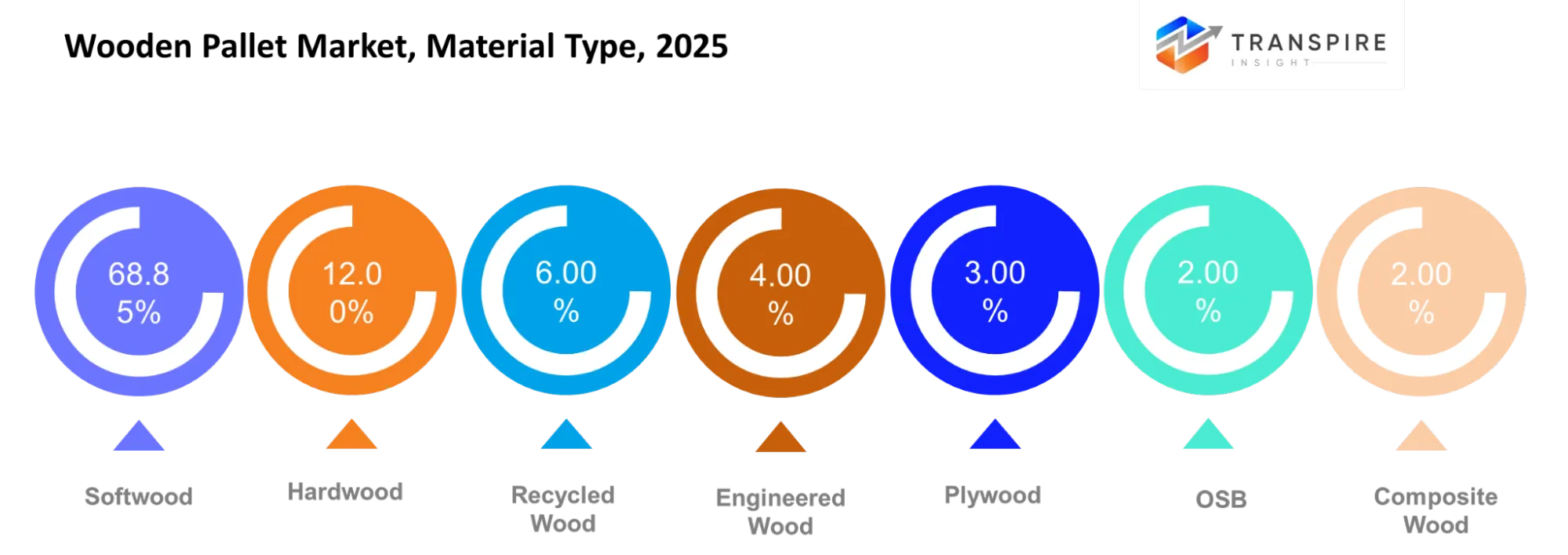
The Wooden Pallet Market share is divided into six categories: By material type, treatment, product, load capacity, end user and application.
The Stringer Pallets dominated the market, accounting for nearly 53% in 2025 and is expected to rise at a significant CAGR during the forecast period.
The Wooden Pallet Market is segmented by product type into Stringer Pallets, Block Pallets, Two-Way Entry, Four-Way Entry, Reversible, Non-Reversible, Winged, Custom. Among these, the Stringer Pallets segment dominated the market, accounting for nearly 53% in 2025 and expected to increase at a significant CAGR during the forecast period. In 2025, the Stringer Pallets segment saw a close to 53% market share due to their economic features, strength, easy accessibility with forklifts, and their use in various logistics applications. These pallets are widely used in different sectors, including manufacturing, warehousing, retail, and transportation. The rising number of online purchases and supply-chain optimization is expected to boost their adoption and growth in the future.
The Food & Beverages dominated the market, accounting for nearly 27% in 2025, and is expected to rise at a significant CAGR during the forecast period.
The Wooden Pallet Market is segmented by end user into Food & Beverages, Retail, Pharmaceuticals & Healthcare, Chemicals, Automotive, Manufacturing, Agriculture, Logistics & Warehousing. Among these, the Food & Beverages segment dominated the market, accounting for nearly 27% in 2025 and expected to increase at a significant CAGR during the forecast period. In the market, the Food & Beverages segment had the largest share, accounting for almost 27% of the total market in 2025 due to the requirement for a large number of pallets for shipping packaged food and beverage products, raw materials, and finished products. The rising volumes of shipments occurring from time to time and the strict hygiene conditions required for the products shipped in addition to the ever-expanding food distribution networks have been beneficial for the adoption of wooden pallets across the food and beverage supply chains worldwide.
The Transportation dominated the market, accounting for nearly 61% in 2025 and is expected to rise at a significant CAGR during the forecast period.
The Wooden Pallet Market is segmented by application into Storage, Transportation, Export, Distribution, E-Commerce, Cold Chain, Manufacturing, Cross-Docking. Among these, the Transportation segment dominated the market, accounting for nearly 61% in 2025 and expected to increase at a significant CAGR during the forecast period. The Transportation segment led the market with almost 61% market share in 2025, as a result of extensive use of wooden pallets for cargo handling, shipment protection, warehouse transfers, as well as distribution. The increasing trade, growth of e-commerce logistics and manufacturing activity along with a growing need for effective material handling solutions keep maintaining the demand for pallets across the transportation networks and international supply chains.
Regional Segment Analysis of the Wooden Pallet Market:
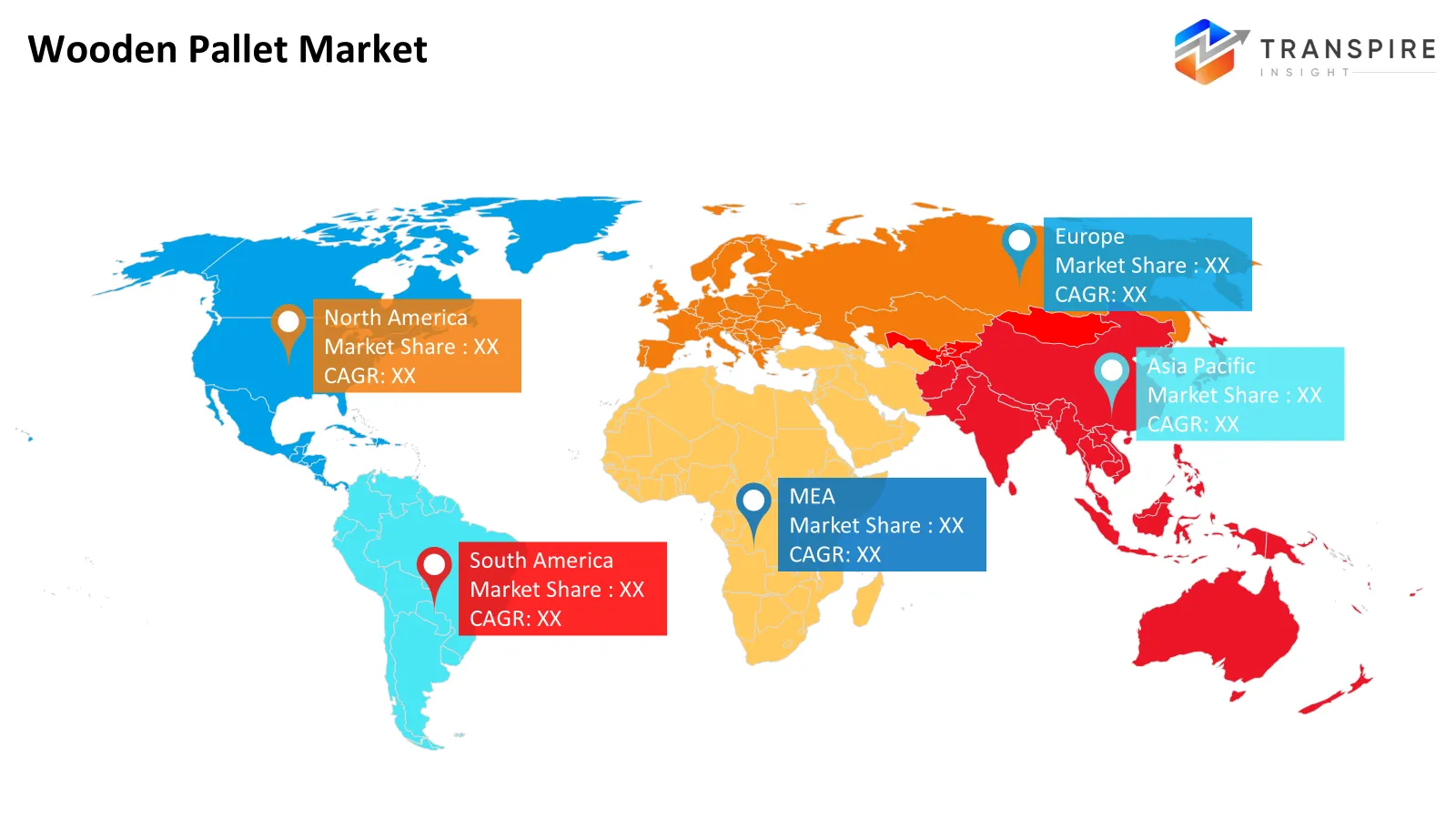
- North America (U.S., Canada, Mexico)
- Europe (Germany, France, U.K., Italy, Spain, Rest of Europe)
- Asia-Pacific (China, Japan, India, Rest of APAC)
- South America (Brazil and the Rest of South America)
- The Middle East and Africa (UAE, South Africa, Rest of MEA)
Asia Pacific is the fastest-growing region in the Wooden Pallet Market during the period, holding around 34% share.
Asia pacific is the fastest-growing region in the Wooden Pallet Market during the forecast period, holding around 34% share during the forecast period. Asia Pacific emerges as the leading region in the Wooden Pallet Market, with about 34% share, thanks to the developments in manufacturing, e-commerce, warehousing, and international trade. The rapid growth of industrialization, infrastructural development, expansion of logistics, and rising demand for more efficient materials handling solutions will further aid the adoption of wooden pallets in regional supply chains.
North America is the fastest-growing region in the Wooden Pallet Market during the period, holding around 32% share.
North America is expected to grow at a rapid CAGR in the Wooden Pallet Market holding around 32% share during the forecast period. During the period, North America is also the fastest-growing region in the Wooden Pallet Market, capturing around 32% of the market share through its well-established manufacturing, retail, e-commerce, warehousing, and transportation infrastructure. In addition, the availability of strong logistics networks, higher pallet usage, rising warehouse automation, and demand for effective and reliable material-handling solutions are propelling the adoption of wooden pallets across supply chains in various parts of the region.
Europe is expected to grow at a rapid CAGR in theWooden Pallet Market, holding around 25% of the share during the forecast period.
Europe is expected to grow at a rapid CAGR in the Wooden Pallet Market holding around 25% share during the forecast period. The Wooden Pallet Market is anticipated to experience a significant growth in Europe, with approximately 25% of the market share estimated during the predicted timeframe, due to robust manufacturing, retail trade, food & beverages, and logistics sectors. Stringent sustainability regulations, circular economy initiatives, cross-border trade, and the rising demand for reusable material handling solutions are stimulating wooden pallet usage.
Strategies for Market Growth in Non-Leading Regions:
The enhancement of lesser-known areas through efficient and adaptable wooden pallet manufacturing technologies would be advantageous for small- to medium-sized pallet manufacturers. Local usage of timber and the establishment of wooden pallet manufacturing plants would reduce reliance on imported products and lead to lower production costs. By forming partnerships with timber suppliers, logistics companies, manufacturers, sellers, and distributors operating in the region, companies producing wooden pallets would have a better chance of penetrating the market. The knowledge of the principles of sustainable timber sourcing, pallet manufacturing, and quality control in the manufacture of wooden pallets can be enhanced through training and education. Moreover, the use of flexible financing options would make wooden pallet products more affordable for consumers and stimulate their demand.
Future Market Trends for the Wooden Pallet Market: -
- Rise of Engineered and Recycled Wood - The increasing prices of wood and high corporate net-zero targets have increased the demand for recycled cores and engineered wood alternatives. They have been growing at a CAGR of 7.19%
- Warehouse Automation and Block Pallets - The high bay automatic storage systems require standardized precision-engineered solutions and as a result there is a large switch towards the movement of four-way entry block pallets with a CAGR of 6.74%
- Smart Pallets with RFID Systems - The logistics providers are increasingly integrating RFID-tagged and sensor-based wooden pallets in order to achieve better digital tracking and supply chain visibility.
- Phytosanitary and Heat Treatment Regulations - These international standards (ISPM-15) continue to drive the industry with over 52% of the market share being the heat treated pallets.
- Growth of the Pharmaceutical Sector - The health care and pharmaceutical industry is one of the fastest growing end-user segments with a CAGR of 8.01% needed due to the growing cold chain market.
- Regional dynamics - The region of Asia Pacific continues to be the biggest contributor to revenue while the region of Middle East and Africa continues to grow at the fastest pace of 7.22%.
Recent Development
- In August 2026: The updated analysis of the pallets market was released by Mordor Intelligence, indicating that the warehouse automation, shifts in e-commerce, and logistics development in the Asia-Pacific region all have an impact on the demand for pallets. For example, the study shows that there is a rise in the adoption of lightweight wooden pallets and block pallets compatible with automation, especially in respect of the fast-growing e-commerce and logistics networks in Asia-Pacific region.
- In September 2026: KraftPal Holdings Ltd launched its KP25039 semi-automatic pallet processing device, aiding in the cost-effective production of corrugated pallets. Indeed, the emergence of the product points to rising competition from various pallet substitutes like lightweight materials and automated technologies forcing traditional pallet producers to improve on efficiency and sustainability.
This study forecasts revenue at global, regional and country levels from 2020 to 2033. Transpire Insights has segmented the Wooden Pallet Market based on the below-mentioned segments:
Wooden Pallet Market, By Material Type
- Softwood
- Hardwood
- Recycled Wood
- Engineered Wood
- Plywood
- OSB
- Composite Wood
- Others
Wooden Pallet Market, By Treatment
- Heat Treated
- Kiln Dried
- Chemical Treated
- Methyl Bromide
- Debarked
- ISPM-15 Compliant
- Untreated
- Others
Wooden Pallet Market, By Product Type
- Stringer Pallets
- Block Pallets
- Two-Way Entry
- Four-Way Entry
- Reversible,
- Non-Reversible
- Winged
- Custom
Wooden Pallet Market, By Load Capacity
- Light-Duty
- Medium-Duty
- Heavy-Duty
- Extra Heavy-Duty
- Standard
- Industrial
- Export Grade
- Custom
Wooden Pallet Market, By End User
- Food & Beverages
- Retail
- Pharmaceuticals & Healthcare
- Chemicals
- Automotive
- Manufacturing
- Agriculture
- Logistics & Warehousing
Wooden Pallet Market, By Application
- Storage
- Transportation
- Export
- Distribution
- E-Commerce
- Cold Chain
- Manufacturing
- Cross-Docking
By Regional Analysis
North America
- US
- Canada
- Mexico
Europe
- Germany
- UK
- France
- Italy
- Spain
- Russia
- Rest of Europe
Asia Pacific
- China
- Japan
- India
- South Korea
- Australia
- Rest of Asia Pacific
South America
- Brazil
- Argentina
- Rest of South America
Middle East & Africa
- UAE
- Saudi Arabia
- Qatar
- South Africa
- Rest of the Middle East & Africa
Frequently Asked Questions
Find quick answers to common questions.
The market is projected to grow at a 5.79% CAGR, reaching USD 24.81 billion by 2033 from USD 11.04 billion.
Stringer Pallets dominate with nearly 53% share in 2025, supported by cost-effectiveness, strength, forklift accessibility, and diverse logistics applications.
Food & Beverages dominates with nearly 27% share in 2025, driven by high shipment volumes, food distribution, and extensive pallet requirements.
Asia Pacific leads with around 34% share, supported by manufacturing, e-commerce, warehousing, infrastructure development, and expanding logistics networks.
Key trends include recycled wood, engineered pallets, warehouse automation, RFID tracking, ISPM-15 compliance, pallet pooling, sustainability, and cold-chain logistics.
- Brambles Limited
- Rehrig Pacific Company
- Millwood Inc.
- PECO Pallet
- CABKA Group
- Litco International Inc.
- Craemer Group
- LOSCAM
- Falkenhahn AG
- Menasha Corporation
- PalletOne Inc.
- Schoeller Allibert
- Kamps Pallets
- First Alliance Logistics
- Nefab Group
About the Authors

Kartik bhong
I am Kartik Bhong, a Senior Research Analyst at Transpire Insight, specializing in the Packaging, Manufacturing, and Construction industry. My work focuses on analyzing market trends, emerging technologies, industry regulations, and competitive landscapes to deliver accurate, data-driven insights. I am passionate about transforming complex industry information into clear, practical content that helps businesses, professionals, and decision-makers stay informed and make confident strategic decisions. Through continuous research and a strong commitment to accuracy, I strive to create reliable, well-researched content that reflects the latest developments across these dynamic industries and supports the vision of Transpire Insight in delivering valuable market intelligence.

Chakradhar Khansole
Chakradhar serves as the Research Director at Transpire Insight, bringing over 8 years of experience in technology, innovation, and strategic market intelligence. He specializes in transforming complex market data into actionable business insights that enable organizations to make informed, growth-oriented decisions. Recognized for his strategic vision and analytical expertise, Chakradhar leads high-impact research initiatives, delivering comprehensive market assessments, competitive intelligence, and forward-looking industry analysis.
Recently Published Reports
-
Apr 2026
Pharmaceutical Cold Chain Packaging Market
Pharmaceutical Cold Chain Packaging Market By Material (Plastic,(Polyethylene (PE), Polypropylene (PP), Polyethylene Terephthalate (PET), Expanded Polystyrene (EPS), Polyurethane (PU),Others), Paper, Metal, Others), By Product (Small Boxes, Pallets, Large Sized Pallet Containers, Others), By End Use (Biopharmaceutical Companies, Clinical Research Organizations, Hospitals, Research Institutes, Logistics and Distribution Companies, Others)”, By Industry Analysis, Size, Share, Growth, Trends, and Forecasts 2026-2033
-
Apr 2026
Active & Intelligent Packaging Market
Active & Intelligent Packaging Market By Type (Active Packaging, Smart Packaging), By Material (Polymer-Based, Paper & Board-Based, Metal-Based, Glass-Based), By Technology (Time-Temperature Indicators, Freshness Indicators, RFID, Antimicrobial Packaging, Modified Atmosphere Packaging), By Application (Food & Beverages, Pharmaceutical, Cosmetics & Personal Care, Electronics & Consumer Goods, Others), By Industry Analysis, Size, Share, Growth, Trends, and Forecasts 2026-2033
-
Apr 2026
Biodegradable Cut Flower Packaging Market
Biodegradable Cut Flower Packaging Market By Material Type (Paper & Paperboard, Biodegradable Plastics, Natural Fibers, Molded Pulp, Others), By Product Type (Sleeves, Wraps, Boxes & Cartons, Bags & Pouches, Inserts & Holders), By Application (Roses, Carnations, Tulips, Chrysanthemums, Mixed Flowers, Others) and By Distribution Channel (Direct Sales, Distributors & Wholesalers, Online Channels), By Industry Analysis, Size, Share, Growth, Trends, and Forecasts 2026-2033
-
May 2026
Pharmaceutical Packaging Market
Pharmaceutical Packaging Market By Material Type (Plastic, Glass, Metal, Paper & Paperboard, Others), By Packaging Type (Bottles, Blister Packs, Vials, Ampoules, Pouches & Sachets, Others) and By End User (Hospitals & Clinics, Retail Pharmacies, Online Pharmacies, Pharmaceutical Manufacturers), By Industry Analysis, Size, Share, Growth, Trends, and Forecasts 2026-2033