
Lightweight Construction Materials Market Summary:
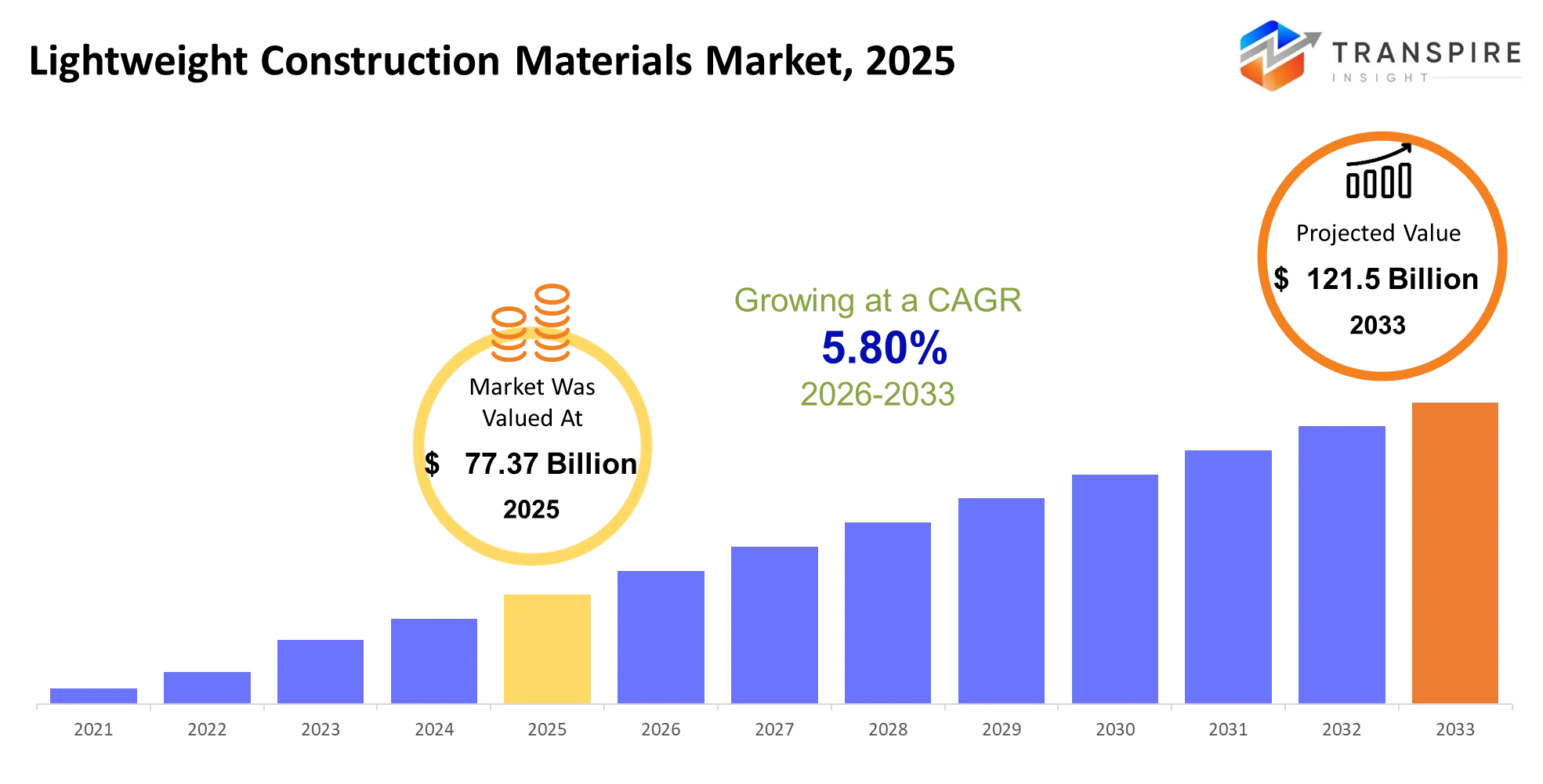
As per the Transpire Insight Analysis, The Lightweight Construction Materials Market size is estimated at USD 77.37 billion in 2025 and is anticipated to reach USD 121.5 billion by 2033, growing at a CAGR of 5.80% from 2026 to 2033.
The lightweight construction materials market supplies lower-weight concrete, blocks, panels, metals, wood systems, insulation and composites that reduce a building’s dead load while improving construction speed, thermal performance or transport efficiency. During the past three to five years, procurement has shifted from choosing materials mainly by upfront cost to assessing installation productivity, fire performance and whole-life carbon. The structural change is the closer integration of lightweight materials with off-site construction: factory-made AAC panels, insulated panels and engineered components are designed for modular assembly rather than site-intensive masonry. This shift accelerated after pandemic-era labour shortages, supply-chain disruption and rising energy costs exposed the risk of slow, material-heavy building methods. Growth follows a practical chain: lighter components require smaller lifting equipment and can reduce structural loads, enabling faster erection and potentially lower foundation and transport costs. Embodied-carbon disclosure rules and green-building procurement are reinforcing this transition by making material efficiency a commercial selection criterion.
Lightweight Construction Materials Market Size & Forecast:
- Market Size 2025: USD 77.37 Billion
- Expected Market Value (2033): USD 121.5 Billion
- Forecast CAGR (2026–2033): 5.80%
- Leading Region in 2025: Europe
- Fastest Growing Region: Asia-Pacific
- Key Company Profiles: CRH, Holcim, Saint-Gobain, James Hardie, Trinity, Granite Construction, Owens Corning, Kingspan, Lafarge, Knauf, BASF, Sika, Cemex, Wienerberger, Heidelberg Materials.
Key Lightweight Construction Materials Market Insights:
The market is moving away from the sale of lower-weight inputs and towards the sale of tested low-carbon building systems that minimize labour exposure, installation time and envelope-energy losses. It is not the weight of the material anymore, but certified performance, factory integration and regional production reach that are the key to competitive advantage.
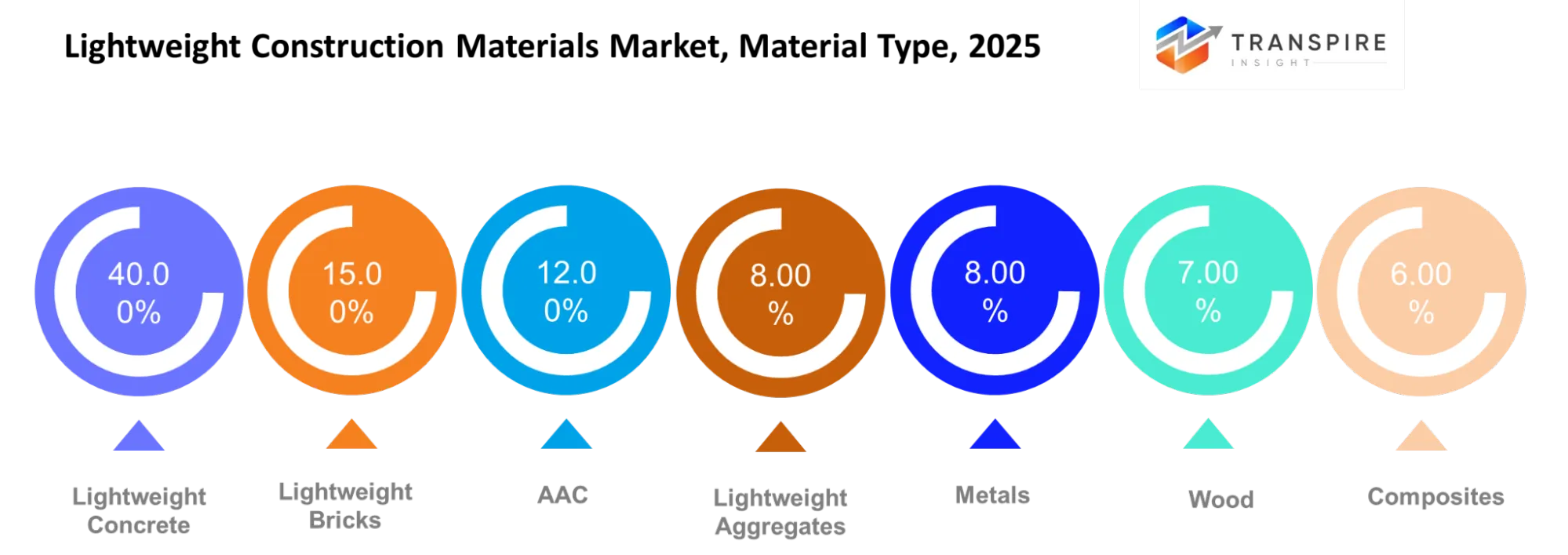
- Buyers are choosing lower-loaded slabs, with carbon documentation, as Holcim continues to develop ECOPact formulations at 40.00% lightweight concrete.
- Wienerberger continues to increase the use of 15.00% lightweight bricks; precision bricks are popular with installers because of their reduced reliance on wet trade.
- 12.00% AAC, Holcim's planned acquisition of Xella, is the focus of lightweight walling, while modular builders are turning to large-format, factory-made elements.
- The percentage of lightweight aggregates used is 8.00%, with CRH scaling up use of circular materials; contractors are increasingly looking to recycled-content material sources as alternatives to virgin material.
- 8.00% metals, as Kingspan is working to increase the procurement of recycled steel, and insulated-envelope buyers are looking for embodied carbon reductions that can be audited.
- 7.00% wood as Saint-Gobain supports lighter façade systems; developers are testing hybrid timber solutions for faster dry construction.
- James Hardie's fibre-cement cladding system is 6.00% of the composites market, while low-maintenance façade upgrades are preferred for retrofit projects.
- 4.00% foams as BASF's performance-driven insulation chemistry becomes increasingly important, while building owners are focusing on the ability to provide thinner systems that maintain usable floor space.
- 7.20% advance in growth of composites as Sika aims to develop engineered reinforcement and bonding; digital design allows the creation of material-efficient solutions for structures.
What are the Key Drivers, Restraints, and Opportunities in the Lightweight Construction Materials Market?
Driver:
Construction firms are under pressure to deliver projects with fewer site workers, shorter programmes and better energy performance. Labour scarcity, volatile fuel costs and post-pandemic project delays triggered stronger interest in factory-produced AAC blocks, insulated panels, lightweight steel framing and precast components. Their value is not simply lower weight: reduced handling effort, quicker enclosure of buildings and lower structural loading can cut programme risk and improve contractor throughput. Meanwhile, government and corporate procurement increasingly considers embodied carbon, encouraging specifications that use recycled-content aggregates, engineered wood and efficient insulation. The International Energy Agency and ABC have called for stronger policy commitments on near-zero-emission buildings and low-emission materials, raising the strategic value of verifiable material performance.
Restraint:
Adoption remains uneven because lightweight systems often require redesigned detailing, trained installers, fire and acoustic certification, and reliable local supply. Developers may resist a higher purchase price even where lifecycle savings are credible. This persists structurally because building codes, tender practices and contractor liability are fragmented; many teams still compare material cost per unit rather than total installed cost, programme savings and operational energy outcomes.
Opportunity:
The next expansion lies in digitally specified, low-carbon prefabricated systems that make material performance auditable before procurement. BIM-linked environmental product declarations, AI-assisted design optimisation and automated factory production can compare structural load, thermal efficiency, installation time and embodied carbon at project level. Southeast Asia, India and the Middle East offer particularly strong potential for AAC panels, structural insulated panels and modular housing, as urban housing shortages, extreme heat and contractor labour constraints increase demand for faster, energy-efficient building delivery.
What Has the Impact of Artificial Intelligence Been on the Lightweight Construction Materials Market?
AI is beginning to influence lightweight materials construction through optimised design, manufacturing control, and project scheduling rather than displacing material science. For design, AI-enabled Building Information Modelling (BIM) workflows can compare alternatives for walls, floors, and façades by structural load, insulation capacity, price, and embodied carbon, allowing architects to choose the least material-intensive option (lightweight concrete, Autoclaved Aerated Concrete (AAC), panels, engineered wood, composites, etc.) that can still deliver on fire and acoustic performance requirements. Research into 2026 indicates that AI-enhanced BIM can offer lower-carbon options and potentially cut embodied-carbon impacts by up to 30% in appropriate design-stage use cases - though conclusions depend heavily on accurate product and project data. On the manufacturing side, machine-vision systems can inspect panel surface finish, curing consistency, and block size; predictive models can leverage production data to predict kiln, mixer, or equipment failures; and on the project side, AI-enabled scheduling can optimise prefabricated lightweight unit delivery based on crane time and crew schedules, reducing storage damage and downtime. Major constraints include data integration; many smaller producers don't have digitally available data on material properties, EPD, or quality; proprietary BIM libraries can be incomplete; and AI-generated suggestions need structural, fire, and moisture-resistant engineering validation.
In September 2026, Quotr launched a $4 million seed funding round led by Llama Ventures. The company's AI-native construction estimation platform accelerates early-stage preconstruction by automating drawing analysis and material estimations across dozens of complex trade categories, helping builders avoid structural budget and timeline overruns before a project breaks ground.https://www.businesswire.com/news/home/20260930844525/en/Quotr-Raises-%244M-to-Bring-AI-Capabilities-to-Preconstruction
Key Lightweight Construction Materials Market Trends:
Lightweight construction is becoming more than just the substitution of materials; it is now being assessed as a building system, in terms of weight, carbon, installation speed and performance. Procurement is rewarding suppliers who are able to deliver lightweight products, prefabrication, digital design, environmental data, and site execution.
- Where developers are focused on speed of enclosure, minimisation of handling and thermal efficiency, AAC blocks and panels are replacing heavier masonry.
- Prefabrication has driven demand for panels and structural elements that are consistent in size and can be transported and installed efficiently, without a lot of wet work.
- Reporting embodied carbon is bringing recycled aggregates, bio-based materials and lower impact insulation to the forefront of a specification.
- Mineral-based, tested façade and insulation assemblies are being subjected to fire-performance scrutiny at a faster rate than lightweight assemblies that have not been tested.
- Architects are increasingly able to optimise load, carbon and constructability earlier in the design process, thanks to the growing number of BIM libraries that contain material-performance data.
- Robotic assembly and 3D printing are helping to improve repeatability for lightweight forms, minimizing reliance on scarce site labour.
- The use of engineered wood and hybrid timber-steel systems is becoming a focus of interest where speed of installation and reduced structural mass are important.
- Thin, light insulation and façade systems with high efficiency and without overloading existing structures are being favoured.
- As institutional buyers increasingly require traceability and sustainability evidence, producers are extending their traceability and implementing EPDs and recycled content claims.
Lightweight Construction Materials Market Segmentation
Material Type:
Lightweight Concrete dominates with 40.00%, supported by its ability to reduce structural dead load while fitting established batching, reinforcement, and placement practices. Lightweight Bricks account for 15.00%, benefiting wall construction where easier handling and installation improve site productivity. AAC holds 12.00%, combining low density with thermal and acoustic performance for building envelopes. Lightweight Aggregates and Metals each represent 8.00%, serving concrete formulation and weight-efficient structural systems, respectively. Wood captures 7.00%, while Composites contribute 6.00% and Foams 4.00%. Advanced Composites record a 7.20% CAGR, driven by applications requiring high strength-to-weight performance and engineered durability.
Product Type:
Lightweight Panels and Blocks anchor enclosure applications because lower mass simplifies handling and accelerates installation. Insulated Panels strengthen adoption by combining thermal control with fewer construction layers, reducing labour and assembly time. Structural Components benefit where dead-load reduction improves span efficiency, while Roofing Materials support lighter roof assemblies. Flooring Materials, Wall Systems, and Insulation Products gain as developers prioritize installation, energy performance, and prefabricated delivery. Suppliers increasingly bundle materials into engineered systems instead of selling standalone components.
Construction Type:
Residential and Commercial projects provide the broadest deployment base because lightweight systems fit repetitive layouts and faster schedules. Industrial applications prioritize long spans, equipment loads, and logistics efficiency, while Infrastructure projects use lower structural weight to reduce transport and foundation requirements. Institutional buildings add demand through renovation and energy upgrades. Modular and Prefabricated construction create opportunities by shifting work from sites to controlled factories, improving consistency, reducing waste, shortening schedules, and supporting standardized lightweight assemblies and methods.
Application:
Walls and Floors remain core uses because lightweight materials reduce structural loading while supporting rapid enclosure and interior installation. Roofing benefits from reduced dead weight, easier handling, and improved thermal assemblies, while Facades combine lightweight cladding with insulation and weather protection. Structural Components and Bridges gain where lower mass simplifies foundations, lifting, and transport. Insulation and Partitions favour dry-installation methods that reduce site disruption, enabling faster renovation cycles and easier reconfiguration across residential and commercial building projects today.
End User:
Contractors and Construction Companies influence adoption because they evaluate materials through labour requirements, installation speed, site handling, and schedule certainty. Architects and Engineers shape specifications by balancing structural performance, fire safety, durability, and thermal requirements. Developers consider lifecycle carbon, procurement resilience, and total installed cost when selecting lightweight systems. Government Agencies can accelerate adoption through project standards and renovation programs. Homebuilders prioritize repeatable products, while Infrastructure Operators focus on maintenance, transport efficiency, durability, and long service intervals.
Technology:
Precast Construction and Prefabrication improve consistency by moving production into controlled environments with standardized processes. Modular Construction compresses site schedules by integrating lightweight assemblies before delivery, while 3D Printing expands geometric flexibility and material-efficient design. Advanced Composites support high strength-to-weight requirements in specialized structural applications. Foam Technology improves insulation and weight performance, while Smart Materials enable responsive building behaviour. Lightweight Steel Technology advances efficient framing through optimized sections, digital fabrication, and coordinated assembly across modern industrialized construction workflows.
What are the Key Use Cases Driving the Lightweight Construction Materials Market?
The primary application remains load-efficient construction, with Lightweight Concrete representing 40.00% of the market share. Lightweight Concrete is used in slabs, roof decks, bridge decks, precast, and high-rise floors, reducing dead load, foundation size, handling complexity, and enabling spans.
Applications are growing in building envelopes and fast-track interiors. Autoclaved Aerated Concrete, lightweight bricks, insulated panels, plasterboard, and lightweight steel are used in support walls, facades, partitions, roofs, and renovations, where low mass and dry installation improve site productivity.
Emerging applications combine lightweight materials with digital fabrication and modular delivery. Automated batching, standardized attachments, prefabricated systems, advanced composites, and AI-led mix improvements improve uniformity while providing an optimal trade-off between density, strength, cost, and embodied carbon.
|
Report Metrics |
Details |
|
Market size value in 2025 |
USD 77.37 Billion |
|
Market size value in 2026 |
USD 81.86 Billion |
|
Revenue forecast in 2033 |
USD 121.5 Billion |
|
Growth rate |
CAGR of 5.80% from 2026 to 2033 |
|
Base year |
2025 |
|
Historical data |
2021 - 2024 |
|
Forecast period |
2026 - 2033 |
|
Report coverage |
Revenue forecast, competitive landscape, growth factors, and trends |
|
Regional scope |
United States; Canada; Mexico; United Kingdom; Germany; France; Italy; Spain; Denmark; Sweden; Norway; China; Japan; India; Australia; South Korea; Thailand; Brazil; Argentina; South Africa; Saudi Arabia; United Arab Emirates |
|
Key companies profiled |
CRH, Holcim, Saint-Gobain, James Hardie, Trinity, Granite Construction, Owens Corning, Kingspan, Lafarge, Knauf, BASF, Sika, Cemex, Wienerberger, Heidelberg Materials. |
|
Customization scope |
Free report customisation (country, regional & segment scope). Available customised purchase options to meet your exact research needs. |
|
Report Segmentation |
Material Type (Lightweight Concrete, Lightweight Bricks, AAC, Lightweight Aggregates, Metals, Wood, Composites, Foams); Product Type (Lightweight Panels, Insulated Panels, Blocks, Structural Components, Roofing Materials, Flooring Materials, Wall Systems, Insulation Products); Construction Type (Residential, Commercial, Industrial, Infrastructure, Institutional, Renovation, Modular, Prefabricated); Application (Walls, Floors, Roofing, Facades, Structural Components, Bridges, Insulation, Partitions); End User (Contractors, Construction Companies, Architects, Engineers, Developers, Government Agencies, Homebuilders, Infrastructure Operators); Technology (Precast Construction, Prefabrication, Modular Construction, 3D Printing, Advanced Composites, Foam Technology, Smart Materials, Lightweight Steel Technology). |
Which Regions are Driving the Lightweight Construction Materials Market Growth?
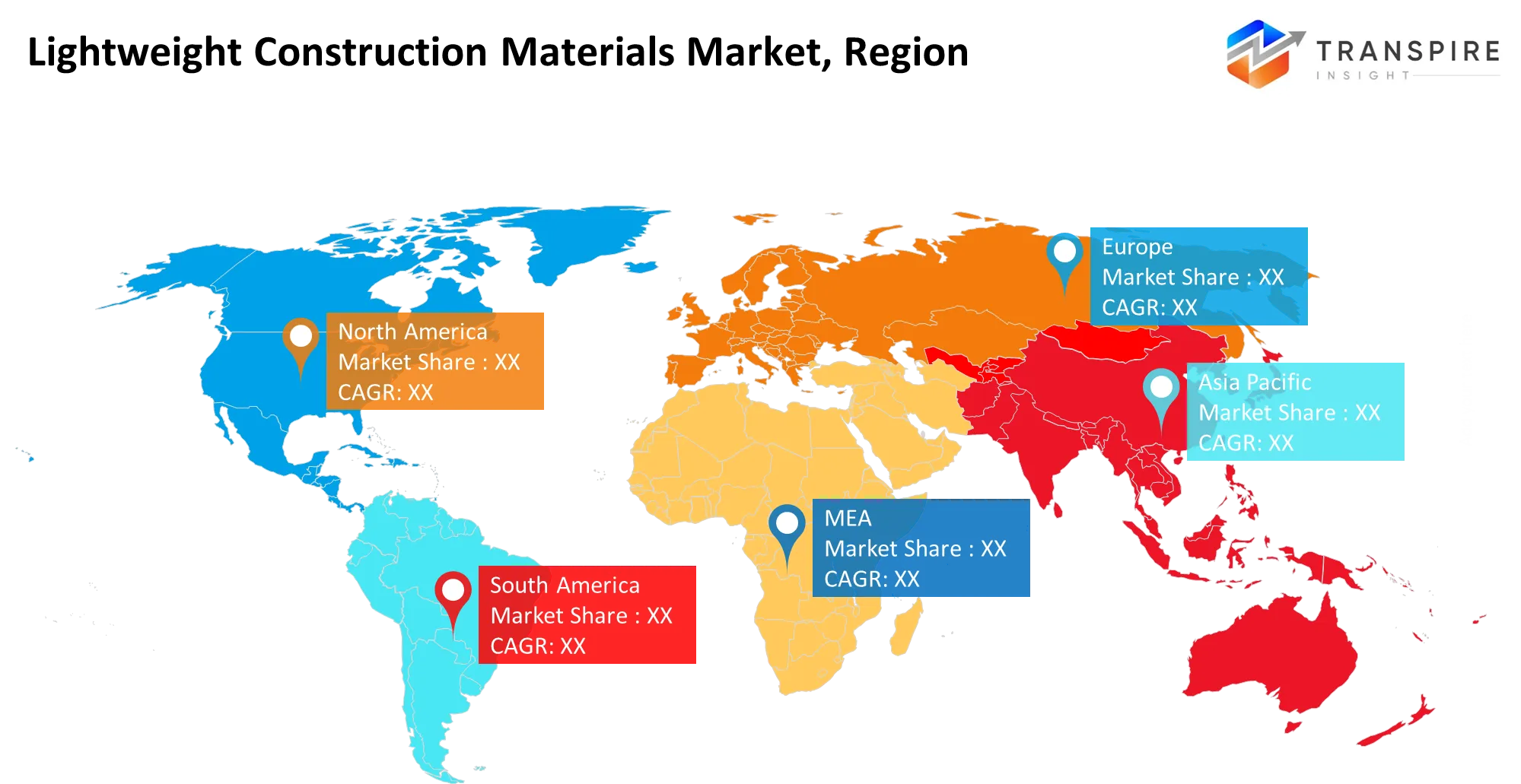
Europe remains a high-value market, with 31.00% of the market located in Europe due to intense building energy, retrofit, and lifecycle emissions standards. The new Energy Performance of Buildings Directive requires member states to develop national renovation strategies and sets minimum energy performance standards for relevant building envelope components in the course of retrofits and amendments to the existing directive, detailing support for insulated panels, lightweight facades, AAC, and lower carbon wall systems. Strong certification systems, retrofit financing, and the presence of off-site manufacturing make Europe a high-value market, not just high volume.
In June 2026, ROCKWOOL acquired the remaining 66 per cent stake in ScanArc Plasma Technologies, bringing its ownership to 100 per cent. This full acquisition deepens their collaboration to convert factories to electric melting solutions using low-carbon electricity.https://www.rockwool.com/group/about-us/news/2026/rockwool-acquires-swedish-company-to-further-strengthen-sustainable-melting-technologies/
North America accounts for a 23.00% share, as energy retrofits, high-end roofing, and proven insulated envelope investments influence a new set of specifications. Latin America accounts for a 9.00% share, while the Middle East and Africa each account for an 8.00% share, with both regions benefiting from heat-adapted construction and urban development needs. Portfolio investments by Holcim and Kingspan have opened new channels to insulation, walling and envelope solutions in the Americas. The opportunity is greatest where adapting an insulated, code-compliant thermal performance fabric in regional production is paired with rapid construction of warehouses, data centres and homes.
In March 2026, Holcim completed the acquisition of a majority stake in Cementos Pacasmayo, a prominent building materials producer in Peru. This strategic action expands Holcim's production footprint and capacity for advanced building solutions directly inside the rapidly developing Latin American market.https://www.holcim.com/media/media-releases/q1-2026-results
Asia Pacific represents 29.00% of demand and a 6.90% CAGR, compared with Europe's regulation-driven, renovation-centric profile. Development of fresh urban housing, industrial buildings and transport infrastructure, where inexpensive blocks, panels and lightweight concrete can hasten construction, underpins regional expansion. Large regional production centres, as well as the growth of modular capacity, offer scale advantages not seen in many established markets. Autoclaved aerated concrete demand is a good example of the region's importance. Asia Pacific represented 46.40% of AAC worldwide revenue in 2025 and is forecast to grow at 7.11% CAGR through 2031.
In March 2026, building materials manufacturer Manbro Industries Limited completed the acquisition of a 50.04% stake in Green AAC Block and Mortar Private Limited. This cash infusion makes Green AAC Block and Mortar a subsidiary of Manbro, strategically expanding the parent company’s regional production capacity in high-demand sustainable building materials.https://scanx.trade/stock-market-news/companies/manbro-industries-completes-acquisition-of-50-04-stake-in-green-aac-block-and-mortar-private-limited/36453794
Who are the Key Players in the Lightweight Construction Materials Market, and how do they compete?
The market share by cementitious, insulation, walling, roof and facade systems is fragmented, but differentiation through verified carbon, fire, thermal and installation credentials is gaining. Cemex, CRH, Lafarge and Heidelberg Materials are differentiated from local concrete, aggregates and logistics through lower-carbon mixes and recycled inputs, accessing multiple markets. Holcim is shifting from bulk markets towards high-value systems, acquiring insulation, roofing, walling and circular-construction technologies through the building and construction-materials acquisitions, and expanding its existing business through circular-construction business in concrete and aggregates; its proposed acquisition of Xella would add premium AAC and lightweight-block wall systems.
Saint-Gobain and Knauf compete through integrated interior, facade and insulation systems, with Saint-Gobain investing in a low-carbon stone-wool plant in the United Kingdom that will begin production in 2027. Kingspan offers high-performance insulated panels and building-envelope systems with EPDs and is expanding its manufacturing capacity across the United States, Europe, India, South-East Asia and Australia, while Owens Corning focuses its portfolio on North American and European roofing, insulation and doors businesses, investing in manufacturing-efficiency projects. James Hardie targets niche durable-cladding opportunities; Trinity, Granite Construction, BASF and Sika compete through aggregates, infrastructure inputs, chemical admixtures, foam technologies and high-performance bonding systems.
Key Players are:
- CRH
- Holcim
- Saint-Gobain
- James Hardie
- Trinity
- Granite Construction
- Owens Corning
- Kingspan
- Lafarge
- Knauf
- BASF
- Sika
- Cemex
- Wienerberger
- Heidelberg Materials
Recent Development News
- In January 2026, Kingspan Insulated Panels North America launched KingRib® Wall insulated metal panels, introducing new wall-profile options for commercial construction. The launch broadens lightweight building-envelope solutions by combining insulated panel construction with streamlined installation, durability, and architectural flexibility for modern commercial projects.https://kipna.kingspan.com/en-us/news/kingspan-launches-kingrib-wall
- In September 2026, i2Cool secured tens of millions of Yuan in a Series B financing round from TopoScend Capital. This funding will accelerate the commercial scaling and integration of its radiative cooling nanoparticles into sustainable architectural coatings and lightweight construction surface materials.https://www.webull.com/news/15271096659223552
- In September 2026, Fab-Form Industries Ltd. announced a patent application for its new structural foundation technology utilising interlocking sheathing panels. This product launch introduces moisture-resistant composite materials that improve seismic performance by significantly reducing structural mass and lowering dependence on traditional concrete.https://ca.finance.yahoo.com/news/fab-form-announces-world-patent-192400986.html
What Strategic Insights Define the Future of the Lightweight Construction Materials Market?
The market is heading towards industrialised, performance-tied construction. The future products will be specified as system components for walls, roofs, floors, and façades rather than raw materials. But there is a concealed danger in specification fragmentation, whereby a lightweight product will offer clear structural or thermal benefits but will not be specified if its fire, water, sound, carbon, and installation performance does not address the requirements of the relevant local codes, insurers, and architects simultaneously. One opportunity emerges in the connection between digital product information and offsite manufacturing. The combination of Embodied Carbon Data-enabled Building Information modelling libraries, proof of architecture through material passports, and AI-enabled design tools will make it easier to compare, and thus win approval for, lower-load, lower-carbon system alternatives in advance of procurement. This is particularly important when renovating, where lightweight insulation and façades can deliver building performance benefits without costly structural upgrades.
Key Segmentations are:
Material Type
- Lightweight Concrete
- Lightweight Bricks
- AAC
- Lightweight Aggregates
- Metals
- Wood
- Composites
- Foams
Product Type
- Lightweight Panels
- Insulated Panels
- Blocks
- Structural Components
- Roofing Materials
- Flooring Materials
- Wall Systems
- Insulation Products
Construction Type
- Residential
- Commercial
- Industrial
- Infrastructure
- Institutional
- Renovation
- Modular
- Prefabricated
Application
- Walls
- Floors
- Roofing
- Facades
- Structural Components
- Bridges
- Insulation
- Partitions
End User
- Contractors
- Construction Companies
- Architects
- Engineers
- Developers
- Government Agencies
- Homebuilders
- Infrastructure Operators
Technology
- Precast Construction
- Prefabrication
- Modular Construction
- 3D Printing
- Advanced Composites
- Foam Technology
- Smart Materials
- Lightweight Steel Technology
By Regional Analysis
North America
- US
- Canada
- Mexico
Europe
- Germany
- UK
- France
- Italy
- Spain
- Russia
- Rest of Europe
Asia Pacific
- China
- Japan
- India
- South Korea
- Australia
- Rest of Asia Pacific
South America
- Brazil
- Argentina
- Rest of South America
Middle East & Africa
- UAE
- Saudi Arabia
- Qatar
- South Africa
- Rest of the Middle East & Africa
Frequently Asked Questions
Find quick answers to common questions.
The lightweight construction materials market size was valued at USD 77.37 billion in 2025 and is poised to reach USD 121.5 billion by 2033, expanding at a 5.80% CAGR.
Key segments for the lightweight construction materials market are Material Type (Lightweight Concrete, Lightweight Bricks, AAC, Lightweight Aggregates, Metals, Wood, Composites, Foams); Product Type (Lightweight Panels, Insulated Panels, Blocks, Structural Components, Roofing Materials, Flooring Materials, Wall Systems, Insulation Products); Construction Type (Residential, Commercial, Industrial, Infrastructure, Institutional, Renovation, Modular, Prefabricated); Application (Walls, Floors, Roofing, Facades, Structural Components, Bridges, Insulation, Partitions); End User (Contractors, Construction Companies, Architects, Engineers, Developers, Government Agencies, Homebuilders, Infrastructure Operators); Technology (Precast Construction, Prefabrication, Modular Construction, 3D Printing, Advanced Composites, Foam Technology, Smart Materials, Lightweight Steel Technology).
Growth is primarily driven by stricter lifecycle-carbon requirements, adoption of prefabricated and modular construction, demand for faster installation, and the use of lightweight systems to reduce structural loads, material handling, and project costs.
The lightweight construction materials market is led by major manufacturers, including CRH, Holcim, Saint-Gobain, James Hardie, Trinity, Granite Construction, Owens Corning, Kingspan, Lafarge, Knauf, BASF, Sika, Cemex, Wienerberger, and Heidelberg Materials.
Europe holds 31.00% of the market, supported by stringent building and carbon regulations, renovation activity, advanced manufacturing infrastructure, and strong adoption of insulation, AAC, prefabrication, and low-carbon construction systems.
Commercial opportunities include AI-optimized materials, prefabricated and modular systems, low-carbon insulation and AAC solutions, automated manufacturing, and localized production for rapidly urbanizing markets.
- CRH
- Holcim
- Saint-Gobain
- James Hardie
- Trinity
- Granite Construction
- Owens Corning
- Kingspan
- Lafarge
- Knauf
- BASF
- Sika
- Cemex
- Wienerberger
- Heidelberg Materials
About the Authors

Pankaj Ghogare Patil
I am Pankaj Ghogare Patil, a Senior Research Analyst at Transpire Insight, specializing in the Pharmaceutical, Chemicals & Materials, Healthcare IT, and Biotechnology industry. My expertise lies in conducting comprehensive market research, analyzing industry trends, evaluating competitive landscapes, and translating complex data into actionable insights. At Transpire Insight, I closely follow emerging technologies, regulatory developments, and market innovations to create accurate, well-researched, and informative content that helps businesses and professionals make informed decisions. I am committed to producing credible, evidence-based articles that reflect industry best practices while making technical topics accessible and valuable for a broad audience.

Chakradhar Khansole
Chakradhar serves as the Research Director at Transpire Insight, bringing over 8 years of experience in technology, innovation, and strategic market intelligence. He specializes in transforming complex market data into actionable business insights that enable organizations to make informed, growth-oriented decisions. Recognized for his strategic vision and analytical expertise, Chakradhar leads high-impact research initiatives, delivering comprehensive market assessments, competitive intelligence, and forward-looking industry analysis.
Recently Published Reports
-
May 2026
Healthcare Polymer Packaging Market
Healthcare Polymer Packaging Market Size, Share & Analysis Report By Packaging Type (Syringes, IV Bottles and Pouches, Clamshells, Blisters, Bottles & Jars, Containers, Tubes, IV Parental Packaging, Others), By Type (Regulated, Non-regulated), By Polymer Type (LDPE (Low-Density Polyethylene), HDPE (High-Density Polyethylene), Homo-polymer (Homo), Random Copolymer (Random), Block Copolymer (Block), PET, Polystyrene, Polyvinyl Chloride, Polyamide/EVOH, Others), and Geography (North America, Europe, Asia-Pacific, Middle East and Africa, South and Central America), 2021 - 2031
-
Apr 2026
Hydrophilic Tape (Waterstop) Market
Hydrophilic Tape (Waterstop) Market Size, Share & Analysis Report By Type (Bentonite-Based Hydrophilic Tape, Rubber-Based Hydrophilic Tape), By Application (Residential Buildings, Commercial Buildings, Infrastructure Projects), and Geography (North America, Europe, Asia-Pacific, Middle East and Africa, South and Central America), 2021 - 2031
-
Apr 2026
Metalens Market
Metalens Market Size, Share & Analysis Report By Type (Visible Light Metalens, and Infrared Metalens), By Application (Consumer Electronics, Automotive Electronics, Industrial, Medical, and Others), and Geography (North America, Europe, Asia-Pacific, Middle East and Africa, South and Central America), 2021 - 2031
-
Apr 2026
PBT Resin Market
PBT Resin Market Size, Share & Analysis Report By Type (Reinforced PBT Resin, Unreinforced PBT Resin), By Processing Method (Injection Molding, Extrusion, Blow Molding, Others), By End-User (Automotive, Electrical & Electronics, Consumer Appliances, Industrial Machinery, Medical Devices, Packaging, Others), and Geography (North America, Europe, Asia-Pacific, Middle East and Africa, South and Central America), 2021 - 2031