
Inland Water Freight Transport Market Summary:
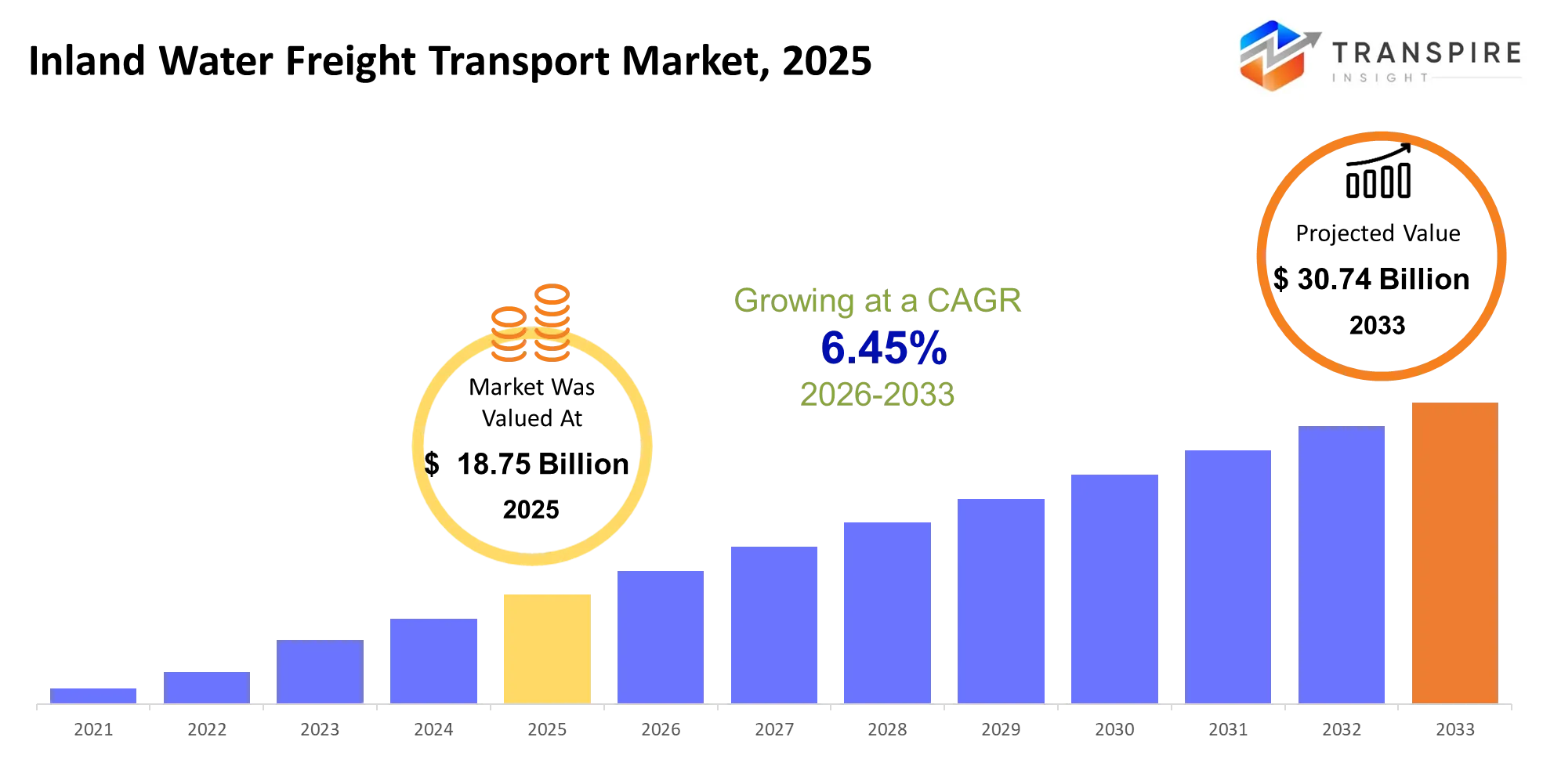
As per the Transpire Insight Analysis, The Inland Water Freight Transport Market size is estimated at USD 18.75 billion in 2025 and is anticipated to reach USD 30.74 billion by 2033, growing at a CAGR of 6.45% from 2026 to 2033.
The inland water freight transport market transports heavy, low-time-sensitive commodities such as petroleum, chemicals, grain, coal, ores and building materials between river ports, production facilities, terminals and seaports. Its strategic importance has increased in recent years as logistics providers have faced issues such as road congestion, fuel price volatility, driver shortages and decarbonisation obligations. A tectonic shift is underway from more piecemeal barge movements to integrated digital-enabled, multi-modal logistics with real-time vessel-tracking, electronic freight documentation and river-information services. A series of recent low-water situations in Europe and frequent navigation interference events demonstrate the importance of robust routing, investments in infrastructure and water-level prediction. As investments in locks, channels, terminals and port access make routes more dependable, shippers are able to shift more cargo from roads to waterways; higher vessel utilisation decreases unit transport costs and increases operator revenues; and climate policies reinforce the downward pressure on road freight.
Inland Water Freight Transport Market Size & Forecast:
- Market Size 2025: USD 18.75 Billion
- Expected Market Value (2033): USD 30.74 Billion
- Forecast CAGR (2026–2033): 6.45%
- Leading Region in 2025: North America
- Fastest Growing Region: Asia-Pacific
- Key Company Profiles: Ingram Barge, Kirby Corporation, American Commercial Barge Line, Campbell Transportation, Heartland Barge, PACC Offshore Services, DP World, Maersk, CMA CGM, MSC, Rhenus Logistics, Imperial Logistics, Spliethoff Group, HGK Shipping, Contargo.
Key Inland Water Freight Transport Market Insights:
Inland freight is a network-control business: the operators who are able to offer a combination of fleet capacity, terminal access, data and multimodal links have more pricing power than vessel-only operators. The market is shifting from volume-based barge operations to less polluting, digitally scheduled and climate-proof freight corridors.
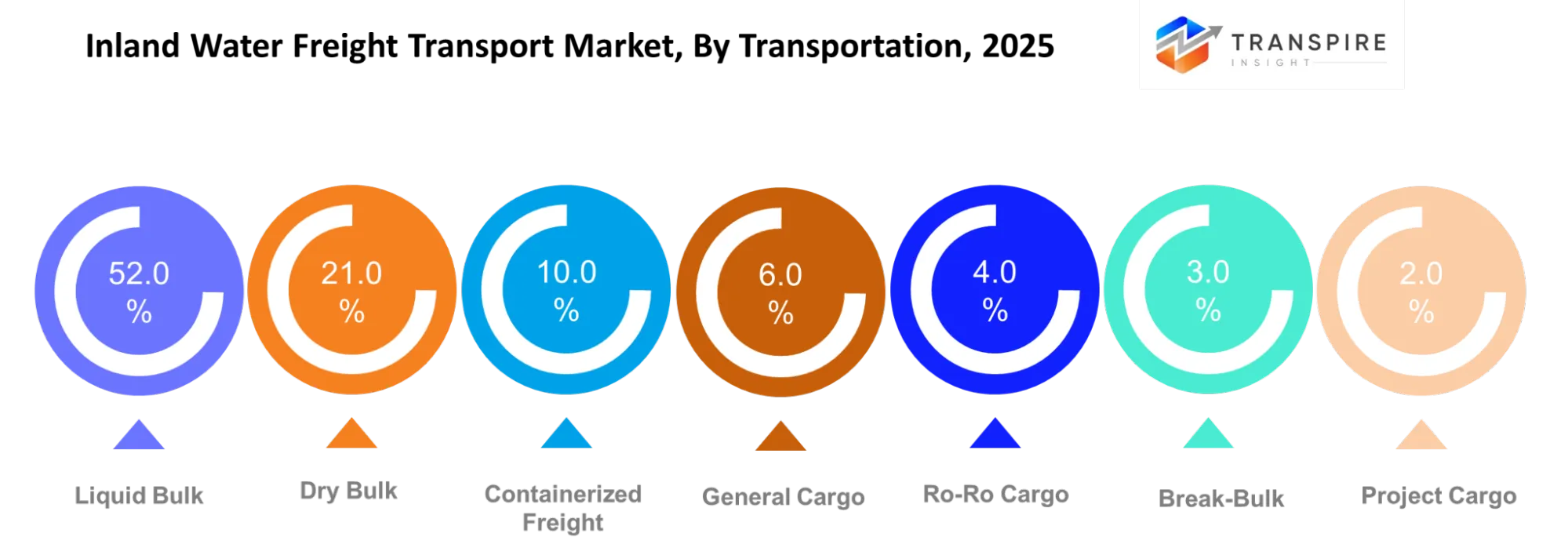
- Liquid bulk is at 52.0%, with customers favouring safe flows from the refinery to the terminal, to be reinforced by Kirby's chemical-barge expansion.
- Dry bulk, which accounted for 21.0% and increased by 3.5% CAGR, is gaining from Ingram's fuel-efficient barge renewal for agricultural and industrial commodities.
- CMA CGM's barge-rail-truck model is bolstered by containerized freight, which accounted for 10.0% of the cargo. Cargo owners want to see shipment visibility from door to door, which is why containerized freight is supporting CMA CGM's barge-rail-truck model.
- With the integrated forwarding model, General cargo benefits from Rhenus Logistics' reduction of fragmented handling, with 6.0% of its share.
- At 4.0%, Ro-Ro cargo is a positive for DP World's terminal-led approach, while equipment and vehicle shippers are looking for quicker port-hinterland connections.
- The project-logistics niche is bolstered by break-bulk freight at 3.0%. Break-bulk freight, at 3.0%, helps Spliethoff's project-logistics niche since it is not subject to road-permit restrictions.
- Project cargo is 2.0%, offering PACC Offshore Services special opportunities due to the need for heavy-lift coordination on energy-equipment movements.
- Other cargo at 2.0% supports HGK Shipping's digital fleet efforts, and operators experiment with predictive planning and shallow-water resilience.
- Contargo's inland container services are a response to the demand for scheduled, low-emission barge services as opposed to ad hoc trucking.
What are the Key Drivers, Restraints, and Opportunities in the Inland Water Freight Transport Market?
Driver:
Decarbonisation commitments and congestion in road-based freight networks are pushing industrial shippers to reconsider barge transport for high-volume cargo. The trigger has been tighter climate policy, greater scrutiny of supply-chain emissions, and the operational disruption caused by truck-driver scarcity and road bottlenecks. A single barge convoy can consolidate cargo that would otherwise require many truck movements, making inland waterways commercially attractive for petroleum, chemicals, grain, coal, aggregates, and steel-related flows. This improves asset utilisation, raises demand for terminal handling, and increases freight revenue on established river corridors. Government-backed upgrades to dredging, locks, terminals, bridge clearances, and tracking systems further improve service reliability.
Restraint:
Unreliable navigability remains the market’s most persistent limitation. Drought, low water levels, flooding, sedimentation, ageing locks, restricted bridge clearances, and uneven port infrastructure can reduce vessel loading or interrupt sailings. This structural problem persists because waterway rehabilitation requires long approval cycles, high public expenditure, cross-border coordination, and continuous maintenance. Smaller operators also face difficulty financing fleet renewal and digital equipment.
Opportunity:
Automated navigation, predictive traffic management, alternative propulsion and multimodal terminals can turn infrastructure constraints into productivity gains. EU programmes supporting zero-emission vessels and digitalisation are accelerating this transition. Expanding container and urban-waterway services along congested industrial corridors can attract higher-value cargo, improve vessel utilisation and reduce reliance on road transport. These developments can strengthen route efficiency, broaden cargo opportunities and enable premium logistics services built around reliability, visibility and lower operating emissions.
What Has the Impact of Artificial Intelligence Been on the Inland Water Freight Transport Market?
AI is shifting inland water freight from using experience to guiding using data. Operators can factor in water-level forecasts, weather, lock openings, vessel position, cargo priority, fuel consumption and port congestion to recommend the best route, departure window, load level and convoy combination, all of which can help minimise unnecessary waiting time or fuel consumption-especially along corridors affected by lock queues or shallow-water constraints. Predictive tools make it easier to plan maintenance: machine-learning models can detect abnormal engine performance, monitor component degradation and plan maintenance to avoid vessel unavailability for critical voyages.
At terminals, AI-enabled planning improves berth planning, cargo sequencing, gantry crane deployment and barge-to-rail or barge-to-truck conversion planning. Adoption of real-time tracking and predictive analytics makes cargo visibility and vessel routing decisions in the sector far more accurate. The biggest challenge is integration: inland shipping can rely on an older fleet, many operators, different data formats, varying national navigation systems, and high capital costs for sensors, connectivity, software, cybersecurity, and staff upskilling-as well as a lack of reliable hydrological data to generate automated recommendations. Digital interoperability frameworks such as DINA, eFTI, and the upcoming revision of River Information Services are attempting to address this.https://www.radioholland.com/2026/02/04/seadronix-stolt-tankers-b-v-and-radio-holland-trial-ai-powered-maritime-navigation-system/
Key Inland Water Freight Transport Market Trends:
The market is shifting from traditional river transport to a network of lower-emission transport solutions, with more and more investment in reliability, interoperability and flexible cargo handling. The biggest change is not just greater vessel capacity; it's smarter coordination between waterways, terminals, ports and road/rail.
- Periodic status updates are being replaced by real-time vessel tracking, enhancing shipper visibility and exception management. Periodic status updates are giving way to real-time vessel tracking, which enhances shipper visibility and exception management.
- Predictive routing is adding weather, water depth, lock queues, and fuel usage to schedules.
- While eFTI is still being rolled out in European freight networks, electronic freight documentation is getting the job done for now.
- River Information Services are becoming more than just navigation support; they are also becoming interoperable data infrastructure that connects vessels, ports, authorities and logistics platforms.
- The low-water disruption is causing a shift in fleet design to more flexible loading strategies, shallow-draft ships, and improved hydrological forecasting.
- The transition of pilots to fleet-renewal decisions for hybrid, electric and alternative-fuel vessel projects is progressing as emission regulations become stricter.
- Port investment is focusing more on multimodal terminals that transfer bulk cargo efficiently between barge, rail, warehouse, and truck
- The use of autonomous and remotely assisted navigation is being considered by operators due to crew shortages and production pressure.
- Inland water transport is being used more selectively for resilient bulk corridors, instead of barges being seen just as a cheap mode of transport.
- Decarbonisation policy is to promote modal-shift planning, particularly for longer, less road-efficient freight services.
Inland Water Freight Transport Market Segmentation
Type of Transportation:
Liquid Bulk dominates with a 52.0% share, supported by regular petroleum, chemical, and industrial fluid movements between refineries, storage terminals, and manufacturing facilities. Dry Bulk is projected to expand at a 3.5% CAGR, driven by grain, minerals, ores, and construction material shipments. Containerized Freight accounts for 10.0%, benefiting from inland connections between seaports and distribution hubs, while General Cargo represents 6.0%. Ro-Ro Cargo contributes 4.0%, supporting vehicle and equipment movements. Break-Bulk holds 3.0%, Project Cargo 2.0%, and Others 2.0%, serving specialized shipments where waterways offer cost-effective alternatives to road transportation and heavy-haul logistics.
Vessel Type:
Barges remain central because their modular capacity supports bulk and container movements across established waterways. Towboats efficiently push multiple barges, improving payload economics on high-volume corridors, while Self-Propelled Vessels provide greater flexibility for point-to-point services. Tankers remain essential for petroleum and chemical cargoes, whereas Container Vessels support scheduled intermodal distribution. Bulk Carriers handle minerals and agricultural commodities, while Ro-Ro Vessels and Other Vessels serve vehicles, machinery, oversized loads, and specialized freight requiring adaptable handling and route planning.
End User:
Agriculture & Food remains an important user because grain and processed food movements benefit from high-capacity, cost-efficient waterborne transport. Petroleum & Chemicals depend on tank barges for regular refinery, storage, and industrial deliveries, while Metallurgy & Mining use waterways for ores and heavy materials. Construction relies on water transport for aggregates and project inputs, and Energy requires movement of fuels and industrial equipment. Manufacturing and Retail & Consumer Goods are expanding their use as containerized distribution and multimodal terminals improve inland connectivity.
Cargo Type:
Coal remains relevant to power and industrial supply chains, while Petroleum Products and Chemicals require specialized tanker capacity and controlled handling procedures. Grain benefits from large-volume barge transport linking agricultural regions with processing facilities, export terminals, and ports. Metals & Ores rely on waterways for heavy, high-density cargo where road movement can be costly, while Containers support diversified manufactured-goods distribution. Construction Materials, including aggregates and cement-related inputs, benefit from high payload capacity and direct connections between production sites, terminals and infrastructure projects.
Operation:
Domestic services remain foundational because established river corridors connect production centres with regional terminals and ports. Short-Haul movements benefit from frequent barge cycles, while Cross-Border operations increasingly depend on harmonised documentation and customs visibility. Long-Haul services require stronger scheduling and water-level management, whereas Scheduled operations provide predictable capacity for recurring cargo flows. Charter services offer flexibility for irregular shipments, while Feeder operations connect inland terminals with larger maritime gateways. Specialized operations increasingly use digital coordination to improve vessel utilisation, cargo tracking and terminal synchronization.
What are the Key Use Cases Driving the Inland Water Freight Transport Market?
Liquid bulk is the core use case, holding a 52.0% share because inland waterways efficiently move petroleum products and chemicals in continuous, high-volume flows. Tankers and barge fleets link refineries, chemical plants, storage terminals, and industrial clusters, reducing dependence on road transport. Dry bulk, expanding at a 3.5% CAGR, supports grain, metals, ores, and construction-material shipments.
Containerised freight accounts for 10.0% and increasingly connects seaports with inland terminals and distribution centres, easing road congestion. General cargo, at 6.0%, supports industrial replenishment, while Ro-Ro services carry vehicles and equipment.
Emerging demand includes renewable-energy components, recyclable materials, construction inputs, and project cargo. Digital scheduling, electronic documentation, automated navigation, and low-emission propulsion improve service reliability, enabling more frequent multimodal movements across water-linked industrial corridors.
|
Report Metrics |
Details |
|
Market size value in 2025 |
USD 18.75 Billion |
|
Market size value in 2026 |
USD 19.84 Billion |
|
Revenue forecast in 2033 |
USD 30.74 Billion |
|
Growth rate |
CAGR of 6.45% from 2026 to 2033 |
|
Base year |
2025 |
|
Historical data |
2021 - 2024 |
|
Forecast period |
2026 - 2033 |
|
Report coverage |
Revenue forecast, competitive landscape, growth factors, and trends |
|
Regional scope |
United States; Canada; Mexico; United Kingdom; Germany; France; Italy; Spain; Denmark; Sweden; Norway; China; Japan; India; Australia; South Korea; Thailand; Brazil; Argentina; South Africa; Saudi Arabia; United Arab Emirates |
|
Key companies profiled |
Ingram Barge, Kirby Corporation, American Commercial Barge Line, Campbell Transportation, Heartland Barge, PACC Offshore Services, DP World, Maersk, CMA CGM, MSC, Rhenus Logistics, Imperial Logistics, Spliethoff Group, HGK Shipping, Contargo |
|
Customization scope |
Free report customisation (country, regional & segment scope). Available customised purchase options to meet your exact research needs. |
|
Report Segmentation |
Type of Transportation (Liquid Bulk, Dry Bulk, Containerized Freight, Roll-On/Roll-Off Cargo, Break-Bulk, General Cargo, Project Cargo, Other Cargo); Vessel Type (Barges, Towboats, Self-Propelled Vessels, Tankers, Container Vessels, Bulk Carriers, Ro-Ro Vessels, Other Vessels); End User (Agriculture & Food, Petroleum & Chemicals, Metallurgy & Mining, Construction, Energy, Manufacturing, Retail & Consumer Goods, Others); Cargo Type (Coal, Petroleum Products, Chemicals, Grain, Metals & Ores, Containers, Construction Materials, Others); Operation (Domestic, Cross-Border, Short-Haul, Long-Haul, Scheduled, Charter, Feeder, Specialized). |
Which Regions are driving growth in the inland water freight transport market?
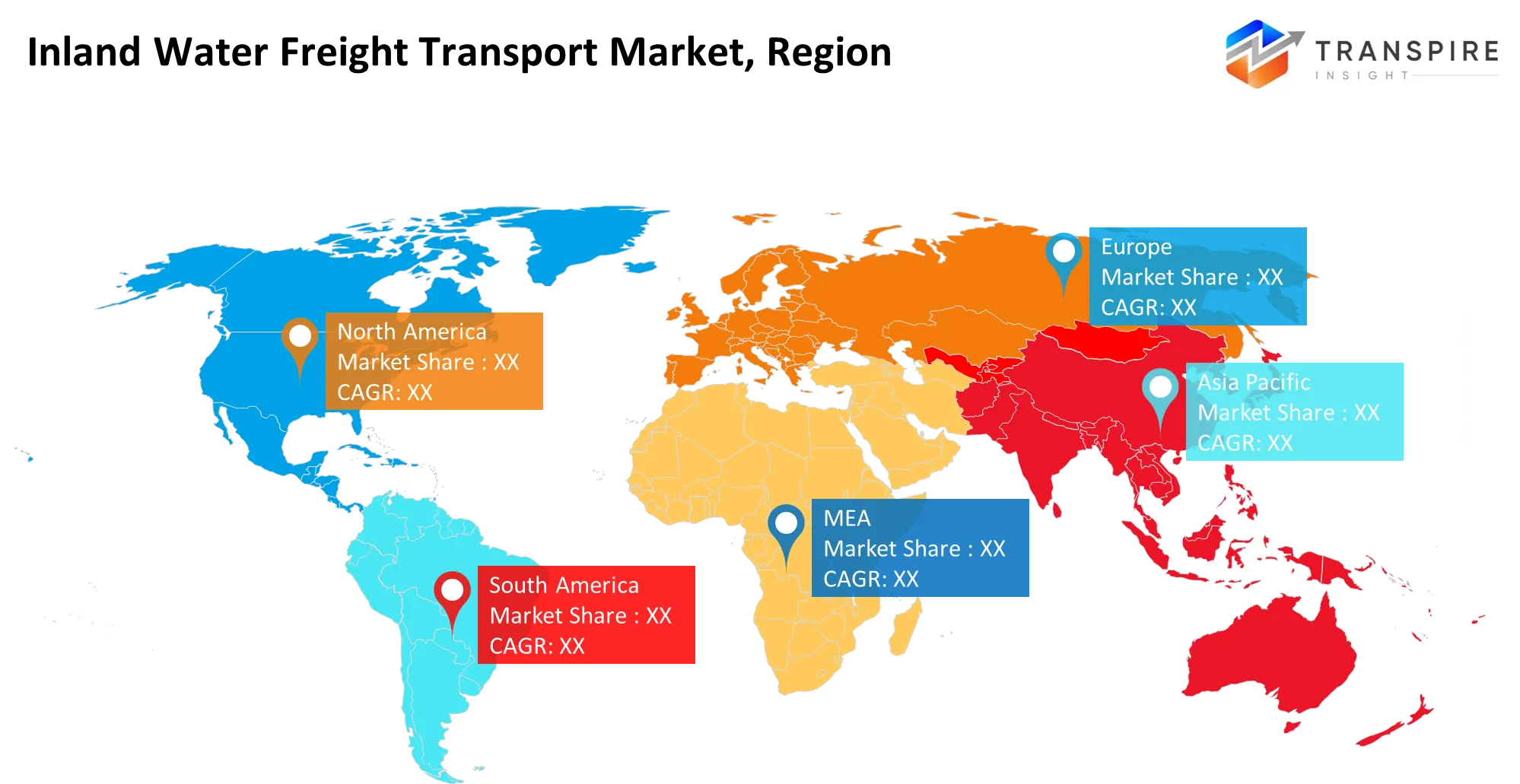
North America dominates the market with a 31.0% share, owing to the Mississippi River system, the chemical hubs along the Gulf Coast, and robust barge networks supporting large-volume movements of petroleum, chemicals, grain, fertiliser, and aggregates. The advantage for North America lies in an established towboat-and-barge operating model versus shorter-distance container flows. The Water Resources Development Act of 2024 has increased policy focus on navigation, ports, and water-resources infrastructure. Operators are focused on strategic investments into tank-barge fleet capacity and optimisation of the existing fleet; however, high capital cost to invest in new barges limits the rate of fleet expansion.
In September 2026, acquired St. John Fleeting LLC. This acquisition expanded Turn Services' marine footprint and fleeting capacity on the Lower Mississippi River by adding space for up to 300 dry, liquid, and speciality chemical barges within the Port of South Louisiana's jurisdiction.https://neworleanscitybusiness.com/blog/2026/09/14/turn-services-st-john-fleeting-acquisition/
Europe has a 28.0% share, including the Rhine, Danube, Rhine-Meuse-Scheldt, and a heavily developed port-hinterland network. Europe benefits more from cross-border integration, container barge activities, and modal shifts stimulated by regulation compared to the North American commodity-oriented river system. Its stability results from developed terminals, road congestion costs, and policies relating to electronic freight information and river information services. As digitalisation and decarbonisation progress, operational transparency becomes more competitive for carriers.
In January 2026, Inland Terminals Group (ITG), Van Berkel Logistics, and Contargo launched a unified container data-sharing framework under the Dutch government's Digital Infrastructure Logistics program.https://www.worldcargonews.com/news/2026/06/dutch-terminals-boost-inland-links/
Asia-Pacific makes up 25.0% of the market and represents the most rapidly expanding region, with a forecasted CAGR of 5.6%. The investments in waterways, industrial corridors, ports, and inland terminals made in the last few years have made river logistics commercially more relevant for China, India, and Southeast Asia. Still, growth in Asia-Pacific will heavily depend on the growth of manufacturing industries, the demand for port construction projects, commodity distribution, and infrastructure to support trade activities. The greatest potential lies in linking the inland industrial locations with the ports through container, bulk, and multimodal barge corridors.
In July 2026, the Ningbo-Zhoushan Port Authority completed a major phase in the expansion of its core container terminals. This project enhanced handling capacity and deepened harbor basins to support large container vessels and growing trade-linked infrastructure demand.https://rynda.io/news/4c1677b1-998f-454e-b058-6538b04e68e8
Who are the Key Players in the Inland Water Freight Transport Market, and how do they compete?
Industry competition is dispersed among specialist barge operators, logistics integrators, port groups, and deep-inland extensions of ocean carriers. In high-volume bulk corridors, scale matters but differentiation increasingly depends on having a large fleet available, port access, handling expertise for specific cargo types, and digital "visualisation" of cargo movements. Competitors include: Ingram Barge, Kirby, ACBL, Campbell, Heartland Barge, who compete primarily on route density, towboat-barge assets, specific cargo types, and long-term industrial contracts; ACBL is investing in network management systems; Kirby has a portfolio of stable cash-generating chemical-transport assets; a prevailing high price for newly built barges signals that existing operators are prioritising asset utilisation, contract re-pricing, and premium fleet renewal; and ACBL is developing Internet of Things-enabled fleet management capabilities.
Operators such as HGK, Contargo, Rhenus Logistics, Imperial Logistics, and Spliethoff differentiate on Europe-wide multimodal connectivity, container logistics, project cargo, and special cargo handling expertise. DP World, Maersk, CMA CGM, and MSC own ports, have vast ocean-network reach, and offer deep inland forwarding that secures cargo well beyond the quay. CMA CGM moved 6.9 million TEUs of intermodal volume in 2023, illustrating the strategic importance of bridging between inland barge networks and international shipping.
Key Players are:
- Ingram Barge
- Kirby Corporation
- American Commercial Barge Line
- Campbell Transportation
- Heartland Barge
- PACC Offshore Services
- DP World
- Maersk
- CMA CGM
- MSC
- Rhenus Logistics
- Imperial Logistics
- Spliethoff Group
- HGK Shipping
- Contargo
Recent Development News
- In April 2026, Covestro partnered with HGK Shipping to commission the wind-assisted cargo vessel "Amadeus Titanium" into active freight service. This launch integrates eco-friendly wind propulsion into river logistics, drastically reducing fuel overheads and carbon emissions for bulk chemical inland distribution.https://hgkshipping.de/en/news-en/
- In 2026, CMA CGM launched an electric and hybrid inland barge project for the Fos–Lyon corridor in France. The planned 156-TEU vessel is expected to support nearly 12,000 TEUs annually, while a €40 million modernization programme at Lyon Rhône Terminal is intended to expand inland waterway capacity and strengthen lower-emission freight connections along the Rhône corridor.https://www.cma-cgm.com/news/4281/the-cma-cgm-group-launches-a-call-for-projects-worth-for-200-million-to-step-up-the-pace-of-decarbonization-of-the-french-shipping-industry
What Strategic Insights Define the Future of the Inland Water Freight Transport Market?
The industry is moving towards fewer, more integrated freight corridors where vessel operators, terminals, ports, rail operators and digital services coordinate cargo on a corridor basis from first to last port. At risk, the low water regimes are only the symptoms; continuous climate-driven disruptions will undermine shipper confidence when operators have no flexible loading plans, alternative terminals and visible arrival predictions. The opportunity is a climate-resilient intermodal design; shallow-draft fleets, water-level predictive analytics, digital documentation and decarbonized propulsion will begin to convert water-based shipping from a low-cost alternative to a dependable strategic mode. The bottom line as invest for corridor liquidity not just fleet capacity; operators should secure port capacity, digital connectivity to shippers and regulators, water-level predictive routing and rail-port partnerships that reduce empty repositioning, improve asset utilization, and preserve revenues when water levels are uncertain. Future digital freight and river information services will further foster interoperability.
Key Segmentations are:
Type of Transportation
- Liquid Bulk
- Dry Bulk
- Containerized Freight
- Roll-On/Roll-Off Cargo
- Break-Bulk
- General Cargo
- Project Cargo
- Other Cargo
Vessel Type
- Barges
- Towboats
- Self-Propelled Vessels
- Tankers
- Container Vessels
- Bulk Carriers
- Ro-Ro Vessels
- Other Vessels
End User
- Agriculture & Food
- Petroleum & Chemicals
- Metallurgy & Mining
- Construction
- Energy
- Manufacturing
- Retail & Consumer Goods
- Others
Cargo Type
- Coal
- Petroleum Products
- Chemicals
- Grain
- Metals & Ores
- Containers
- Construction Materials
- Others
Operation
- Domestic
- Cross-Border
- Short-Haul
- Long-Haul
- Scheduled
- Charter
- Feeder
- Specialised
By Regional Analysis
North America
- US
- Canada
- Mexico
Europe
- Germany
- UK
- France
- Italy
- Spain
- Russia
- Rest of Europe
Asia Pacific
- China
- Japan
- India
- South Korea
- Australia
- Rest of Asia Pacific
South America
- Brazil
- Argentina
- Rest of South America
Middle East & Africa
- UAE
- Saudi Arabia
- Qatar
- South Africa
- Rest of the Middle East & Africa
Frequently Asked Questions
Find quick answers to common questions.
The inland water freight transport market size was valued at USD 18.75 billion in 2025 and is poised to reach USD 30.74 billion by 2033, expanding at a 6.45% CAGR.
Key segments for the inland water freight transport market are Type of Transportation (Liquid Bulk, Dry Bulk, Containerized Freight, Roll-On/Roll-Off Cargo, Break-Bulk, General Cargo, Project Cargo, Other Cargo); Vessel Type (Barges, Towboats, Self-Propelled Vessels, Tankers, Container Vessels, Bulk Carriers, Ro-Ro Vessels, Other Vessels); End User (Agriculture & Food, Petroleum & Chemicals, Metallurgy & Mining, Construction, Energy, Manufacturing, Retail & Consumer Goods, Others); Cargo Type (Coal, Petroleum Products, Chemicals, Grain, Metals & Ores, Containers, Construction Materials, Others); Operation (Domestic, Cross-Border, Short-Haul, Long-Haul, Scheduled, Charter, Feeder, Specialized).
Growth is primarily driven by modal-shift policies, investment in inland ports and waterways, demand for cost-efficient bulk transportation, fleet digitalisation, low-emission vessel adoption, and expanding multimodal logistics networks.
The inland water freight transport market is led by major manufacturers, including Ingram Barge, Kirby Corporation, American Commercial Barge Line, Campbell Transportation, Heartland Barge, PACC Offshore Services, DP World, Maersk, CMA CGM, MSC, Rhenus Logistics, Imperial Logistics, Spliethoff Group, HGK Shipping, and Contargo.
North America holds a 31.0% share, supported by extensive river networks, large agricultural and industrial cargo flows, established barge fleets, inland ports, and strong connections between production centres and export terminals.
Commercial opportunities include zero-emission vessels, AI-based route optimisation, automated navigation, multimodal terminals, containerised inland services, and urban-waterway freight networks.
- Ingram Barge
- Kirby Corporation
- American Commercial Barge Line
- Campbell Transportation
- Heartland Barge
- PACC Offshore Services
- DP World
- Maersk
- CMA CGM
- MSC
- Rhenus Logistics
- Imperial Logistics
- Spliethoff Group
- HGK Shipping
- Contargo
About the Authors

Mayur Shinde
I am Mayur Shinde, a Senior Research Analyst at Transpire Insight, specializing in the Automotive & Transportation and Information & Communication Technology (ICT) Industry. My work focuses on analyzing emerging market trends, technological advancements, competitive landscapes, and industry developments to deliver accurate, data-driven insights. I am passionate about transforming complex market information into clear, actionable content that helps businesses, professionals, and decision-makers stay informed and make confident strategic decisions.

Chakradhar Khansole
Chakradhar serves as the Research Director at Transpire Insight, bringing over 8 years of experience in technology, innovation, and strategic market intelligence. He specializes in transforming complex market data into actionable business insights that enable organizations to make informed, growth-oriented decisions. Recognized for his strategic vision and analytical expertise, Chakradhar leads high-impact research initiatives, delivering comprehensive market assessments, competitive intelligence, and forward-looking industry analysis.
Recently Published Reports
-
Apr 2026
ATV & UTV Market
ATV & UTV Market Size, Share & Analysis Report By Type (ATV, and UTV), By Variants (Less Than 400 CC, 400 CC To 800 CC, and More Than 800 CC), and Geography (North America, Europe, Asia-Pacific, Middle East and Africa, South and Central America), 2021 - 2031
-
Apr 2026
Automotive Central Gateway Module Market
Automotive Central Gateway Module Market Size, Share & Analysis Report By Type (Ethernet Central Gateway Module, CAN Central Gateway Module, LIN Central Gateway Module, and FlexRay), By Application (Powertrain Control, Body Control, Infotainment System, Advanced Driver Assistance Systems (ADAS), and Others), By End User (Passenger Vehicles, and Commercial Vehicles), and Geography (North America, Europe, Asia-Pacific, Middle East and Africa, South and Central America), 2021 - 2031
-
Apr 2026
Automotive Engine Oil Filter Market
Automotive Engine Oil Filter Market Size, Share & Analysis Report By Filter Type (Fuel Filter, Engine Oil Filter, Hydraulic Oil Filter, and Others), By Filter Media (Cellulose, Synthetic, and Micro), By Sales Channel (OEMs, and Aftermarket), By Vehicle Type (Passenger Cars, Light Commercial Vehicles, Heavy Duty Trucks, Buses and Coaches, and Off-road Vehicles), and Geography (North America, Europe, Asia-Pacific, Middle East and Africa, South and Central America), 2021 - 2031
-
Apr 2026
Automotive Parts Aluminium Die Casting Market
Automotive Parts Aluminium Die Casting Market Size, Share & Analysis Report By Production Process (Pressure Die Casting, Vacuum Die Casting, Squeeze Die Casting, Gravity Die Casting), By Application (Body Parts, Engine Parts, Transmission Parts, Battery And Related Components, Other Application Types), and Geography (North America, Europe, Asia-Pacific, Middle East and Africa, South and Central America), 2021 - 2031
Our Clients



