
Sep 05, 2026
Market Forecast
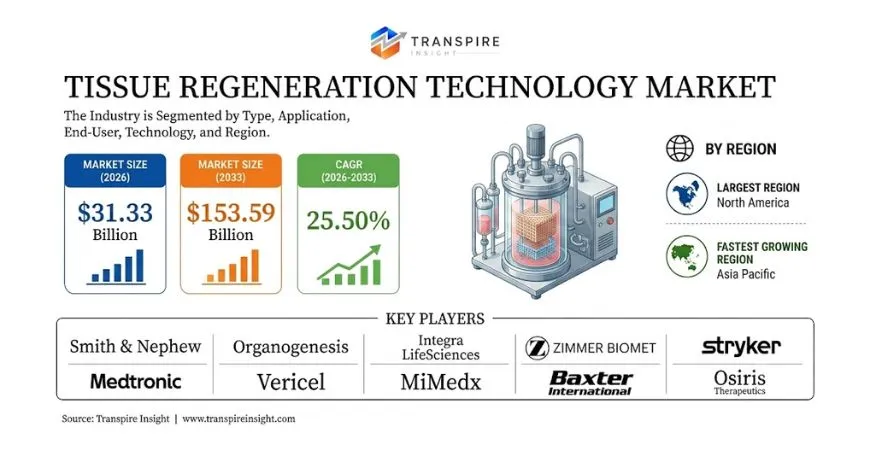
The global tissue regeneration technology market was valued at USD 25.04 billion in 2025 and is projected to grow from USD 31.33 billion in 2026 to USD 153.59 billion by 2033, at a CAGR of 25.50% through the forecast period, according to a new report by Transpire Insights.
Advances in stem cell biology, biomaterial science, and 3D bioprinting are converging to transform tissue regeneration from a research discipline into an expanding clinical and commercial reality. The aging global population with its associated burden of chronic wounds, orthopaedic conditions, and organ failure creates a structural demand driver that gives tissue regeneration technologies a patient population that is growing faster than conventional surgical and pharmaceutical approaches can fully address.
Tissue Regeneration Technology Market Growth & Trends
Chronic wound management is the highest-volume clinical application for tissue regeneration technology today. Diabetic foot ulcers, venous leg ulcers, and pressure injuries collectively affect tens of millions of patients globally, and the failure rate of conventional wound care in achieving closure in complex chronic wounds creates a significant unmet clinical need that regenerative products including bioengineered skin substitutes, growth factor matrices, and cellular therapies are progressively addressing. FDA-approved products from Organogenesis, MiMedx, and Integra LifeSciences have established commercial infrastructure for regenerative wound care in the US market.
Orthopaedic regeneration is the second major clinical growth area, encompassing bone defect repair, cartilage regeneration, and spinal fusion augmentation. The intersection of an ageing population with high rates of musculoskeletal disease and trauma, combined with the commercial validation of bone morphogenetic protein-based bone graft substitutes and newer scaffold-based cartilage repair products, is creating a well-capitalised market with active product development from major medical device companies including Stryker, Zimmer Biomet, and Medtronic.
Emerging Economies & Technology
3D bioprinting is the technology platform generating the most transformative long-term expectations in tissue regeneration. The ability to print living tissue constructs with precise spatial arrangement of cells, growth factors, and supporting biomaterial scaffolds creates a manufacturing pathway toward engineered tissue and organ substitutes that conventional cell therapy and scaffold approaches cannot approach. Commercial bioprinting of skin for burn treatment and pharmaceutical testing is already at commercial scale, and clinical-stage programmes for printed cartilage, vascular grafts, and kidney organoids are advancing through regulatory pathways in the US, EU, and Japan.
Decellularised extracellular matrix products derived from animal tissues with cells removed to leave a biocompatible scaffold for host cell repopulation are establishing a commercially robust segment between conventional wound care products and more complex engineered tissue constructs. These products offer clinical efficacy advantages over standard wound care with a manufacturing process and regulatory pathway that is more tractable than fully cellular regenerative products, making them a commercially important bridge category that is growing across wound care, orthopaedic, and cardiac repair applications.
Wound Healing Segment
Wound healing applications hold 49% of the global tissue regeneration technology market, the largest segment. The scale of the chronic wound patient population, the significant healthcare cost associated with non-healing wounds, and the commercial maturity of the regenerative wound care market with multiple FDA-cleared products, established reimbursement pathways, and trained clinical user communities give wound healing the most developed commercial infrastructure of any tissue regeneration application area.
Advanced wound care products incorporating platelet-rich plasma, amniotic membrane allografts, and bioengineered cellular matrices are the fastest-evolving sub-segment, with a competitive landscape that includes both established medical device companies and specialist regenerative medicine firms competing for wound clinic and hospital-based wound care service specification. Clinical outcomes data demonstrating improved healing rates over standard care is the primary commercial differentiator in this segment.
3D Bioprinting: Fastest-Growing Technology
3D bioprinting is growing at a CAGR of 18.4% the fastest rate across all tissue regeneration technology platforms. Investment in bioprinting platforms from both commercial companies and academic medical centres is accelerating, driven by the technology's potential to produce patient-specific tissue constructs, its utility in pharmaceutical drug testing on tissue models, and the competitive dynamic between a growing number of well-capitalised bioprinting companies racing toward first clinical approvals.
Pharmaceutical and cosmetic testing on 3D bioprinted tissue models skin, liver, lung, and gut constructs is a commercially established and growing bioprinting market that is providing revenue while longer-term clinical implant applications complete their development and regulatory journey. CollPlant and similar companies are developing plant-collagen bioink systems that provide the biological scaffold material for bioprinting without the animal-derived collagen sourcing challenges that complicate regulatory and ethical review.
North America – Largest Regional Market
North America holds 39% of the global tissue regeneration technology market, the largest regional share. The United States has the world's most developed commercial infrastructure for regenerative medicine products, with FDA breakthrough therapy designations and regenerative medicine advanced therapy designations providing accelerated approval pathways for qualifying products. CMS reimbursement for established regenerative wound care and orthopaedic regeneration products sustains commercial adoption at scale, and the US academic medical centre system drives clinical research that generates the evidence base for expanding clinical adoption.
Venture capital and corporate investment in regenerative medicine companies is concentrated in the US, with established medical technology companies including Stryker, Medtronic, and Baxter International making significant acquisitions in the regenerative medicine space alongside continued investment from specialist regenerative medicine venture funds. This investment environment sustains the innovation pipeline that will drive next-generation product launches through the forecast period.
Asia Pacific – Fastest-Growing Region
Asia Pacific is advancing at a CAGR of 17.1% the highest regional rate in this market. Japan has the world's most progressive regulatory framework for regenerative medicine products, with the Act on the Safety of Regenerative Medicine enabling conditional approval of regenerative medical products based on smaller efficacy datasets than conventional pharmaceutical approval, accelerating commercial launch timelines. South Korea and Australia are active markets for regenerative wound care and orthopaedic regeneration products with established reimbursement frameworks.
China is investing heavily in regenerative medicine research and manufacturing, with state-supported programmes in stem cell therapy, biomaterial development, and bioprinting advancing domestic capability in technologies that were previously imported or dependent on international academic collaboration. The scale of China's chronic disease and aging population burden and the government's recognition of regenerative medicine as a strategic healthcare technology area is sustaining investment at a pace that is rapidly closing the gap with established Western markets.
What Are the Recent Developments in the Tissue Regeneration Technology Market?
Q4 2024 – Organogenesis: Received expanded Medicare reimbursement coverage for its Apligraf and Dermagraft bioengineered skin products in diabetic foot ulcer treatment, significantly broadening commercial access to its cellular tissue technology products for outpatient wound care providers.
Q4 2024 – CollPlant: Completed a Phase I clinical safety study for its rhCollagen-based 3D bioprinted breast implant, representing one of the first human clinical evaluations of a fully bioprinted soft tissue implant and a milestone for the broader field of 3D bioprinting in reconstructive surgery.
Q1 2025 – Stryker: Acquired a specialist cartilage repair company to expand its regenerative orthopaedics portfolio, adding a cell-based cartilage regeneration product to its joint reconstruction business targeting younger, more active patients with focal cartilage defects.
Q2 2025 – Integra LifeSciences: Launched an enhanced version of its Integra Dermal Regeneration Template with optimised pore architecture for faster neovascularisation, reducing the typical time to second-stage skin grafting in complex wound reconstruction by approximately one week.
Q2 2025 – Vericel: Received FDA approval for an expanded indication for its MACI autologous chondrocyte implant product covering larger cartilage defect sizes than previously approved, extending the eligible patient population for its cell-based knee cartilage repair therapy.
Q3 2025 – MiMedx: Secured a multi-site clinical agreement with a US academic medical centre network to investigate amniotic membrane allograft products in diabetic wound care protocols, generating real-world evidence data to support broader commercial adoption across wound care service lines.
About Transpire Insight
Turning Complex Data into Clear, Actionable Market Intelligence
In today’s hyper-competitive and fast-moving economy, guessing isn’t a business strategy. To lead your industry, launch game-changing products, or scale into new geographies, you need precise, reliable market intelligence, not just high-level noise.
At Transpire Insight, we are a full-service market research, data analytics, and strategic consulting firm. We help corporate leaders, innovators, and investors navigate complex market shifts with absolute confidence.
By combining rigorous primary research, deep statistical modeling, and hands-on domain expertise, we convert raw data into high-impact strategic roadmaps that drive measurable growth.
What Drives Us
Markets don’t stand still, and neither do we. Our core mission is simple: to empower organizations with verified, technology-enabled insights that remove guesswork from strategic planning.
Whether you are evaluating a niche technological shift, assessing supply chain dynamics, or looking for high-growth target segments, our intelligence gives you a decisive competitive edge.
Why Leading Enterprises Trust Transpire Insight
We don't offer one-size-fits-all research. Our analysts specialize in dedicated verticals—from Biotechnology and Semiconductors to Advanced Automotive, Clean Energy, and Industrial Manufacturing. We speak your industry's language and understand the specific nuances, regulatory shifts, and economic drivers shaping your market.
Syndicated Market Reports: In-depth, turn-key research studies covering market size, share, competitive benchmarking, and multi-year forecasts.
Customized Market Intelligence: Tailored research engagements built around your exact business questions, specific product lines, or targeted regional dynamics.
Strategic Consulting: On-demand analytical support, entry-strategy planning, and direct consultation to help you act on data with speed and accuracy.
Reliable forecasts demand ground-truth data. Our research process combines comprehensive desk research with extensive primary interviews across key industry stakeholders including C-suite executives, supply chain leaders, procurement heads, and subject matter experts. Every report undergoes strict validation to ensure maximum precision and relevance.
Our Core Sectors
We provide continuous tracking and deep-dive analytical coverage across high-impact industries:
Manufacturing and Construction
Let’s Shape Your Growth Strategy Together
Whether you are preparing for your next fiscal cycle, analyzing market entry barriers, or looking for deep-dive quantitative data, Transpire Insight is your trusted intelligence partner.
Ready to gain a clearer view of your market?
Email Us: [email protected]
Speak to Our Analyst: +91 7666513636
Want to dive deeper? Head over to www.transpireinsight.com or join our community on Twitter, LinkedIn, and Facebook for the latest updates

 [email protected]
 APAC:+91 7666513636
 Address


