
Aug 13, 2026
Market Forecast
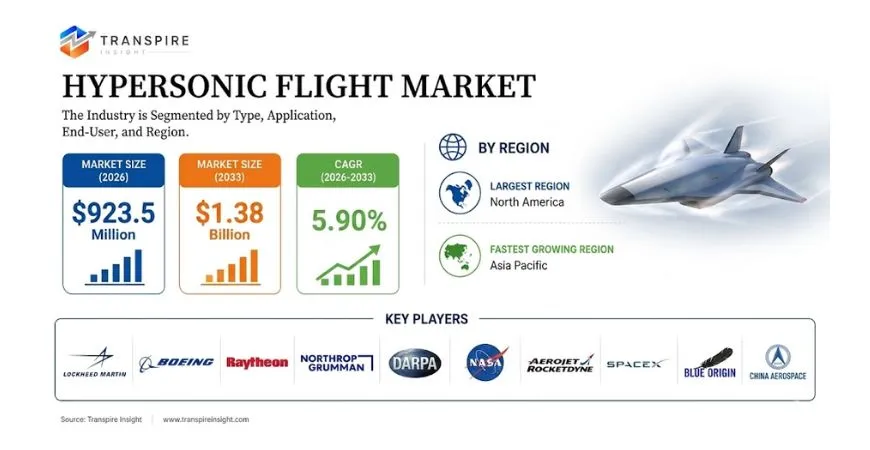
The hypersonic flight market was valued at USD 873.7 million in 2025 and is projected to grow from USD 923.5 million in 2026 to USD 1.38 billion by 2033, at a CAGR of 5.90% through the forecast period, according to a new report by Transpire Insights.
Sustained investment by the United States, China, and Russia in hypersonic weapons development — combined with growing programme activity in Europe, Australia, India, and Japan — is driving this market forward. Hypersonic flight represents one of the most technically demanding frontiers in aerospace, and the military, strategic, and commercial applications being pursued in parallel are generating multi-billion dollar R&D expenditure that underpins market growth well into the next decade.
Hypersonic Flight Market Growth & Trends
The strategic imperative behind military hypersonic investment is straightforward: systems flying at Mach 5 and above with manoeuvring capability provide extremely limited response time for existing air defence networks. The United States, China, and Russia are all developing hypersonic glide vehicle and boost-glide weapon systems as a response to the perceived vulnerability of traditional ballistic and subsonic cruise missile arsenals against modern air defence, and competitive pressure among these three powers is creating a continuous investment cycle that shows no sign of abating.
NATO member states — particularly the UK, France, and Germany — are investing in hypersonic research and development both to develop defensive countermeasure capability and to reduce their dependence on the United States for advanced strike options. Australia is participating in the SCIFiRE programme with the US and UK, targeting an air-launched hypersonic cruise missile by the end of the decade. India is advancing its Hypersonic Technology Demonstrator Vehicle programme. These parallel national programmes are expanding the geographic distribution of hypersonic investment beyond the three principal powers.
Emerging Economies & Technology
The technology challenge in hypersonic flight encompasses thermal management, propulsion, guidance, and materials science simultaneously — making it one of the most cross-disciplinary engineering programmes in contemporary aerospace. Hypersonic vehicles experience surface temperatures exceeding 2,000°C during sustained atmospheric flight, requiring thermal protection systems using ultra-high temperature ceramics, refractory metal composites, and ablative materials that do not yet have established manufacturing supply chains at scale.
Scramjet propulsion — the air-breathing engine concept that enables sustained hypersonic flight without the rocket propellant mass fraction of ballistic systems — remains the central technical challenge for hypersonic aircraft and cruise missile development. While scramjet combustion has been demonstrated in flight, achieving reliable sustained operation across the full speed range and altitude envelope required for operational systems remains an active area of research at DARPA, NASA, and their international equivalents. Progress in computational fluid dynamics and additive manufacturing of hypersonic propulsion components is accelerating the pace of experimental validation.
Hypersonic Missiles Segment
Hypersonic missiles hold 47% of the hypersonic flight market — both the largest and most commercially advanced segment. Russia's deployment of the Kinzhal air-launched ballistic missile and Zircon anti-ship hypersonic cruise missile, combined with China's DF-17 hypersonic glide vehicle system, represent the only currently operational hypersonic weapons systems and have set the benchmark against which US and allied programmes are measured. US programmes including the Army's Long-Range Hypersonic Weapon, the Navy's Conventional Prompt Strike, and the Air-Launched Rapid Response Weapon are all in various stages of development and early low-rate production.
The combination of strategic deterrence value and the absence of effective countermeasures makes hypersonic missiles a high-priority procurement item for defence ministries that can sustain the significant development costs. Unlike hypersonic aircraft or spaceplanes — which face longer development timelines and require solving additional propulsion and reusability challenges — hypersonic glide vehicles and boost-glide systems can leverage existing ballistic missile launch infrastructure, making them more achievable in the near term.
Hypersonic Aircraft: Fastest-Growing Segment
Hypersonic aircraft are growing at a CAGR of 9.4% — the fastest rate in the market. The segment encompasses both military high-speed strike and reconnaissance aircraft concepts and the longer-term commercial hypersonic transport vision. Lockheed Martin's SR-72 demonstrator programme and DARPA's various hypersonic demonstrator contracts represent the military side of the development pipeline, targeting sustained Mach 5+ flight with recoverable, reusable airframes — a capability that would enable conventional strike and intelligence gathering with response times measured in minutes rather than hours.
The commercial hypersonic transport segment — companies including Boom Supersonic, Hermeus, and Spike Aerospace working on Mach 3-5 passenger aircraft — is still in early development phases, but the underlying commercial logic of dramatically reduced long-haul flight times has attracted serious investment and engineering talent. These programmes will be a longer-duration growth story than the near-term military hypersonic investment cycle, but their eventual contribution to the market is potentially transformative.
North America – Largest Regional Market
North America holds 36% of the hypersonic flight market — the largest regional share. The United States is the world's largest single investor in hypersonic technology across both government-funded programmes — through DARPA, AFRL, ONR, and the Army's DEVCOM — and private sector contracts with Lockheed Martin, Raytheon, Northrop Grumman, and L3Harris. The scale and breadth of US investment reflects both the strategic priority assigned to hypersonic capability and the competitive response to Chinese and Russian programme advances.
NASA's hypersonic research programme contributes civilian technology development that feeds into both commercial transport concepts and military propulsion research, maintaining a civilian technology base that complements the predominantly defence-driven investment cycle. Aerojet Rocketdyne's scramjet propulsion work — much of it conducted under DARPA and Air Force Research Laboratory contracts — represents decades of accumulated expertise that gives US hypersonic propulsion development a depth of institutional knowledge that is difficult for newer programmes to match quickly.
Asia Pacific – Fastest-Growing Region
Asia Pacific is advancing at a CAGR of 11.3% — the highest regional growth rate in this market. China is the dominant driver, with a hypersonic weapons and research programme that is broadly comparable in ambition and investment scale to the United States. The DF-17 is operationally deployed, the DF-ZF hypersonic glide vehicle is in service, and the Chinese aerospace research establishment is investing in scramjet technology, high-temperature materials, and hypersonic wind tunnel testing infrastructure that positions it for both near-term weapons development and longer-term aircraft applications.
India and Japan are both investing in hypersonic research programmes, and Australia's participation in the US-UK SCIFiRE programme is expanding its involvement in hypersonic technology development beyond what its domestic industrial base could sustain independently. The Indo-Pacific security environment — and the perceived hypersonic capability gap between China and the region's US-aligned nations — is creating political motivation for accelerated investment that is driving programme timelines and funding levels across the region.
What Are the Recent Developments in the Hypersonic Flight Market?
Q4 2024 – Raytheon: Completed a flight test of its Hypersonic Air-breathing Weapon Concept (HAWC) demonstrator under DARPA contract, validating scramjet ignition and sustained combustion across the target speed and altitude envelope for a future air-launched hypersonic cruise missile.
Q4 2024 – Northrop Grumman: Received a US Air Force contract for continued development of the Hypersonic Attack Cruise Missile, advancing the programme toward an initial operational capability target and expanding the company's hypersonic propulsion and thermal protection manufacturing capability.
Q1 2025 – Lockheed Martin: Advanced the SR-72 technology demonstrator programme with a wind tunnel test series validating the integrated propulsion system concept across the subsonic-to-hypersonic speed transition — one of the most demanding performance requirements for a reusable hypersonic aircraft.
Q2 2025 – Aerojet Rocketdyne: Delivered the first flight-qualified scramjet engines for a DARPA hypersonic demonstrator programme, marking the first production delivery of a scramjet propulsion system intended for flight test rather than ground demonstration.
Q2 2025 – BAE Systems: Secured a UK MOD contract to develop hypersonic glide vehicle thermal protection system materials under the UK's Hypersonic Technologies and Capability Development Framework, contributing to the UK's independent hypersonic strike capability development.
Q3 2025 – L3Harris: Announced the qualification of a new high-temperature guidance system electronics package for hypersonic glide vehicle applications, addressing one of the key technical challenges in providing accurate terminal guidance at hypersonic speeds in high-heat environments.
About Transpire Insight
Turning Complex Data into Clear, Actionable Market Intelligence
In today’s hyper-competitive and fast-moving economy, guessing isn’t a business strategy. To lead your industry, launch game-changing products, or scale into new geographies, you need precise, reliable market intelligence, not just high-level noise.
At Transpire Insight, we are a full-service market research, data analytics, and strategic consulting firm. We help corporate leaders, innovators, and investors navigate complex market shifts with absolute confidence.
By combining rigorous primary research, deep statistical modeling, and hands-on domain expertise, we convert raw data into high-impact strategic roadmaps that drive measurable growth.
What Drives Us
Markets don’t stand still, and neither do we. Our core mission is simple: to empower organizations with verified, technology-enabled insights that remove guesswork from strategic planning.
Whether you are evaluating a niche technological shift, assessing supply chain dynamics, or looking for high-growth target segments, our intelligence gives you a decisive competitive edge.
Why Leading Enterprises Trust Transpire Insight
We don't offer one-size-fits-all research. Our analysts specialize in dedicated verticals—from Biotechnology and Semiconductors to Advanced Automotive, Clean Energy, and Industrial Manufacturing. We speak your industry's language and understand the specific nuances, regulatory shifts, and economic drivers shaping your market.
Syndicated Market Reports: In-depth, turn-key research studies covering market size, share, competitive benchmarking, and multi-year forecasts.
Customized Market Intelligence: Tailored research engagements built around your exact business questions, specific product lines, or targeted regional dynamics.
Strategic Consulting: On-demand analytical support, entry-strategy planning, and direct consultation to help you act on data with speed and accuracy.
Reliable forecasts demand ground-truth data. Our research process combines comprehensive desk research with extensive primary interviews across key industry stakeholders including C-suite executives, supply chain leaders, procurement heads, and subject matter experts. Every report undergoes strict validation to ensure maximum precision and relevance.
Our Core Sectors
We provide continuous tracking and deep-dive analytical coverage across high-impact industries:
Manufacturing and Construction
Let’s Shape Your Growth Strategy Together
Whether you are preparing for your next fiscal cycle, analyzing market entry barriers, or looking for deep-dive quantitative data, Transpire Insight is your trusted intelligence partner.
Ready to gain a clearer view of your market?
Email Us: inquiry@transpireinsight.com
Speak to Our Analyst: +91 7666513636
Want to dive deeper? Head over to www.transpireinsight.com or join our community on Twitter, LinkedIn, and Facebook for the latest updates

 inquiry@transpireinsight.com
 APAC:+91 7666513636
 Address


