
Aug 21, 2026
Market Forecast
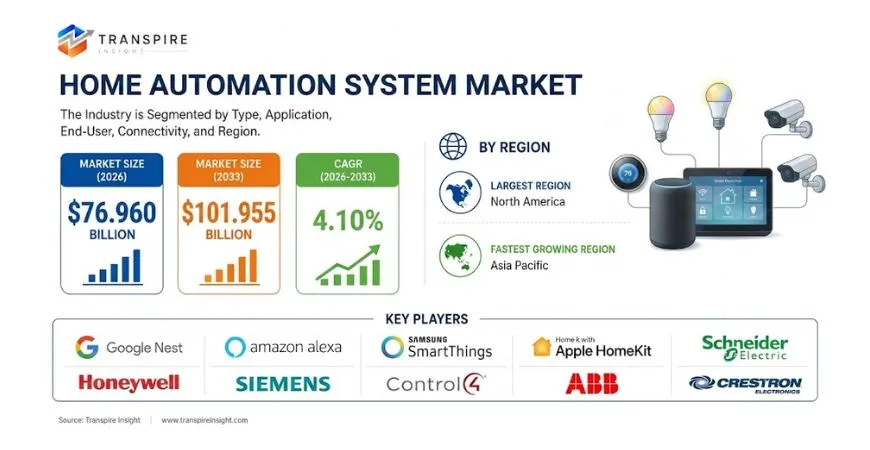
The home automation system market was valued at USD 73.926 billion in 2025 and is projected to grow from USD 76.960 billion in 2026 to USD 101.955 billion by 2033, at a CAGR of 4.10% through the forecast period, according to a new report by Transpire Insight.
The convergence of AI-powered voice control, expanding smart device ecosystems, falling hardware costs, and growing consumer familiarity with connected home technology is making home automation accessible and practical for mainstream homeowners, not just early-adopter enthusiasts. Energy management a driver increasingly shaped by electricity price volatility and residential solar adoption is also pulling homeowners toward smart home platforms as a practical tool for energy cost reduction alongside their security and convenience functions.
Home Automation System Market Growth & Trends
Voice-controlled automation has been the gateway feature that brought home automation into mainstream consumer adoption. Amazon Alexa and Google Nest have established connected speaker and display devices in tens of millions of homes globally, and the connected device ecosystems built around these platforms have progressively expanded the scope of home automation from basic lighting and speaker control to comprehensive smart security, HVAC management, and appliance integration. Apple HomeKit's focus on privacy and premium hardware integration has carved a strong position among iOS-loyal consumers investing in premium home automation.
Energy management is emerging as the highest-ROI use case for home automation in a period of elevated energy costs. Smart thermostats that learn occupancy patterns and optimise heating and cooling schedules, smart EV chargers that charge during off-peak tariff periods, and home energy management systems that coordinate solar generation, battery storage, and grid consumption are all demonstrating measurable financial returns that justify smart home investment on economic grounds alone independent of convenience and security benefits. This energy ROI narrative is expanding the home automation market into value-driven buyer segments that convenience and luxury positioning could not reach.
Emerging Economies & Technology
Asia Pacific is the fastest-growing region for home automation, driven by rapid adoption in China, South Korea, Japan, India, and Southeast Asia where new residential construction is increasingly built with smart home infrastructure as a standard feature rather than an aftermarket upgrade. Chinese property developers including Country Garden, Evergrande, and Longfor Properties have integrated smart home platforms from companies including Xiaomi and Tuya into new residential projects as a differentiation feature for millennial and Gen Z buyers. South Korea's tech-savvy homeowner demographic and strong domestic consumer electronics brands give it an advanced smart home adoption profile relative to most regional peers.
AI-integrated home automation platforms represent the most significant technology development reshaping the market. Platforms that go beyond scheduled control and voice commands toward anticipatory automation adjusting lighting, temperature, and security settings based on predicted occupancy, weather, and user preference patterns are creating a genuinely intelligent home environment rather than a remotely controlled one. Google Nest, Amazon, and Samsung SmartThings are all investing in AI inference capability at the home hub level, and Matter the interoperability standard developed by the Connectivity Standards Alliance is progressively reducing the fragmentation between competing smart home ecosystems that has historically frustrated consumers.
Smart Security Systems Segment
Smart security systems hold 57% of the home automation market the dominant segment by revenue. Connected cameras, video doorbells, smart locks, and alarm systems that deliver mobile alerts, remote monitoring, and professional monitoring service integration have found the widest consumer adoption of any home automation category. Ring, Nest Cam, and Arlo have built mainstream consumer brands around smart home security, and the recurring revenue model of professional monitoring subscriptions gives this segment a revenue depth that one-time hardware sales cannot match.
AI-powered smart security features local object recognition that distinguishes people from animals and vehicles, package detection on doorbell cameras, and facial recognition for authorised visitor management are driving upgrade cycles and new subscription tier adoption among existing smart security system owners. The tangible, practical security value of these AI features provides a clearer consumer value proposition than equivalent AI capabilities in lighting or entertainment automation contexts, supporting stronger monetisation per user.
AI-Integrated Platforms: Fastest-Growing Segment
AI-integrated home automation platforms are growing at a CAGR of 12.9% the fastest rate in the market. The transition from simple scene and schedule automation toward genuinely adaptive home intelligence where the home learns and anticipates rather than simply executes is the next platform-level development that major smart home ecosystem providers are competing to deliver. Google's Gemini AI integration into Nest, Amazon's Alexa AI model upgrades, and Apple's integration of on-device AI into HomeKit processing are all moving the smart home toward this adaptive intelligence paradigm.
Third-party AI integration with home automation platforms is also creating a developer ecosystem around home intelligence applications AI agents that manage energy consumption, coordinate grocery ordering with smart pantry sensors, or generate home maintenance schedules from connected appliance performance data. This application layer above the core platform creates commercial opportunity for both platform providers and independent developers, enriching the smart home ecosystem and increasing the switching costs that help platform providers retain users.
North America – Largest Regional Market
North America holds 41% of the home automation market the largest regional share. The United States has the world's most developed smart home retail infrastructure, with connected home products from Google, Amazon, ADT, and Crestron available across mass retail, specialist electronics, and professional installation channels. High broadband penetration, large residential floor areas that justify multiple connected zones, and consumer willingness to spend on home improvement technology give the US market a structural spending advantage.
The US professional home automation installation channel serving the luxury residential and new home builder markets is a significant premium revenue segment. Control4 and Crestron serve the high end of this market with whole-home integrated automation systems installed by certified integrators, generating average project values significantly above consumer DIY smart home spending. New home builder integration where smart home features are specified at the point of construction is expanding access to the professional installation channel beyond the ultra-premium market.
Asia Pacific – Fastest-Growing Region
Asia Pacific is advancing at a CAGR of 13.8% the highest regional rate in this market. China's smart home market is experiencing particularly strong growth, driven by tech-forward property development, domestic technology giants including Xiaomi, Huawei, and Baidu investing in connected home platforms, and a young urban population highly receptive to technology-integrated living environments. China's smart home market is developing a distinct ecosystem from Western markets, with domestic platforms and device standards rather than Amazon and Google at the centre.
South Korea and Japan contribute through their sophisticated consumer electronics markets and advanced home appliance integration, where washing machines, refrigerators, and air conditioners from Samsung, LG, Panasonic, and Daikin have been network-connected for longer than in most Western markets. The smart building expertise of Korean and Japanese construction companies is also translating into smart apartment and condominium developments that integrate building-level and unit-level automation from the ground up.
What Are the Recent Developments in the Home Automation System Market?
Q4 2024 – Google: Launched Nest Learning Thermostat with Gemini AI integration, enabling natural language programming of heating and cooling schedules, energy consumption forecasting based on weather and occupancy patterns, and proactive HVAC maintenance alerts.
Q4 2024 – Samsung SmartThings: Released SmartThings Energy 3.0 with AI-driven home energy management capability, automatically scheduling high-draw appliances during off-peak electricity tariff periods and providing household energy consumption forecasting for smart meter-connected homes.
Q1 2025 – Amazon Alexa: Announced Alexa Home IQ an adaptive home automation feature using on-device AI to learn household routines and proactively suggest and execute automations without requiring manual scene programming, targeting mainstream consumers who find manual automation setup complex.
Q2 2025 – Apple HomeKit: Released Matter 1.4 support across all Apple HomeKit devices, significantly expanding interoperability with third-party smart home devices and reducing the ecosystem fragmentation that has historically limited smart home expansion beyond Apple device owners.
Q2 2025 – Schneider Electric: Launched Wiser Energy Manager for residential applications, integrating smart home energy monitoring with EV charger management and solar inverter optimisation to enable coordinated home energy management from a single platform.
Q3 2025 – Control4: Introduced an AI-powered home profile feature for its professional home automation platform, enabling system integrators to deploy adaptive home automation that personalises lighting, climate, and entertainment settings based on individual occupant behaviour patterns.
About Transpire Insight
Turning Complex Data into Clear, Actionable Market Intelligence
In today’s hyper-competitive and fast-moving economy, guessing isn’t a business strategy. To lead your industry, launch game-changing products, or scale into new geographies, you need precise, reliable market intelligence, not just high-level noise.
At Transpire Insight, we are a full-service market research, data analytics, and strategic consulting firm. We help corporate leaders, innovators, and investors navigate complex market shifts with absolute confidence.
By combining rigorous primary research, deep statistical modeling, and hands-on domain expertise, we convert raw data into high-impact strategic roadmaps that drive measurable growth.
What Drives Us
Markets don’t stand still, and neither do we. Our core mission is simple: to empower organizations with verified, technology-enabled insights that remove guesswork from strategic planning.
Whether you are evaluating a niche technological shift, assessing supply chain dynamics, or looking for high-growth target segments, our intelligence gives you a decisive competitive edge.
Why Leading Enterprises Trust Transpire Insight
We don't offer one-size-fits-all research. Our analysts specialize in dedicated verticalsfrom Biotechnology and Semiconductors to Advanced Automotive, Clean Energy, and Industrial Manufacturing. We speak your industry's language and understand the specific nuances, regulatory shifts, and economic drivers shaping your market.
Syndicated Market Reports: In-depth, turn-key research studies covering market size, share, competitive benchmarking, and multi-year forecasts.
Customized Market Intelligence: Tailored research engagements built around your exact business questions, specific product lines, or targeted regional dynamics.
Strategic Consulting: On-demand analytical support, entry-strategy planning, and direct consultation to help you act on data with speed and accuracy.
Reliable forecasts demand ground-truth data. Our research process combines comprehensive desk research with extensive primary interviews across key industry stakeholders including C-suite executives, supply chain leaders, procurement heads, and subject matter experts. Every report undergoes strict validation to ensure maximum precision and relevance.
Our Core Sectors
We provide continuous tracking and deep-dive analytical coverage across high-impact industries:
Manufacturing and Construction
Let’s Shape Your Growth Strategy Together
Whether you are preparing for your next fiscal cycle, analyzing market entry barriers, or looking for deep-dive quantitative data, Transpire Insight is your trusted intelligence partner.
Ready to gain a clearer view of your market?
Email Us: [email protected]
Speak to Our Analyst: +91 7666513636
Want to dive deeper? Head over to www.transpireinsight.com or join our community on Twitter, LinkedIn, and Facebook for the latest updates

 [email protected]
 APAC:+91 7666513636
 Address


