
Jun 30, 2026
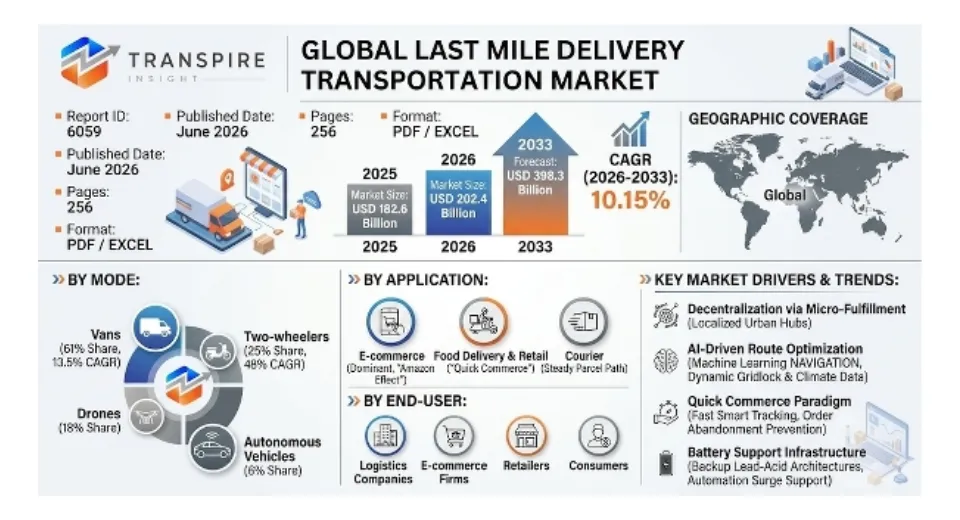
The global last mile delivery transportation market size is projected to reach USD 398.3 billion by 2033, growing at a CAGR of 10.15% from 2026 to 2033, according to a new report by Transpire Insights. The market stood at USD 182.6 billion in 2024 and is expected to touch USD 202.4 billion in 2025, reflecting rapid and consistent expansion across segments and geographies.
Last mile delivery refers to the final stage of the supply chain, where goods move from a distribution hub directly to the end consumer. As consumer expectations around speed and convenience rise sharply, logistics providers are under pressure to invest in faster, smarter, and more sustainable delivery infrastructure.
E-commerce growth in both well-developed and emerging economies keeps driving very high demand for last-mile delivery services all the time. Today's urban shoppers really expect either same-day or next-day delivery - essentially a basic requirement - forcing retailers and logistics companies to greatly enlarge their last-mile networks much faster.
Higher fuel prices and worker shortages are actually motivating operators to automate and optimize routes quite aggressively. Integrating AI-driven dispatch systems, real-time monitoring, and highly advanced route optimization software has significantly enhanced delivery speed. Even more regulatory focus on reducing our carbon emissions is further promoting electric vehicle fleets, with some major players planning to reach zero-emission delivery targets by 2030 itself.
Rapid urbanization in Southeast Asia, South Asia, Latin America, and Sub-Saharan Africa has created huge new markets for last-mile delivery. Consumers in these areas are mobile-first - they're really taking to food delivery and e-commerce services at rates even faster than more established markets see, setting the stage for tech-enabled logistics solutions to flourish.
From a technological standpoint, drone delivery and self-driving vehicle pilots are moving away from test phases and into initial commercial launches. Smaller fulfillment centers located near the heart of densely populated cities are significantly reducing last-mile distances and delivery timeframes. All these investments are greatly changing the competitive landscape and making it much easier to offer same-hour delivery in major metropolitan areas.
Vans Segment
Vans have the biggest share in the last-mile delivery transportation market by mode, bringing home 61% of overall revenue. Their carrying capacity, versatility across both urban and suburban landscapes, and suitability for large quantities of e-commerce packages make them the first choice for many logistics firms globally. Temperature-controlled van versions also cater to growing needs from grocery and pharmaceutical delivery sectors.
With a CAGR of 13.%. 5%, vans are actually the fastest-growing mode segment. A move towards electric vans by companies like Amazon, UPS, and DHL is speeding up adoption further still. Very attractive government incentives for converting EV fleets and decreasing battery prices are making the switch financially sensible for companies of all sizes.
E-commerce Application Segment
E-commerce is the main application really driving demand for last-mile delivery services, thanks to a fundamental shift in consumer behavior across nearly every product category. Our post-pandemic surge in online shopping has shown remarkable persistence, with customers purchasing items ranging from groceries to electronics, clothing, and even home goods over the internet. This wide-ranging demand keeps order quantities very high all through the year - not just during peak periods.
Food delivery ranks as the second-biggest application - and one of the fastest-growing - with the help of platforms like Uber Eats, DoorDash, Zomato, and Swiggy. Courier and retail segments also make meaningful contributions, with click-and-collect and same-day delivery formats becoming increasingly popular among brick-and-mortar stores trying to keep pace with pure-play online competitors.
Asia-Pacific holds the biggest piece of the worldwide final-mile delivery transportation market - 44 percent, followed by Europe at 25 percent, North America at 19 percent, and then the Rest of the World with 12 percent. The region really profits from an enormous and quite digitally connected consumer base, very high smartphone penetration rates, and an extremely dense network of logistics companies serving both big cities and smaller towns.
China really stands out within Asia-Pacific, with JD Logistics and SF Express running some of the most technologically advanced final-mile networks worldwide. India is a close second in terms of growth momentum, driven by increasing middle-class incomes, bettering road infrastructure, and a lively startup scene in fast-commerce and hyperlocal delivery services.
North America Fastest Growth
North America is actually the fastest-growing regional market - expected to have a CAGR of 14. 9 percent through 2033. The region really benefits from consumers having lots of money to spend, very dense suburban retail areas, and huge investments in logistics technology from major players like Amazon, FedEx, UPS, and XPO Logistics.
The US is really rapidly expanding its autonomous delivery and drone programs - with regulatory guidelines changing all the time to allow commercial activities. The growth of same-day grocery delivery and prescription medicine delivery is creating new industries that require really reliable, very frequent final-mile infrastructure.
Two-Wheelers Fastest-Growing Mode
Two-wheelers make up 48 percent of deliveries by quantity - so they're the number one choice globally in urban final-mile operations. In many cities across Asia, Latin America, and parts of Europe, motorcycles and e-bikes act as the fastest and most affordable way to deal with very heavy traffic and deliver small packages or food orders within very short timeframes.
Electric two-wheelers are becoming more popular because companies want to decrease their per-delivery expenses and meet their environmental targets. Swiggy, Zomato, and Delhivery have all said they plan to electrify a large portion of their two-wheeler fleets in India. This change will probably lower your operational costs per delivery even further - while also reducing air pollution in extremely crowded urban areas.
Drones hold a 21% stake in the final mile delivery mode mix - really a game-changer in the market. Although regulatory approvals still hold things back, drone delivery has proven commercially viable for certain applications such as delivering medical supplies to rural communities and dropping off lightweight packages in suburban streets.
Self-driving cars presently command just 6% of the mode share - yet they're poised to grow very quickly indeed as sensor prices drop and software reliability gets better all the time. Companies like Nuro, Starship Technologies, and Gatik are greatly expanding their autonomous delivery services in select US and some European markets. Ultimately, AVs will form the core of high-volume, relatively low-cost suburban delivery systems.
The competitive landscape has seen a flurry of strategic moves as companies race to secure technology, capacity, and geographic reach.
January 2025 - Amazon announced a significant expansion of its electric delivery van fleet in the US, adding 10,000 Rivian-built EVs to its last mile network as part of its Climate Pledge commitments.
February 2025 - UPS launched a new autonomous delivery pilot in suburbs of Phoenix, Arizona, partnering with a robotics startup to test self-driving cargo pods for residential parcel delivery.
March 2025 - DHL expanded its GoGreen Plus carbon-neutral delivery service to 12 new markets across Southeast Asia, offering customers verified emissions offset options at checkout.
April 2025 - Delhivery partnered with a leading Indian EV manufacturer to deploy 5,000 electric three-wheelers across its last mile network in Tier-1 and Tier-2 Indian cities by end of 2025.
May 2025 - FedEx rolled out its AI-powered route optimization engine across its US domestic last mile operations, reporting a 9% reduction in average delivery time per stop in early testing.
June 2025 - Zomato launched its 10-minute grocery delivery service in five new Indian metro cities, expanding its Blinkit network and adding over 200 dark store locations to support ultrafast last mile fulfillment.
August 2025 - JD Logistics opened its first fully automated last mile sorting center in Singapore, using robotic arms and computer vision to process 50,000 parcels per hour with minimal human intervention.
October 2025 - XPO Logistics acquired a regional last mile delivery startup in Germany to strengthen its European footprint, gaining access to a proprietary network of 300 urban delivery hubs across DACH markets.
January 2026 - Swiggy announced a full fleet electrification target for its delivery partner network in India by 2028, backed by a financing program offering subsidized e-bike leases to gig workers.
March 2026 - Blue Dart integrated a real-time consumer communication platform into its last mile tracking system, enabling customers to reschedule or redirect deliveries live via WhatsApp, reducing failed delivery rates by 18%.

 [email protected]
 APAC:+91 7666513636
 Address


