
Jun 30, 2026
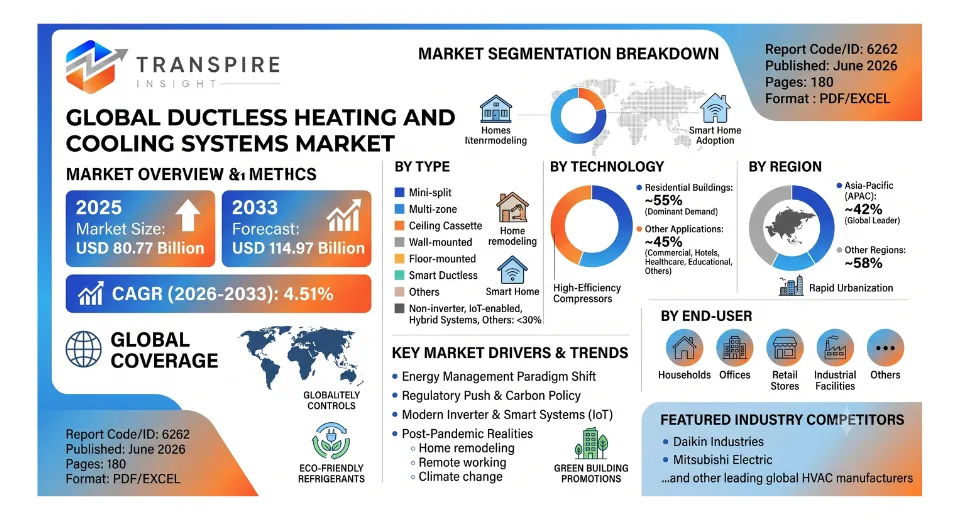
The global ductless heating and cooling systems market size was valued at USD 80.77 billion in 2024 and is anticipated to reach USD 114.97 billion by 2033, growing at a CAGR of 4.51% from 2026 to 2033, according to a new report by Transpire Insights. The market stood at USD 84.41 billion in 2025, supported by strong residential adoption and consistent commercial retrofits across North America and Europe.
Ductless systems give you zone-specific climate control - all without the extensive infrastructure of traditional ducted HVAC systems. This flexibility really sets them apart, making them a very practical choice for both new buildings and existing ones, especially when duct installation would be quite costly or even structurally difficult. Demand continues to grow as energy efficiency standards become much stricter and consumers seek more precise comfort solutions. Some key product categories that drive significant volume include mini-split systems, multi-zone configurations, ceiling cassette units, wall-mounted systems, floor-mounted systems, and an ever-expanding group of intelligent ductless systems. The market spans many areas: residential properties, commercial spaces, hotels, hospitals, schools, and other educational facilities. Various technologies exist within this category, including inverter and non-inverter systems, as well as IoT-enabled and hybrid setups. Major players in this field include Daikin, Mitsubishi Electric, LG Electronics, Panasonic, Fujitsu General, Samsung, Carrier, Trane Technologies, Toshiba, Gree Electric, Hitachi, Midea Group, Lennox, Bosch, and Haier.
Ductless Heating and Cooling Systems Market Growth and Trends
A number of structural factors really support the growth path of this market. Infrastructure renovation projects across the US and Europe are driving demand for ductless retrofits because older buildings almost never have duct space available. The automotive and industrial aftermarkets are also seeing increased volume as facility managers move towards zone-specific climate control. Ductless systems typically use up to 30% less energy than standard HVAC equipment, making them very appealing to both cost-aware facility operators and ESG-focused corporate buyers who care about environmental impact. The healthcare and education sectors are also buying more, driven by indoor air quality needs that favour systems with advanced filtration capabilities. Regulatory pressure surrounding refrigerant transitions - like the shift away from high-GWP refrigerants under the AIM Act in the US and similar EU frameworks - is forcing manufacturers to upgrade their product lines, which actually creates even more replacement demand across all types of end-users.
Emerging Economies and Technology
Growing markets across Southeast Asia, Latin America, and parts of Africa are increasingly showing their value as significant contributors to growth. Fast urbanisation is generating a huge amount of new residential and commercial building projects - perfect places for ductless systems to be installed right from the start, saving time and money on refitting later. On the tech side, IoT integration has completely transformed what ductless systems can do. Real-time performance tracking, remote fault-finding, and even predictive maintenance have become common features on the latest commercial models. AI-enabled compressor control continuously adjusts the system's output depending on how many people are present and the surrounding environment, reducing runtimes whilst maintaining a comfortable temperature. Adoption of low-GWP refrigerants is picking up speed too, with R-32 and R-454B now available through various product lines from top manufacturers. Online shopping platforms are also greatly expanding our reach into markets where traditional HVAC wholesalers are scarce, getting products delivered to installers in even smaller towns and cities.
Mini-Split Systems Segment
Mini-split systems represent the biggest part of the ductless market - about 43% of overall market size. Their huge presence really comes from a pretty simple selling point: very focused cooling and heating for one area, without any need for ducts. Setting up is relatively not so invasive, needing just a tiny hole for the refrigerant lines. This makes them quite well-suited for room extensions, separate garages, computer server rooms, and flats where doing an entire building's new HVAC system isn't possible. Residential take-up has been very good in North America and Europe because families are looking for efficient, zone-by-zone temperature control. This section also profits greatly from an enormous price range, with basic units starting at fairly affordable prices and high-end inverter-driven models holding much higher profit margins for manufacturers.
Residential Buildings Segment
Residential structures account for the largest end-use segment of the ductless systems market. Households are our number one biggest client group - really driven by a desire for room-by-room comfort control, more energy efficiency than central systems offer, and just how easy it is to set up in houses without pre-existing ductwork. The retrofit opportunity in much older residential real estate all over Europe and North America is truly quite big. Many of these properties were built with boilers or resistance-heating systems, and the cost of installing ductwork makes ductless heat pumps the most sensible choice. Government subsidy programs - such as US Inflation Reduction Act tax credits and EU heat pump incentive plans - have brought forward purchasing decisions that people might've delayed even further. The residential sector also profits from an increase in consumer knowledge about saving on operating costs, which significantly reduces the time it takes to get back your investment for potential buyers.
North America Market Dominance
North America has the largest regional share - at 38% of worldwide revenue. The maturity of its industrial infrastructure, very high per-capita energy use, and fairly constant national- and state-level policy backing are the key factors involved here. US demand is particularly boosted by the Inflation Reduction Act - it gives tax credits for qualifying heat pump installations in houses. Building regulations in quite a few states now call for much more efficient standards, ones that ductless inverter systems are perfectly suited to meet. Canada, too, is contributing significantly, especially in colder provinces where cold-climate heat pump performance has become good enough to act as our primary heat source. Activity in commercial refurbishment, such as updating offices and renovating hotels, adds yet another level of demand - keeping North America right at the top spot.
Asia Pacific Fastest Growth
Asia Pacific is the region with the highest growth rate in the market, with an expected CAGR of 12. 1% during our forecasting period. The key players in this area are China, India, Japan, and South Korea. China and India are undergoing rapid urbanization processes resulting in an enormous number of new houses and commercial premises being constructed every year where ductless systems may be included during construction. On the other hand Japan and South Korea are known for their leadership in the development of inverters in product innovation, and local producers within these countries keep pushing forth more efficient standards. Markets in Southeast Asia too are opening up because of increased per capita income and extremely hot weather that has prompted initial air conditioning purchases by many consumers. Investments in infrastructure all over the region including hospitals, hotels, and university campuses offer continuous business opportunities beyond the residential sector alone.
Smart Ductless Systems Segment
Smart ductless systems represent the fastest-growing product segment - with a CAGR of 11. 3%. They feature inverter compressors paired with Internet-of-Things (IoT) connectivity - enabling remote control, usage analysis, and integration into building management software itself. Residential customers are increasingly drawn towards app-based control and compatibility with smart home systems. Commercially speaking, building owners really appreciate the chance to see energy use by each unit - and also get alerts when maintenance is necessary so that they avoid breakdowns altogether. Regulatory support is actually boosting adoption even further - since energy disclosure regulations in various areas force building managers to record and report their HVAC usage. Manufacturers who already have well-developed smart platforms are picking up more market share compared to those without any kind of connectivity offering - making IoT functionality a highly competitive factor - not just an added-value option.
Healthcare Facilities Segment Growth
Healthcare facilities represent a very promising new area of high growth for ductless systems. Hospitals, clinics, and diagnostic centres demand extremely accurate temperature and humidity control - particularly in patient rooms, operating theatres, and pharmaceutical storage areas. Ductless systems offer this level of zone-by-zone accuracy while avoiding the risk of cross-infection linked with centralised air handling systems. Renovation projects in established healthcare facilities really represent a huge potential market since so many older hospitals don't have enough structural space for traditional ductwork installation. The demand coming from this sector is predicted to expand much faster than usual as investments in healthcare infrastructure increase even further in both developed and developing countries. Manufacturers have responded by creating special healthcare-standard product lines boasting improved filters, significantly quieter operation, and antimicrobial coating on internal unit components.
What Are the Recent Developments in the Ductless Heating and Cooling Systems Market?
April 2025 - Daikin Industries accelerated the rollout of IoT-enabled monitoring and remote diagnostics across its VRF and residential split system product lines. The upgrades support predictive maintenance, real-time performance optimization, and integration with building management systems across commercial and multi-family applications.
June 2025 - LG Electronics expanded its ductless portfolio with next-generation inverter-driven mini-split and multi-split systems built for cold-climate performance. The new units integrate variable-speed compressors, low-GWP refrigerants, and AI-enabled controls that adjust energy use based on occupancy and ambient temperature conditions.
September 2025 - Bosch Home Comfort Group launched the Hitachi airHome series of single and multi-room ductless mini-split systems, targeting the residential retrofit segment in European markets with improved cold-weather heating output and simplified installation features.
January 2026 - Daikin unveiled next-generation VRV, light commercial, and residential HVAC solutions at the 2026 AHR Expo, including advanced data center and commercial cooling technologies designed for high-density heat load environments.
February 2026 - LG Electronics introduced the Essential Series air conditioners for Indian households, built to handle the country's varied climate and grid conditions. The systems feature Smart Inverter compressors, variable tonnage technology, and multiple convertible cooling modes tailored for Indian usage patterns.
Drop us an email at:
Call us on:
+91 7666513636

 [email protected]
 APAC:+91 7666513636
 Address


