
Nov 04, 2026
Market Forecast
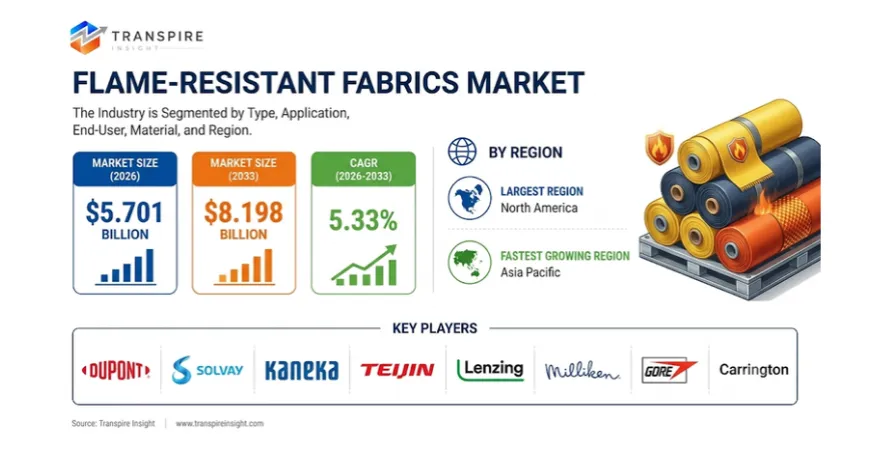
The global flame-resistant fabrics market was valued at USD 5.424 billion in 2025 and is projected to grow from USD 5.701 billion in 2026 to USD 8.198 billion by 2033, at a CAGR of 5.33% through the forecast period, according to a new report by Transpire Insights.
Strengthening industrial safety regulation, expansion of oil and gas operations in developing markets, increasing military procurement, and the growing specification of high-visibility flame-resistant fabrics in electrical and utility sectors are the central drivers behind consistent market growth. The flame-resistant fabrics market benefits from the non-discretionary nature of safety compliance purchasing — workers in hazardous environments must wear certified protective clothing regardless of economic cycles, creating demand resilience that few other industrial textile markets can match.
Flame-Resistant Fabrics Market Growth & Trends
Occupational safety regulation is tightening in developing industrial economies across Asia, Latin America, and the Middle East, creating mandatory protective clothing requirements for oil and gas, chemical, and electrical utility workers who previously operated without FR clothing standards. As these regulatory frameworks reach implementation, the addressable market for flame-resistant fabrics expands significantly — demand creation driven by legislation rather than voluntary adoption sustains procurement independent of discretionary spending decisions at the industrial operator level.
The electrical arc flash hazard segment is one of the fastest-growing application areas for flame-resistant fabrics. As electrical infrastructure investment grows globally — both new construction and the modernisation of ageing grid infrastructure — the population of electrical workers exposed to arc flash risk is expanding. NFPA 70E requirements in North America and IEC 61482 in Europe mandate arc flash protective clothing for electrical workers in hazardous zones, creating structured compliance procurement across utility companies, industrial electrical contractors, and equipment maintenance operations.
Emerging Economies & Technology
Asia Pacific is the fastest-growing region for flame-resistant fabrics, driven by the scale and growth of oil and gas, petrochemical, and manufacturing industries across China, India, Indonesia, and the Gulf states — all of which are tightening industrial safety standards and generating growing demand for certified FR protective clothing. Indian government safety regulations under the Factories Act and Petroleum Rules are requiring FR workwear in defined hazardous industries, with enforcement improving alongside regulatory awareness in the Indian industrial employer community.
High-visibility flame-resistant fabrics — combining the retroreflective visibility function required for road and outdoor workers with the thermal protection of FR fabric construction — are the fastest-growing product category, driven by increasing specification of dual-function PPE that meets both visibility and fire hazard requirements in a single garment. Utility, road maintenance, rail, and oil and gas surface operations all generate demand for this combined protection category, and the development of lightweight, comfortable high-vis FR constructions by DuPont, Milliken, and TenCate is expanding adoption beyond the highest-risk applications toward general outdoor industrial workwear.
Aramid Fabrics Segment
Aramid fabrics hold 47% of the global flame-resistant fabrics market — the dominant product segment. Para-aramid and meta-aramid fibres — including DuPont's Nomex and Kevlar, and Teijin's Twaron — provide inherent flame resistance that cannot be washed out over the garment lifetime, making them the premium specification for the most demanding FR applications including firefighting gear, military combat uniforms, motorsport driver suits, and high-risk industrial applications. Their combination of thermal stability, mechanical strength, and certified FR performance sustains their specification in markets where protective performance is the primary procurement criterion.
Aramid blend fabrics — combining aramid fibres with comfortable natural fibres including cotton and wool or FR-treated synthetic fibres — are an important product development area, creating garments that offer inherent FR performance with improved wearability, breathability, and comfort relative to pure aramid constructions. These blends are enabling aramid-based FR performance to penetrate everyday workwear applications where pure aramid was too expensive and uncomfortable for routine use.
High-visibility FR Fabrics: Fastest-Growing Segment
High-visibility flame-resistant fabrics are growing at a CAGR of 10.8% — the fastest rate in the market. The dual-function nature of these fabrics — simultaneously meeting EN ISO 20471 high-visibility and EN ISO 11612 or NFPA 2112 FR performance standards — addresses the practical reality that many workers face both visibility and fire hazard risks in their operating environments. Utility linemen, pipeline maintenance workers, and road construction personnel near utility infrastructure all require this dual protection, and the administrative simplicity of a single certified garment versus separate protective layers is driving specification.
Sustainability is entering FR fabric specification, with buyers in European utility and industrial sectors increasingly requesting FR fabric certifications that include lifecycle environmental assessment, recycled content claims, and chemical compliance documentation under REACH and bluesign standards. Manufacturers that can provide both certified FR performance and credible sustainability credentials are gaining procurement advantage in markets where ESG commitments are influencing supply chain selection.
North America – Largest Regional Market
North America holds 36% of the global flame-resistant fabrics market — the largest regional share. The United States has the world's most comprehensively regulated industrial FR workwear market, with NFPA 70E electrical safety standards, OSHA petroleum refinery process safety regulations, and NFPA 2112 flame-resistant garment standards creating layered compliance requirements across the US oil and gas, petrochemical, utility, and electrical construction sectors. Major US industrial employers including ExxonMobil, Chevron, and US utilities maintain large FR workwear compliance programmes that generate consistent annual procurement.
Canada's oil sands and natural gas sectors are significant FR fabric markets, with Canadian workplace safety regulations aligned closely with US NFPA standards and with the scale of hydrocarbon extraction operations generating large FR workwear procurement programmes. Canadian utility and pipeline sectors add demand alongside the upstream oil and gas applications.
Asia Pacific – Fastest-Growing Region
Asia Pacific is advancing at a CAGR of 11.5% — the highest regional rate in this market. India and China together represent the two largest developing-market opportunities for FR fabrics globally, with the scale of their industrial worker populations and the progressive tightening of occupational safety regulation creating demand at a scale that no other emerging market region can match. Chinese domestic FR fabric manufacturers are developing competitive products for the domestic market, but international brands including DuPont, Honeywell, and Teijin maintain positions in high-specification applications where certified performance and traceability are procurement requirements.
Middle Eastern oil and gas operations — particularly in Saudi Arabia, the UAE, and Qatar — represent a high-value FR workwear market that operates to the most rigorous international safety standards, as multinational energy companies and their contractors apply global safety frameworks rather than local minimum requirements. The scale of oil and gas capital projects in the region generates large and consistent FR workwear procurement volumes.
What Are the Recent Developments in the Flame-Resistant Fabrics Market?
Q4 2024 – DuPont: Launched Nomex EXL — a new generation of its Nomex meta-aramid fabric incorporating enhanced moisture management and comfort finishing — targeting oil and gas and electrical utility operators seeking improved workwear comfort for workers in high-temperature environments without compromising inherent FR performance.
Q4 2024 – Teijin Aramid: Introduced a recycled-content aramid fabric programme using reclaimed para-aramid fibre from end-of-life protective garments, providing FR workwear manufacturers with a recycled aramid supply option that supports circular economy claims in markets where sustainability credentials influence procurement.
Q1 2025 – Milliken & Company: Received NFPA 2112 and EN ISO 11612 certification for a new high-visibility FR fabric combining arc-flash protection, flash fire resistance, and Class 2 retroreflective visibility performance in a single lightweight construction targeting utility and road maintenance worker applications.
Q2 2025 – TenCate Protective Fabrics: Secured a multi-year supply agreement with a major Middle Eastern petrochemical company for inherent FR workwear fabric supply across its regional operations, providing certified aramid-blend FR fabric for worker coverall programmes at multiple facilities.
Q2 2025 – Honeywell: Launched a new digital FR workwear compliance management platform enabling industrial employers to track individual FR garment wear cycles, washing history, and certification expiry across large workforce PPE programmes — improving garment lifecycle management and ensuring ongoing compliance with NFPA 70E replacement requirements.
Q3 2025 – Bulwark Protection: Introduced a new FR workwear range incorporating cooling technology for hot climate industrial environments, combining certified flame-resistant performance with evaporative cooling fabric technology targeting oil and gas workers in the Middle East and US Gulf Coast where heat stress compounds protective clothing discomfort.
About Transpire Insight
Turning Complex Data into Clear, Actionable Market Intelligence
In today’s hyper-competitive and fast-moving economy, guessing isn’t a business strategy. To lead your industry, launch game-changing products, or scale into new geographies, you need precise, reliable market intelligence, not just high-level noise.
At Transpire Insight, we are a full-service market research, data analytics, and strategic consulting firm. We help corporate leaders, innovators, and investors navigate complex market shifts with absolute confidence.
By combining rigorous primary research, deep statistical modeling, and hands-on domain expertise, we convert raw data into high-impact strategic roadmaps that drive measurable growth.
What Drives Us
Markets don’t stand still, and neither do we. Our core mission is simple: to empower organizations with verified, technology-enabled insights that remove guesswork from strategic planning.
Whether you are evaluating a niche technological shift, assessing supply chain dynamics, or looking for high-growth target segments, our intelligence gives you a decisive competitive edge.
Why Leading Enterprises Trust Transpire Insight
We don't offer one-size-fits-all research. Our analysts specialize in dedicated verticals—from Biotechnology and Semiconductors to Advanced Automotive, Clean Energy, and Industrial Manufacturing. We speak your industry's language and understand the specific nuances, regulatory shifts, and economic drivers shaping your market.
Syndicated Market Reports: In-depth, turn-key research studies covering market size, share, competitive benchmarking, and multi-year forecasts.
Customized Market Intelligence: Tailored research engagements built around your exact business questions, specific product lines, or targeted regional dynamics.
Strategic Consulting: On-demand analytical support, entry-strategy planning, and direct consultation to help you act on data with speed and accuracy.
Reliable forecasts demand ground-truth data. Our research process combines comprehensive desk research with extensive primary interviews across key industry stakeholders including C-suite executives, supply chain leaders, procurement heads, and subject matter experts. Every report undergoes strict validation to ensure maximum precision and relevance.
Our Core Sectors
We provide continuous tracking and deep-dive analytical coverage across high-impact industries:
Manufacturing and Construction
Let’s Shape Your Growth Strategy Together
Whether you are preparing for your next fiscal cycle, analyzing market entry barriers, or looking for deep-dive quantitative data, Transpire Insight is your trusted intelligence partner.
Ready to gain a clearer view of your market?
Email Us: inquiry@transpireinsight.com
Speak to Our Analyst: +91 7666513636
Want to dive deeper? Head over to www.transpireinsight.com or join our community on Twitter, LinkedIn, and Facebook for the latest updates

 inquiry@transpireinsight.com
 APAC:+91 7666513636
 Address


